
Open Reflectivity Standards Organisation www reflectometry org What
- Slides: 7
Open Reflectivity Standards Organisation www. reflectometry. org • What is the problem with reflectometry? – inconsistent data formats & data reduction processes – incompatible & single point of failure analysis packages – inconsistency between x-rays vs neutrons • This creates real problems for open access data, reproducibility and making the most of future developments such as A. I. • ORSO formed in an effort to collaborate on these issues based on the approach used in the SAS community. 1
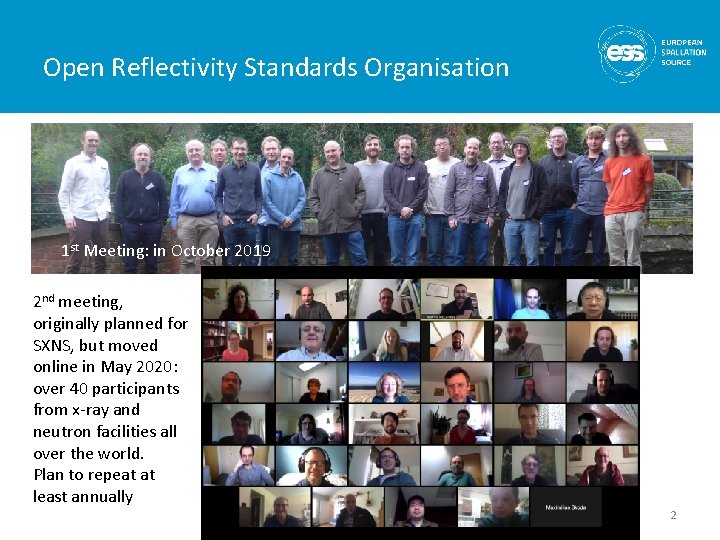
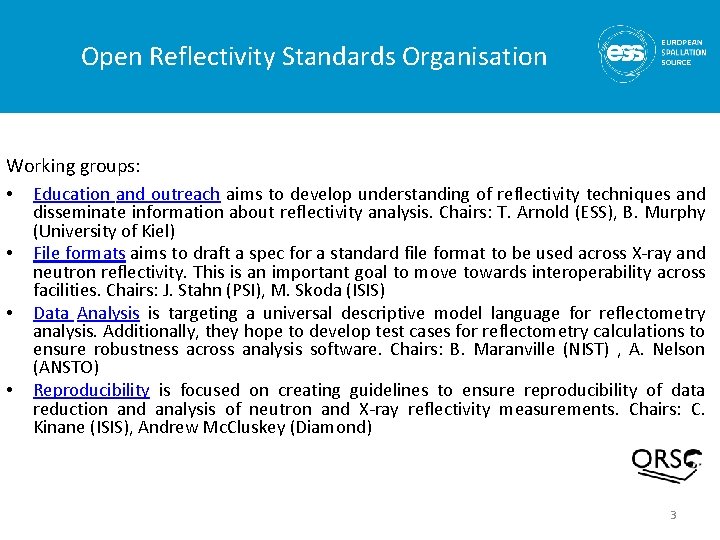
Open Reflectivity Standards Organisation 1 st Meeting: in October 2019 2 nd meeting, originally planned for SXNS, but moved online in May 2020: over 40 participants from x-ray and neutron facilities all over the world. Plan to repeat at least annually 2
Open Reflectivity Standards Organisation Working groups: • Education and outreach aims to develop understanding of reflectivity techniques and • • • disseminate information about reflectivity analysis. Chairs: T. Arnold (ESS), B. Murphy (University of Kiel) File formats aims to draft a spec for a standard file format to be used across X-ray and neutron reflectivity. This is an important goal to move towards interoperability across facilities. Chairs: J. Stahn (PSI), M. Skoda (ISIS) Data Analysis is targeting a universal descriptive model language for reflectometry analysis. Additionally, they hope to develop test cases for reflectometry calculations to ensure robustness across analysis software. Chairs: B. Maranville (NIST) , A. Nelson (ANSTO) Reproducibility is focused on creating guidelines to ensure reproducibility of data reduction and analysis of neutron and X-ray reflectivity measurements. Chairs: C. Kinane (ISIS), Andrew Mc. Cluskey (Diamond) 3
Data analysis working group • • • List of issues: https: //github. com/reflectivity/analysis/issues Shared model language Shared kernel Combining different data types (e. g. X-rays and neutrons) Reflectometry calculation validation (credit: Andrew Nelson, ANSTO) – Automatic workflow – Refnx, Refl 1 D, Born. Again, Gen. X (to come) – Currently only unpolarized samples 4
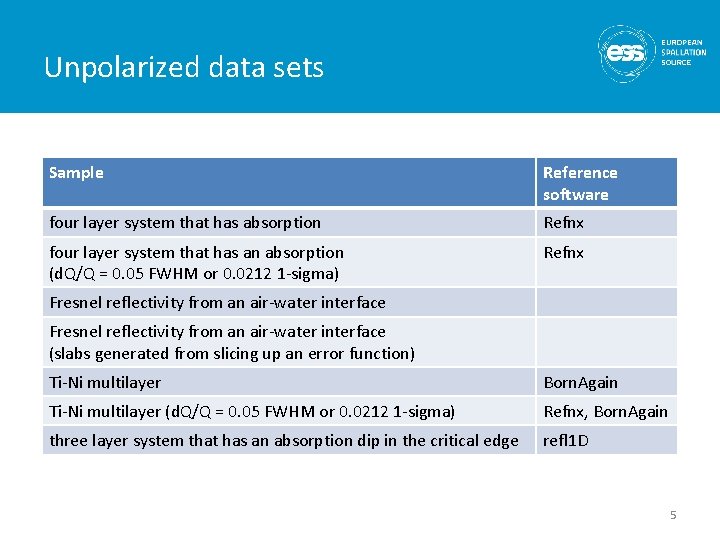
Unpolarized data sets Sample Reference software four layer system that has absorption Refnx four layer system that has an absorption (d. Q/Q = 0. 05 FWHM or 0. 0212 1 -sigma) Refnx Fresnel reflectivity from an air-water interface (slabs generated from slicing up an error function) Ti-Ni multilayer Born. Again Ti-Ni multilayer (d. Q/Q = 0. 05 FWHM or 0. 0212 1 -sigma) Refnx, Born. Again three layer system that has an absorption dip in the critical edge refl 1 D 5
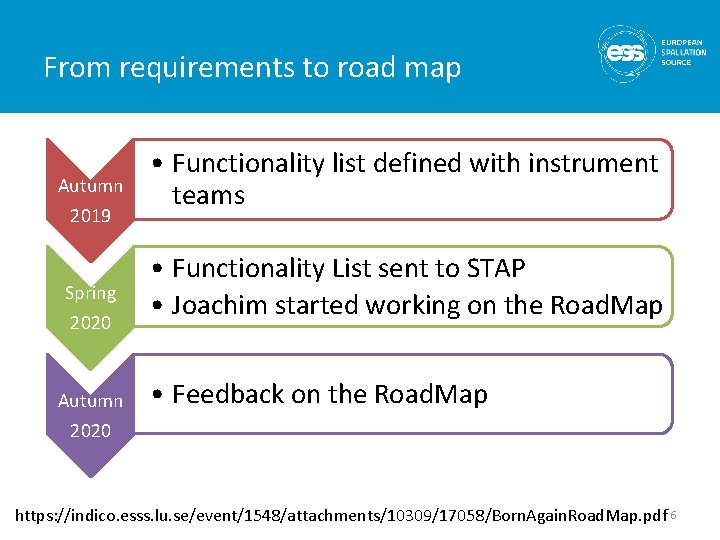
From requirements to road map Autumn 2019 Spring 2020 Autumn • Functionality list defined with instrument teams • Functionality List sent to STAP • Joachim started working on the Road. Map • Feedback on the Road. Map 2020 https: //indico. esss. lu. se/event/1548/attachments/10309/17058/Born. Again. Road. Map. pdf 6
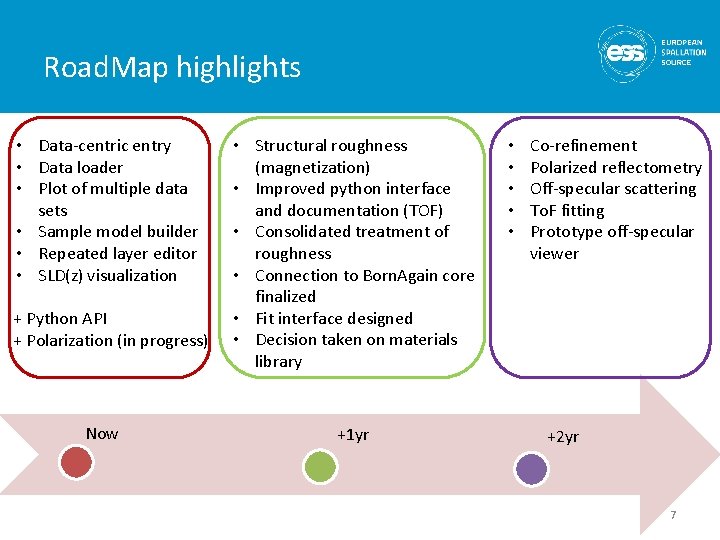
Road. Map highlights • Data-centric entry • Data loader • Plot of multiple data sets • Sample model builder • Repeated layer editor • SLD(z) visualization + Python API + Polarization (in progress) Now • Structural roughness (magnetization) • Improved python interface and documentation (TOF) • Consolidated treatment of roughness • Connection to Born. Again core finalized • Fit interface designed • Decision taken on materials library +1 yr • • • Co-refinement Polarized reflectometry Off-specular scattering To. F fitting Prototype off-specular viewer +2 yr 7