
Open Network Automation Platform ONAP Use Case Driven























- Slides: 63
Open Network Automation Platform (ONAP) Use Case Driven Architecture Proposal DRAFT
Outline Requirements from ONAP Use cases ▪ Merger Architecture Proposal Overview ▪ Merger Architecture Highlights ▪
Contributors: § § § § Vimal Begwani (AT&T) Dean Bragg (AT&T) Lingli Deng (CMCC) Christopher Donley (Huawei) Rajesh Gadiyar (Intel) Xiaojun Xie (China. Telecom) Alla Goldner (Amdocs) Ranny Haiby (Nokia) Jason Hunt (IBM) Roberto Kung (Orange) Xinhui Li (VMW) Dhananjay Pavgi (Tech. Mahindra) Phil Robb (LF) David Sauvageau (Bell Canada) Stephen Terrill (Ericsson) Huabing Zhao (ZTE)
Outline Requirements from ONAP Use cases ▪ Merger Architecture Proposal Overview ▪ Merger Architecture Highlights ▪
Use Case 1: v. Vo. LTE Edge DC Core DC v. IMS v. EPC v. SBC v. PCSCF OS OS v. SPGW v. EPDG OS OS SPTN / WAN GW Control Plane Overlay Underlay GW v. I/SCSCF v. TAS OS OS v. PCRF v. HSS v. MME OS OS OS EBGP-EVPN VXLAN OSPF MPLS-TP / MPLS BGP L 3 VPN OSPF
High Level Requirements: ▪ Functional Requirements: § § § § ▪ Onboard Vo. LTE VNFs, Design and Create v. Vo. LTE Services (topology, workflow, policy, analysis) Deploy Artifacts Fault detection, correlation and policy based auto-healing Performance Monitoring and policy based auto scaling Standard ETSI-NFV interfaces integrate with vendor provided VNFM Integrate with vendor provided EMS Integrate with third party controller Leverage capabilities of different infrastructure environment Platform Requirements: Support for Orchestration of complex deployment § ETSI NFV Interface With Vendor Provided VNFM / EMS § Interface with third party controller and multiple Cloud Infrastructures § Easy to Use Closed Loop Automation Design §
Use Case 2: v. CPE
High Level Requirements: ▪ Functional Requirements: § § § § ▪ Onboarding, Creation and Design of Virtualized Residential Broadband Service Customer ordering – Instantiation, Per service activation, Cut service Self-service -- Tiered bandwidth, Bandwidth on Demand Software management – Upgrade, Delete Auto-healing -- Automatic reboot/restart, Rebuild Fault detection and correlation between L 2 -L 3 connectivity services and Internet, Vo. IP, Video applications Manage localized broadband services by automatically performing the healthcheck of the access connectivity, virtual switching/routing and auditing of service-related configurations Deliver high availability service requirements for emergency communications and surveillance services Platform Requirements: Easy to use Change Management Design & Execution § Easy to Use Closed Loop Automation Design § End 2 end fault/alert report, events and monitoring data collection from infrastructure to service §
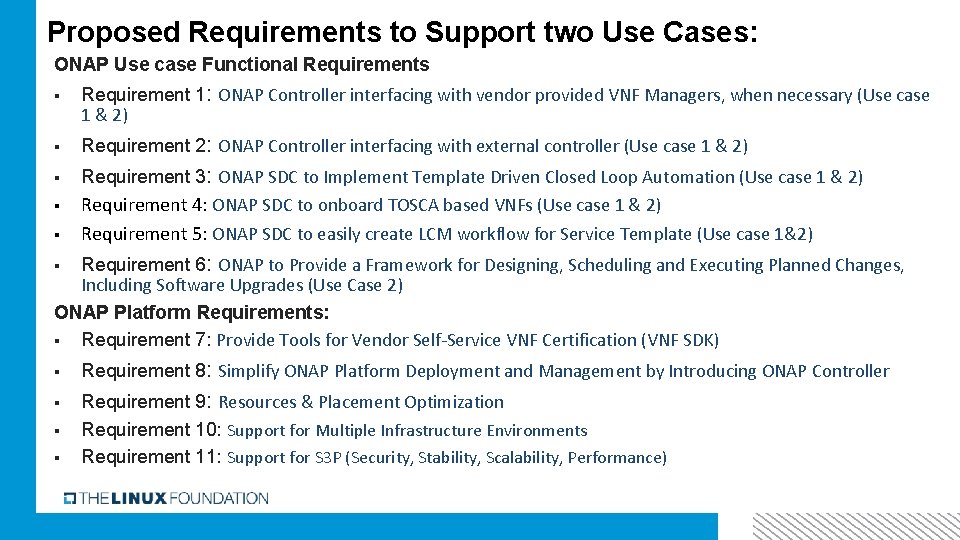
Proposed Requirements to Support two Use Cases: ONAP Use case Functional Requirements ▪ Requirement 1: ONAP Controller interfacing with vendor provided VNF Managers, when necessary (Use case 1 & 2) ▪ Requirement 2: ONAP Controller interfacing with external controller (Use case 1 & 2) ▪ ▪ Requirement 3: ONAP SDC to Implement Template Driven Closed Loop Automation (Use case 1 & 2) Requirement 4: ONAP SDC to onboard TOSCA based VNFs (Use case 1 & 2) ▪ Requirement 5: ONAP SDC to easily create LCM workflow for Service Template (Use case 1&2) Requirement 6: ONAP to Provide a Framework for Designing, Scheduling and Executing Planned Changes, Including Software Upgrades (Use Case 2) ONAP Platform Requirements: ▪ Requirement 7: Provide Tools for Vendor Self-Service VNF Certification (VNF SDK) ▪ ▪ Requirement 8: Simplify ONAP Platform Deployment and Management by Introducing ONAP Controller ▪ Requirement 9: Resources & Placement Optimization Requirement 10: Support for Multiple Infrastructure Environments Requirement 11: Support for S 3 P (Security, Stability, Scalability, Performance) ▪ ▪
Outline Requirements from ONAP Use cases ▪ Merger Architecture Proposal Overview ▪ Merger Architecture Highlights ▪
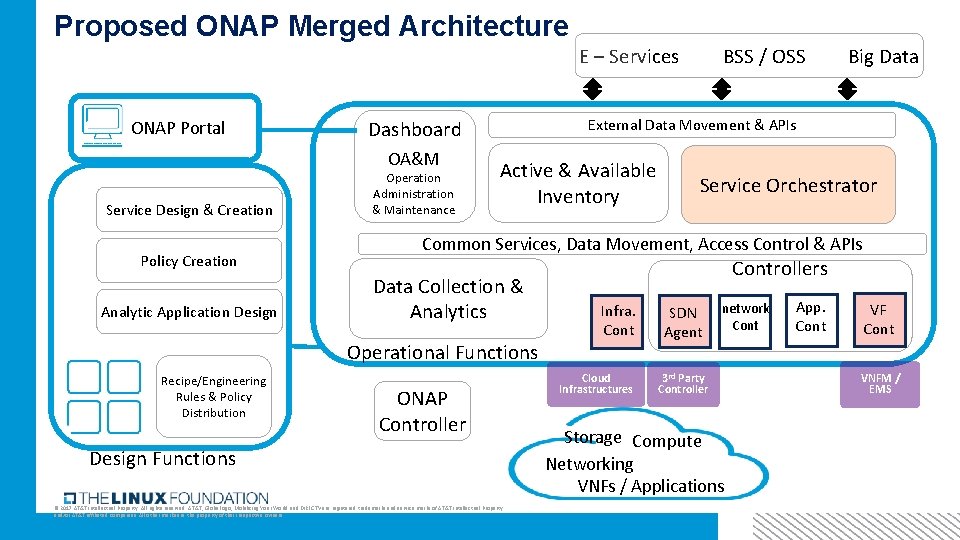
Proposed ONAP Merged Architecture E – Services ONAP Portal Service Design & Creation Policy Creation Analytic Application Design Operation Administration & Maintenance Active & Available Inventory Service Orchestrator Common Services, Data Movement, Access Control & APIs Data Collection & Analytics Operational Functions Recipe/Engineering Rules & Policy Distribution Big Data External Data Movement & APIs Dashboard OA&M BSS / OSS ONAP Controller Design Functions © 2017 AT&T Intellectual Property. All rights reserved. AT&T, Globe logo, Mobilizing Your World and DIRECTV are registered trademarks and service marks of AT&T Intellectual Property and/or AT&T affiliated companies. All other marks are the property of their respective owners. Controllers Infra. Cont Cloud Infrastructures SDN Agent network Cont 3 rd Party Controller Storage Compute Networking VNFs / Applications App. Cont VF Cont VNFM / EMS
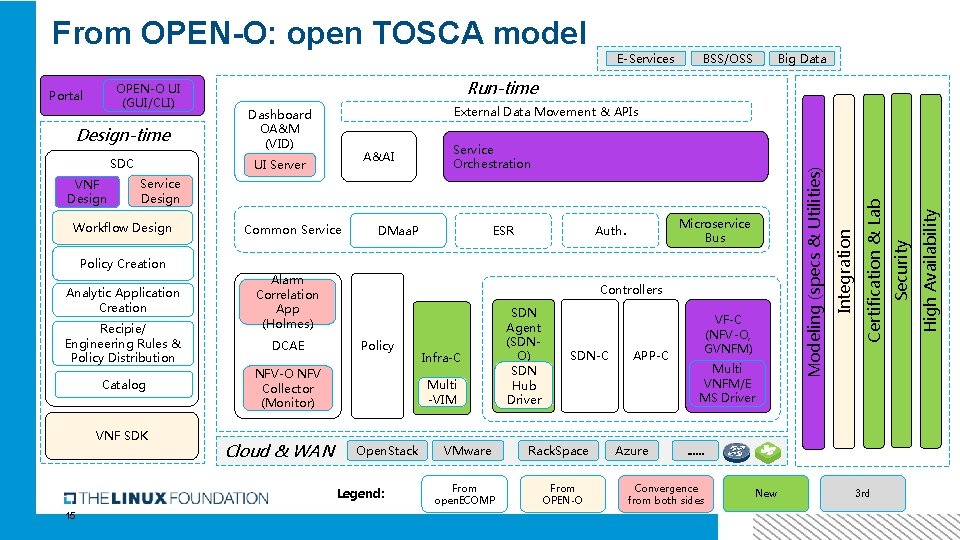
ONAP Merger Architecture Proposal A&AI UI Server Service Orchestration Service Design Workflow Design Common Service DMaa. P Microservice Bus Auth. ESR Policy Creation Analytic Application Creation Recipie/ Engineering Rules & Policy Distribution Catalog VNF SDK Alarm Correlation App (Holmes) DCAE Controllers Policy NFV-O NFV Collector (Monitor) Cloud & WAN Multi -VIM Open. Stack Legend: 13 Infra-C VMware From open. ECOMP SDN Agent (SDNO) SDN Hub Driver SDN-C Rack. Space From OPEN-O APP-C Azure VF-C (NFV-O, GVNFM) Multi VNFM/E MS Driver . . . Convergence from both sides New 3 rd High Availability External Data Movement & APIs Dashboard OA&M (VID) Security VNF Design Run-time Certification & Lab SDC Big Data Integration Design-time BSS/OSS Modeling (specs & Utilities) OPEN-O UI (GUI/CLI) Portal E-Services
From ECOMP: Design & Run Time & Close Loop E-Services UI Server Service Orchestration Service Design Workflow Design Common Service DMaa. P Microservice Bus Auth. ESR Policy Creation Analytic Application Creation Recipie/ Engineering Rules & Policy Distribution Catalog VNF SDK Alarm Correlation App (Holmes) DCAE Controllers Policy NFV-O NFV Collector (Monitor) Cloud & WAN Multi -VIM Open. Stack Legend: 14 Infra-C VMware From open. ECOMP SDN Agent (SDNO) SDN Hub Driver SDN-C Rack. Space From OPEN-O APP-C Azure VF-C (NFV-O, GVNFM) Multi VNFM/E MS Driver . . . Convergence from both sides New 3 rd High Availability A&AI Security VNF Design External Data Movement & APIs Dashboard OA&M (VID) Certification & Lab SDC Run-time Integration Design-time Big Data Modeling (specs & Utilities) OPEN-O UI (GUI/CLI) Portal BSS/OSS
From OPEN-O: open TOSCA model A&AI UI Server Service Orchestration Service Design Workflow Design Common Service DMaa. P Microservice Bus Auth. ESR Policy Creation Analytic Application Creation Recipie/ Engineering Rules & Policy Distribution Catalog VNF SDK Alarm Correlation App (Holmes) DCAE Controllers Policy NFV-O NFV Collector (Monitor) Cloud & WAN Multi -VIM Open. Stack Legend: 15 Infra-C VMware From open. ECOMP SDN Agent (SDNO) SDN Hub Driver SDN-C Rack. Space From OPEN-O APP-C Azure VF-C (NFV-O, GVNFM) Multi VNFM/E MS Driver . . . Convergence from both sides New 3 rd High Availability External Data Movement & APIs Dashboard OA&M (VID) Security VNF Design Run-time Certification & Lab SDC Big Data Integration Design-time BSS/OSS Modeling (specs & Utilities) OPEN-O UI (GUI/CLI) Portal E-Services
From OPEN-O: open source process & tools E-Services UI Server Service Orchestration Service Design Workflow Design Common Service DMaa. P Microservice Bus Auth. ESR Policy Creation Analytic Application Creation Recipie/ Engineering Rules & Policy Distribution Catalog VNF SDK Alarm Correlation App (Holmes) DCAE Controllers Policy NFV-O NFV Collector (Monitor) Cloud & WAN Multi -VIM Open. Stack Legend: 16 Infra-C VMware From open. ECOMP SDN Agent (SDNO) SDN Hub Driver SDN-C Rack. Space From OPEN-O APP-C Azure VF-C (NFV-O, GVNFM) Multi VNFM/E MS Driver . . . Convergence from both sides New 3 rd High Availability A&AI Security VNF Design External Data Movement & APIs Dashboard OA&M (VID) Certification & Lab SDC Run-time Integration Design-time Big Data Modeling (specs & Utilities) OPEN-O UI (GUI/CLI) Portal BSS/OSS
From OPEN-O: Ease of VNF Insertion E-Services UI Server Service Orchestration Service Design Workflow Design Common Service DMaa. P Microservice Bus Auth. ESR Policy Creation Analytic Application Creation Recipie/ Engineering Rules & Policy Distribution Catalog VNF SDK Alarm Correlation App (Holmes) DCAE Controllers Policy NFV-O NFV Collector (Monitor) Cloud & WAN Multi -VIM Open. Stack Legend: 17 Infra-C VMware From open. ECOMP SDN Agent (SDNO) SDN Hub Driver SDN-C Rack. Space From OPEN-O APP-C Azure VF-C (NFV-O, GVNFM) Multi VNFM/E MS Driver . . . Convergence from both sides New 3 rd High Availability A&AI Security VNF Design External Data Movement & APIs Dashboard OA&M (VID) Certification & Lab SDC Run-time Integration Design-time Big Data Modeling (specs & Utilities) OPEN-O UI (GUI/CLI) Portal BSS/OSS
Looking forward: Multiple Vendors Environment E-Services UI Server Service Orchestration Service Design Workflow Design Common Service DMaa. P Microservice Bus Auth. ESR Policy Creation Analytic Application Creation Recipie/ Engineering Rules & Policy Distribution Catalog VNF SDK Alarm Correlation App (Holmes) DCAE Controllers Policy NFV-O NFV Collector (Monitor) Cloud & WAN Multi -VIM Open. Stack Legend: 18 Infra-C VMware From open. ECOMP SDN Agent (SDNO) SDN Hub Driver SDN-C Rack. Space From OPEN-O APP-C Azure VF-C (NFV-O, GVNFM) Multi VNFM/E MS Driver . . . Convergence from both sides New 3 rd High Availability A&AI Security VNF Design External Data Movement & APIs Dashboard OA&M (VID) Certification & Lab SDC Run-time Integration Design-time Big Data Modeling (specs & Utilities) OPEN-O UI (GUI/CLI) Portal BSS/OSS
Outline Requirements from ONAP Use cases ▪ Merger Architecture Proposal Overview ▪ Merger Architecture Highlights ▪ ONAP Modeling • ONAP Common Service • ONAP Service Orchestrator • ONAP Controllers o Overview o VF-C o SDN-Agent • • Template Driven Closed Loop Support for Design, Schedule and Execute Changes (e. g. Software Upgrades) VNF SDK Resource and Placement Optimization Operations Management Framework (OMF) Support for Multiple Infrastructure Environments
ONAP Modeling Overview Tosca/Yang/Hot template and data modeling for VNF and Service ▪ A common informational model specification for different data modeling ▪ Parser and translator code about NFV data modeling and tools ▪ Policy model specify EMF and SUPA ▪
Landscape of modeling in ONAP Deployment Model Design BPEL TOSCA HEAT SDC TOSCA HEAT RESTCONF BPEL Controller DG YANG Management Model SWIFT DCAE YANG TOSCA NFVO GVNFM EMS FCAPS OPENSTACK NEUTRON Service Conf. HEAT GLANCE CINDER YANG Network Device EMF VNF-C SVNFM YANG SDN NETCONF TOSCA Policy VNF in DC VNF in Core (lb, fw…) (EPC, IMS…) TOSCA EMF YANG HEAT YANG ODL HEAT L 4 -L 7 L 1 -L 3 Policy A&AI APP-C Infra-C Network-C BPEL EMF Runtime DG YANG DG DG YANG SO YANG
VNF Modelling Vendors Provider HOT (ECOMP) Parser (ECOMP) TOSCA (TOSCA NFV) Parser (TOSCA) YANG (ETSI NFV) Parser (YANG) Design-time Onboarding (VNF SDK) Run-time Design (SDC) LCM (MSO, APP-C, VNF-C, SDN-C, etc. ) Catalog Translators (Utilities) Different DMs are used for VNF templates. ECOMP uses HEAT, OPEN-O uses TOSCA. We will be working together on supporting HEAT, TOSCA and YANG VNF modeling. The core implementation engine for LCM and operation in run time should be data model agnostic.
Outline Requirements from ONAP Use cases ▪ Merger Architecture Proposal Overview ▪ Merger Architecture Highlights ▪ ONAP Modeling • ONAP Common Service • ONAP Service Orchestrator • ONAP Controllers o Overview o VF-C o SDN-Agent • • Template Driven Closed Loop Support for Design, Schedule and Execute Changes (e. g. Software Upgrades) VNF SDK Resource and Placement Optimization Operations Management Framework (OMF) Support for Multiple Infrastructure Environments
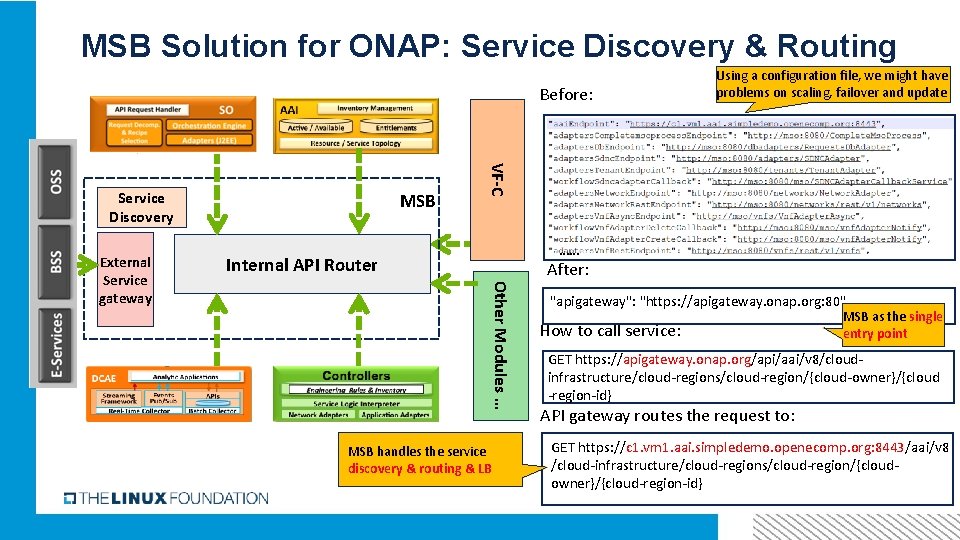
ONAP Common Service ▪ Functionalities ˗ Service Registration & Discovery for Micro Services ˗ Centralized Authentication and Authorization ˗ Centralized User Management ▪ Benefits ˗ Mitigate Code Complexity by Avoiding Multiple Point to Point Service Access ˗ Decouple business logic and UI by Removing Cross Domain Solution
MSB Solution for ONAP: Service Discovery & Routing Before: …… Internal API Router After: Other Modules … External Service gateway MSB VF-C Service Discovery Using a configuration file, we might have problems on scaling, failover and update MSB handles the service discovery & routing & LB "apigateway": "https: //apigateway. onap. org: 80" How to call service: MSB as the single entry point GET https: //apigateway. onap. org/api/aai/v 8/cloudinfrastructure/cloud-regions/cloud-region/{cloud-owner}/{cloud -region-id} API gateway routes the request to: GET https: //c 1. vm 1. aai. simpledemo. openecomp. org: 8443/aai/v 8 /cloud-infrastructure/cloud-regions/cloud-region/{cloudowner}/{cloud-region-id}
MSB Solution: Centralized Auth with Plugin(SSO) ONAP Services Auth Service Business requests MSB User Management requests Admin Auth Plugin API Monitor ing Centralized Authentication 1. User send a service request to MSB 2. MSB auth plugin check the auth token 2. 1 If a valid token exist, MSB forward the request to the destination service provider 2. 2 If not, MSB forward the request to the Auth Service, and redirect user request to login page 2. 3 Auth service create a token cookie after user login with valid name and password Centralized Authorization(Assuming user already login) 1. User send a service request to MSB 2. MSB auth plugin send the user token and request(Http method + Resource url) to Auth Service 2. 1 If user has the permission, MSB forward the request to the destination service provider 2. 2 If not, MSB return operation not allowed error to user Logging Other Plugin Other Services Centralized User, Role and Permission Management Centralized in the Auth Service Note: Auth Service is not in the scope of MSB
Outline Requirements from ONAP Use cases ▪ Merger Architecture Proposal Overview ▪ Merger Architecture Highlights ▪ ONAP Modeling • ONAP Common Service • ONAP Service Orchestrator • ONAP Controllers o Overview o VF-C o SDN-Agent • • Template Driven Closed Loop Support for Design, Schedule and Execute Changes (e. g. Software Upgrades) VNF SDK Resource and Placement Optimization Operations Management Framework (OMF) Support for Multiple Infrastructure Environments
Two Layers of Service Orchestration SO Global Service Orchestrator DCI SDN Controller Domain Service Orchestrator v. FW WAN Controller Domain Service Orchestrator DC Controller v. FW OS OS v. CPE OS DC GW TIC-Edge WAN DC Controller v. LB DC Controller OS OS OS v. FW v. CPE OS DC GW v. CPE DC GW Domain A TIC-Core Case 1: lager scale SPs Case 2: Federated Orchestration DC GW OS TIC-Core Domain B
Workflow for Service Orchestration ▪ Declarative (topology) workflow v. s. imperative workflow • • ▪ Topology driven workflow couples topology modeling with workflow o Issue 1: Not suitable for workflows that cannot be deduced from service topology template ❖ E. g. for interactions with entities outside service template (A&AI, Catalogue, etc. ) o Issue 2: Not flexible enough for dynamic workflow, e. g. runtime status dependent ❖ E. g. for location based deployment of VFs among multiple DCs ❖ E. g. dynamic software upgrade workflow based on runtime HA active-backup status Imperative workflow decouples topology modeling from workflow o Addresses the above two issues o Allows the core workflow specification & execution implementation be topology template agnostic o Avoids complex workflow translation when switching between TOSCA/YANG/HEAT template DM TOSCA provides both built-in topology and imperative workflow in a single template • • Work in progress for TOSCA built-in imperative workflows, addresses Issue 2 but cannot solve Issue 1. Joint Proposal to extend TOSCA specification to allow for external BPMN/BPEL workflow to address the above issues and be compliant with existing implementations.
Alternatives for TOSCA Service Orchestration Workflow Service Agnostic WFs (one for each LCM op) qu Re es O Inv Im pe oke ple rat me ion on nta ti t Domain Service Orchestrator Determine top-level workflow Success/Fail Invoke Rainy Day Option: Invoke Inverse Invoke Load Success/Fail BPMN t TOSCA Orchestrator Determine top-level workflow BPMN es Determine top-level workflow t es qu Re Service Orchestrator Global Service Orchestrator Service Agnostic WFs (one for each LCM op) Service Specific WFs Option 1: Topology & BPMN Hybrid Workflow Option 2: Decoupled 2 layer BPMN Workflow
ONAP TOSCA-based Orchestration Work Proposal – Option 1 Description: ▪ ▪ Propose expansion of ONAP to include a declarative topologically-driven approach to orchestration, in addition to imperative BPMN/BPEL capabilities - Enhance ONAP SDC design framework to support integrated or independent use of declarative (TOSCA) and imperative (BPMN/BPEL) models - Enhance ONAP run-time orchestration to process TOSCA models and workflows - While TOSCA is native for cloud resources, BPMN/BPEL imperative orchestration is currently more suitable for supporting complex lifecycle management scenarios Benefits - Provide a rich design environment supporting declarative and imperative orchestration options - Single template for orchestrating service/resource instantiation and lifecycle management - TOSCA is designed for cloud resources and therefore can natively support applications to be instantiated on cloud infrastructure platforms Use Cases for Applying TOSCA-based Orchestration in ONAP: ▪ ▪ ▪ VNF and Service instantiation using TOSCA templates on cloud platforms - TOSCA template created by ONAP SDC design platform and deployed to other components for orchestration - Common template supporting various cloud based technologies such as VM (e. g. , Openstack), Containers (e. g. , Docker), Container cluster management (e. g. , Kubernetes) TOSCA-based template model integrates multiple lifecycle management actions and workflows - Instantiation - Closed loop actions (restart, stop, self-heal, scale out/scale in, etc. ) - Change management (software upgrades, reconfiguration of VNFs) Service instantiation in a tiered approach employing both TOSCA and BPMN/BPEL Note: TOSCA-based orchestration is also being introduced in the ECOMP Controller proposal for ONAP component software management
TOSCA-based Orchestration: Option 1 Execution Time Design Time Request SDC Service Orchestrator Tools for Declarative & Imperative Model Design AT&T Proprietary (Restricted) Inv Ope oke r Imp lem ation ent atio n For each BPMN work step that delegates to the TOSCA Orchestrator: • Determine the associated TOSCA Service Template and associated Inputs • load into the TOSCA Orchestrator • Call TOSCA Orchestrator to perform the relevant action TOSCA Orchestrator Resource Model Rainy Day Option: Invoke Inverse Metadata Model Driven Orchestration Success/Fail Service Model Invoke Model Distribution Load Resource Model Runtime Catalog BPMN Determine toplevel workflow Design Catalog Service Model Preference to keep as simple as possible, to promote Declarative processing approach Upon receipt of a SO request, initiate appropriate top-level BPMN workflow. The TOSCA Orchestrator uses the Service Template to determine the proper Operations and sequencing thereof on the various Node Types
ONAP TOSCA-based Orchestration Proposal – Option 2 ▪ Implementation Proposal Standard TOSCA parser decoupled from workflow execution • BPMN/BPEL workflow engine for two layer workflows • ▪ High level architecture principles Be Decoupled and micro-serviced based • Be practical or available on time • • Leverage what is available and mature and do not reinvent the wheel
ONAP TOSCA-based Orchestration Proposal: Option 2 Execution Time Design Time Request Upon receipt of a SO request, initiate appropriate top-level BPMN workflow. SDC Domain Service Orchestrator Determine toplevel workflow Tools for Imperative Model Design Catalog Metadata Model Driven Orchestration Resource Model BPMN Service Model Success/Fail Resource Model Model Distribution Invoke Service Model Runtime Catalog Service Agnostic WFs Service Specific WFs For each service agnostic work step that delegates to the next level of workflow: • Determine the associated service workflow and associated Inputs • perform the relevant action The same BPMN workflow engine executes the two layer service workflows. AT&T Proprietary (Restricted)
Outline Requirements from ONAP Use cases ▪ Merger Architecture Proposal Overview ▪ Merger Architecture Highlights ▪ ONAP Modeling • ONAP Common Service • ONAP Service Orchestrator • ONAP Controllers o Overview o VF-C o SDN-Agent • • Template Driven Closed Loop Support for Design, Schedule and Execute Changes (e. g. Software Upgrades) VNF SDK Resource and Placement Optimization Operations Management Framework (OMF) Support for Multiple Infrastructure Environments
ONAP Controller Framework ▪ Summary: § § § ONAP Controller Family include SDN-C, APP-C, SDN Agent & VF-C SND Agent for interfacing with third party controller VF-C for interface with Vendor VNFM /EMS and domain service orchestration Service Orchestrator will call the right controller, depending on the VNF being managed Goal is create as much commonality between controller as possible, to the rest of ONAP all controllers look and behave the same way Service Orchestrator Compiler Policy Cache & Event Matching Adaptors API Handlers Service Logic Execution SDN Agent Adaptors … 3 rd Party Controller API Handlers Compiler Service Logic Interpreter SDN-C Database Service Logic/Eng Rules Assigned Inventory Compiler Configuration Repository Operational & Config Tree (Svc Model) Policy Cache & Event Matching Service Topology & VF State Policy Cache & Event Matching MD-SAL Context DB Config Tree Adaptors SDN-C Operational Tree Adaptors Adaptors Service Logic Execution VF-C Service Logic Interpreter APP-C API Handlers Adaptors … VNFM / EMS Adaptors
Outline Requirements from ONAP Use cases ▪ Merger Architecture Proposal Overview ▪ Merger Architecture Highlights ▪ ONAP Modeling • ONAP Common Service • ONAP Service Orchestrator • ONAP Controllers o Overview o VF-C o SDN-Agent • • Template Driven Closed Loop Support for Design, Schedule and Execute Changes (e. g. Software Upgrades) VNF SDK Resource and Placement Optimization Operations Management Framework (OMF) Support for Multiple Infrastructure Environments
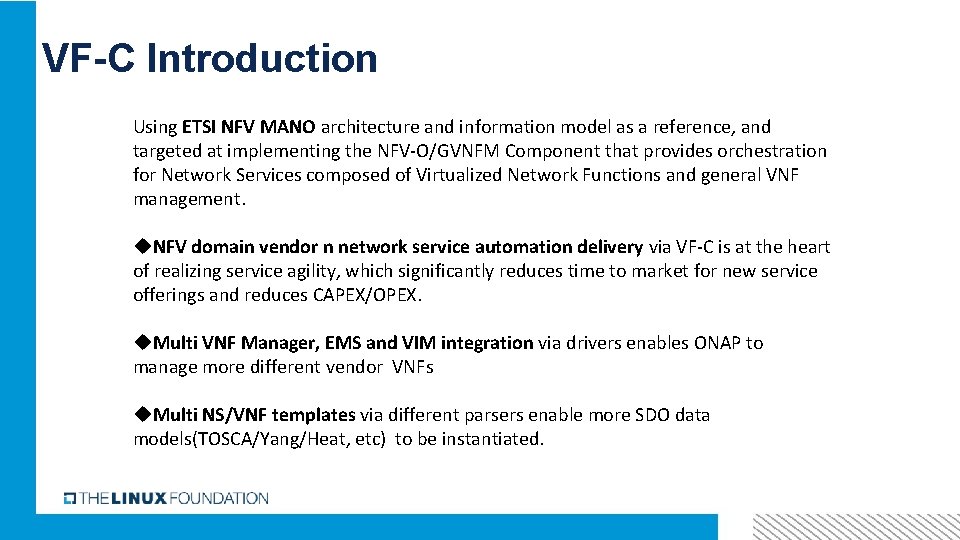
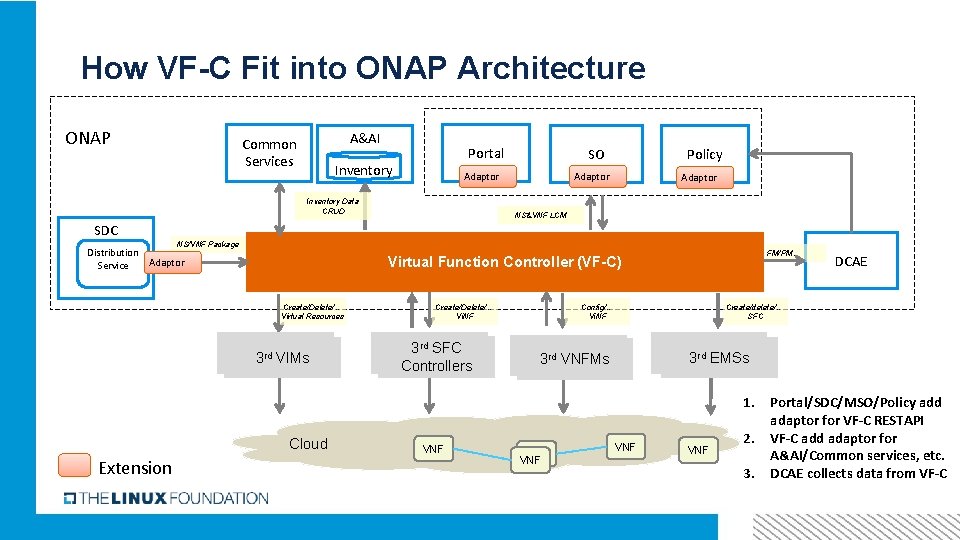
VF-C Introduction Using ETSI NFV MANO architecture and information model as a reference, and targeted at implementing the NFV-O/GVNFM Component that provides orchestration for Network Services composed of Virtualized Network Functions and general VNF management. u. NFV domain vendor n network service automation delivery via VF-C is at the heart of realizing service agility, which significantly reduces time to market for new service offerings and reduces CAPEX/OPEX. u. Multi VNF Manager, EMS and VIM integration via drivers enables ONAP to manage more different vendor VNFs u. Multi NS/VNF templates via different parsers enable more SDO data models(TOSCA/Yang/Heat, etc) to be instantiated.
How VF-C Fit into ONAP Architecture ONAP A&AI Common Services Portal Inventory SO Adaptor Inventory Data CRUD Policy Adaptor NS&VNF LCM SDC NS/VNF Package Distribution Adaptor Service FM/PM… Virtual Function Controller (VF-C) Create/Delete/… Virtual Resources rd VIMs 3 VIM Create/Delete/… Vi. NF 3 rd SFC VNFM Controllers Create/delete/… SFC Config/… Vi. NF 3 rd SFC 3 rd EMSs Controllers 3 rd. EMS VNFMs 1. Cloud Extension VNF v. CE VNF DCAE VNF 2. 3. Portal/SDC/MSO/Policy add adaptor for VF-C RESTAPI VF-C add adaptor for A&AI/Common services, etc. DCAE collects data from VF-C
VF-C Solution : VFC Components& Main Features API Handler NFV Lifecycle Management NFV Information Model Workflow Engine Wo W Workflow Templates Drivers 3 rd VNFM Drivers 3 rd 3 EMS rd EMS 3 rd EMS Drivers 3 rd 3 EMS rd EMS VIM Drivers 3 rd 3 EMS rd EMS 3 rd SFC Drivers n Support BPMN/BPEL workflow n Support NFV information Model and multi data models n Support ETSI architecture and IFA interfaces n Support VNF EPA features n Integrated with 3 rd VNFMs and VNF, such as Ericsson, JUJU, Huawei, and ZTE, etc n Integrated with multiple cloud systems, such as redhat, vmware, windriver, and unbuntu, etc
Outline ▪ ▪ ▪ Requirements from ONAP Use cases Merger Architecture Proposal Overview Merger Architecture Highlights • • • ONAP Modeling ONAP Common Service ONAP Service Orchestrator ONAP Controllers o Overview o VF-C o SDN-Agent Template Driven Closed Loop Support for Design, Schedule and Execute Changes (e. g. Software Upgrades) VNF SDK Resource and Placement Optimization Operations Management Framework (OMF) Support for Multiple Infrastructure Environments
Outline Requirements from ONAP Use cases ▪ Merger Architecture Proposal Overview ▪ Merger Architecture Highlights ▪ • • • ONAP Modeling ONAP Common Service ONAP Service Orchestrator ONAP Controllers Template Driven Closed Loop Support for Design, Schedule and Execute Changes (e. g. Software Upgrades) VNF SDK Resource and Placement Optimization Operations Management Framework (OMF) Support for Multiple Infrastructure Environments
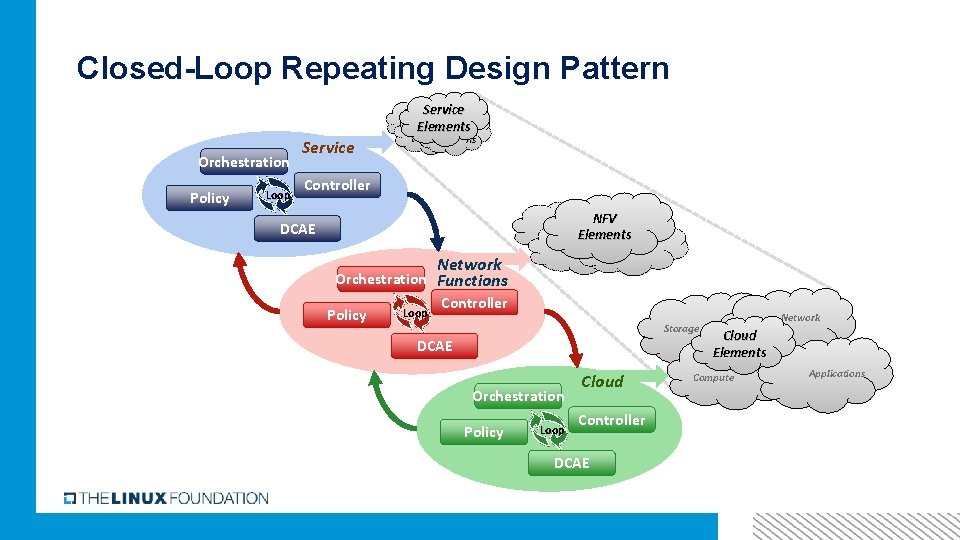
Closed-Loop Repeating Design Pattern Orchestration Policy Loop Service Storag e Compu Applicatio Elements te ns Controller NFV Elements DCAE Network Orchestration Functions Policy Loop Compute Controller Storage DCAE Orchestration Policy Loop Cloud Controller DCAE Network Cloud Elements Compute Applications
Control Loop Design and Execution Flow Control Loop Design Time Create template, Configure CL, Deploy CL, Stop/Restart, Reconfigure SDC Onboard VNF, Alarm file and create service Test, Certify, Distribute Closed Loop Distribute Control loop Query services, VNFs Get performance counter file Submit closed loop for distribution Deploy control loop Service Change Handler DCAE Dispatcher Cloudify (includes plugins) Databus Controller Check distribution status DCAE Inventory CDAP Broker VES Collector DCAE Control Loop Management Cockpit Create and Activate policies: TCA and Operational, Stop/Start, Reconfigure TCA Docker CDAP Control Loop Runtime Execution Example VF Source VES TCA Docker CDAP DCAE Collector DCAE Analytic Policy Engine DMaa. P Signature Detected DROOLS Policy Initiate Action Policy Engine Action Execution App-C NETCONF
Outline Requirements from ONAP Use cases ▪ Merger Architecture Proposal Overview ▪ Merger Architecture Highlights ▪ • • • ONAP Modeling ONAP Common Service ONAP Service Orchestrator ONAP Controllers Template Driven Closed Loop Support for Design, Schedule and Execute Changes (e. g. Software Upgrades) VNF SDK Resource and Placement Optimization Operations Management Framework (OMF) Support for Multiple Infrastructure Environments
VNF Change Management Process Design: Scheduling: Execution: • Building blocks for individual tasks • Schedule optimization for avoiding conflicts • Automated workflow orchestration and tracking • Design workflow as a composition of building blocks • Conflict rules as policies • Ability to intercept execution – pause/resume • Policy enabled go/no-go Improved manageability: Systematic design of workflow, scheduling and execution Minimize service disruption: conflict avoidance for schedule and automated roll-out/fall-backs
CM Process Design SDC (catalog) CM Building Blocks in Catalog • DCAE micro-services, A&AI APIs, Controller capabilities (e. g. , health check APIs), scripts/workflows. Onboard component capabilities DCAE A&AI Controllers (APP-C, SDN-C) CM Designer • Modular composition to stitch different building blocks into a workflow (using a visual designer) e. g. , In-place software upgrade, Build and Replace. SDC (CM Designer) SDC (CM catalog)
Change Management Scheduling & Conflict Avoidance ONAP Portal CM Schedule Optimizer -> SNIRO • • Conflict scoping Service Impact scoping Execution ordering 6 Tracking/ Notification OSS Create a schedule/plan for rolling out a change such that we minimize service disruption during the change within the specific completion time Dependency modeling • 5 4 3 CM Portal 1 7 CM schedule optimizer (SNIRO) 3 DCAE CM Orchestration 2 3 A&AI Policy 1 – Send workflow, VNF list and time range to SNIRO 2 – Request constraints for scheduling 3 – Request data for schedule optimization 4 – Identify CM schedule 5 – Provide the schedule for approval 6 – Once approved, send the schedule to Change tracking/notification OSS. 7 – Push the approved change schedule for execution
ONAP Portal Change Execution ** Orchestration Execution: Execute the orchestration building blocks and use RESTAPIs to interface controller for software upgrade, or A&AI for updates to the CM flag ONAP Portal: • Track status of CM workflow execution – success/failure status of each building block • Intercept CM workflow execution – pause/resume functions, and ability to inject new steps in the workflow Pre / Post Analytics: • Performance analytics – pre/post performance comparisons, go/no-go decisions for networkwide deployment • CM Portal 7 DCAE Orchestration 2 Policy 2 b 5 6 3 Controllers (APP-C, SDN-O, MCAP) 1 4 8 7 b A&AI 1 – Start execution based on schedule 2 – Conflict check 2 b – Check roll-out status 3 – (Pre) health check 4 – Update CM flag 5 – VNF upgrade 6 – (Post) health check 7 – Pre/post impact analysis 7 b – Fallback (possibly) 8 – Update CM flag ** – Status tracking and pause/resume execution at any/all times
Outline Requirements from ONAP Use cases ▪ Merger Architecture Proposal Overview ▪ Merger Architecture Highlights ▪ • • • ONAP Modeling ONAP Common Service ONAP Service Orchestrator ONAP Controllers Template Driven Closed Loop Support for Design, Schedule and Execute Changes (e. g. Software Upgrades) VNF SDK Resource and Placement Optimization Operations Management Framework (OMF) Support for Multiple Infrastructure Environments
VNF Onboarding SDK Description: • Propose to build an SDK and automation/dev. Ops tools for VNF onboarding. This functionality uses VNF guidelines & information model as needed. ₋ This project implements methods and processes for VNF vendors to onboard ONAP compliant VNF packages to Service Providers or market place, including automated ingestion to Design Platform (SDC). ₋ This project focuses on the SDK tools, not ONAP business models (e. g. , market place). ₋ • Benefits: Provide a standard packaging and submission process for VNF vendors to multiple ONAP service providers. ₋ Enforce VNF packages to meet ONAP standards and requirements for deployment and lifecycle management of the VNF products. ₋ Reduce the costs of onboarding and to provide speedy time-to-market of the VNFs. ₋ Use Cases: Vendor uses SDK to validate VNF package. • Service Provider uses SDK to automate ingestion of a VNF package to SDC Design Platform. •
VNF Onboarding SDK 1. Service Provider Option Supplier A VNF Package Supplier B VNF Package Supplier A VNF Package ONAP Compliant SDK Create & Validate Certified VNF Package SP’s SDC ONAP Compliant SDK Create & Validate Certified VNF Package 2. Supplier-SP Option Supplier B VNF Package SDK Create & Validate Certified VNF Package Market Place 3. Marketplace Optionally to include SP specific configuration changes Supplier A VNF Package Supplier B VNF Package ONAP Compliant SDK Create & Validate VNF Catalog Certified VNF Package SP additional Validation & Onboarding SDK Validate & Onboard SP’s SDC
Outline Requirements from ONAP Use cases ▪ Merger Architecture Proposal Overview ▪ Merger Architecture Highlights ▪ • • • ONAP Modeling ONAP Common Service ONAP Service Orchestrator ONAP Controllers Template Driven Closed Loop Support for Design, Schedule and Execute Changes (e. g. Software Upgrades) VNF SDK Resource and Placement Optimization Operations Management Framework (OMF) Support for Multiple Infrastructure Environments
ONAP Optimization Framework (ONAP-OF) The ONAP Optimization Framework (ONAP-OF) is being proposed as a new platform component that to introduce the Homing, License and Change Management Schedule optimizers in an manner that allows other implementers to also extend or replace the optimizations supported with their specific optimizers. Background: • Optimization was an early concept in ECOMP (to many objects for manual mechanisms) • Spans Service, Network, Infrastructure, and Resources • ECOMP has four (4) optimizers today: • Placement • Within a cloud instance • Integrated with Open. Stack • Homing • Spans cloud instances • Policy driven • Provides ability for business, service, and network rules to be used in selecting locations for service resources • License • Selects Software Entitlements and License Keys for software being deployed or reconfigured • Allows complex criteria, conformant to contractual constrictions to be used • Allows for business rules to drive cost reductions in entitlements used • CM Schedule • Uses Rules to avoid conflicts between related elements during scheduled software change/upgrade activities • Evaluates Vertical Relationships (implementation stack) • Evaluates Horizontal Relationships (service path)
ONAP Optimization Framework (ONAP-OF) Proposal ONAP-OF SCOPE • Develop an extensible framework to deploy optimization applications for ONAP – Provide standard interface for optimization requests from other ONAP entities. – Interact with ONAP-C for micro service management – Provide Management framework that will allow: – New Optimizers Applications to be deployed in a distributed manner – Provide ability to add Optimization Data Providers – Provide ability to add new data sets that can be provided by a Data Provider • Provide three (3) sample Optimizers – Homing allows selection of cloud instances to be used for service components – License allows complex criteria to be used in selecting software entitlements and license keys needed to enable deployed software – CM Schedule allows policy to dictate conflicts to avoid when attempting to establish a schedule for a large number of SW instances requiring modification. ONAP-OF Reference Architecture
Outline Requirements from ONAP Use cases ▪ Merger Architecture Proposal Overview ▪ Merger Architecture Highlights ▪ • • • ONAP Modeling ONAP Common Service ONAP Service Orchestrator ONAP Controllers Template Driven Closed Loop Support for Design, Schedule and Execute Changes (e. g. Software Upgrades) VNF SDK Resource and Placement Optimization Operations Management Framework (OMF) Support for Multiple Infrastructure Environments
ONAP : Operations Management Framework (OMF) OMF Portal : Provides GUI for operations team to perform tasks such as: § Request for Network Configuration Change § Execute workflow for network change § Administrative tasks such as Role based access to OMF § Execute test case § OMF Middleware : § Business Logic Layer : implement O&M functions as u. S and reusable components e. g. New Service Rollout Mgmt § Integration Layer : Build cartridges/adaptors to interface with external systems. § OMF Configuration Engine § Manage, Perform and Orchestrate Service level Configuration changes § OMF Test Engine § Perform Service Regression, Validation tests, Device Health check Tests. §
Outline Requirements from ONAP Use cases ▪ Merger Architecture Proposal Overview ▪ Merger Architecture Highlights ▪ • • • ONAP Modeling ONAP Common Service ONAP Service Orchestrator ONAP Controllers Template Driven Closed Loop Support for Design, Schedule and Execute Changes (e. g. Software Upgrades) VNF SDK Resource and Placement Optimization Operations Management Framework (OMF) Support for Multiple Infrastructure Environments
Multiple Infrastructure Support Abstraction Layer ▪ Enhancement Summary: § § § Expand ONAP SDC to Capture Artifacts to Support Multiple Infrastructure Environment Create an Infrastructure Abstraction Layer with Adaptors for Various Infrastructures Service Orchestrator and other ONAP Applications will Interface with the Abstraction Layer with right template Infrastructure Abstraction Layer will Interact with Different Infrastructures and pass right templates This is a very high level view, additional design details to be worked with the TSC controller sub-group. Under Development Design Environment Execution Environment
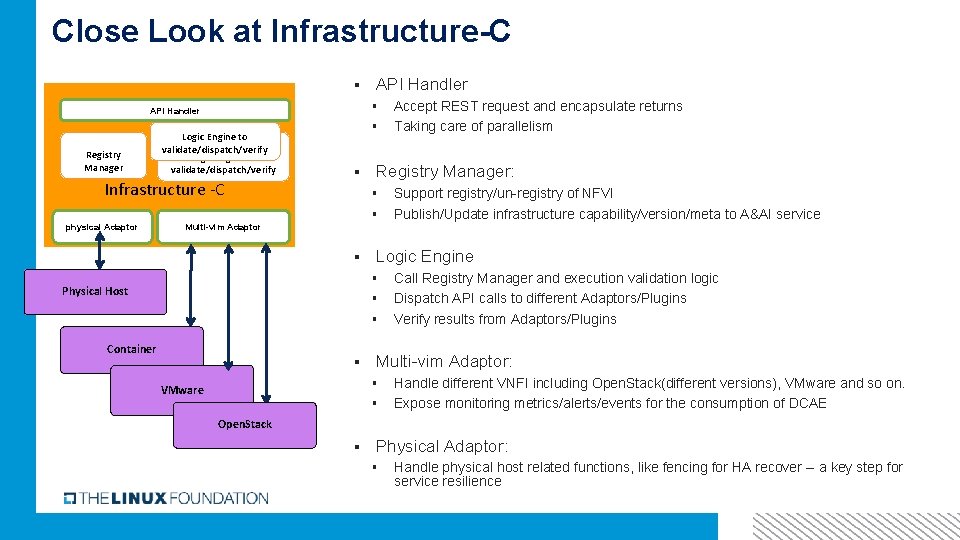
Multiple Infrastructure Support § Create an Infrastructure Abstraction Layer with Adaptors for Various Infrastructures § Service Orchestrator and other ONAP Applications will Interface with the Abstraction Layer for infrastructure functions § Infrastructure Abstraction Layer will Interact with Different Infrastructures and pass right templates SDC DCAE Service Orchestrator A&AI Catalog API Handler template collector Logic Engine to validate/dispatch/verify Registry Manager Infrastructure -C Multi-vim Adaptor physical Adaptor VF-C APP-C Physical Host § Expand ONAP SDC to Capture Artifacts to Support Multiple Infrastructure Environment § Expand A&AI to contain registries of VIM information § capabilities § version § meta data § Infrastructure-C to provide one unified entry to multiple Container VMware Open. Stack Design time Run time § § infrastructure environments: Called by both APP-C and VF-C Authentication Federation Standard API on infrastructure LCM, health check/recover expose monitoring/alerts/events for DCAE or any consumer
Close Look at Infrastructure-C § § API Handler Registry Manager API Handler Logic Engine to validate/dispatch/verify Infrastructure -C § § Registry Manager: § § physical Adaptor Accept REST request and encapsulate returns Taking care of parallelism Support registry/un-registry of NFVI Publish/Update infrastructure capability/version/meta to A&AI service Multi-vim Adaptor § Logic Engine § Physical Host § § Container § Multi-vim Adaptor: § VMware Call Registry Manager and execution validation logic Dispatch API calls to different Adaptors/Plugins Verify results from Adaptors/Plugins § Handle different VNFI including Open. Stack(different versions), VMware and so on. Expose monitoring metrics/alerts/events for the consumption of DCAE Open. Stack § Physical Adaptor: § Handle physical host related functions, like fencing for HA recover -- a key step for service resilience
BAKCUP SLIDES
Proposed ONAP Merged Architecture Service Orchestrator (SO) E – Services • Orchestrates BSS /and OSS Bigdelivery, Data manages the Active & Available Inventory (A&AI) Dashboard • Real-time topology map with context views of virtual networks, services OA&M and applications Operation • Uses the network resources as the Administration database of record due to their & Maintenance Service Design & Creation dynamic nature ONAP Portal VNF SDK Policy Creation Analytic Application Design Platform modification or removal of networks & services • Provides cross domain orchestration and External Data Movement coordination& APIs • Integrate TOSCA end-to-end orchestration • Service Design: environment to define service and resource, constraints, instantiation & modification recipes. Recipe/Engineering • Policy Creation: Associate anomalous Rules & Policy and actionable conditions with Distribution automated remedy actions • Provides SDK to onboard and certify Vendor VNFs Functions Design Active & Available Inventory Service Orchestrator Common Services, Data Movement, Access Control & APIs Data Collection & Analytics Operational Functions Controllers SDN Agent Infra. Cont network Cont App. Controllers VF Cont • Network: Configuration Management of VNFs, infrastructure Data Collection, Analytics & Events rd Party & WANs VNFM / 3 networking EMS Controller • Service/App: configures & manages of Service VFs (DCAE) ONAP • VF-C: works with DCAE, policy and orchestrator to provide • Collects Telemetry Data from VNFs and Life cycle and FCAPS management for complicated VNFs, and other sources Controller provides adaptors to support vendor EMS / VNF-Manager • Analytic Applications Detect Anomalous Storage Compute • SDN Agent: adaptor for 3 rp party controllers. conditions Networking • Infrastructure: Configuration Management of infrastructure • Publishes Actionable conditions VNFs / Applications (compute, storage, etc. ) © 2017 AT&T Intellectual Property. All rights reserved. AT&T, Globe logo, Mobilizing Your World and DIRECTV are registered trademarks and service marks of AT&T Intellectual Property and/or AT&T affiliated companies. All other marks are the property of their respective owners.