
Open MP Part 2 Work Sharing Schedule Synchronization
![Work Sharing: tasks #pragma omp task [clauses]…… • Tasks allow to parallelize irregular problems](https://slidetodoc.com/presentation_image_h/34e6b6f12590664aa780dc092c448671/image-7.jpg "Work Sharing: tasks #pragma omp task [clauses]…… • Tasks allow to parallelize irregular problems")
![OPENMP Synchronization: review PRAGMA DESCRIPTION #pragma omp for ordered [clauses. . . ] (loop](https://slidetodoc.com/presentation_image_h/34e6b6f12590664aa780dc092c448671/image-24.jpg "OPENMP Synchronization: review PRAGMA DESCRIPTION #pragma omp for ordered [clauses. . . ] (loop")
- Slides: 33
Open. MP Part 2 Work. Sharing, Schedule, Synchronization and OMP best practices
Recap of Part 1 ü What is OPENMP? ü Fork/Join Programming model ü OPENMP Core Elements ü #pragma omp parallel OR Parallel construct ü run time variables ü environment variables ü data scoping (private, shared…) ü work sharing constructs #pragma omp for sections tasks Ø schedule clause Ø synchronization Ø compile and run openmp program in c++ and fortran
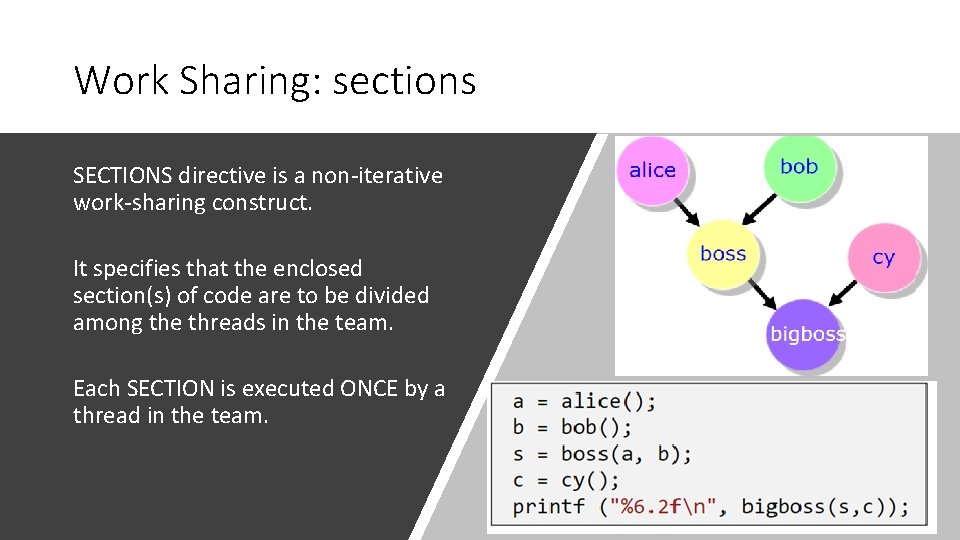
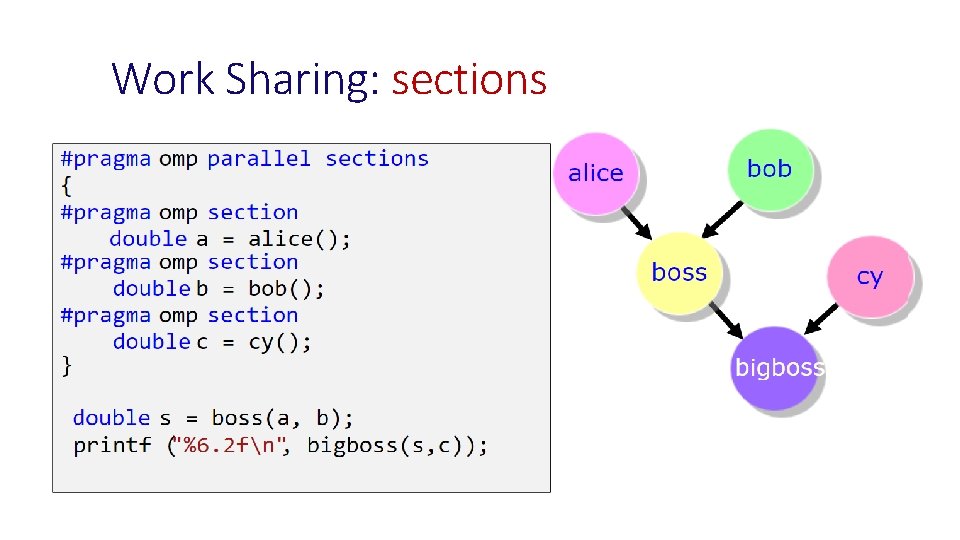
Work Sharing: sections SECTIONS directive is a non-iterative work-sharing construct. It specifies that the enclosed section(s) of code are to be divided among the threads in the team. Each SECTION is executed ONCE by a thread in the team.
Work Sharing: sections
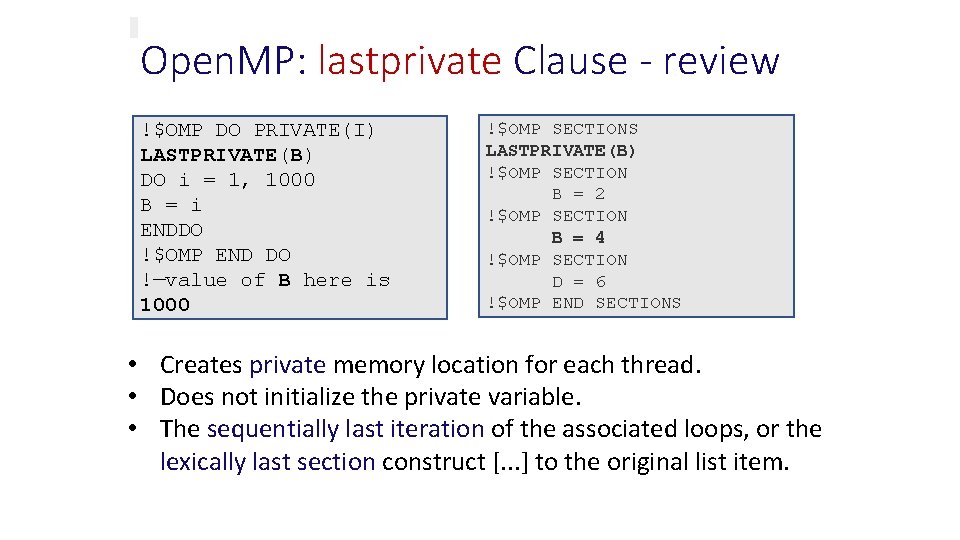
Open. MP: lastprivate Clause - review !$OMP DO PRIVATE(I) LASTPRIVATE(B) DO i = 1, 1000 B = i ENDDO !$OMP END DO !—value of B here is 1000 !$OMP SECTIONS LASTPRIVATE(B) !$OMP SECTION B = 2 !$OMP SECTION B = 4 !$OMP SECTION D = 6 !$OMP END SECTIONS • Creates private memory location for each thread. • Does not initialize the private variable. • The sequentially last iteration of the associated loops, or the lexically last section construct [. . . ] to the original list item.
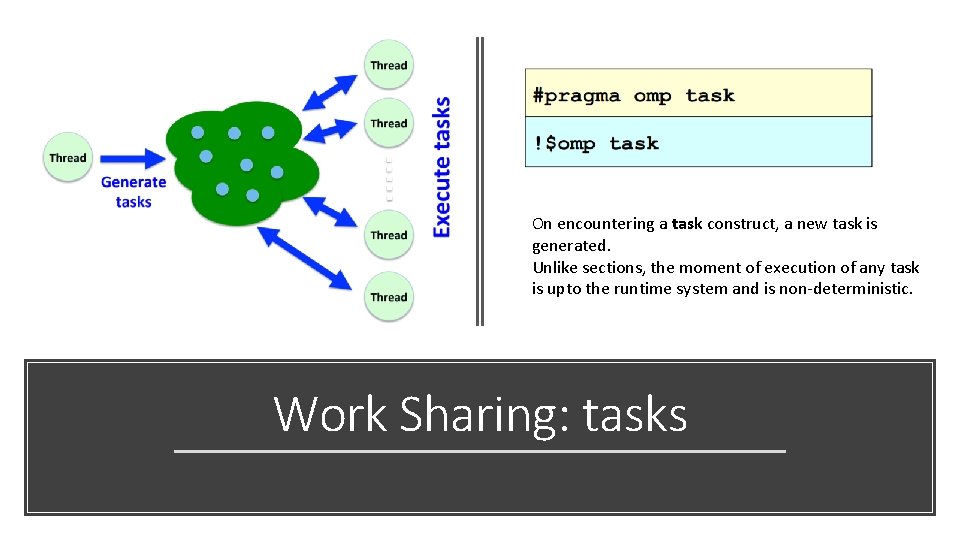
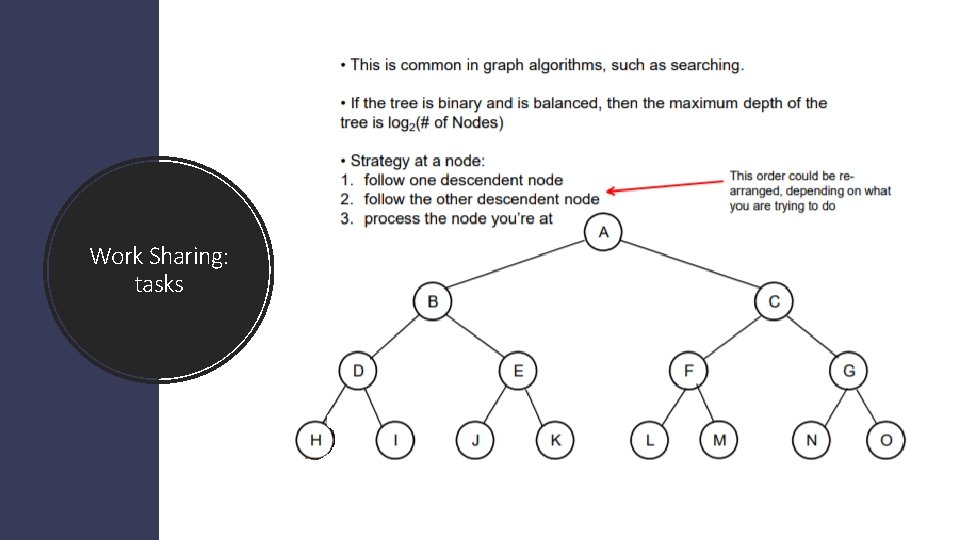
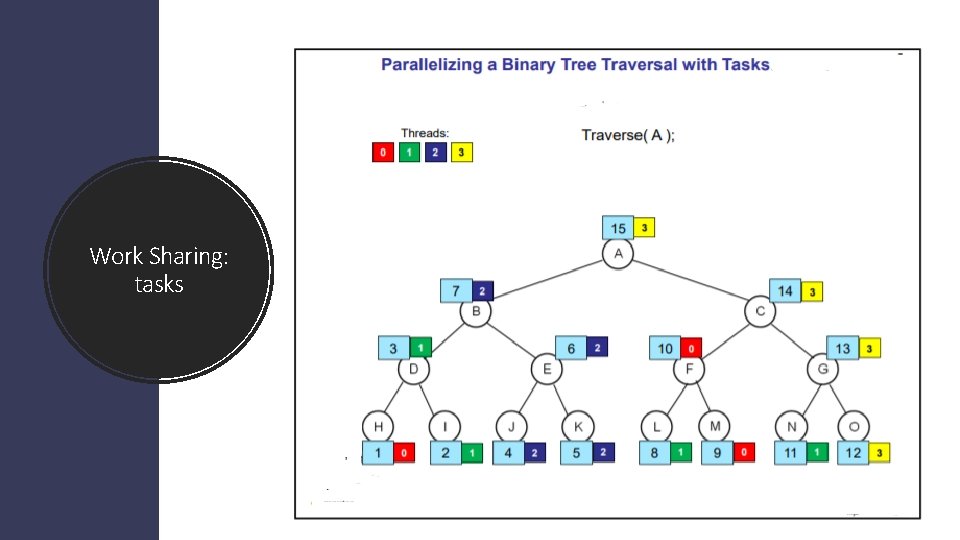
On encountering a task construct, a new task is generated. Unlike sections, the moment of execution of any task is upto the runtime system and is non-deterministic. Work Sharing: tasks
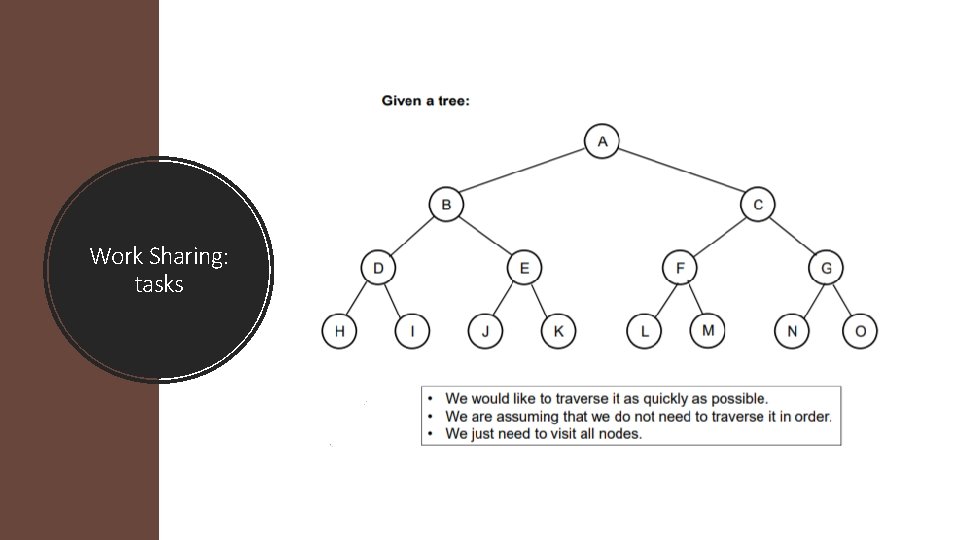
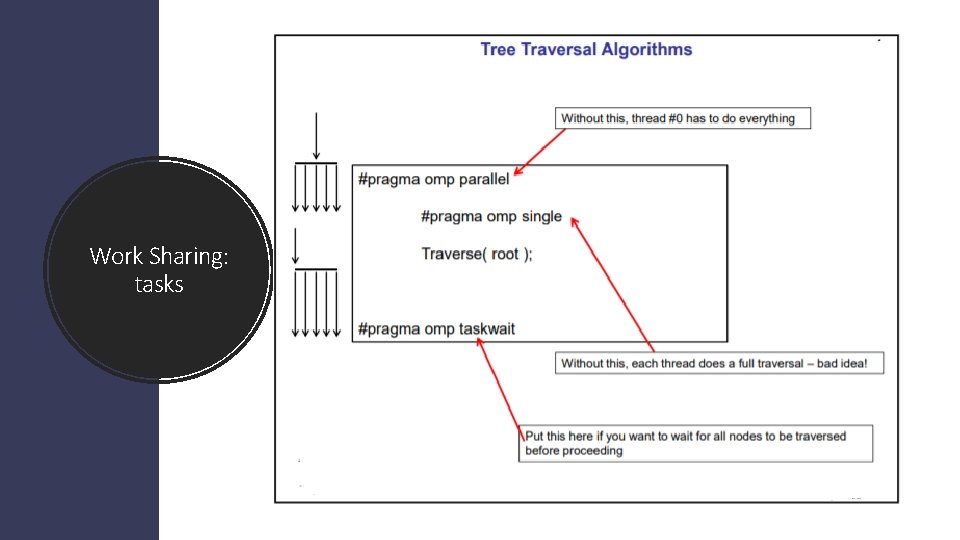
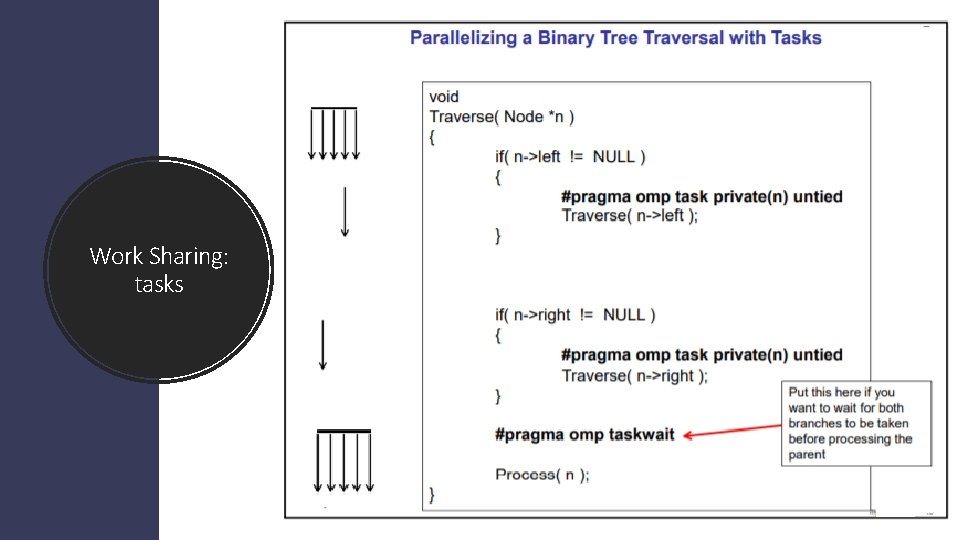
Work Sharing: tasks #pragma omp task [clauses]…… • Tasks allow to parallelize irregular problems (Unbounded loops & Recursive algorithms ) • A task has - Code to execute – Data environment (It owns its data) – Internal control variables – An assigned thread that executes the code and the data • Each encountering thread packages a new instance of a task (code and data) • Some thread in the team executes the task at some later time • All tasks within a team have to be independent and there is no implicit barrier.
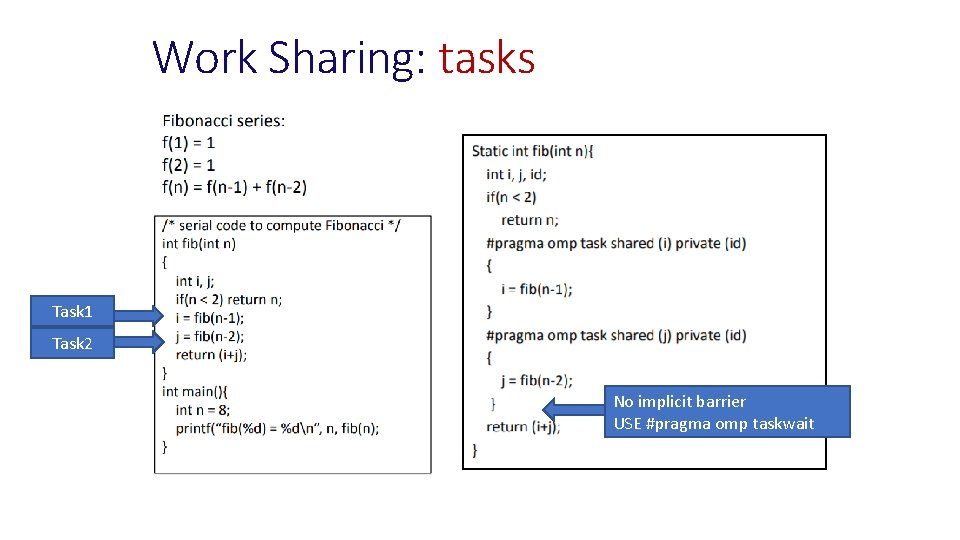
Work Sharing: tasks Task 1 Task 2 No implicit barrier USE #pragma omp taskwait
Work Sharing: tasks
Work Sharing: tasks
Work Sharing: tasks
Work Sharing: tasks
Work Sharing: tasks
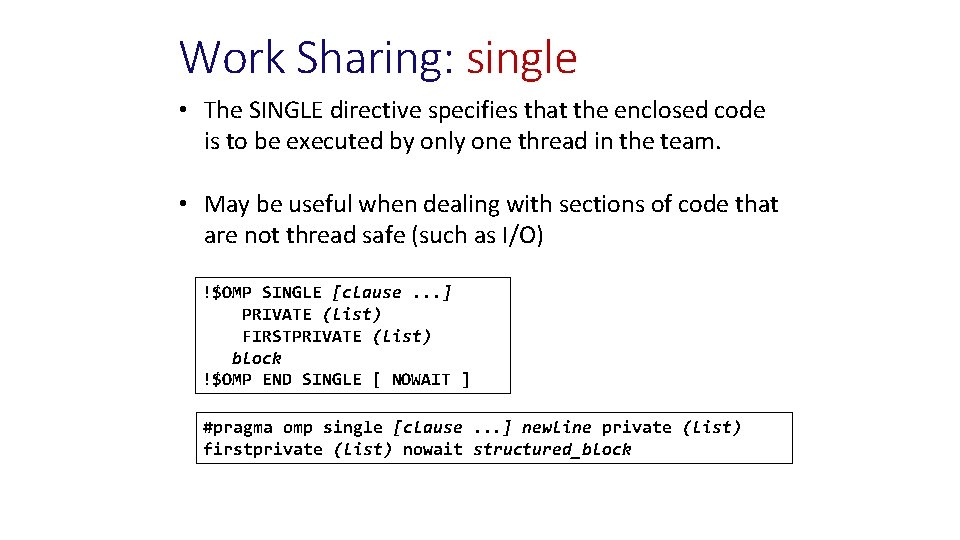
Work Sharing: single • The SINGLE directive specifies that the enclosed code is to be executed by only one thread in the team. • May be useful when dealing with sections of code that are not thread safe (such as I/O) !$OMP SINGLE [clause. . . ] PRIVATE (list) FIRSTPRIVATE (list) block !$OMP END SINGLE [ NOWAIT ] #pragma omp single [clause. . . ] newline private (list) firstprivate (list) nowait structured_block
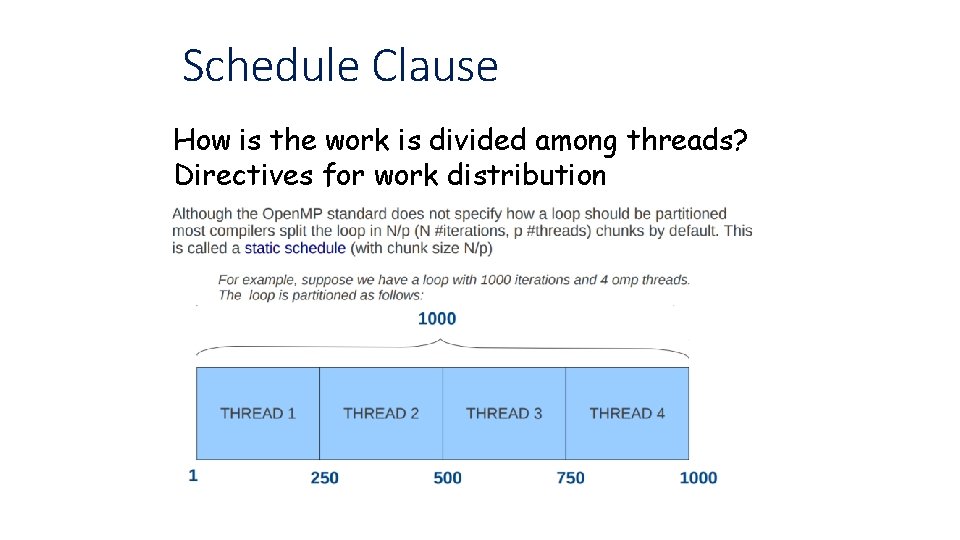
Schedule Clause How is the work is divided among threads? Directives for work distribution
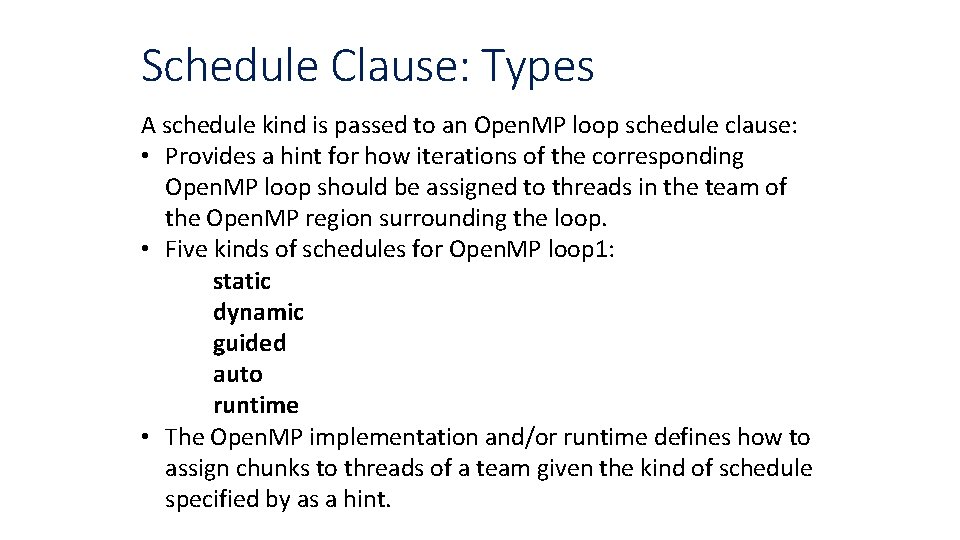
Schedule Clause: Types A schedule kind is passed to an Open. MP loop schedule clause: • Provides a hint for how iterations of the corresponding Open. MP loop should be assigned to threads in the team of the Open. MP region surrounding the loop. • Five kinds of schedules for Open. MP loop 1: static dynamic guided auto runtime • The Open. MP implementation and/or runtime defines how to assign chunks to threads of a team given the kind of schedule specified by as a hint.
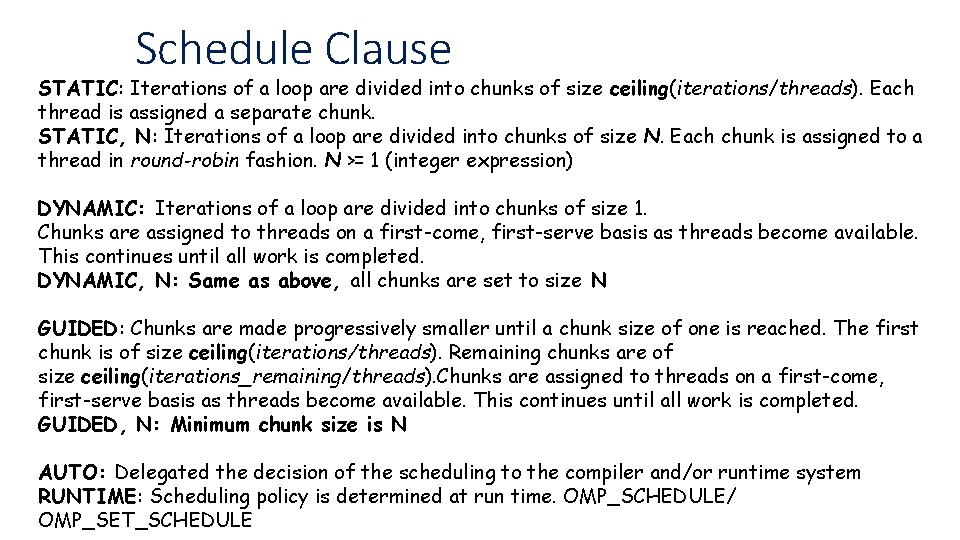
Schedule Clause STATIC: Iterations of a loop are divided into chunks of size ceiling(iterations/threads). Each thread is assigned a separate chunk. STATIC, N: Iterations of a loop are divided into chunks of size N. Each chunk is assigned to a thread in round-robin fashion. N >= 1 (integer expression) DYNAMIC: Iterations of a loop are divided into chunks of size 1. Chunks are assigned to threads on a first-come, first-serve basis as threads become available. This continues until all work is completed. DYNAMIC, N: Same as above, all chunks are set to size N GUIDED: Chunks are made progressively smaller until a chunk size of one is reached. The first chunk is of size ceiling(iterations/threads). Remaining chunks are of size ceiling(iterations_remaining/threads). Chunks are assigned to threads on a first-come, first-serve basis as threads become available. This continues until all work is completed. GUIDED, N: Minimum chunk size is N AUTO: Delegated the decision of the scheduling to the compiler and/or runtime system RUNTIME: Scheduling policy is determined at run time. OMP_SCHEDULE/ OMP_SET_SCHEDULE
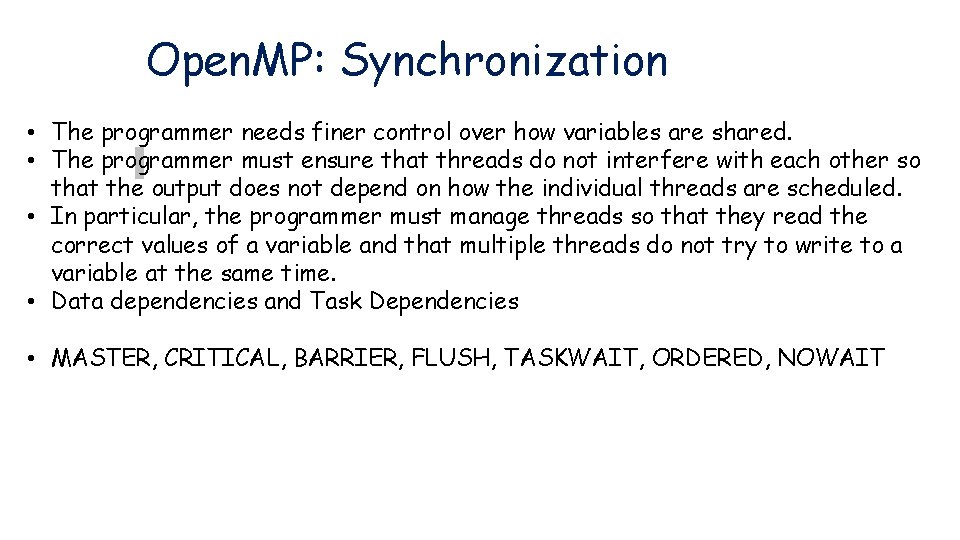
Open. MP: Synchronization • The programmer needs finer control over how variables are shared. • The programmer must ensure that threads do not interfere with each other so that the output does not depend on how the individual threads are scheduled. • In particular, the programmer must manage threads so that they read the correct values of a variable and that multiple threads do not try to write to a variable at the same time. • Data dependencies and Task Dependencies • MASTER, CRITICAL, BARRIER, FLUSH, TASKWAIT, ORDERED, NOWAIT
Data Dependencies Open. MP assumes that there is NO datadependency across jobs running in parallel When the omp parallel directive is placed around a code block, it is the programmer’s responsibility to make sure data dependency is ruled out
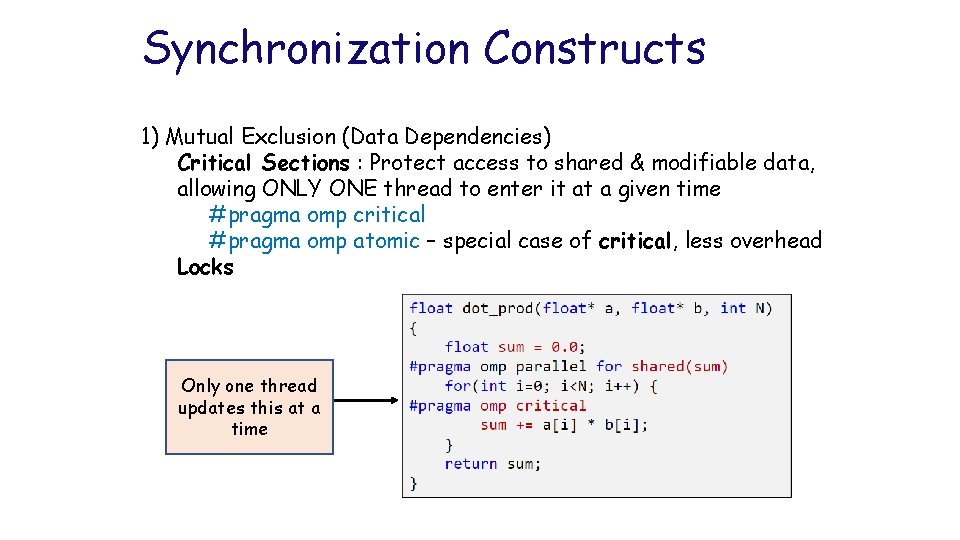
Synchronization Constructs 1) Mutual Exclusion (Data Dependencies) Critical Sections : Protect access to shared & modifiable data, allowing ONLY ONE thread to enter it at a given time #pragma omp critical #pragma omp atomic – special case of critical, less overhead Locks Only one thread updates this at a time
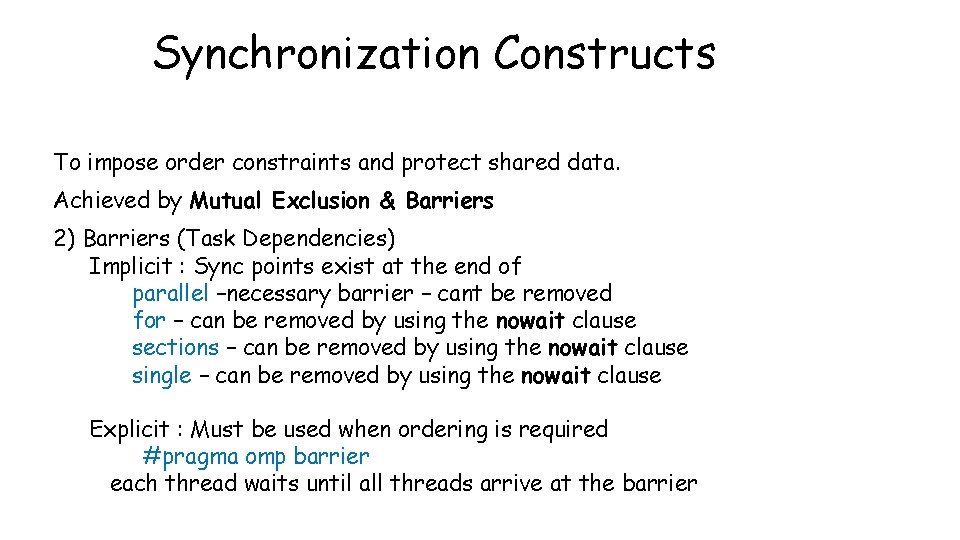
Synchronization Constructs To impose order constraints and protect shared data. Achieved by Mutual Exclusion & Barriers 2) Barriers (Task Dependencies) Implicit : Sync points exist at the end of parallel –necessary barrier – cant be removed for – can be removed by using the nowait clause sections – can be removed by using the nowait clause single – can be removed by using the nowait clause Explicit : Must be used when ordering is required #pragma omp barrier each thread waits until all threads arrive at the barrier
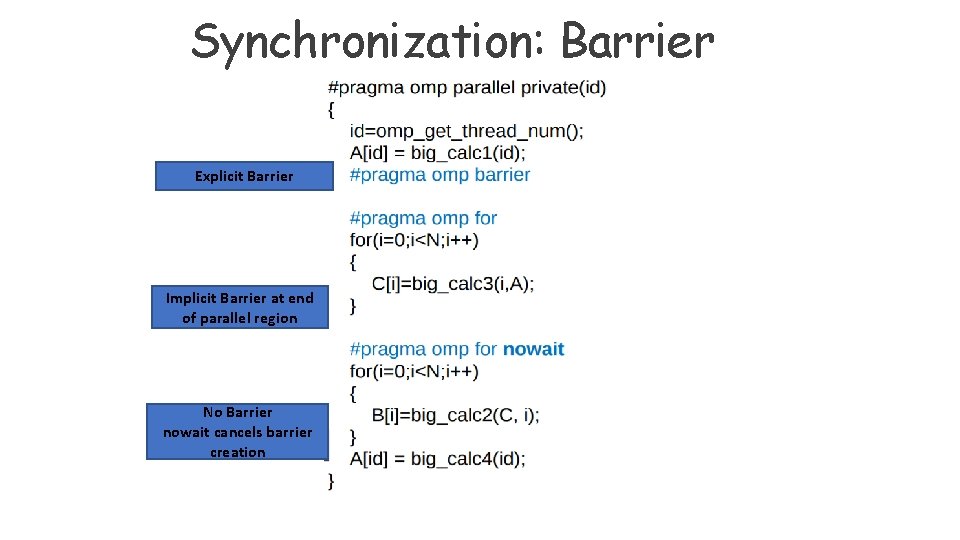
Synchronization: Barrier Explicit Barrier Implicit Barrier at end of parallel region No Barrier nowait cancels barrier creation
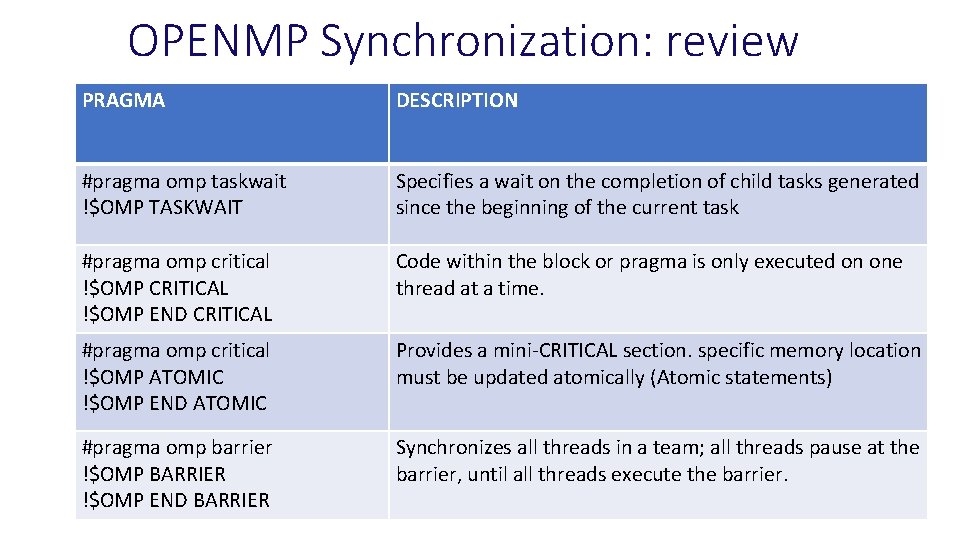
OPENMP Synchronization: review PRAGMA DESCRIPTION #pragma omp taskwait !$OMP TASKWAIT Specifies a wait on the completion of child tasks generated since the beginning of the current task #pragma omp critical !$OMP CRITICAL !$OMP END CRITICAL Code within the block or pragma is only executed on one thread at a time. #pragma omp critical !$OMP ATOMIC !$OMP END ATOMIC Provides a mini-CRITICAL section. specific memory location must be updated atomically (Atomic statements) #pragma omp barrier !$OMP BARRIER !$OMP END BARRIER Synchronizes all threads in a team; all threads pause at the barrier, until all threads execute the barrier.
OPENMP Synchronization: review PRAGMA DESCRIPTION #pragma omp for ordered [clauses. . . ] (loop region) #pragma omp ordered structured_block Used within a DO / for loop Iterations of the enclosed loop will be executed in the same order as if they were executed on a serial processor. Threads will need to wait before executing their chunk of iterations if previous iterations haven't completed yet. #pragma omp flush (list) Synchronization point at which all threads have the same view of memory for all shared objects. FLUSH is implied for barrier parallel - upon entry and exit critical - upon entry and exit ordered - upon entry and exit for - upon exit sections - upon exit single - upon exi
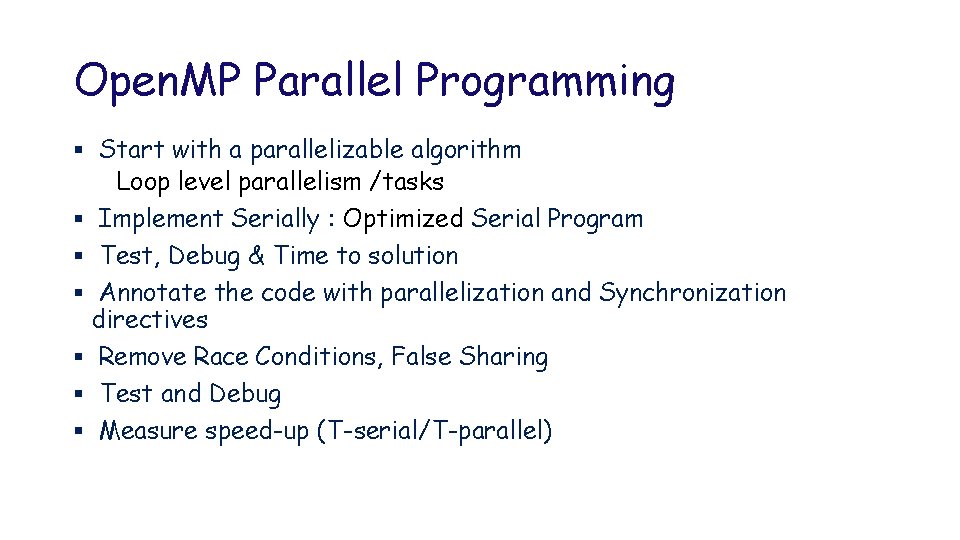
Open. MP Parallel Programming § Start with a parallelizable algorithm Loop level parallelism /tasks § Implement Serially : Optimized Serial Program § Test, Debug & Time to solution § Annotate the code with parallelization and Synchronization directives § Remove Race Conditions, False Sharing § Test and Debug § Measure speed-up (T-serial/T-parallel)
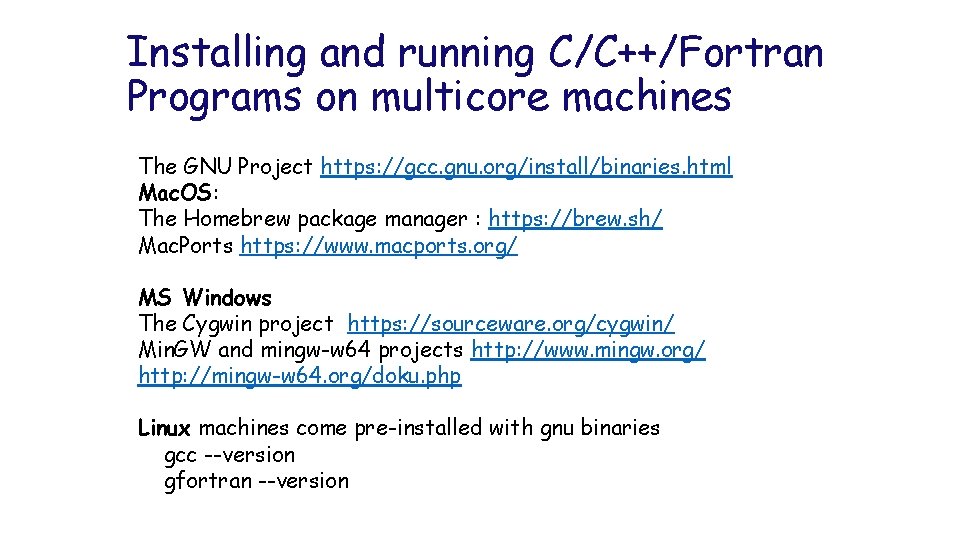
Installing and running C/C++/Fortran Programs on multicore machines The GNU Project https: //gcc. gnu. org/install/binaries. html Mac. OS: The Homebrew package manager : https: //brew. sh/ Mac. Ports https: //www. macports. org/ MS Windows The Cygwin project https: //sourceware. org/cygwin/ Min. GW and mingw-w 64 projects http: //www. mingw. org/ http: //mingw-w 64. org/doku. php Linux machines come pre-installed with gnu binaries gcc --version gfortran --version
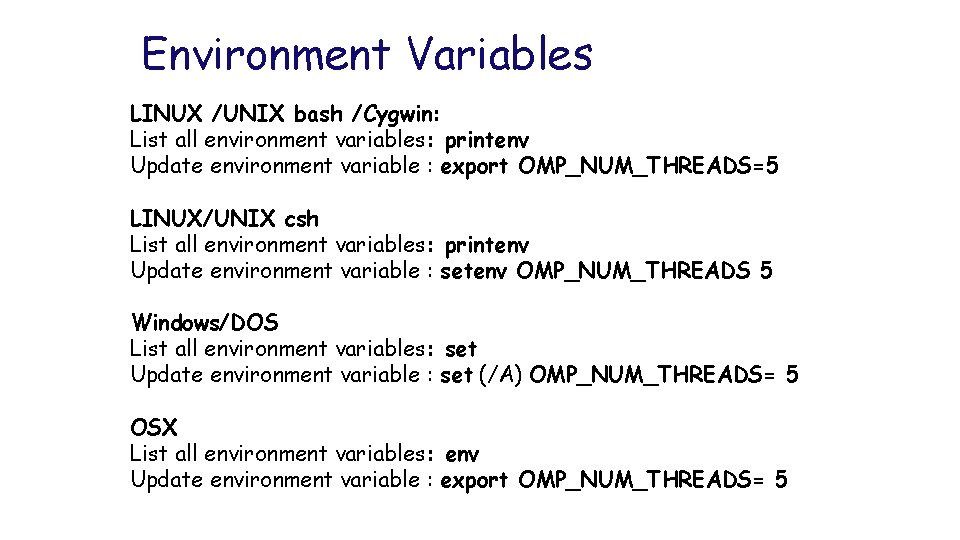
Environment Variables LINUX /UNIX bash /Cygwin: List all environment variables: printenv Update environment variable : export OMP_NUM_THREADS=5 LINUX/UNIX csh List all environment variables: printenv Update environment variable : setenv OMP_NUM_THREADS 5 Windows/DOS List all environment variables: set Update environment variable : set (/A) OMP_NUM_THREADS= 5 OSX List all environment variables: env Update environment variable : export OMP_NUM_THREADS= 5
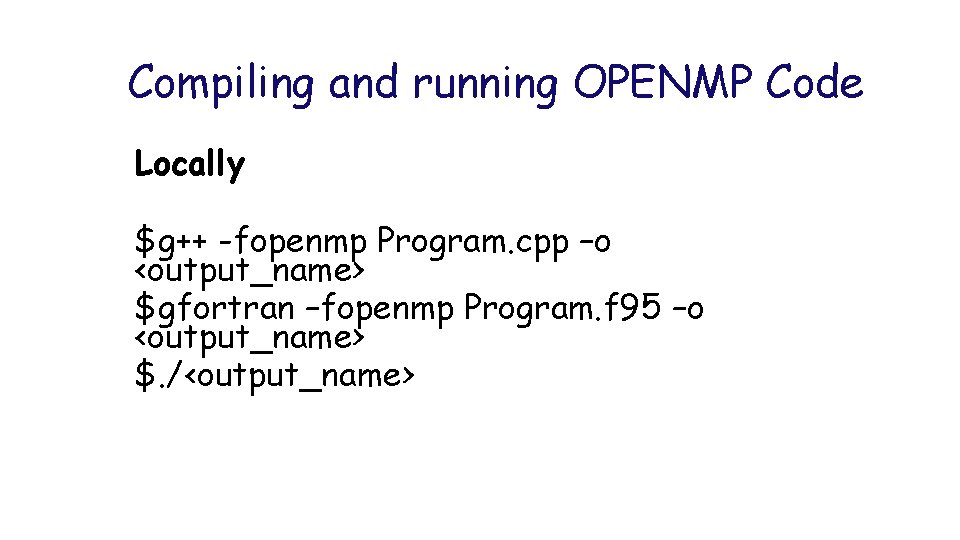
Compiling and running OPENMP Code Locally $g++ -fopenmp Program. cpp –o <output_name> $gfortran –fopenmp Program. f 95 –o <output_name> $. /<output_name>
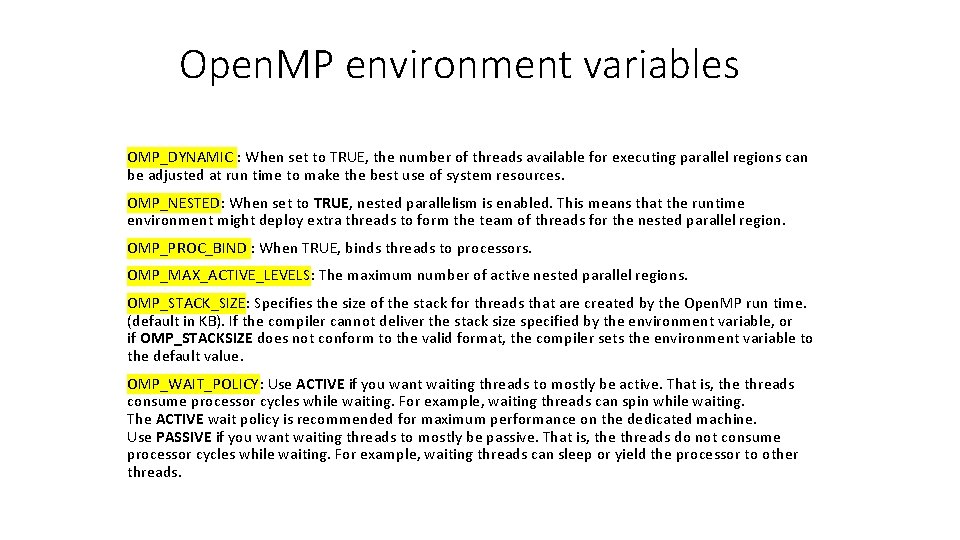
Open. MP environment variables OMP_DYNAMIC : When set to TRUE, the number of threads available for executing parallel regions can be adjusted at run time to make the best use of system resources. OMP_NESTED: When set to TRUE, nested parallelism is enabled. This means that the runtime environment might deploy extra threads to form the team of threads for the nested parallel region. OMP_PROC_BIND : When TRUE, binds threads to processors. OMP_MAX_ACTIVE_LEVELS: The maximum number of active nested parallel regions. OMP_STACK_SIZE: Specifies the size of the stack for threads that are created by the Open. MP run time. (default in KB). If the compiler cannot deliver the stack size specified by the environment variable, or if OMP_STACKSIZE does not conform to the valid format, the compiler sets the environment variable to the default value. OMP_WAIT_POLICY: Use ACTIVE if you want waiting threads to mostly be active. That is, the threads consume processor cycles while waiting. For example, waiting threads can spin while waiting. The ACTIVE wait policy is recommended for maximum performance on the dedicated machine. Use PASSIVE if you want waiting threads to mostly be passive. That is, the threads do not consume processor cycles while waiting. For example, waiting threads can sleep or yield the processor to other threads.
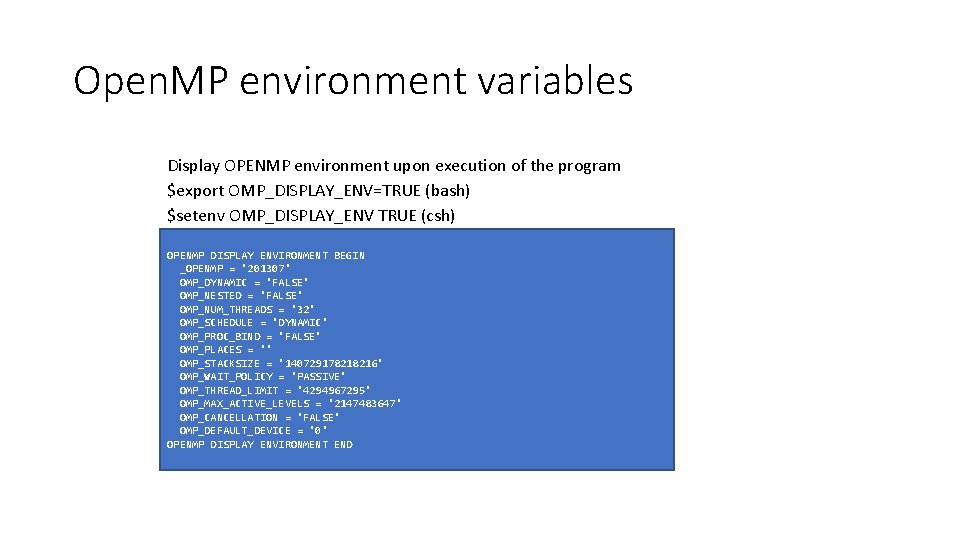
Open. MP environment variables Display OPENMP environment upon execution of the program $export OMP_DISPLAY_ENV=TRUE (bash) $setenv OMP_DISPLAY_ENV TRUE (csh) OPENMP DISPLAY ENVIRONMENT BEGIN _OPENMP = '201307' OMP_DYNAMIC = 'FALSE' OMP_NESTED = 'FALSE' OMP_NUM_THREADS = '32' OMP_SCHEDULE = 'DYNAMIC' OMP_PROC_BIND = 'FALSE' OMP_PLACES = '' OMP_STACKSIZE = '140729178218216' OMP_WAIT_POLICY = 'PASSIVE' OMP_THREAD_LIMIT = '4294967295' OMP_MAX_ACTIVE_LEVELS = '2147483647' OMP_CANCELLATION = 'FALSE' OMP_DEFAULT_DEVICE = '0' OPENMP DISPLAY ENVIRONMENT END
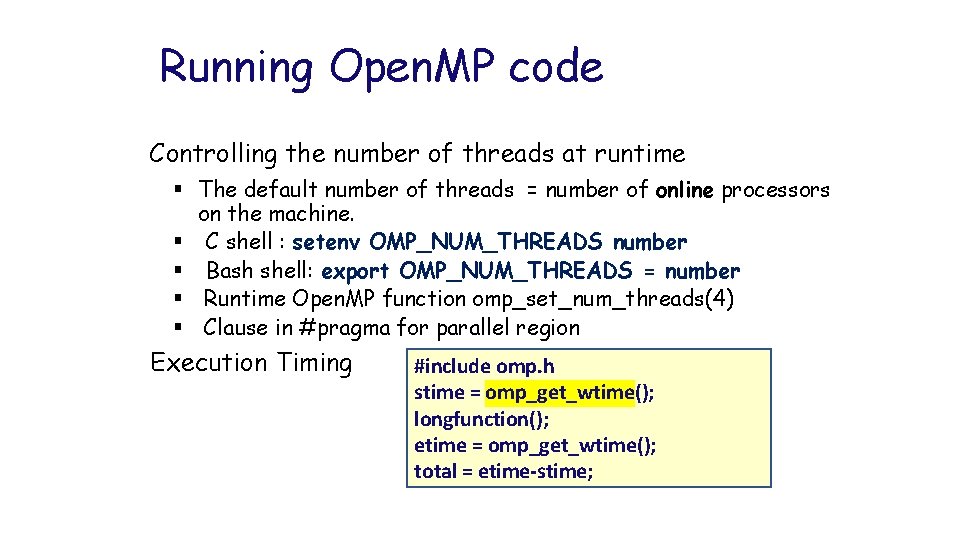
Running Open. MP code Controlling the number of threads at runtime § The default number of threads = number of online processors on the machine. § C shell : setenv OMP_NUM_THREADS number § Bash shell: export OMP_NUM_THREADS = number § Runtime Open. MP function omp_set_num_threads(4) § Clause in #pragma for parallel region Execution Timing #include omp. h stime = omp_get_wtime(); longfunction(); etime = omp_get_wtime(); total = etime-stime;
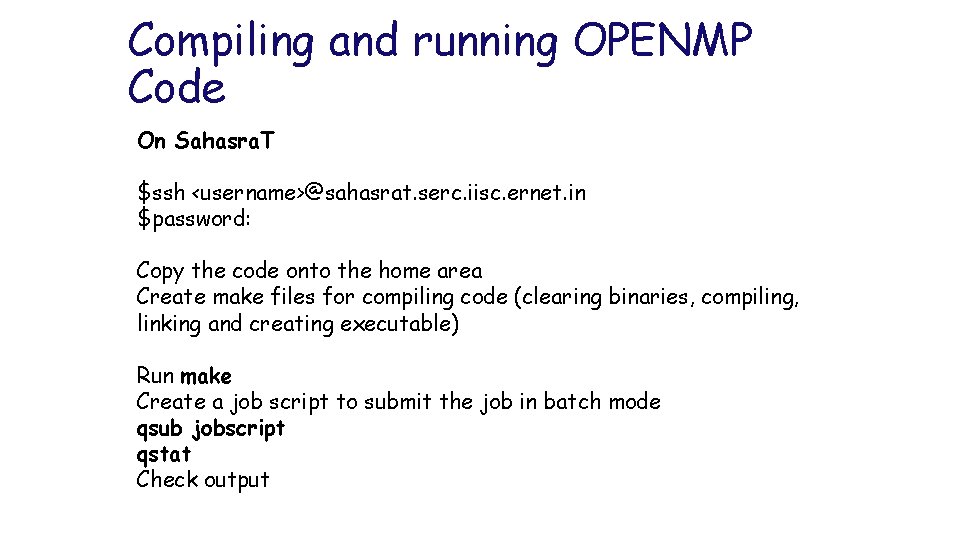
Compiling and running OPENMP Code On Sahasra. T $ssh <username>@sahasrat. serc. iisc. ernet. in $password: Copy the code onto the home area Create make files for compiling code (clearing binaries, compiling, linking and creating executable) Run make Create a job script to submit the job in batch mode qsub jobscript qstat Check output
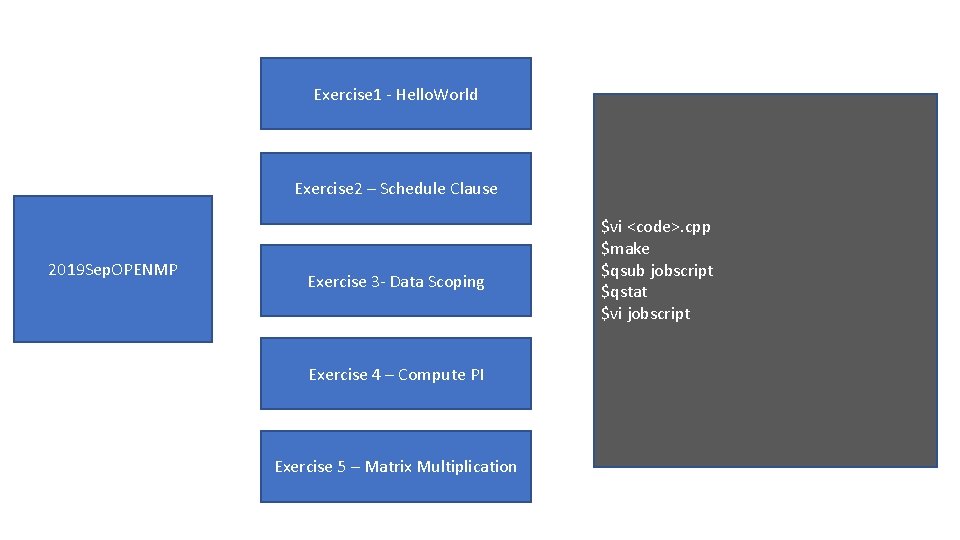
Exercise 1 - Hello. World Exercise 2 – Schedule Clause 2019 Sep. OPENMP Exercise 3 - Data Scoping Exercise 4 – Compute PI Exercise 5 – Matrix Multiplication $vi <code>. cpp $make $qsub jobscript $qstat $vi jobscript