
OPEN INNOVATION INTEL Professor DEOKJOO LEE AIDA MERCADO
- Slides: 32
OPEN INNOVATION @INTEL Professor: DEOK-JOO LEE AIDA MERCADO
CONTENS Ø Introduction Ø Managing the Gap between Research and Development at Intel Ø IBM and AT&A: traditional Approaches to R&D Ø Intel Innovates a New Approach to R&D
Ø Intel’s Additional Mechanisms to Access External Innovation Ø Evaluating Intel’s Approach to Innovation Ø Intel Capital Ø Internal Knowledge with External Knowledge
Introduction Ø Why to study Intel Company? ? Because we can see how companies can pursue innovation opportunities in an environment of abundant knowledge. Intel company is the world’s largest semiconductor chip market based on revenue. Was founded in 1968 for Gordon Moore, Robert Noyce and Andrew Grove.
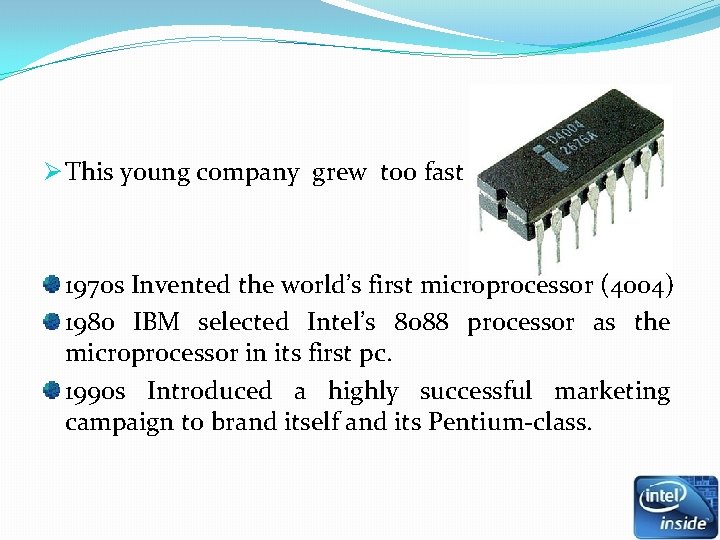
Ø This young company grew too fast 1970 s Invented the world’s first microprocessor (4004) 1980 IBM selected Intel’s 8088 processor as the microprocessor in its first pc. 1990 s Introduced a highly successful marketing campaign to brand itself and its Pentium-class.
Ø 2001 the microprocessors accounted for approximately 81% of the company’s revenues Intel was the world’s leading semiconductor manufacturer with revenues of $26. 5 billion 83000 employees 80+ countries worldwide
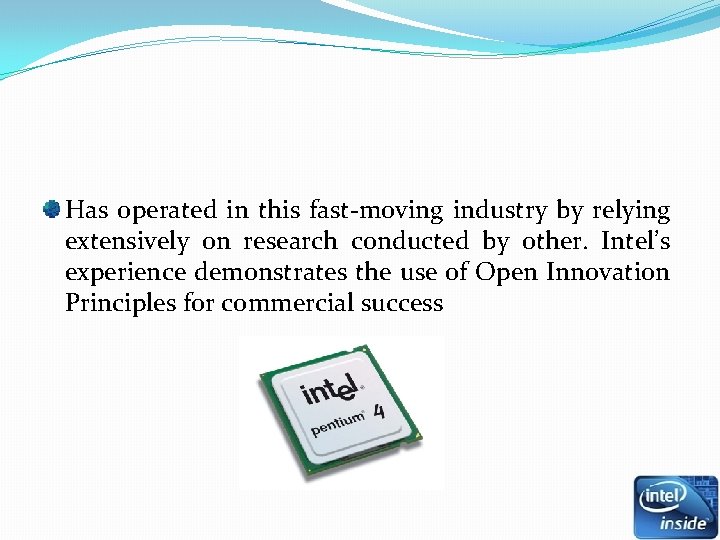
Has operated in this fast-moving industry by relying extensively on research conducted by other. Intel’s experience demonstrates the use of Open Innovation Principles for commercial success
Managing the Gap between research and Development Ø When Noyce and Moore were and Fairchild they observed the difficulty of transferring new research discoveries into a production that was because de R&D group had become separated from the production group. Ø With that experience Intel adopted a new attitude : “ Although the semiconductor industry depends on research breakthroughs for continued progress, Intel will operate without any formal research organization”
Ø As Dr. Gargini phrased (The Director of Technology strategy for Intel Corporation )“The point is to make excellent chips, not to publish brilliant papers” Ø Whit this manufacturing philosophy Intel conducted its research activities on the Noyce principle of “Minimum Information”
“Minimum information principle attempts to guess at what the answer is to a problem, and then goes back into the science only as far as needed to see if that guess was right or not. If this does not solve the problem, one makes another guess, and then goes back again”… one advantage of the minimum information principle is that Intel generates many fewer spinoff companies.
Ø How could Intel get the benefit of a dedicated development fab, without losing the production focus that had defined the company? Invest in standardizing Intel equipment and processes between the lab and fab.
Intel innovates a new Approach to R&D Ø In 1996 the consequences of AT&T and IBM retrenchment in semiconductor research, combined with Intel’s own tremendous growth, dictated a change in Intel’s Approach to Innovation. Ø Intel decided to make a distributed model of research through the creation of three labs.
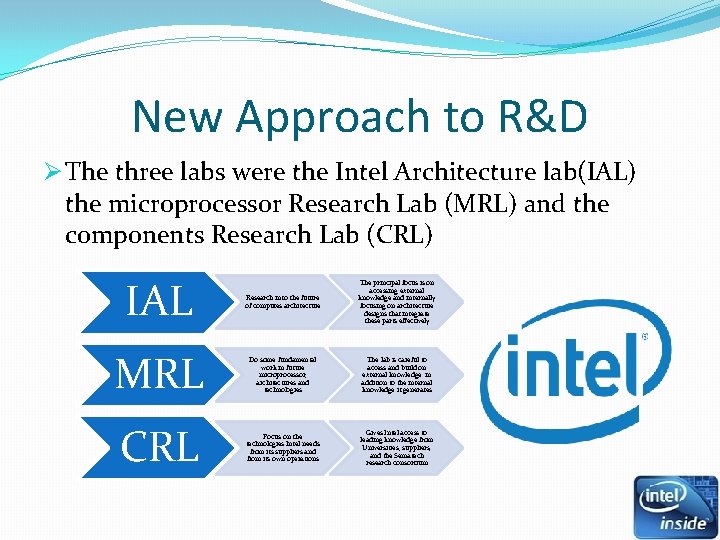
New Approach to R&D Ø The three labs were the Intel Architecture lab(IAL) the microprocessor Research Lab (MRL) and the components Research Lab (CRL) IAL Research into the future of computes architecture The principal focus is on accessing external knowledge and internally focusing on architecture designs that integrate these parts effectively MRL Do some fundamental work in future microprocessor, architectures and technologies The lab is careful to access and build on external knowledge in addition to the internal knowledge it generates CRL Focus on the technologies Intel needs from its suppliers and from its own operations Gives Intel access to leading knowledge from Universities, suppliers, and the Sematech research consortium
External Innovation Ø In Addition to internal research activities Intel conducts a variety of activities to promote linkages between its labs and the external research community. �The company start to circulate The Intel Technical Journal (www. intel. com/technology/ITJ/)
Ø In 2000 Intel founded about 300 external research projects, resulting in more than $100 million in research grant. Ø Intel assigns internal employees to interact directly with the students they found, as well as the students’ professors. Students have access to a senior Intel manager in an area related to their research.
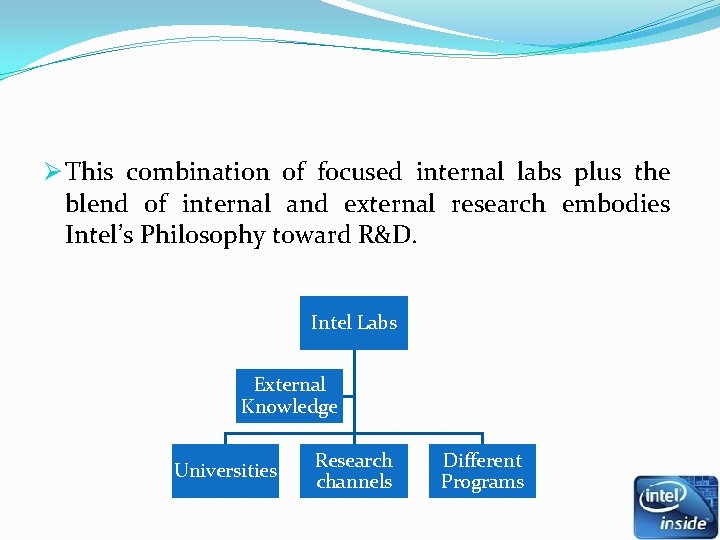
Ø This combination of focused internal labs plus the blend of internal and external research embodies Intel’s Philosophy toward R&D. Intel Labs External Knowledge Universities Research channels Different Programs
�Nowadays Intel Has its own researches working in more than 34 countries and had research projects with about 150 University faculty in different countries. �Intel’s research today is run by David Tennenhouse used to manage research programs at the Defense Advanced Research Projects Agency (DARPA).
Evaluating Intel’s Approach to Innovation Ø The company often pays to found external research projects but is not the only desired attribute of a company’s innovations system: Intel offers its researches six months on the manufacturing line, the Noyce principle of minimum information, and a career path that promises close coordination with manufacturing.
Intel was a comparatively small player in the semiconductor industry in relation to IBM and AT&T but Now has surpassed all the other semiconductor companies in revenue and profit. (www. mydigitalfc. com/companies/intel-profit-andrevenue-soar-q 1 -847)
Intel Capital Ø Intel had found a way to benefit from venture capital (VC). It has created a farsighted program with corporate VC, which builds strong connections between Intel and the start-up community that surrounds it. Ø The program VC explore new business area beyond microprocessors by funding and observing the experiments these start-ups conduct.
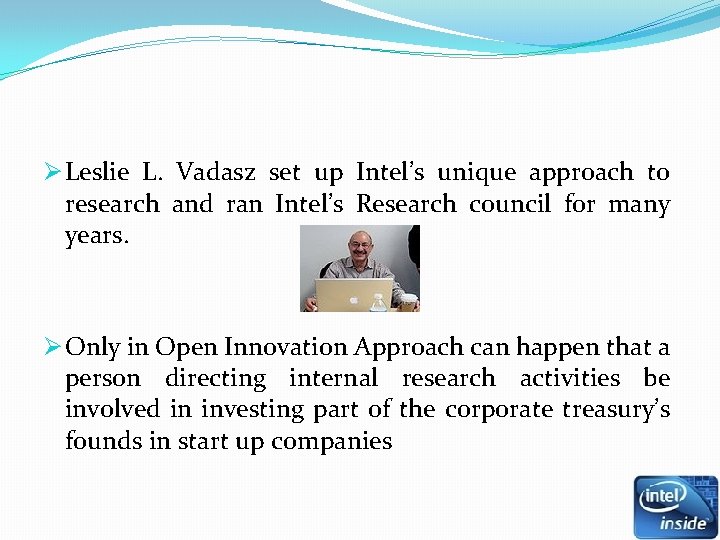
Ø Leslie L. Vadasz set up Intel’s unique approach to research and ran Intel’s Research council for many years. Ø Only in Open Innovation Approach can happen that a person directing internal research activities be involved in investing part of the corporate treasury’s founds in start up companies
Strategic Role of Intel Capital Ø As of June 2002, Intel Capital held more than 475 investments in portfolio companies, with a market value of more than $ 1. 4 billion. But marking external equity investments is not a new practice for Intel. 1980 s Intel began investing in the close suppliers, primarily to ensure a stable source of quality inputs for its design and manufacturing processes. The goal of these investments was strategic: to give Intel the technology supply base it needed to achieve its business goals.
By the mid-1990 s the focus was expanded beyond Intel’s supply chain, to include “the market ecosystem” of software and hardware developers that supported Intel’s microprocessor product.
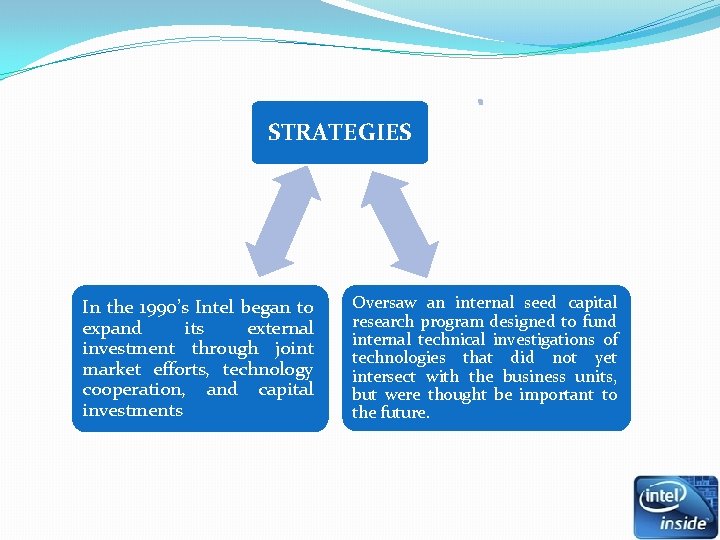
STRATEGIES In the 1990’s Intel began to expand its external investment through joint market efforts, technology cooperation, and capital investments Oversaw an internal seed capital research program designed to fund internal technical investigations of technologies that did not yet intersect with the business units, but were thought be important to the future.
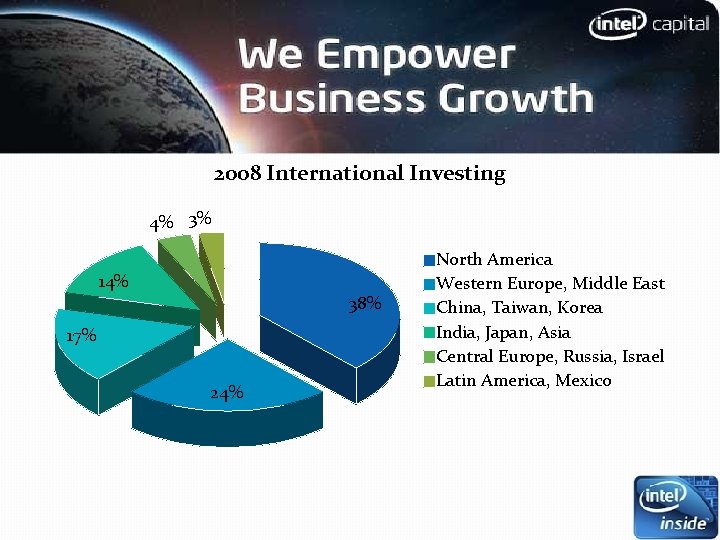
Ø The combination of seed projects and external investments gave Intel a unique insight into the future technology opportunities and enhanced its knowledge as a corporate investor. Ø In 2001, more than half of Intel capital investment occurred outside the U. S. A, helping Intel advance its strategy of globalizing its business and further developing its international markets
Intel Capital’s Investments Process Ø Progress in negotiations would lead to an investment project authorization (IPA) meeting at Intel to considerer topics such as the target company’s management, its competitors, and the terms of the developing deal. Ø Key Questions: 1. What do we get? 2. What do we give? 3. What is the measure of strategic success for this investment? ?
Ø Even Intel cannot answer the key question one would ideally want to ask about its corporate venture investment. Ø Intel need not closely manage every investment, more over, the metrics that disclose the current market value of Intel’s portfolio holdings take no account of any internal learning, development, or increased sales of Intel’s own products as a result of its investment activities.
2008 International Investing 4% 3% 14% 38% 17% 24% North America Western Europe, Middle East China, Taiwan, Korea India, Japan, Asia Central Europe, Russia, Israel Latin America, Mexico
Connecting Internal Knowledge with External Knowledge Ø Intel’s Approach provides a fascinating example of how Open Innovation principles can leverage internal and external knowledge in a very different way from closed innovation paradigm. Ø Internal Research capabilities allow it to conduct much deeper due diligence on the technical side of its investments than is typically done by most venture capitalists and this helped to accelerate the penetration of Intel’s value network into de market.
Ø Intel does not achieve the tight control via vertical integration that IBM achieved in the Closed Innovation paradigm. But Intel’s funding of academic research and its investing in complementary start-up companies gives it influence far beyond the scope of its own products.
Looking Ahead Ø The new initiative on new ‘lablets’ is a novel extension of Intel’s model, but the initiative lacks the scale and scope to address the challenges of quantum computing that lurk on the horizon. And integrating the discoveries from the universities research community in effective quantum computing architectures will require extensive internal research, even long-term research, of the kind that Intel has not historically had to performance.
Looking Ahead Ø YOU HAVE TO ASK YOURSELF WHERE IS THE NEXT BIG IDEA GOING TO COME FROM? If You believe it will come from directed discovery then You are well advised to invest in focused internal research activities to increase your chance of finding it. If You believe that the next big idea is likely to come from any one of large number of areas, then You’re better advised to structure yourself to be able to monitor a variety of research sources, and to respond quickly to research discoveries when and if they arise