
Open Information Extraction from the Web Michele Banko
Open Information Extraction from the Web Michele Banko, Michael J Carafella, Stephen Soderland, Matt Broadhead and Oren Etzioni IJCAI, 2007 Nivedha Sivakumar (nivedha@seas. upenn. edu) Feb-11 -2019
Problem & Motivation • Standard Information Extraction (IE): – Yesterday, New York based Foo Inc. announced their acquisition of Bar Corp. – Merger. Between(company 1, company 2, date) • Proposes new self-supervised, domainindependent IE, Open. IE – Information extracted: t = (ei , ri, j , ej) – (<proper noun>, works with, < proper noun >) 2
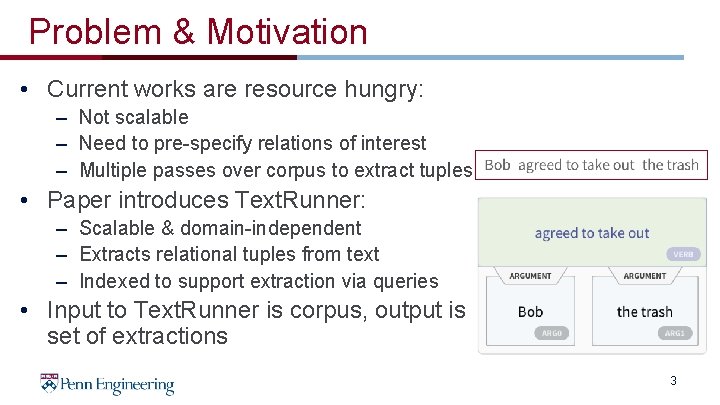
Problem & Motivation • Current works are resource hungry: – Not scalable – Need to pre-specify relations of interest – Multiple passes over corpus to extract tuples • Paper introduces Text. Runner: – Scalable & domain-independent – Extracts relational tuples from text – Indexed to support extraction via queries • Input to Text. Runner is corpus, output is set of extractions 3
Contents: • Previous works • Novel aspects of this paper • Text. Runner architecture – – Self-supervised learner Single pass extractor Redundancy-based assessor Query processing • Results – Comparison with So. TA – Global statistics on facts learned • Conclusions, shortcomings and future work 4
Previous Works • Entity chunking common in previous work: – Trainable systems with hand-tagged instances as input • DIPRE [Brin, 1998], SNOWBALL [Agichtein & Gravano, 2000], Web-based Q&A [Ravichandran & Hovy, 2002] – Relation extraction with kernel-based methods [Bunescu & Mooney, 2005], maximum-entropy models [Kambhatla, 2004], & graphical models [Rosario & Hearst, 2004] 5
Previous So. TA: Know. It. All • Previous state of the art: Know. It. All – Self-supervised learning: can label training data with domain-independent extraction patterns – Corpus heterogeneity: use of POS tagger • Parsers are harder mechanisms, hence less scalable • Shortcomings of Know. It. All: – Needs pre-specified relation names as input – Multiple passes over corpus – Can take weeks to extract relational data 6
Contributions of this work • Paper proposes Open IE – System makes a single data-driven pass over its corpus – Extracts a large set of relational tuples without human intervention • Paper introduces Text. Runner – Fully implemented, highly scalable Open IE system – Tuples indexed to support efficient extraction via user queries • Reports qualitative and quantitative results over Text. Runner’s 11 million most probable extractions 7
Text. Runner Architecture • Text. Runner consists of 3 key modules: – Self-supervised learner: given a corpus sample, learner outputs classifier that labels extractions – Single Pass Extractor: Makes single pass over entire corpus to extract tuples • Self-supervised learner classifies tuples – Redundancy-based assessor: computes probability of correct tuple instance 8
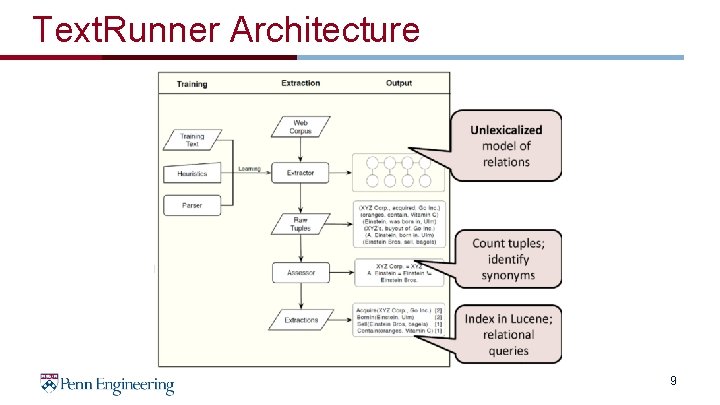
Text. Runner Architecture 9
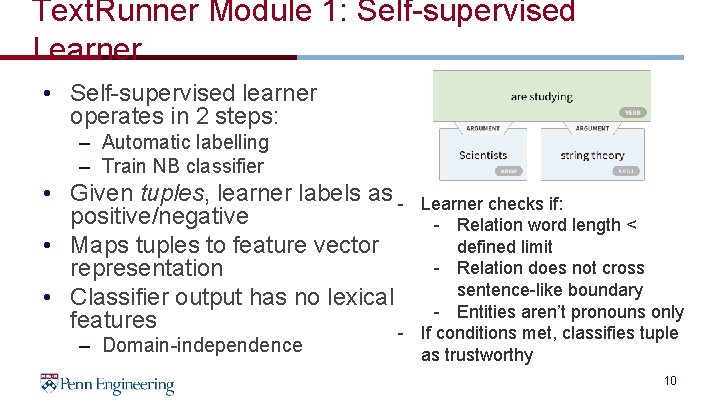
Text. Runner Module 1: Self-supervised Learner • Self-supervised learner operates in 2 steps: – Automatic labelling – Train NB classifier • Given tuples, learner labels as positive/negative • Maps tuples to feature vector representation • Classifier output has no lexical features – Domain-independence Learner checks if: - Relation word length < defined limit - Relation does not cross sentence-like boundary - Entities aren’t pronouns only If conditions met, classifies tuple as trustworthy 10
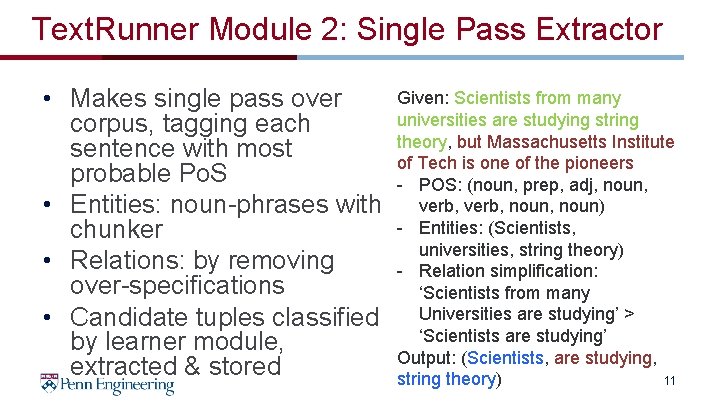
Text. Runner Module 2: Single Pass Extractor • Makes single pass over corpus, tagging each sentence with most probable Po. S • Entities: noun-phrases with chunker • Relations: by removing over-specifications • Candidate tuples classified by learner module, extracted & stored Given: Scientists from many universities are studying string theory, but Massachusetts Institute of Tech is one of the pioneers - POS: (noun, prep, adj, noun, verb, noun) - Entities: (Scientists, universities, string theory) - Relation simplification: ‘Scientists from many Universities are studying’ > ‘Scientists are studying’ Output: (Scientists, are studying, string theory) 11
More Text. Runner Modules • Redundancy-based Assessor: – Omits non-essential modifications, merges identical tuples • Was developed by = was originally developed by – With distinct t-counts, can estimate probability of t being a correct instance • Query Processing: – Inverted indexing over pool of machines for quick retrieval 12
Results: Comparison with Traditional IE • Experimental setup: – 9 million web page corpus – Pre-specify 10 random relations in >1000 sentences • Performance: 33% lower errors for Text. Runner – Higher precision but matches recall • Precision = fraction of retrieved tuple extractions relevant to user query • Recall = fraction of relevant tuple extractions retrieved – Identical correct extractions; improvement by better entity identification – Errors in both due to poor noun phrases: • Truncated arguments/added stray words • Error rate of 32% for Text. Runner vs 47% for Know. It. All 13
Results: Tuple Selection before Global Analysis • Given 9 million web pages, extracted 60. 5 million tuples • Restricted analysis to subset of high probability tuples: – Assigned probability of at least 0. 8 – Relation supported by at least 10 distinct sentences – Relation not found in top 0. 1% of relations • Filtered set has 11. 3 million tuples with 278 K distinct relations 14
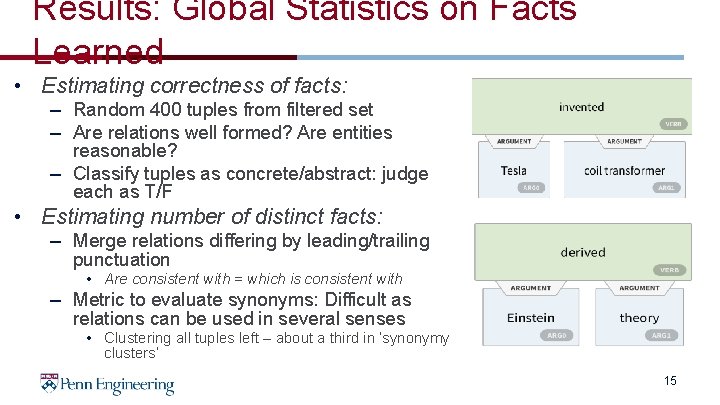
Results: Global Statistics on Facts Learned • Estimating correctness of facts: – Random 400 tuples from filtered set – Are relations well formed? Are entities reasonable? – Classify tuples as concrete/abstract: judge each as T/F • Estimating number of distinct facts: – Merge relations differing by leading/trailing punctuation • Are consistent with = which is consistent with – Metric to evaluate synonyms: Difficult as relations can be used in several senses • Clustering all tuples left – about a third in ‘synonymy clusters’ 15
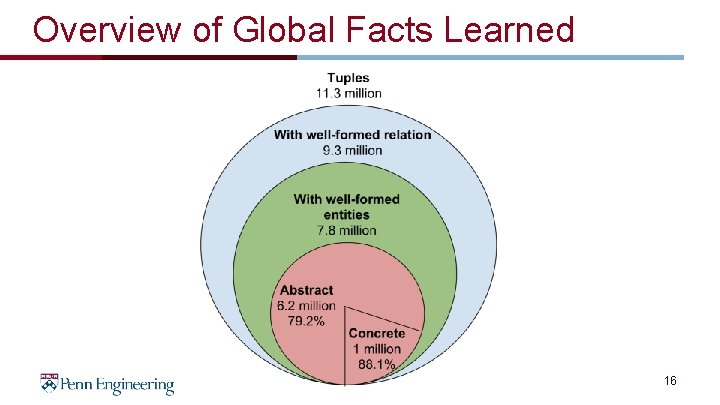
Overview of Global Facts Learned 16
Conclusions • Novel self-supervised, domain-independent paradigm • Automatic relation extraction for enhanced speeds • Text. Runner: Open. IE system for large extractions • Better computing speed and scalability that So. TA • Significance: Textual representation of actual fact as triples – Important but not sufficient for commonsense reasoning 17
Shortcomings of Text. Runner Scientists from many universities are studying string theory, but Massachusetts Institute of Tech is one of the pioneers • Use of linguistic parser to label extractions not scalable – If Massachusetts Institute of Tech is not defined in parser, learner may not classify as a trustworthy – WOE (Wu and Weld): does not need lexicalized features for self-supervised learning; higher precision & recall • No definition on the form that entities may take – Massachusetts Institute of Tech may not be recognized as one entity – Re. Verb (Fader, et al): improves precision & recall with relation -phrase identifier with lexical constrains 18
Future Work & Discussion • Integrate scalable methods to detect synonyms • Learn types of entities commonly taken by relations – Can distinguish between different senses of relations • Unify tuples into graph-like structure for complex queries • Open. IE visualization in Allen. NLP: https: //demo. allennlp. org/open-informationextraction 19
- Slides: 19