
Open GL Texture Mapping Basic Stragegy Three steps

Open. GL Texture Mapping
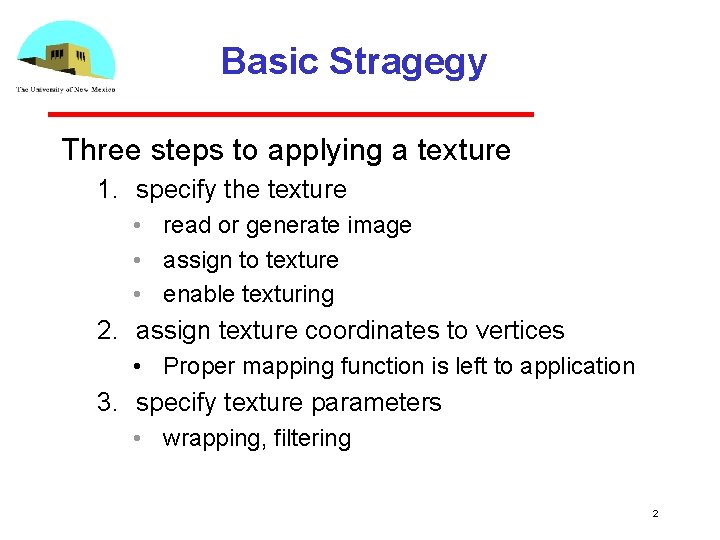
Basic Stragegy Three steps to applying a texture 1. specify the texture • read or generate image • assign to texture • enable texturing 2. assign texture coordinates to vertices • Proper mapping function is left to application 3. specify texture parameters • wrapping, filtering 2

Texture Mapping y z x geometry t display image s Angel: Interactive Computer Graphics 45 E © Addison-Wesley 2009 3
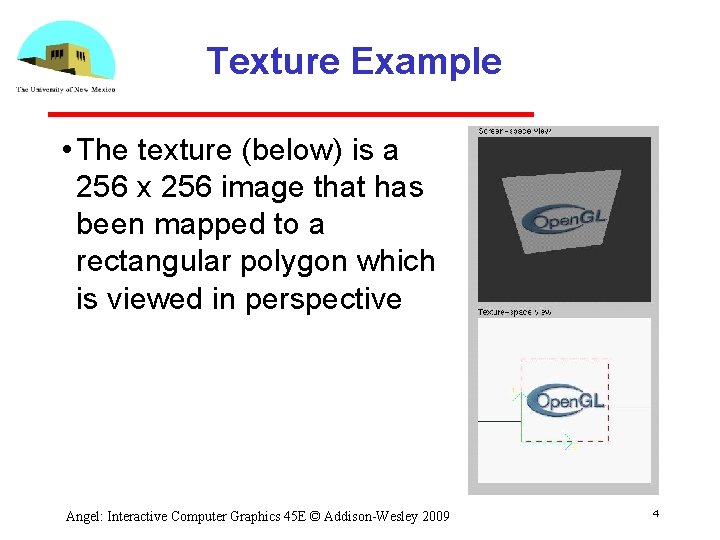
Texture Example • The texture (below) is a 256 x 256 image that has been mapped to a rectangular polygon which is viewed in perspective Angel: Interactive Computer Graphics 45 E © Addison-Wesley 2009 4
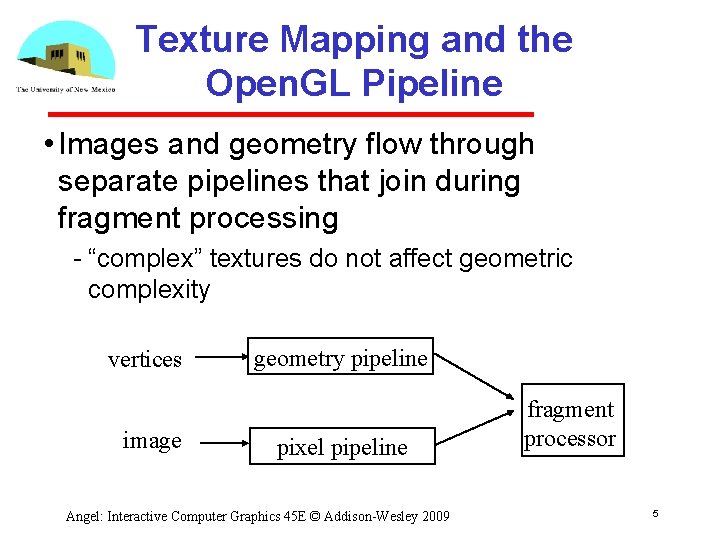
Texture Mapping and the Open. GL Pipeline • Images and geometry flow through separate pipelines that join during fragment processing “complex” textures do not affect geometric complexity vertices image geometry pipeline pixel pipeline Angel: Interactive Computer Graphics 45 E © Addison-Wesley 2009 fragment processor 5
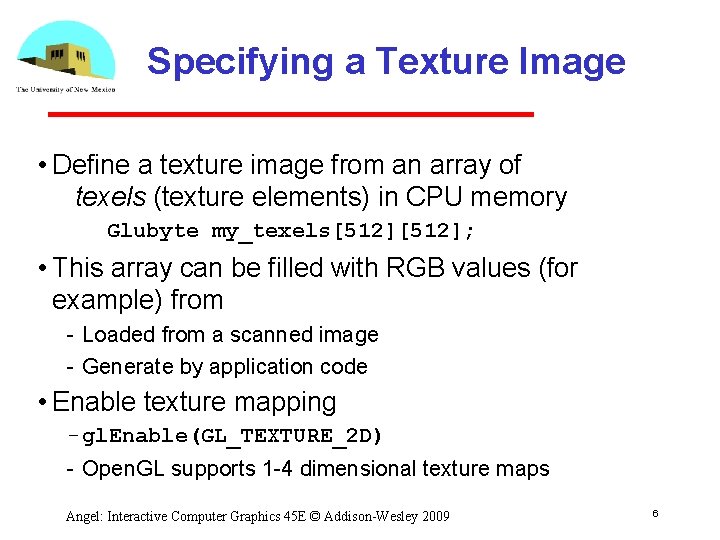
Specifying a Texture Image • Define a texture image from an array of texels (texture elements) in CPU memory Glubyte my_texels[512]; • This array can be filled with RGB values (for example) from Loaded from a scanned image Generate by application code • Enable texture mapping gl. Enable(GL_TEXTURE_2 D) Open. GL supports 1 4 dimensional texture maps Angel: Interactive Computer Graphics 45 E © Addison-Wesley 2009 6
Names and Binding • All textures are assigned an index as a name. • For convenience, you can generate many at the same time void gl. Gen. Textures(GLsizei n, GLuint * textures); n is the number of textures to generate at this time (can make more later) textures is a pointer to a place to store the names (i. e. , indexes) • Once you have a name, you bind the name to set the Open. GL state. void gl. Bind. Texture(GLenum target, GLuint texture); texture is the name of the texture Target is the type of texture – usually GL_TEXTURE_2 D • Now this texture is your current texture Remember: Open. GL is a state machine! 7
Define Image as a Texture gl. Tex. Image 2 D( target, level, components, w, h, border, format, type, texels ); type of texture, e. g. GL_TEXTURE_2 D level: used for mipmapping (discussed later), should be 0 otherwise components: elements per texel, usually 3 (RGB) or 4 (RGBA) w, h: width and height of texels in pixels border: used for smoothing (discussed later) format and type: describe texels: pointer to texel array target: gl. Tex. Image 2 D(GL_TEXTURE_2 D, 0, 3, 512, 0, GL_RGB, GL_UNSIGNED_BYTE, my_texels); 8
Converting A Texture Image • Open. GL requires texture dimensions to be powers of 2 • If dimensions of image are not powers of 2 • glu. Scale. Image( format, w_in, h_in, type_in, *data_in, w_out, h_out, type_out, *data_out ); data_in is source image data_out is for destination image • Image interpolated and filtered during scaling Angel: Interactive Computer Graphics 45 E © Addison-Wesley 2009 9
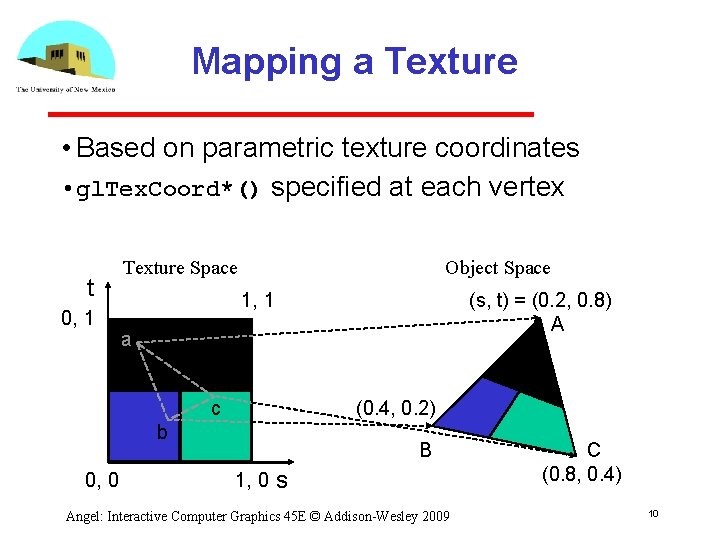
Mapping a Texture • Based on parametric texture coordinates • gl. Tex. Coord*() specified at each vertex t 0, 1 Texture Space Object Space 1, 1 (s, t) = (0. 2, 0. 8) A a c (0. 4, 0. 2) b 0, 0 B 1, 0 s Angel: Interactive Computer Graphics 45 E © Addison-Wesley 2009 C (0. 8, 0. 4) 10
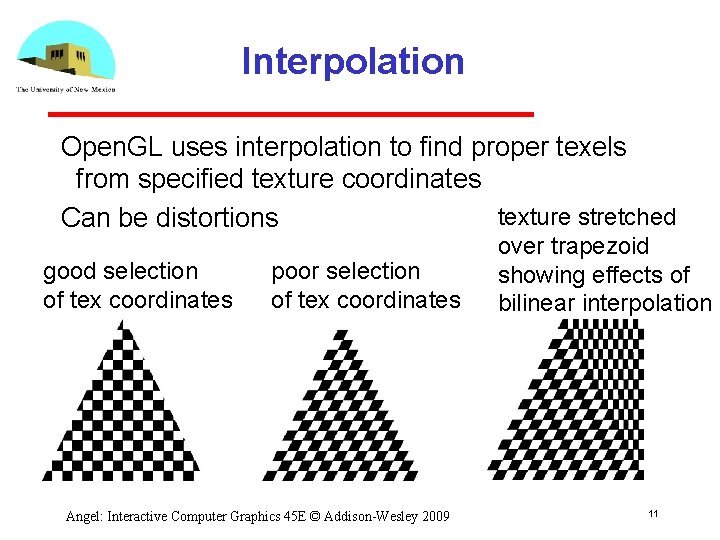
Interpolation Open. GL uses interpolation to find proper texels from specified texture coordinates texture stretched Can be distortions good selection of tex coordinates poor selection of tex coordinates Angel: Interactive Computer Graphics 45 E © Addison-Wesley 2009 over trapezoid showing effects of bilinear interpolation 11
Typical Code gl. Begin(GL_POLYGON); gl. Color 3 f(r 0, g 0, b 0); //if no shading used gl. Normal 3 f(u 0, v 0, w 0); // if shading used gl. Tex. Coord 2 f(s 0, t 0); gl. Vertex 3 f(x 0, y 0, z 0); gl. Color 3 f(r 1, g 1, b 1); gl. Normal 3 f(u 1, v 1, w 1); gl. Tex. Coord 2 f(s 1, t 1); gl. Vertex 3 f(x 1, y 1, z 1); . . gl. End(); //show demos Angel: Interactive Computer Graphics 45 E © Addison-Wesley 2009 12
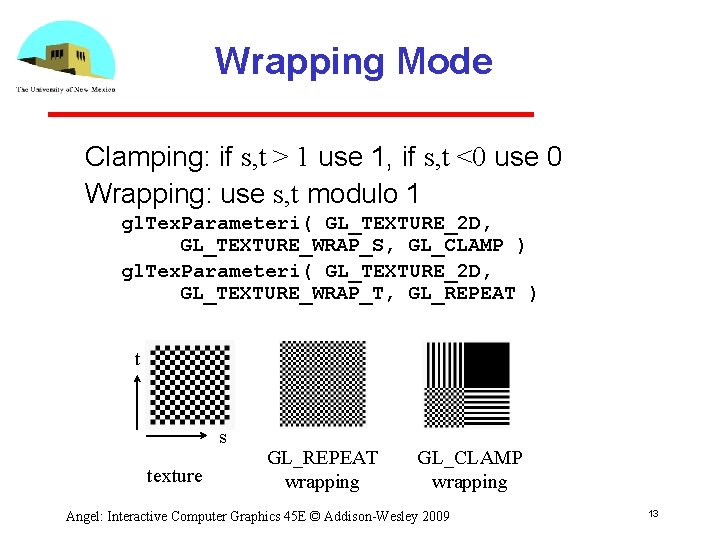
Wrapping Mode Clamping: if s, t > 1 use 1, if s, t <0 use 0 Wrapping: use s, t modulo 1 gl. Tex. Parameteri( GL_TEXTURE_2 D, GL_TEXTURE_WRAP_S, GL_CLAMP ) gl. Tex. Parameteri( GL_TEXTURE_2 D, GL_TEXTURE_WRAP_T, GL_REPEAT ) t s texture GL_REPEAT wrapping GL_CLAMP wrapping Angel: Interactive Computer Graphics 45 E © Addison-Wesley 2009 13
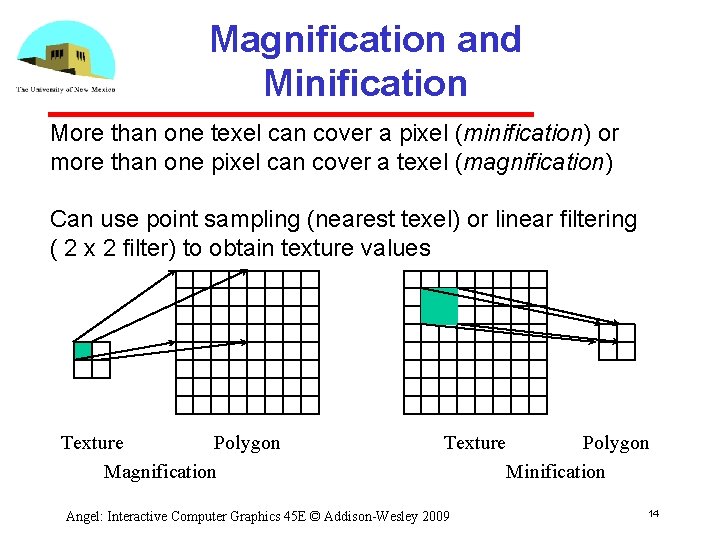
Magnification and Minification More than one texel can cover a pixel (minification) or more than one pixel can cover a texel (magnification) Can use point sampling (nearest texel) or linear filtering ( 2 x 2 filter) to obtain texture values Texture Polygon Magnification Texture Angel: Interactive Computer Graphics 45 E © Addison-Wesley 2009 Polygon Minification 14
Filter Modes determined by gl. Tex. Parameteri( target, type, mode ) gl. Tex. Parameteri(GL_TEXTURE_2 D, GL_TEXURE_MAG_FILTER, GL_NEAREST); gl. Tex. Parameteri(GL_TEXTURE_2 D, GL_TEXURE_MIN_FILTER, GL_LINEAR); Note that linear filtering requires a border of an extra texel for filtering at edges (border = 1) Angel: Interactive Computer Graphics 45 E © Addison-Wesley 2009 15

Texture Functions • Controls how texture is applied • gl. Tex. Env{fi}[v]( GL_TEXTURE_ENV, prop, param ) • GL_TEXTURE_ENV_MODE modes GL_MODULATE: modulates with computed shade GL_BLEND: blends with an environmental color GL_REPLACE: use only texture color GL(GL_TEXTURE_ENV, GL_TEXTURE_ENV_MODE, GL_MODULATE); • Set blend color with GL_TEXTURE_ENV_COLOR Angel: Interactive Computer Graphics 45 E © Addison-Wesley 2009 16
Applying Textures II 1. 2. 3. 4. 5. 6. 7. 8. specify textures in texture objects set texture filter set texture function set texture wrap mode set optional perspective correction hint bind texture object enable texturing supply texture coordinates for vertex coordinates can also be generated Angel: Interactive Computer Graphics 45 E © Addison-Wesley 2009 17
- Slides: 17