
Open Flow Enabling Innovation in Campus Networks ACM
Open. Flow: Enabling Innovation in Campus Networks ACM SIGCOMM 2008 1
Introduction THE NEED FOR PROGRAMMABLE NETWORKS 2
The Need For Programmable Networks • Today, there is almost no practical way to experiment with new network protocols – The scale is not big enough to gain confidence – Kind of a vicious circle • Virtualized programmable networks could lower the barrier to entry for new ideas. • Networking community is working on a nationwide solution – Such as GENI – But it’ll take years to deploy 3
The Need For Programmable Networks • This paper focus on a shorter-term question – “As researchers, how can we run experiments in campus network? ” • Goal: purpose a new switch feature that extend programmability – Commercial solutions are too closed, inflexible – Research solutions either have insufficient performance/fanout, or are too expensive 4
The Need For Programmable Networks • Solution: compromise on generality – Amenable to high-performance and low-cost implementations – Capable of supporting a board range of research – Assured to isolate experimental traffic from production traffic – Consistent with vendors’ need for closed platforms 5
THE OPENFLOW SWITCH 6
The Openflow Switch • Most Ethernet switch contain flow-tables – Typically built from TCAMs, run at line-rate – Identify a common set of function and exploit them • Openflow is an open protocol to program the flow-table in different switches and routers – Network administrator can isolate experiment traffic from regular ones – Researcher can control their own flow 7
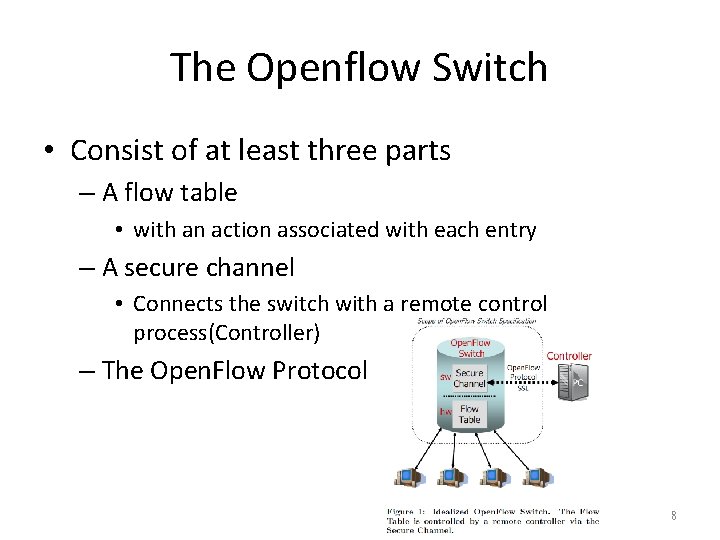
The Openflow Switch • Consist of at least three parts – A flow table • with an action associated with each entry – A secure channel • Connects the switch with a remote control process(Controller) – The Open. Flow Protocol 8
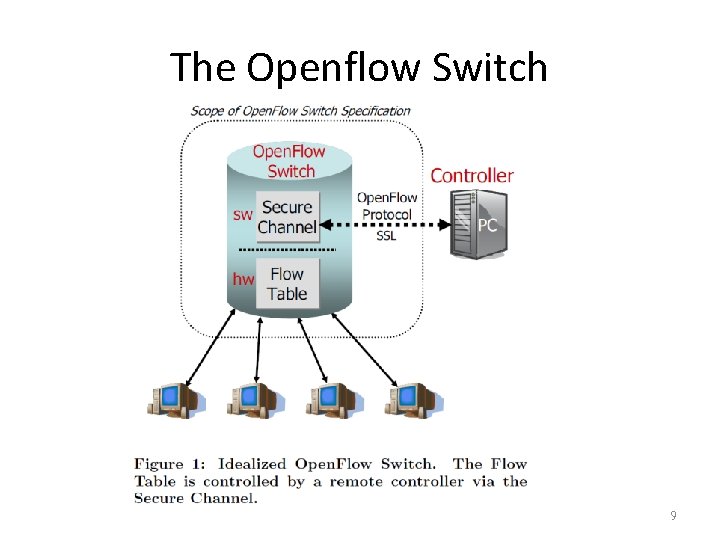
The Openflow Switch 9
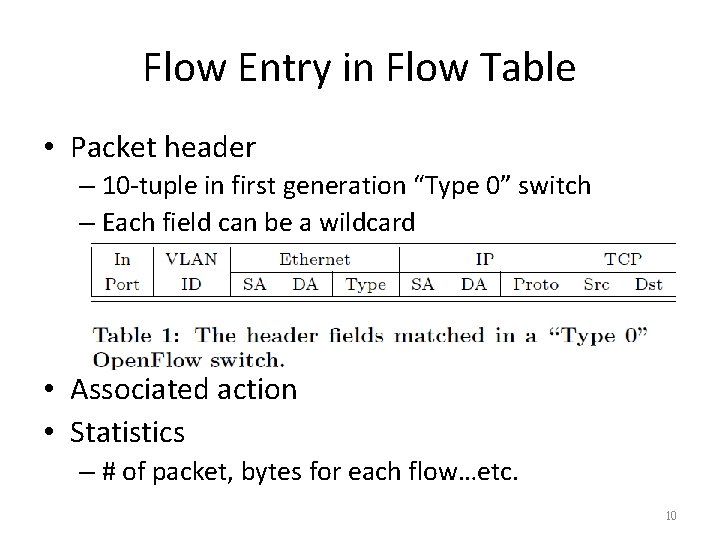
Flow Entry in Flow Table • Packet header – 10 -tuple in first generation “Type 0” switch – Each field can be a wildcard • Associated action • Statistics – # of packet, bytes for each flow…etc. 10
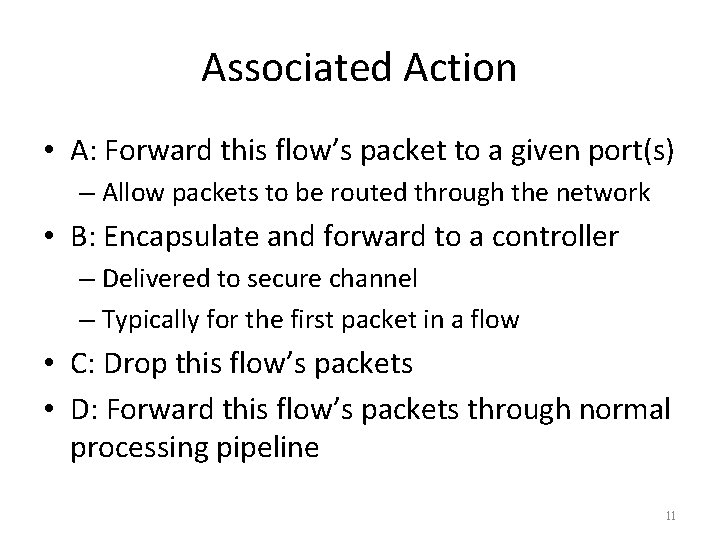
Associated Action • A: Forward this flow’s packet to a given port(s) – Allow packets to be routed through the network • B: Encapsulate and forward to a controller – Delivered to secure channel – Typically for the first packet in a flow • C: Drop this flow’s packets • D: Forward this flow’s packets through normal processing pipeline 11
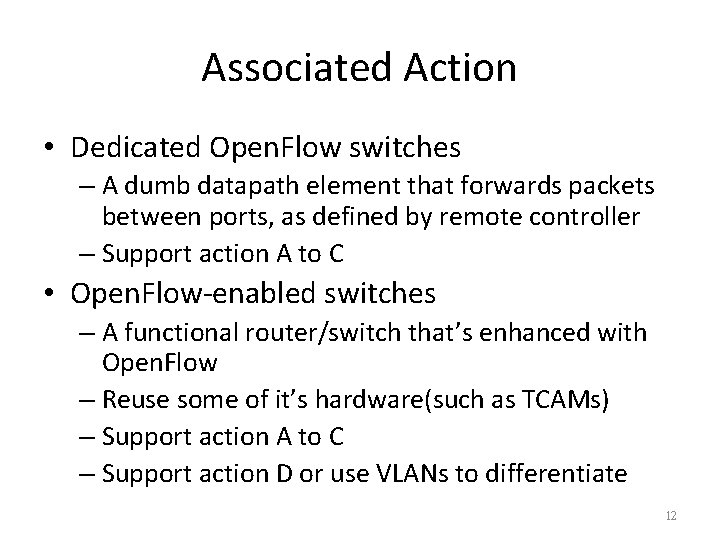
Associated Action • Dedicated Open. Flow switches – A dumb datapath element that forwards packets between ports, as defined by remote controller – Support action A to C • Open. Flow-enabled switches – A functional router/switch that’s enhanced with Open. Flow – Reuse some of it’s hardware(such as TCAMs) – Support action A to C – Support action D or use VLANs to differentiate 12
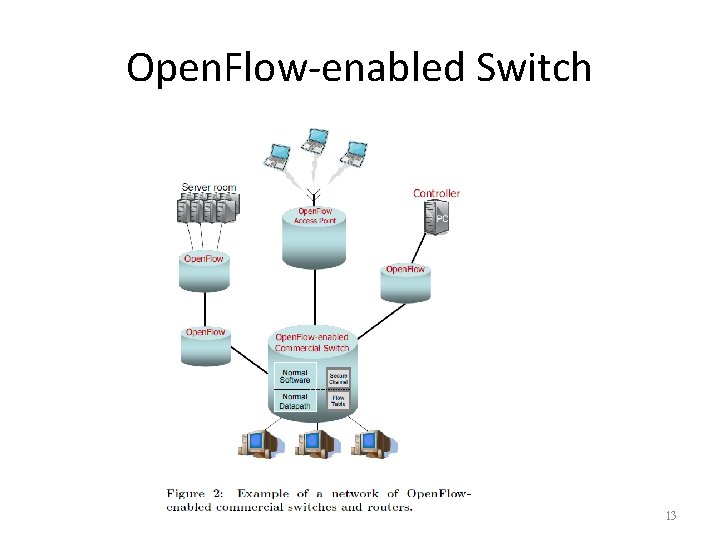
Open. Flow-enabled Switch 13
Associated Action • Those that supports the minimum required action mentioned earlier is called “type 0” switch. • Some switch will support some extra features, these are called “type 1” switch. 14
Controller • A controller adds and removes flow-entries • A simple static controller – Just establish flows to interconnect a set of test computers for the duration of the experiment – Isolate experimental traffic from normal ones – Generalization of VLANs • There can be some more sophisticated controllers – Dynamically add/remove flows in the progress of the experiment – Share the network between multiple researchers 15
USING OPENFLOW 16
Using Open. Flow • Ex: Amy want to test her new Amy-OSPF routing protocol • The Amy-OSPF will run in a controller • Each time a new flow starts, the Amy-OSPF will pick a route • All the following packets will be forwarded accordingly • Amy can limit this action only to the packet coming from her own computer’s port 17
Using Open. Flow • Question: can such a centralized controller be fast enough to process new flows and program the Flow Switches? • A part of this question is answered in Ethane prototype(ACM SIGCOMM 2007) • A low-cost commodity PC can handle over 10000 new flows per second – Enough for campus 18
Experiments in a Production Network • Two important properties – Packets belonging to other users should be routed normally – Amy should only be able to add flow entries for the traffic she is allowed to control • First one is achieved by Open. Flow-enabled switches • Second one depends on controller implementation 19
Some more examples • Network Management and Access control • VLANs • Mobile wireless VOIP clients – User a controller that track the user’s location, and do the handoff by changing the flow-tables • Non-IP network – Can use Ethernet header, Ethernet type or new non-IP protocols 20
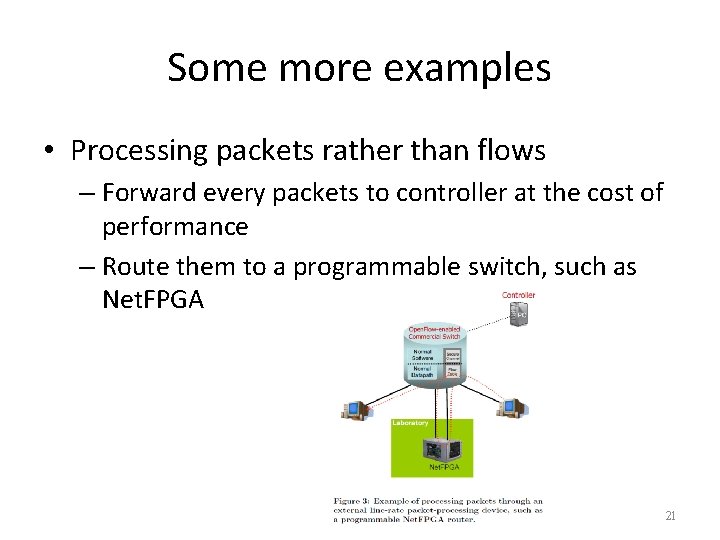
Some more examples • Processing packets rather than flows – Forward every packets to controller at the cost of performance – Route them to a programmable switch, such as Net. FPGA 21
Conclusion • Open. Flow is a pragmatic compromise – Allow researches to run experiments on heterogeneous switches and routers in a uniform way – Vendors don’t have to expose their internal working – Researchers don’t have to write vendor-specific programs • Hoping that new generation of control software will emerges • Accelerating the innovation in networking 22
Backup Slides • What is VLAN? • http: //s 90304 a 123. pixnet. net/blog/post/3879 3827 -ccna%E 6%95%99%E 5%AD%B 8 -vlan 23
- Slides: 23