
Open Economy Macroeconomics OPENECONOMY MACROECONOMICS BASIC CONCEPTS 0
Open Economy Macroeconomics OPEN-ECONOMY MACROECONOMICS: BASIC CONCEPTS 0
Introduction § One of the Ten Principles of Economics from Chapter 1: Trade can make everyone better off. § This chapter introduces basic concepts of international macroeconomics: § The trade balance (trade deficits, surpluses) § International flows of assets § Exchange rates OPEN-ECONOMY MACROECONOMICS: BASIC CONCEPTS 1
Closed vs. Open Economies § A closed economy does not interact with other economies in the world. § An open economy interacts freely with other economies around the world. OPEN-ECONOMY MACROECONOMICS: BASIC CONCEPTS 2
The Flow of Goods & Services § Exports: domestically-produced g&s sold abroad § Imports: foreign-produced g&s sold domestically § Net exports (NX), aka the trade balance = value of exports – value of imports § http: //www. youtube. com/watch? v=2 ZVs 7 o. AHVjg OPEN-ECONOMY MACROECONOMICS: BASIC CONCEPTS 3
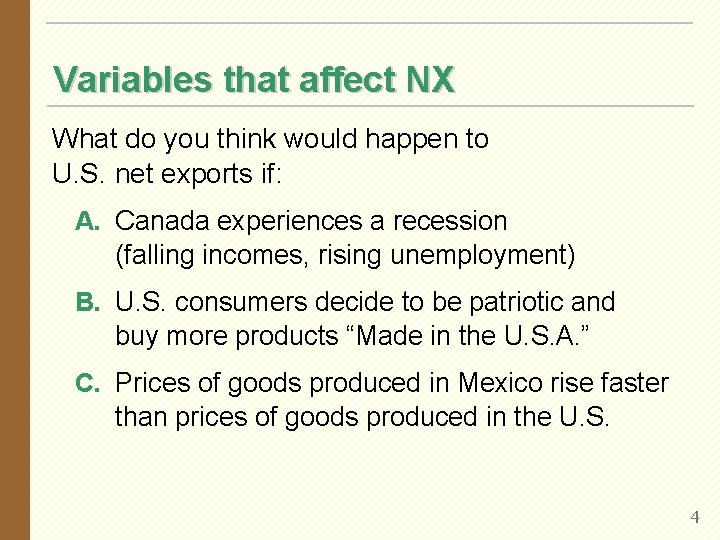
Variables that affect NX What do you think would happen to U. S. net exports if: A. Canada experiences a recession (falling incomes, rising unemployment) B. U. S. consumers decide to be patriotic and buy more products “Made in the U. S. A. ” C. Prices of goods produced in Mexico rise faster than prices of goods produced in the U. S. 4
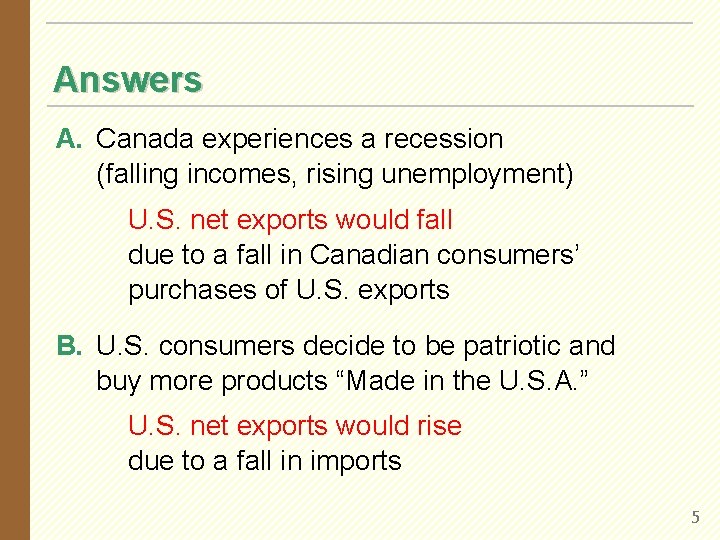
Answers A. Canada experiences a recession (falling incomes, rising unemployment) U. S. net exports would fall due to a fall in Canadian consumers’ purchases of U. S. exports B. U. S. consumers decide to be patriotic and buy more products “Made in the U. S. A. ” U. S. net exports would rise due to a fall in imports 5
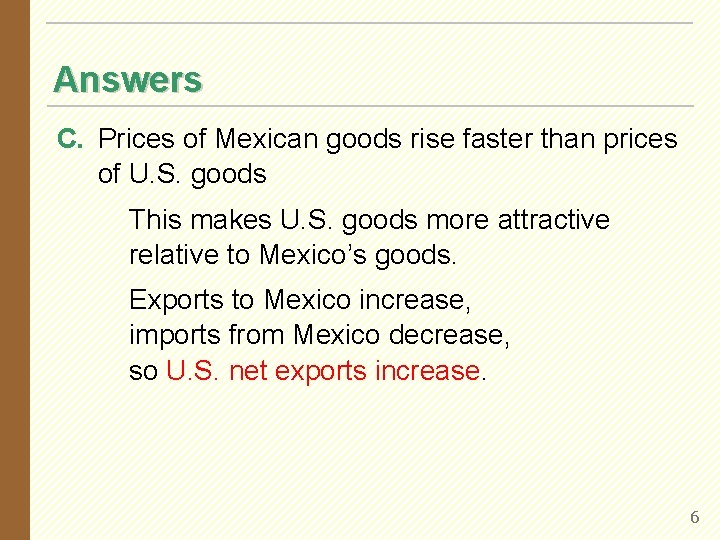
Answers C. Prices of Mexican goods rise faster than prices of U. S. goods This makes U. S. goods more attractive relative to Mexico’s goods. Exports to Mexico increase, imports from Mexico decrease, so U. S. net exports increase. 6
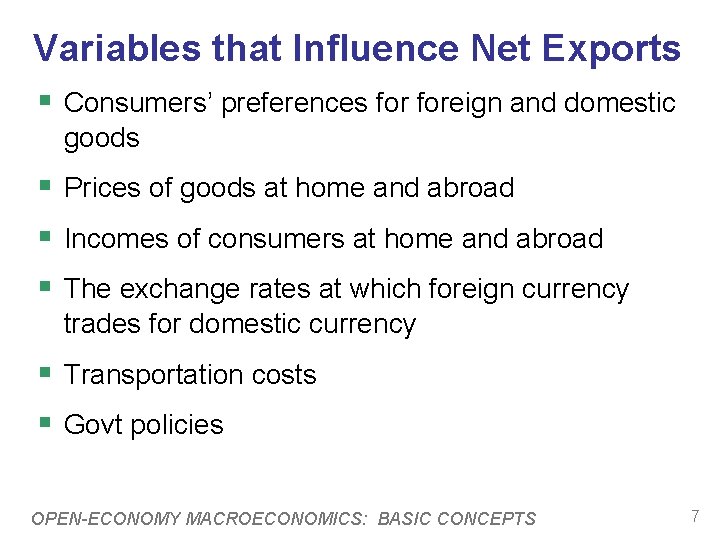
Variables that Influence Net Exports § Consumers’ preferences foreign and domestic goods § Prices of goods at home and abroad § Incomes of consumers at home and abroad § The exchange rates at which foreign currency trades for domestic currency § Transportation costs § Govt policies OPEN-ECONOMY MACROECONOMICS: BASIC CONCEPTS 7
Trade Surpluses & Deficits NX measures the imbalance in a country’s trade in goods and services. § Trade deficit: an excess of imports over exports § Trade surplus: an excess of exports over imports § Balanced trade: when exports = imports OPEN-ECONOMY MACROECONOMICS: BASIC CONCEPTS 8
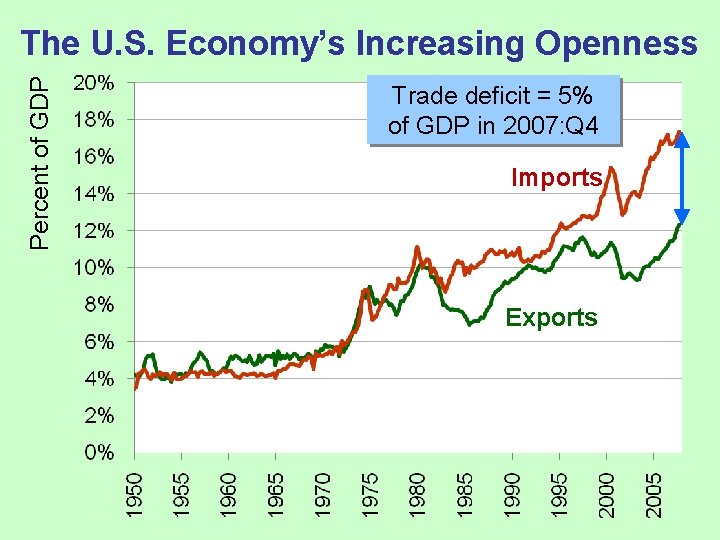
Percent of GDP The U. S. Economy’s Increasing Openness Trade deficit = 5% of GDP in 2007: Q 4 Imports Exports
The Flow of Capital § Net capital outflow (NCO): domestic residents’ purchases of foreign assets minus foreigners’ purchases of domestic assets § NCO is also called net foreign investment. OPEN-ECONOMY MACROECONOMICS: BASIC CONCEPTS 10
The Flow of Capital The flow of capital abroad takes two forms: § Foreign direct investment: Domestic residents actively manage the foreign investment, e. g. , Mc. Donalds opens a fast-food outlet in Moscow. § Foreign portfolio investment: Domestic residents purchase foreign stocks or bonds, supplying “loanable funds” to a foreign firm. OPEN-ECONOMY MACROECONOMICS: BASIC CONCEPTS 11
The Flow of Capital NCO measures the imbalance in a country’s trade in assets: § When NCO > 0, “capital outflow” Domestic purchases of foreign assets exceed foreign purchases of domestic assets. § When NCO < 0, “capital inflow” Foreign purchases of domestic assets exceed domestic purchases of foreign assets. OPEN-ECONOMY MACROECONOMICS: BASIC CONCEPTS 12
Variables that Influence NCO § § Real interest rates paid on foreign assets Real interest rates paid on domestic assets Perceived risks of holding foreign assets Govt policies affecting foreign ownership of domestic assets OPEN-ECONOMY MACROECONOMICS: BASIC CONCEPTS 13
The Equality of NX and NCO § An accounting identity: NCO = NX § arises because every transaction that affects NX also affects NCO by the same amount (and vice versa) § When a foreigner purchases a good from the U. S. , § U. S. exports and NX increase § the foreigner pays with currency or assets, so the U. S. acquires some foreign assets, causing NCO to rise. OPEN-ECONOMY MACROECONOMICS: BASIC CONCEPTS 14
The Equality of NX and NCO § An accounting identity: NCO = NX § arises because every transaction that affects NX also affects NCO by the same amount (and vice versa) § When a U. S. citizen buys foreign goods, § U. S. imports rise, NX falls § the U. S. buyer pays with U. S. dollars or assets, so the other country acquires U. S. assets, causing U. S. NCO to fall. OPEN-ECONOMY MACROECONOMICS: BASIC CONCEPTS 15
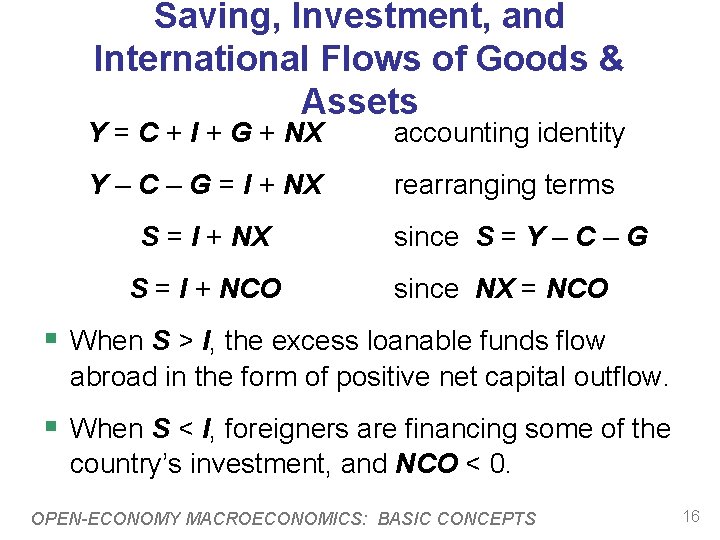
Saving, Investment, and International Flows of Goods & Assets Y = C + I + G + NX accounting identity Y – C – G = I + NX rearranging terms S = I + NX S = I + NCO since S = Y – C – G since NX = NCO § When S > I, the excess loanable funds flow abroad in the form of positive net capital outflow. § When S < I, foreigners are financing some of the country’s investment, and NCO < 0. OPEN-ECONOMY MACROECONOMICS: BASIC CONCEPTS 16
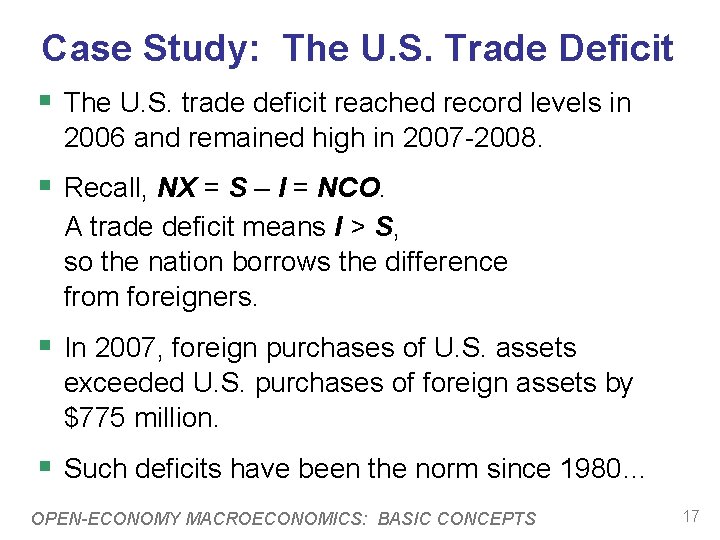
Case Study: The U. S. Trade Deficit § The U. S. trade deficit reached record levels in 2006 and remained high in 2007 -2008. § Recall, NX = S – I = NCO. A trade deficit means I > S, so the nation borrows the difference from foreigners. § In 2007, foreign purchases of U. S. assets exceeded U. S. purchases of foreign assets by $775 million. § Such deficits have been the norm since 1980… OPEN-ECONOMY MACROECONOMICS: BASIC CONCEPTS 17
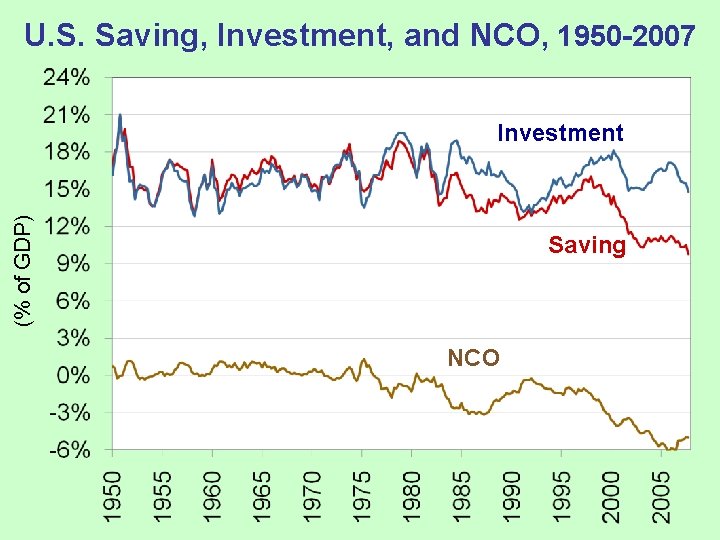
U. S. Saving, Investment, and NCO, 1950 -2007 (% of GDP) Investment Saving NCO
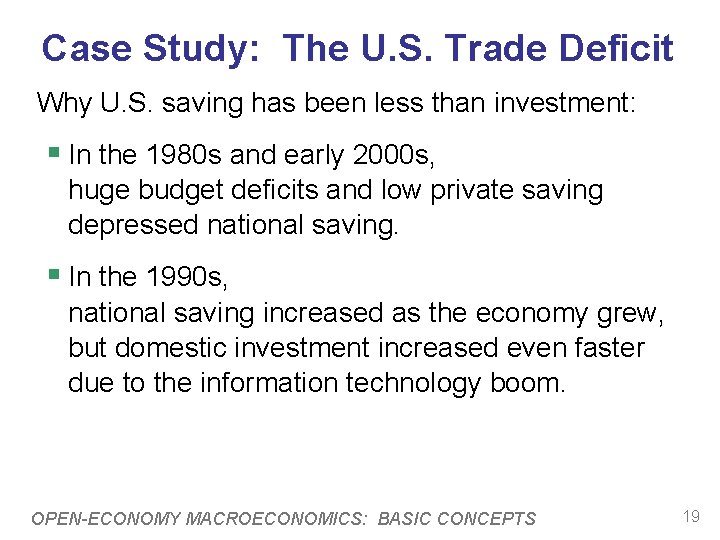
Case Study: The U. S. Trade Deficit Why U. S. saving has been less than investment: § In the 1980 s and early 2000 s, huge budget deficits and low private saving depressed national saving. § In the 1990 s, national saving increased as the economy grew, but domestic investment increased even faster due to the information technology boom. OPEN-ECONOMY MACROECONOMICS: BASIC CONCEPTS 19
Case Study: The U. S. Trade Deficit § Is the U. S. trade deficit a problem? § The extra capital stock from the ’ 90 s investment boom may well yield large returns. § The fall in saving of the ’ 80 s and ’ 00 s, while not desirable, at least did not depress domestic investment, as firms could borrow from abroad. § A country, like a person, can go into debt for good reasons or bad ones. A trade deficit is not necessarily a problem, but might be a symptom of a problem. OPEN-ECONOMY MACROECONOMICS: BASIC CONCEPTS 20
Case Study: The U. S. Trade Deficit as of 12 -31 -2007 People abroad owned $20. 1 trillion in U. S. assets. U. S. residents owned $17. 6 trillion in foreign assets. U. S. ’ net indebtedness to other countries = $2. 5 trillion. Higher than every other country’s net indebtedness. So, U. S. is “the world’s biggest debtor nation. ” § So far, the U. S. earns higher interest rates on foreign assets than it pays on its debts to foreigners. § But if U. S. debt continues to grow, foreigners may demand higher interest rates, and servicing the debt would become a drain on U. S. income. OPEN-ECONOMY MACROECONOMICS: BASIC CONCEPTS 21
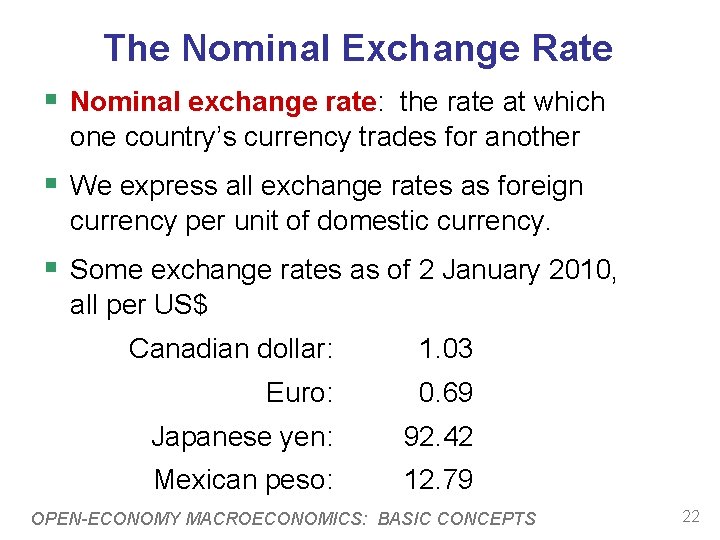
The Nominal Exchange Rate § Nominal exchange rate: the rate at which one country’s currency trades for another § We express all exchange rates as foreign currency per unit of domestic currency. § Some exchange rates as of 2 January 2010, all per US$ Canadian dollar: 1. 03 Euro: 0. 69 Japanese yen: 92. 42 Mexican peso: 12. 79 OPEN-ECONOMY MACROECONOMICS: BASIC CONCEPTS 22
Appreciation and Depreciation § Appreciation (or “strengthening”): an increase in the value of a currency as measured by the amount of foreign currency it can buy § Depreciation (or “weakening”): a decrease in the value of a currency as measured by the amount of foreign currency it can buy § Examples: During 2007, the U. S. dollar… § depreciated 9. 5% against the Euro § appreciated 1. 5% against the S. Korean Won OPEN-ECONOMY MACROECONOMICS: BASIC CONCEPTS 23
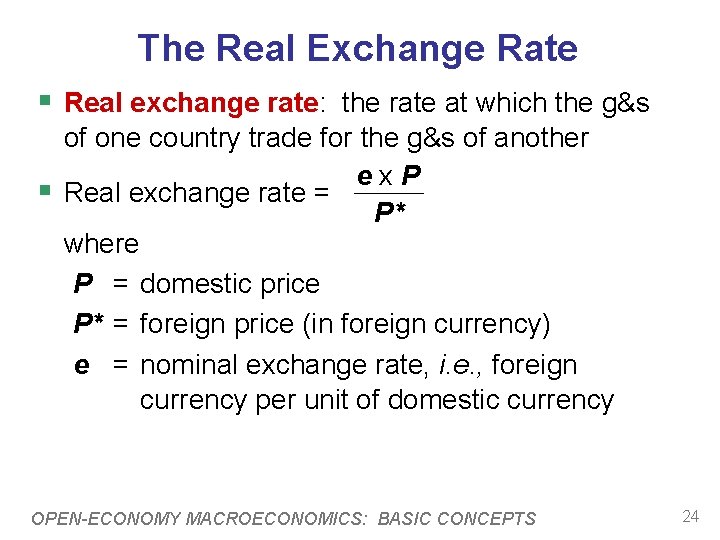
The Real Exchange Rate § Real exchange rate: the rate at which the g&s § of one country trade for the g&s of another ex. P Real exchange rate = P* where P = domestic price P* = foreign price (in foreign currency) e = nominal exchange rate, i. e. , foreign currency per unit of domestic currency OPEN-ECONOMY MACROECONOMICS: BASIC CONCEPTS 24
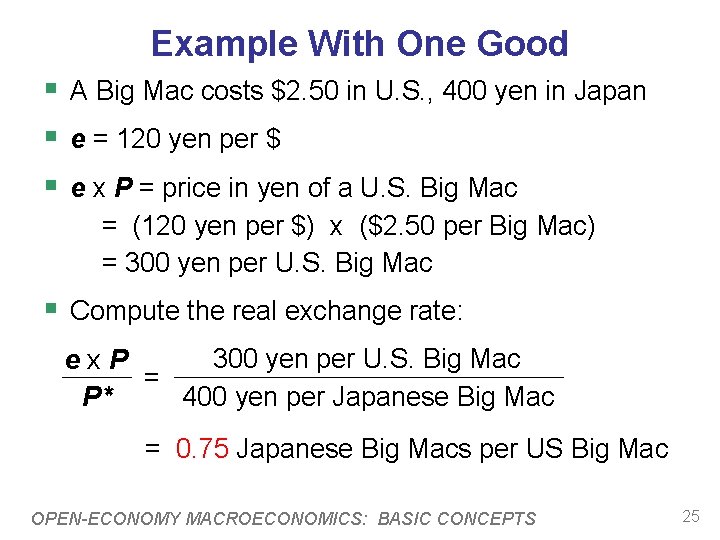
Example With One Good § A Big Mac costs $2. 50 in U. S. , 400 yen in Japan § e = 120 yen per $ § e x P = price in yen of a U. S. Big Mac = (120 yen per $) x ($2. 50 per Big Mac) = 300 yen per U. S. Big Mac § Compute the real exchange rate: 300 yen per U. S. Big Mac ex. P = P* 400 yen per Japanese Big Mac = 0. 75 Japanese Big Macs per US Big Mac OPEN-ECONOMY MACROECONOMICS: BASIC CONCEPTS 25
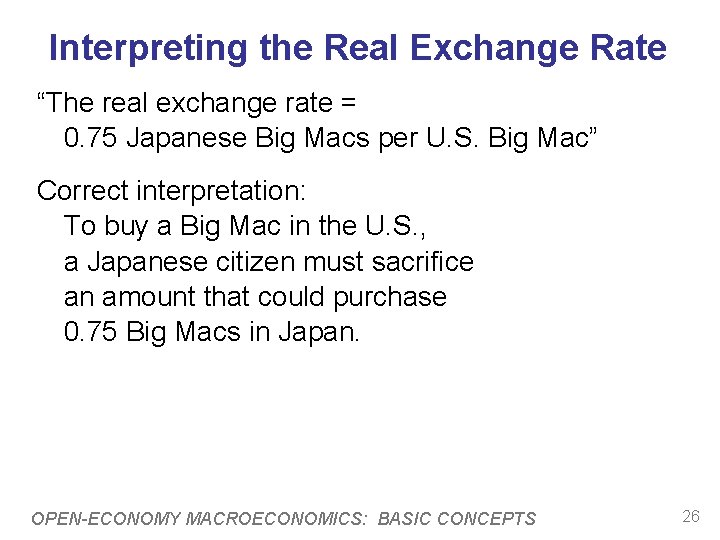
Interpreting the Real Exchange Rate “The real exchange rate = 0. 75 Japanese Big Macs per U. S. Big Mac” Correct interpretation: To buy a Big Mac in the U. S. , a Japanese citizen must sacrifice an amount that could purchase 0. 75 Big Macs in Japan. OPEN-ECONOMY MACROECONOMICS: BASIC CONCEPTS 26
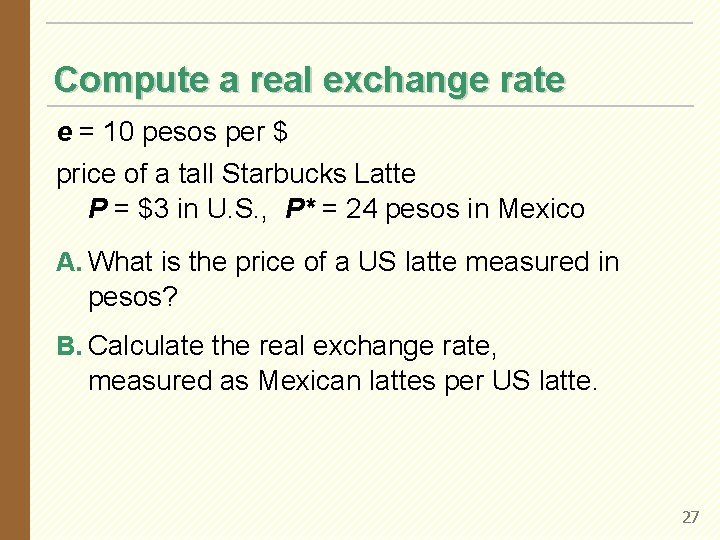
Compute a real exchange rate e = 10 pesos per $ price of a tall Starbucks Latte P = $3 in U. S. , P* = 24 pesos in Mexico A. What is the price of a US latte measured in pesos? B. Calculate the real exchange rate, measured as Mexican lattes per US latte. 27
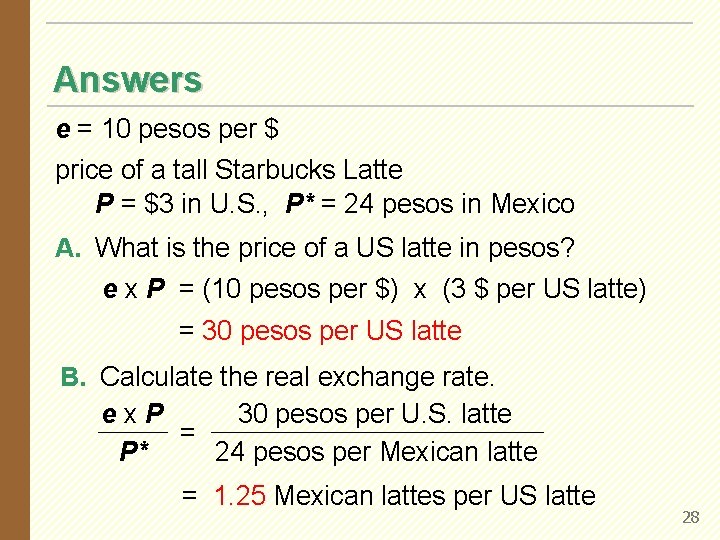
Answers e = 10 pesos per $ price of a tall Starbucks Latte P = $3 in U. S. , P* = 24 pesos in Mexico A. What is the price of a US latte in pesos? e x P = (10 pesos per $) x (3 $ per US latte) = 30 pesos per US latte B. Calculate the real exchange rate. ex. P 30 pesos per U. S. latte = P* 24 pesos per Mexican latte = 1. 25 Mexican lattes per US latte 28
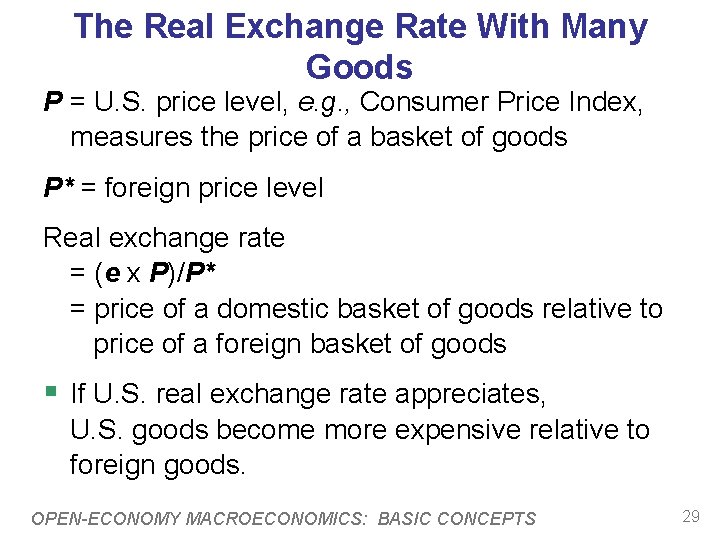
The Real Exchange Rate With Many Goods P = U. S. price level, e. g. , Consumer Price Index, measures the price of a basket of goods P* = foreign price level Real exchange rate = (e x P)/P* = price of a domestic basket of goods relative to price of a foreign basket of goods § If U. S. real exchange rate appreciates, U. S. goods become more expensive relative to foreign goods. OPEN-ECONOMY MACROECONOMICS: BASIC CONCEPTS 29
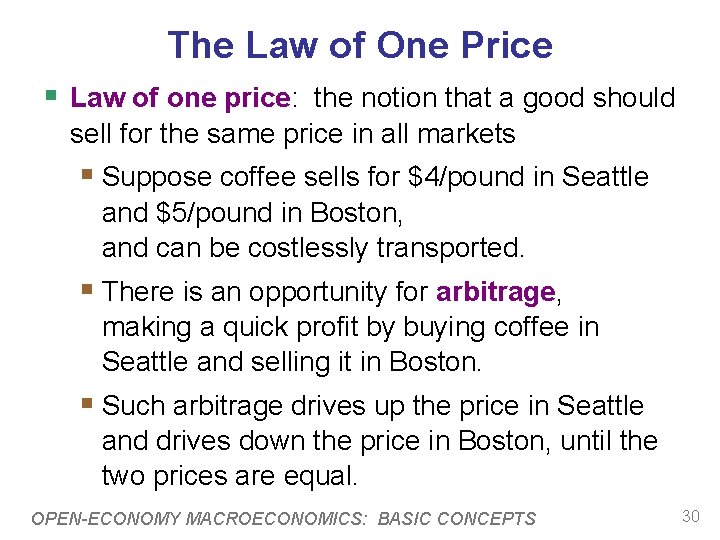
The Law of One Price § Law of one price: the notion that a good should sell for the same price in all markets § Suppose coffee sells for $4/pound in Seattle and $5/pound in Boston, and can be costlessly transported. § There is an opportunity for arbitrage, making a quick profit by buying coffee in Seattle and selling it in Boston. § Such arbitrage drives up the price in Seattle and drives down the price in Boston, until the two prices are equal. OPEN-ECONOMY MACROECONOMICS: BASIC CONCEPTS 30
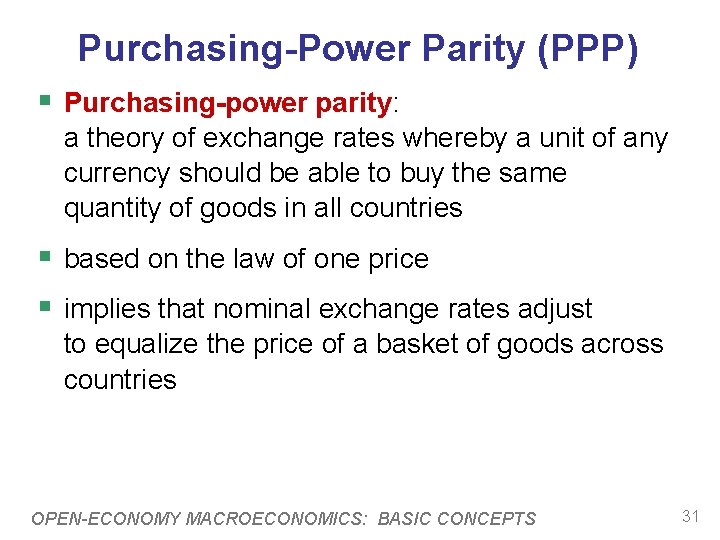
Purchasing-Power Parity (PPP) § Purchasing-power parity: a theory of exchange rates whereby a unit of any currency should be able to buy the same quantity of goods in all countries § based on the law of one price § implies that nominal exchange rates adjust to equalize the price of a basket of goods across countries OPEN-ECONOMY MACROECONOMICS: BASIC CONCEPTS 31
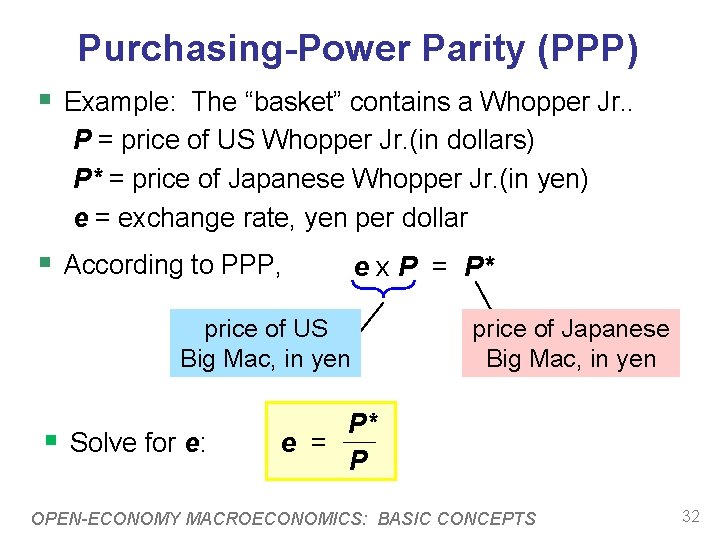
Purchasing-Power Parity (PPP) § Example: The “basket” contains a Whopper Jr. . P = price of US Whopper Jr. (in dollars) P* = price of Japanese Whopper Jr. (in yen) e = exchange rate, yen per dollar § According to PPP, e x P = P* price of US Big Mac, in yen § Solve for e: price of Japanese Big Mac, in yen P* e = P OPEN-ECONOMY MACROECONOMICS: BASIC CONCEPTS 32
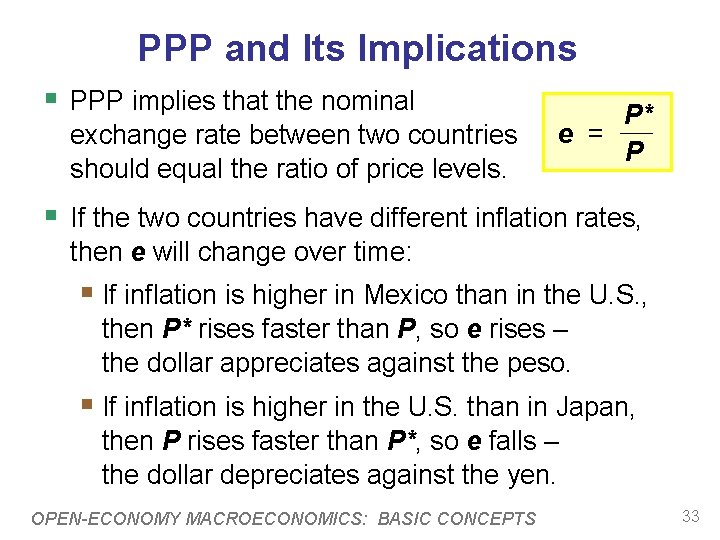
PPP and Its Implications § PPP implies that the nominal exchange rate between two countries should equal the ratio of price levels. P* e = P § If the two countries have different inflation rates, then e will change over time: § If inflation is higher in Mexico than in the U. S. , then P* rises faster than P, so e rises – the dollar appreciates against the peso. § If inflation is higher in the U. S. than in Japan, then P rises faster than P*, so e falls – the dollar depreciates against the yen. OPEN-ECONOMY MACROECONOMICS: BASIC CONCEPTS 33
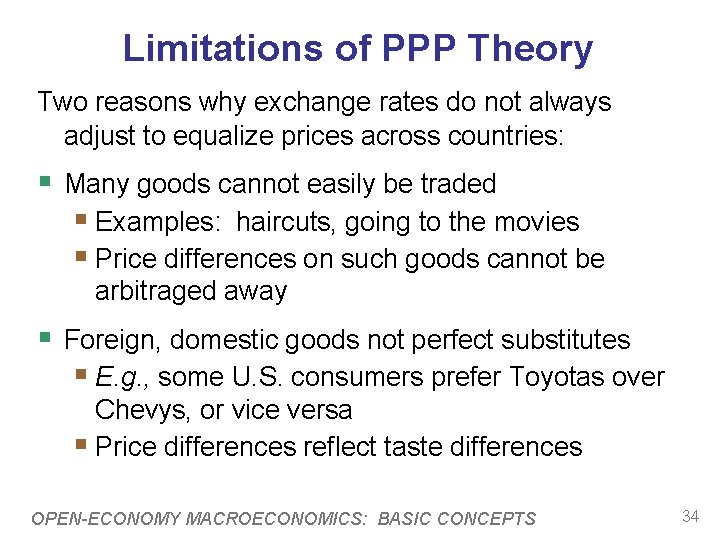
Limitations of PPP Theory Two reasons why exchange rates do not always adjust to equalize prices across countries: § Many goods cannot easily be traded § Examples: haircuts, going to the movies § Price differences on such goods cannot be arbitraged away § Foreign, domestic goods not perfect substitutes § E. g. , some U. S. consumers prefer Toyotas over Chevys, or vice versa § Price differences reflect taste differences OPEN-ECONOMY MACROECONOMICS: BASIC CONCEPTS 34
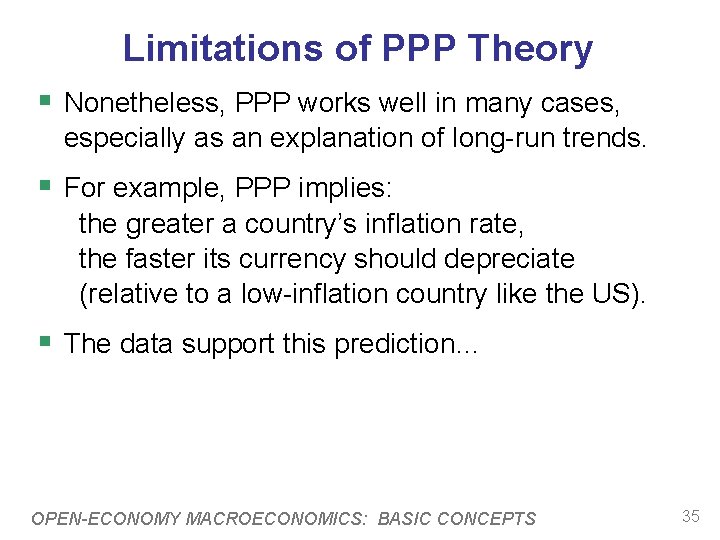
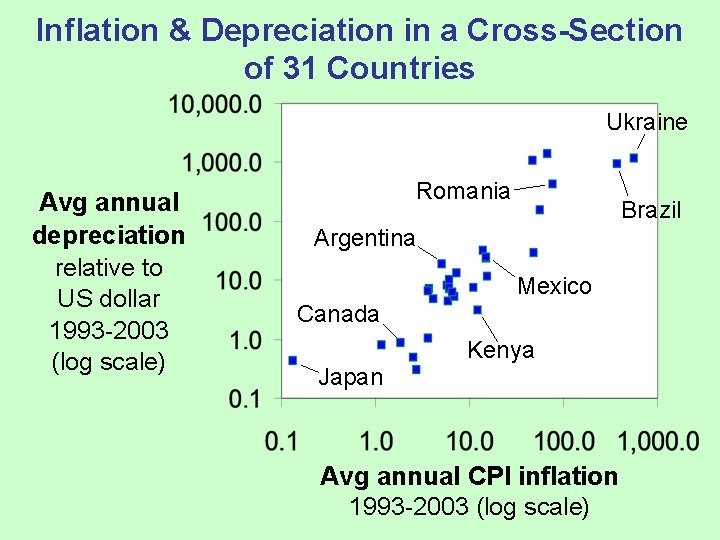
Limitations of PPP Theory § Nonetheless, PPP works well in many cases, especially as an explanation of long-run trends. § For example, PPP implies: the greater a country’s inflation rate, the faster its currency should depreciate (relative to a low-inflation country like the US). § The data support this prediction… OPEN-ECONOMY MACROECONOMICS: BASIC CONCEPTS 35
Inflation & Depreciation in a Cross-Section of 31 Countries Ukraine Avg annual depreciation relative to US dollar 1993 -2003 (log scale) Romania Brazil Argentina Mexico Canada Kenya Japan Avg annual CPI inflation 1993 -2003 (log scale)
Chapter review questions 1. Which of the following statements about a country with a trade deficit is not true? A. Exports < imports B. Net capital outflow < 0 C. Investment < saving D. Y < C + I + G 2. A Ford Escape SUV sells for $24, 000 in the U. S. and 720, 000 rubles in Russia. If purchasing-power parity holds, what is the nominal exchange rate (rubles per dollar)? 37
Answers 1. Which of the following statements about a country with a trade deficit is not true? A. Exports < imports B. Net capital outflow < 0 C. Investment < saving not true! D. Y < C + I + G A trade deficit means NX < 0. Since NX = S – I, a trade deficit implies I > S. 38
Answers 2. A Ford Escape SUV sells for $24, 000 in the U. S. and 720, 000 rubles in Russia. If purchasing-power parity holds, what is the nominal exchange rate (rubles per dollar)? P* = 720, 000 rubles P = $24, 000 e = P*/P = 720000/24000 = 30 rubles per dollar 39
- Slides: 40