
Open e Prescribing Masterclass David Jobling Keith Farrar
Open e. Prescribing Masterclass David Jobling & Keith Farrar 08. 04. 2015
Introduction to Open Source What is Open Source? - Paradigm Shift • Based on software improvement via collaborative open innovation • Driven by those with desire to use and / or improve the product • Successful new business models (e. g. Red. Hat) • Scale of openness to suit the needs Based of 4 Software Freedoms • Free to use software however you wish • Free to redistribute copies • Free to understand how it works and adapt it • Free to make and share improvements with anyone
Introduction to Open Source Why Open Source? • Removes vendor Lock-In • Increases responsiveness to fixes and changes in requirements • Increases the number of vendors who can support the solutions • Decreases Total Cost of Ownership • Removes up-front licence fees and capital outlays • More competitive pricing for support & maintenance • Stimulates wider participation in improving and innovating products • Greater control in delivering open interface between systems • As easy to support and manage source control as proprietary solutions

e. PMA Functionality 4
Introduction to Opene. P – Functional Overview Elements of an e. PMA system • Ability to document a Medication History • Support for in-patient prescribing with scheduling of medicines administration • Support for the documentation of the administration of medicines • Support for the creation of ‘short term leave’ prescriptions, with the automatic suspension of administration during patient absence • Support for discharge prescribing and reconciliation of changes made since capture of medication history • Support for out-patient prescribing
Introduction to Opene. P – Functional Overview Additional Features of an e. PMA system • Support for intravenous infusion functionality • Support for multiple-component prescriptions (e. g. palliative care syringes) • Support for ‘complex prescriptions • • Step up & step down doses • Chlordiazepoxide alcohol ‘de-toxification’ • Sliding scale insulin Clinical decision support alerting users to • Allergies • Contraindications • Therapeutic duplications • Drug-drug interactions
Introduction to Opene. P – Functional Overview Additional Features of an e. PMA system • Alert if user chooses a medicine not on the T 2 / T 3 list • Indicator warning about BNF maximum for anti-psychotic medication • Alert if cumulative doses exceed BNF maximum • Pharmacist review of all medications • Pharmacist noting system • Intervention log • Ability to ‘order’ supply • Ability to refer back for physician review

Opene. P Roadmap 8
Opene. P – Development roadmap Phase 1 Delivery September 2015 • Pharmacist review functionality • Documentation of medicines on admission • Discharge prescribing • Medicines reconciliation at each stage of the admission / discharge process • Short-term leave prescribing with auto-suspension of drug chart • Prompt to check allergy status before any medicines are prescribed • Enhancements to T 2 / T 3 functionality • Enhancements to Medicines Administration to support ‘self-administration’ • Delivery of BNF maximum doses and cumulative warning • PGD functionality • Live Demonstration (https: //www. ehrscape. com/openep. html? patient. Id=999005)
Opene. P – Development roadmap Phase 2 Delivery May 2016 • Antibiotic Stewardship enhancements • Sliding scale insulin • Management of ‘High Risk Medicines’ • Ward stock lists and stock ordering • Electronic Controlled Drug Registers • Links to external systems (BNF; ‘Yellow Card’; etc) 10
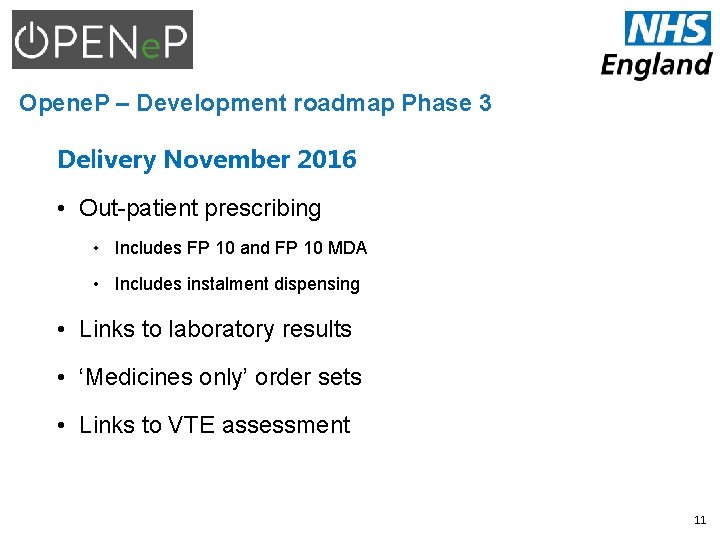
Opene. P – Development roadmap Phase 3 Delivery November 2016 • Out-patient prescribing • Includes FP 10 and FP 10 MDA • Includes instalment dispensing • Links to laboratory results • ‘Medicines only’ order sets • Links to VTE assessment 11
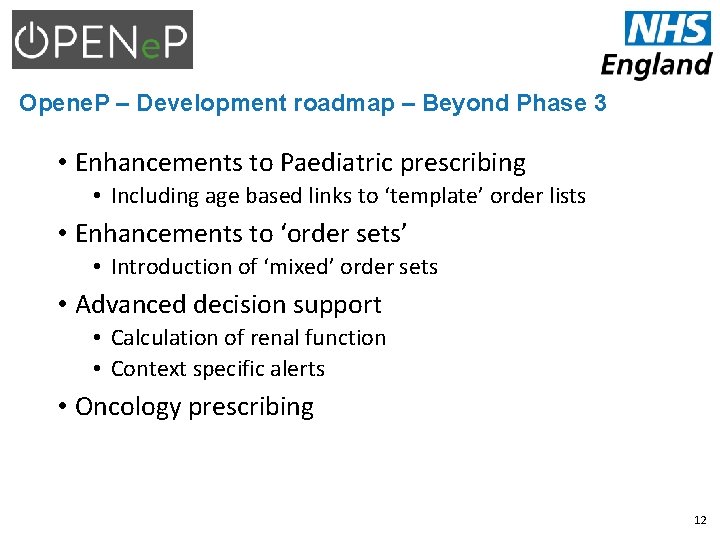
Opene. P – Development roadmap – Beyond Phase 3 • Enhancements to Paediatric prescribing • Including age based links to ‘template’ order lists • Enhancements to ‘order sets’ • Introduction of ‘mixed’ order sets • Advanced decision support • Calculation of renal function • Context specific alerts • Oncology prescribing 12

Comparison with commercial systems 13
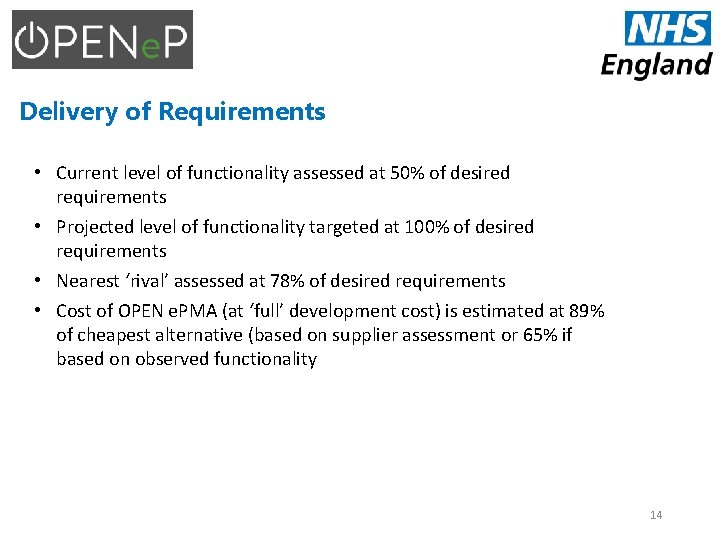
Delivery of Requirements • Current level of functionality assessed at 50% of desired requirements • Projected level of functionality targeted at 100% of desired requirements • Nearest ‘rival’ assessed at 78% of desired requirements • Cost of OPEN e. PMA (at ‘full’ development cost) is estimated at 89% of cheapest alternative (based on supplier assessment or 65% if based on observed functionality 14
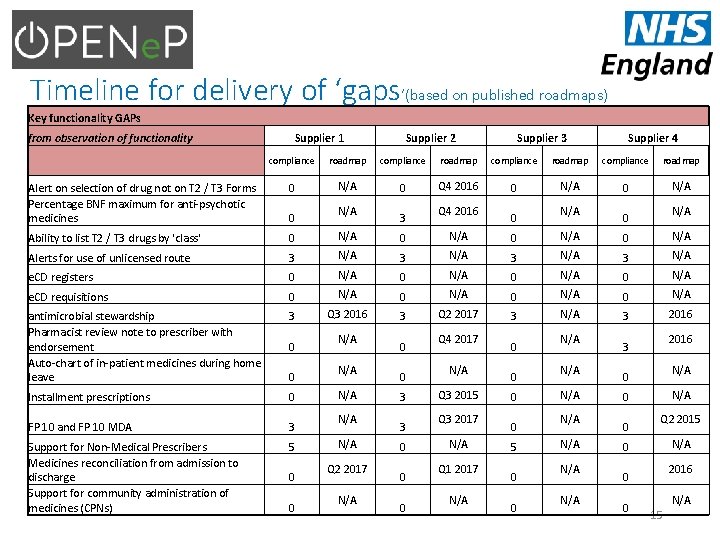
Timeline for delivery of ‘gaps’(based on published roadmaps) ) Key functionality GAPs from observation of functionality Supplier 1 Supplier 2 Supplier 3 Supplier 4 compliance roadmap Alert on selection of drug not on T 2 / T 3 Forms Percentage BNF maximum for anti-psychotic medicines 0 N/A 0 Q 4 2016 0 N/A Ability to list T 2 / T 3 drugs by 'class' 0 N/A Alerts for use of unlicensed route 3 N/A e. CD registers 0 N/A e. CD requisitions 0 N/A antimicrobial stewardship Pharmacist review note to prescriber with endorsement Auto-chart of in-patient medicines during home leave 3 Q 3 2016 3 Q 2 2017 3 N/A 3 2016 Installment prescriptions 0 FP 10 and FP 10 MDA 3 Support for Non-Medical Prescribers Medicines reconciliation from admission to discharge Support for community administration of medicines (CPNs) 5 0 0 0 N/A N/A N/A Q 2 2017 N/A 3 0 0 3 3 0 0 0 Q 4 2016 Q 4 2017 N/A Q 3 2015 Q 3 2017 N/A Q 1 2017 N/A 0 0 0 5 0 0 N/A N/A N/A 0 2016 3 N/A 0 0 Q 2 2015 N/A 0 2016 0 0 N/A 15

Progress to date 16
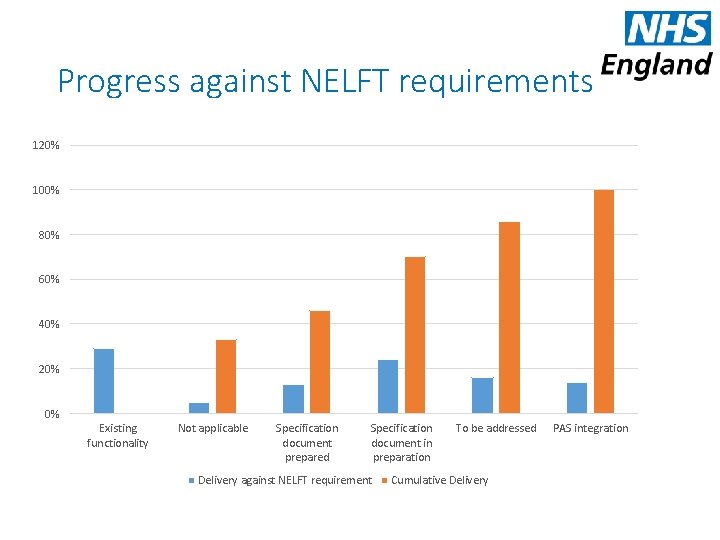
Progress against NELFT requirements 120% 100% 80% 60% 40% 20% 0% Existing functionality Not applicable Specification document prepared Specification document in preparation Delivery against NELFT requirement To be addressed Cumulative Delivery PAS integration
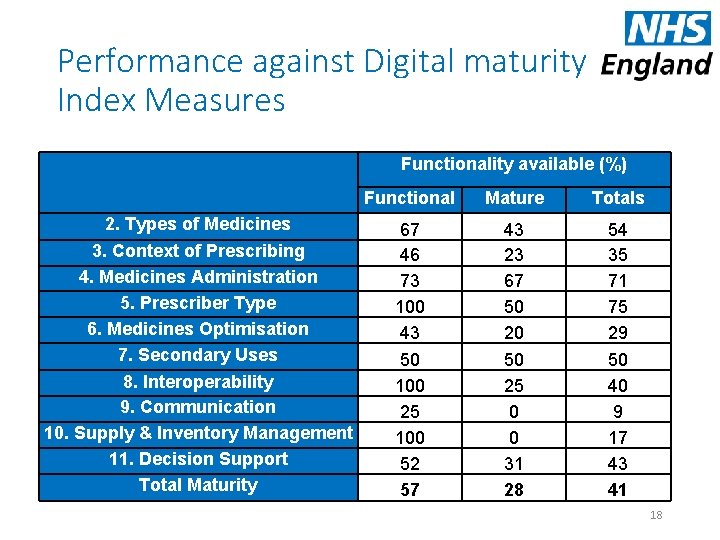
Performance against Digital maturity Index Measures 2. Types of Medicines 3. Context of Prescribing 4. Medicines Administration 5. Prescriber Type 6. Medicines Optimisation 7. Secondary Uses 8. Interoperability 9. Communication 10. Supply & Inventory Management 11. Decision Support Total Maturity Functionality available (%) Functional Mature Totals 67 46 73 100 43 50 100 25 100 52 57 43 23 67 50 20 50 25 0 0 31 28 54 35 71 75 29 50 40 9 17 43 41 18

Safety Process 19
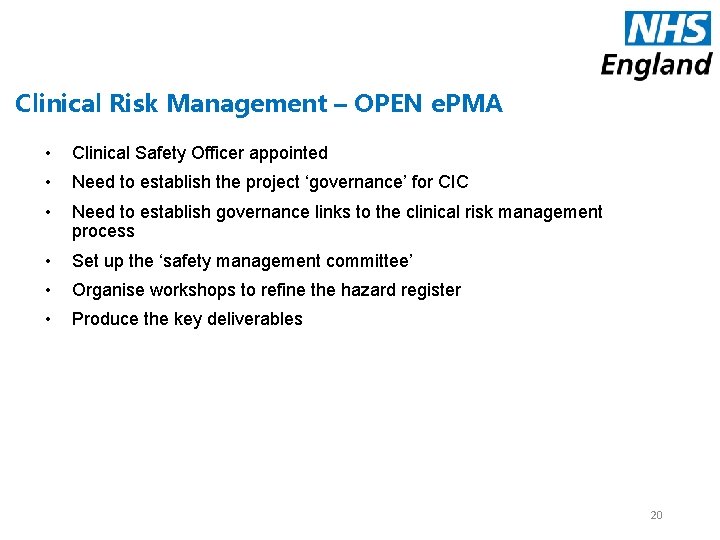
Clinical Risk Management – OPEN e. PMA • Clinical Safety Officer appointed • Need to establish the project ‘governance’ for CIC • Need to establish governance links to the clinical risk management process • Set up the ‘safety management committee’ • Organise workshops to refine the hazard register • Produce the key deliverables 20

Finance & Procurement 21
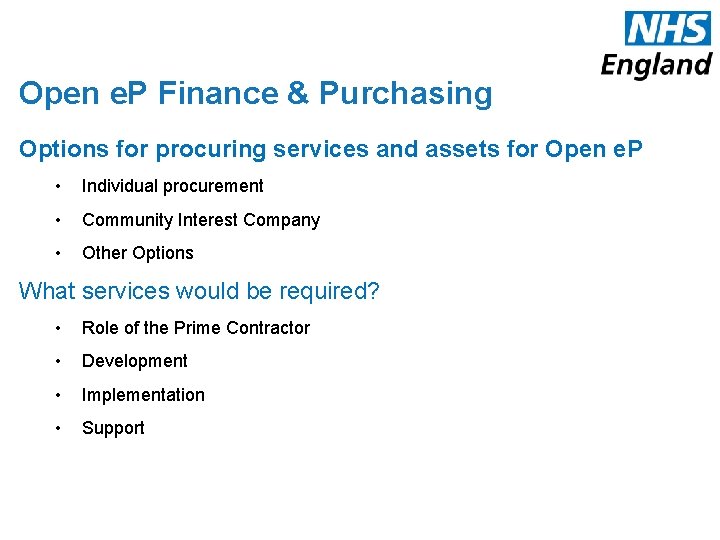
Open e. P Finance & Purchasing Options for procuring services and assets for Open e. P • Individual procurement • Community Interest Company • Other Options What services would be required? • Role of the Prime Contractor • Development • Implementation • Support
Open e. P Finance & Procurement Why Open e. P? • Involvement in development • Quality of the product • Shared Knowledge • Shared Governance • Shared Resources Technology Fund • Capital / Revenue • Procuring Services – G-Cloud • Utilising Match Funding
For more Information Peter Coates NHS England Open Source Programme Head 07798 725131 petercoates@nhs. net David Jobling Community Development Lead 07818 522951 d. Jobling@nhs. net Keith Farrar Clinical Lead OPEN e. Prescribing Project 0784 341 7036 keith. farrar@nhs. net www. openep. org Twitter @open_ep info@openep. org
- Slides: 24