
OPEN DAYS Cohesion policy Interreg for 2021 2027
- Slides: 17
OPEN DAYS Cohesion policy & Interreg for 2021 -2027 October 2019
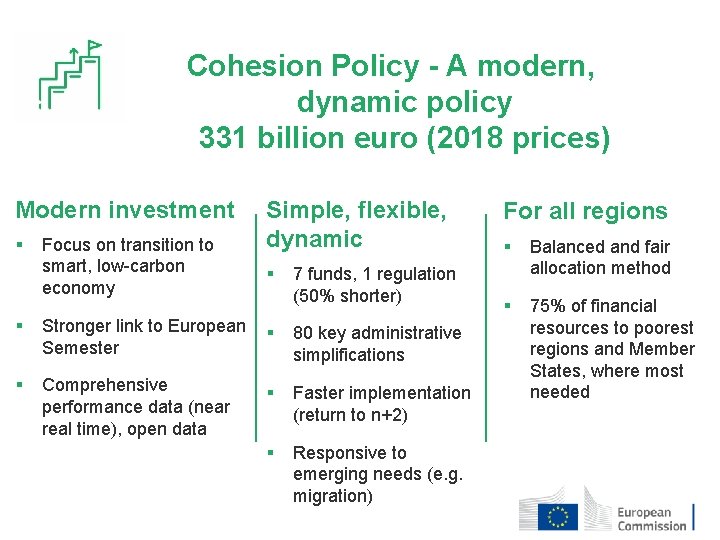
Cohesion Policy - A modern, dynamic policy 331 billion euro (2018 prices) Modern investment § Focus on transition to smart, low-carbon economy Simple, flexible, dynamic § 7 funds, 1 regulation (50% shorter) § Stronger link to European Semester § 80 key administrative simplifications § Comprehensive performance data (near real time), open data § Faster implementation (return to n+2) § Responsive to emerging needs (e. g. migration) For all regions § Balanced and fair allocation method § 75% of financial resources to poorest regions and Member States, where most needed
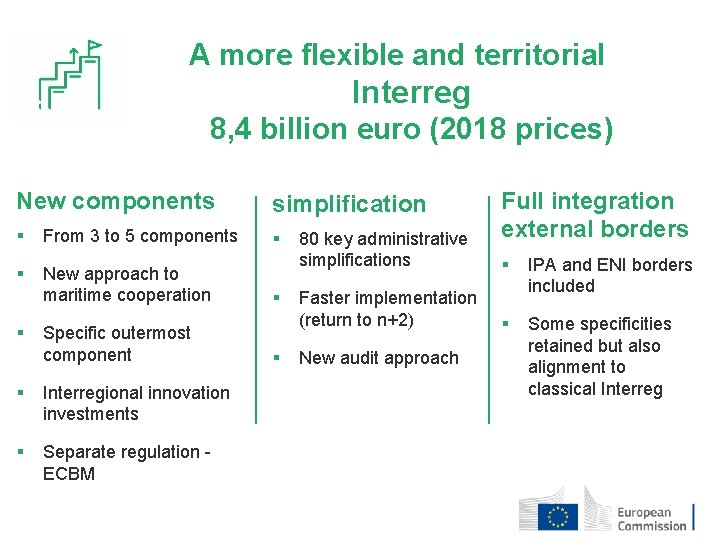
A more flexible and territorial Interreg 8, 4 billion euro (2018 prices) New components simplification § From 3 to 5 components § § New approach to maritime cooperation § Specific outermost component § Interregional innovation investments § Separate regulation ECBM § § 80 key administrative simplifications Faster implementation (return to n+2) New audit approach Full integration external borders § IPA and ENI borders included § Some specificities retained but also alignment to classical Interreg
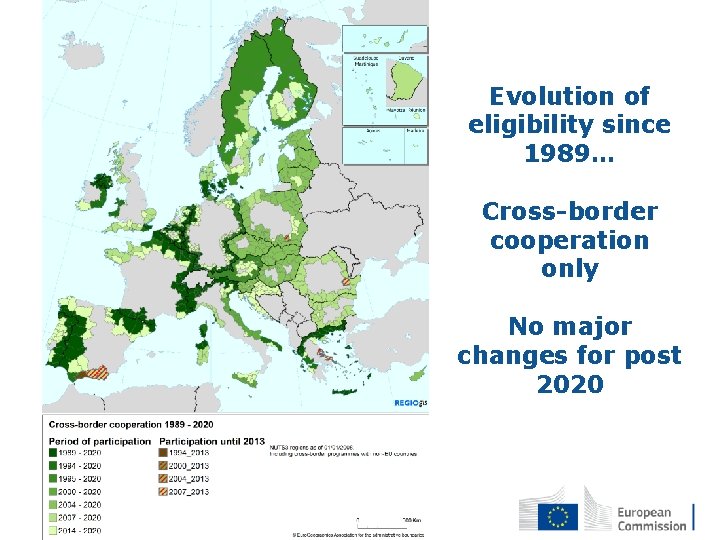
Evolution of eligibility since 1989… Cross-border cooperation only No major changes for post 2020
1. MFF negotiations
MFF negotiations – timing ü Objective to reach a political agreement in 2019/2020 ü EP position adopted in interim report on the MFF package (14/11/2018) ü No EU Council position yet § MFF negotiating box prepared during AT and RO Presidencies § EU Council 17 -18 October – possibly first discussion on the figures (overall levels, balances between headings) § FI Presidency objective: finalise the revision of the negotiating box and reach an agreement at the December EU Council ü Sectoral proposals can only be finalised after MFF deal (i. e. in 2020) Risk: new legislation may be delayed
7 MFF negotiations – key issues related to CP ü 7 -year MFF rather confirmed – MFF mid-term review and CP mid-term review still to be negotiated ü CP budget – EP calls for the same budget in real terms ü Different proposals for co-financing rates – EP in favour of increase ü pre-financing levels - EP in favour of increase ü Thematic concentration – level (national vs. regional) and thresholds still under discussion ü Decommitment rules – different options (incl. n+3 and transition)
2. Cohesion policy & Interreg legislative package
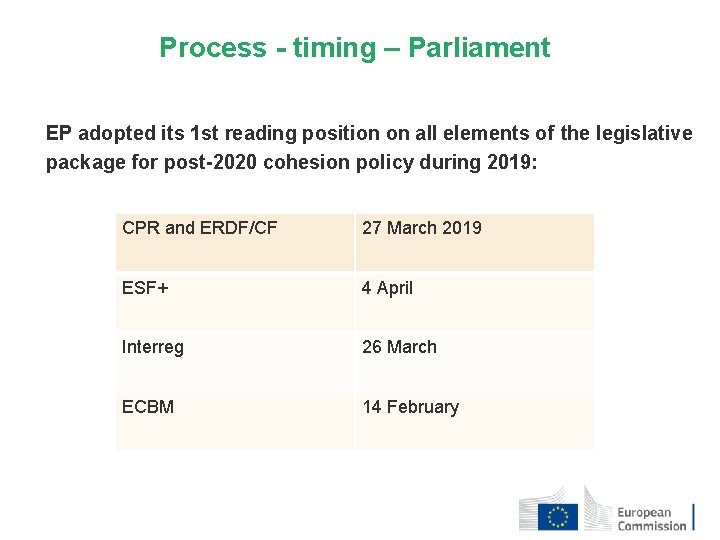
Process - timing – Parliament EP adopted its 1 st reading position on all elements of the legislative package for post-2020 cohesion policy during 2019: CPR and ERDF/CF 27 March 2019 ESF+ 4 April Interreg 26 March ECBM 14 February
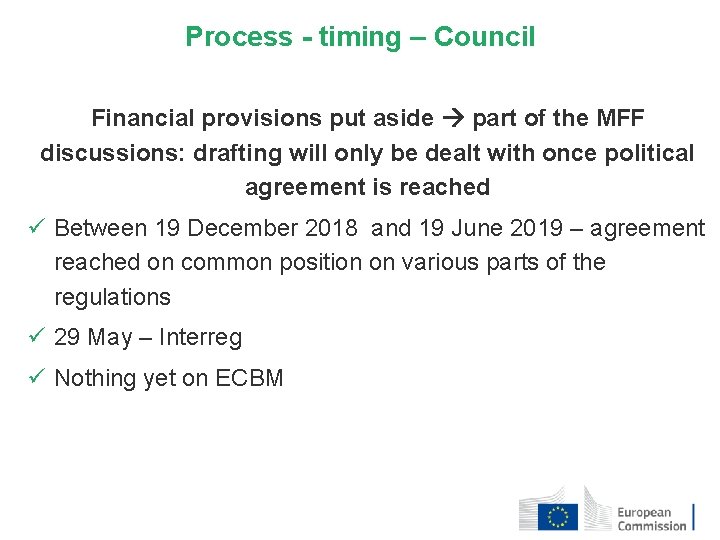
Process - timing – Council Financial provisions put aside part of the MFF discussions: drafting will only be dealt with once political agreement is reached ü Between 19 December 2018 and 19 June 2019 – agreement reached on common position on various parts of the regulations ü 29 May – Interreg ü Nothing yet on ECBM
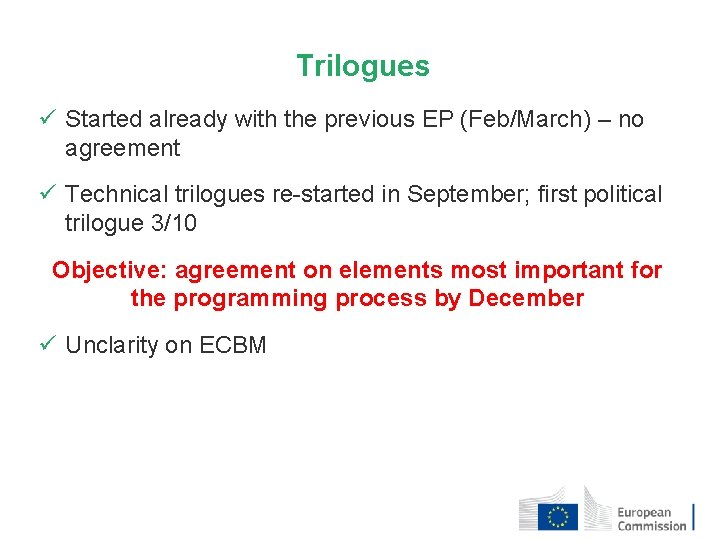
Trilogues ü Started already with the previous EP (Feb/March) – no agreement ü Technical trilogues re-started in September; first political trilogue 3/10 Objective: agreement on elements most important for the programming process by December ü Unclarity on ECBM
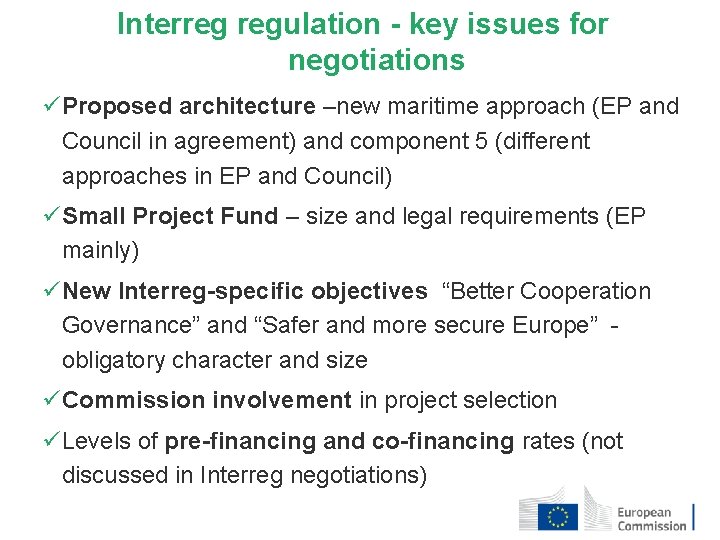
Interreg regulation - key issues for negotiations ü Proposed architecture –new maritime approach (EP and Council in agreement) and component 5 (different approaches in EP and Council) ü Small Project Fund – size and legal requirements (EP mainly) ü New Interreg-specific objectives “Better Cooperation Governance” and “Safer and more secure Europe” obligatory character and size ü Commission involvement in project selection ü Levels of pre-financing and co-financing rates (not discussed in Interreg negotiations)
3. Programming negotiations –
Programming negotiations ü Commission is prepared for the 2021 -2027 programming exercise more than half a year earlier than for the 2014 -2020 period § The CPR proposal was issued already in May 2018 and includes details on programme templates § Commission issued orientation papers for all cross-border cooperation areas § Commission will issue by end October, orientation papers for transnational areas, maritime cooperation and IPA CBC § Commission will issue by end 2019 a strategic programming document for future NDICI (former ENI) programmes
Programming negotiations - upcoming events ü Indicative calendar for programming 2021 -2027 based current progress: § Informal dialogue between the Commission and the Member states/Interreg authorities has started § Mature drafts of programming documents expected to be submitted by mid-2020 § Formal submission of programming documents ready for adoption expected in the second half of 2020
Programming negotiations – past experience ü Lessons learned: § We need to be faster in 2021 -2027 in order not to delay implementation § It is important to make as much progress as possible during the informal stage in order to allow for their fast adoption once the new legislation is in place § Interreg programming requires enough time for constructive dialogues among Member States/regions involved – possible decisional bottlenecks § Lack of cross-border and transnational data complicates analytical phase – hence the “orientation papers” – BUT enough time should be foreseen for robust SWOT analysis
Programming negotiations - conclusions ü Interreg programming can be complex (many actors, across borders) ü Time it takes should not be underestimated ü Useful to call upon external expertise for “objective” elements ü Stakeholders’ involvement crucial ü Difficult to work while the legislative framework is unclear (we all know this but have to accept ) ü DG REGIO staff always available to support and engage Thank you for passing by…. Hopefully our good cooperation can continue.