
OPEN DAYS Cohesion policy for 2021 2027 October
OPEN DAYS Cohesion policy for 2021 -2027 October 2019
A modern, dynamic policy 331 billion euro (2018 prices) Modern investment § Focus on transition to smart, low-carbon economy Simple, flexible, dynamic § 7 funds, 1 regulation (50% shorter) § Stronger link to European § Semester 80 key administrative simplifications § Comprehensive performance data (near real time), open data § Faster implementation (return to n+2) § Responsive to emerging needs (e. g. migration) For all regions § Balanced and fair allocation method § 75% of financial resources to poorest regions and Member States, where most needed
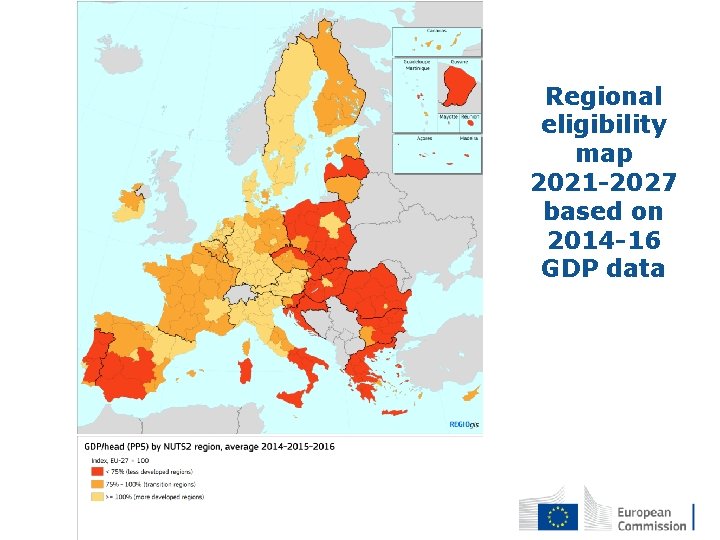
Regional eligibility map 2021 -2027 based on 2014 -16 GDP data
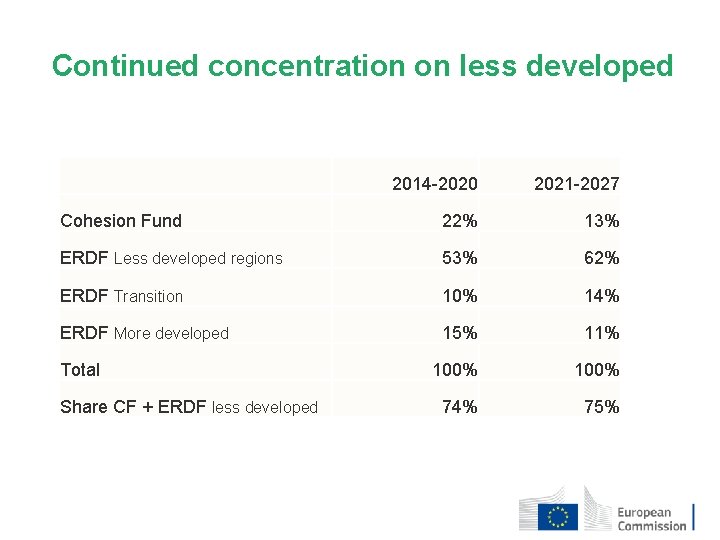
Continued concentration on less developed 2014 -2020 2021 -2027 Cohesion Fund 22% 13% ERDF Less developed regions 53% 62% ERDF Transition 10% 14% ERDF More developed 15% 11% 100% 74% 75% Total Share CF + ERDF less developed
1. MFF negotiations
MFF negotiations – timing ü Objective to reach a political agreement in 2019/2020 ü EP position adopted in interim report on the MFF package voted 14/11/2018 ü No EUCO position yet § MFF negotiating box prepared during AT and RO PRES § EUCO 17 -18 October – possibly first discussion on the figures (overall levels, balances between headings) § FI PRES objective: finalise the revision of the negotiating box and reach an agreement at the December EUCO ü Sectoral proposals can only be finalised after MFF deal (ie in 2020) Risk: new legislation may be delayed
7 MFF negotiations – key issues related to CP ü 7 -year MFF rather confirmed – MFF mid-term review and CP midterm review still to be negotiated ü CP budget – EP calls for the same budget in real terms ü Different proposals for co-financing rates – EP in favour of increase ü Pre-financing levels - EP in favour of increase ü Transfers to directly managed instruments such as CEF – divergent positions on EP and Council side ü Thematic concentration – level (national vs. regional) and thresholds still under discussion ü Decommitment rules – different options (incl. n+3 and transition) ü Reference periods 2014 -2016 vs 2015 -2017 – COM presented the statistical update/changes to NUTS classification to assist PRES
2. Cohesion policy legislative package
Process - timing – Parliament EP adopted its 1 st reading position on all elements of the legislative package for post-2020 cohesion policy: ü CPR and ERDF/CF – 27 March 2019. ü ESF+ – 4 April ü Interreg – 26 March ü ECBM – 14 February ü AMF, BMVI and ISF – 13 March
Process - timing – Council CPR divided into Blocks + sectoral regulations: ü 19 December 2018 – Block 1 (programming) and 5 (management and control); ü 15 February 2019 – Block 2 (enabling conditions and performance review); ERDF/CF ü 3 April – Block 3 (monitoring, evaluation, communication) and Block 4 (eligibility and financial instruments); ESF+ ü 17 April – Block 6 (financial management); ü 29 May – Block 7 (definitions, delegation of powers, transitional and final provisions); Interreg ü 19 June – Annexes (PA and programme templates, audit trail, payment application, categories of intervention, indicators) Financial provisions put aside part of the MFF discussions: drafting will only be dealt with once political agreement is reached
Trilogues ü Started already with the previous EP (Feb/March) – discussion on programming (Block 1) – no agreement ü Technical trilogues re-started in Septmeber (Block 5); first political trilogue 3 rd October Objective: agreement on Blocks which are the most important for the programming proces, by December Block 1 – programming Block 2 – enabling contions and performance review Block 5 – management and control system + specific objectives of ERDF, ESF+ and Interreg
CP legislative package - key issues for negotiations ü CPR and EAFRD ü Obligatory PA covering AMIF, ISF and BMVI ü Partnership and horizontal principles ü Use of Invest. EU as a delivery mechanism (contribution agreement) ü Technical assistance (flat-rate; higher thresholds) ü Mid-term review and 5+2 programming ü Transfers to directly-managed programmes ü Public procurement (and other, MFF- related) horizontal enabling conditions ü Eligibility of VAT ü Reimbursement of interim payments at 90% ü Role of the Commission in selection of operations ü EPPO
3. Programming negotiations – progress and upcoming events
Programming negotiations ü Commission is prepared for the 2021 -2027 programming exercise more than half a year earlier than for the 2014 -2020 period § The CPR proposal was issued already in May 2018 and includes details on programme templates § The Commission’s position concerning the investment needs in the Member States in the form of Annex D of the European Semester country reports was published in February 2019 § The launch events marking the start of the negotiations on the new programming period took place in all MSs in the spring 2019
Programming negotiations - upcoming events ü During summer 2019 the Member States sent to the Commission their timetables (roadmaps) for cohesion policy programming including § a target date for the submission of mature programming documents ready for adoption before the end of 2020 and § an intermediate date for the submission of complete drafts ü Indicative calendar for programming 2021 -2027 based on the roadmaps § Informal dialogue between the Commission and the Member states from the launch events until the new legislation is adopted § Mature drafts of programming documents expected to be submitted by the majority of Member States in the first half of 2020 § Formal submission of programming documents ready for adoption expected by the majority of Member States in the second half of 2020
Programming negotiations – past experience ü Experience from the past: § 2014 -2020 programming process took on average 2 years (1. 5 - 3. 5 years) o The informal dialogue (following the launch events) started only in late 2012 o The Partnership Agreements were formally submitted in Jan-Mar 2014 and adopted in May-Nov 2014 o The programmes were formally submitted in Feb-Jun 2014 and adopted in Jun 2014 – Dec 2015 ü Lessons learned: § We need to be faster in 2021 -2027 in order not to delay implementation § It is important to make as much progress as possible on the programming documents during the informal stage in order to allow for their fast adoption shortly after the new legislation is in place § To ensure a faster start of the implementation, the work on the programming documents should go on in parallel with the work on the enabling conditions and simplified cost options
- Slides: 16