
OPEN DATA PROGRAMS DEFINITIONS Opening up data is
- Slides: 6
OPEN DATA PROGRAMS: DEFINITIONS Opening up data is about making information accessible and usable • But what types of data? • For whom? • For what purposes? • How should it be made available?
OPEN DATA Wikipedia: Some data should be freely available to everyone to use & republish as they wish, without restrictions from copyright, patents or other mechanisms of control. Socrata: Making data that belongs to the public broadly accessible & usable by humans and machines, free of any constraints. Open Knowledge International: Data that can be freely used, re-used & redistributed by anyone - subject only, at most, to the requirement to attribute and sharealike. Sunlight Foundation: Includes text such as policies, ordinances, executive orders.
OPEN DATA PRINCIPLES Open data is: Public – We presume that data are as open as allowed by law and subject to (reasonable) privacy, confidentiality, and security restrictions. Accessible – Available in convenient, modifiable, machine- readable, and open formats that can be retrieved, downloaded, indexed, and searched. Described – Give users sufficient information to understand their strengths, weaknesses, analytical limitations, security requirements, and how to process them.
OPEN DATA PRINCIPLES (cont. ) Open data is: Reusable – Available under an open license that places no restrictions on their use. Complete – Published as primary data (as close to source as possible) at the finest possible granularity. Timely – Published as quickly as possible, with appropriate and predicable updates. Managed Post-Release – Data should have a steward to manage and answer questions about it.
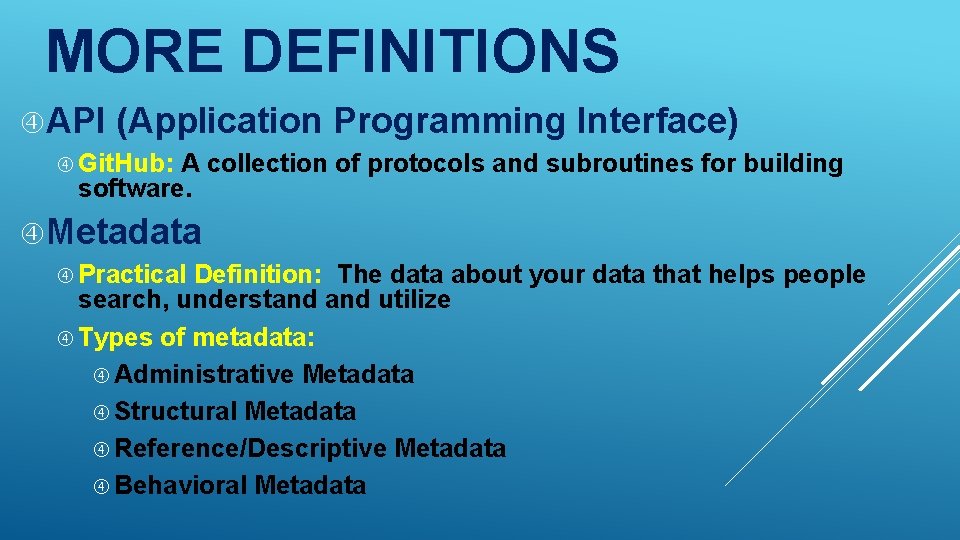
MORE DEFINITIONS API (Application Programming Interface) Git. Hub: A collection of protocols and subroutines for building software. Metadata Practical Definition: The data about your data that helps people search, understand utilize Types of metadata: Administrative Metadata Structural Metadata Reference/Descriptive Metadata Behavioral Metadata
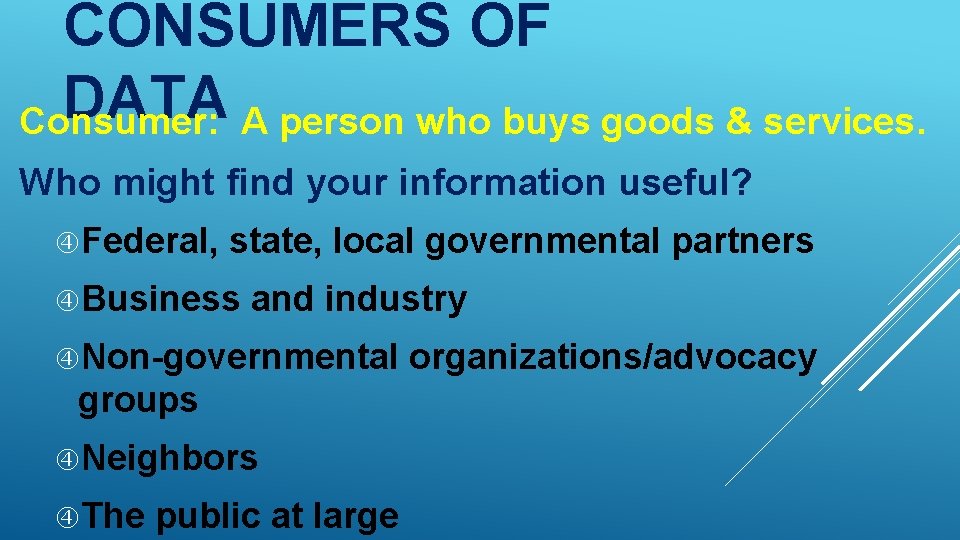
CONSUMERS OF DATA Consumer: A person who buys goods & services. Who might find your information useful? Federal, state, local governmental partners Business and industry Non-governmental organizations/advocacy groups Neighbors The public at large