
Open Data Cube Jupyter Notebooks A powerful way

Open Data Cube Jupyter Notebooks A powerful way for demonstration, research, and teaching WGISS Webinar-3: Burgeoning Role of Python for Earth Observation Data Analysis Tuesday, August 22, 2017

About this talk - All the contents are from public domain - Introduction to data cube - What is Python? Why Python? - Python modules and libraries - Jupyter Notebooks Demos
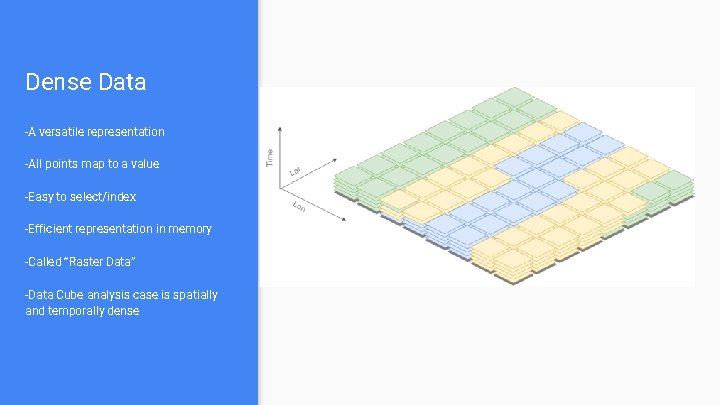
Dense Data -A versatile representation -All points map to a value -Easy to select/index -Efficient representation in memory -Called “Raster Data” -Data Cube analysis case is spatially and temporally dense
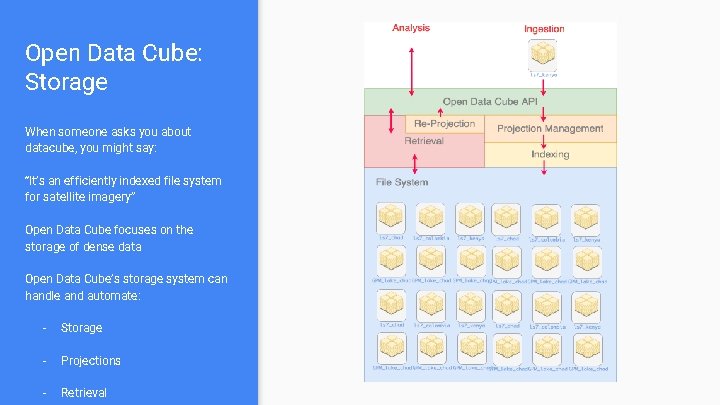
Open Data Cube: Storage When someone asks you about datacube, you might say: “It’s an efficiently indexed file system for satellite imagery” Open Data Cube focuses on the storage of dense data Open Data Cube’s storage system can handle and automate: - Storage - Projections - Retrieval
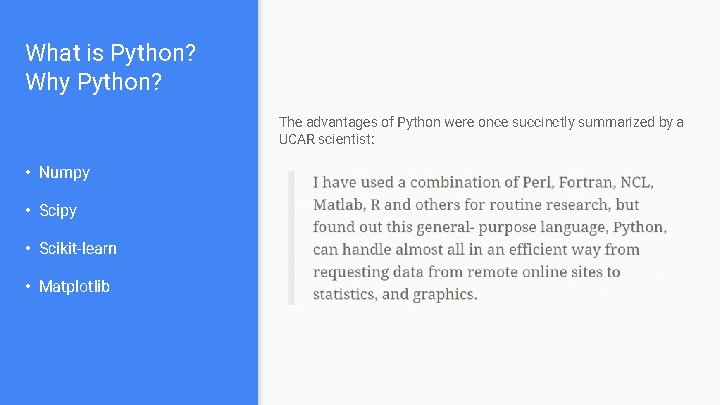
What is Python? Why Python? The advantages of Python were once succinctly summarized by a UCAR scientist: • Numpy • Scikit-learn • Matplotlib
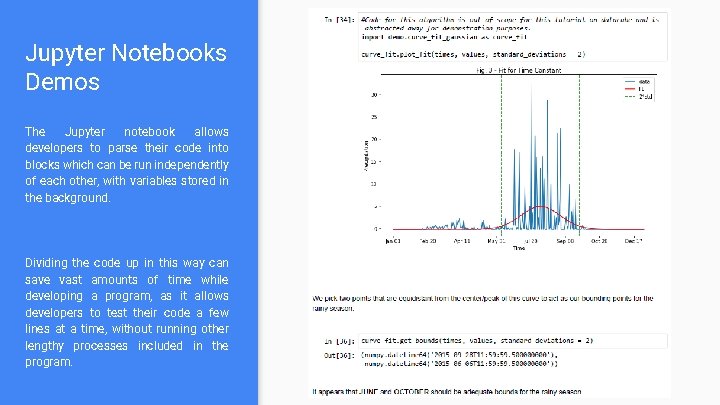
Jupyter Notebooks Demos The Jupyter notebook allows developers to parse their code into blocks which can be run independently of each other, with variables stored in the background. Dividing the code up in this way can save vast amounts of time while developing a program, as it allows developers to test their code a few lines at a time, without running other lengthy processes included in the program.
- Slides: 6