
Open charm measurements with CBM M Deveaux Goethe
Open charm measurements with CBM M. Deveaux, Goethe University Frankfurt on behalf of the CBM collaboration.
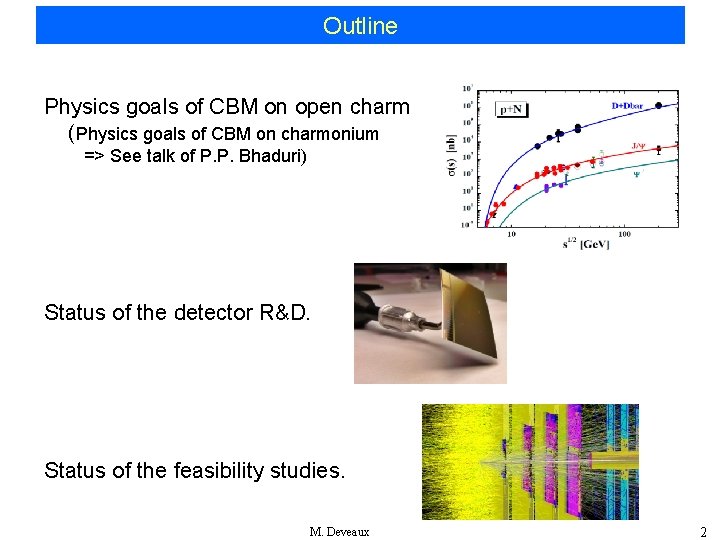
Outline Physics goals of CBM on open charm (Physics goals of CBM on charmonium => See talk of P. P. Bhaduri) Status of the detector R&D. Status of the feasibility studies. M. Deveaux 2
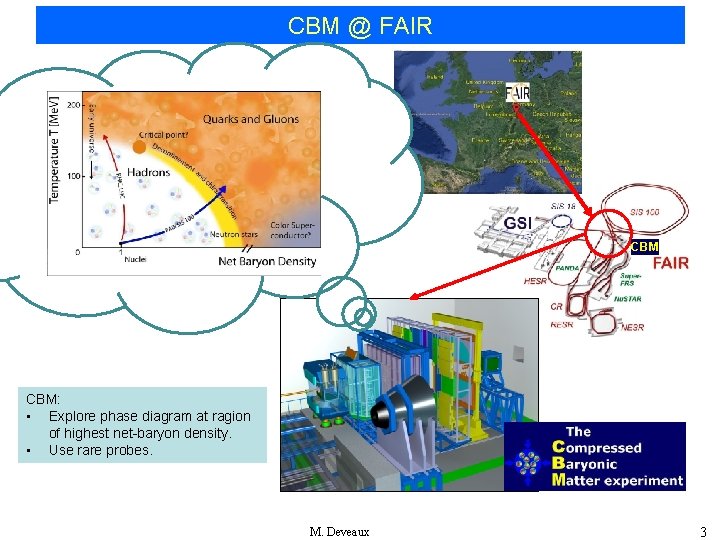
CBM @ FAIR 999 CBM: • Explore phase diagram at ragion of highest net-baryon density. • Use rare probes. M. Deveaux 3
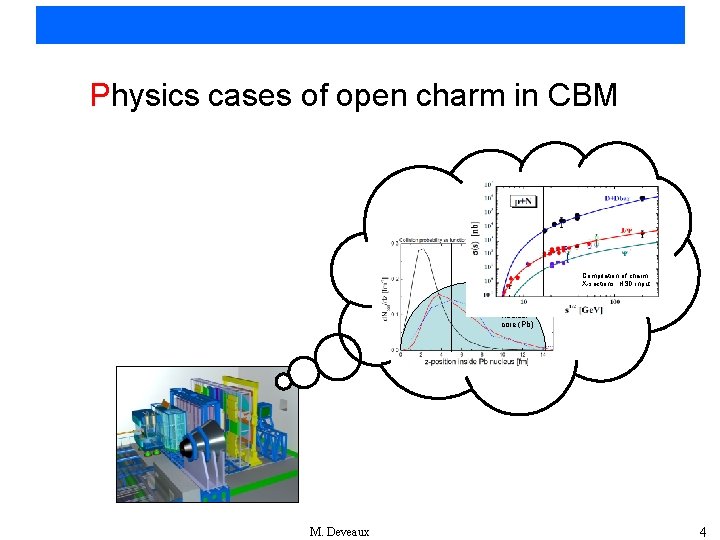
Physics cases of open charm in CBM Compilation of charm X-sections, HSD input Nuclear core (Pb) M. Deveaux 4
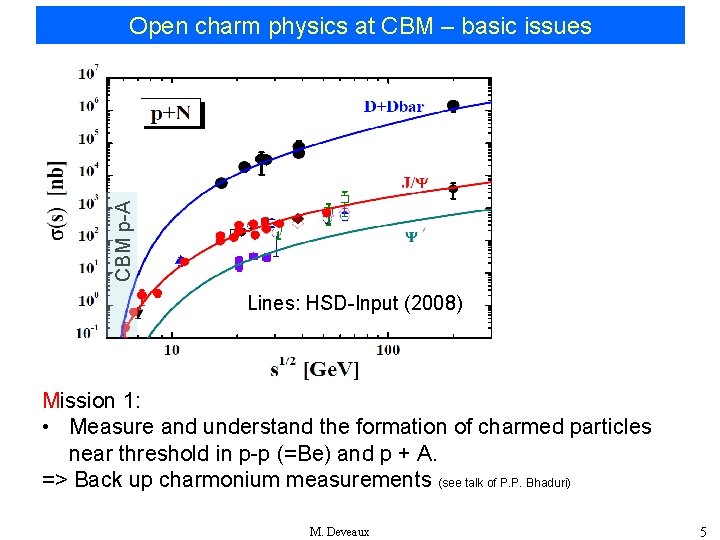
CBM p-A Open charm physics at CBM – basic issues Lines: HSD-Input (2008) Mission 1: • Measure and understand the formation of charmed particles near threshold in p-p (=Be) and p + A. => Back up charmonium measurements (see talk of P. P. Bhaduri) M. Deveaux 5
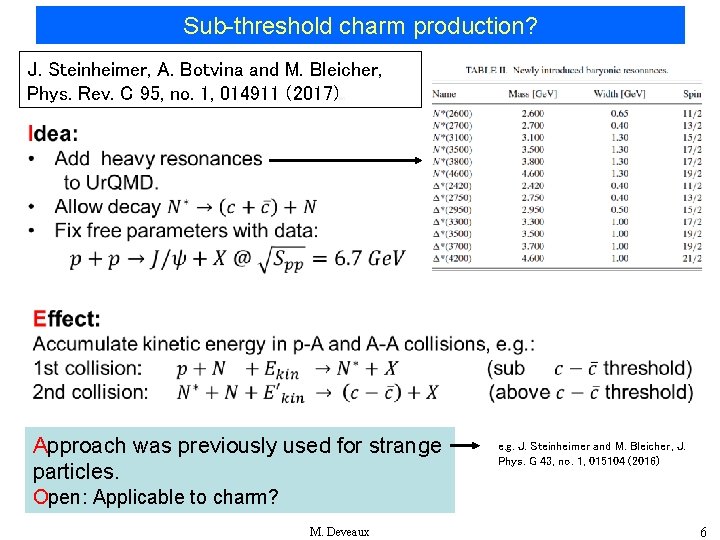
Sub-threshold charm production? J. Steinheimer, A. Botvina and M. Bleicher, Phys. Rev. C 95, no. 1, 014911 (2017) an Approach was previously used for strange particles. e. g. J. Steinheimer and M. Bleicher, J. Phys. G 43, no. 1, 015104 (2016) Open: Applicable to charm? M. Deveaux 6
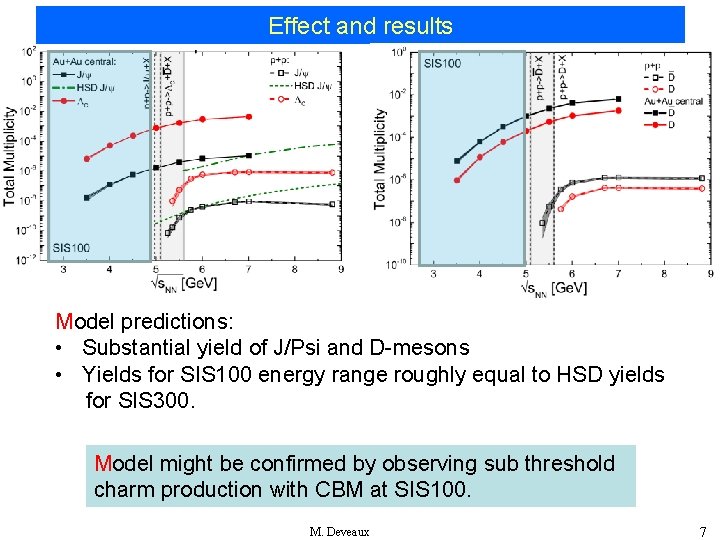
Effect and results Model predictions: • Substantial yield of J/Psi and D-mesons • Yields for SIS 100 energy range roughly equal to HSD yields for SIS 300. Model might be confirmed by observing sub threshold charm production with CBM at SIS 100. M. Deveaux 7
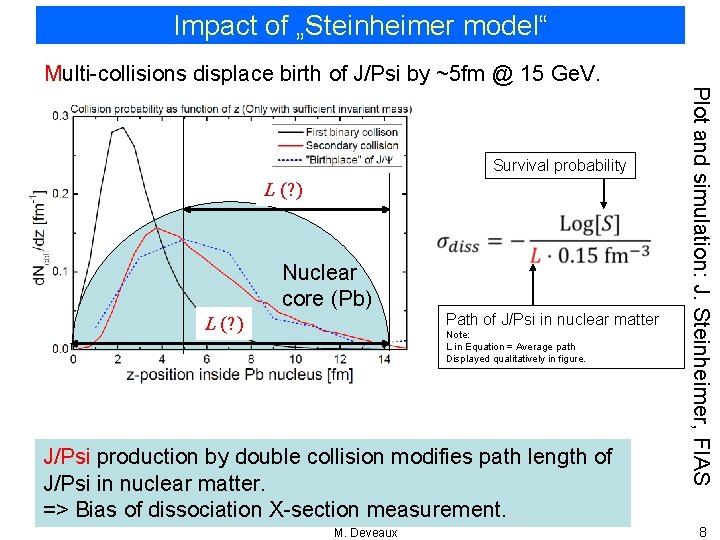
Impact of „Steinheimer model“ Multi-collisions displace birth of J/Psi by ~5 fm @ 15 Ge. V. L (? ) Nuclear core (Pb) L (? ) Path of J/Psi in nuclear matter Note: L in Equation = Average path Displayed qualitatively in figure. J/Psi production by double collision modifies path length of J/Psi in nuclear matter. => Bias of dissociation X-section measurement. M. Deveaux Plot and simulation: J. Steinheimer, FIAS Survival probability 8
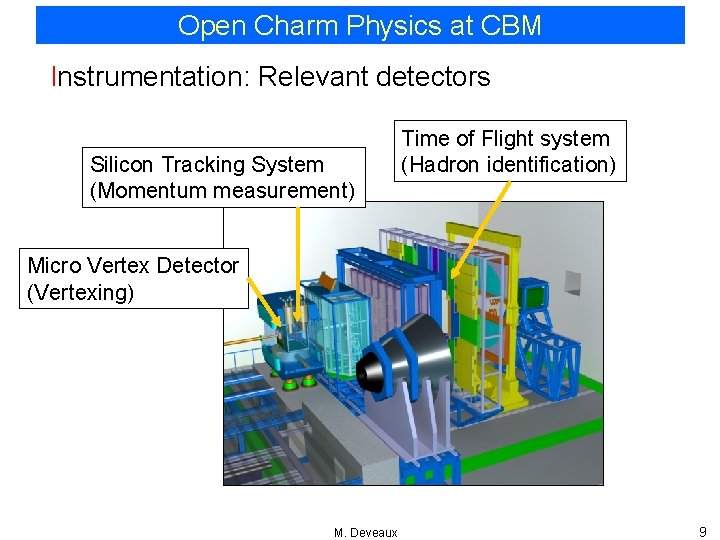
Open Charm Physics at CBM Instrumentation: Relevant detectors Silicon Tracking System (Momentum measurement) Time of Flight system (Hadron identification) Micro Vertex Detector (Vertexing) M. Deveaux 9
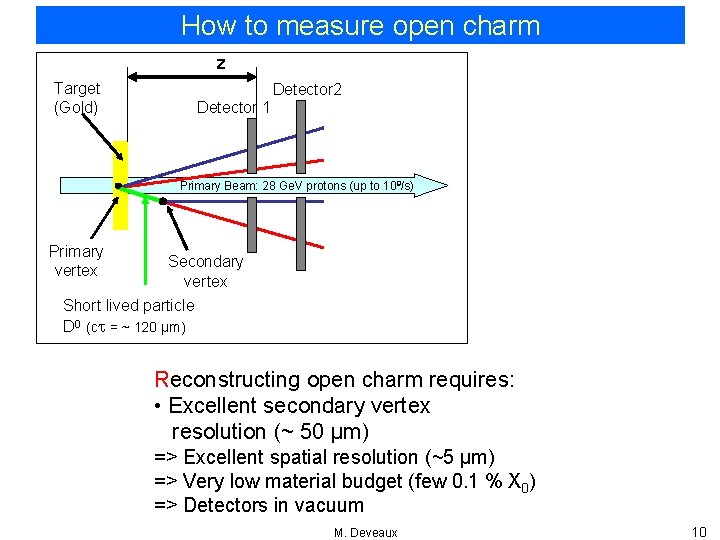
How to measure open charm z Target (Gold) Detector 2 Detector 1 Primary Beam: 28 Ge. V protons (up to 109/s) Primary vertex Secondary vertex Short lived particle D 0 (ct = ~ 120 µm) Reconstructing open charm requires: • Excellent secondary vertex resolution (~ 50 µm) => Excellent spatial resolution (~5 µm) => Very low material budget (few 0. 1 % X 0) => Detectors in vacuum M. Deveaux 10
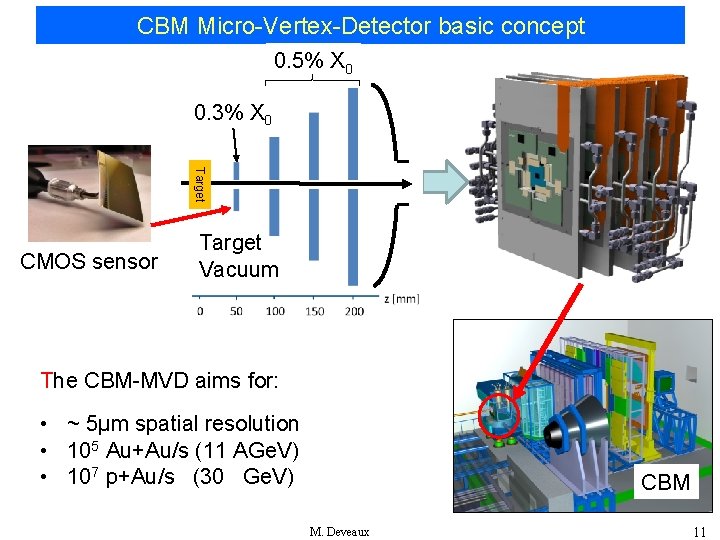
CBM Micro-Vertex-Detector basic concept 0. 5% X 0 0. 3% X 0 Target CMOS sensor Target Vacuum The CBM-MVD aims for: • ~ 5µm spatial resolution • 105 Au+Au/s (11 AGe. V) • 107 p+Au/s (30 Ge. V) CBM M. Deveaux 11
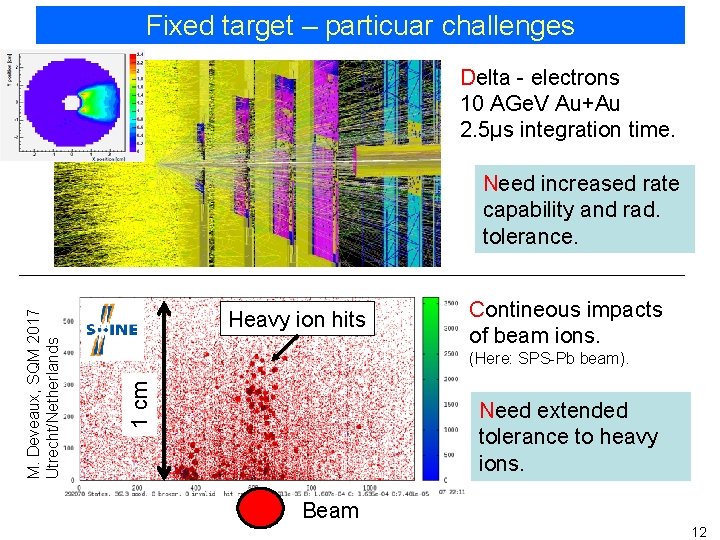
Fixed target – particuar challenges Delta - electrons 10 AGe. V Au+Au 2. 5µs integration time. Heavy ion hits Contineous impacts of beam ions. (Here: SPS-Pb beam). 1 cm M. Deveaux, SQM 2017 Utrecht/Netherlands Need increased rate capability and rad. tolerance. Need extended tolerance to heavy ions. Beam 12
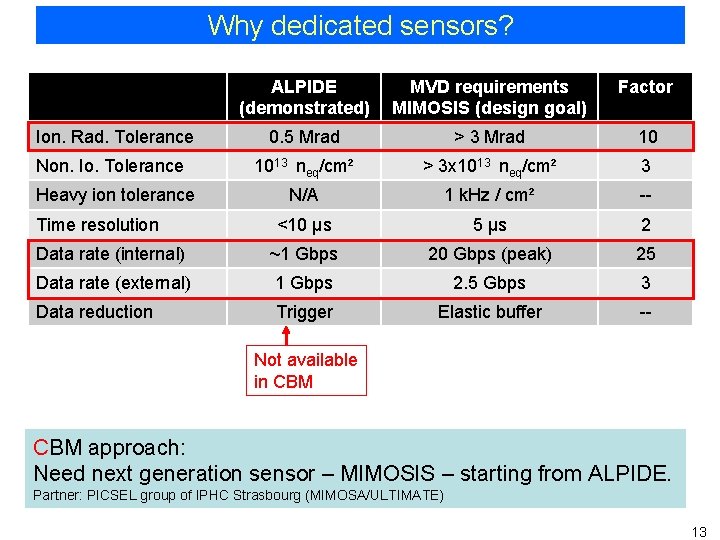
Why dedicated sensors? ALPIDE (demonstrated) MVD requirements MIMOSIS (design goal) Factor Ion. Rad. Tolerance 0. 5 Mrad > 3 Mrad 10 Non. Io. Tolerance 1013 neq/cm² > 3 x 10¹³ neq/cm² 3 N/A 1 k. Hz / cm² -- <10 µs 5 µs 2 Data rate (internal) ~1 Gbps 20 Gbps (peak) 25 Data rate (external) 1 Gbps 2. 5 Gbps 3 Data reduction Trigger Elastic buffer -- Heavy ion tolerance Time resolution Not available in CBM approach: Need next generation sensor – MIMOSIS – starting from ALPIDE. Partner: PICSEL group of IPHC Strasbourg (MIMOSA/ULTIMATE) 13
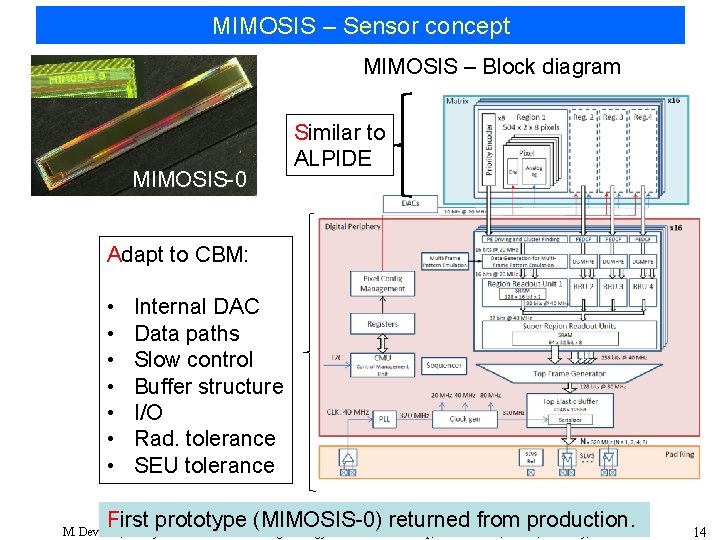
MIMOSIS – Sensor concept MIMOSIS – Block diagram MIMOSIS-0 Similar to ALPIDE Adapt to CBM: • • Internal DAC Data paths Slow control Buffer structure I/O Rad. tolerance SEU tolerance First prototype (MIMOSIS-0) returned from production. M. Deveaux, Heavy Flavor Production in High-Energy Collisions Workshop, 31 Oct. 2017, LBNL, Berkeley, USA 14
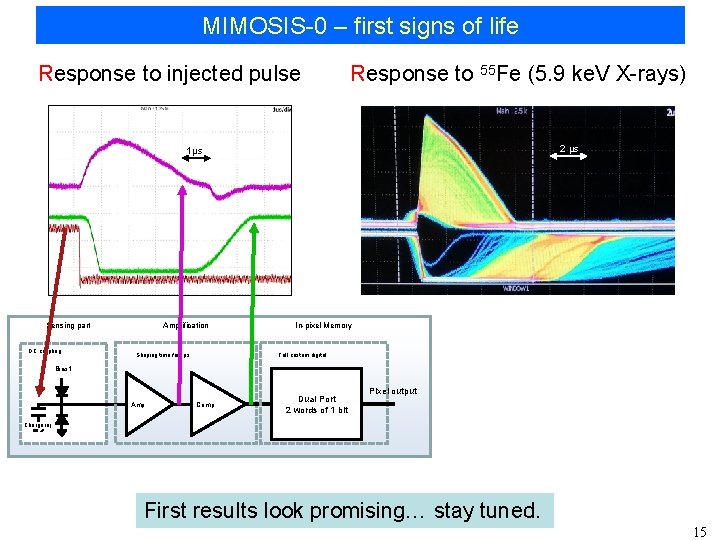
MIMOSIS-0 – first signs of life Response to injected pulse Response to 55 Fe (5. 9 ke. V X-rays) 2 µs 1µs Sensing part DC coupling Amplification Shaping time few µs In-pixel Memory Full custom digital Bias 1 Amp Comp Dual Port 2 words of 1 bit Pixel output Charge inj. 160 a. F First results look promising… stay tuned. M. Deveaux 15
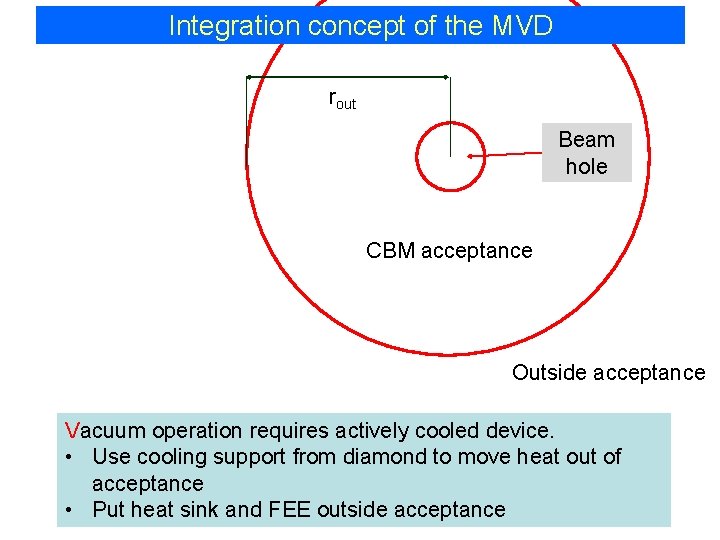
Integration concept of the MVD rout Beam hole CBM acceptance Outside acceptance Vacuum operation requires actively cooled device. • Use cooling support from diamond to move heat out of acceptance • Put heat sink and FEE outside acceptance
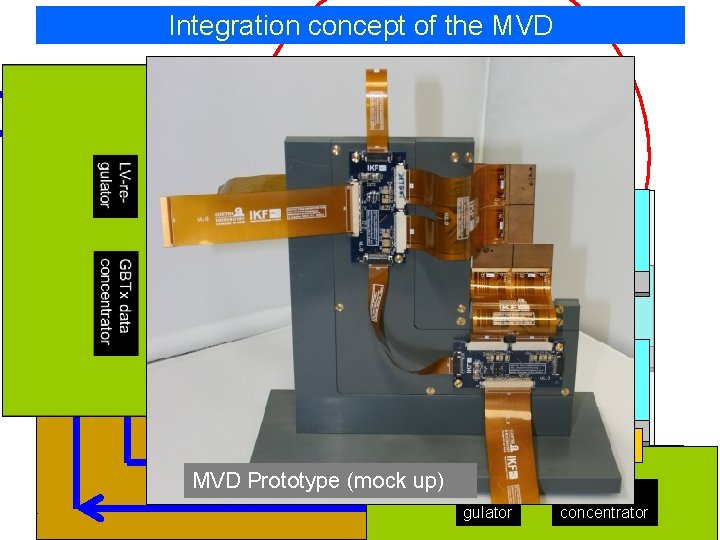
Integration concept of the MVD Sensor Discri MVD Prototype (mock up) M. Deveaux LV-regulator GBTx data concentrator 17
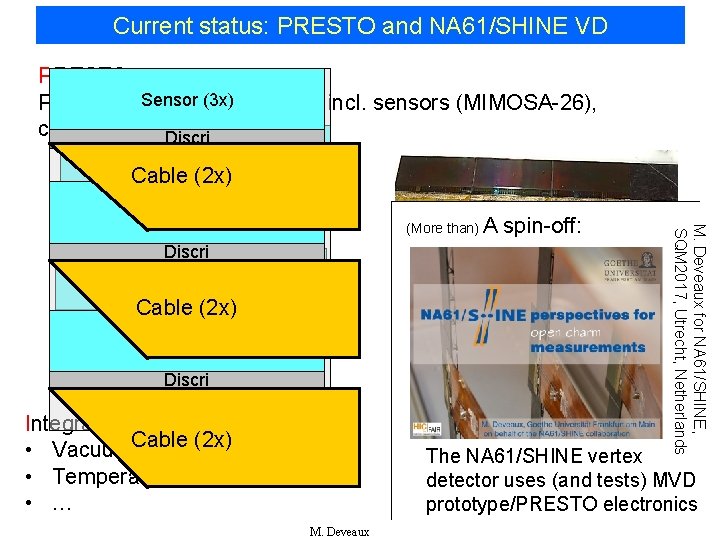
Current status: PRESTO and NA 61/SHINE VD PRESTO: Sensor (3 x) Prototype of a quarter station incl. sensors (MIMOSA-26), cables, support etc. Discri Cable (2 x) Sensor Discri Integration completed. Test: Cable (2 x) • Vacuum compatibility • Temperature cycling • … M. Deveaux for NA 61/SHINE, SQM 2017, Utrecht, Netherlands (More than) A spin-off: The NA 61/SHINE vertex detector uses (and tests) MVD prototype/PRESTO electronics M. Deveaux
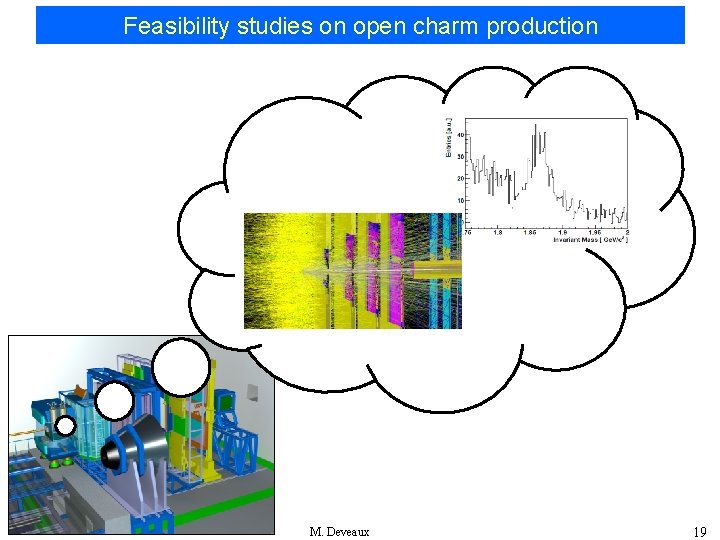
Feasibility studies on open charm production M. Deveaux 19
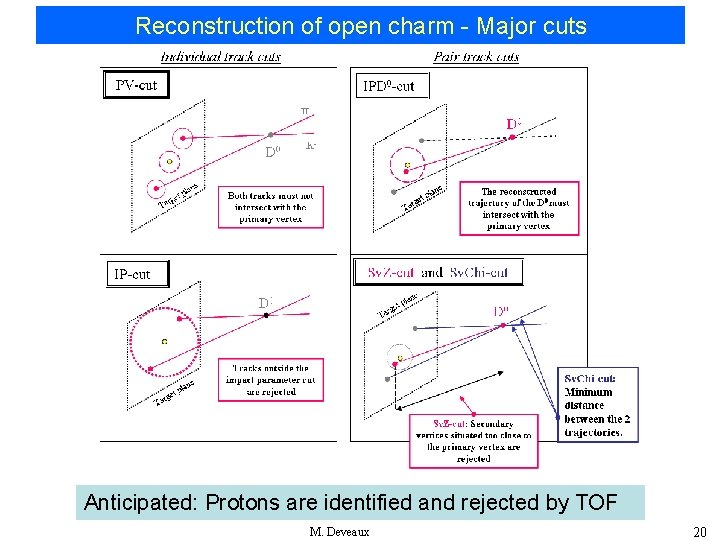
Reconstruction of open charm - Major cuts Anticipated: Protons are identified and rejected by TOF M. Deveaux 20
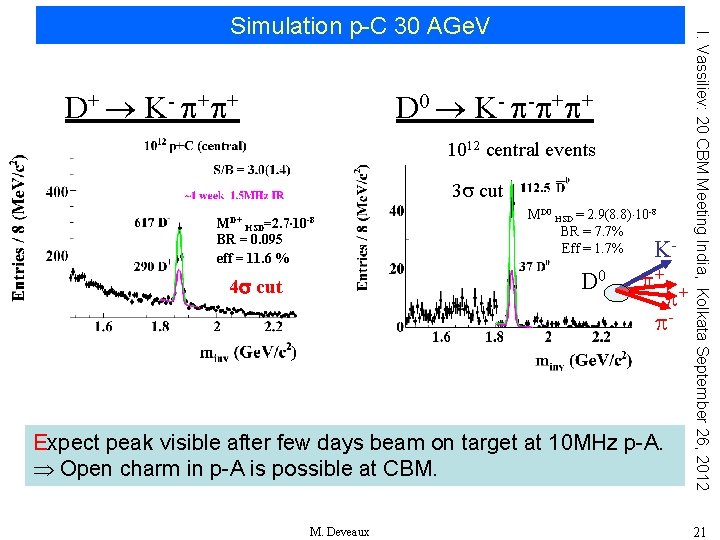
D 0 K - - + + D+ K- + + 1012 central events 3 cut MD+ HSD=2. 7 10 -8 BR = 0. 095 eff = 11. 6 % MD 0 HSD = 2. 9(8. 8) 10 -8 BR = 7. 7% Eff = 1. 7% D 0 4 cut K + + - Expect peak visible after few days beam on target at 10 MHz p-A. Þ Open charm in p-A is possible at CBM. M. Deveaux I. Vassiliev: 20 CBM Meeting India, Kolkata September 26, 2012 Simulation p-C 30 AGe. V 21
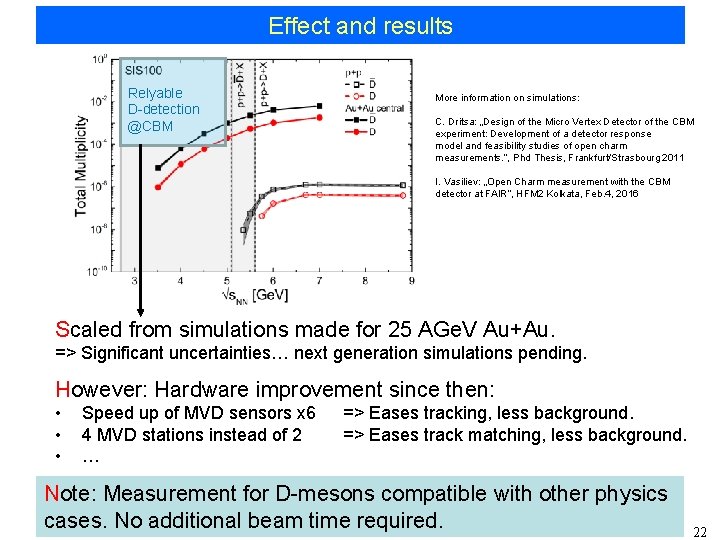
Effect and results Relyable D-detection @CBM More information on simulations: C. Dritsa: „Design of the Micro Vertex Detector of the CBM experiment: Development of a detector response model and feasibility studies of open charm measurements. “, Phd Thesis, Frankfurt/Strasbourg 2011 I. Vasiliev: „Open Charm measurement with the CBM detector at FAIR”, HFM 2 Kolkata, Feb. 4, 2016 Scaled from simulations made for 25 AGe. V Au+Au. => Significant uncertainties… next generation simulations pending. However: Hardware improvement since then: • • • Speed up of MVD sensors x 6 4 MVD stations instead of 2 … => Eases tracking, less background. => Eases track matching, less background. Note: Measurement for D-mesons compatible with other physics cases. No additional beam time required. M. Deveaux 22
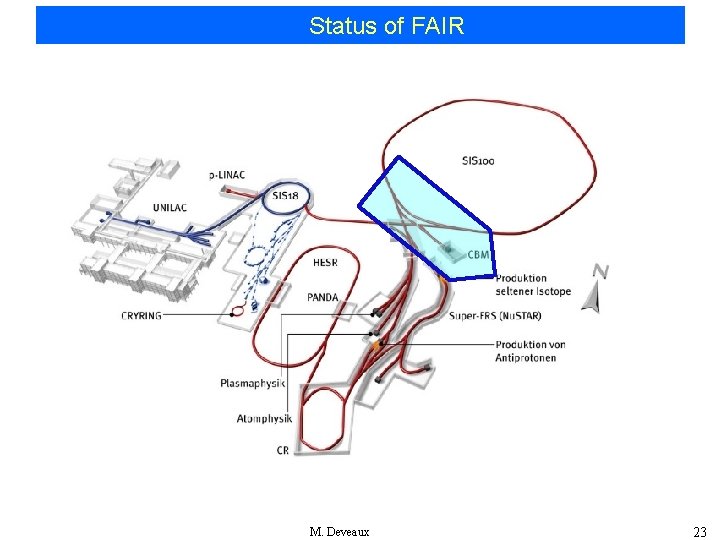
Status of FAIR M. Deveaux 23
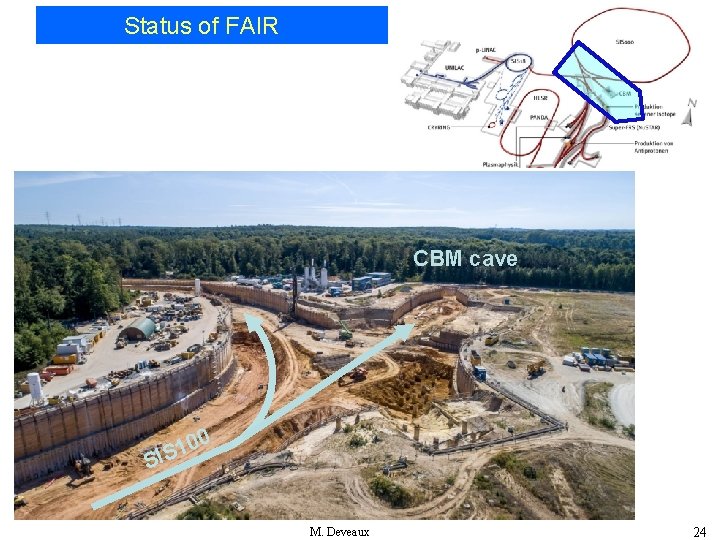
Status of FAIR CBM cave S 0 0 1 IS M. Deveaux 24
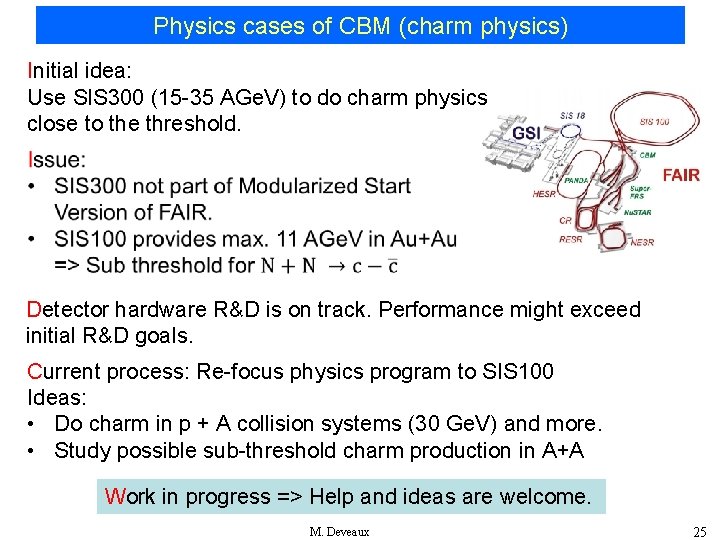
Physics cases of CBM (charm physics) Initial idea: Use SIS 300 (15 -35 AGe. V) to do charm physics close to the threshold. Detector hardware R&D is on track. Performance might exceed initial R&D goals. Current process: Re-focus physics program to SIS 100 Ideas: • Do charm in p + A collision systems (30 Ge. V) and more. • Study possible sub-threshold charm production in A+A Work in progress => Help and ideas are welcome. M. Deveaux 25
The team The PICSEL group of IPHC Strasbourg Group Prof. J. Stroth, Goethe Uni Frankfurt/M The CBM collaboration M. Deveaux 26
Backup M. Deveaux 27
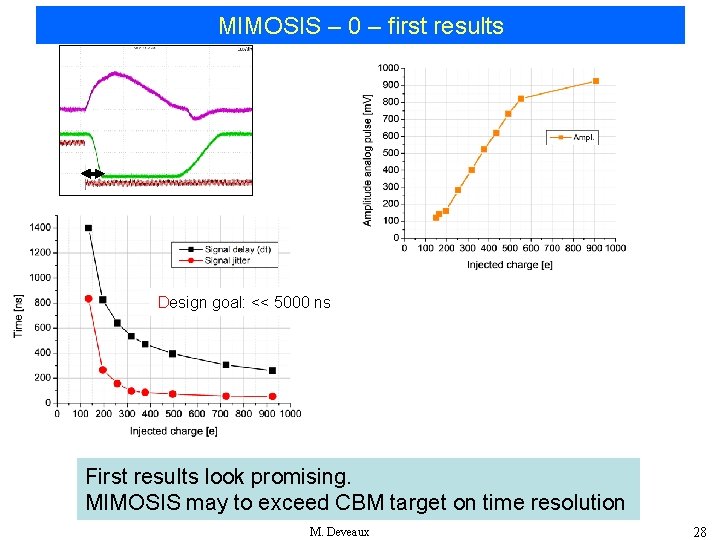
MIMOSIS – 0 – first results Design goal: << 5000 ns First results look promising. MIMOSIS may to exceed CBM target on time resolution M. Deveaux 28
- Slides: 28