
Open Access Institutional Repositories and the role of


- Slides: 61
Open Access, Institutional Repositories and the role of research libraries Norbert Lossau § Göttingen State and University Library, Germany § Budapest, 10 July 2008 §
Topics § § I Open Access II Institutional Repositories III The role of libraries IV Recommendations how to implement OA and IRs in Hungary 2
=>The start: „Budapest Open Access Initiative (BOAI)“ , Dec. 1 -2, 2001 =>The „Berlin Declaration“ requests Free and unrestricted access to sciences and human knowledge representation worldwide (October 2003) Requests archive servers on the institutional level („institutional repositories“) Institutional repositories need to be networked in order to become a global, interoperable, trusted, long-term repository infrastructure (for Europe see: DRIVER) 3 3
„The University cancelled an undisclosed number of journals. It emphasized that the problem was runaway journal prices, not the library budget: ‘Berkeley will continue to face this runaway serials pricing even after the present budget crisis is over. ’” (Memorandum, Senate of the University of California at Berkeley, 4. September 2003) 4
An Open Letter to All University Presidents and Provosts Concerning Increasingly Expensive Journals, 2005 by Prof. Theodore Bergstrom, Economics Dept. UCL Santa Barbara and Prof. R. Preston Mc. Afee, Business, Economics & Management, California Institute of Technology „For nearly a century, a symbiotic relationship existed between scholars and scholarly publishers. Academics freely provided their discoveries, work, and time editing and reviewing, and scholarly publishers provided packaging and sold the output of the academics’ labors for a modest profit. This benefited both groups, because the publishers received the most valuable inputs for free, while the academics were sheltered from the business end of publishing and received the packaged output at reasonable profits. As the primary concern of academics is the wide dissemination of their ideas, the arrangement was suitable for both parties. “ 5
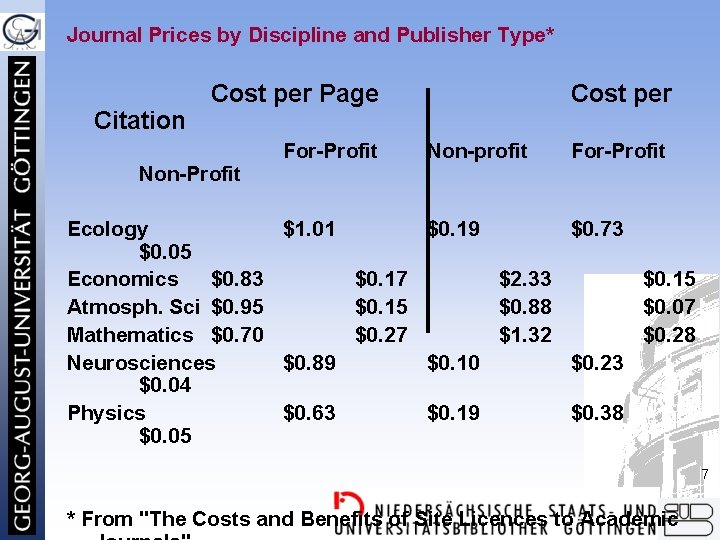
„In the 1970 s, some for-profit scholarly publishers discovered that library demands for journals were remarkably unresponsive to price increases and that the publishers could greatly increase their revenues by sharply increasing their prices. This is evidenced by the dramatic disparity that has emerged between the prices charged by for-profit publishers such as Elsevier, Wiley, and Kluwer, those charged by non -profit societies and university presses. This gap widened in the 1980 s and further widened in the 1990 s, so that the for-profit journals charge about five times as much per page and fifteen times as much per citation as the non 6 profits, as evidenced by. . “
Journal Prices by Discipline and Publisher Type* Citation Cost per Page Non-Profit For-Profit Cost per Non-profit For-Profit Ecology $1. 01 $0. 19 $0. 73 $0. 05 Economics $0. 83 $0. 17 $2. 33 $0. 15 Atmosph. Sci $0. 95 $0. 15 $0. 88 $0. 07 Mathematics $0. 70 $0. 27 $1. 32 $0. 28 Neurosciences $0. 89 $0. 10 $0. 23 $0. 04 Physics $0. 63 $0. 19 $0. 38 $0. 05 7 * From "The Costs and Benefits of Site Licences to Academic
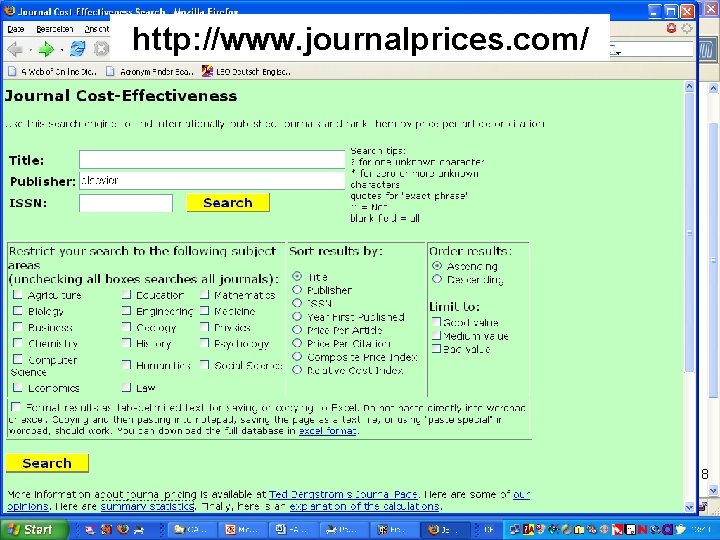
http: //www. journalprices. com/ 8
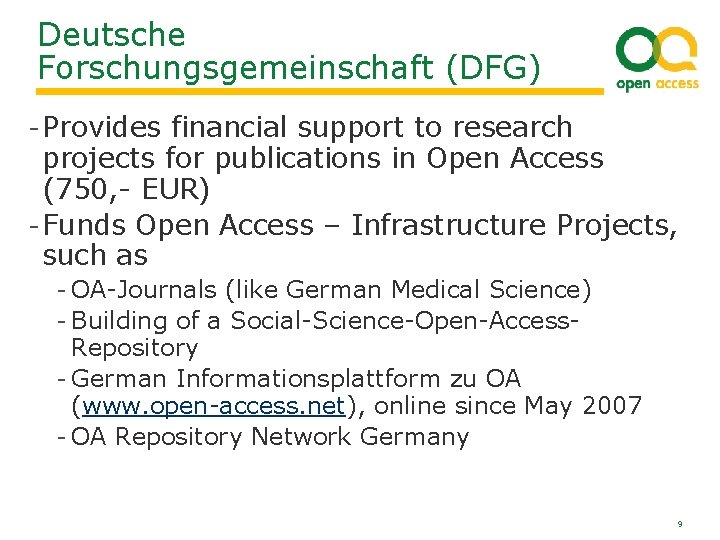
Deutsche Forschungsgemeinschaft (DFG) - Provides financial support to research projects for publications in Open Access (750, - EUR) - Funds Open Access – Infrastructure Projects, such as - OA-Journals (like German Medical Science) - Building of a Social-Science-Open-Access- Repository - German Informationsplattform zu OA (www. open-access. net), online since May 2007 - OA Repository Network Germany 9
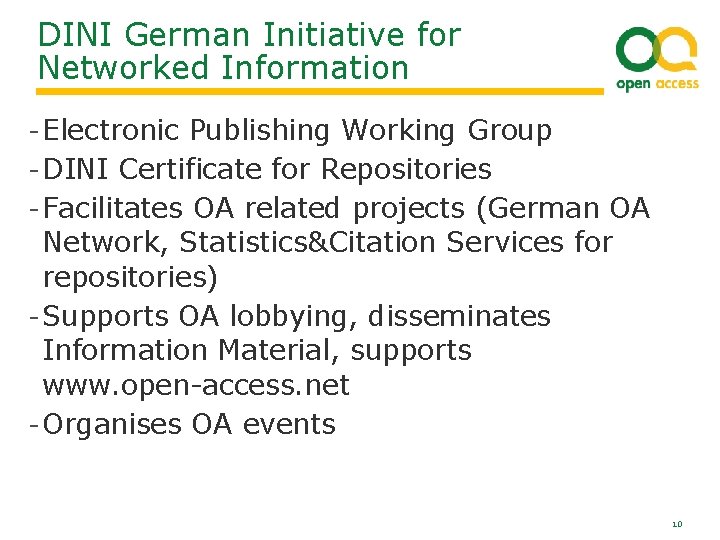
DINI German Initiative for Networked Information - Electronic Publishing Working Group - DINI Certificate for Repositories - Facilitates OA related projects (German OA Network, Statistics&Citation Services for repositories) - Supports OA lobbying, disseminates Information Material, supports www. open-access. net - Organises OA events 10
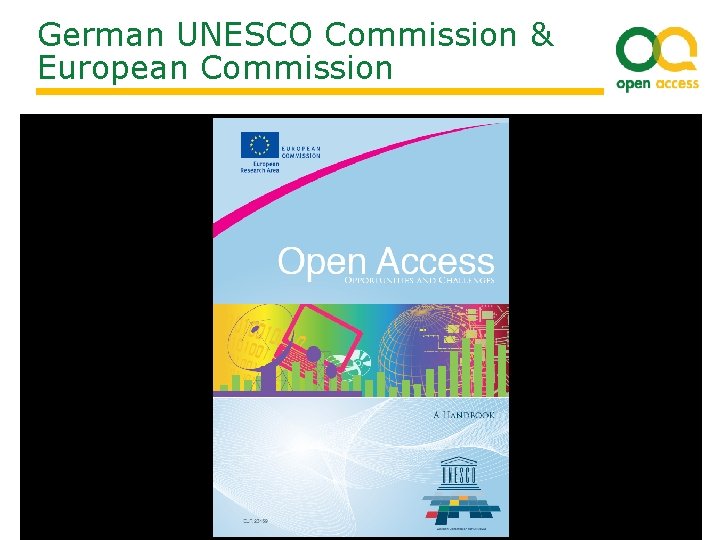
German UNESCO Commission & European Commission 11
Local OA-activities at Universities (<=research libraries) -OA-Resolutions -Provide locally tailored information „How to publish Open Access“ -Build up and drive document servers, e. Scholarship repositories -Support institutional memberships in OA publishers&journals -University Presses -Local advocacy Examples: HU and FU Berlin, Bielefeld, Göttingen, Hamburg, Konstanz, Stuttgart, … 12
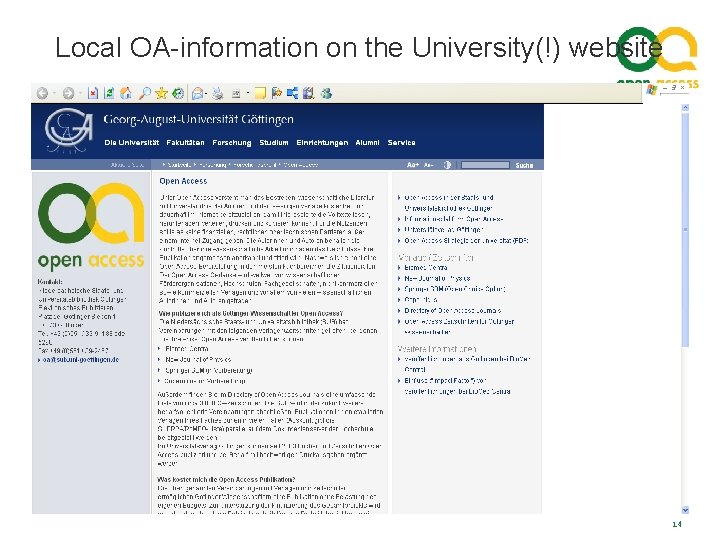
Göttingen University as an example -OA-Resolution published in December 2005 -Local OA-information on the University(!) website (since September 2007) 13
Local OA-information on the University(!) website 14
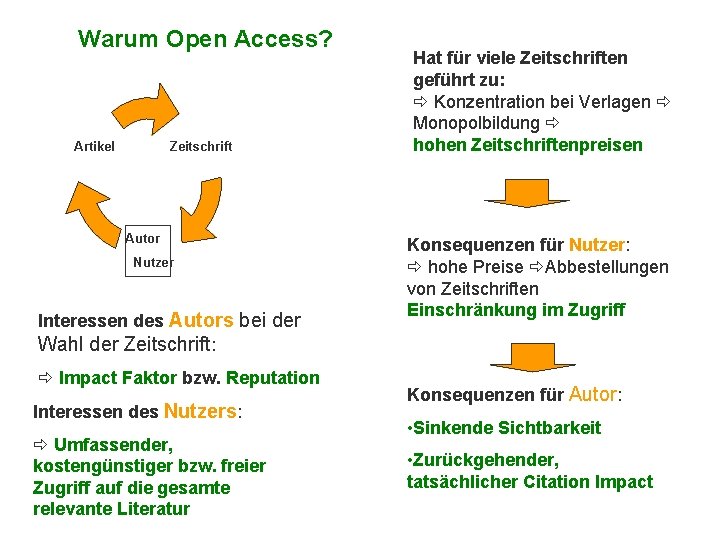
Warum Open Access? Zeitschrift Artikel Autor Nutzer Interessen des Autors bei der Wahl der Zeitschrift: Impact Faktor bzw. Reputation Interessen des Nutzers: Umfassender, kostengünstiger bzw. freier Zugriff auf die gesamte relevante Literatur Hat für viele Zeitschriften geführt zu: Konzentration bei Verlagen Monopolbildung hohen Zeitschriftenpreisen Konsequenzen für Nutzer: hohe Preise Abbestellungen von Zeitschriften Einschränkung im Zugriff Konsequenzen für Autor: • Sinkende Sichtbarkeit • Zurückgehender, tatsächlicher Citation Impact
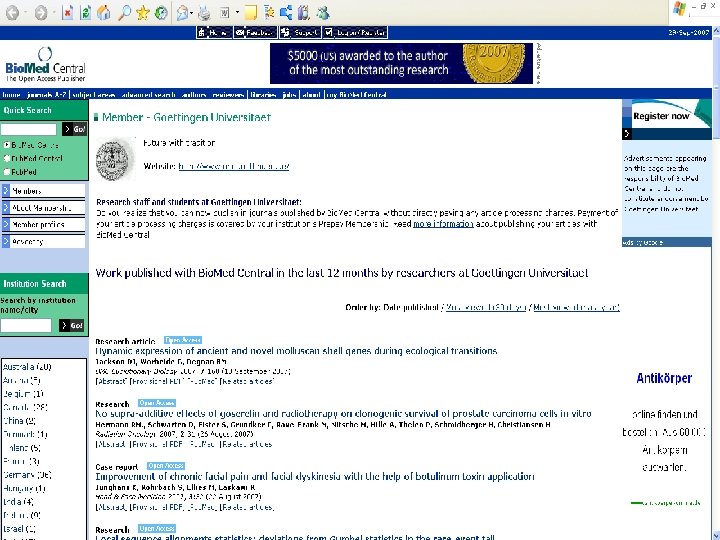
Göttingen University as an example -OA-Resolution published in December 2005 -Local OA-information on the University(!) website (since September 2007) -Agreements with publishers about OA publishing for Göttingen authors (Bio. Med Central, NJP, Springer SBM, others to follow) 16
17
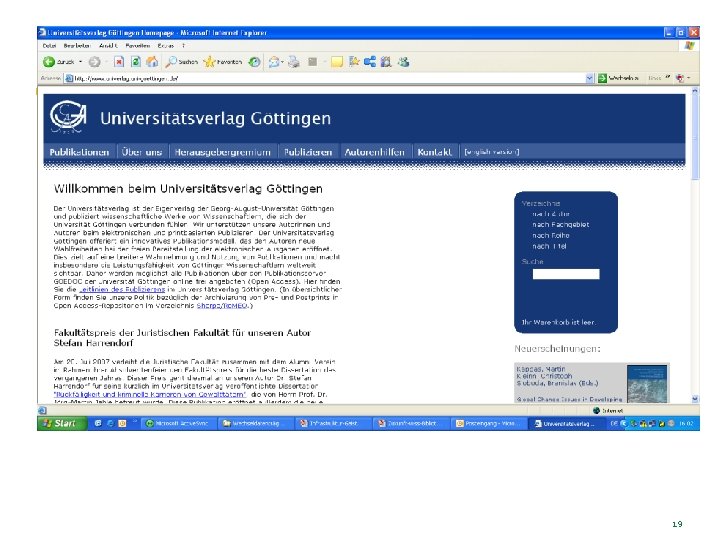
Göttingen University as an example -OA-Resolution published in December 2005 -Local OA-information on the University(!) website (since September 2007) -Agreements with publishers about OA publishing for Göttingen authors (Bio. Med Central, NJP, Springer SBM, others to follow) -Relaunch of the University‘s document- and GOEScholar repository -Göttingen University Press, an OA publisher 18
19
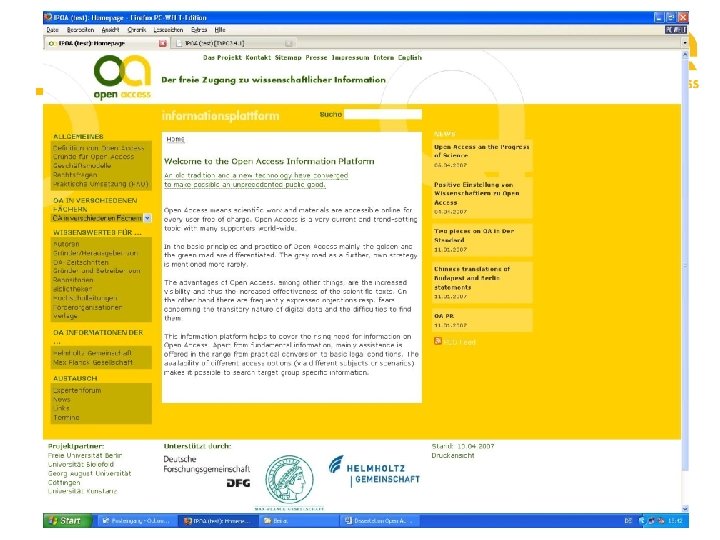
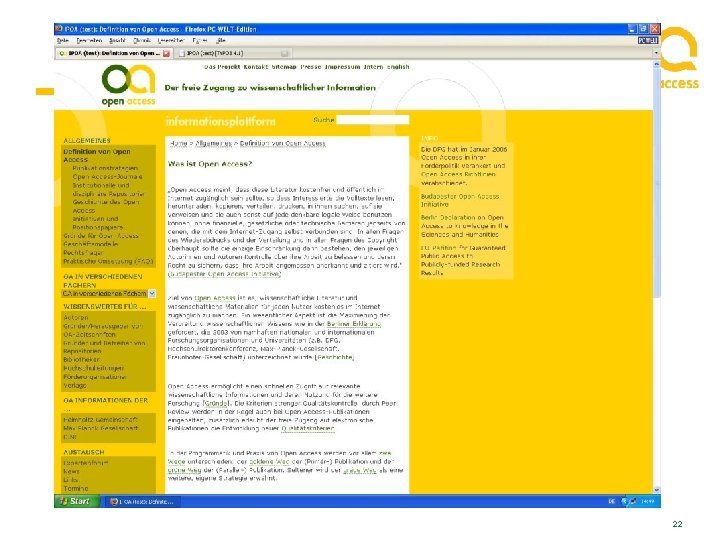
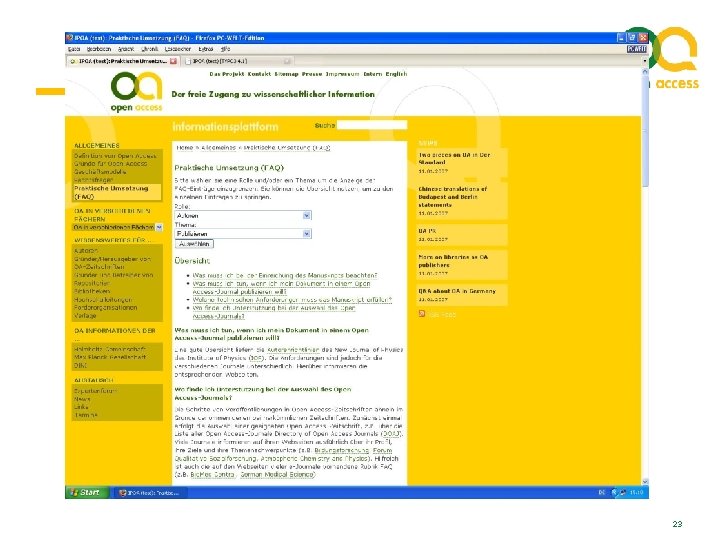
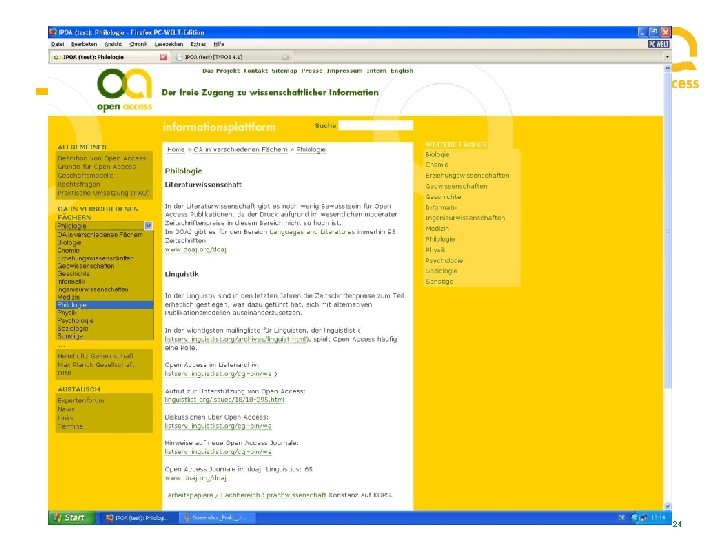
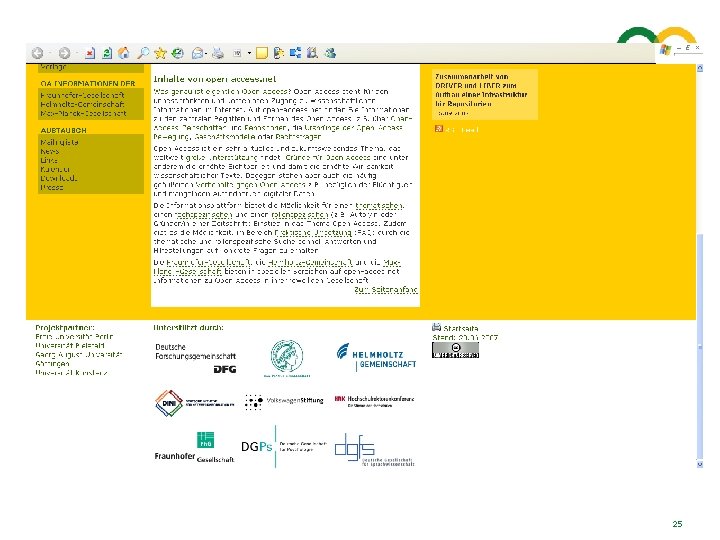
Göttingen University as an example -OA-Resolution published in December 2005 -Local OA-information on the University(!) website (since September 2007) -Agreements with publishers about OA publishing for Göttingen authors (Bio. Med Central, NJP, Springer SBM, others to follow) -Relaunch of the University‘s document- and GOEScholar repository -Göttingen University Press, an OA publisher -Host for www. open-access. net, closely collaborating with core partners FU Berlin, Bielefeld, Konstanz, MPG and many others 20
21
22
23
24
25
Topics § § I Open Access II Institutional Repositories III The role of libraries IV Recommendations how to implement OA and IRs in Hungary 26
Open. DOAR – The Directory of Open Access Repositories o o o Goal: Create the most comprehensive database of open access repositories Includes core information about repositories, such as language, country, repository software Initial co-funding by OSI, JISC, CURL, SPARC Europe 27 http: //www. opendoar. org/
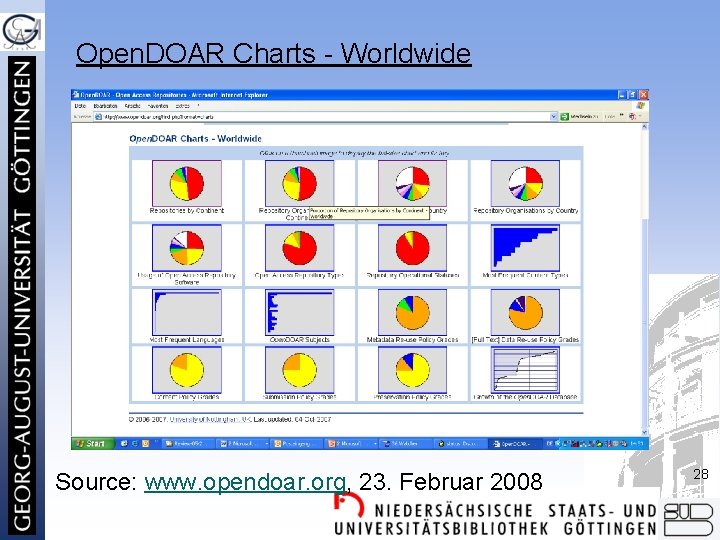
Open. DOAR Charts - Worldwide Source: www. opendoar. org, 23. Februar 2008 28
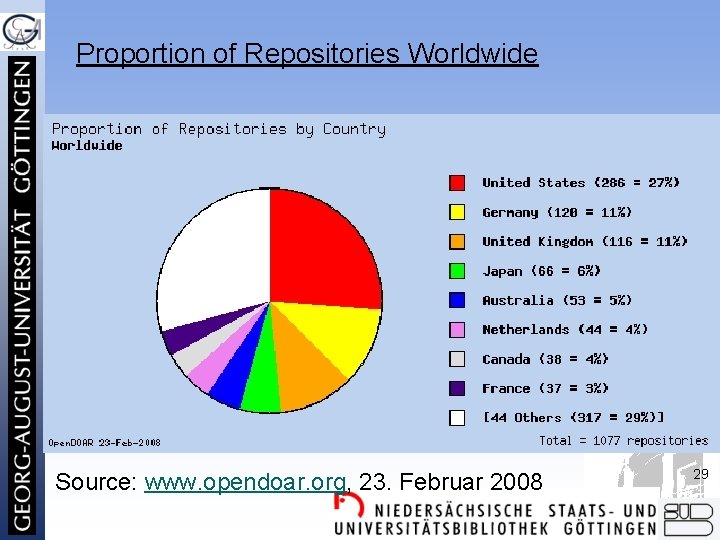
Proportion of Repositories Worldwide Source: www. opendoar. org, 23. Februar 2008 29
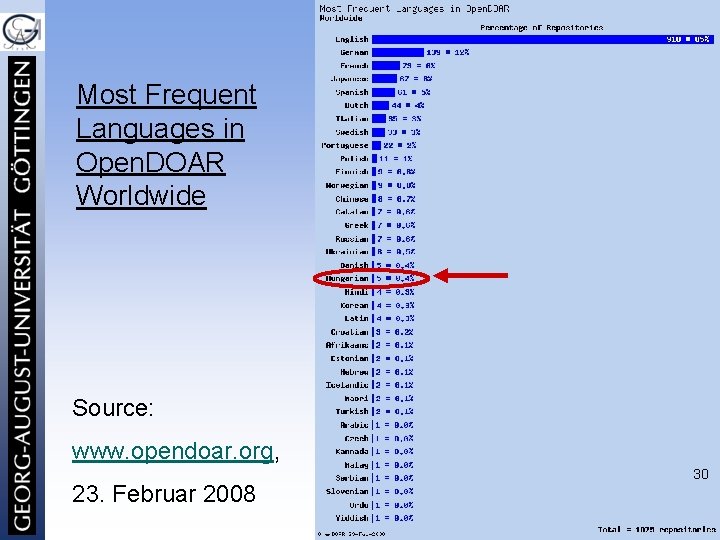
Most Frequent Languages in Open. DOAR Worldwide Source: www. opendoar. org, 23. Februar 2008 30
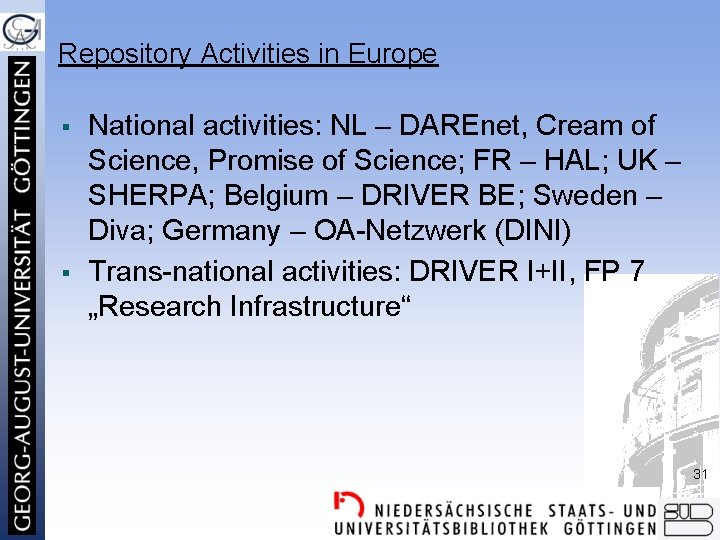
Repository Activities in Europe § § National activities: NL – DAREnet, Cream of Science, Promise of Science; FR – HAL; UK – SHERPA; Belgium – DRIVER BE; Sweden – Diva; Germany – OA-Netzwerk (DINI) Trans-national activities: DRIVER I+II, FP 7 „Research Infrastructure“ 31
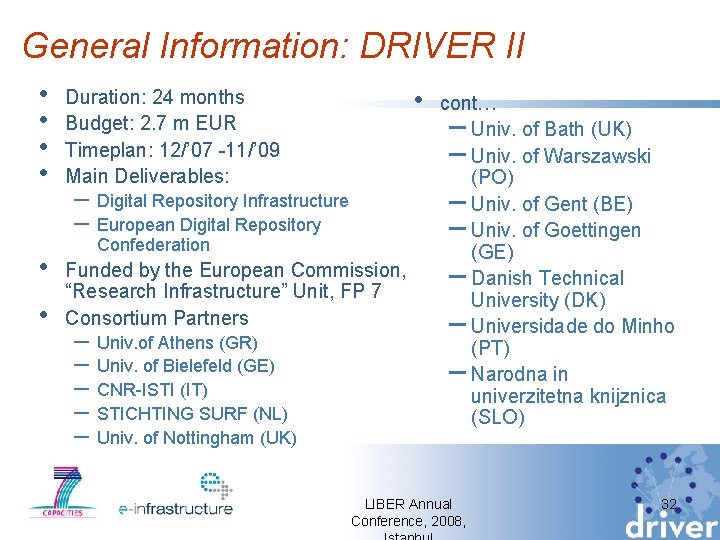
General Information: DRIVER II • • Duration: 24 months Budget: 2. 7 m EUR Timeplan: 12/’ 07 -11/’ 09 Main Deliverables: – Digital Repository Infrastructure – European Digital Repository Confederation Funded by the European Commission, “Research Infrastructure” Unit, FP 7 Consortium Partners – Univ. of Athens (GR) – Univ. of Bielefeld (GE) – CNR-ISTI (IT) – STICHTING SURF (NL) – Univ. of Nottingham (UK) cont… – Univ. of Bath (UK) – Univ. of Warszawski (PO) – Univ. of Gent (BE) – Univ. of Goettingen (GE) – Danish Technical University (DK) – Universidade do Minho (PT) – Narodna in univerzitetna knijznica (SLO) LIBER Annual Conference, 2008, 32
DRIVER History • DRIVER (I), started 1 June 2006, ended 30 November 2007 • DRIVER II, started 1 December 2007, ends 30 November 2009 • Recent event: DRIVER Summit 16/17 January 2008, Göttingen LIBER Annual Conference, 2008, 33
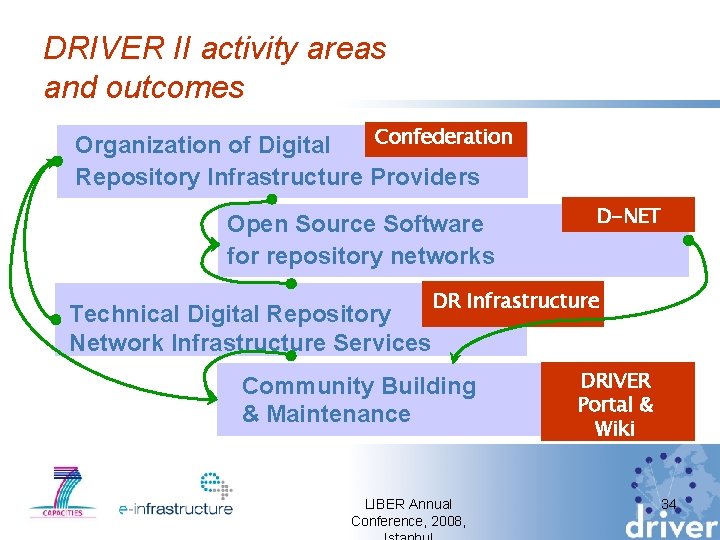
DRIVER II activity areas and outcomes Confederation Organization of Digital Repository Infrastructure Providers Open Source Software for repository networks Technical Digital Repository Network Infrastructure Services D-NET DR Infrastructure Community Building & Maintenance LIBER Annual Conference, 2008, DRIVER Portal & Wiki 34
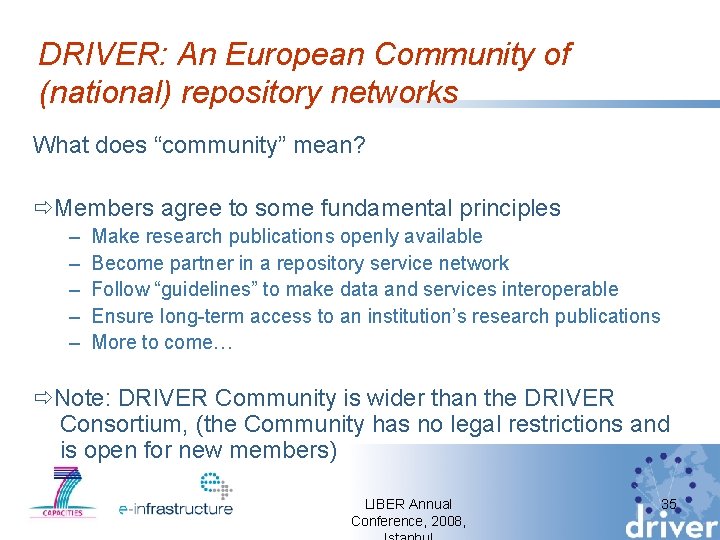
DRIVER: An European Community of (national) repository networks What does “community” mean? Members agree to some fundamental principles – – – Make research publications openly available Become partner in a repository service network Follow “guidelines” to make data and services interoperable Ensure long-term access to an institution’s research publications More to come… Note: DRIVER Community is wider than the DRIVER Consortium, (the Community has no legal restrictions and is open for new members) LIBER Annual Conference, 2008, 35
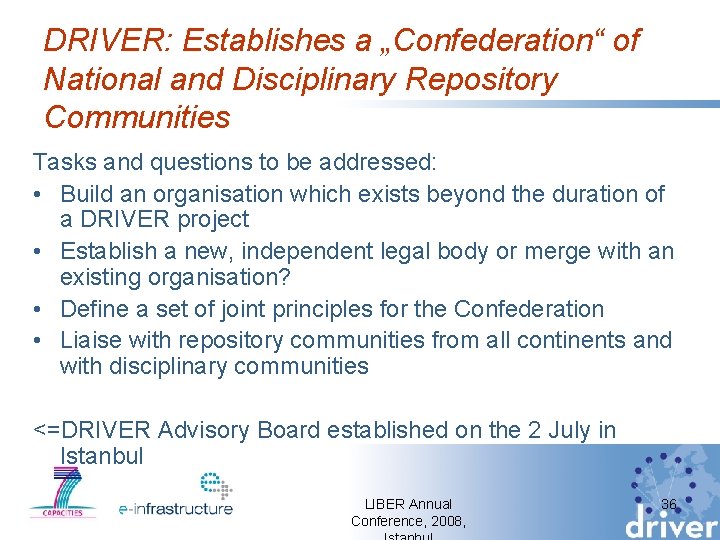
DRIVER: Establishes a „Confederation“ of National and Disciplinary Repository Communities Tasks and questions to be addressed: • Build an organisation which exists beyond the duration of a DRIVER project • Establish a new, independent legal body or merge with an existing organisation? • Define a set of joint principles for the Confederation • Liaise with repository communities from all continents and with disciplinary communities <=DRIVER Advisory Board established on the 2 July in Istanbul LIBER Annual Conference, 2008, 36
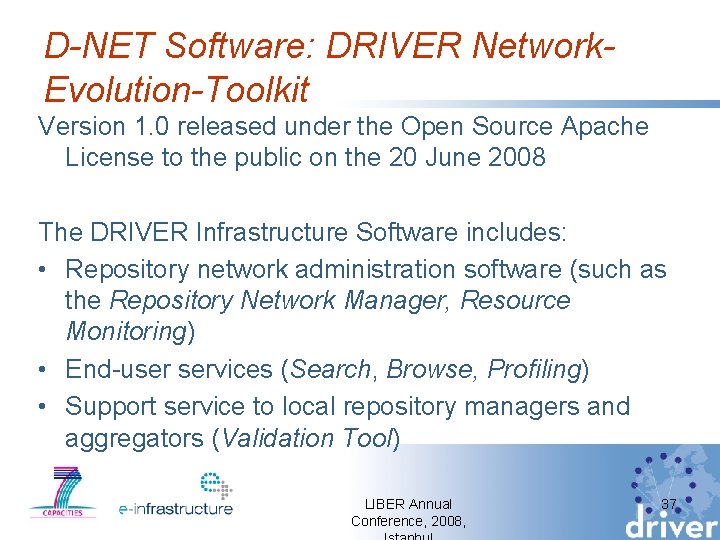
D-NET Software: DRIVER Network. Evolution-Toolkit Version 1. 0 released under the Open Source Apache License to the public on the 20 June 2008 The DRIVER Infrastructure Software includes: • Repository network administration software (such as the Repository Network Manager, Resource Monitoring) • End-user services (Search, Browse, Profiling) • Support service to local repository managers and aggregators (Validation Tool) LIBER Annual Conference, 2008, 37
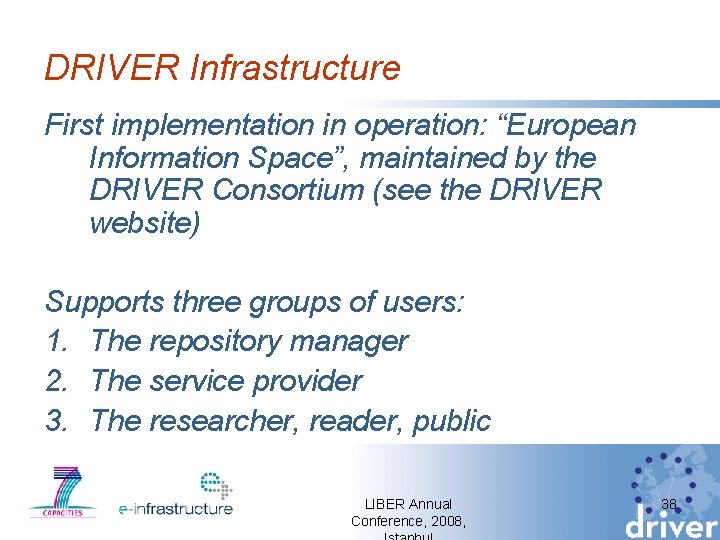
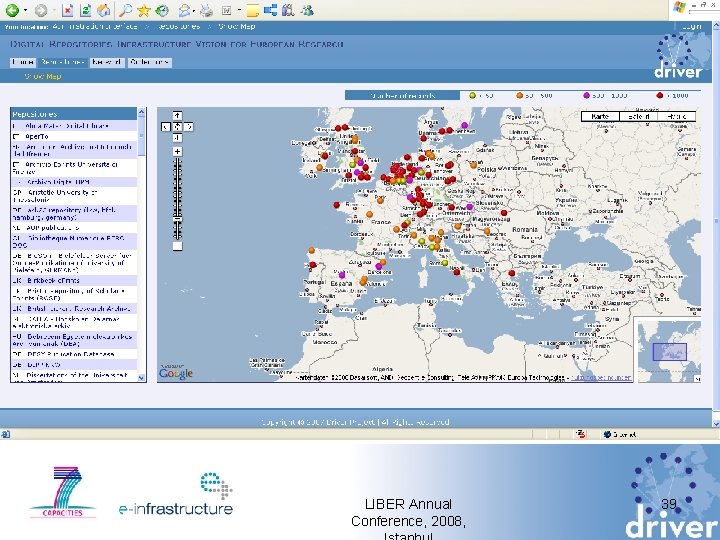
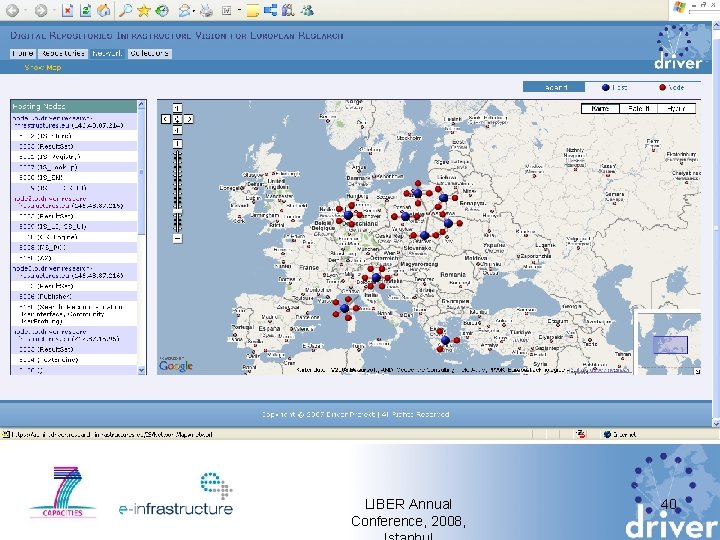
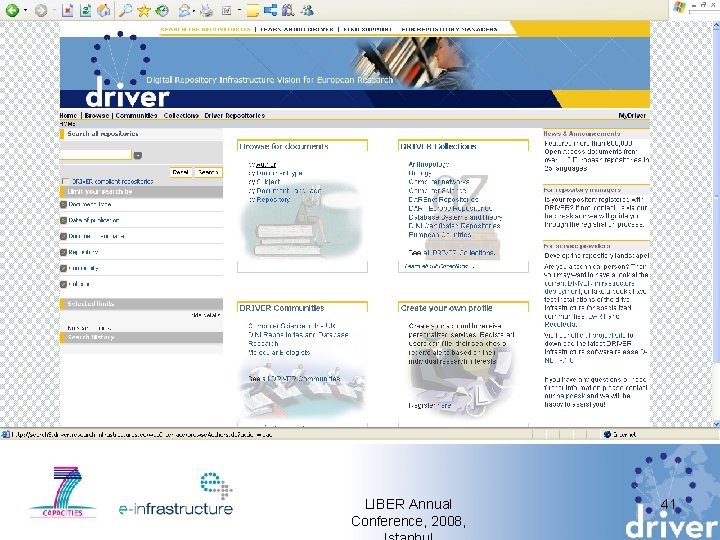
DRIVER Infrastructure First implementation in operation: “European Information Space”, maintained by the DRIVER Consortium (see the DRIVER website) Supports three groups of users: 1. The repository manager 2. The service provider 3. The researcher, reader, public LIBER Annual Conference, 2008, 38
LIBER Annual Conference, 2008, 39
LIBER Annual Conference, 2008, 40
LIBER Annual Conference, 2008, 41
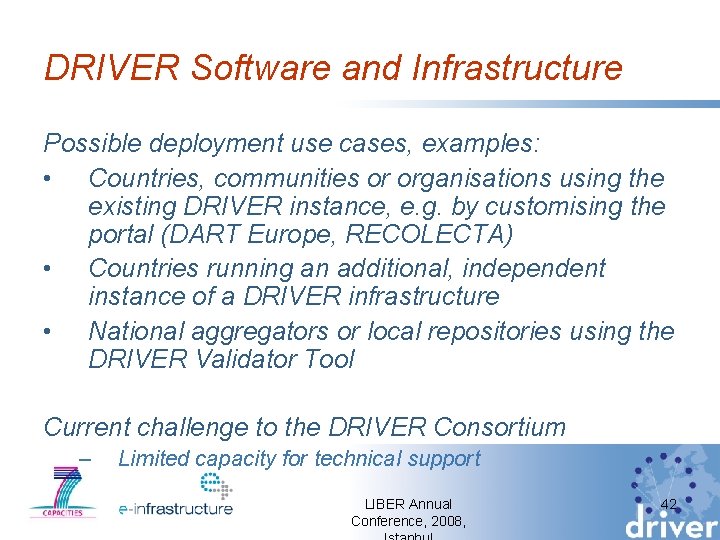
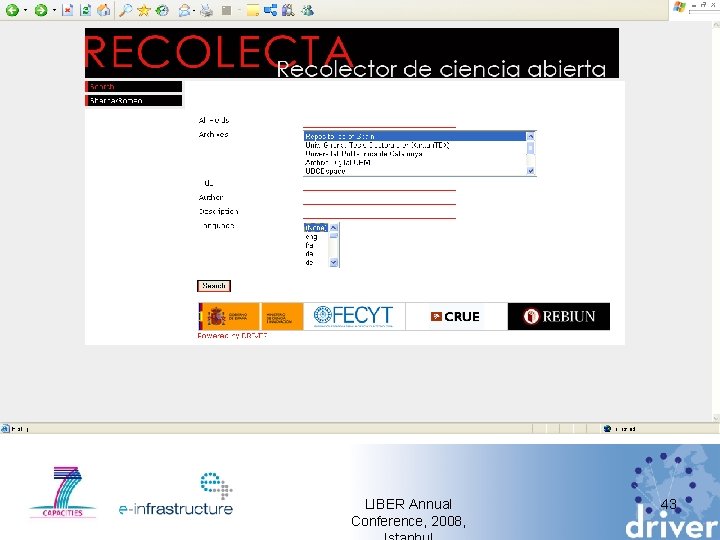
DRIVER Software and Infrastructure Possible deployment use cases, examples: • Countries, communities or organisations using the existing DRIVER instance, e. g. by customising the portal (DART Europe, RECOLECTA) • Countries running an additional, independent instance of a DRIVER infrastructure • National aggregators or local repositories using the DRIVER Validator Tool Current challenge to the DRIVER Consortium – Limited capacity for technical support LIBER Annual Conference, 2008, 42
LIBER Annual Conference, 2008, 43
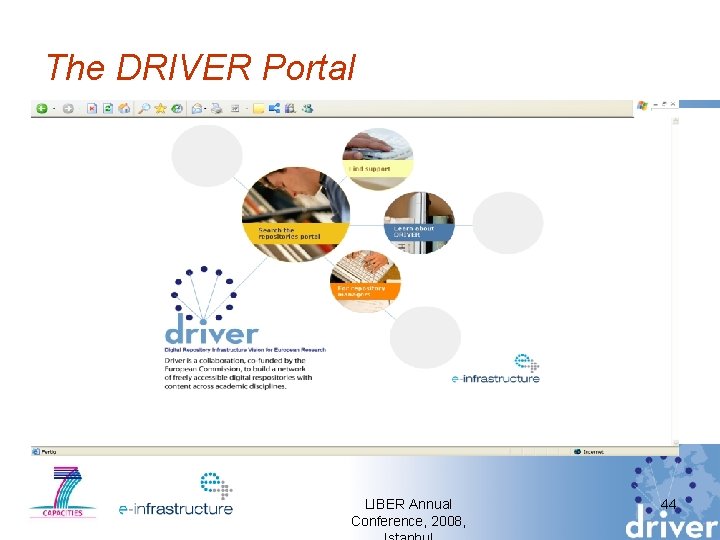
The DRIVER Portal LIBER Annual Conference, 2008, 44
LIBER Annual Conference, 2008, 45
LIBER Annual Conference, 2008, 46
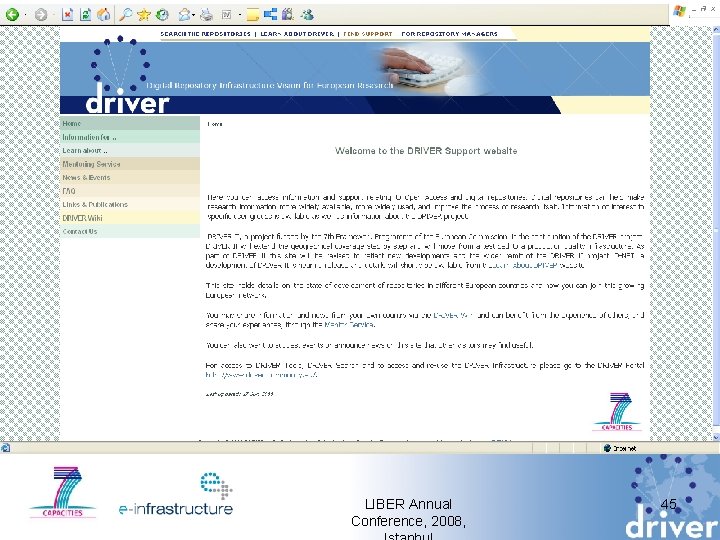
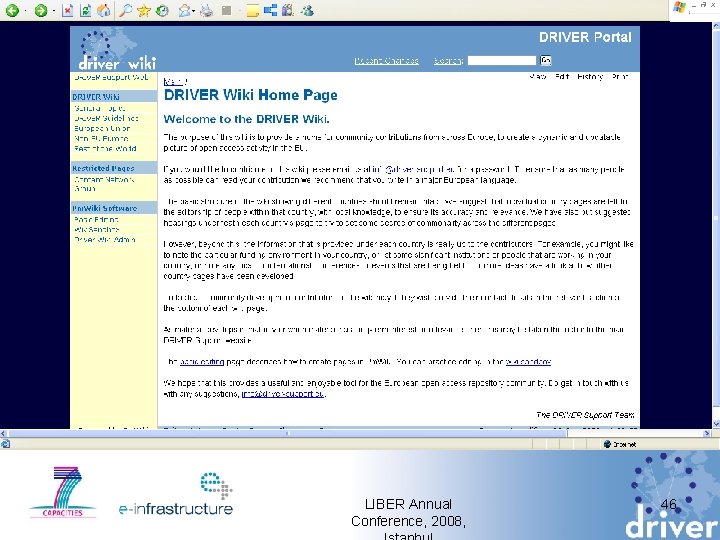
How can a single repository become a member of the DRIVER community? • • The concept of DRIVER sees national communities as the basis and as natural partners for the European repository network Contact the DRIVER Wiki and find out about your national contact point(s) (“correspondents”) to the DRIVER community – – • Become a member of your existing national community OR Support the building of a national community within your country (see also DRIVER Mentoring Service) In case there is no correspondent: register your interest on the DRIVER website to – Become a member of the DRIVER community LIBER Annual Conference, 2008, 47
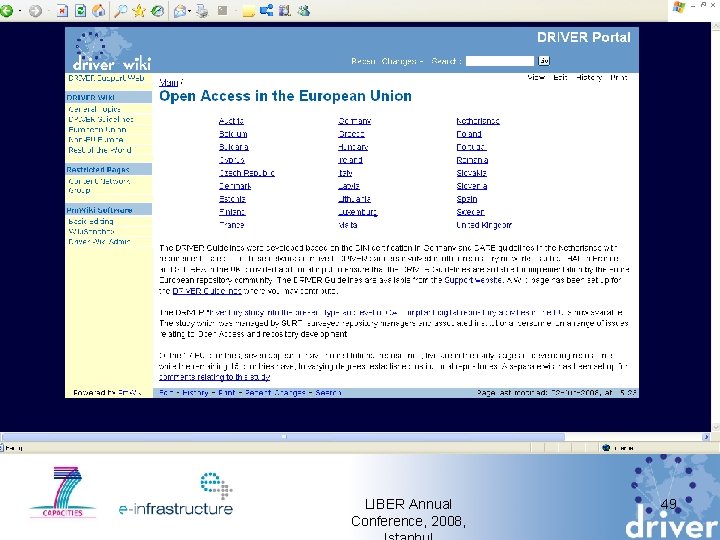
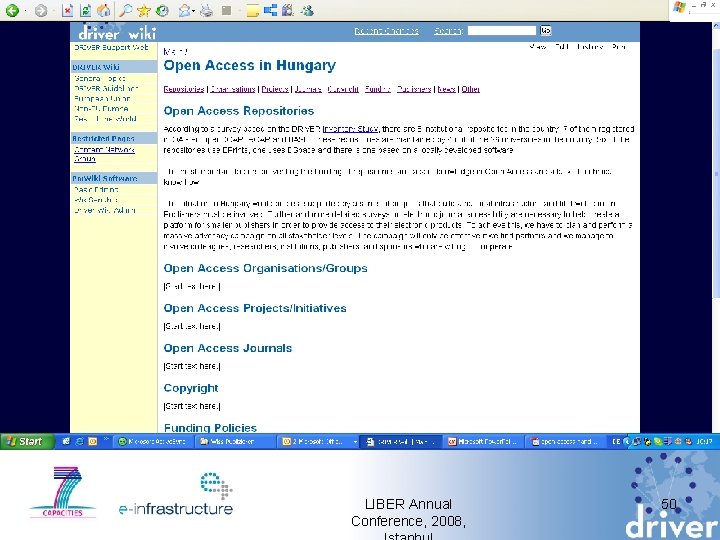
How does DRIVER relate to national repository communities? • National communities are usually represented by country “correspondents” – One institution or a group of institutions takes responsibility to build a national repository community (like DARENet-NL, SHERPA-UK, OA-Netzwerk-GE, RECOLECTA-ES, HAL-FR) Country “correspondents” … – Maintain the national repository information on the DRIVER Wiki – Organise repository events in their countries – Translate repository guidelines and other relevant information into national languages – Build up national data aggregators, clean data, can offer additional services LIBER Annual Conference, 2008, 48
LIBER Annual Conference, 2008, 49
LIBER Annual Conference, 2008, 50
Do national repository communities have to deploy DRIVER software (D-NET)? • NO. D-NET has been developed as technically advanced, open source toolkit for re-use by repository networks. Deployment guarantees interoperability, saves costs and time, but not mandatory. • BUT: Data and services have to support interoperability (see the DRIVER Guidelines) LIBER Annual Conference, 2008, 51
Benefits of joining the DRIVER community • You will contribute to the successful implementation of Open Access by joining a powerful, cross-country community • Your researchers require an international infrastructure • Local institutions and countries research output becomes visible as part of a common international knowledge base • Funding and research organisations can build their own interface on the DRIVER data index to demonstrate their efforts • You will share in developments by service providers LIBER Annual Conference, 2008, 52
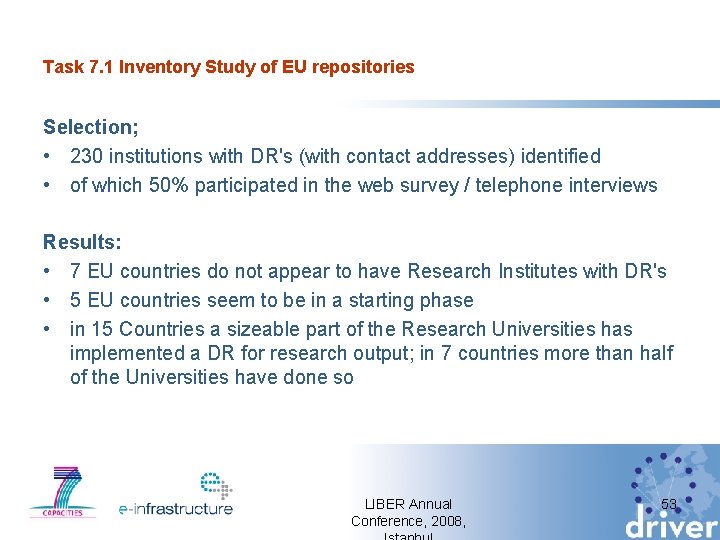
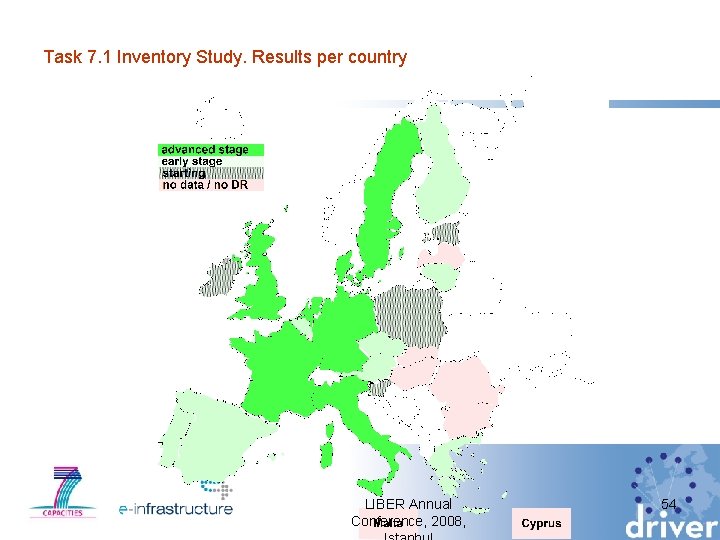
Task 7. 1 Inventory Study of EU repositories Selection; • 230 institutions with DR's (with contact addresses) identified • of which 50% participated in the web survey / telephone interviews Results: • 7 EU countries do not appear to have Research Institutes with DR's • 5 EU countries seem to be in a starting phase • in 15 Countries a sizeable part of the Research Universities has implemented a DR for research output; in 7 countries more than half of the Universities have done so LIBER Annual Conference, 2008, 53
Task 7. 1 Inventory Study. Results per country LIBER Annual Conference, 2008, 54
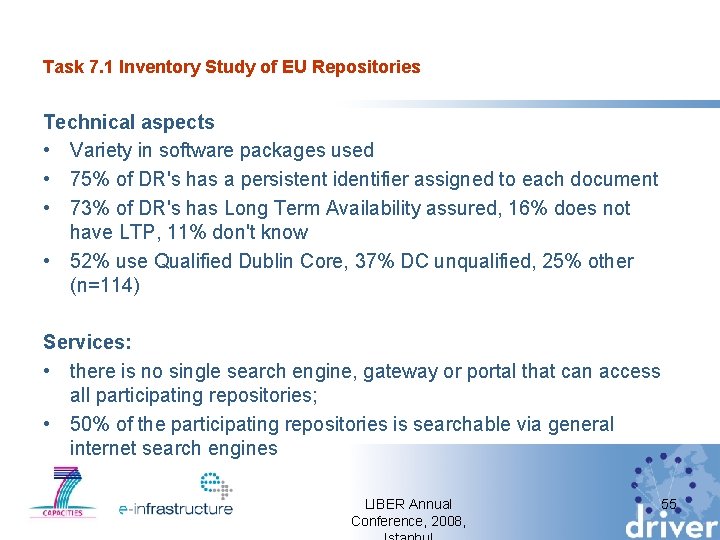
Task 7. 1 Inventory Study of EU Repositories Technical aspects • Variety in software packages used • 75% of DR's has a persistent identifier assigned to each document • 73% of DR's has Long Term Availability assured, 16% does not have LTP, 11% don't know • 52% use Qualified Dublin Core, 37% DC unqualified, 25% other (n=114) Services: • there is no single search engine, gateway or portal that can access all participating repositories; • 50% of the participating repositories is searchable via general internet search engines LIBER Annual Conference, 2008, 55
Topics § § I Open Access II Institutional Repositories III The role of libraries IV Recommendations how to implement OA and IRs in Hungary 56
III The role of libraries (1) Provide comprehensive access to research publications § § Open Access is a strategic activity for research libraries Requires lead and full support by library managers 57
III The role of libraries (2) Libraries § Inform senior decision makers at your University/Institution § Go to faculties and inform them about open access § Modify your licensing agreements with publishers to support the institutional deposit of research publications § Convert the traditional licensing model “subscription for access” to “subscription/financing for publishing” § Build (or offer) institutional repositories and locally accepted workflows to deposit metadata & publication § Support nation wide & international OA and repository network activities § Support OA journals & monographs § … 58
Topics § § I Open Access II Institutional Repositories III The role of libraries IV Recommendations how to implement OA and IRs in Hungary 59
Recommendations how to implement OA and IRs in Hungary § § § § Build an initiative group that facilitates OA awareness and IR networking Agree on a national correspondent for the European DRIVER network Identify supporting organisations in Hungary (? Academy, ? Hungarian Rectors Council, other? ? ? ) Build up a Hungarian Open Access Information Portal (model, see www. open-access. net) =>lobbying and raising awareness Talk to colleagues in other countries about ways to modify licensing agreements with publishers (add an OA component) Are there funding streams available to support the activities? Could Euro. Horcs facilitate some funding within Hungary? … 60
Köszönöm szépen! Kérdések? Contact: lossau@sub. uni-goettingen. de 61