
OPCVL Petition Prepared by the Workers and Inhabitants
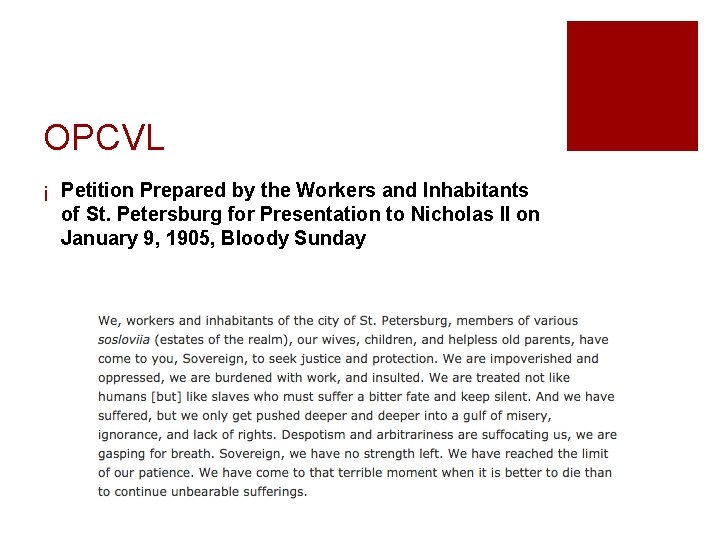
OPCVL ¡ Petition Prepared by the Workers and Inhabitants of St. Petersburg for Presentation to Nicholas II on January 9, 1905, Bloody Sunday
Russian Revolution 1917
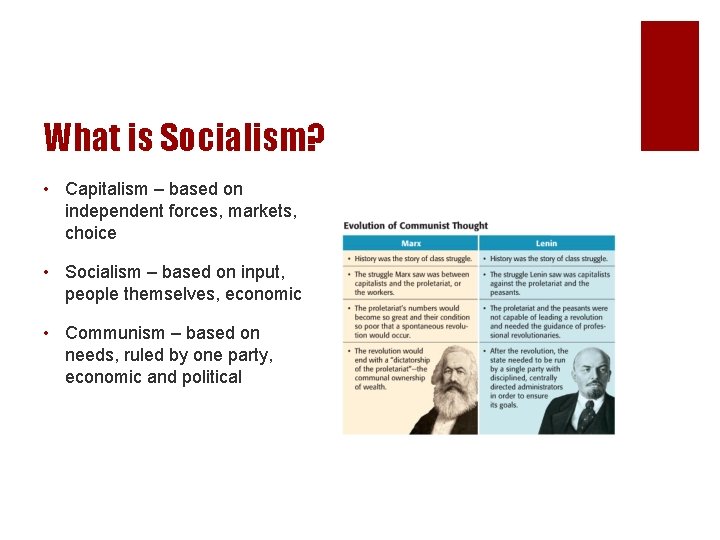
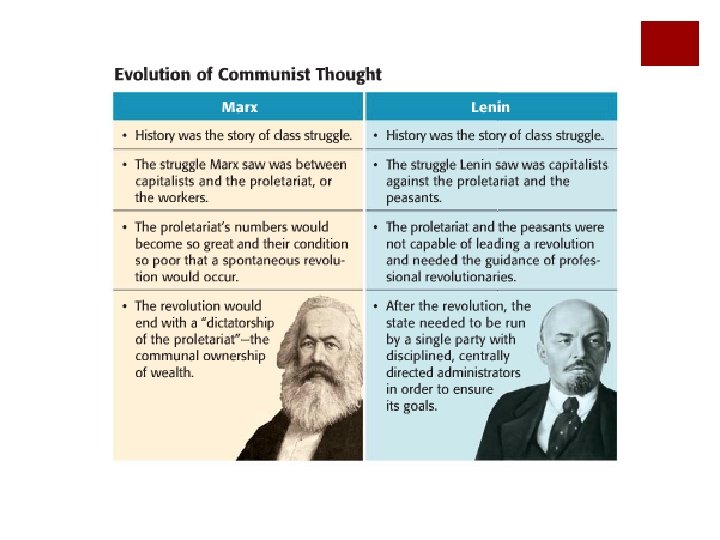
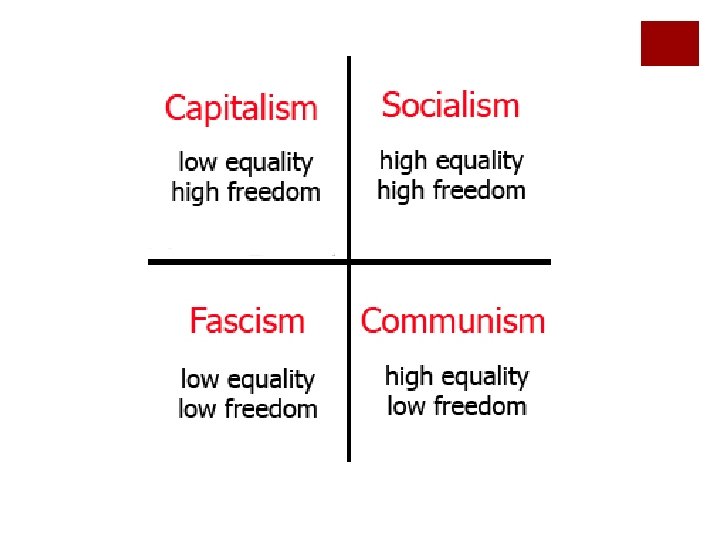
What is Socialism? • Capitalism – based on independent forces, markets, choice • Socialism – based on input, people themselves, economic • Communism – based on needs, ruled by one party, economic and political
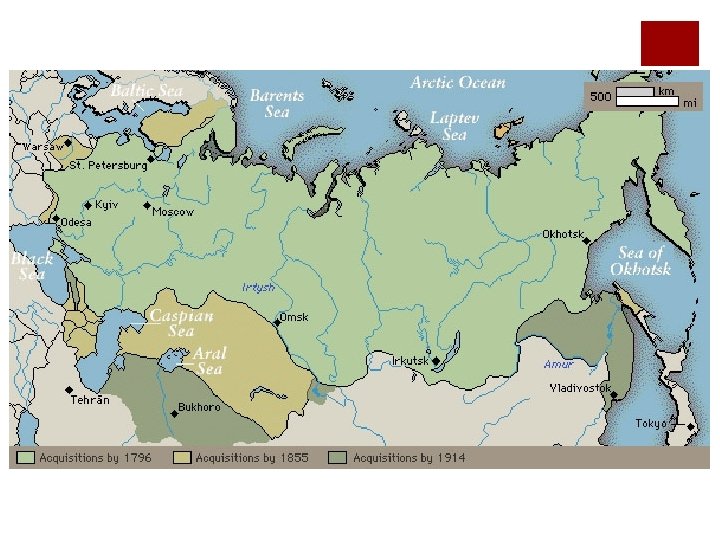
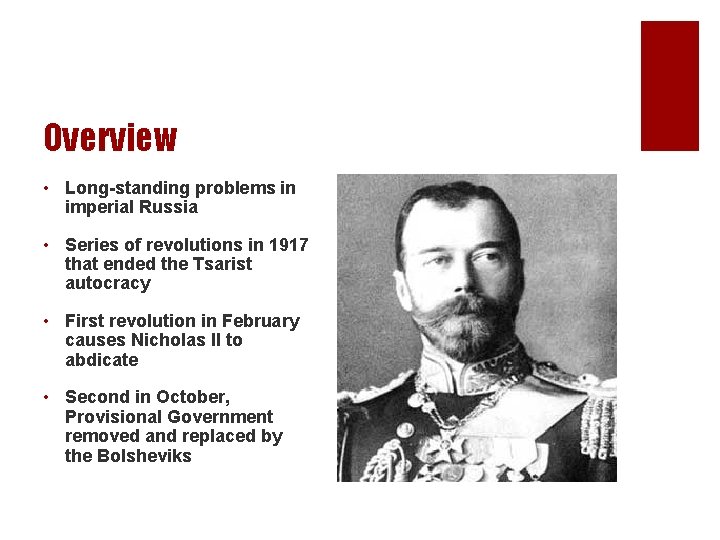
Overview • Long-standing problems in imperial Russia • Series of revolutions in 1917 that ended the Tsarist autocracy • First revolution in February causes Nicholas II to abdicate • Second in October, Provisional Government removed and replaced by the Bolsheviks
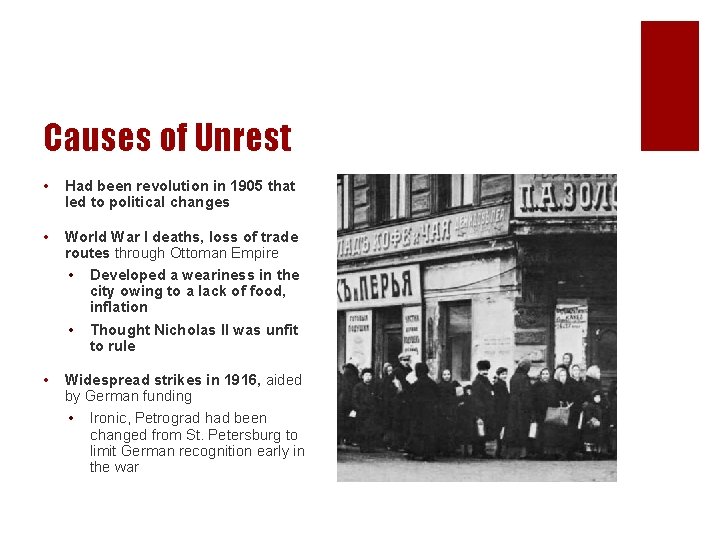
Causes of Unrest • Had been revolution in 1905 that led to political changes • World War I deaths, loss of trade routes through Ottoman Empire • Developed a weariness in the city owing to a lack of food, inflation • Thought Nicholas II was unfit to rule • Widespread strikes in 1916, aided by German funding • Ironic, Petrograd had been changed from St. Petersburg to limit German recognition early in the war
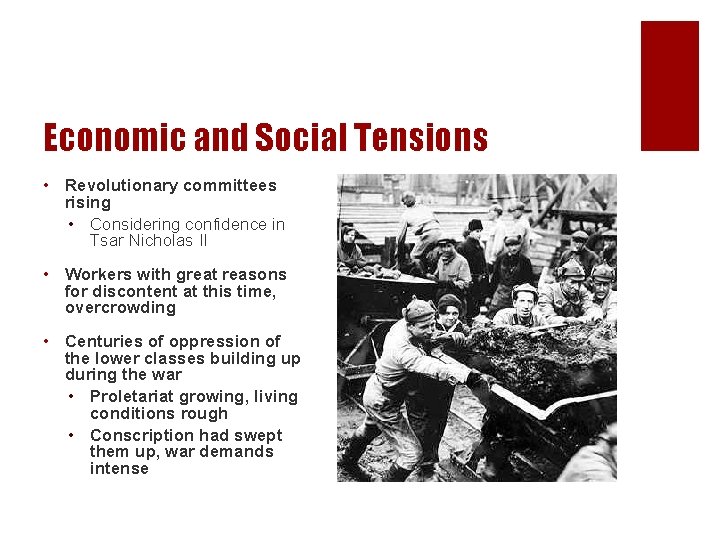
Economic and Social Tensions • Revolutionary committees rising • Considering confidence in Tsar Nicholas II • Workers with great reasons for discontent at this time, overcrowding • Centuries of oppression of the lower classes building up during the war • Proletariat growing, living conditions rough • Conscription had swept them up, war demands intense
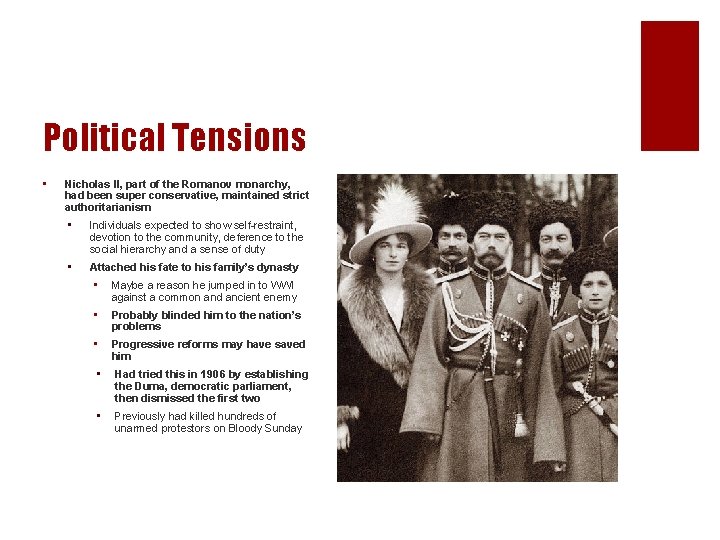
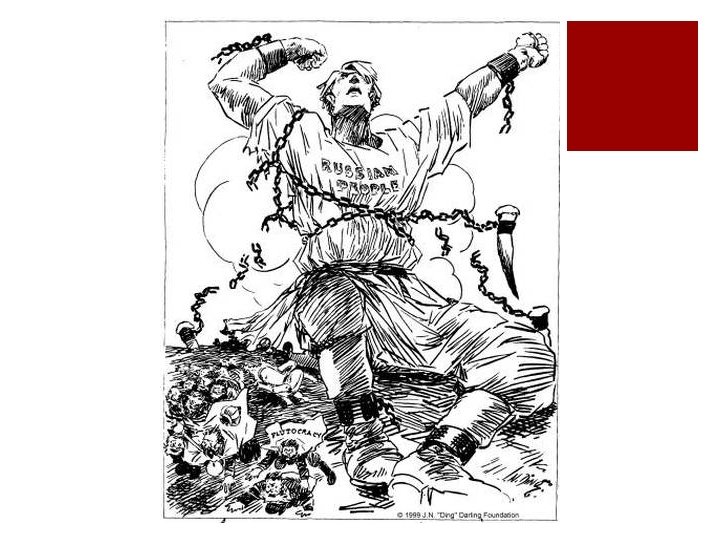
Political Tensions • Nicholas II, part of the Romanov monarchy, had been super conservative, maintained strict authoritarianism • Individuals expected to show self-restraint, devotion to the community, deference to the social hierarchy and a sense of duty • Attached his fate to his family’s dynasty • Maybe a reason he jumped in to WWI against a common and ancient enemy • Probably blinded him to the nation’s problems • Progressive reforms may have saved him • Had tried this in 1906 by establishing the Duma, democratic parliament, then dismissed the first two • Previously had killed hundreds of unarmed protestors on Bloody Sunday
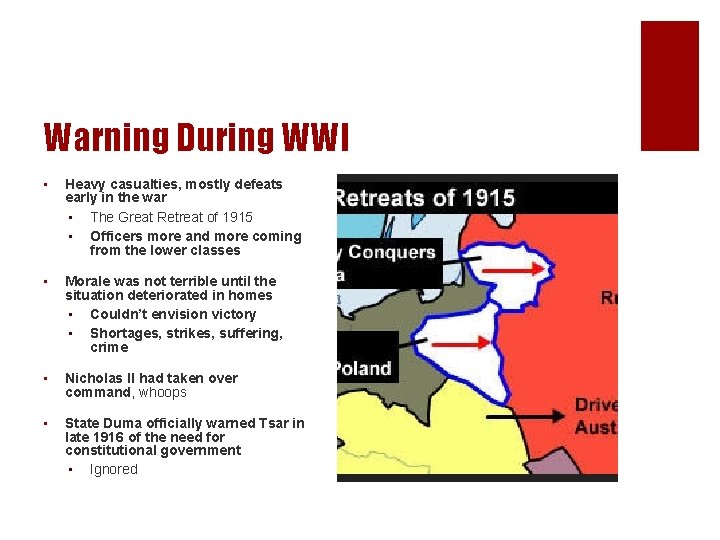
Warning During WWI • Heavy casualties, mostly defeats early in the war • The Great Retreat of 1915 • Officers more and more coming from the lower classes • Morale was not terrible until the situation deteriorated in homes • Couldn’t envision victory • Shortages, strikes, suffering, crime • Nicholas II had taken over command, whoops • State Duma officially warned Tsar in late 1916 of the need for constitutional government • Ignored
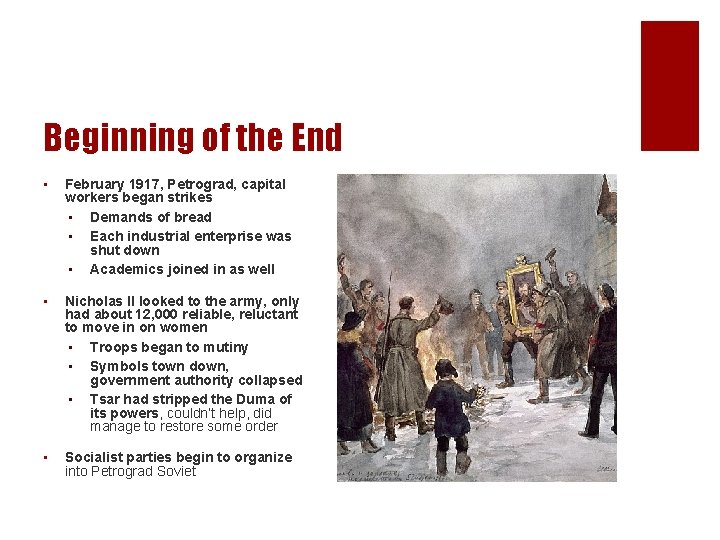
Beginning of the End • February 1917, Petrograd, capital workers began strikes • Demands of bread • Each industrial enterprise was shut down • Academics joined in as well • Nicholas II looked to the army, only had about 12, 000 reliable, reluctant to move in on women • Troops began to mutiny • Symbols town down, government authority collapsed • Tsar had stripped the Duma of its powers, couldn’t help, did manage to restore some order • Socialist parties begin to organize into Petrograd Soviet
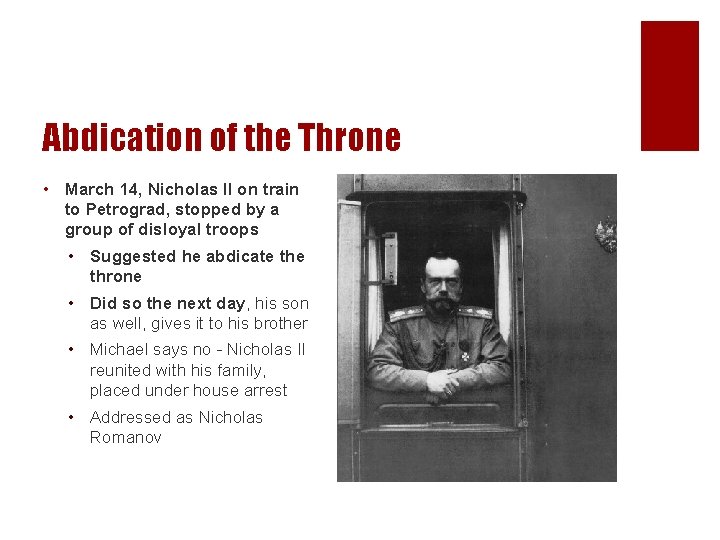
Abdication of the Throne • March 14, Nicholas II on train to Petrograd, stopped by a group of disloyal troops • Suggested he abdicate throne • Did so the next day, his son as well, gives it to his brother • Michael says no - Nicholas II reunited with his family, placed under house arrest • Addressed as Nicholas Romanov
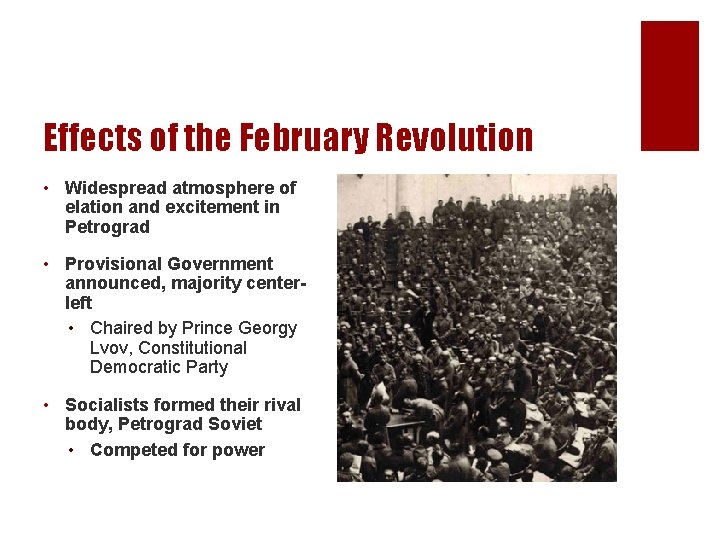
Effects of the February Revolution • Widespread atmosphere of elation and excitement in Petrograd • Provisional Government announced, majority centerleft • Chaired by Prince Georgy Lvov, Constitutional Democratic Party • Socialists formed their rival body, Petrograd Soviet • Competed for power
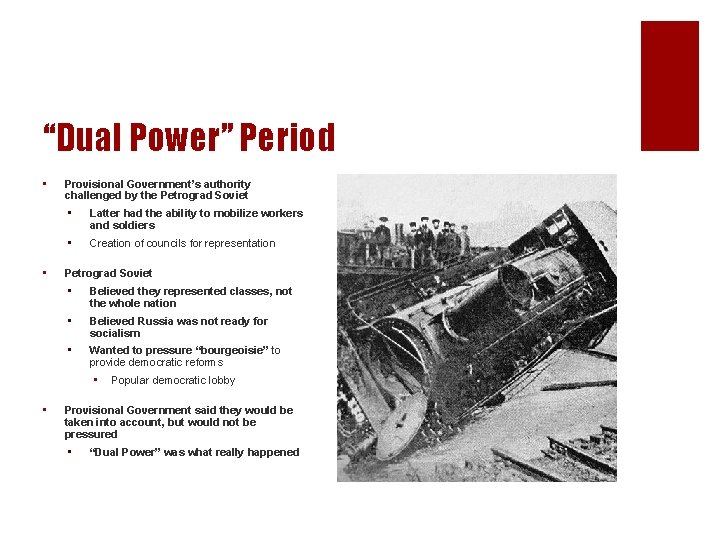
“Dual Power” Period • • Provisional Government’s authority challenged by the Petrograd Soviet • Latter had the ability to mobilize workers and soldiers • Creation of councils for representation Petrograd Soviet • Believed they represented classes, not the whole nation • Believed Russia was not ready for socialism • Wanted to pressure “bourgeoisie” to provide democratic reforms • • Popular democratic lobby Provisional Government said they would be taken into account, but would not be pressured • “Dual Power” was what really happened
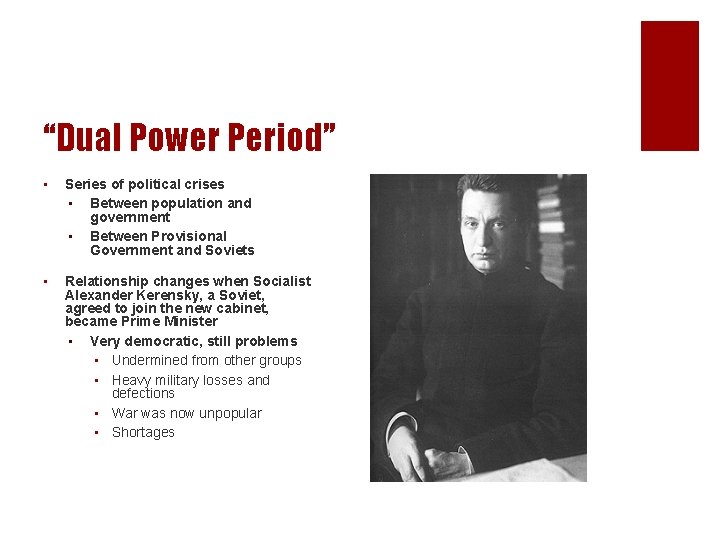
“Dual Power Period” • Series of political crises • Between population and government • Between Provisional Government and Soviets • Relationship changes when Socialist Alexander Kerensky, a Soviet, agreed to join the new cabinet, became Prime Minister • Very democratic, still problems • Undermined from other groups • Heavy military losses and defections • War was now unpopular • Shortages
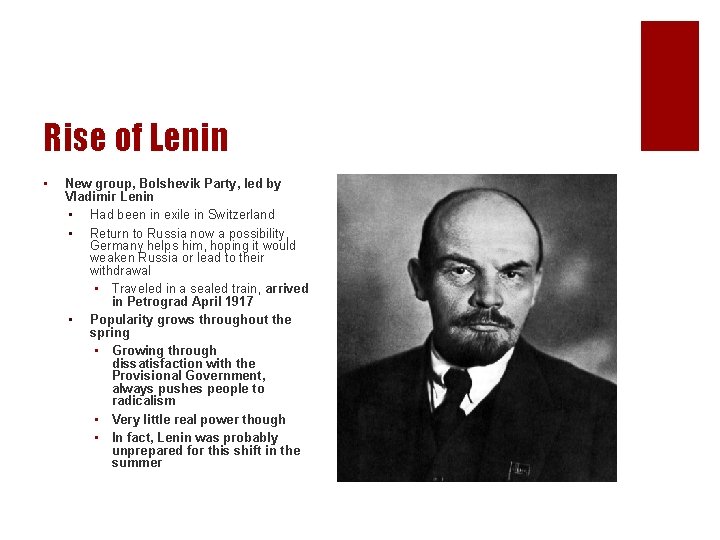
Rise of Lenin • New group, Bolshevik Party, led by Vladimir Lenin • Had been in exile in Switzerland • Return to Russia now a possibility, Germany helps him, hoping it would weaken Russia or lead to their withdrawal • Traveled in a sealed train, arrived in Petrograd April 1917 • Popularity grows throughout the spring • Growing through dissatisfaction with the Provisional Government, always pushes people to radicalism • Very little real power though • In fact, Lenin was probably unprepared for this shift in the summer
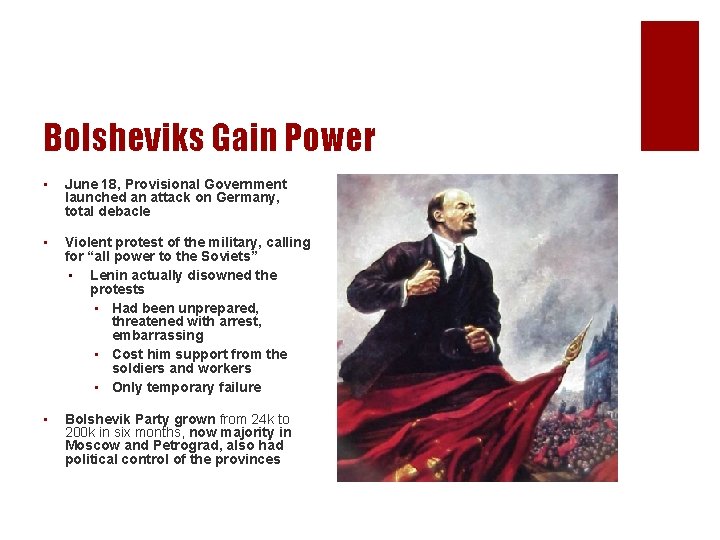
Bolsheviks Gain Power • June 18, Provisional Government launched an attack on Germany, total debacle • Violent protest of the military, calling for “all power to the Soviets” • Lenin actually disowned the protests • Had been unprepared, threatened with arrest, embarrassing • Cost him support from the soldiers and workers • Only temporary failure • Bolshevik Party grown from 24 k to 200 k in six months, now majority in Moscow and Petrograd, also had political control of the provinces
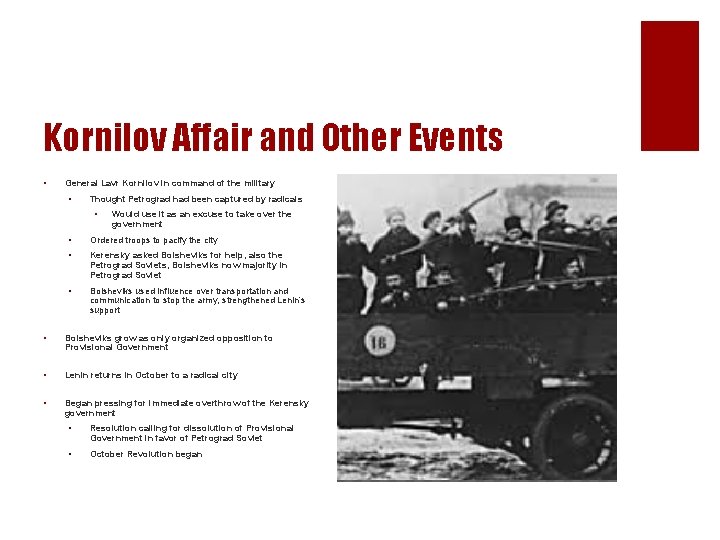
Kornilov Affair and Other Events • General Lavr Kornilov in command of the military • Thought Petrograd had been captured by radicals • Would use it as an excuse to take over the government • Ordered troops to pacify the city • Kerensky asked Bolsheviks for help, also the Petrograd Soviets, Bolsheviks now majority in Petrograd Soviet • Bolsheviks used influence over transportation and communication to stop the army, strengthened Lenin’s support • Bolsheviks grow as only organized opposition to Provisional Government • Lenin returns in October to a radical city • Began pressing for immediate overthrow of the Kerensky government • Resolution calling for dissolution of Provisional Government in favor of Petrograd Soviet • October Revolution began
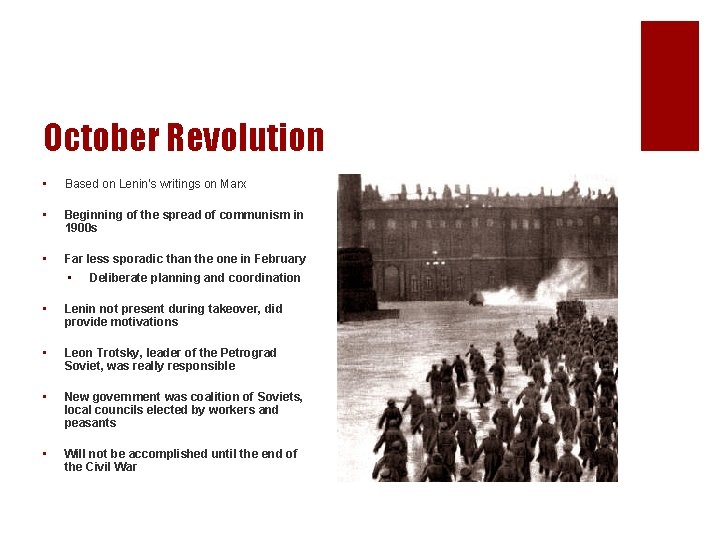
October Revolution • Based on Lenin’s writings on Marx • Beginning of the spread of communism in 1900 s • Far less sporadic than the one in February • Deliberate planning and coordination • Lenin not present during takeover, did provide motivations • Leon Trotsky, leader of the Petrograd Soviet, was really responsible • New government was coalition of Soviets, local councils elected by workers and peasants • Will not be accomplished until the end of the Civil War
Significant Years - Review ¡ 1905 ¡ Russo-Japanese War ¡ Bloody Sunday ¡ 1906 ¡ Duma established ¡ 1914 ¡ WWI begins ¡ 1917 ¡ February Revolution – Tsar overthrown ¡ Now Provisional Government (Kerensky) ¡ October Revolution – PG overthrown, ¡ Now Bolsheviks (Lenin)
Historiography Soviet and Western
Who wore it better? Soviet Historian Liberal (Western) Historian
For Debate ¡ Was the October movement a revolution or a coup? ¡ Was Lenin of good intentions or a power-hungry dictator? ¡ Does socialism have a pla
- Slides: 31