
OPC UA Solutions for Device Control and Integration


- Slides: 53
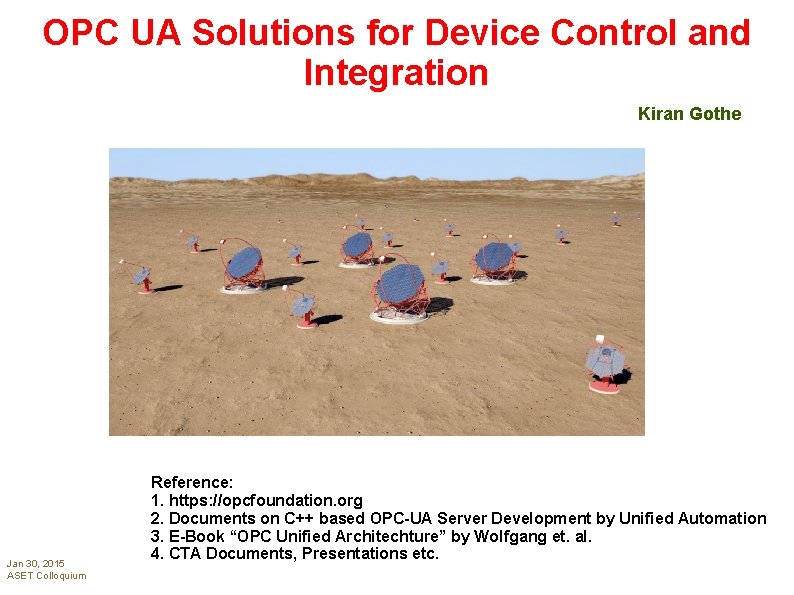
OPC UA Solutions for Device Control and Integration Kiran Gothe Jan 30, 2015 ASET Colloquium Reference: 1. https: //opcfoundation. org 2. Documents on C++ based OPC-UA Server Development by Unified Automation 3. E-Book “OPC Unified Architechture” by Wolfgang et. al. 4. CTA Documents, Presentations etc.
Outline of the talk Motivation What is OPC UA? Why does OPC-UA matter? Implementation Summary
Motivation
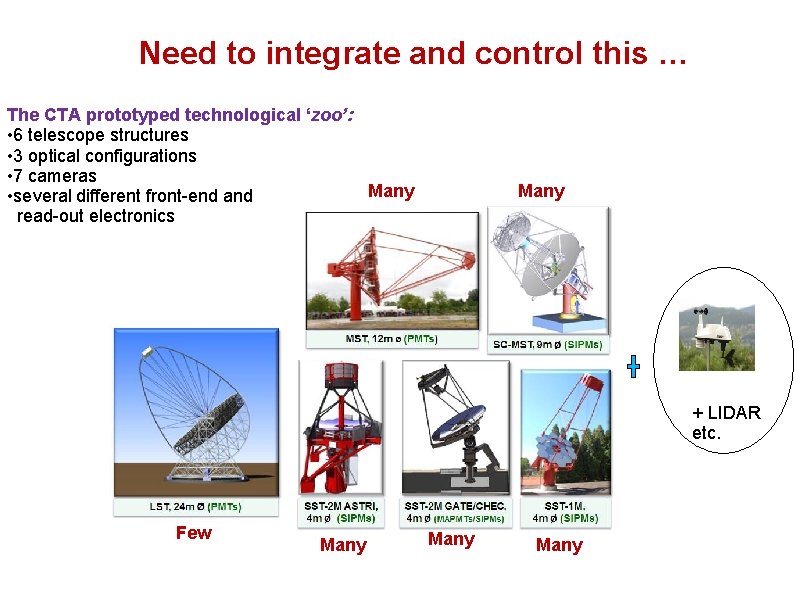
Need to integrate and control this … The CTA prototyped technological ‘zoo’: • 6 telescope structures • 3 optical configurations • 7 cameras Many • several different front-end and read-out electronics Many + LIDAR etc. Few Many
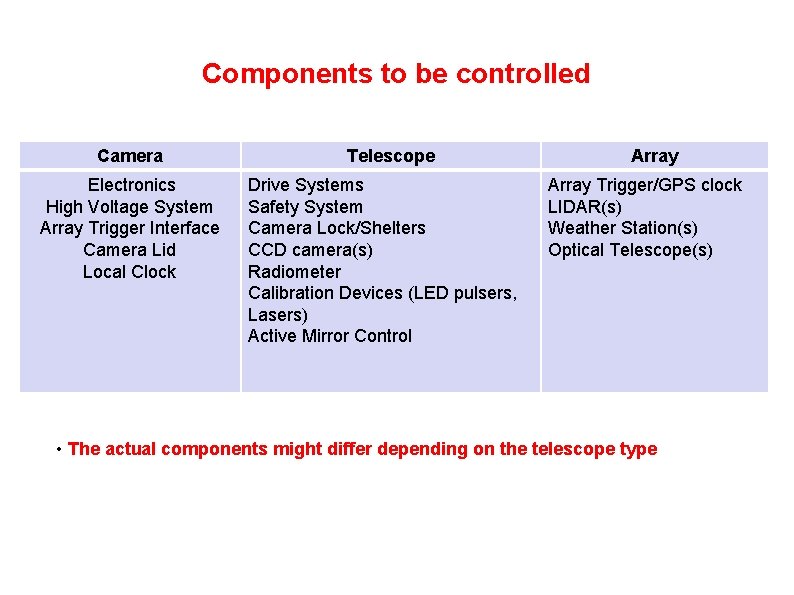
Components to be controlled Camera Electronics High Voltage System Array Trigger Interface Camera Lid Local Clock Telescope Drive Systems Safety System Camera Lock/Shelters CCD camera(s) Radiometer Calibration Devices (LED pulsers, Lasers) Active Mirror Control Array Trigger/GPS clock LIDAR(s) Weather Station(s) Optical Telescope(s) • The actual components might differ depending on the telescope type
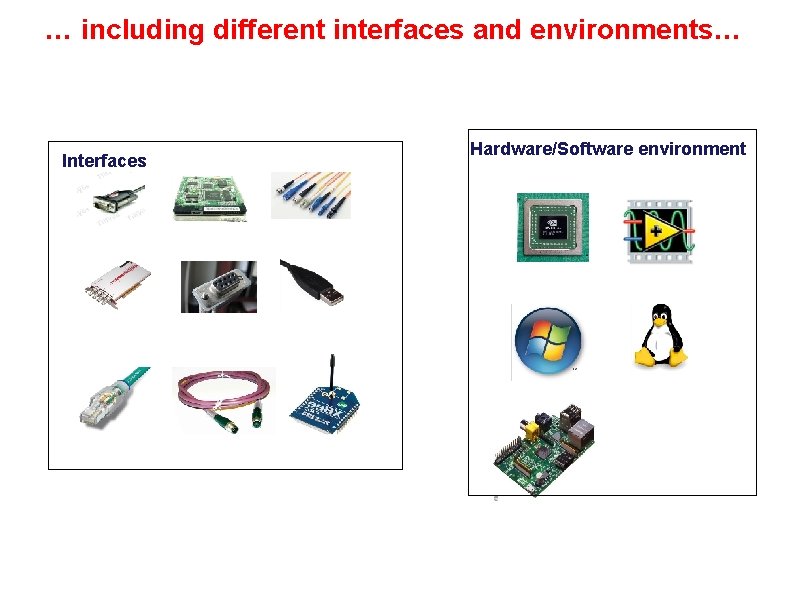
… including different interfaces and environments… Interfaces Hardware/Software environment
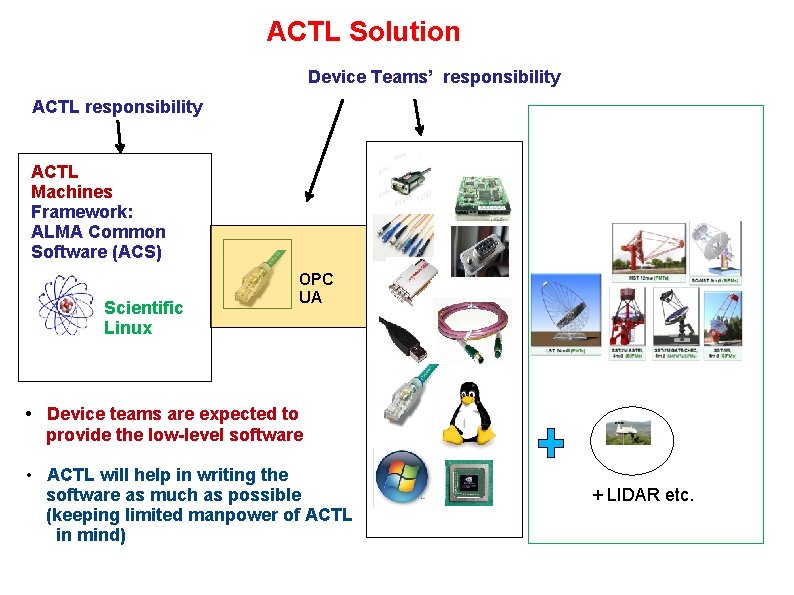
ACTL Solution Device Teams’ responsibility ACTL Machines Framework: ALMA Common Software (ACS) Scientific Linux OPC UA • Device teams are expected to provide the low-level software • ACTL will help in writing the software as much as possible (keeping limited manpower of ACTL in mind) + LIDAR etc.
What is OPC-UA?
OPC • OPC (Open Platform Communications ): a standard interface defined by the OPC Foundation that provides rules and information about how software applications and devices can send and receive different kinds of data between each other. • Released in mid-nineties • By 2009 (roughly), the total OPC market has over 2, 500 vendors providing over 15, 000 OPCenabled products. • Utilizes the Microsoft-based COM/DCOM technology to provide standard specifications for data access , historical data access, and alarms and events. • Limitations because of this reliance on the Microsoft Windows platform
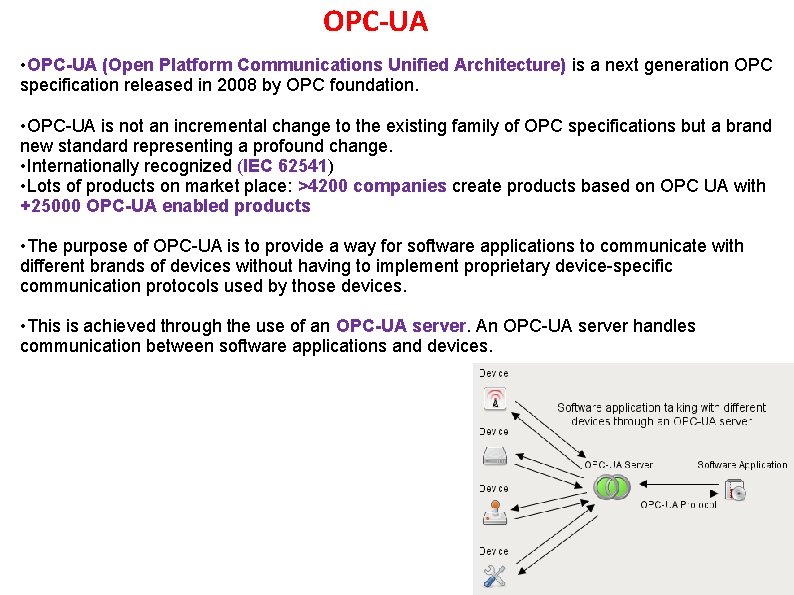
OPC-UA • OPC-UA (Open Platform Communications Unified Architecture) is a next generation OPC specification released in 2008 by OPC foundation. • OPC-UA is not an incremental change to the existing family of OPC specifications but a brand new standard representing a profound change. • Internationally recognized (IEC 62541) • Lots of products on market place: >4200 companies create products based on OPC UA with +25000 OPC-UA enabled products • The purpose of OPC-UA is to provide a way for software applications to communicate with different brands of devices without having to implement proprietary device-specific communication protocols used by those devices. • This is achieved through the use of an OPC-UA server. An OPC-UA server handles communication between software applications and devices.
Why does OPC-UA matter?
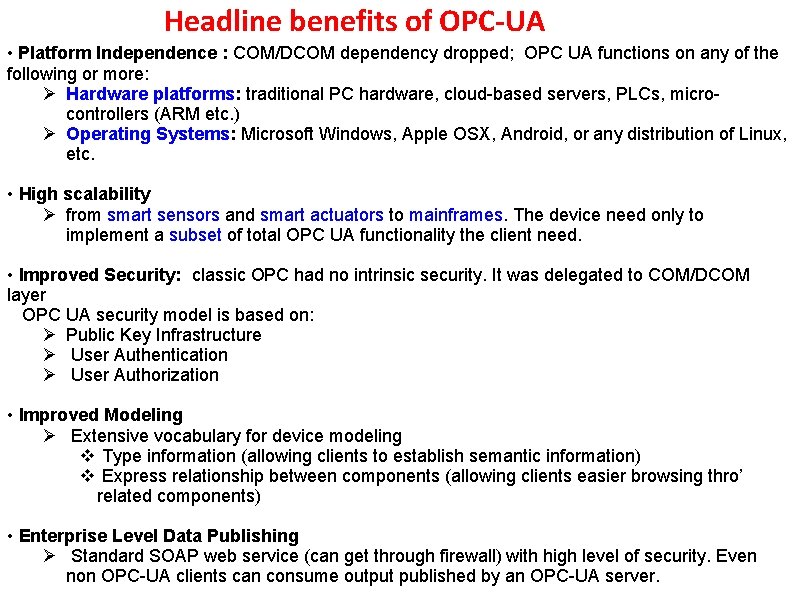
Headline benefits of OPC-UA • Platform Independence : COM/DCOM dependency dropped; OPC UA functions on any of the following or more: Hardware platforms: traditional PC hardware, cloud-based servers, PLCs, microcontrollers (ARM etc. ) Operating Systems: Microsoft Windows, Apple OSX, Android, or any distribution of Linux, etc. • High scalability from smart sensors and smart actuators to mainframes. The device need only to implement a subset of total OPC UA functionality the client need. • Improved Security: classic OPC had no intrinsic security. It was delegated to COM/DCOM layer OPC UA security model is based on: Public Key Infrastructure User Authentication User Authorization • Improved Modeling Extensive vocabulary for device modeling v Type information (allowing clients to establish semantic information) v Express relationship between components (allowing clients easier browsing thro’ related components) • Enterprise Level Data Publishing Standard SOAP web service (can get through firewall) with high level of security. Even non OPC-UA clients can consume output published by an OPC-UA server.
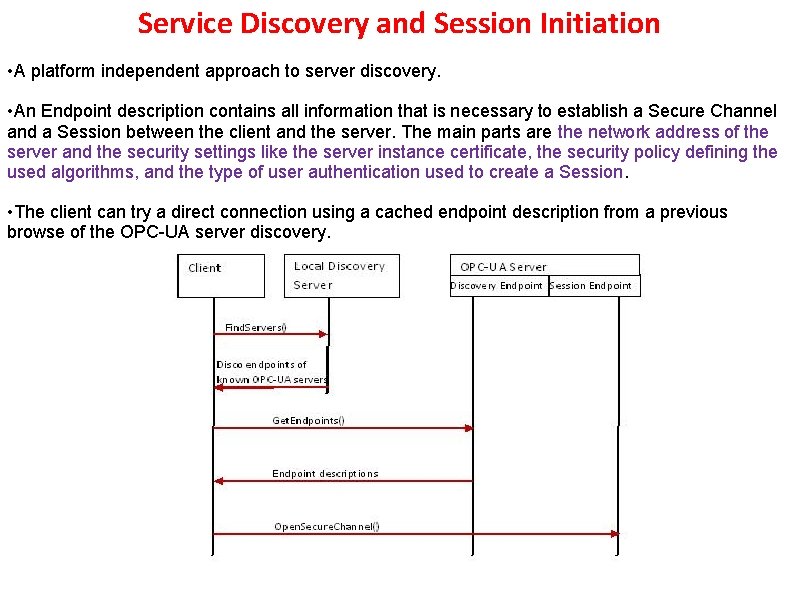
Service Discovery and Session Initiation • A platform independent approach to server discovery. • An Endpoint description contains all information that is necessary to establish a Secure Channel and a Session between the client and the server. The main parts are the network address of the server and the security settings like the server instance certificate, the security policy defining the used algorithms, and the type of user authentication used to create a Session. • The client can try a direct connection using a cached endpoint description from a previous browse of the OPC-UA server discovery.
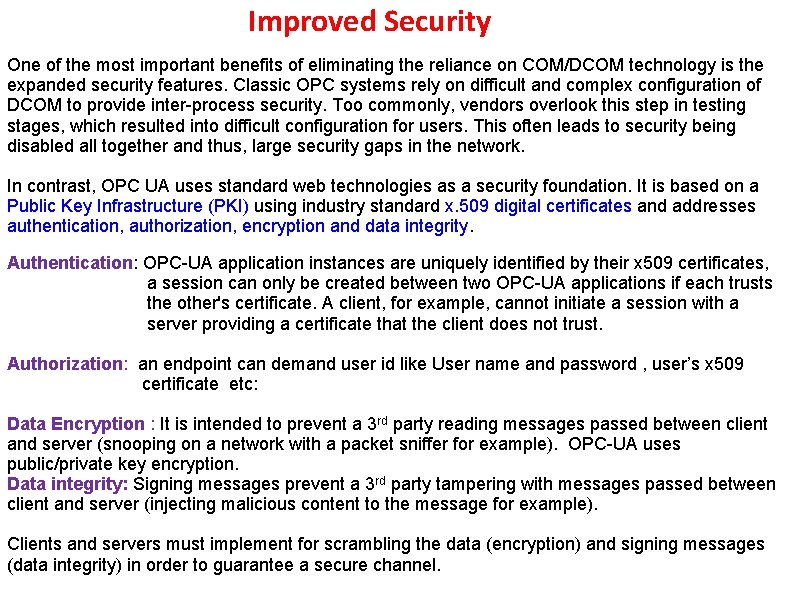
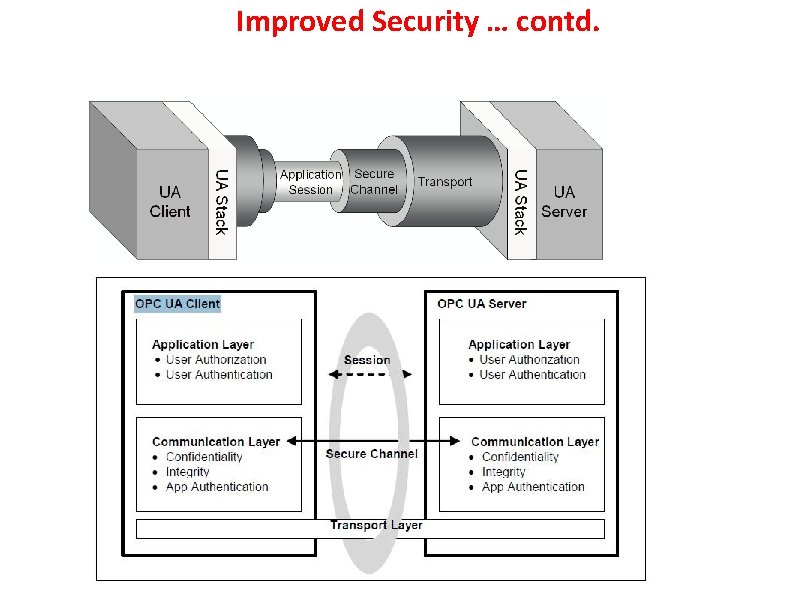
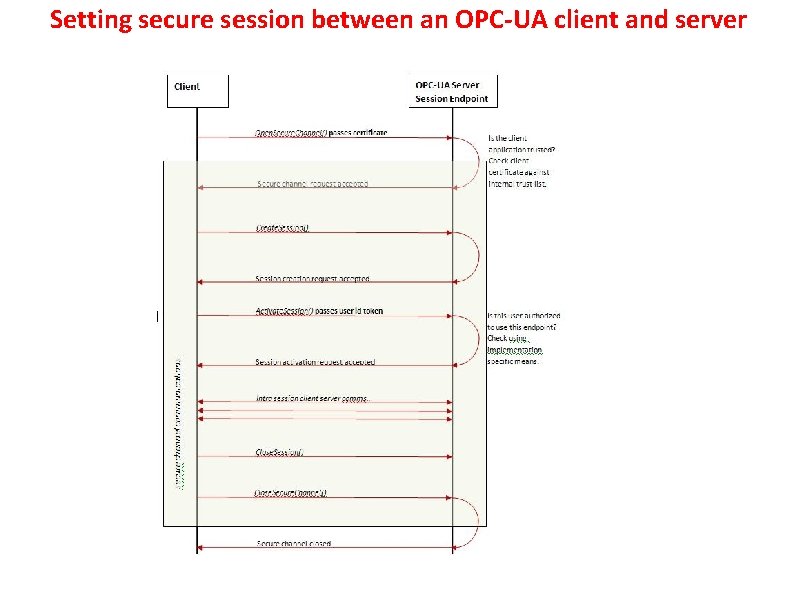
Improved Security One of the most important benefits of eliminating the reliance on COM/DCOM technology is the expanded security features. Classic OPC systems rely on difficult and complex configuration of DCOM to provide inter-process security. Too commonly, vendors overlook this step in testing stages, which resulted into difficult configuration for users. This often leads to security being disabled all together and thus, large security gaps in the network. In contrast, OPC UA uses standard web technologies as a security foundation. It is based on a Public Key Infrastructure (PKI) using industry standard x. 509 digital certificates and addresses authentication, authorization, encryption and data integrity. Authentication: OPC-UA application instances are uniquely identified by their x 509 certificates, a session can only be created between two OPC-UA applications if each trusts the other's certificate. A client, for example, cannot initiate a session with a server providing a certificate that the client does not trust. Authorization: an endpoint can demand user id like User name and password , user’s x 509 certificate etc: Data Encryption : It is intended to prevent a 3 rd party reading messages passed between client and server (snooping on a network with a packet sniffer for example). OPC-UA uses public/private key encryption. Data integrity: Signing messages prevent a 3 rd party tampering with messages passed between client and server (injecting malicious content to the message for example). Clients and servers must implement for scrambling the data (encryption) and signing messages (data integrity) in order to guarantee a secure channel.
Improved Security … contd.
Setting secure session between an OPC-UA client and server
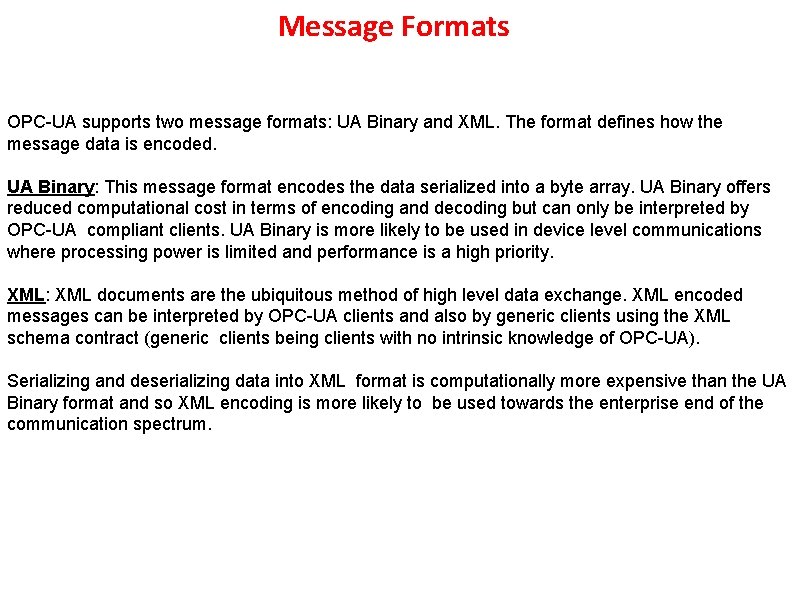
Message Formats OPC-UA supports two message formats: UA Binary and XML. The format defines how the message data is encoded. UA Binary: This message format encodes the data serialized into a byte array. UA Binary offers reduced computational cost in terms of encoding and decoding but can only be interpreted by OPC-UA compliant clients. UA Binary is more likely to be used in device level communications where processing power is limited and performance is a high priority. XML: XML documents are the ubiquitous method of high level data exchange. XML encoded messages can be interpreted by OPC-UA clients and also by generic clients using the XML schema contract (generic clients being clients with no intrinsic knowledge of OPC-UA). Serializing and deserializing data into XML format is computationally more expensive than the UA Binary format and so XML encoding is more likely to be used towards the enterprise end of the communication spectrum.
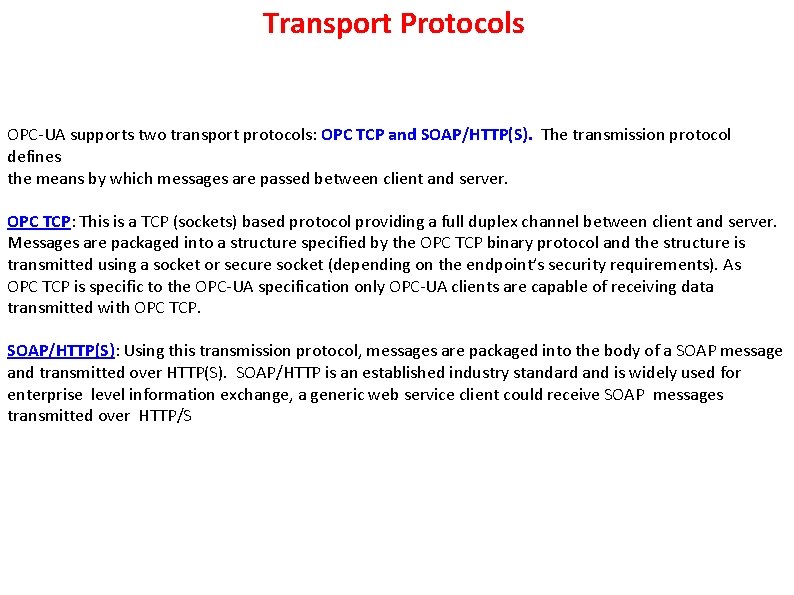
Transport Protocols OPC-UA supports two transport protocols: OPC TCP and SOAP/HTTP(S). The transmission protocol defines the means by which messages are passed between client and server. OPC TCP: This is a TCP (sockets) based protocol providing a full duplex channel between client and server. Messages are packaged into a structure specified by the OPC TCP binary protocol and the structure is transmitted using a socket or secure socket (depending on the endpoint’s security requirements). As OPC TCP is specific to the OPC-UA specification only OPC-UA clients are capable of receiving data transmitted with OPC TCP. SOAP/HTTP(S): Using this transmission protocol, messages are packaged into the body of a SOAP message and transmitted over HTTP(S). SOAP/HTTP is an established industry standard and is widely used for enterprise level information exchange, a generic web service client could receive SOAP messages transmitted over HTTP/S
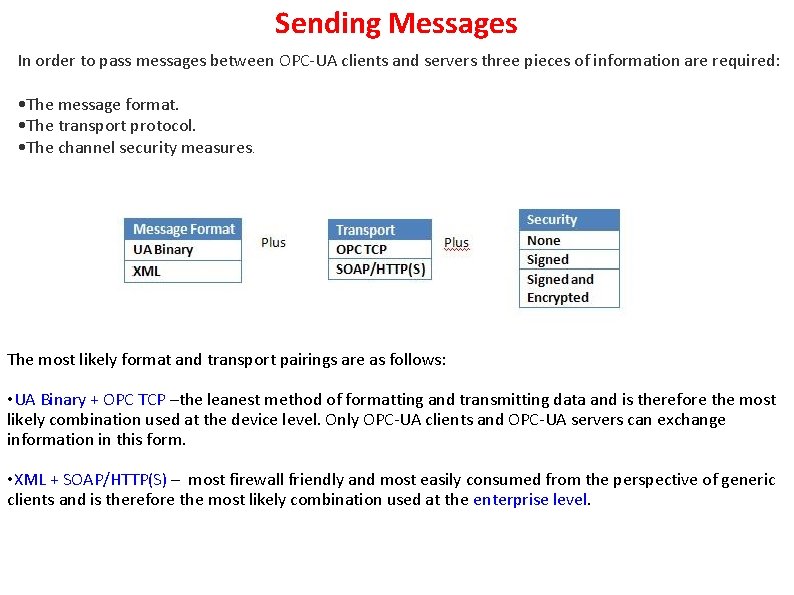
Sending Messages In order to pass messages between OPC-UA clients and servers three pieces of information are required: • The message format. • The transport protocol. • The channel security measures. The most likely format and transport pairings are as follows: • UA Binary + OPC TCP –the leanest method of formatting and transmitting data and is therefore the most likely combination used at the device level. Only OPC-UA clients and OPC-UA servers can exchange information in this form. • XML + SOAP/HTTP(S) – most firewall friendly and most easily consumed from the perspective of generic clients and is therefore the most likely combination used at the enterprise level.
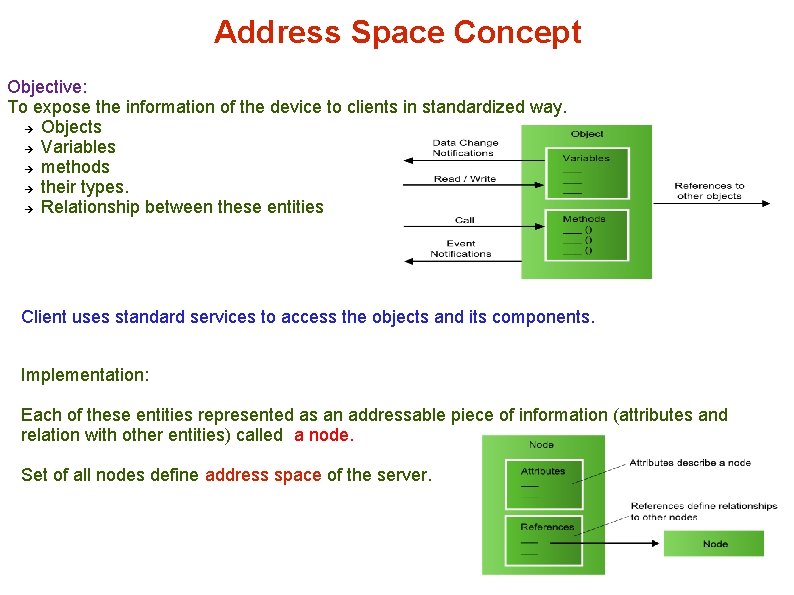
Address Space Concept Objective: To expose the information of the device to clients in standardized way. Objects Variables methods their types. Relationship between these entities Client uses standard services to access the objects and its components. Implementation: Each of these entities represented as an addressable piece of information (attributes and relation with other entities) called a node. Set of all nodes define address space of the server.
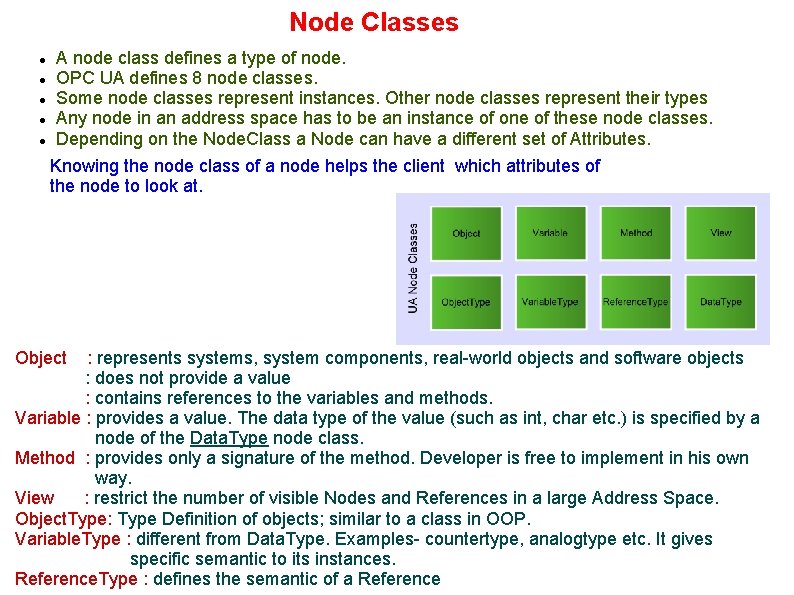
Node Classes A node class defines a type of node. OPC UA defines 8 node classes. Some node classes represent instances. Other node classes represent their types Any node in an address space has to be an instance of one of these node classes. Depending on the Node. Class a Node can have a different set of Attributes. Knowing the node class of a node helps the client which attributes of the node to look at. Object : represents systems, system components, real-world objects and software objects : does not provide a value : contains references to the variables and methods. Variable : provides a value. The data type of the value (such as int, char etc. ) is specified by a node of the Data. Type node class. Method : provides only a signature of the method. Developer is free to implement in his own way. View : restrict the number of visible Nodes and References in a large Address Space. Object. Type: Type Definition of objects; similar to a class in OOP. Variable. Type : different from Data. Type. Examples- countertype, analogtype etc. It gives specific semantic to its instances. Reference. Type : defines the semantic of a Reference
Reading Device Data The OPC-UA specification describes two services by which OPC-UA clients access device data via OPC-UA servers. Read Service (Poll): The parameters for this service include A list of node IDs, indicating which nodes and which attributes of the nodes are to be read The maximum age of the data the client expects If the data corresponding to the node IDs in the server's cache is too old to satisfy the stipulated maximum age, then the server should try to retrieve the data direct from the underlying device Subscription Service (Publish Subscribe): This service allows an OPC-UA client to subscribe to OPC-UA server data updates and request that it receive update notifications with a specified periodicity.
Implementation
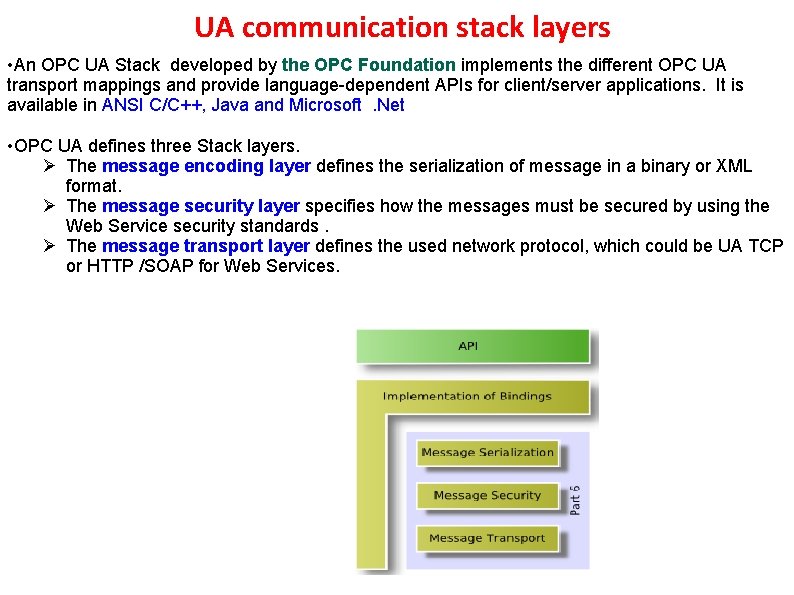
UA communication stack layers • An OPC UA Stack developed by the OPC Foundation implements the different OPC UA transport mappings and provide language-dependent APIs for client/server applications. It is available in ANSI C/C++, Java and Microsoft . Net • OPC UA defines three Stack layers. The message encoding layer defines the serialization of message in a binary or XML format. The message security layer specifies how the messages must be secured by using the Web Service security standards. The message transport layer defines the used network protocol, which could be UA TCP or HTTP /SOAP for Web Services.
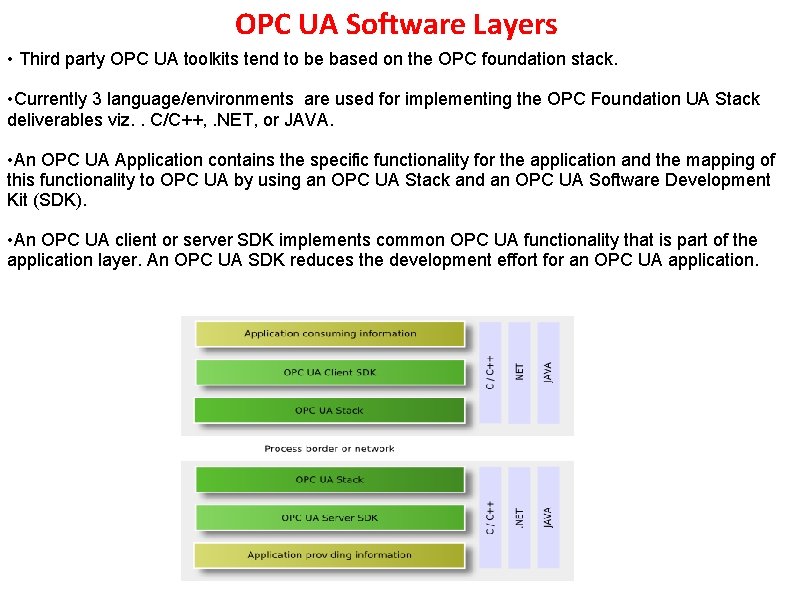
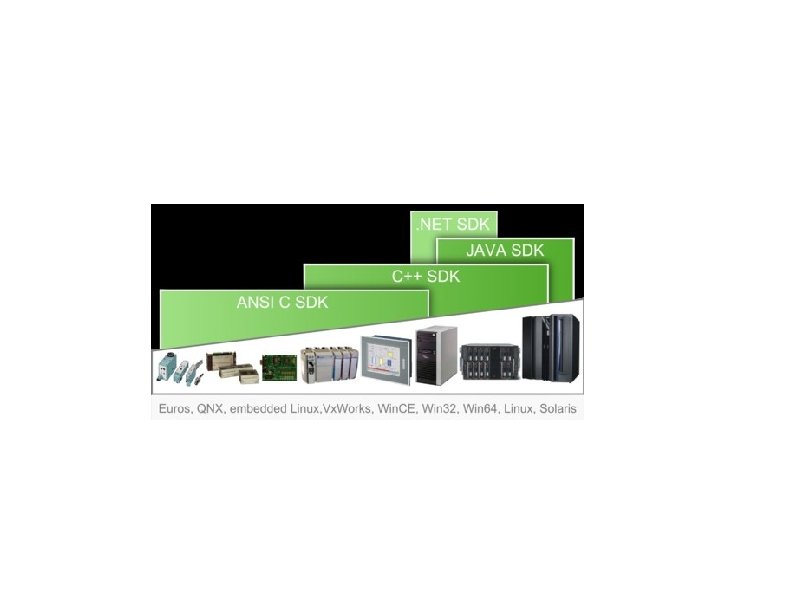
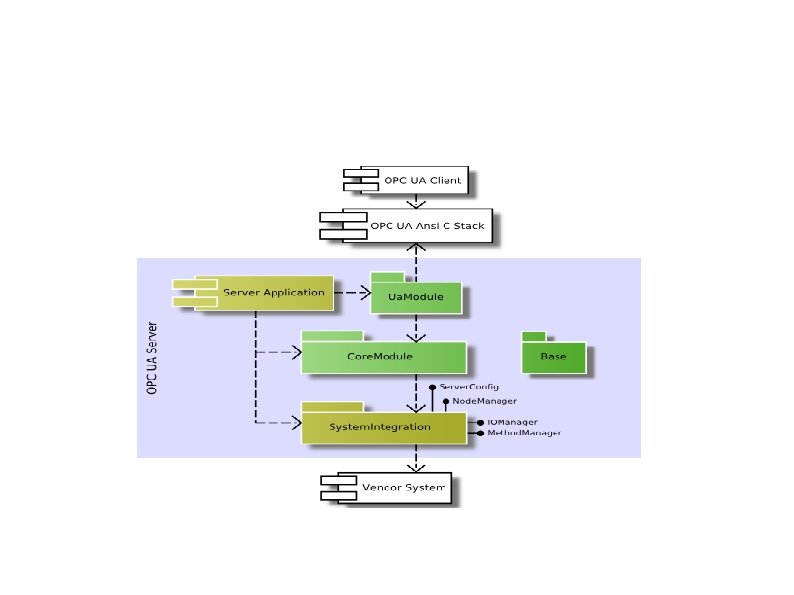
OPC UA Software Layers • Third party OPC UA toolkits tend to be based on the OPC foundation stack. • Currently 3 language/environments are used for implementing the OPC Foundation UA Stack deliverables viz. . C/C++, . NET, or JAVA. • An OPC UA Application contains the specific functionality for the application and the mapping of this functionality to OPC UA by using an OPC UA Stack and an OPC UA Software Development Kit (SDK). • An OPC UA client or server SDK implements common OPC UA functionality that is part of the application layer. An OPC UA SDK reduces the development effort for an OPC UA application.
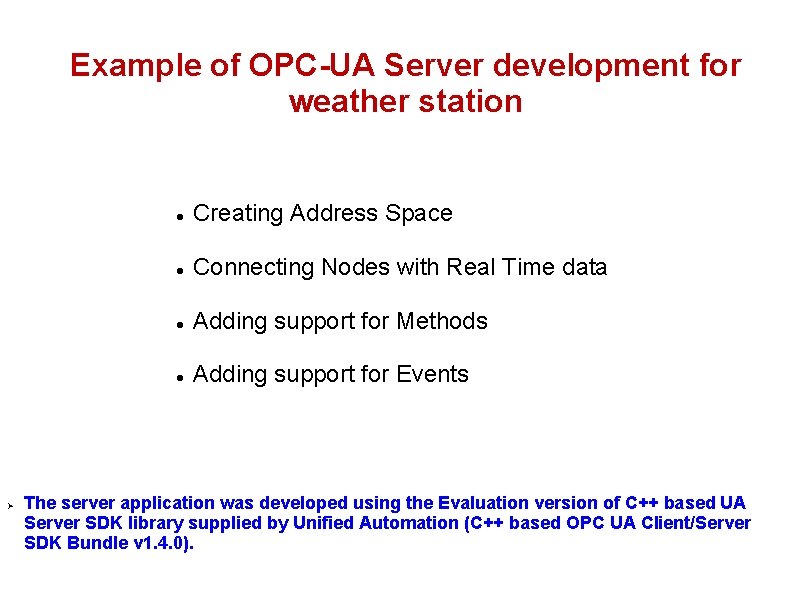
Example of OPC-UA Server development for weather station Creating Address Space Connecting Nodes with Real Time data Adding support for Methods Adding support for Events The server application was developed using the Evaluation version of C++ based UA Server SDK library supplied by Unified Automation (C++ based OPC UA Client/Server SDK Bundle v 1. 4. 0).
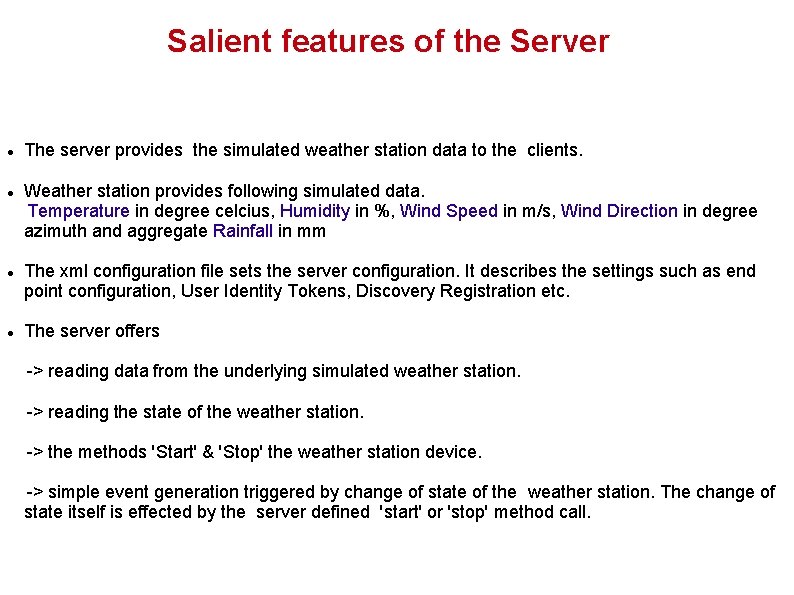
Salient features of the Server The server provides the simulated weather station data to the clients. Weather station provides following simulated data. Temperature in degree celcius, Humidity in %, Wind Speed in m/s, Wind Direction in degree azimuth and aggregate Rainfall in mm The xml configuration file sets the server configuration. It describes the settings such as end point configuration, User Identity Tokens, Discovery Registration etc. The server offers -> reading data from the underlying simulated weather station. -> reading the state of the weather station. -> the methods 'Start' & 'Stop' the weather station device. -> simple event generation triggered by change of state of the weather station. The change of state itself is effected by the server defined 'start' or 'stop' method call.
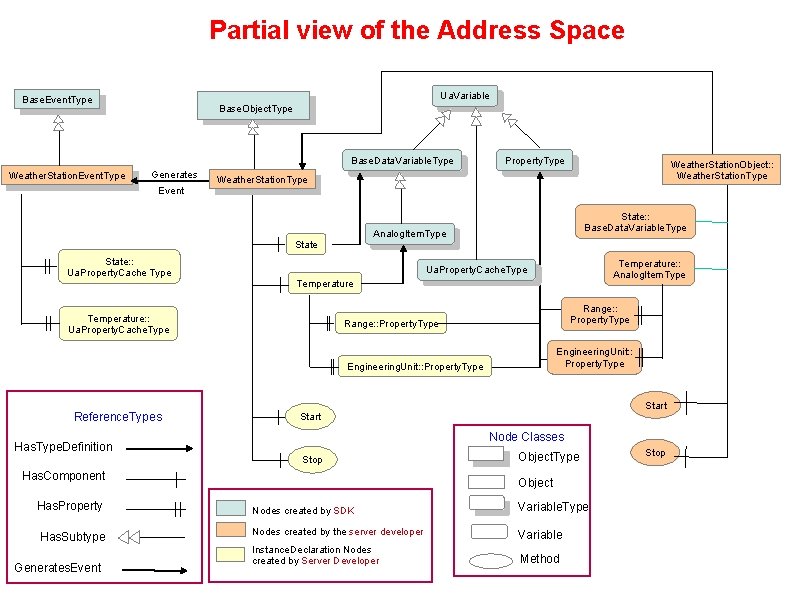
Partial view of the Address Space Ua. Variable Base. Event. Type Base. Object. Type Base. Data. Variable. Type Weather. Station. Event. Type Generates Event State: : Base. Data. Variable. Type Analog. Item. Type Temperature Range: : Property. Type Engineering. Unit: : Property. Type Start Node Classes Has. Type. Definition Stop Has. Component Has. Property Has. Subtype Generates. Event Temperature: : Analog. Item. Type Ua. Property. Cache. Type Temperature: : Ua. Property. Cache. Type Reference. Types Weather. Station. Object: : Weather. Station. Type State: : Ua. Property. Cache Type Property. Type Object Nodes created by SDK Variable. Type Nodes created by the server developer Variable Instance. Declaration Nodes created by Server Developer Method Stop
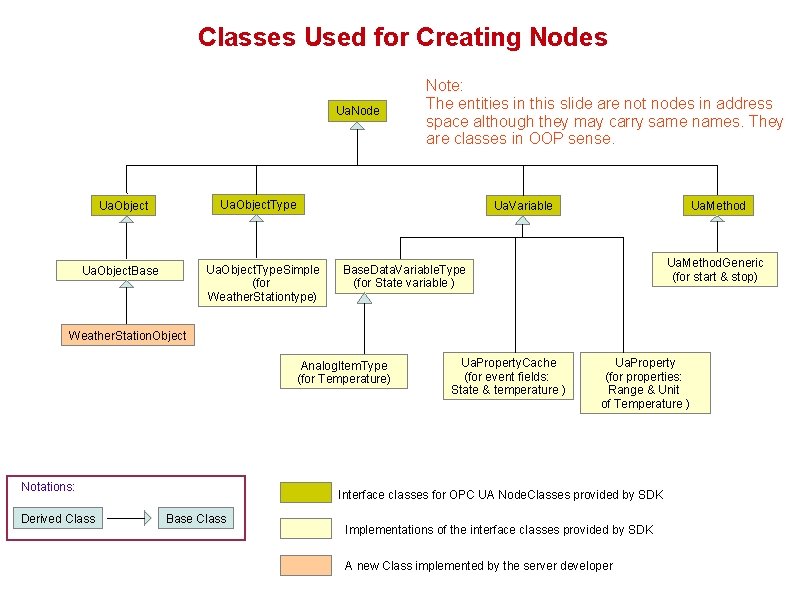
Classes Used for Creating Nodes Ua. Node Note: The entities in this slide are not nodes in address space although they may carry same names. They are classes in OOP sense. Ua. Object. Type Ua. Object Ua. Variable Ua. Object. Type. Simple (for Weather. Stationtype) Ua. Object. Base Ua. Method. Generic (for start & stop) Base. Data. Variable. Type (for State variable ) Weather. Station. Object Analog. Item. Type (for Temperature) Notations: Derived Class Ua. Property. Cache (for event fields: State & temperature ) Ua. Property (for properties: Range & Unit of Temperature ) Interface classes for OPC UA Node. Classes provided by SDK Base Class Implementations of the interface classes provided by SDK A new Class implemented by the server developer
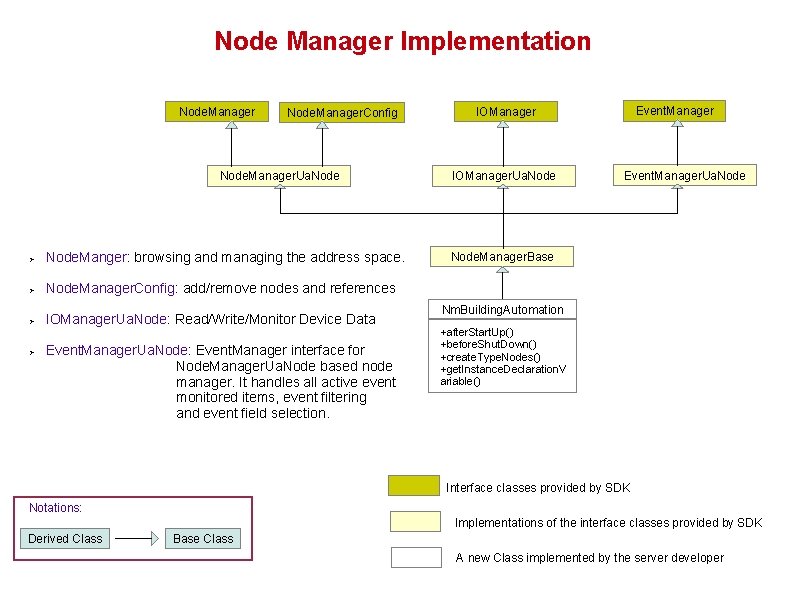
Node Manager Implementation Node. Manager. Config Node. Manager. Ua. Node. Manger: browsing and managing the address space. Node. Manager. Config: add/remove nodes and references IOManager. Ua. Node: Read/Write/Monitor Device Data Event. Manager. Ua. Node: Event. Manager interface for Node. Manager. Ua. Node based node manager. It handles all active event monitored items, event filtering and event field selection. Event. Manager IOManager. Ua. Node Event. Manager. Ua. Node. Manager. Base Nm. Building. Automation +after. Start. Up() +before. Shut. Down() +create. Type. Nodes() +get. Instance. Declaration. V ariable() Interface classes provided by SDK Notations: Implementations of the interface classes provided by SDK Derived Class Base Class A new Class implemented by the server developer
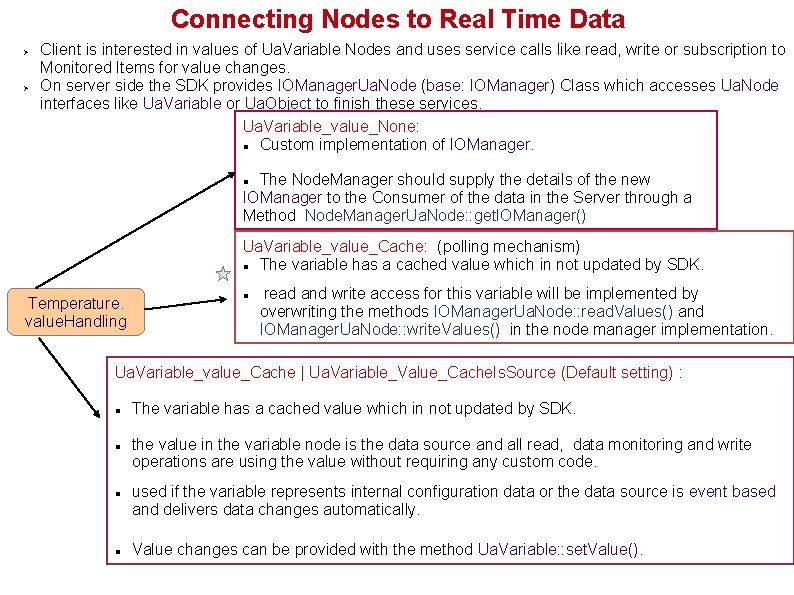
Connecting Nodes to Real Time Data Client is interested in values of Ua. Variable Nodes and uses service calls like read, write or subscription to Monitored Items for value changes. On server side the SDK provides IOManager. Ua. Node (base: IOManager) Class which accesses Ua. Node interfaces like Ua. Variable or Ua. Object to finish these services. Ua. Variable_value_None: Custom implementation of IOManager. The Node. Manager should supply the details of the new IOManager to the Consumer of the data in the Server through a Method Node. Manager. Ua. Node: : get. IOManager() Ua. Variable_value_Cache: (polling mechanism) The variable has a cached value which in not updated by SDK. Temperature. value. Handling read and write access for this variable will be implemented by overwriting the methods IOManager. Ua. Node: : read. Values() and IOManager. Ua. Node: : write. Values() in the node manager implementation. Ua. Variable_value_Cache | Ua. Variable_Value_Cache. Is. Source (Default setting) : The variable has a cached value which in not updated by SDK. the value in the variable node is the data source and all read, data monitoring and write operations are using the value without requiring any custom code. used if the variable represents internal configuration data or the data source is event based and delivers data changes automatically. Value changes can be provided with the method Ua. Variable: : set. Value().
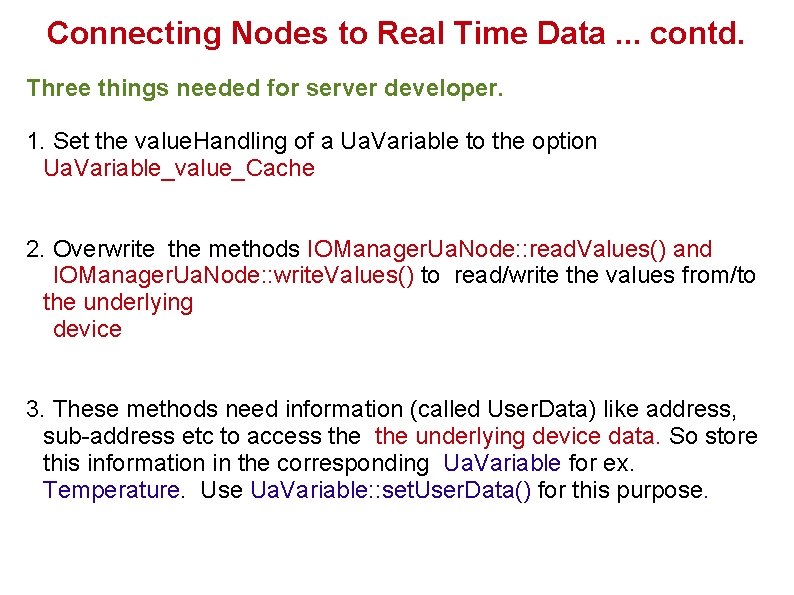
Connecting Nodes to Real Time Data. . . contd. Three things needed for server developer. 1. Set the value. Handling of a Ua. Variable to the option Ua. Variable_value_Cache 2. Overwrite the methods IOManager. Ua. Node: : read. Values() and IOManager. Ua. Node: : write. Values() to read/write the values from/to the underlying device 3. These methods need information (called User. Data) like address, sub-address etc to access the underlying device data. So store this information in the corresponding Ua. Variable for ex. Temperature. Use Ua. Variable: : set. User. Data() for this purpose.
Summary • The OPC-UA standard provides a comprehensive and secure way to build and operate multivendor clients and servers. • OPC-UA’s platform independence is a major advantage over classic OPC UA provides the necessary infrastructure for interoperability across the enterprise, from machine-to-machine, machine-to-enterprise and everything in-between. • OPC foundation has so far made available the communication stack layer that handles the communication between clients and servers. Currently 3 language/environments are used for implementing the OPC Foundation UA Stack deliverables viz. . C/C++, . NET, or JAVA. • The application developer’s task is made a bit simpler by use of SDKs developed by 3 rd party. These SDKs build upon the OPC foundation’s communication stack layer. Reference: 1. https: //opcfoundation. org 2. Documents on C++ based OPC-UA Server Development by Unified Automation 3. E-Book “OPC Unified Architechture” by Wolfgang et. al. 4. CTA Documents, Presentations etc.
Thanks!
Back-up slides
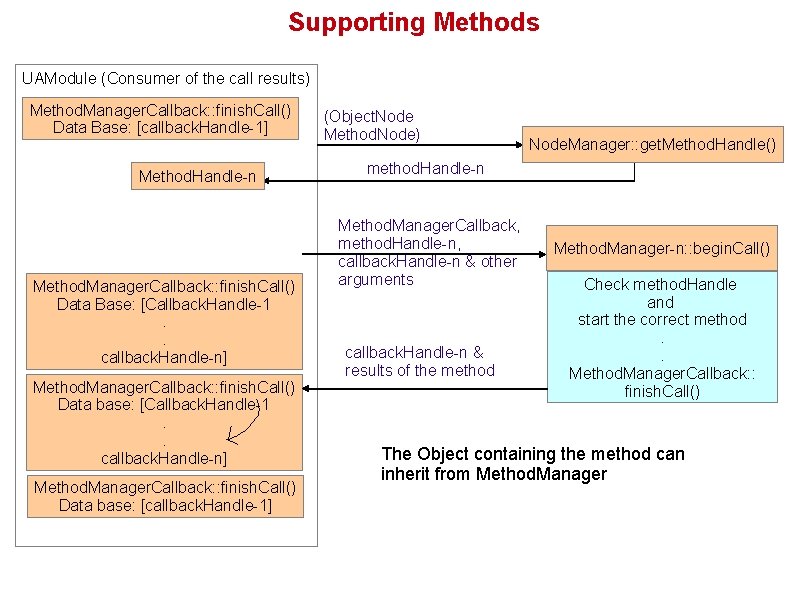
Supporting Methods UAModule (Consumer of the call results) Method. Manager. Callback: : finish. Call() Data Base: [callback. Handle-1] Method. Handle-n Method. Manager. Callback: : finish. Call() Data Base: [Callback. Handle-1. . callback. Handle-n] Method. Manager. Callback: : finish. Call() Data base: [callback. Handle-1] (Object. Node Method. Node) Node. Manager: : get. Method. Handle() method. Handle-n Method. Manager. Callback, method. Handle-n, callback. Handle-n & other arguments callback. Handle-n & results of the method Method. Manager-n: : begin. Call() Check method. Handle and start the correct method . . Method. Manager. Callback: : finish. Call() The Object containing the method can inherit from Method. Manager
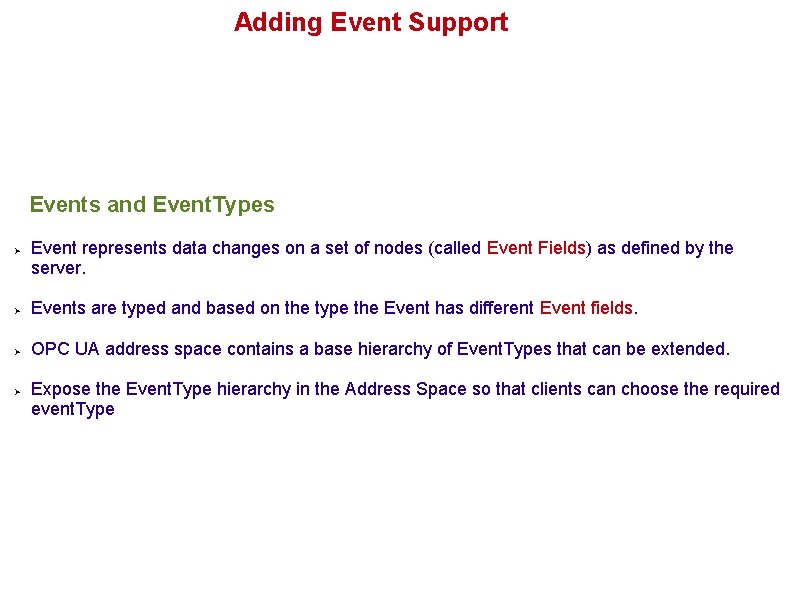
Adding Event Support Events and Event. Types Event represents data changes on a set of nodes (called Event Fields) as defined by the server. Events are typed and based on the type the Event has different Event fields. OPC UA address space contains a base hierarchy of Event. Types that can be extended. Expose the Event. Type hierarchy in the Address Space so that clients can choose the required event. Type
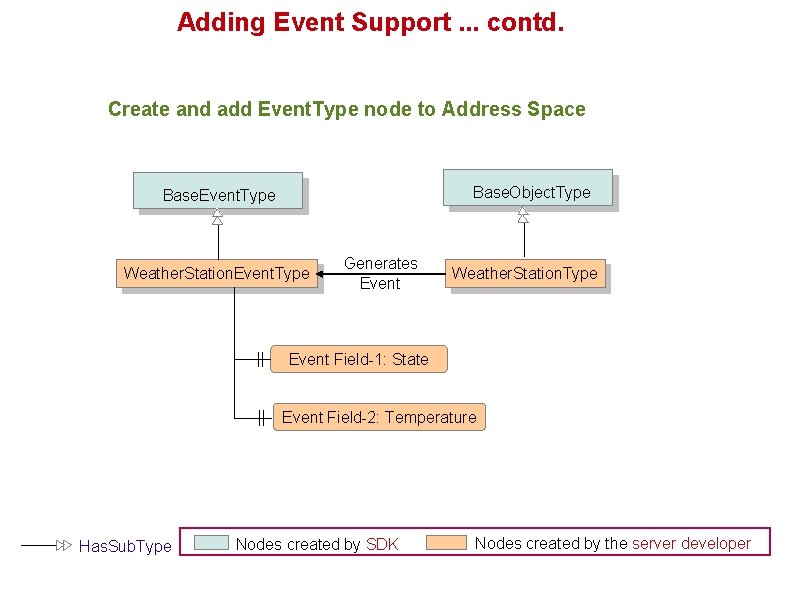
Adding Event Support. . . contd. Create and add Event. Type node to Address Space Base. Object. Type Base. Event. Type Weather. Station. Event. Type Generates Event Weather. Station. Type Event Field-1: State Event Field-2: Temperature Has. Sub. Type Nodes created by SDK Nodes created by the server developer
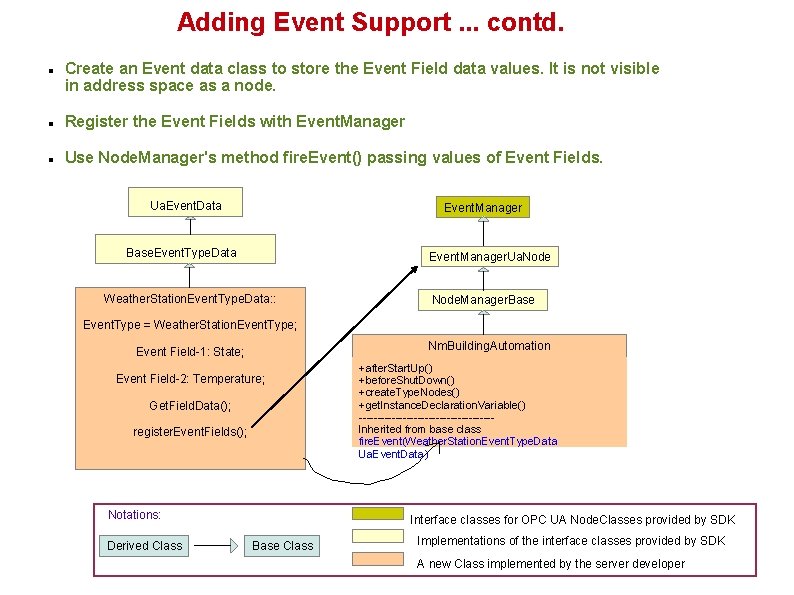
Adding Event Support. . . contd. Create an Event data class to store the Event Field data values. It is not visible in address space as a node. Register the Event Fields with Event. Manager Use Node. Manager's method fire. Event() passing values of Event Fields. Ua. Event. Data Event. Manager Base. Event. Type. Data Event. Manager. Ua. Node Weather. Station. Event. Type. Data: : Node. Manager. Base Event. Type = Weather. Station. Event. Type; Nm. Building. Automation Event Field-1: State; Event Field-2: Temperature; Get. Field. Data(); register. Event. Fields(); Notations: Derived Class +after. Start. Up() +before. Shut. Down() +create. Type. Nodes() +get. Instance. Declaration. Variable() ------------------Inherited from base class fire. Event(Weather. Station. Event. Type. Data Ua. Event. Data) Interface classes for OPC UA Node. Classes provided by SDK Base Class Implementations of the interface classes provided by SDK A new Class implemented by the server developer
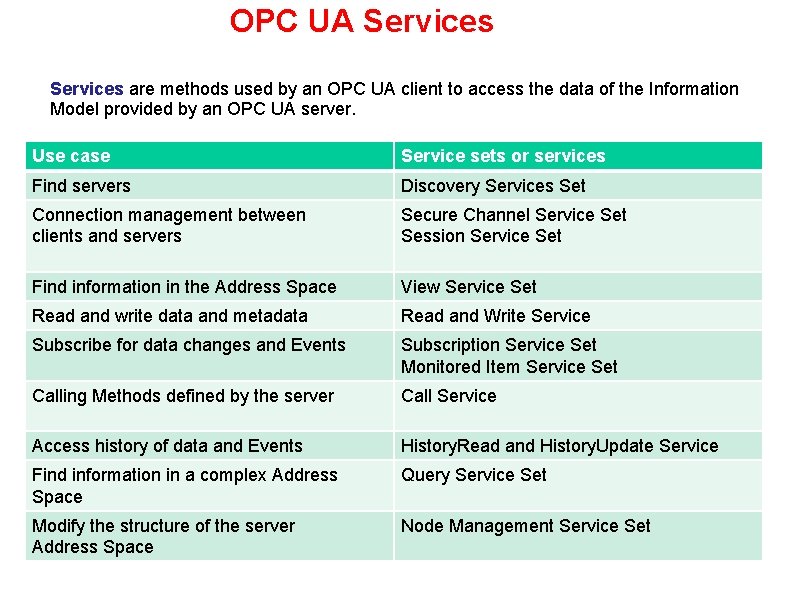
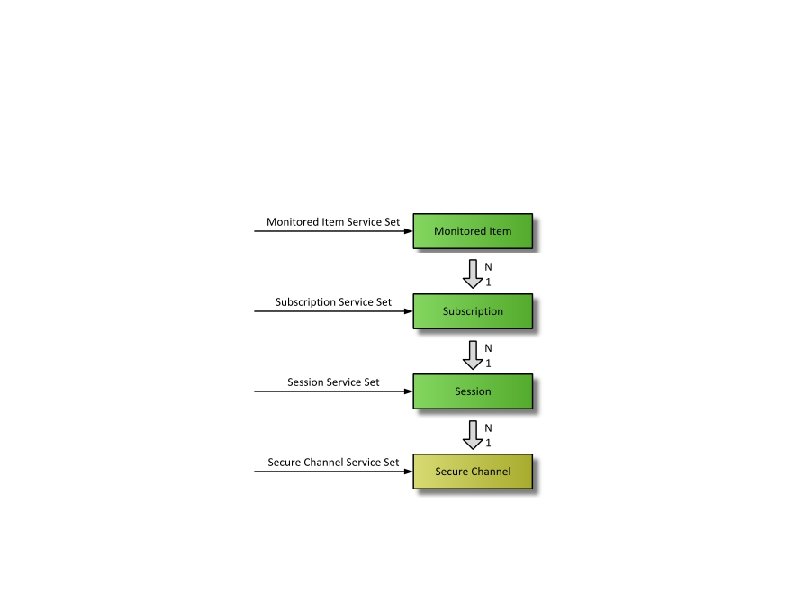
OPC UA Services are methods used by an OPC UA client to access the data of the Information Model provided by an OPC UA server. Use case Service sets or services Find servers Discovery Services Set Connection management between clients and servers Secure Channel Service Set Session Service Set Find information in the Address Space View Service Set Read and write data and metadata Read and Write Service Subscribe for data changes and Events Subscription Service Set Monitored Item Service Set Calling Methods defined by the server Call Service Access history of data and Events History. Read and History. Update Service Find information in a complex Address Space Query Service Set Modify the structure of the server Address Space Node Management Service Set
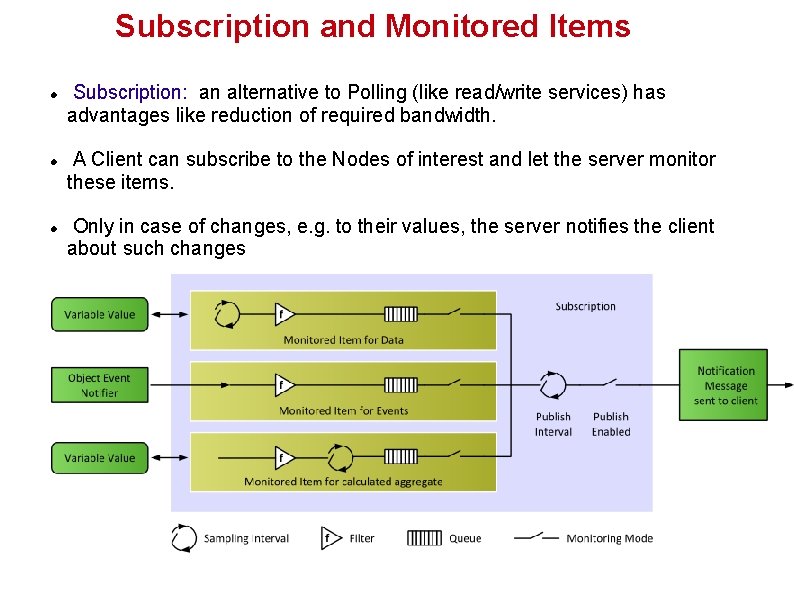
Subscription and Monitored Items Subscription: an alternative to Polling (like read/write services) has advantages like reduction of required bandwidth. A Client can subscribe to the Nodes of interest and let the server monitor these items. Only in case of changes, e. g. to their values, the server notifies the client about such changes
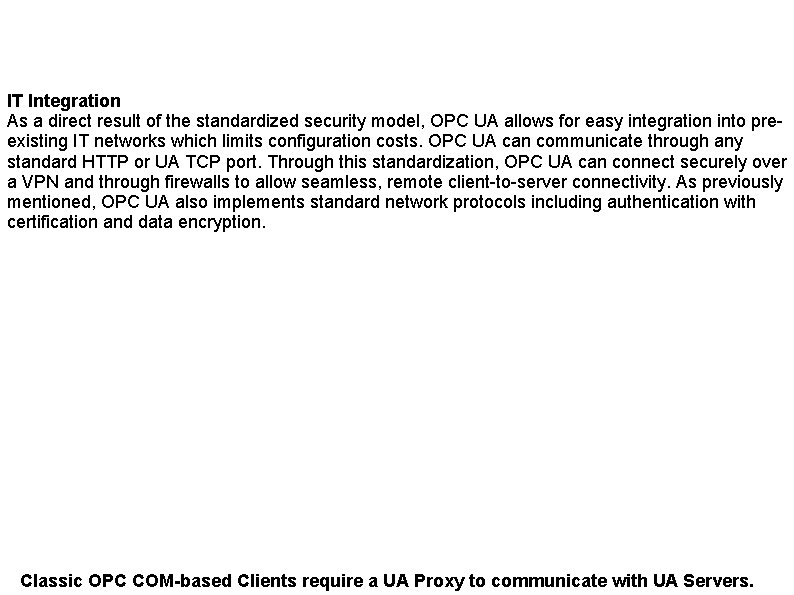
IT Integration As a direct result of the standardized security model, OPC UA allows for easy integration into preexisting IT networks which limits configuration costs. OPC UA can communicate through any standard HTTP or UA TCP port. Through this standardization, OPC UA can connect securely over a VPN and through firewalls to allow seamless, remote client-to-server connectivity. As previously mentioned, OPC UA also implements standard network protocols including authentication with certification and data encryption. Classic OPC COM-based Clients require a UA Proxy to communicate with UA Servers.
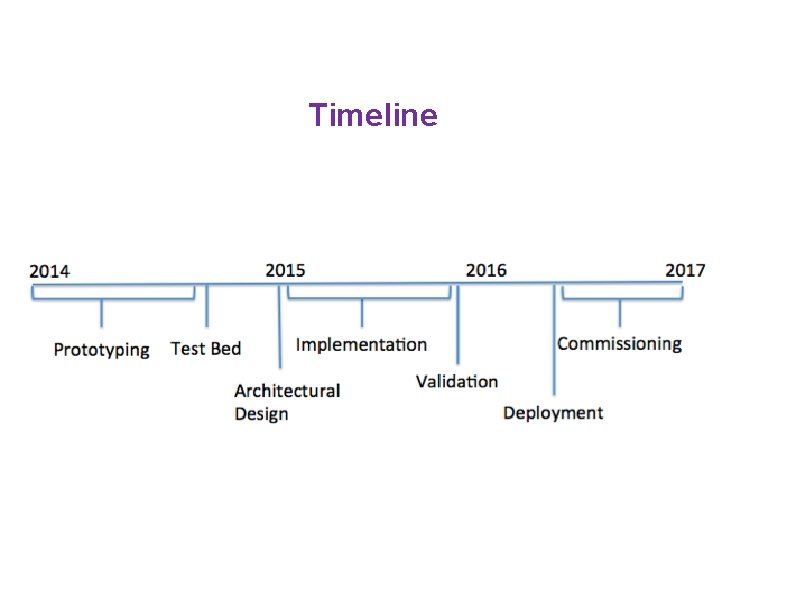
Timeline
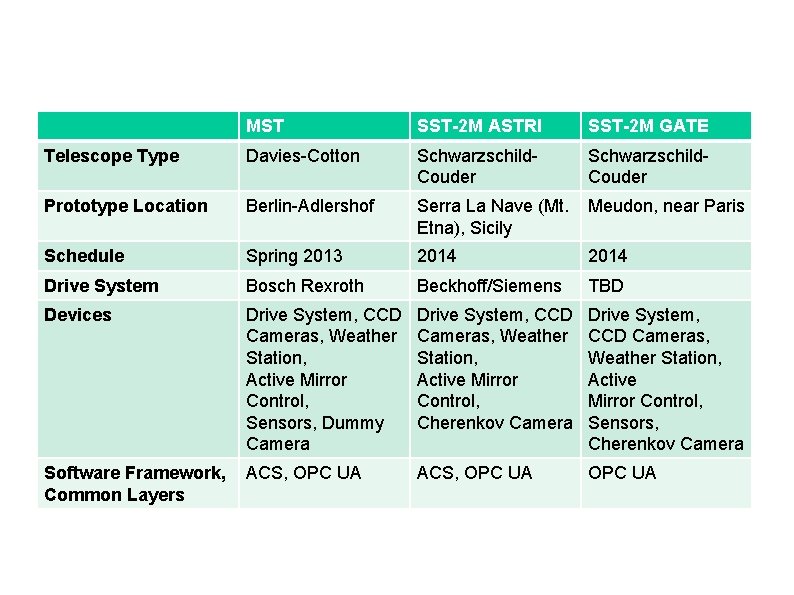
MST SST-2 M ASTRI SST-2 M GATE Telescope Type Davies-Cotton Schwarzschild. Couder Prototype Location Berlin-Adlershof Serra La Nave (Mt. Meudon, near Paris Etna), Sicily Schedule Spring 2013 2014 Drive System Bosch Rexroth Beckhoff/Siemens TBD Devices Drive System, CCD Cameras, Weather Station, Active Mirror Control, Sensors, Dummy Camera Drive System, CCD Cameras, Weather Station, Active Mirror Control, Cherenkov Camera Drive System, CCD Cameras, Weather Station, Active Mirror Control, Sensors, Cherenkov Camera Software Framework, Common Layers ACS, OPC UA
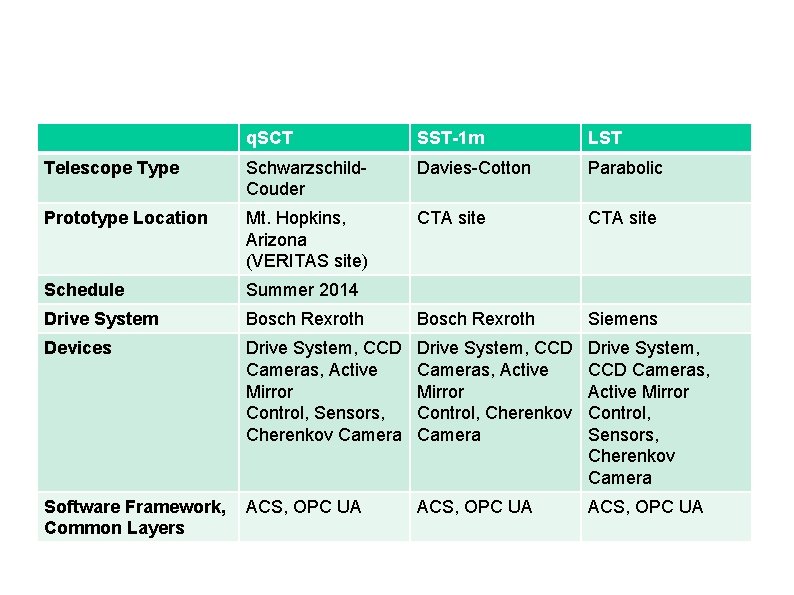
q. SCT SST-1 m LST Telescope Type Schwarzschild. Couder Davies-Cotton Parabolic Prototype Location Mt. Hopkins, Arizona (VERITAS site) CTA site Schedule Summer 2014 Drive System Bosch Rexroth Siemens Devices Drive System, CCD Cameras, Active Mirror Control, Sensors, Cherenkov Camera Drive System, CCD Cameras, Active Mirror Control, Sensors, Cherenkov Camera Software Framework, Common Layers ACS, OPC UA
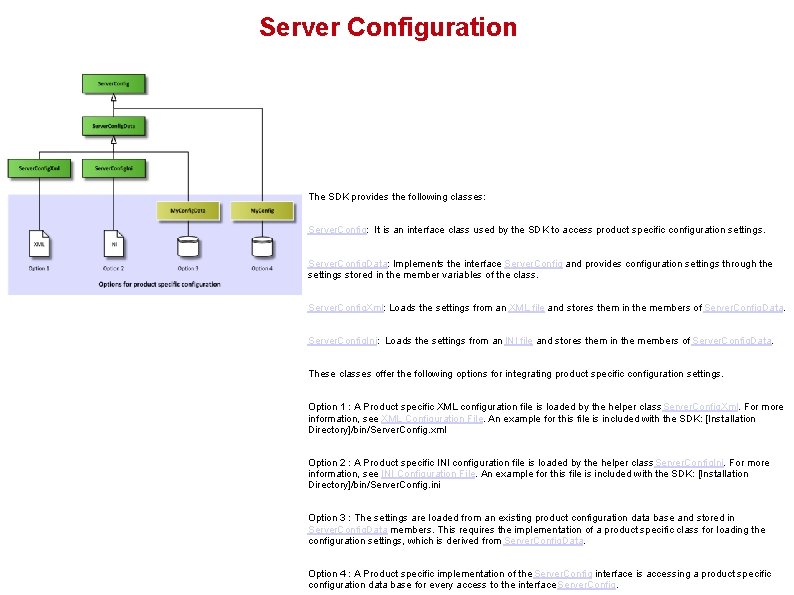
Server Configuration The SDK provides the following classes: Server. Config: It is an interface class used by the SDK to access product specific configuration settings. Server. Config. Data: Implements the interface Server. Config and provides configuration settings through the settings stored in the member variables of the class. Server. Config. Xml: Loads the settings from an XML file and stores them in the members of Server. Config. Data. Server. Config. Ini: Loads the settings from an INI file and stores them in the members of Server. Config. Data. These classes offer the following options for integrating product specific configuration settings. Option 1 : A Product specific XML configuration file is loaded by the helper class Server. Config. Xml. For more information, see XML Configuration File. An example for this file is included with the SDK: [Installation Directory]/bin/Server. Config. xml Option 2 : A Product specific INI configuration file is loaded by the helper class Server. Config. Ini. For more information, see INI Configuration File. An example for this file is included with the SDK: [Installation Directory]/bin/Server. Config. ini Option 3 : The settings are loaded from an existing product configuration data base and stored in Server. Config. Data members. This requires the implementation of a product specific class for loading the configuration settings, which is derived from Server. Config. Data. Option 4 : A Product specific implementation of the Server. Config interface is accessing a product specific configuration data base for every access to the interface Server. Config.
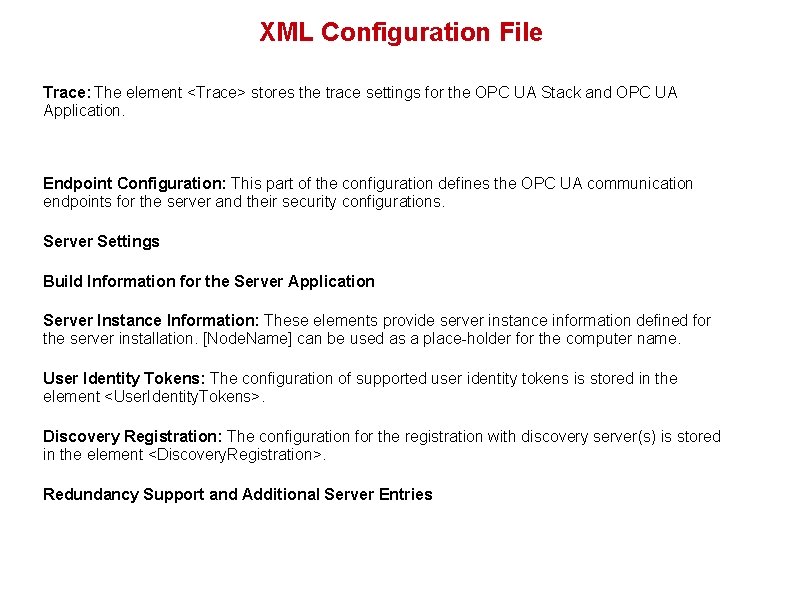
XML Configuration File Trace: The element <Trace> stores the trace settings for the OPC UA Stack and OPC UA Application. Endpoint Configuration: This part of the configuration defines the OPC UA communication endpoints for the server and their security configurations. Server Settings Build Information for the Server Application Server Instance Information: These elements provide server instance information defined for the server installation. [Node. Name] can be used as a place-holder for the computer name. User Identity Tokens: The configuration of supported user identity tokens is stored in the element <User. Identity. Tokens>. Discovery Registration: The configuration for the registration with discovery server(s) is stored in the element <Discovery. Registration>. Redundancy Support and Additional Server Entries
OPC is a standard interface to communicate between numerous data sources, including devices on a factory floor, laboratory equipment, test system fixtures, and databases. The OPC Foundation defined a set of standard interfaces that allow any client to access any OPCcompatible device using a protocol now referred to as Classic OPC. This protocol utilizes the Microsoft-based COM/DCOM technology to provide standard specifications for data access (DA), historical data access (HDA), and alarms and events (A&E). Although basing a protocol on this technology made sense in the 1990 s, Classic OPC has several limitations because of this reliance on the Microsoft Windows platform, in the form of security issues and platform dependency. OPC Unified Architecture (UA) is a new communication technology standard which was first released by the OPC Foundation in 2006 as an improvement upon its predecessor, Classic OPC UA includes all of the functionality found in Classic OPC. This is done by bringing together the different specifications of Classic OPC into a single entry point to a system offering current data access, alarms and events, combined with the history of both. Furthermore, OPC UA is based on a cross-platform, business-optimized Service-Oriented Architecture (SOA), which expands on the security and functionality found in Classic OPC, instead of the Microsoft-based COM/DCOM technology. OPC UA supports two protocols: a binary protocol that employs minimal resources, allowing for easy enablement through a firewall; and a Web Service protocol (SOAP) which uses standard HTTP/HTTPS ports. Because of the benefits of this new protocol, an increasing trend of industrial applications have adopted the UA protocol both in the traditional OPC-centric Industrial Automation space and emerging areas, such as energy.
An OPC-UA server uses device-specific protocols to communicate with different brands and kinds of devices and an OPC-UA protocol to communicate with software applications. Software applications only need to implement a single OPC-UA communication protocol to talk to an OPC-UA server. A software application sends data to an OPC-UA server using an OPC-UA protocol. The OPC-UA server receives the data and sends the data to a device using the device's specific communication protocol. Communication back to the software application works the same in reverse - data is received by the OPC-UA server using the device-specific protocol and sent to the software application using the OPC-UA protocol. OPC-UA was created by and is maintained by the OPC Foundation. OPC-UA is the successor of the OPC standard. OPC is a Microsoft-based technology that is used only on Windows computers. One of the benefits of OPC-UA over OPC is that OPC-UA is operating system independent - can be used on Windows, Linux, OS X, Android etc. OPC-UA specifies a binary TCP-based communication protocol and a SOAP, HTTP-based protocol. These two communication protocols can be used by software applications to communicate with OPC-UA servers.
Redundancy : the inclusion of extra components which are not strictly necessary to functioning, in case of failure in other components. robustness is the ability of a computer system to cope with errors during execution. Robustness can also be defined as the ability of an algorithm to continue operating despite abnormalities in input, calculations, etc scalability is necessary to be able to integrate OPC interfaces directly into the systems running on many different platforms. Interoperability is the ability of making systems and organizations work together (inter-operate). While the term was initially defined for Information technology or systems engg. services to allow for information exchange.