
OPAQUE OPRFbased asymmetric PAKE a k a augmented
OPAQUE: OPRF-based asymmetric* PAKE * a. k. a. augmented [S. Jarecki, H. Krawczyk, J. Xu, Eurocrypt 2018] [draft-krawczyk-cfrg-opaque-00] 1
a. PAKE: ‘a’ for asymmetric/augmented n n Password-Authenticated Key Exchange in the client-server setting ¨ a. PAKE requirements: PKI free and security against server compromise (forces offline dict attack) prevent pre-computation attacks ¨ In other words, best possible security, only unavoidable attacks allowed: online guesses + offline upon server compromise Compare password-over-TLS: ¨ n Prevents pre-computation (via salted hashes) but fully dependent on PKI + server sees passwd (and so do middle boxes, termination points, Mit. M, etc. ) Clearly, a. PAKE is better (no PKI dependence, server does not see pwd) … but is it, really? 2
All knonwn a. PAKE protocols are vulnerable to pre-computation attacks! n Why? They do not accommodate secret salt ¨ n Either they do not use salt at all or send it in the clear from server to user Wait, but there a. PAKE that are proven secure… ¨ … Yes, but the standard a. PAKE definitions do not exclude pre -computation attacks (this includes BMP’ 00 and GMR’ 06) n Worse than password-over-TLS in this fundamental a. PAKE aspect This includes SRP, SPAKE 2+, Aug. PAKE, VTBPEKE, etc. 3
Is this essential (proven impossibility)? Nope… 4
OPAQUE: First a. PAKE secure against pre-computation (and with proof) 5

Oblivious PRF (OPRF) Pseudo-Random Function (PRF) Fk(x) ? x Fk or $ Fk(x)or $ Adv Indistinguishable from random function (w/o secret key) q OPRF protocol S(k) C(x) FK Nothing Fk(x) OPRF: An interactive PRF “service” that returns PRF results without the server learning the input or output of the function 6
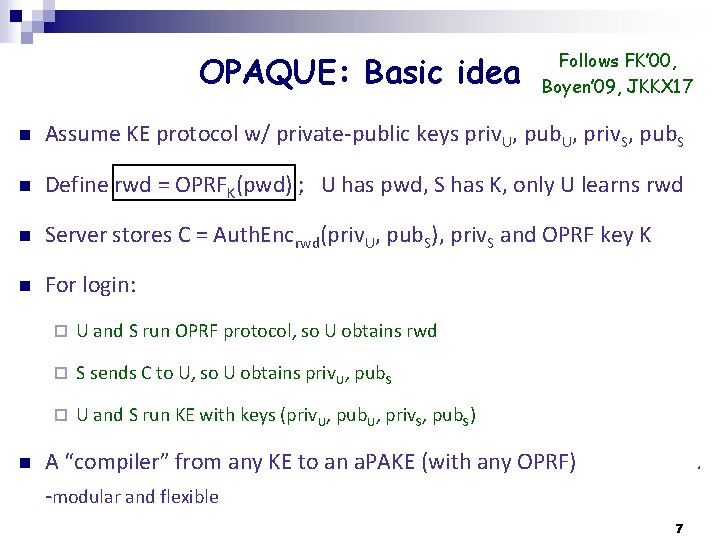
OPAQUE: Basic idea Follows FK’ 00, Boyen’ 09, JKKX 17 n Assume KE protocol w/ private-public keys priv. U, pub. U, priv. S, pub. S n Define rwd = OPRFK(pwd) ; U has pwd, S has K, only U learns rwd n Server stores C = Auth. Encrwd(priv. U, pub. S), priv. S and OPRF key K n For login: n ¨ U and S run OPRF protocol, so U obtains rwd ¨ S sends C to U, so U obtains priv. U, pub. S ¨ U and S run KE with keys (priv. U, pub. U, priv. S, pub. S) A “compiler” from any KE to an a. PAKE (with any OPRF) . -modular and flexible 7

DH-OPRF n Server: 1 var-base exponent’n Client: 1 var-base, 1 fixd-base Single round 8
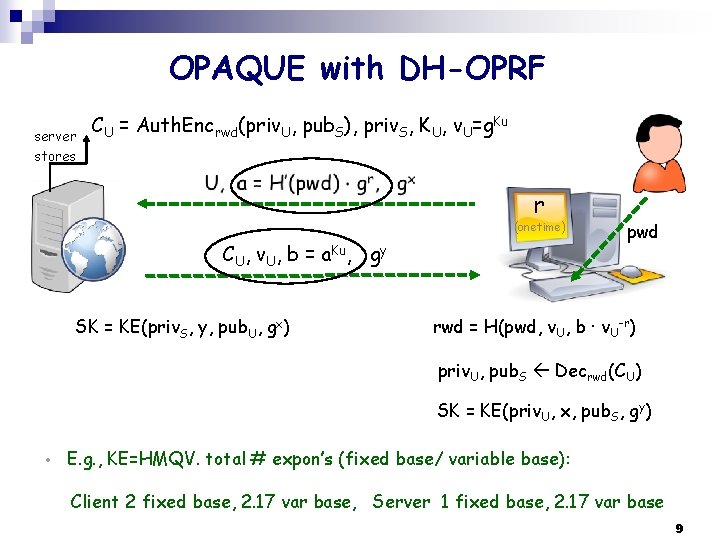
OPAQUE with DH-OPRF server stores CU = Auth. Encrwd(priv. U, pub. S), priv. S, KU, v. U=g. Ku r (onetime) CU, v. U, b = a. Ku, gy SK = KE(priv. S, y, pub. U, gx) pwd rwd = H(pwd, v. U, b ∙ v. U-r) priv. U, pub. S Decrwd(CU) SK = KE(priv. U, x, pub. S, gy) • E. g. , KE=HMQV. total # expon’s (fixed base/ variable base): Client 2 fixed base, 2. 17 var base, Server 1 fixed base, 2. 17 var base 9
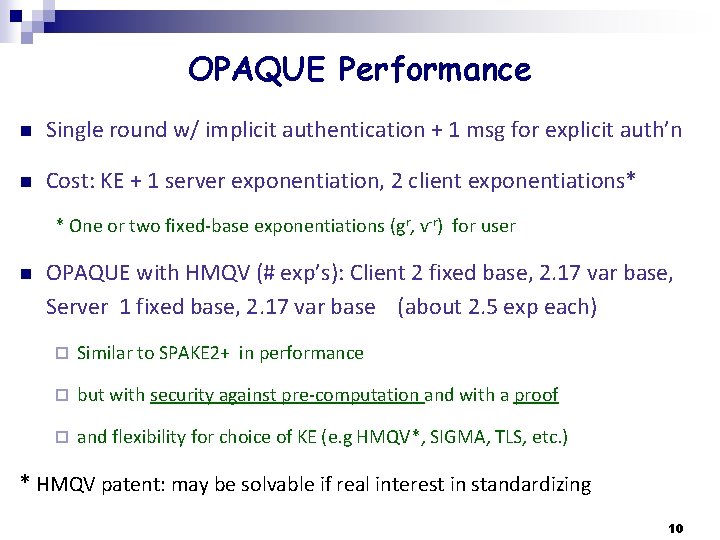
OPAQUE Performance n Single round w/ implicit authentication + 1 msg for explicit auth’n n Cost: KE + 1 server exponentiation, 2 client exponentiations* * One or two fixed-base exponentiations (gr, v-r) for user n OPAQUE with HMQV (# exp’s): Client 2 fixed base, 2. 17 var base, Server 1 fixed base, 2. 17 var base (about 2. 5 exp each) ¨ Similar to SPAKE 2+ in performance ¨ but with security against pre-computation and with a proof ¨ and flexibility for choice of KE (e. g HMQV*, SIGMA, TLS, etc. ) * HMQV patent: may be solvable if real interest in standardizing 10
OPAQUE with TLS 1. 3 n Reuse DH exchange of TLS DH exchange, use priv. U as signature key for client authentication (perfect fit with 3 -flight handshake) n User account privacy: use resumption key if available Or: Add extra round trip (between TLS 2 nd and 3 rd flight) ¨ post-handshake client auth’n and exported authenticators may help 11
OPAQUE Security n Secure against pre-computation attacks (secret salt)!! n Proof ¨ Strong a. PAKE model (PKI-free and disallows pre-computation attacks) ¨ Proof of OPAQUE is generic: OPRF + KE (with KCI) ¨ With DH-OPRF: In ROM under Gap-OMDH n Forward security n User-side hash iterations ¨ increased security against offline attacks upon server compromise 12
OPAQUE Features n Efficient, provably secure and … n No reliance on PKI n Server never sees password, not even at init (good against pwd reuse) n Private salt: Attacker cannot pre-compute dictionary n Hash iterations can be offloaded to user n TLS integration (hedged PKI: PAKE-protected TLS) n Storing other user secrets n User-transparent server-side threshold implementation 13
Final Remarks n IF we are looking for a strong a. PAKE to standardize (are we? ) OPAQUE seems to fit perfectly n In particular, a good fit for TLS 1. 3 n Passwords are not going away, so let’s improve their use ¨ Additional new tools help too: Sphinx password manager, TOPPSS password protected secret sharing, … 14
- Slides: 14