
OPAL SP 2000 Road Safety Standard Objectives Provide

OPAL (SP 2000) Road Safety Standard

Objectives Provide an update on the new Road Safety Standard: Ø Background, current status Ø Standard composition Ø Summary of changes Ø Implementation strategy and way forward 2

Background and current status q q Current OPAL Road Safety Standard does not cater for all Upstream and Downstream operators posing challenges for contractors to implement all the requirements while operating at different Blocks. Major challenges identified were: Ø Ø q q Driver Training Vehicle specifications and Roadworthiness Assurance Standards (RAS) In-Vehicle Monitoring System (IVMS) Consequence Management As a result of these misalignments, contractors are confused and exposed to unnecessary burden (both financial and operational) that ultimately leads to unsatisfactory compliance level. Typical examples were: q q Defensive driving permits; drivers have to go for 2 or 3 trainings and contractors pay for it. Vehicles being inspected several times during the year and carrying 2 or 3 RAS inspections stickers. 3

Background and current status HE Undersecretary of MOG mandated OPAL to align road safety standard for the whole industry. 5 Preemployment criteria 1 SP 2000 Consequence management ALARP Focus Areas Defensive driving training program and permit IVMS strategy 4 Vehicle specifications and RAS 3 2 Risk based
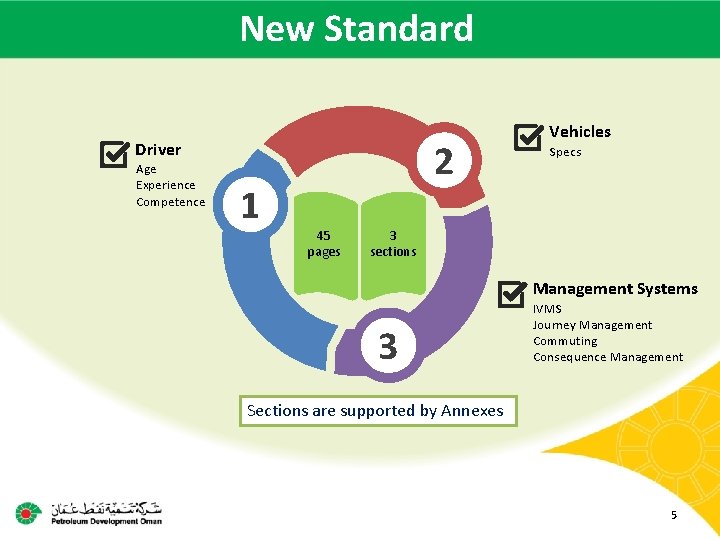
New Standard 2 Driver Age Experience Competence 1 45 pages Vehicles Specs 3 sections Management Systems 3 IVMS Journey Management Commuting Consequence Management Sections are supported by Annexes 5
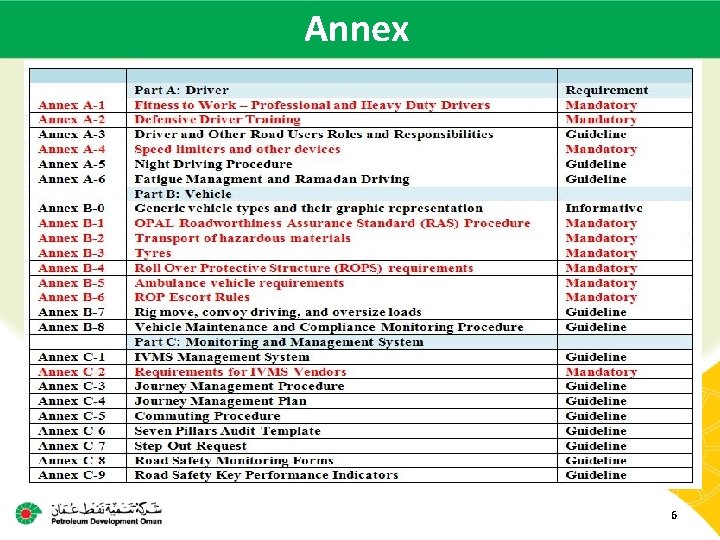
Annex 6
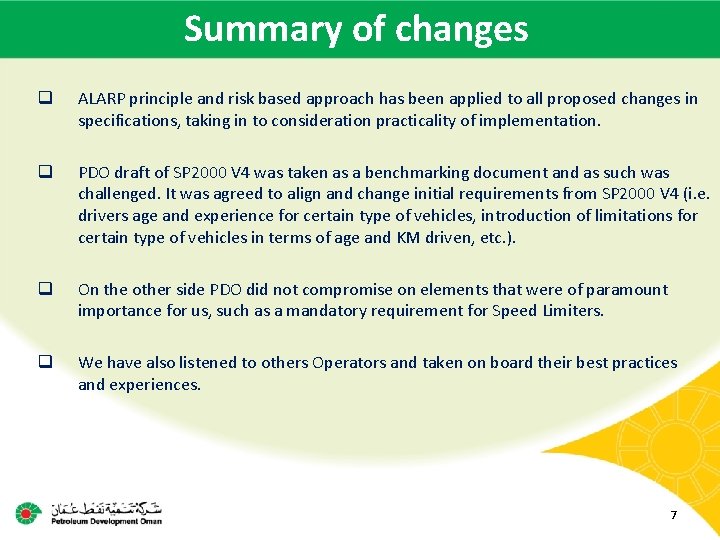
Summary of changes q ALARP principle and risk based approach has been applied to all proposed changes in specifications, taking in to consideration practicality of implementation. q PDO draft of SP 2000 V 4 was taken as a benchmarking document and as such was challenged. It was agreed to align and change initial requirements from SP 2000 V 4 (i. e. drivers age and experience for certain type of vehicles, introduction of limitations for certain type of vehicles in terms of age and KM driven, etc. ). q On the other side PDO did not compromise on elements that were of paramount importance for us, such as a mandatory requirement for Speed Limiters. q We have also listened to others Operators and taken on board their best practices and experiences. 7
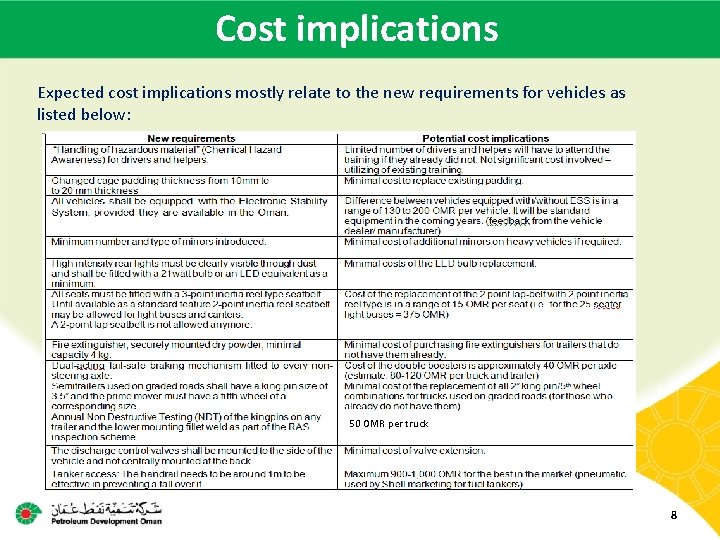
Cost implications Expected cost implications mostly relate to the new requirements for vehicles as listed below: 50 OMR per truck 8
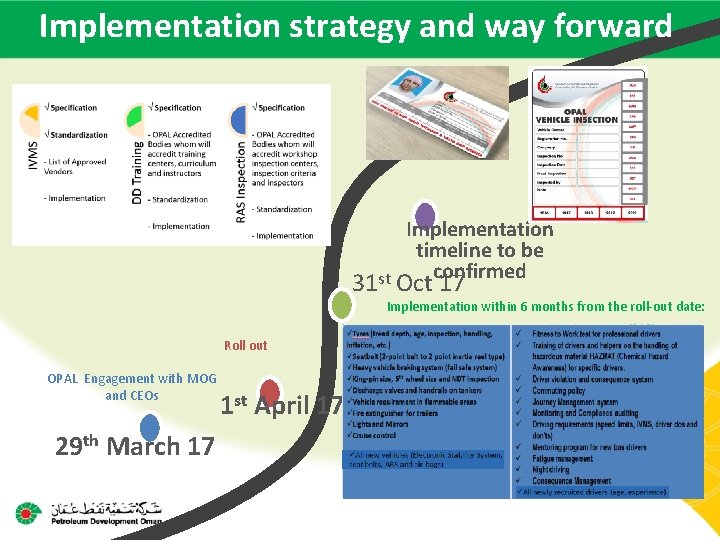
Implementation strategy and way forward Implementation timeline to be confirmed 31 st Oct 17 Implementation within 6 months from the roll-out date: Roll out OPAL Engagement with MOG and CEOs 29 th March 17 1 st April 17
Back-up Slides 10

Standard Example of the aligned Standard on Commuting: q Each Operator/Company shall define their own commuting policy to ensure compliance to this Standard. q The Operator/Company shall actively discourage the use of PRIVATE VEHICLE in the interior. q Operator/Company are not permitted to pay directly to their employees for travel arrangements, except the payments regulated by Sultanate Of Oman. q Operator/Company must arrange commuting by flight or heavy bus that is compliant to this Standard for distance beyond 200 km one way. q Where commuting by flight or heavy bus is not practical due to financial/logistic reasons, Operator shall define use of an OPAL compliant light vehicle/buses for more than 200 km one way, provided all necessary authorisations are obtained from the authorized person as defined in the commuting policy. q OPAL compliant light vehicles/buses can be used for commuting distances less than 200 km one way. q Operator/Company can arrange their own bus or contract with any transport company that is fully compliant with the requirements given in this Standard. 11
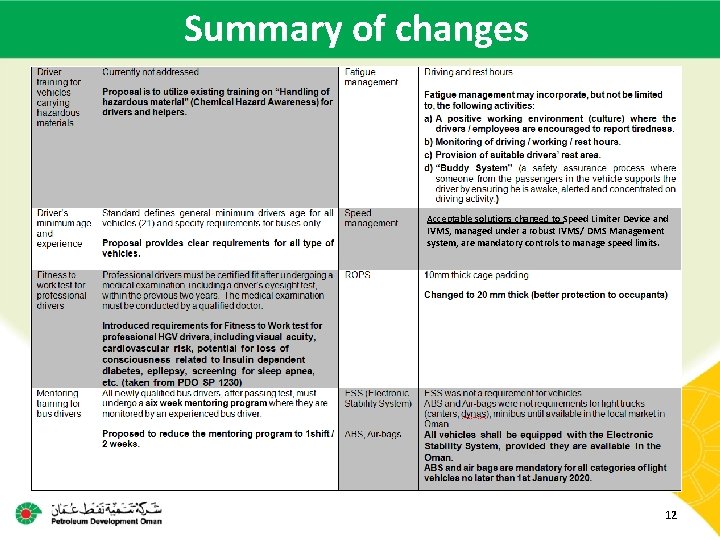
Summary of changes Acceptable solutions changed to Speed Limiter Device and IVMS, managed under a robust IVMS/ DMS Management system, are mandatory controls to manage speed limits. 12

Summary of changes 13

Summary of changes 14

Summary of changes Consequence Management Proposed (pending Legal review) Current 15
- Slides: 15