
OPAL outcomes for personal and adaptive learning Rachel
- Slides: 15
OPAL: outcomes for personal and adaptive learning Rachel Ellaway 1, Patricia Warren 2, Catriona Bell 3, Phillip Evans 2 and Susan Rhind 3 1 MVM Learning Technology Section, 2 Medical Teaching Organisation, 3 Veterinary Teaching Organisation, University of Edinburgh, UK
OPAL • University e-Learning Fund Project 2004 -2005 • Opportunity to create staff and student focused curriculum maps for medicine and veterinary medicine • Instantiated inside their respective VLEs • Divergent practices following curriculum needs • Based on learning objectives and outcomes • But really … why do this?
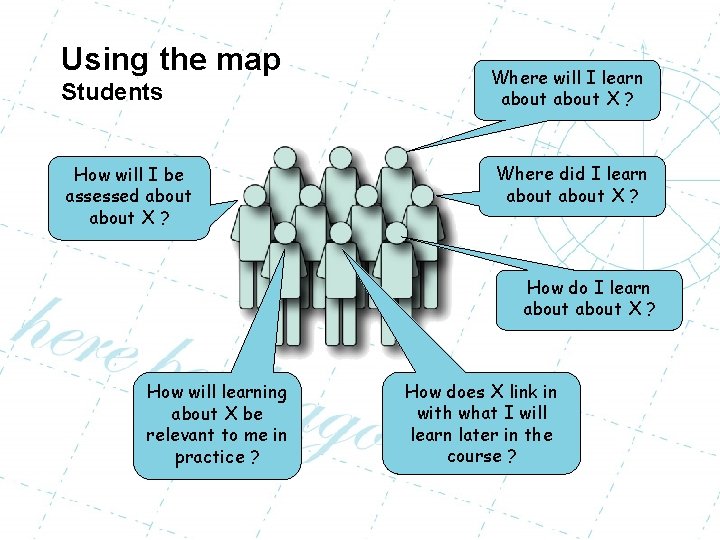
Using the map Students How will I be assessed about X ? Where will I learn about X ? Where did I learn about X ? How do I learn about X ? How will learning about X be relevant to me in practice ? How does X link in with what I will learn later in the course ?
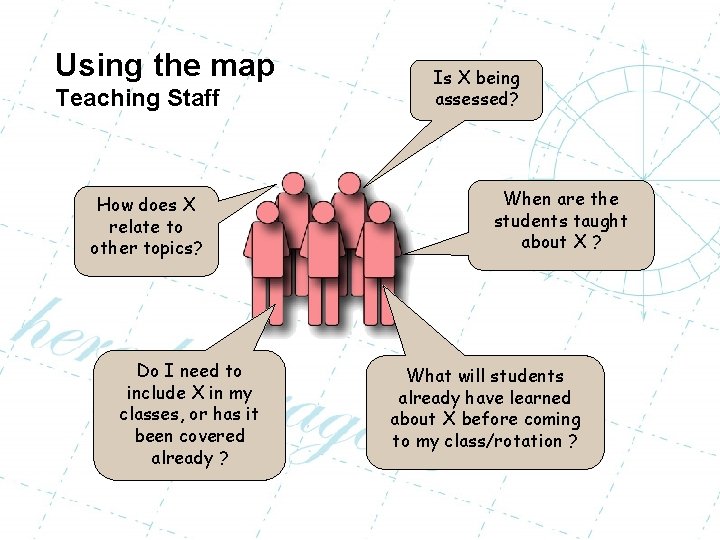
Using the map Teaching Staff How does X relate to other topics? Do I need to include X in my classes, or has it been covered already ? Is X being assessed? When are the students taught about X ? What will students already have learned about X before coming to my class/rotation ?
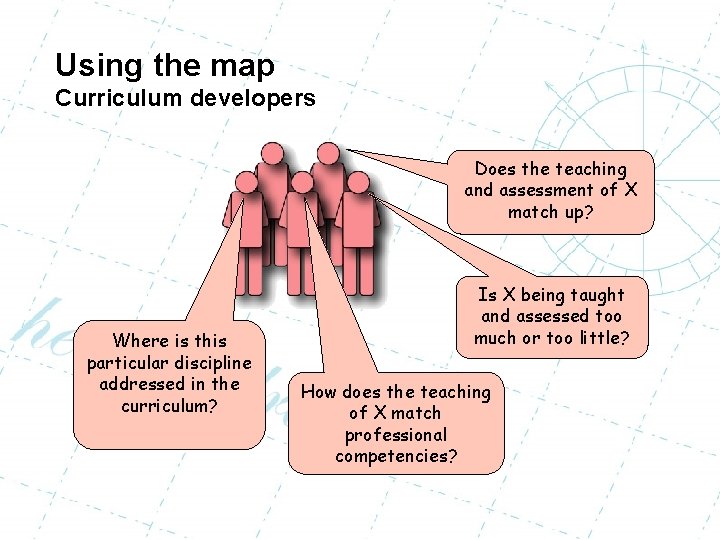
Using the map Curriculum developers Does the teaching and assessment of X match up? Where is this particular discipline addressed in the curriculum? Is X being taught and assessed too much or too little? How does the teaching of X match professional competencies?
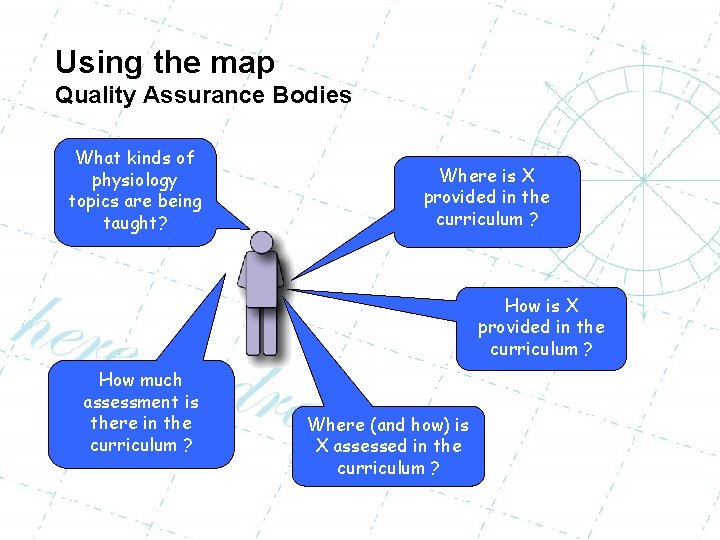
Using the map Quality Assurance Bodies What kinds of physiology topics are being taught? Where is X provided in the curriculum ? How is X provided in the curriculum ? How much assessment is there in the curriculum ? Where (and how) is X assessed in the curriculum ?
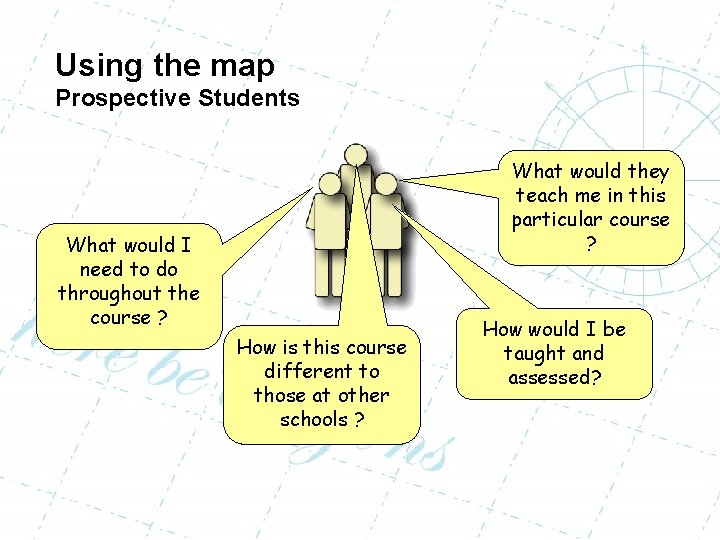
Using the map Prospective Students What would they teach me in this particular course ? What would I need to do throughout the course ? How is this course different to those at other schools ? How would I be taught and assessed?
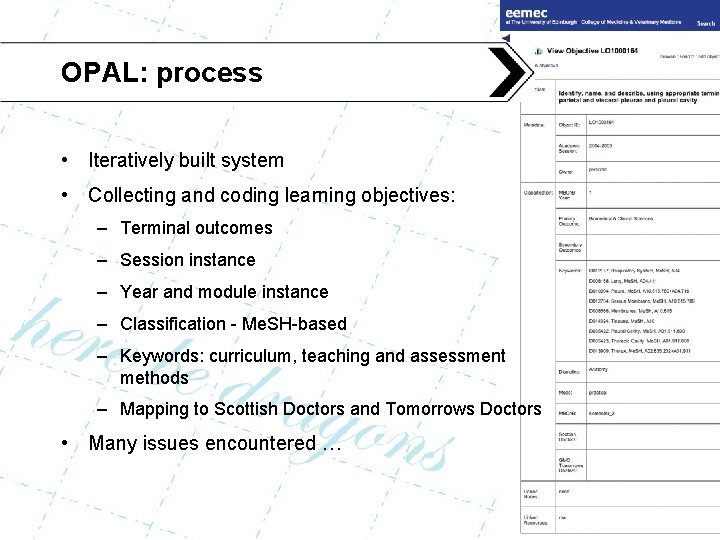
OPAL: process • Iteratively built system • Collecting and coding learning objectives: – Terminal outcomes – Session instance – Year and module instance – Classification - Me. SH-based – Keywords: curriculum, teaching and assessment methods – Mapping to Scottish Doctors and Tomorrows Doctors • Many issues encountered …
Coding and Semantics i • Learning objective statements in many forms: – Unitary, compound list, bulleted list, hierarchy, prose – Needed to be unitary - comprehensible as an independent statement – Many needed to be normalised - restructured and revalidated - in new form • Dealing with semantic complexity e. g. synonyms: locomotor, bones and joints, rheumatology etc problematic for syntactic systems (computers) • Medical classification using Me. SH: – US system - US language and spelling – Subjective trees and hierarchies – Missing terms - redefined terms - Ed. Me. SH – When to use tree inheritance – How to handle resulting glossary
Coding and Semantics ii • Required vocabularies for: – teaching method (PBL, bedside, self-directed) – assessment mode (OSCE, portfolio, exam) – curriculum structures (semester, rotation, attachment) • Stability of curriculum outcomes (internal for Medics vs external for Vets) • Versioning between academic sessions • Relationship to ever more granular curriculum representations • Ownership and maintenance by teaching staff
Relation to parent systems • All OPAL management, representation and linking are fully integrated with respective programme’s VLEs • Anticipated OPAL becoming the VLE’s underlying semantic and ontological underpinning layers (SOULs) • Follows an object oriented architecture • Connects with all basic system objects: people, events, resources, information etc • Cross-connects with emerging subsystems - PPD, logbooks etc • Cross-mapping opportunities (SDMCG, MEDINE Tuning)
Diverging and converging Practice • OPAL for medicine and veterinary medicine differs: – Outcome framework - internal vs external – Keywording - structured vs unstructured – Granularity of objectives – Intra-system connectivity • And converge: – Versioning, ownership and unitary statements – Multiple classifications – Complexity and extent of process – Limited ability to carry out - central support staff as curriculum cartographers
Unresolved Issues • How to move the process to curriculum mainstream (with appropriate resourcing) • How to get curriculum-wide buy-in and commitment from teaching staff • How to accommodate the multi-dimensional and semantically complex nature of the task more efficiently - without losing functionality • Resolving tensions between process and product • Resolving inherent partialities of curriculum cartographers • How to represent the OPAL map in many different ways to different users for different purposes
Where next? • Complete full curriculum LO maps • Complete system object mapping • Complete student and staff rendering and representation and tools • Finesse and speed up process • Hand over LO ownership to teachers • Link these maps with other maps elsewhere in a sustainable way … … points to educational informatics as a discrete discipline and basis for practice
OPAL: outcomes for personal and adaptive learning Rachel Ellaway 1, Patricia Warren 2, Catriona Bell 3, Phillip Evans 2 and Susan Rhind 3 1 MVM Learning Technology Section, 2 Medical Teaching Organisation, 3 Veterinary Teaching Organisation, University of Edinburgh, UK