
Op amp 2 Active Filters Voltage subtraction I
Op amp 2 Active Filters
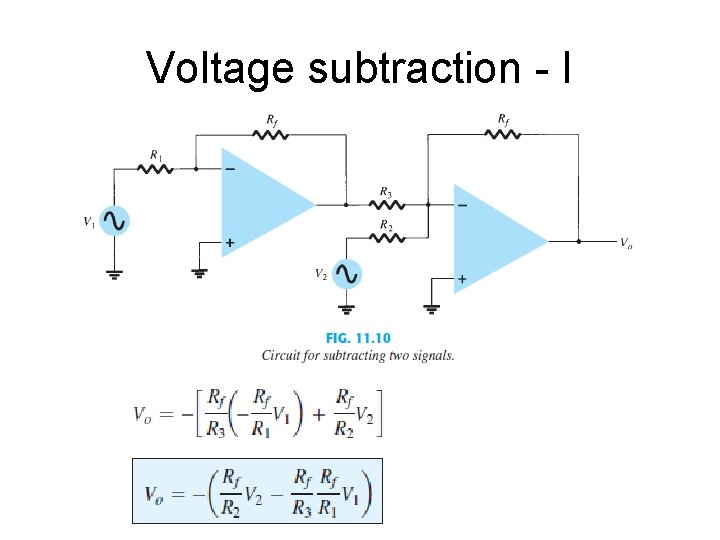
Voltage subtraction - I
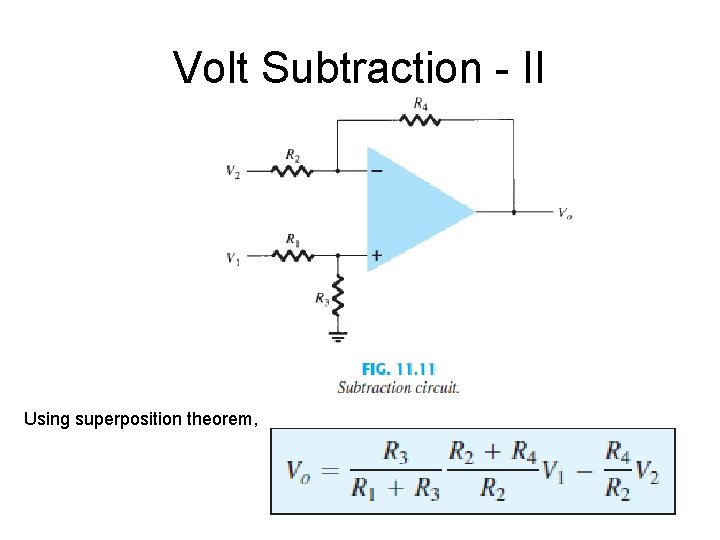
Volt Subtraction - II Using superposition theorem,
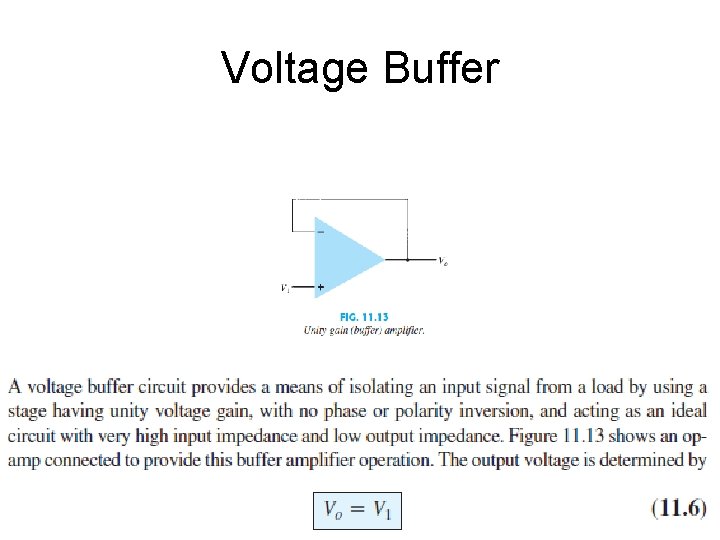
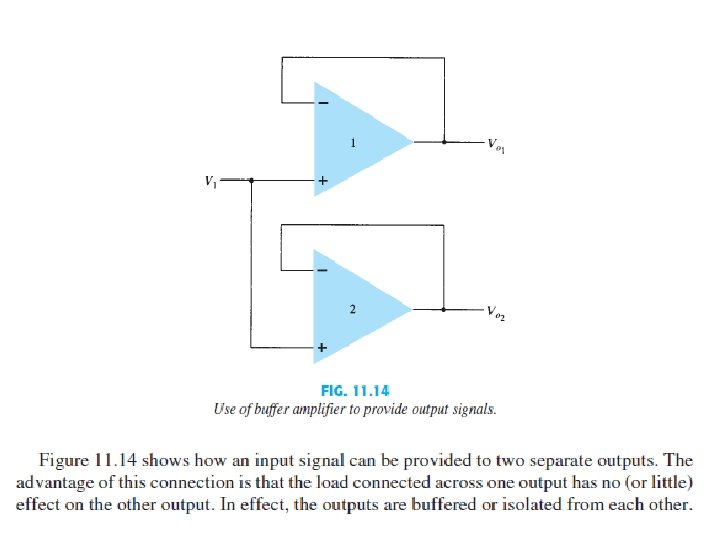
Voltage Buffer
Filter • Active filter • Passive filter • Analog filter - An analog filter processes continuoustime signals • Digital filter - A digital filter processes discrete-time signals • Software • Hardware
• • • What if filter? Purpose of filter? Types of filters? What is cut-off frequency? Draw frequency responses of 4 filters? What is pass-band?
Types • • • Low-pass filter High-pass filter Band-rejection / elimination filter Notch filter – Ideal vs. real filter – Cut-off frequency – Pass-band
• What is active filter? • What passive filter?
Passive Filters • made up of passive components - resistors, capacitors and inductors • no amplifying elements (- transistors, op-amps, etc) • no signal gain • 1 st order - design is simple (just use standard equations to find resonant frequency of the circuit) • 2 nd order - complex equations • require no power supplies • not restricted by the bandwidth limitations of the op-amps • can be used at very high frequencies • can handle larger current or voltage levels than active devices • They are particularly non-ideal (lossy) • They are bulky and expensive Ref: 080222 HKN EE 3110 Active Filter (Part 1) 10
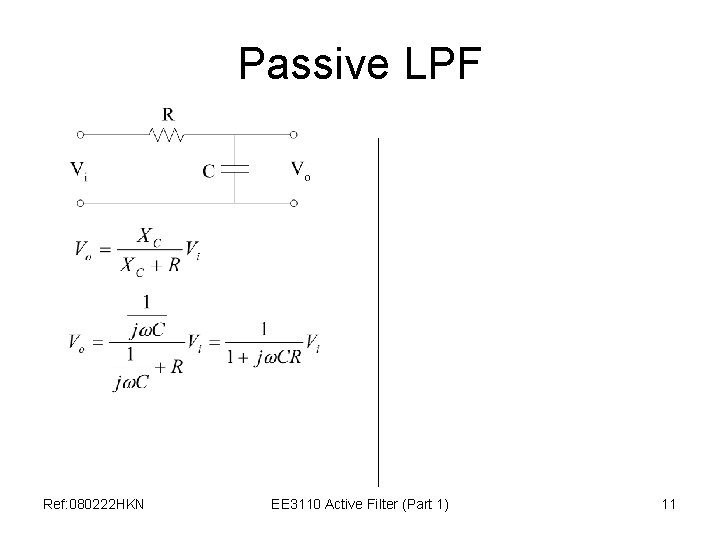
Passive LPF Ref: 080222 HKN EE 3110 Active Filter (Part 1) 11
Passive elements : Inductor BIG PROBLEM! • high accuracy (1% or 2%), small physical size, or large inductance values are required? ? • standard values of inductors are not very closely spaced • difficult to find an off-the-shelf inductor within 10 percent of any arbitrary value • adjustable inductors are used • tuning such inductors to the required values is timeconsuming and expensive for larger quantities of filters • inductors are often prohibitively expensive EE 3110 Active Filter (Part 1) 12
Active Filter • • no inductors made up of op-amps, resistors and capacitors provides virtually any arbitrary gain generally easier to design • high input impedance prevents excessive loading of the driving source • low output impedance prevents the filter from being affected by the load • at high frequencies is limited by the gain-bandwidth of the opamps • easy to adjust over a wide frequency range without altering the desired response Ref: 080222 HKN EE 3110 Active Filter (Part 1) 13
Active filter using Op. Amp • A filter circuit can be constructed using passive components: resistors and capacitors. • An active filter additionally uses an amplifier to provide voltage amplification and signal isolation or buffering.
Op Amp Advantages • Advantages of active RC filters include: – reduced size and weight, and therefore parasitics – increased reliability and improved performance – simpler design than for passive filters and can realize a wider range of functions as well as providing voltage gain – in large quantities, the cost of an IC is less than its passive counterpart
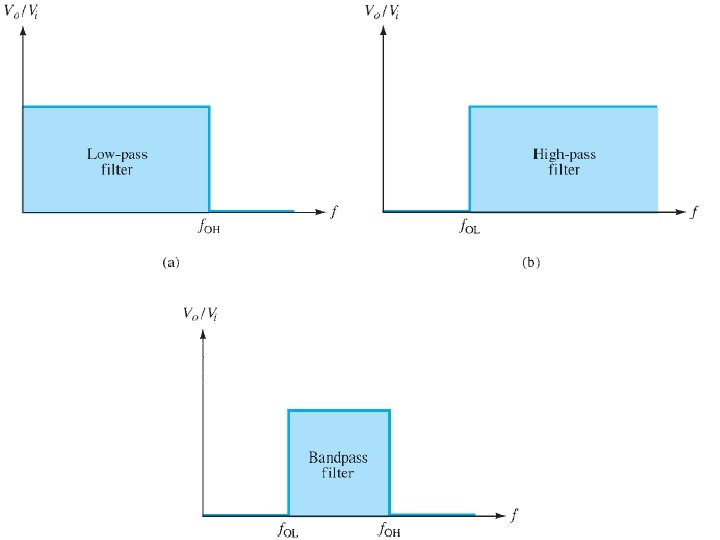
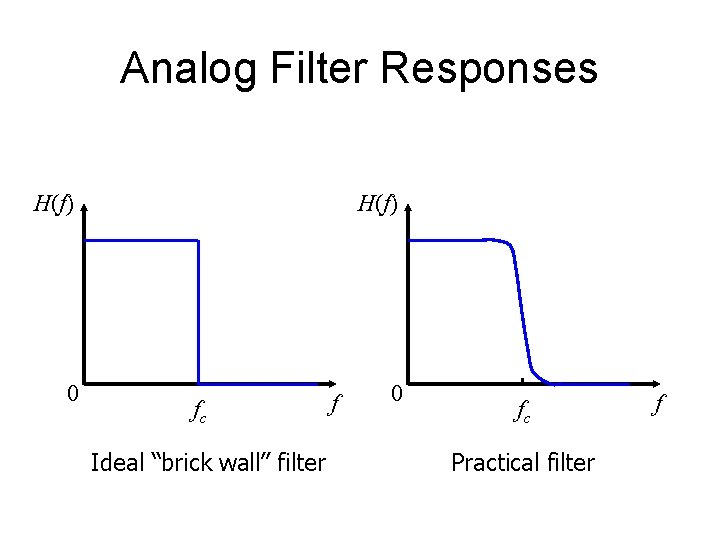
Analog Filter Responses H(f) 0 H(f) fc Ideal “brick wall” filter f 0 fc Practical filter f
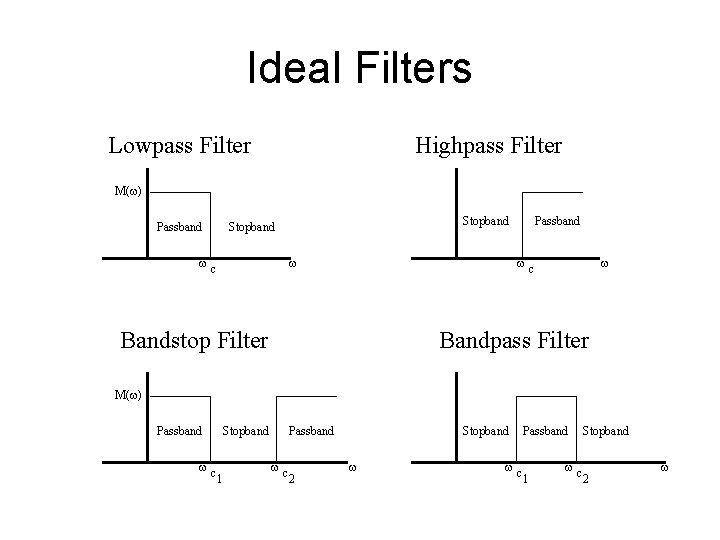
Ideal Filters Lowpass Filter Highpass Filter M(w) Passband Stopband wc w Passband wc Bandstop Filter w Bandpass Filter M(w) Passband wc Stopband 1 Passband wc 2 Stopband w wc Passband 1 wc Stopband 2 w
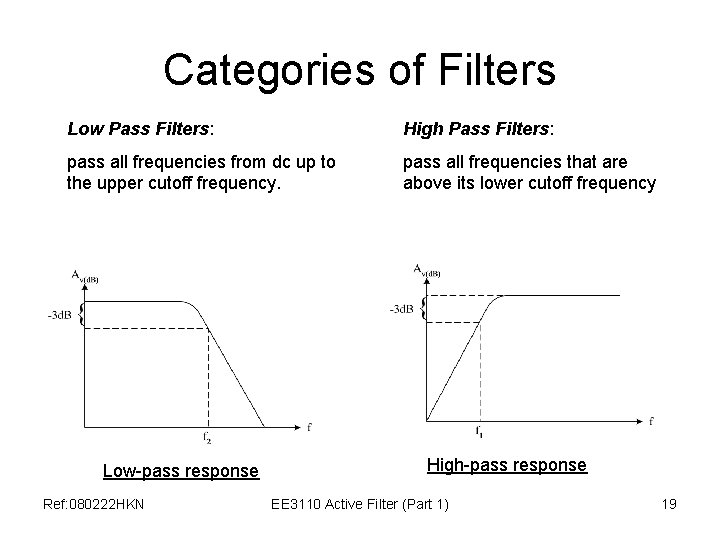
Categories of Filters Low Pass Filters: High Pass Filters: pass all frequencies from dc up to the upper cutoff frequency. pass all frequencies that are above its lower cutoff frequency Low-pass response Ref: 080222 HKN High-pass response EE 3110 Active Filter (Part 1) 19
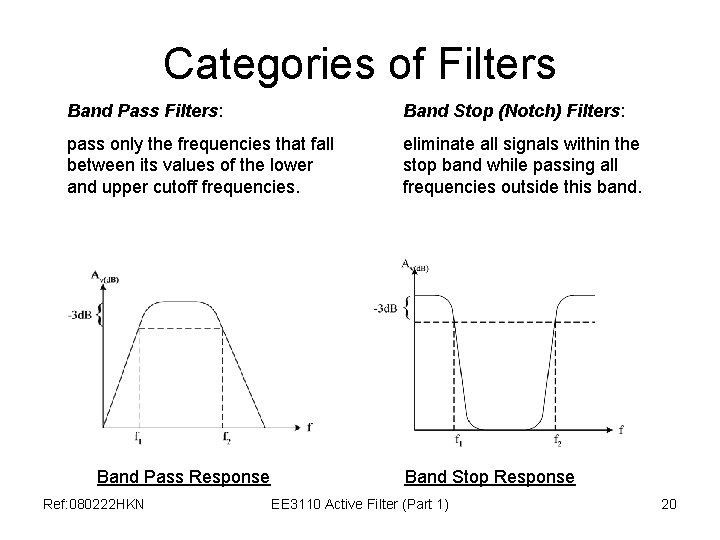
Categories of Filters Band Pass Filters: Band Stop (Notch) Filters: pass only the frequencies that fall between its values of the lower and upper cutoff frequencies. eliminate all signals within the stop band while passing all frequencies outside this band. Band Pass Response Ref: 080222 HKN Band Stop Response EE 3110 Active Filter (Part 1) 20
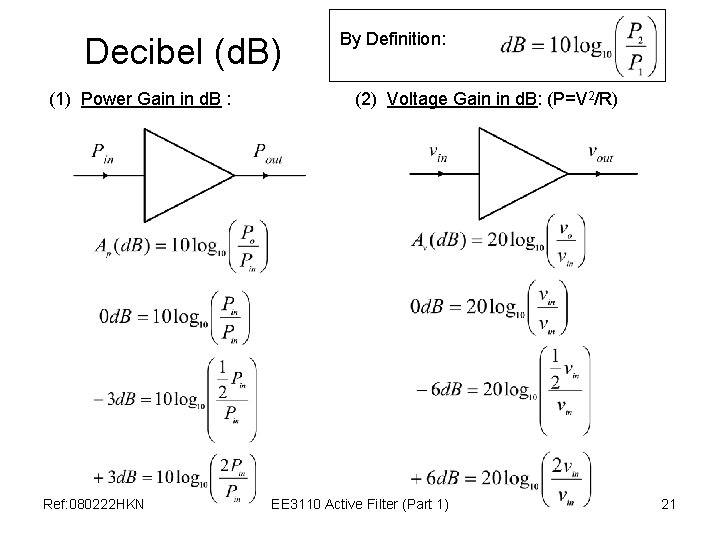
Decibel (d. B) (1) Power Gain in d. B : Ref: 080222 HKN By Definition: (2) Voltage Gain in d. B: (P=V 2/R) EE 3110 Active Filter (Part 1) 21
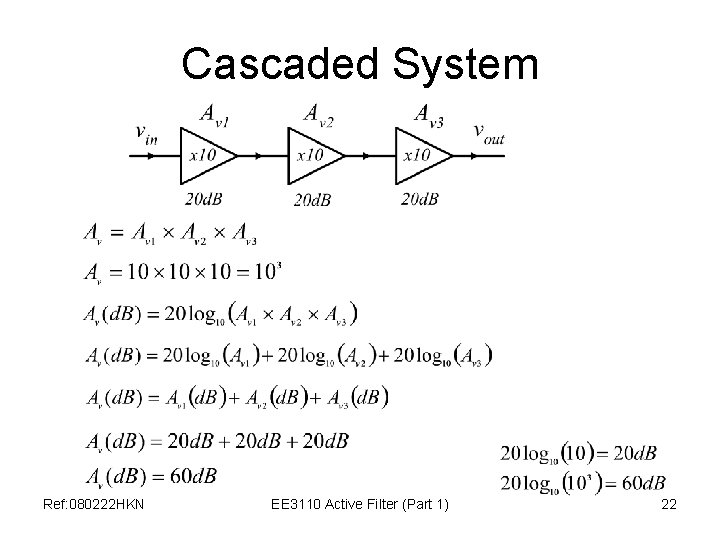
Cascaded System Ref: 080222 HKN EE 3110 Active Filter (Part 1) 22
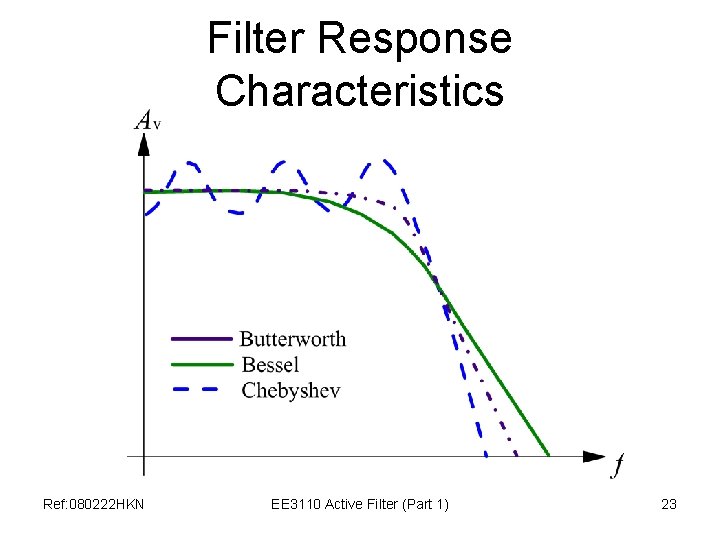
Filter Response Characteristics Ref: 080222 HKN EE 3110 Active Filter (Part 1) 23
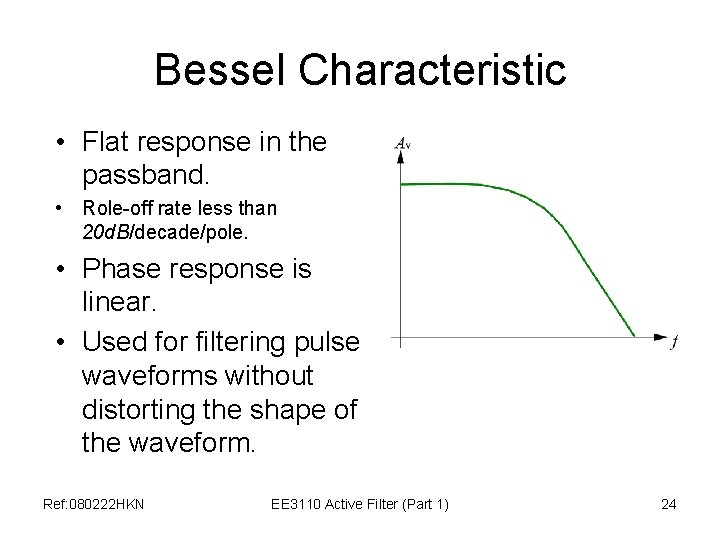
Bessel Characteristic • Flat response in the passband. • Role-off rate less than 20 d. B/decade/pole. • Phase response is linear. • Used for filtering pulse waveforms without distorting the shape of the waveform. Ref: 080222 HKN EE 3110 Active Filter (Part 1) 24
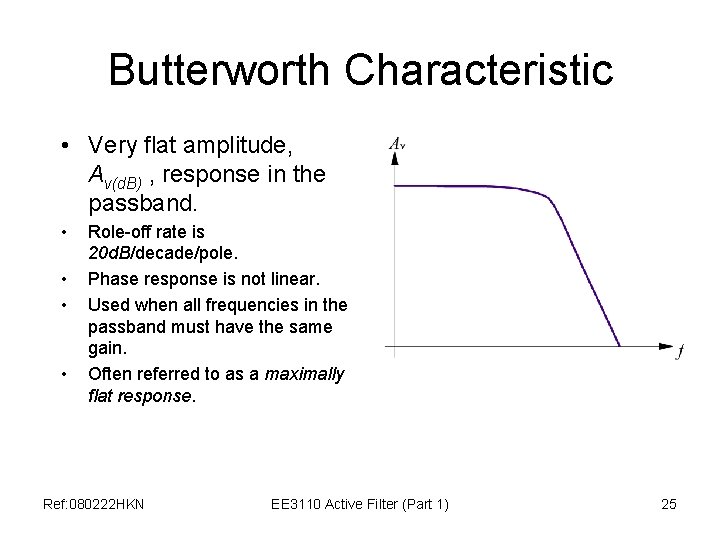
Butterworth Characteristic • Very flat amplitude, Av(d. B) , response in the passband. • • Role-off rate is 20 d. B/decade/pole. Phase response is not linear. Used when all frequencies in the passband must have the same gain. Often referred to as a maximally flat response. Ref: 080222 HKN EE 3110 Active Filter (Part 1) 25
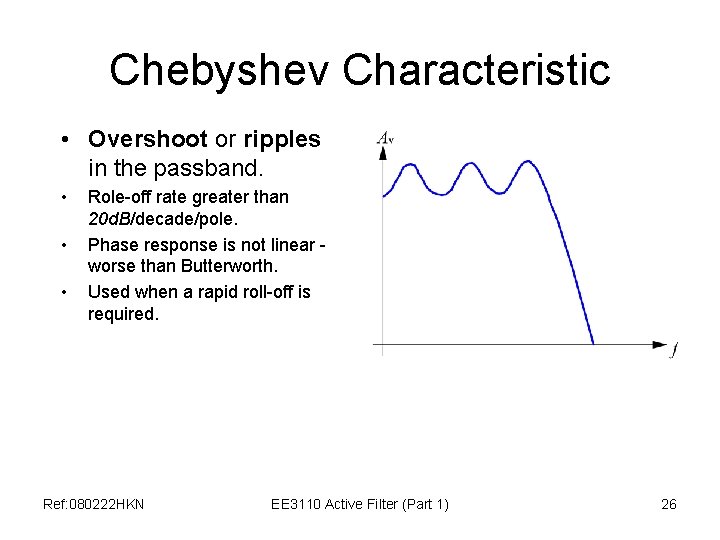
Chebyshev Characteristic • Overshoot or ripples in the passband. • • • Role-off rate greater than 20 d. B/decade/pole. Phase response is not linear worse than Butterworth. Used when a rapid roll-off is required. Ref: 080222 HKN EE 3110 Active Filter (Part 1) 26
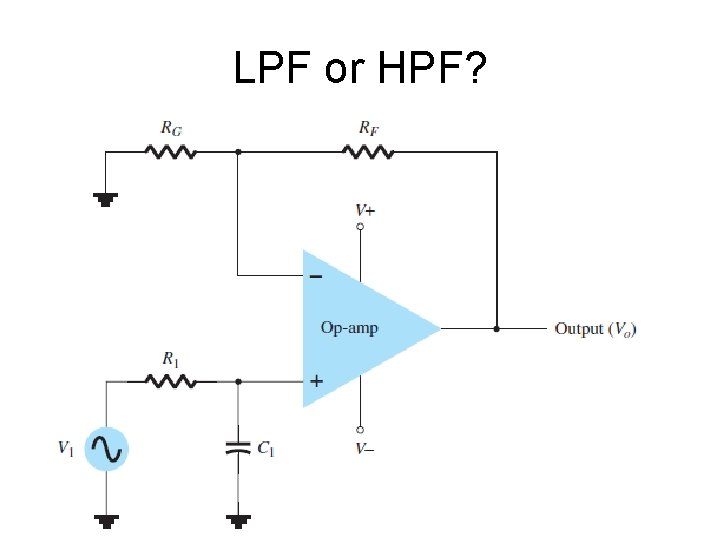
LPF or HPF?
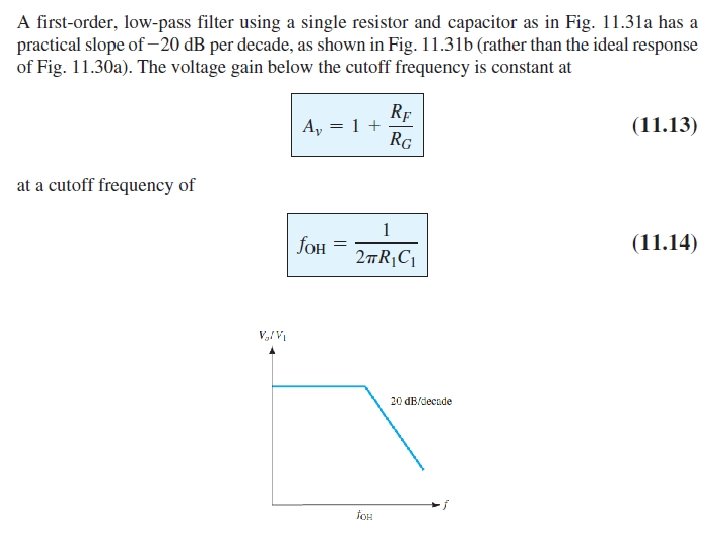
Better response? 2 nd order?
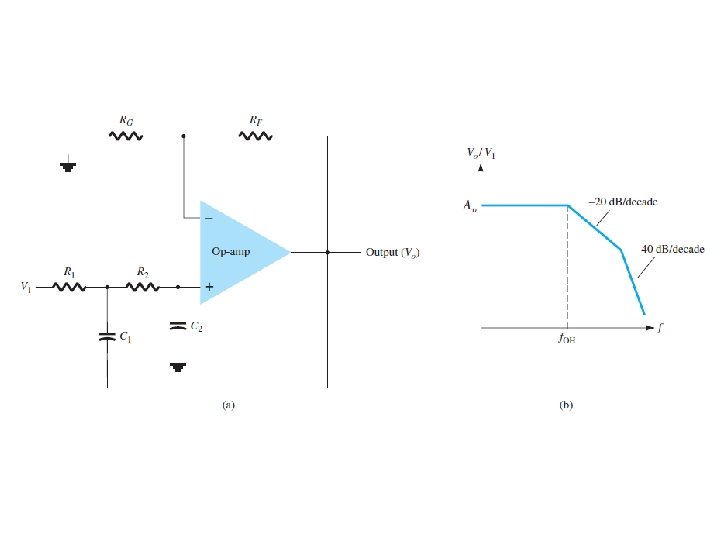
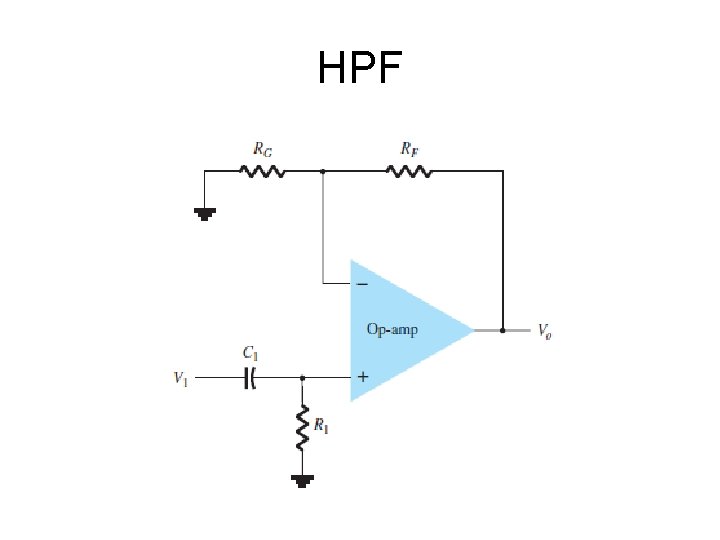
HPF
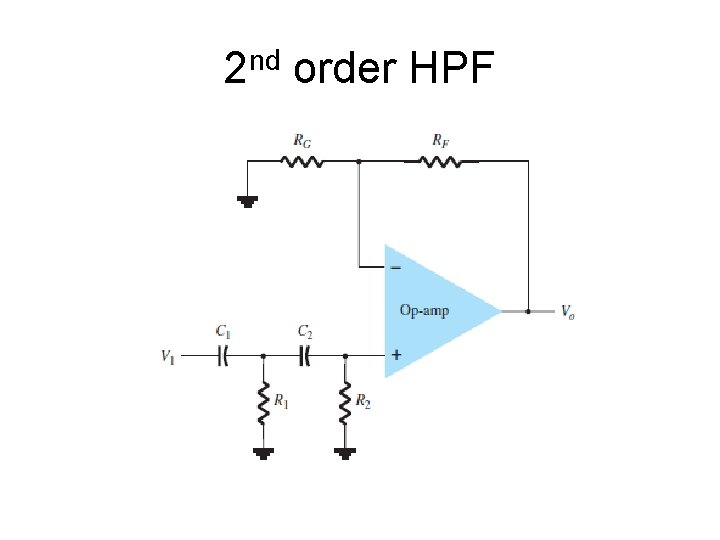
2 nd order HPF
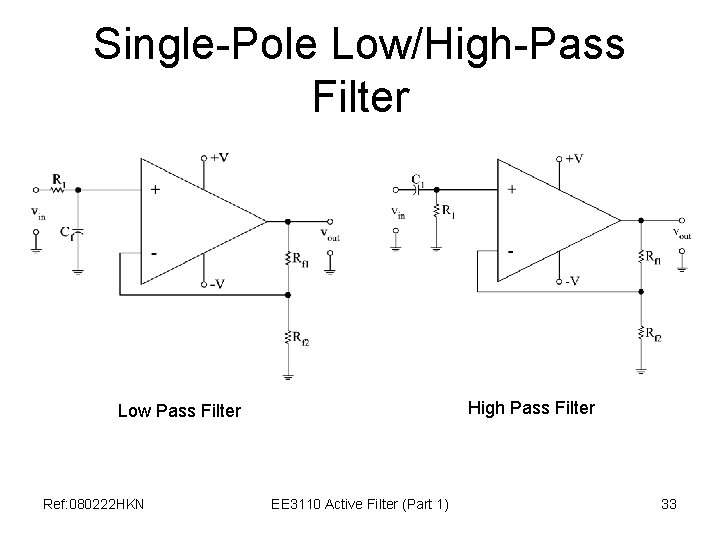
Single-Pole Low/High-Pass Filter High Pass Filter Low Pass Filter Ref: 080222 HKN EE 3110 Active Filter (Part 1) 33
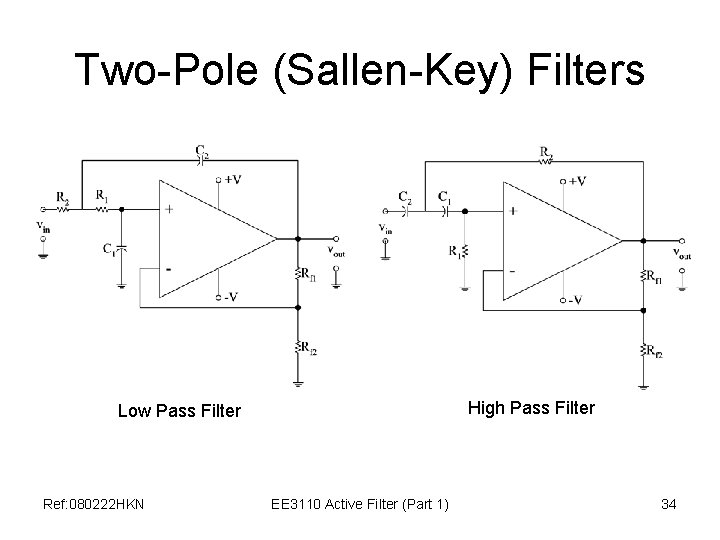
Two-Pole (Sallen-Key) Filters High Pass Filter Low Pass Filter Ref: 080222 HKN EE 3110 Active Filter (Part 1) 34
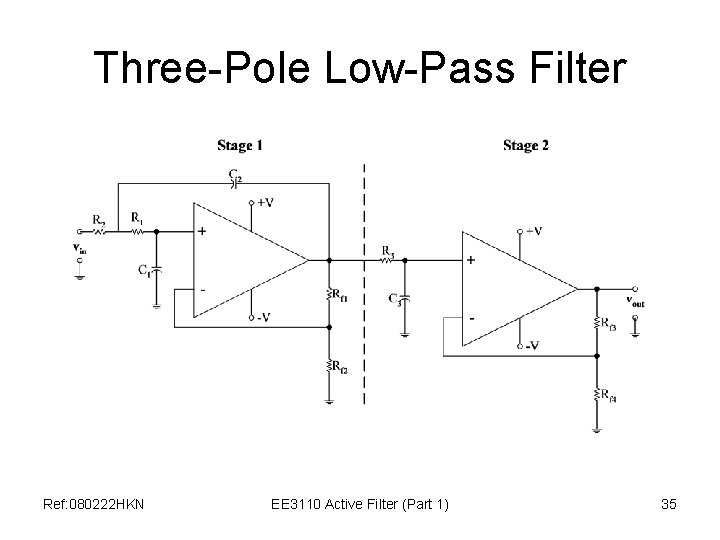
Three-Pole Low-Pass Filter Ref: 080222 HKN EE 3110 Active Filter (Part 1) 35
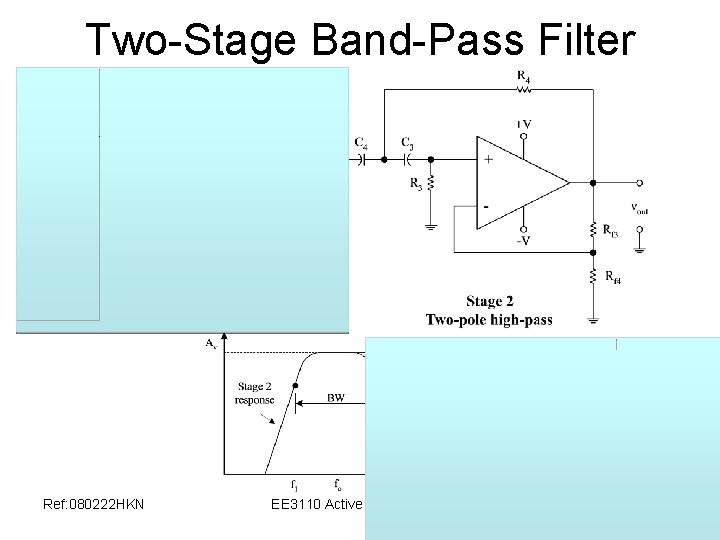
Two-Stage Band-Pass Filter BW = f 2 – f 1 Q = f 0 / BW Ref: 080222 HKN EE 3110 Active Filter (Part 1) 36
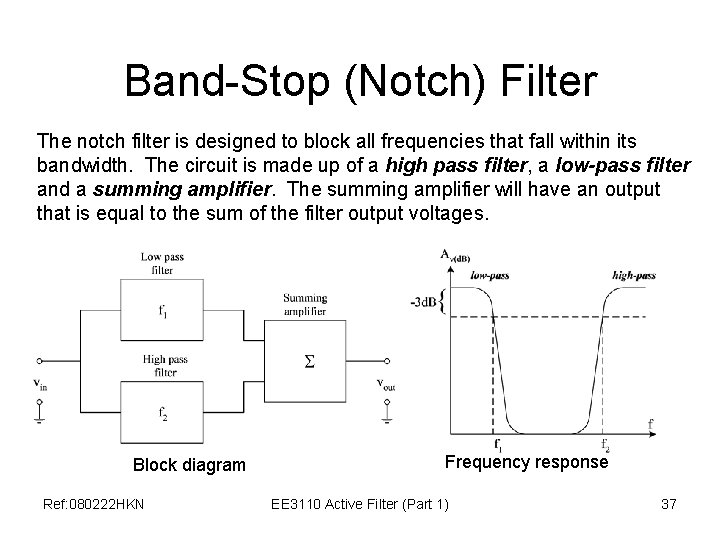
Band-Stop (Notch) Filter The notch filter is designed to block all frequencies that fall within its bandwidth. The circuit is made up of a high pass filter, a low-pass filter and a summing amplifier. The summing amplifier will have an output that is equal to the sum of the filter output voltages. Block diagram Ref: 080222 HKN Frequency response EE 3110 Active Filter (Part 1) 37
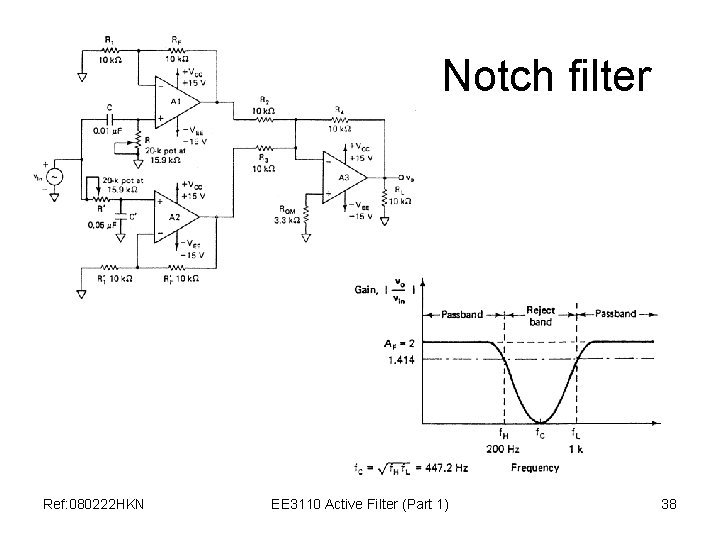
Notch filter Ref: 080222 HKN EE 3110 Active Filter (Part 1) 38
- Slides: 38