
Onyx ONE A Randomized Trial of a DurablePolymer
Onyx ONE – A Randomized Trial of a Durable-Polymer Drug-Eluting Stent vs. a Polymer-Free Drug-Coated Stent in Patients at High Risk of Bleeding Treated With 1 -Month DAPT Stephan Windecker Azeem Latib, Elvin Kedhi, Ajay Kirtane, David Kandzari, Roxana Mehran, Matthew Price, Sandeep Brar, Lisa Bousquette, Alexandre Abizaid, Daniel Simon, Stephen Worthley, Azfar Zaman and Gregg W. Stone on behalf of the Onyx ONE Investigators Onyx ONE
Disclosure Statement of Financial Interest I, Stephan Windecker, declare the following: • Research grants to the institution from Abbott, Amgen, Bayer, BMS, Boston Scientific, Biotronik, CLS Behring, Edwards Lifesciences, Medtronic, Polares and Sinomed Onyx ONE
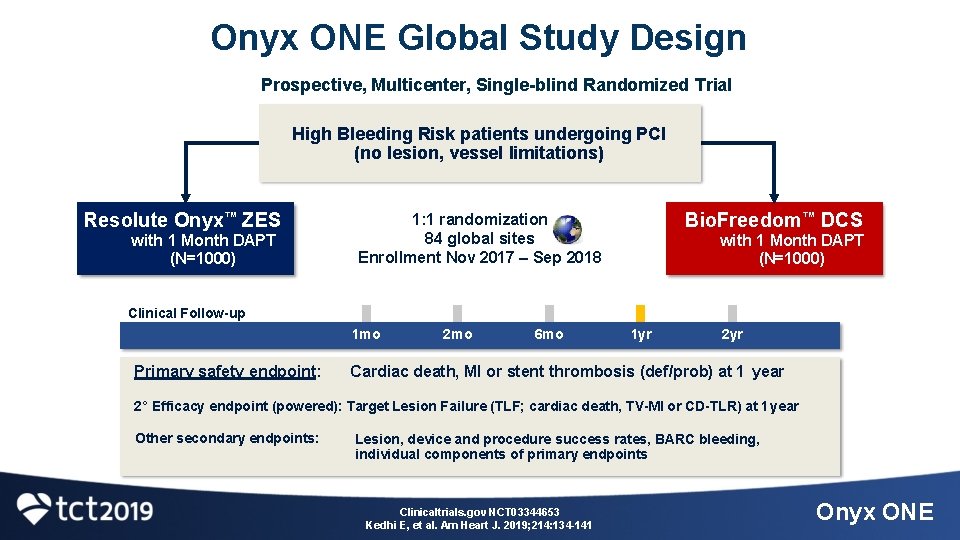
Onyx ONE Global Study Design Prospective, Multicenter, Single-blind Randomized Trial High Bleeding Risk patients undergoing PCI (no lesion, vessel limitations) Resolute Onyx™ ZES with 1 Month DAPT (N=1000) Bio. Freedom™ DCS 1: 1 randomization 84 global sites Enrollment Nov 2017 – Sep 2018 with 1 Month DAPT (N=1000) Clinical Follow-up 1 mo Primary safety endpoint: 2 mo 6 mo 1 yr 2 yr Cardiac death, MI or stent thrombosis (def/prob) at 1 year 2° Efficacy endpoint (powered): Target Lesion Failure (TLF; cardiac death, TV-MI or CD-TLR) at 1 year Other secondary endpoints: Lesion, device and procedure success rates, BARC bleeding, individual components of primary endpoints Clinicaltrials. gov NCT 03344653 Kedhi E, et al. Am Heart J. 2019; 214: 134 -141 Onyx ONE
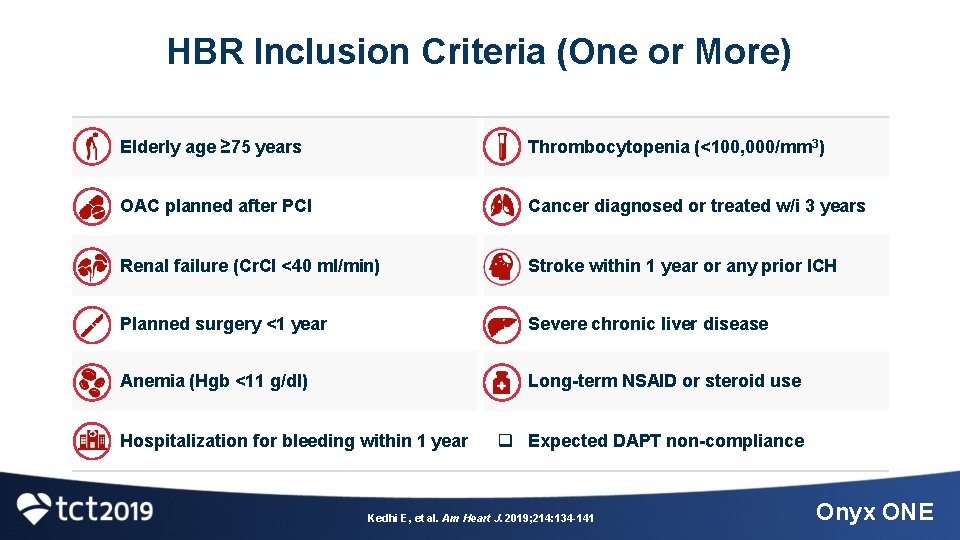
HBR Inclusion Criteria (One or More) Elderly age ≥ 75 years Thrombocytopenia (<100, 000/mm 3) OAC planned after PCI Cancer diagnosed or treated w/i 3 years Renal failure (Cr. Cl <40 ml/min) Stroke within 1 year or any prior ICH Planned surgery <1 year Severe chronic liver disease Anemia (Hgb <11 g/dl) Long-term NSAID or steroid use Hospitalization for bleeding within 1 year Expected DAPT non-compliance Kedhi E, et al. Am Heart J. 2019; 214: 134 -141 Onyx ONE
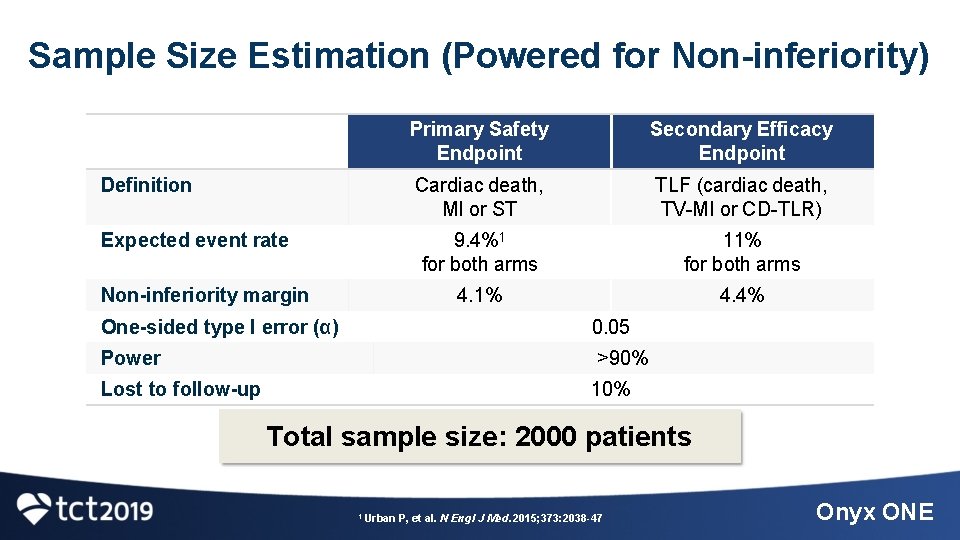
Sample Size Estimation (Powered for Non-inferiority) Definition Expected event rate Non-inferiority margin Primary Safety Endpoint Secondary Efficacy Endpoint Cardiac death, MI or ST TLF (cardiac death, TV-MI or CD-TLR) 9. 4%1 for both arms 11% for both arms 4. 1% 4. 4% One-sided type I error (α) 0. 05 Power >90% Lost to follow-up 10% Total sample size: 2000 patients 1 Urban P, et al. N Engl J Med. 2015; 373: 2038 -47 Onyx ONE
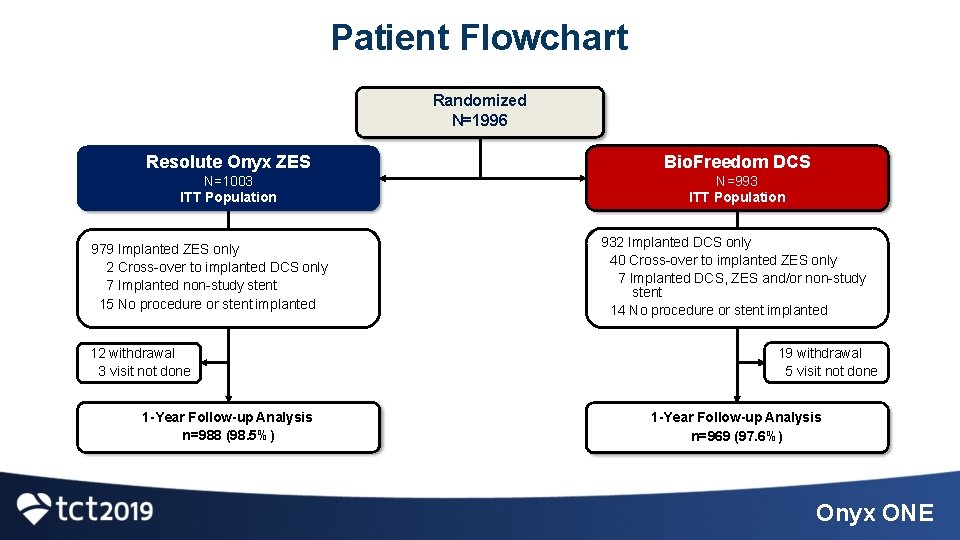
Patient Flowchart Randomized N=1996 Resolute Onyx ZES Bio. Freedom DCS N=1003 ITT Population N=993 ITT Population 979 Implanted ZES only 2 Cross-over to implanted DCS only 7 Implanted non-study stent 15 No procedure or stent implanted 12 withdrawal 3 visit not done 1 -Year Follow-up Analysis n=988 (98. 5%) 932 Implanted DCS only 40 Cross-over to implanted ZES only 7 Implanted DCS, ZES and/or non-study stent 14 No procedure or stent implanted 19 withdrawal 5 visit not done 1 -Year Follow-up Analysis n=969 (97. 6%) Onyx ONE
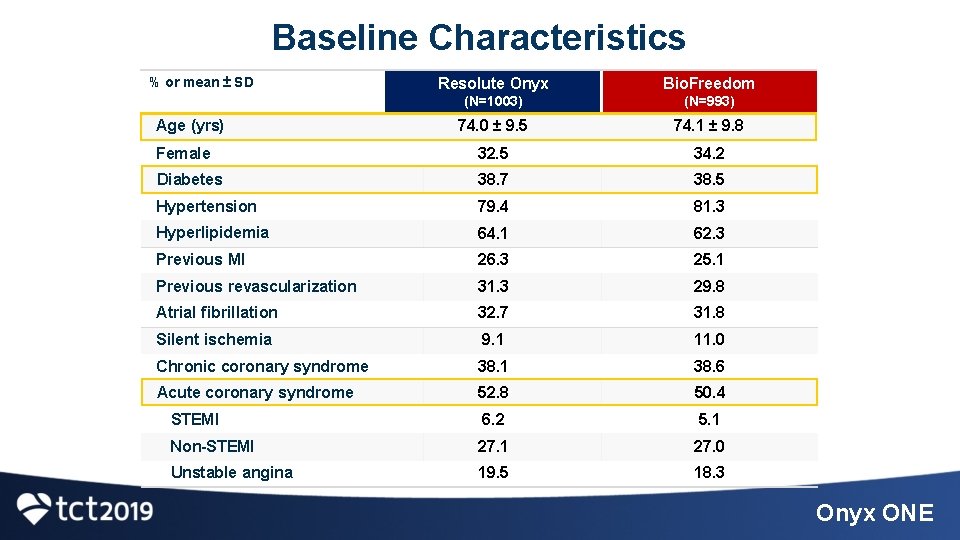
Baseline Characteristics % or mean ± SD Resolute Onyx Bio. Freedom (N=1003) (N=993) 74. 0 ± 9. 5 74. 1 ± 9. 8 Female 32. 5 34. 2 Diabetes 38. 7 38. 5 Hypertension 79. 4 81. 3 Hyperlipidemia 64. 1 62. 3 Previous MI 26. 3 25. 1 Previous revascularization 31. 3 29. 8 Atrial fibrillation 32. 7 31. 8 Silent ischemia 9. 1 11. 0 Chronic coronary syndrome 38. 1 38. 6 Acute coronary syndrome 52. 8 50. 4 STEMI 6. 2 5. 1 Non-STEMI 27. 1 27. 0 Unstable angina 19. 5 18. 3 Age (yrs) Onyx ONE
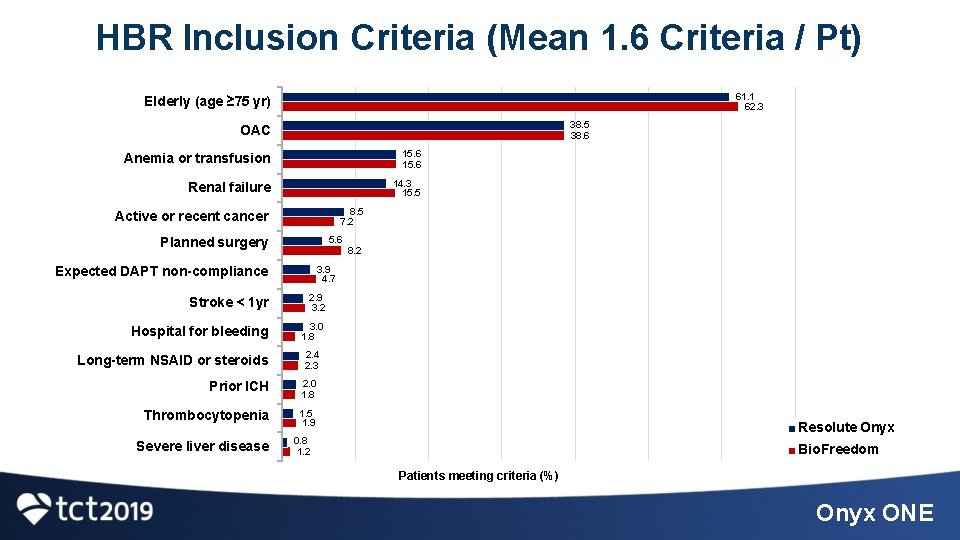
HBR Inclusion Criteria (Mean 1. 6 Criteria / Pt) 61. 1 62. 3 Elderly (age ≥ 75 yr) 38. 5 38. 6 OAC Anemia or transfusion 15. 6 Renal failure 14. 3 15. 5 8. 5 7. 2 Active or recent cancer 5. 6 Planned surgery Expected DAPT non-compliance 3. 9 4. 7 Stroke < 1 yr 2. 9 3. 2 Hospital for bleeding 3. 0 1. 8 Long-term NSAID or steroids 2. 4 2. 3 Prior ICH 2. 0 1. 8 Thrombocytopenia 1. 5 1. 9 Severe liver disease 8. 2 Resolute Onyx 0. 8 1. 2 Bio. Freedom Patients meeting criteria (%) Onyx ONE
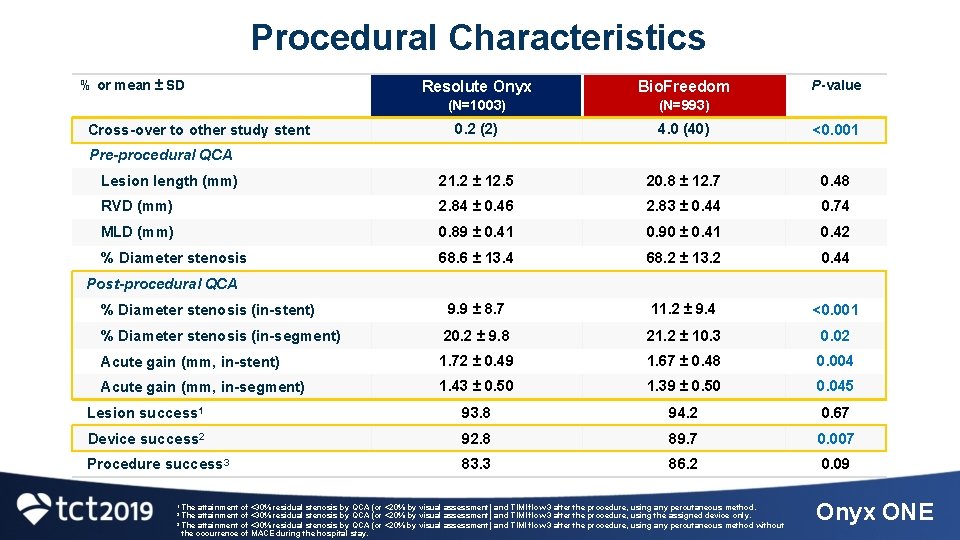
Procedural Characteristics % or mean ± SD P-value Resolute Onyx Bio. Freedom (N=1003) (N=993) 0. 2 (2) 4. 0 (40) <0. 001 Lesion length (mm) 21. 2 ± 12. 5 20. 8 ± 12. 7 0. 48 RVD (mm) 2. 84 ± 0. 46 2. 83 ± 0. 44 0. 74 MLD (mm) 0. 89 ± 0. 41 0. 90 ± 0. 41 0. 42 % Diameter stenosis 68. 6 ± 13. 4 68. 2 ± 13. 2 0. 44 % Diameter stenosis (in-stent) 9. 9 ± 8. 7 11. 2 ± 9. 4 <0. 001 % Diameter stenosis (in-segment) 20. 2 ± 9. 8 21. 2 ± 10. 3 0. 02 Acute gain (mm, in-stent) 1. 72 ± 0. 49 1. 67 ± 0. 48 0. 004 Acute gain (mm, in-segment) 1. 43 ± 0. 50 1. 39 ± 0. 50 0. 045 Lesion success 1 93. 8 94. 2 0. 67 Device success 2 92. 8 89. 7 0. 007 Procedure success 3 83. 3 86. 2 0. 09 Cross-over to other study stent Pre-procedural QCA Post-procedural QCA The attainment of <30% residual stenosis by QCA (or <20% by visual assessment) and TIMI flow 3 after the procedure, using any percutaneous method. The attainment of <30% residual stenosis by QCA (or <20% by visual assessment) and TIMI flow 3 after the procedure, using the assigned device only. 3 The attainment of <30% residual stenosis by QCA (or <20% by visual assessment) and TIMI flow 3 after the procedure, using any percutaneous method without the occurrence of MACE during the hospital stay. 1 2 Onyx ONE
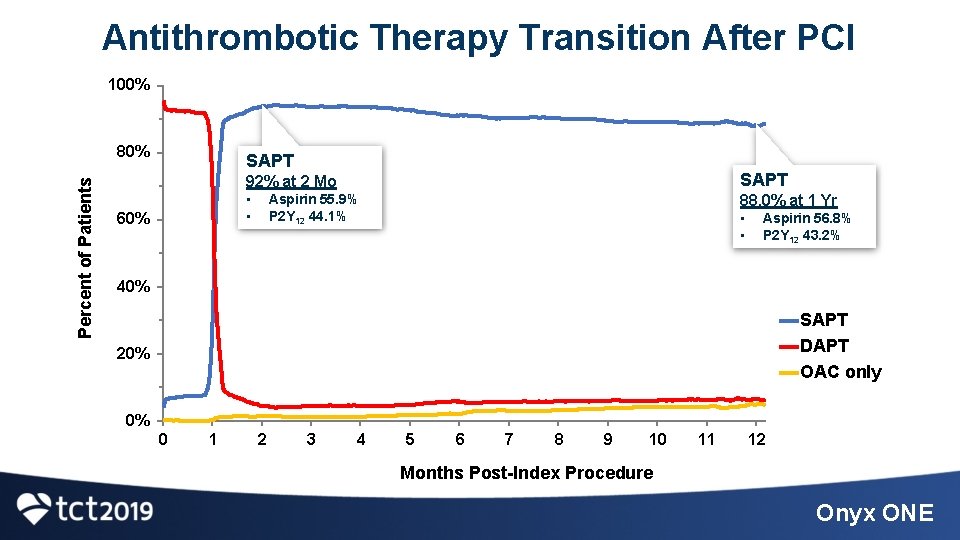
Antithrombotic Therapy Transition After PCI 100% Percent of Patients 80% SAPT 60% 92% at 2 Mo SAPT • • 88. 0% at 1 Yr Aspirin 55. 9% P 2 Y 12 44. 1% • • Aspirin 56. 8% P 2 Y 12 43. 2% 40% SAPT DAPT OAC only 20% 0% 0 1 2 3 4 5 6 7 8 9 10 11 12 Months Post-Index Procedure Onyx ONE
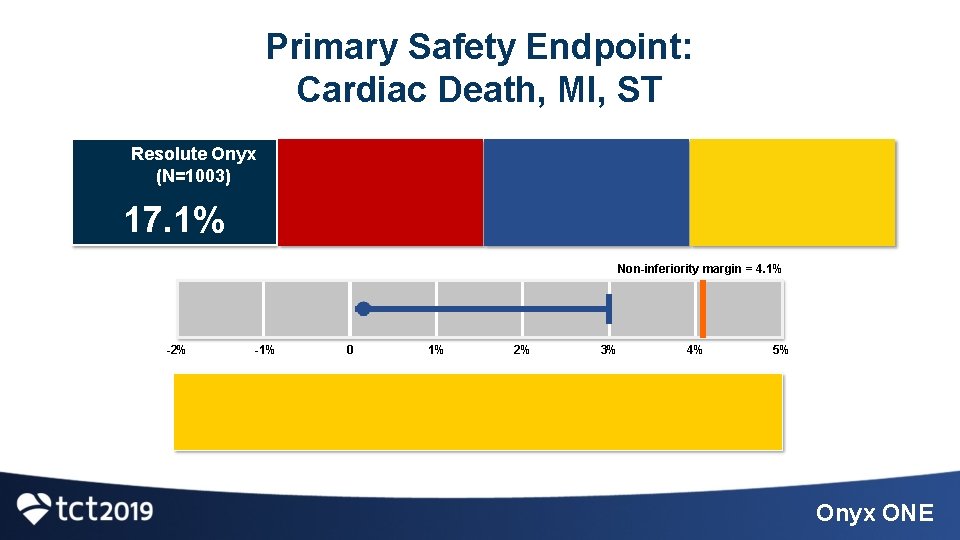
Primary Safety Endpoint: Cardiac Death, MI, ST Resolute Onyx (N=1003) 17. 1% Bio. Freedom (N=993) 16. 9% Difference: 0. 2% Upper 1 -sided 95% CI: 3. 0% P-value non-inferiority 0. 011 Non-inferiority margin = 4. 1% -2% -1% 0 1% 2% 3% 4% 5% Non-Inferiority Endpoint Met Onyx ONE
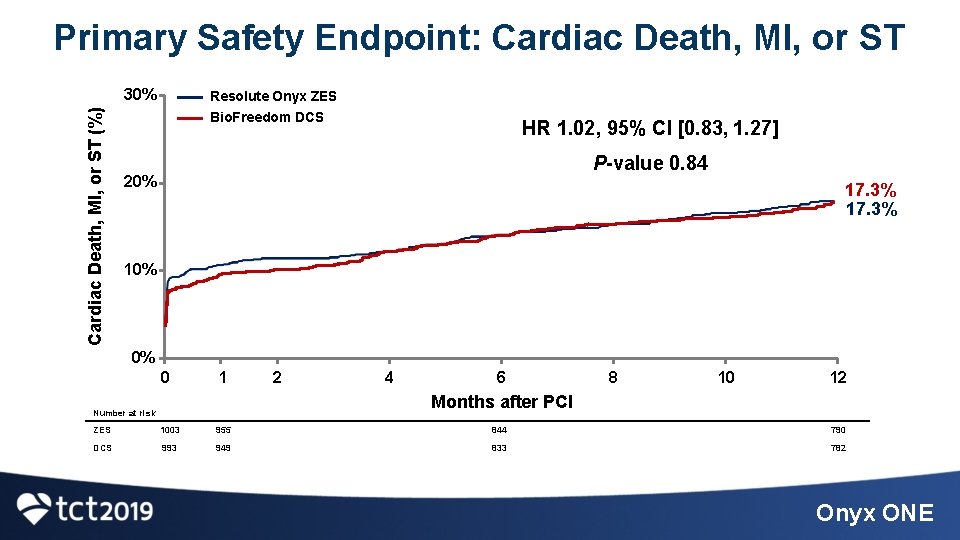
Primary Safety Endpoint: Cardiac Death, MI, or ST (%) 30% Resolute Onyx ZES Bio. Freedom DCS HR 1. 02, 95% CI [0. 83, 1. 27] P-value 0. 84 20% 17. 3% 10% 0% 0 1 2 4 6 8 10 12 Months after PCI Number at risk ZES 1003 955 844 790 DCS 993 949 833 782 Onyx ONE
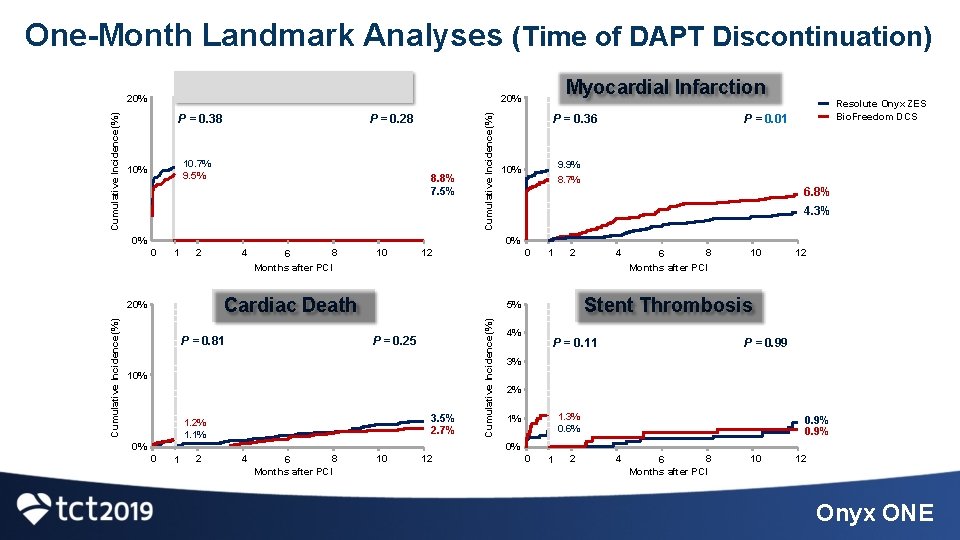
One-Month Landmark Analyses (Time of DAPT Discontinuation) Cardiac death, MI or ST P = 0. 38 P = 0. 28 10. 7% 9. 5% 10% 8. 8% 7. 5% 0% P = 0. 36 Resolute Onyx ZES Bio. Freedom DCS P = 0. 01 9. 9% 8. 7% 10% 6. 8% 4. 3% 0% 0 1 4 2 8 6 Months after PCI 10 12 0 Cardiac Death P = 0. 81 1 P = 0. 25 10% 3. 5% 2. 7% 1. 2% 1. 1% 0% 4 2 8 6 Months after PCI 10 12 Stent Thrombosis 5% Cumulative Incidence (%) 20% Cumulative Incidence (%) Myocardial Infarction 20% Cumulative Incidence (%) 20% 4% P = 0. 11 P = 0. 99 3% 2% 1. 3% 0. 6% 1% 0. 9% 0% 0 1 2 4 8 6 Months after PCI 10 12 Onyx ONE
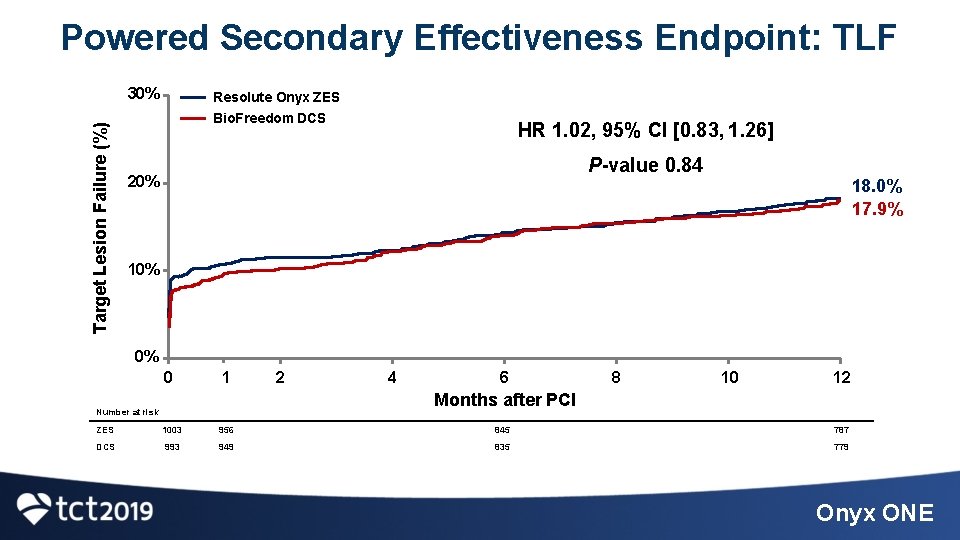
Powered Secondary Effectiveness Endpoint: TLF Target Lesion Failure (%) 30% Resolute Onyx ZES Bio. Freedom DCS HR 1. 02, 95% CI [0. 83, 1. 26] P-value 0. 84 20% 18. 0% 17. 9% 10% 0% 0 1 2 4 6 8 10 12 Months after PCI Number at risk ZES 1003 956 845 787 DCS 993 949 835 779 Onyx ONE
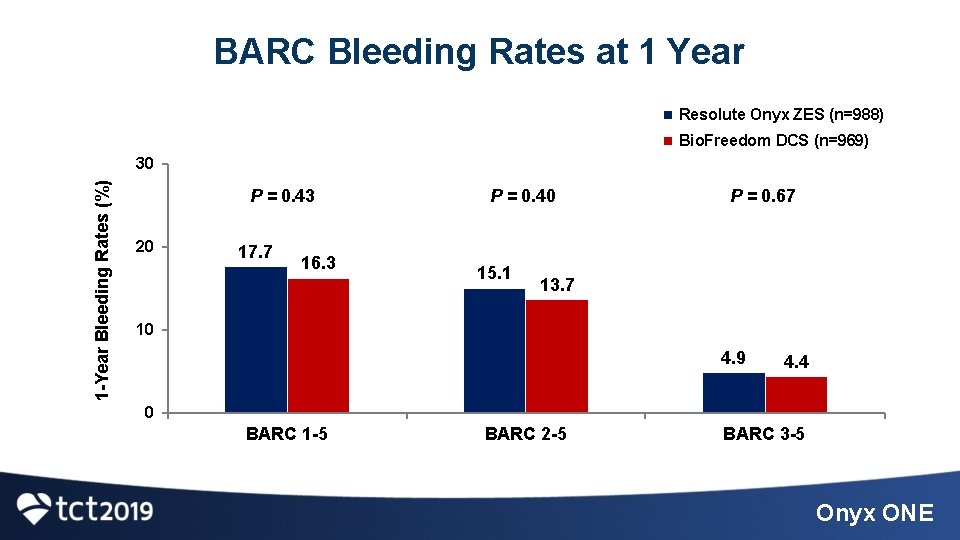
BARC Bleeding Rates at 1 Year Resolute Onyx ZES (n=988) Bio. Freedom DCS (n=969) 1 -Year Bleeding Rates (%) 30 P = 0. 43 20 17. 7 16. 3 P = 0. 40 15. 1 P = 0. 67 13. 7 10 4. 9 4. 4 0 BARC 1 -5 BARC 2 -5 BARC 3 -5 Onyx ONE
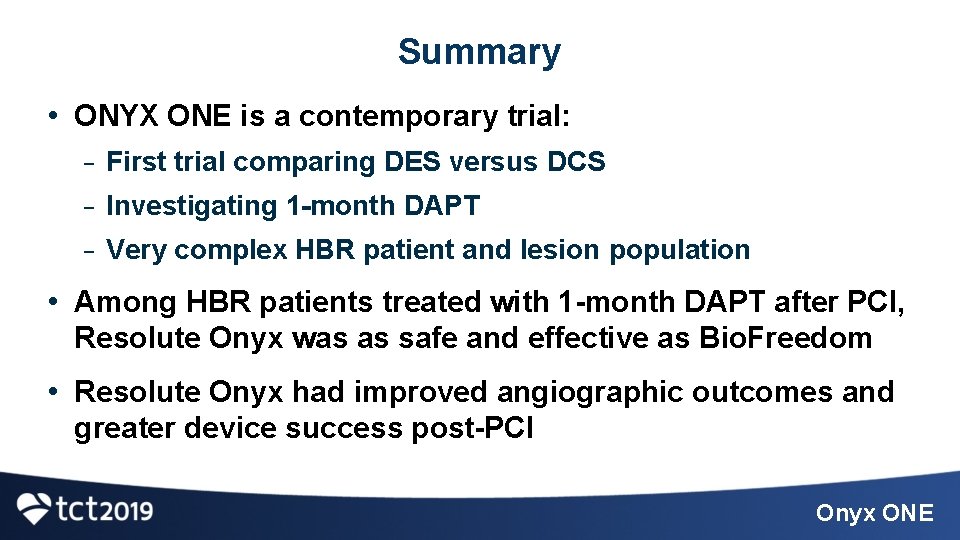
Summary • ONYX ONE is a contemporary trial: − First trial comparing DES versus DCS − Investigating 1 -month DAPT − Very complex HBR patient and lesion population • Among HBR patients treated with 1 -month DAPT after PCI, Resolute Onyx was as safe and effective as Bio. Freedom • Resolute Onyx had improved angiographic outcomes and greater device success post-PCI Onyx ONE
Conclusion These data demonstrate that Resolute Onyx is safe and effective in complex high bleeding risk patients who receive 1 -month DAPT Onyx ONE
- Slides: 17