
Ontology Theory Christopher Menzel Department of Philosophy Texas

- Slides: 18
Ontology Theory Christopher Menzel Department of Philosophy Texas A&M University cmenzel@tamu. edu ECAI 2002 Workshop on Ontologies and Semantic Interoperability
Analysis: A Historical Paradigm • 18 th Century Analysis: Intuition • Intuitive theoretical foundations • Conceptual confusions • Inconsistencies • 19 th Century Analysis: Arithmetization • Rigorous theoretical foundations • Shared understanding • Broader applicability ECAI 2002 Workshop on Ontologies and Semantic Interoperability
Ontology: The Current Situation • Similar to 18 th Century analysis • Intuitive theoretical foundations • Conceptual confusions • High potential for inconsistency • Ontology needs its own “arithmetization” • Benefits • Shared understanding • Broader applicability • Sound foundation for integration ECAI 2002 Workshop on Ontologies and Semantic Interoperability
Intuitions I: Ontologies 1. Ontologies consist of propositions. 2. The content of an ontology O consists of the propositions entailed by O that involve only concepts in O. • • Ontologies are comparable in terms of their content. In particular, two ontologies are equivalent if they have the same content. 3. Ontologies are objects • I. e, things we can talk about and quantify over. ECAI 2002 Workshop on Ontologies and Semantic Interoperability
Intuitions II: Propositions 4. Propositions are not sentences, they are what sentences express. • Different sentences in different languages (or possibly the same language) can express the same proposition. 5. Propositions are structured • • Propositions “consist” of concepts Hence, propositions can be logically equivalent without being identical. 6. Propositions are objects ECAI 2002 Workshop on Ontologies and Semantic Interoperability
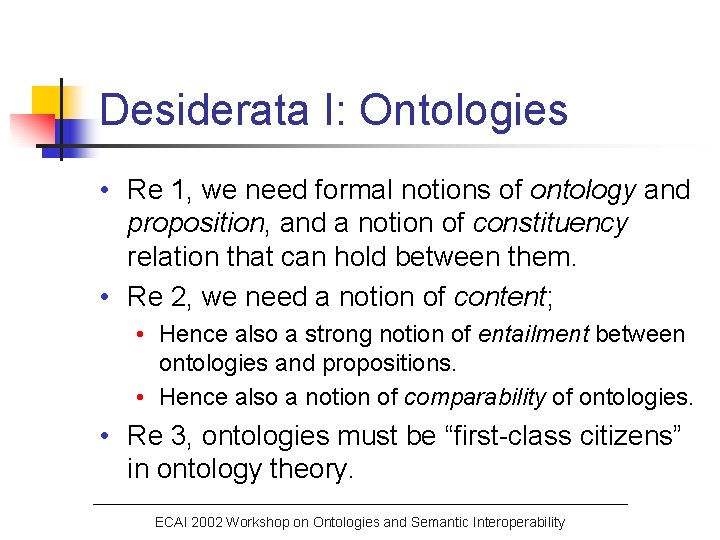
Desiderata I: Ontologies • Re 1, we need formal notions of ontology and proposition, and a notion of constituency relation that can hold between them. • Re 2, we need a notion of content; • Hence also a strong notion of entailment between ontologies and propositions. • Hence also a notion of comparability of ontologies. • Re 3, ontologies must be “first-class citizens” in ontology theory. ECAI 2002 Workshop on Ontologies and Semantic Interoperability
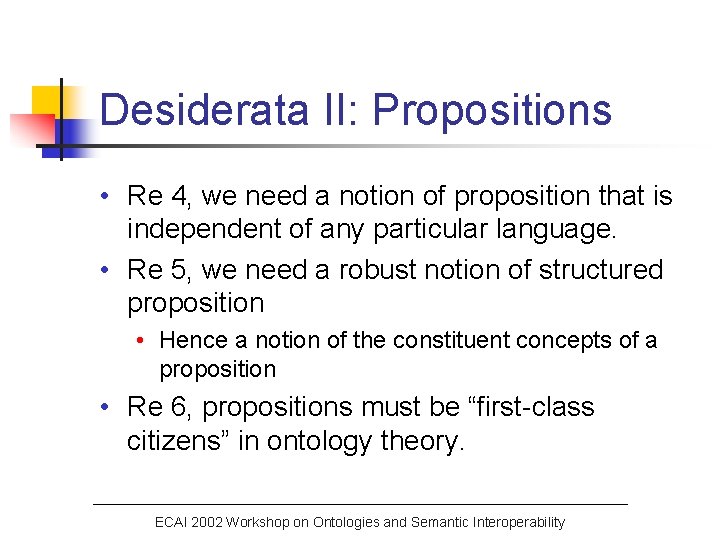
Desiderata II: Propositions • Re 4, we need a notion of proposition that is independent of any particular language. • Re 5, we need a robust notion of structured proposition • Hence a notion of the constituent concepts of a proposition • Re 6, propositions must be “first-class citizens” in ontology theory. ECAI 2002 Workshop on Ontologies and Semantic Interoperability
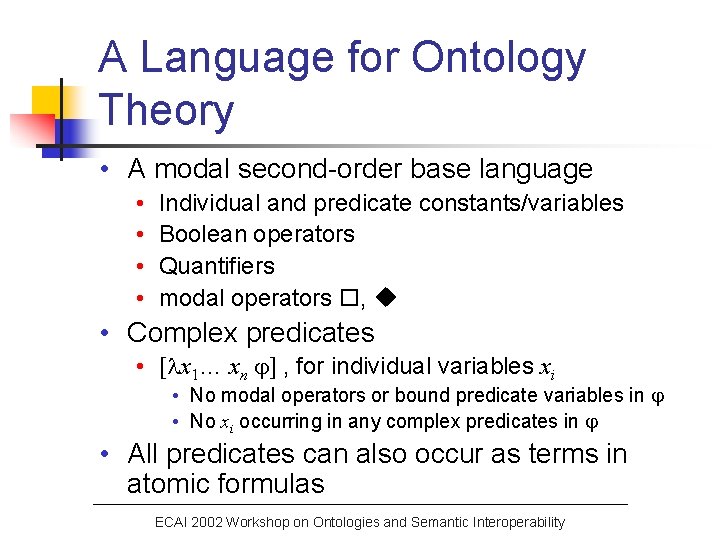
A Language for Ontology Theory • A modal second-order base language • • Individual and predicate constants/variables Boolean operators Quantifiers modal operators , • Complex predicates • [ x 1… xn ] , for individual variables xi • No modal operators or bound predicate variables in • No xi occurring in any complex predicates in • All predicates can also occur as terms in atomic formulas ECAI 2002 Workshop on Ontologies and Semantic Interoperability
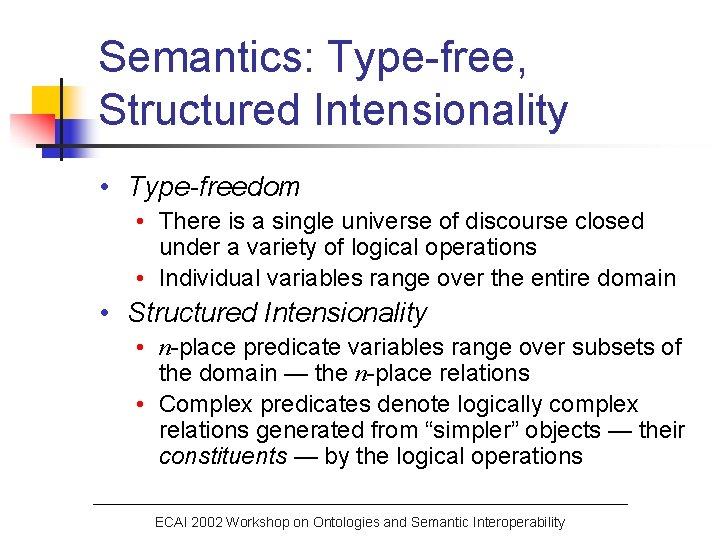
Semantics: Type-free, Structured Intensionality • Type-freedom • There is a single universe of discourse closed under a variety of logical operations • Individual variables range over the entire domain • Structured Intensionality • n-place predicate variables range over subsets of the domain — the n-place relations • Complex predicates denote logically complex relations generated from “simpler” objects — their constituents — by the logical operations ECAI 2002 Workshop on Ontologies and Semantic Interoperability
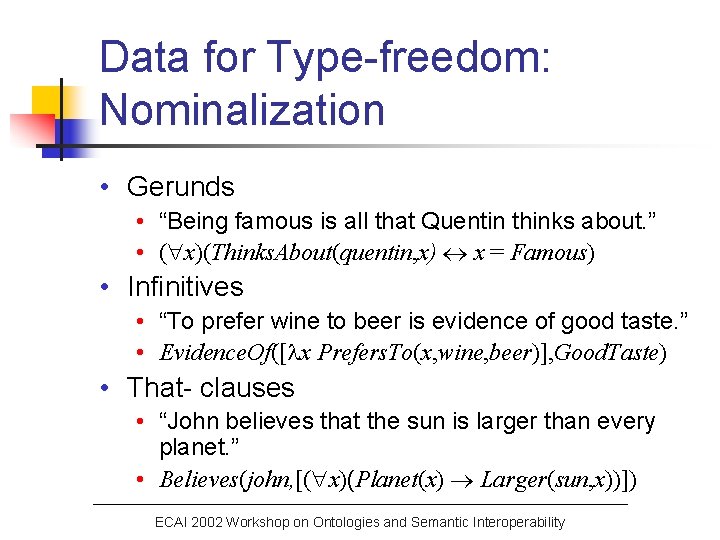
Data for Type-freedom: Nominalization • Gerunds • “Being famous is all that Quentin thinks about. ” • ( x)(Thinks. About(quentin, x) x = Famous) • Infinitives • “To prefer wine to beer is evidence of good taste. ” • Evidence. Of([ x Prefers. To(x, wine, beer)], Good. Taste) • That- clauses • “John believes that the sun is larger than every planet. ” • Believes(john, [( x)(Planet(x) Larger(sun, x))]) ECAI 2002 Workshop on Ontologies and Semantic Interoperability
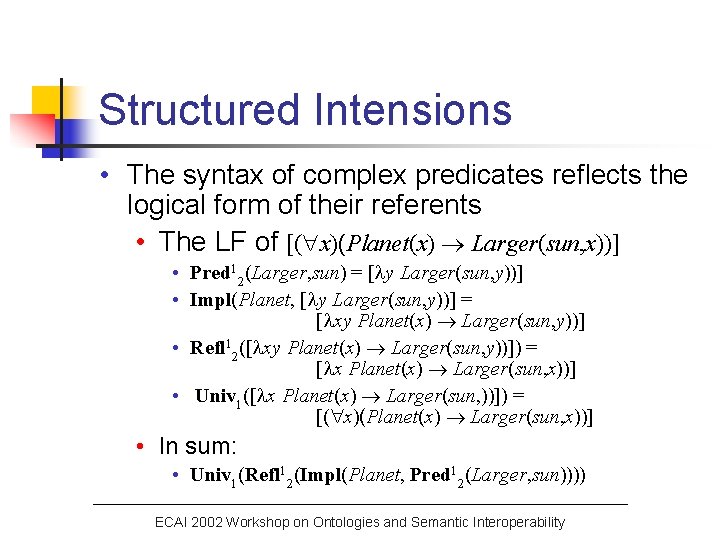
Structured Intensions • The syntax of complex predicates reflects the logical form of their referents • The LF of [( x)(Planet(x) Larger(sun, x))] • Pred 12(Larger, sun) = [ y Larger(sun, y))] • Impl(Planet, [ y Larger(sun, y))] = [ xy Planet(x) Larger(sun, y))] • Refl 12([ xy Planet(x) Larger(sun, y))]) = [ x Planet(x) Larger(sun, x))] • Univ 1([ x Planet(x) Larger(sun, ))]) = [( x)(Planet(x) Larger(sun, x))] • In sum: • Univ 1(Refl 12(Impl(Planet, Pred 12(Larger, sun)))) ECAI 2002 Workshop on Ontologies and Semantic Interoperability
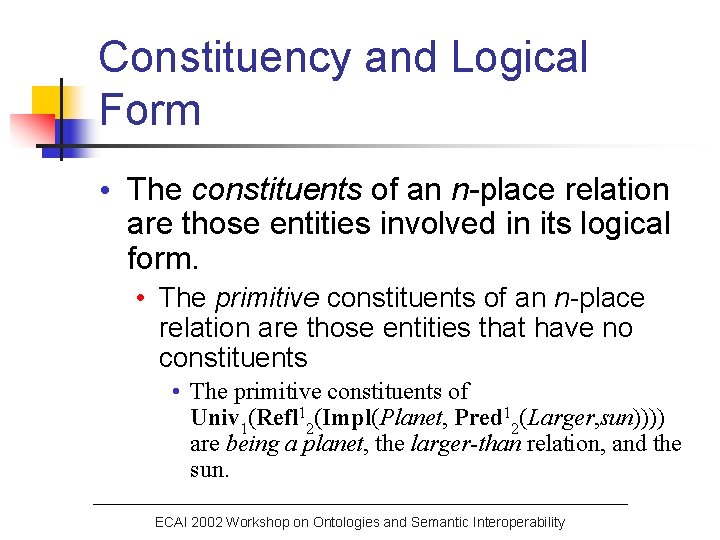
Constituency and Logical Form • The constituents of an n-place relation are those entities involved in its logical form. • The primitive constituents of an n-place relation are those entities that have no constituents • The primitive constituents of Univ 1(Refl 12(Impl(Planet, Pred 12(Larger, sun)))) are being a planet, the larger-than relation, and the sun. ECAI 2002 Workshop on Ontologies and Semantic Interoperability
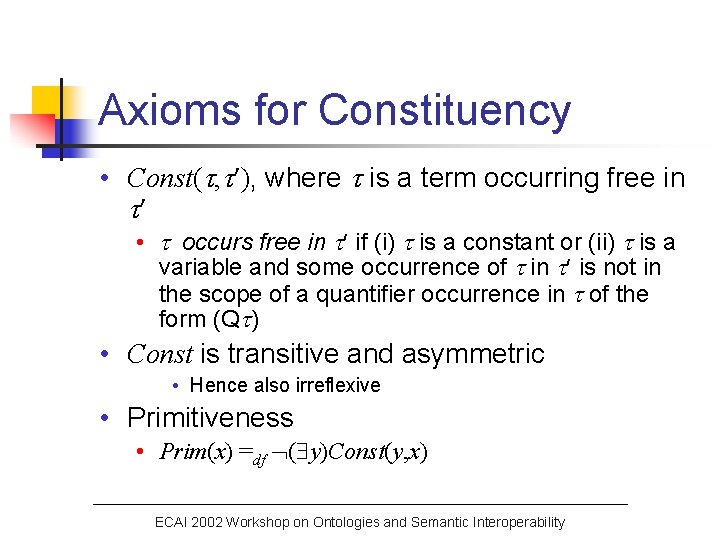
Axioms for Constituency • Const( , ), where is a term occurring free in • occurs free in if (i) is a constant or (ii) is a variable and some occurrence of in is not in the scope of a quantifier occurrence in of the form (Q ) • Const is transitive and asymmetric • Hence also irreflexive • Primitiveness • Prim(x) =df ( y)Const(y, x) ECAI 2002 Workshop on Ontologies and Semantic Interoperability
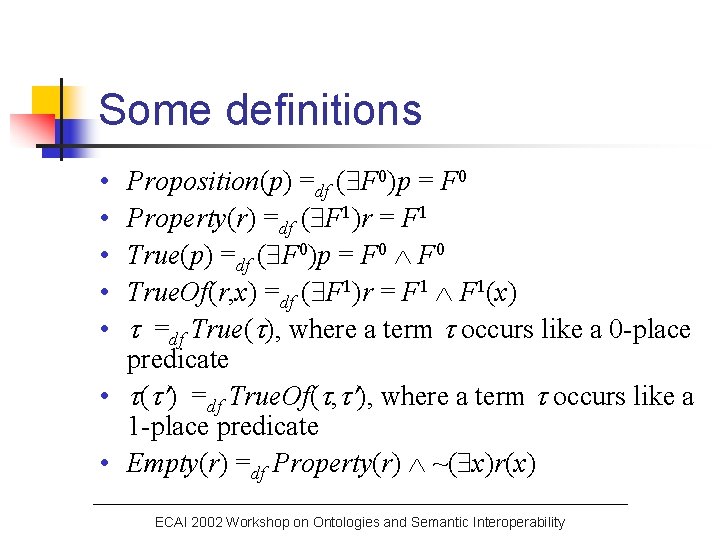
Some definitions • • • Proposition(p) =df ( F 0)p = F 0 Property(r) =df ( F 1)r = F 1 True(p) =df ( F 0)p = F 0 True. Of(r, x) =df ( F 1)r = F 1(x) =df True( ), where a term occurs like a 0 -place predicate • ( ) =df True. Of( , ), where a term occurs like a 1 -place predicate • Empty(r) =df Property(r) ~( x)r(x) ECAI 2002 Workshop on Ontologies and Semantic Interoperability
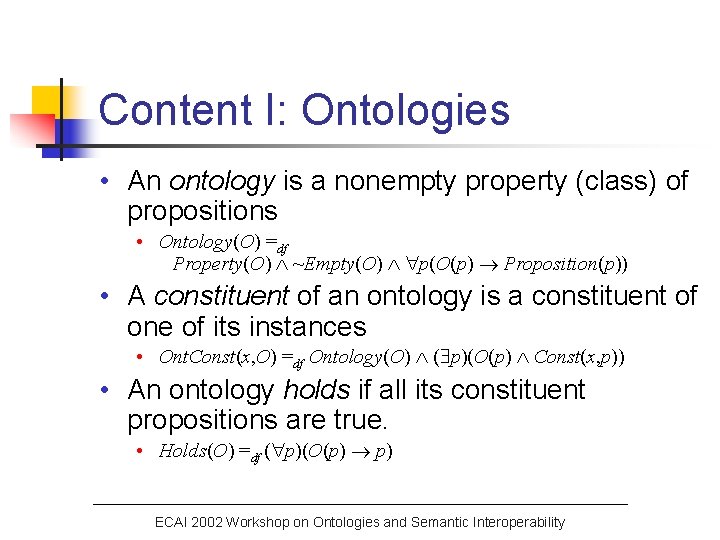
Content I: Ontologies • An ontology is a nonempty property (class) of propositions • Ontology(O) =df Property(O) ~Empty(O) p(O(p) Proposition(p)) • A constituent of an ontology is a constituent of one of its instances • Ont. Const(x, O) =df Ontology(O) ( p)(O(p) Const(x, p)) • An ontology holds if all its constituent propositions are true. • Holds(O) =df ( p)(O(p) p) ECAI 2002 Workshop on Ontologies and Semantic Interoperability
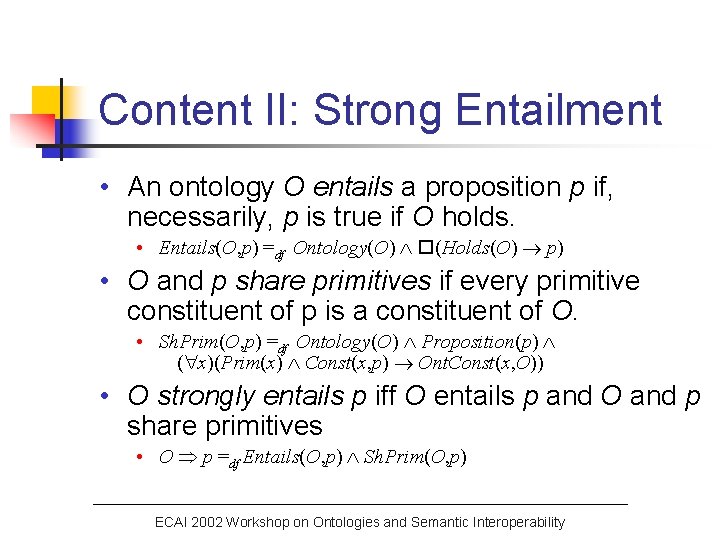
Content II: Strong Entailment • An ontology O entails a proposition p if, necessarily, p is true if O holds. • Entails(O, p) =df Ontology(O) (Holds(O) p) • O and p share primitives if every primitive constituent of p is a constituent of O. • Sh. Prim(O, p) =df Ontology(O) Proposition(p) ( x)(Prim(x) Const(x, p) Ont. Const(x, O)) • O strongly entails p iff O entails p and O and p share primitives • O p =df Entails(O, p) Sh. Prim(O, p) ECAI 2002 Workshop on Ontologies and Semantic Interoperability
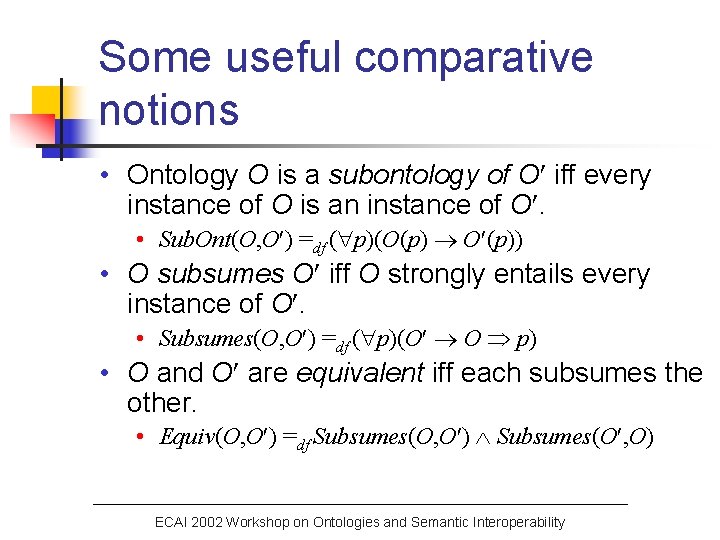
Some useful comparative notions • Ontology O is a subontology of O iff every instance of O is an instance of O. • Sub. Ont(O, O ) =df ( p)(O(p) O (p)) • O subsumes O iff O strongly entails every instance of O. • Subsumes(O, O ) =df ( p)(O O p) • O and O are equivalent iff each subsumes the other. • Equiv(O, O ) =df Subsumes(O, O ) Subsumes(O , O) ECAI 2002 Workshop on Ontologies and Semantic Interoperability
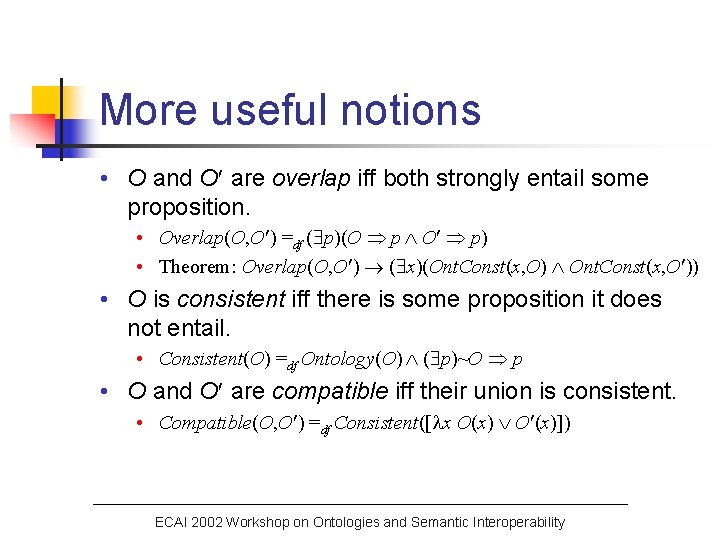
More useful notions • O and O are overlap iff both strongly entail some proposition. • Overlap(O, O ) =df ( p)(O p O p) • Theorem: Overlap(O, O ) ( x)(Ont. Const(x, O) Ont. Const(x, O )) • O is consistent iff there is some proposition it does not entail. • Consistent(O) =df Ontology(O) ( p)~O p • O and O are compatible iff their union is consistent. • Compatible(O, O ) =df Consistent([ x O(x) O (x)]) ECAI 2002 Workshop on Ontologies and Semantic Interoperability