
Ontology Learning for Chinese Information Organization and Knowledge
- Slides: 26
Ontology Learning for Chinese Information Organization and Knowledge Discovery in Ethnology and Anthropology Kong Jing Institute of Ethnology & Anthropology, Chinese Academy of Social Sciences
Outline p Introduction n p p Ontology learning frame for information organization and knowledge discovery CHOL(a Chinese Ontology Learning Tool) n n n p p Definition of Ontology learning Development of Ontology learning Our research objective Architecture Components Approaches Experiment in Ethnology and Anthropology Conclusion & Future Work 20 th CODATA International Conference Beijing, 23 -25 October 2006 2
Definition p Ontology learning is defined as the set of methods and techniques used for building an ontology from scratch, enriching, or adapting an existing ontology in a semiautomatic fashion using several sources. (A. Gómez-Pérez, D. Manzano-Macho. A survey of ontology learning methods and Techniques. Onto. Web Deliverable D 1. 5, 2003, 6) 20 th CODATA International Conference Beijing, 23 -25 October 2006 3
Development p p Recently, there has been a surge of interest in studying on ontology learning. In 2000, the first workshop on ontology learning held in conjunction with the 14 th European Conference on Artificial Intelligence (ECAI 2000). In the past years, many ontology learning tools such as Text. To. Onto、Onto. Learn、 Onto. LT、 Adaptiva、 the ASIUM system、the Mo’k Workbench、SOAT and DOGMA have been developed. 20 th CODATA International Conference Beijing, 23 -25 October 2006 4
Our research objective Despite the significant amount of work done on ontology learning in recent years, learning ontology from Chinese text hasn’t been widely applied in practice. So our research objective is to study the application of ontology learning in Chinese information organization and knowledge discovery. 20 th CODATA International Conference Beijing, 23 -25 October 2006 5
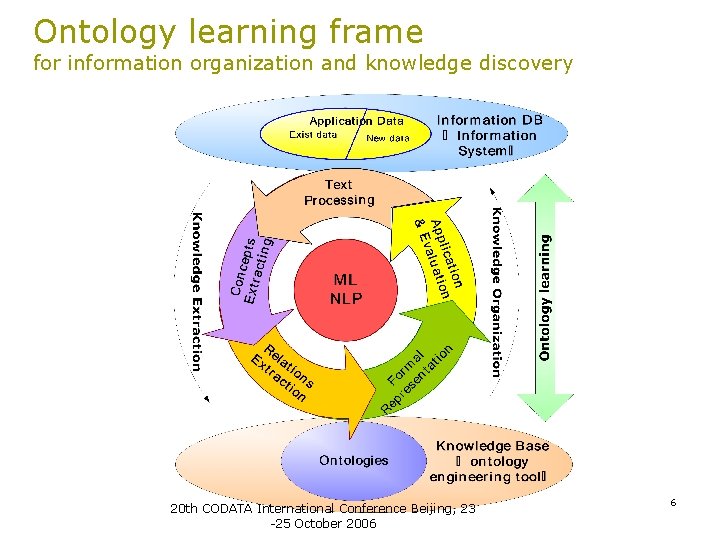
Ontology learning frame for information organization and knowledge discovery 20 th CODATA International Conference Beijing, 23 -25 October 2006 6
CHOL (a Chinese Ontology Learning Tool) p Architecture p Components Approaches p
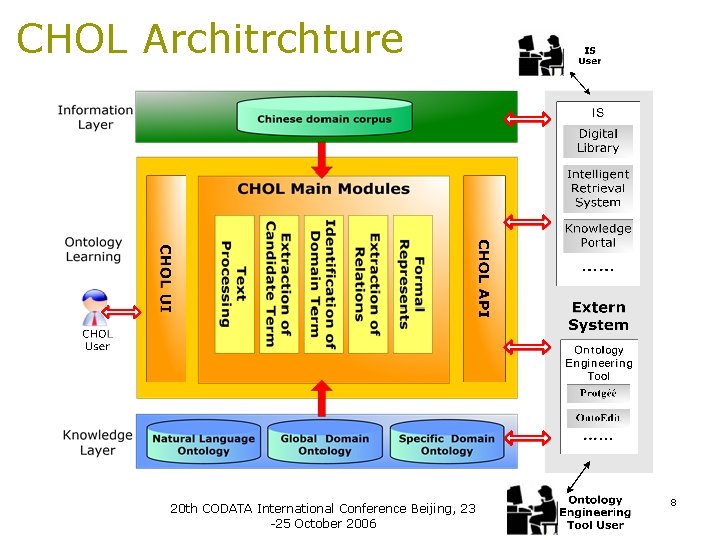
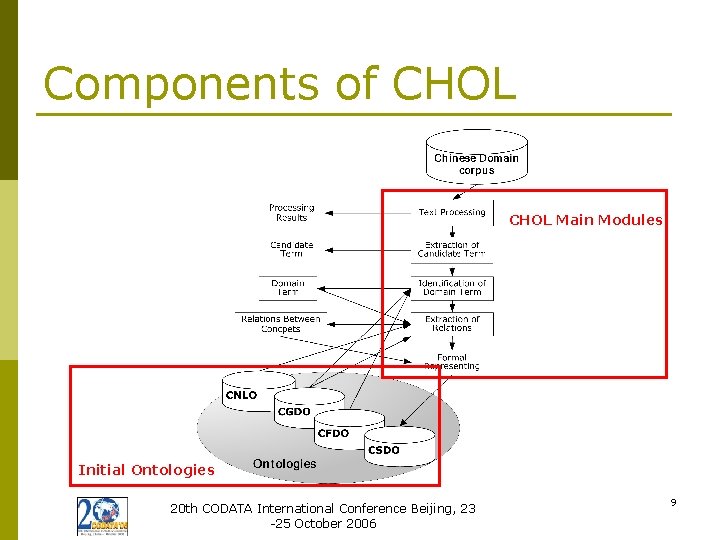
CHOL Architrchture 20 th CODATA International Conference Beijing, 23 -25 October 2006 8
Components of CHOL Main Modules Initial Ontologies 20 th CODATA International Conference Beijing, 23 -25 October 2006 9
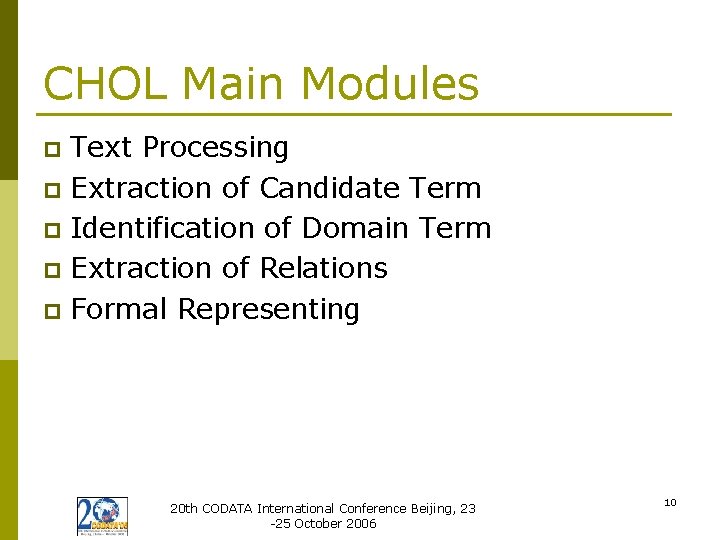
CHOL Main Modules Text Processing p Extraction of Candidate Term p Identification of Domain Term p Extraction of Relations p Formal Representing p 20 th CODATA International Conference Beijing, 23 -25 October 2006 10
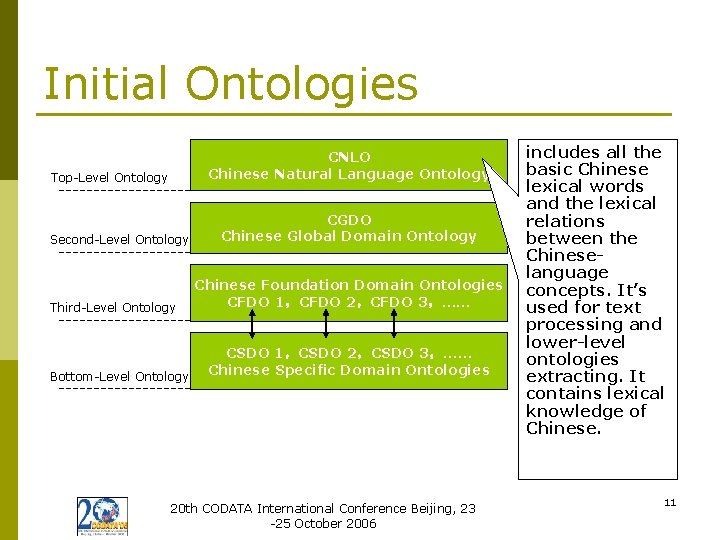
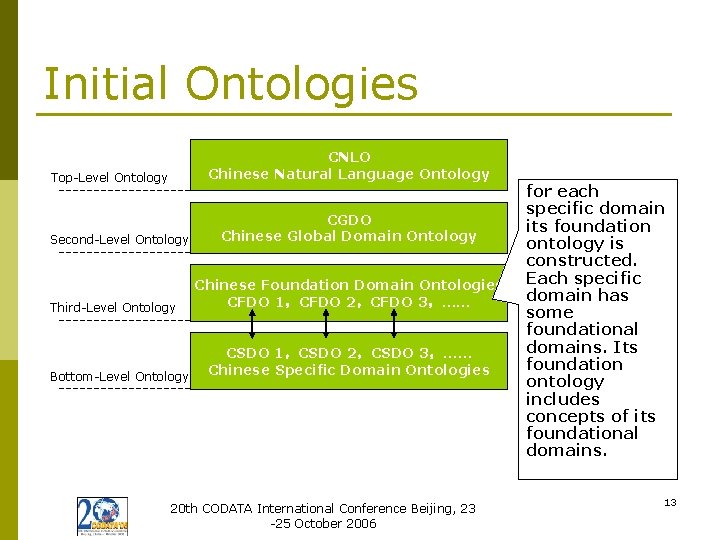
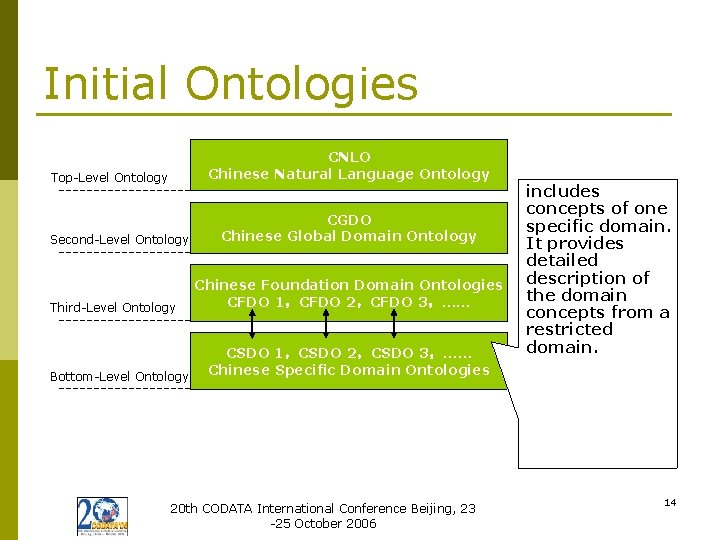
Initial Ontologies CNLO Chinese Natural Language Ontology Top-Level Ontology Second-Level Ontology Third-Level Ontology Bottom-Level Ontology CGDO Chinese Global Domain Ontology Chinese Foundation Domain Ontologies CFDO 1,CFDO 2,CFDO 3,…… CSDO 1,CSDO 2,CSDO 3,…… Chinese Specific Domain Ontologies 20 th CODATA International Conference Beijing, 23 -25 October 2006 includes all the basic Chinese lexical words and the lexical relations between the Chineselanguage concepts. It’s used for text processing and lower-level ontologies extracting. It contains lexical knowledge of Chinese. 11
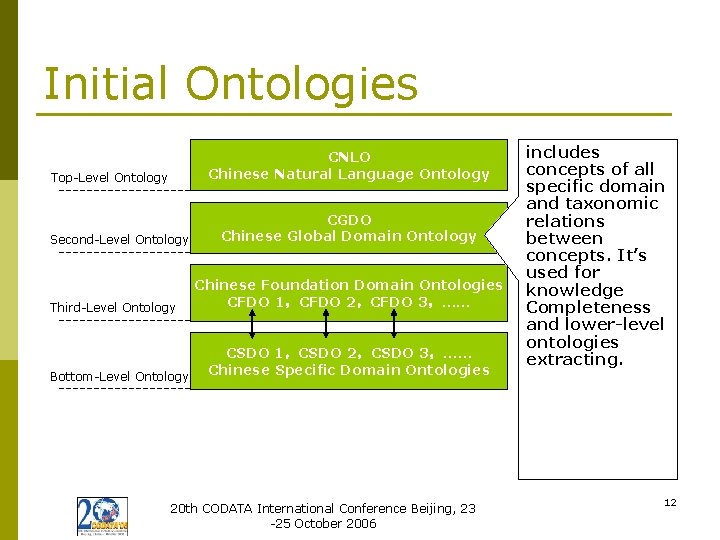
Initial Ontologies CNLO Chinese Natural Language Ontology Top-Level Ontology Second-Level Ontology Third-Level Ontology Bottom-Level Ontology CGDO Chinese Global Domain Ontology Chinese Foundation Domain Ontologies CFDO 1,CFDO 2,CFDO 3,…… CSDO 1,CSDO 2,CSDO 3,…… Chinese Specific Domain Ontologies 20 th CODATA International Conference Beijing, 23 -25 October 2006 includes concepts of all specific domain and taxonomic relations between concepts. It’s used for knowledge Completeness and lower-level ontologies extracting. 12
Initial Ontologies CNLO Chinese Natural Language Ontology Top-Level Ontology Second-Level Ontology Third-Level Ontology Bottom-Level Ontology CGDO Chinese Global Domain Ontology Chinese Foundation Domain Ontologies CFDO 1,CFDO 2,CFDO 3,…… CSDO 1,CSDO 2,CSDO 3,…… Chinese Specific Domain Ontologies 20 th CODATA International Conference Beijing, 23 -25 October 2006 for each specific domain its foundation ontology is constructed. Each specific domain has some foundational domains. Its foundation ontology includes concepts of its foundational domains. 13
Initial Ontologies CNLO Chinese Natural Language Ontology Top-Level Ontology Second-Level Ontology Third-Level Ontology Bottom-Level Ontology CGDO Chinese Global Domain Ontology Chinese Foundation Domain Ontologies CFDO 1,CFDO 2,CFDO 3,…… CSDO 1,CSDO 2,CSDO 3,…… Chinese Specific Domain Ontologies 20 th CODATA International Conference Beijing, 23 -25 October 2006 includes concepts of one specific domain. It provides detailed description of the domain concepts from a restricted domain. 14
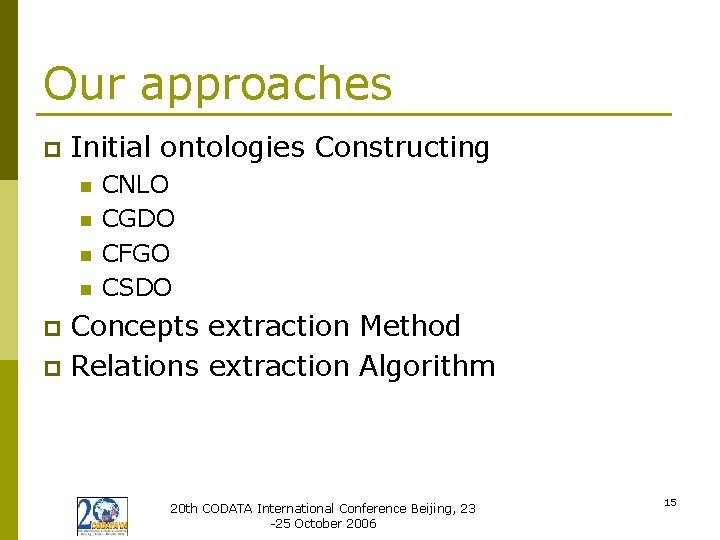
Our approaches p Initial ontologies Constructing n n CNLO CGDO CFGO CSDO Concepts extraction Method p Relations extraction Algorithm p 20 th CODATA International Conference Beijing, 23 -25 October 2006 15
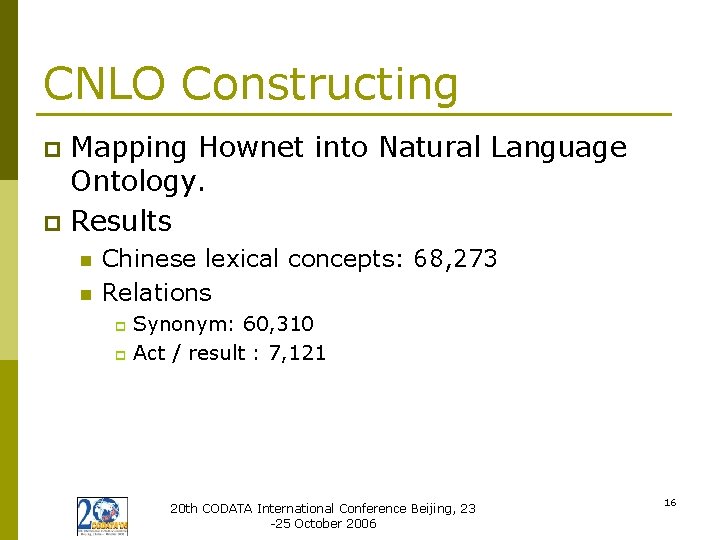
CNLO Constructing Mapping Hownet into Natural Language Ontology. p Results p n n Chinese lexical concepts: 68, 273 Relations Synonym: 60, 310 p Act / result : 7, 121 p 20 th CODATA International Conference Beijing, 23 -25 October 2006 16
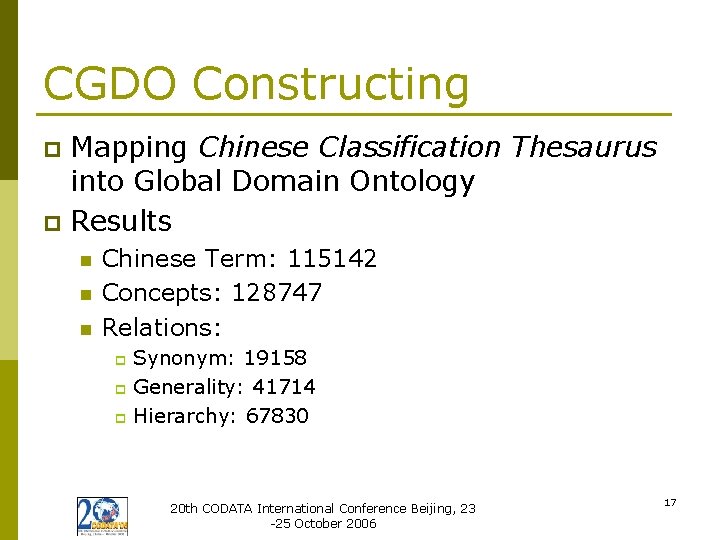
CGDO Constructing Mapping Chinese Classification Thesaurus into Global Domain Ontology p Results p n n n Chinese Term: 115142 Concepts: 128747 Relations: Synonym: 19158 p Generality: 41714 p Hierarchy: 67830 p 20 th CODATA International Conference Beijing, 23 -25 October 2006 17
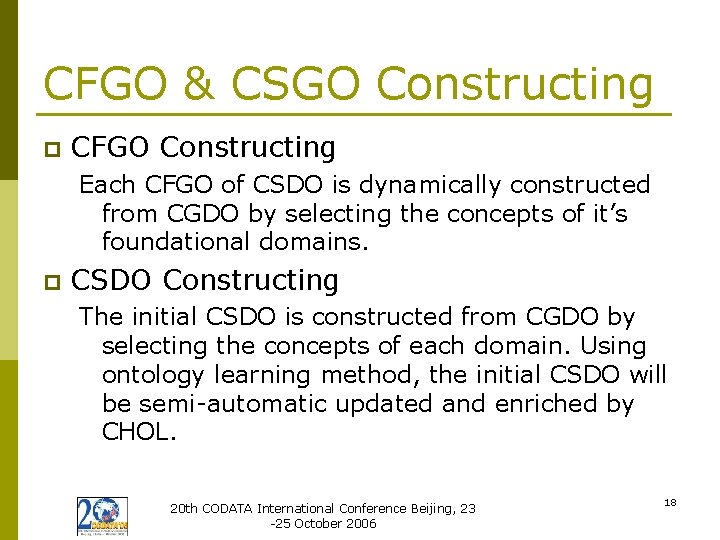
CFGO & CSGO Constructing p CFGO Constructing Each CFGO of CSDO is dynamically constructed from CGDO by selecting the concepts of it’s foundational domains. p CSDO Constructing The initial CSDO is constructed from CGDO by selecting the concepts of each domain. Using ontology learning method, the initial CSDO will be semi-automatic updated and enriched by CHOL. 20 th CODATA International Conference Beijing, 23 -25 October 2006 18
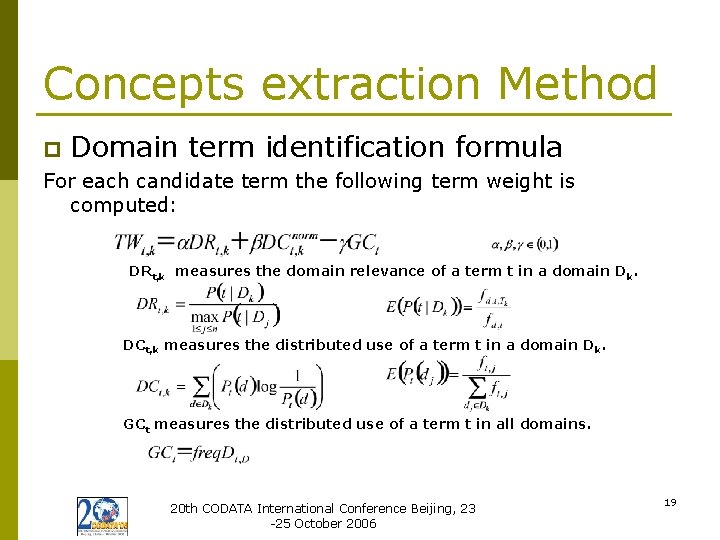
Concepts extraction Method p Domain term identification formula For each candidate term the following term weight is computed: DRt, k measures the domain relevance of a term t in a domain Dk. DCt, k measures the distributed use of a term t in a domain Dk. GCt measures the distributed use of a term t in all domains. 20 th CODATA International Conference Beijing, 23 -25 October 2006 19
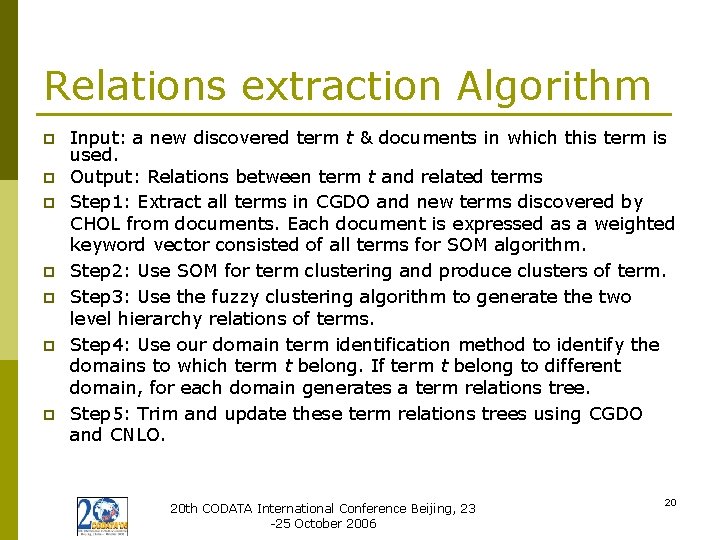
Relations extraction Algorithm p p p p Input: a new discovered term t & documents in which this term is used. Output: Relations between term t and related terms Step 1: Extract all terms in CGDO and new terms discovered by CHOL from documents. Each document is expressed as a weighted keyword vector consisted of all terms for SOM algorithm. Step 2: Use SOM for term clustering and produce clusters of term. Step 3: Use the fuzzy clustering algorithm to generate the two level hierarchy relations of terms. Step 4: Use our domain term identification method to identify the domains to which term t belong. If term t belong to different domain, for each domain generates a term relations tree. Step 5: Trim and update these term relations trees using CGDO and CNLO. 20 th CODATA International Conference Beijing, 23 -25 October 2006 20
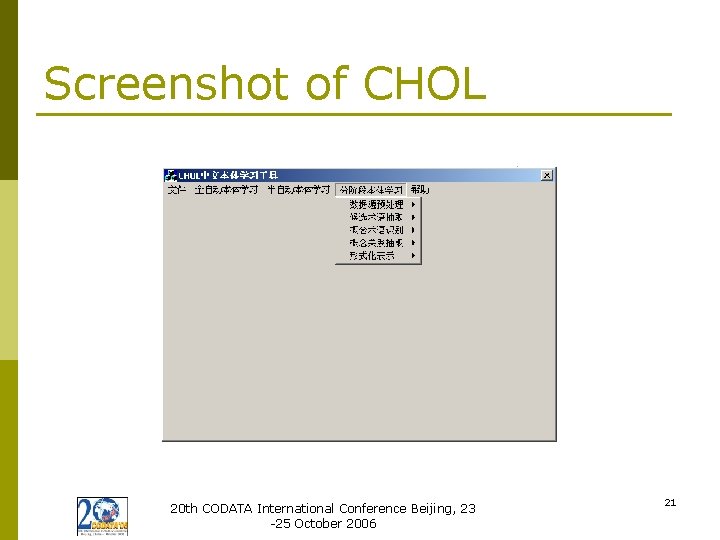
Screenshot of CHOL 20 th CODATA International Conference Beijing, 23 -25 October 2006 21
Experiment in Ethnology and Anthropology p We have tested CHOL in ethnology and anthropology to find and extract unknown term and the relations between terms from Chinese text about minority custom in China. 20 th CODATA International Conference Beijing, 23 -25 October 2006 22
Example: p CHOL applied in Chinese minority festival database. n Extracted concepts: “雪顿节(Xuedunjie)”、“望果节(Wangguojie)”、“法会(Fahui)”、“三月街 (Sanyuejie)”、“采花山(Caihuasan)”、“姊妹节(Zimeijie)”…… n Extracted relations: “瑶族(Yao)”-“盘王节(Panwangjie)” “畲族(She)”-“乌饭(Wufan)” “藏族(Tibetan)”-“转山会(Zhuanshanhui)” …… 20 th CODATA International Conference Beijing, 23 -25 October 2006 23
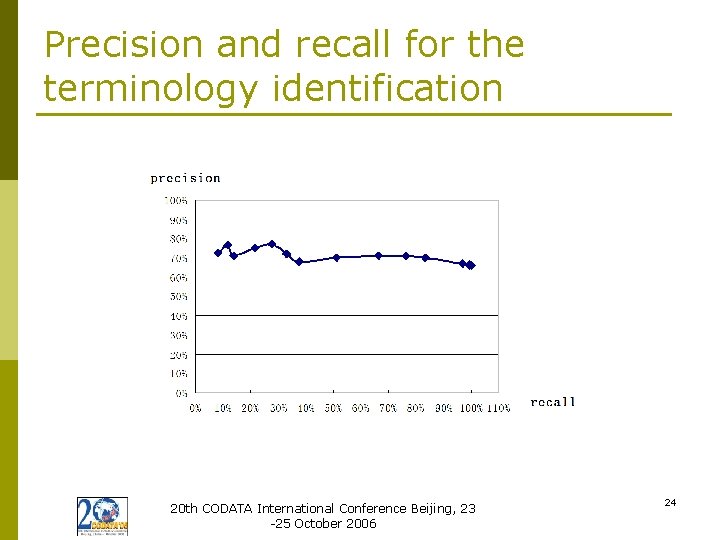
Precision and recall for the terminology identification 20 th CODATA International Conference Beijing, 23 -25 October 2006 24
Conclusion & Future Work p p p We have developed a prototype system for ontology learning from Chinese corpus, named CHOL. In CHOL, we propose some methods to identify term of domain and to extract taxonomic relations between terms. These methods are proved to be feasible and effective in application of information organization and knowledge discovery in ethnology and anthropology. At present, CHOL is just a simple prototype system. In future, we will use more methods, especially, deep semantic analysis. CHOL will be applied in more different domain and larger datasets. 20 th CODATA International Conference Beijing, 23 -25 October 2006 25
Thanks kongjing@cass. org. cn