
Ontology Languages for Subject Matter Experts Conrad Bock
Ontology Languages for Subject Matter Experts Conrad Bock Nov 3, 2005 1
Knowledge Acquisition / Elicitation Bottleneck § Mark’s comments Aug 25, 2005: – NCI infrastructure requires highly trained content specialists, won’t scale, compare to Open Directory. – Arden adopted by vendors and academics, but failing due to lack of content. § Key obstacle to success of ontologies is communication of knowledge from humans to machine. § Same obstacle faced by expert systems, 2 and never overcome.
Knowledge Acquisition / Elicitation Bottleneck § Observation: subject matter experts cannot easily adapt to existing knowledge languages. § Diagnosis: – Existing knowledge languages are not well-suited for subject matter experts. – The problem is in the languages, not lack of SME training in the languages. – The concepts underlying knowledge languages originated in computer programming. – KL’s are computer languages adapted for SME’s, without attention to SME mental models. – Not much advancement in KL’s from SME viewpoint since expert system days (except some aspects of UML 3 and a bit of OWL).
Classes § Originated in allocating and parsing blocks of memory. § Not present in: – conventional logic (set and predicates don’t hav properties). – native subject matter expert discussion (“classification” doesn’t necessarily mean a CS class, see default inheritance problems). § SME use focus on instances and relations between sets of instances defined by 4 navigating properties (roles).
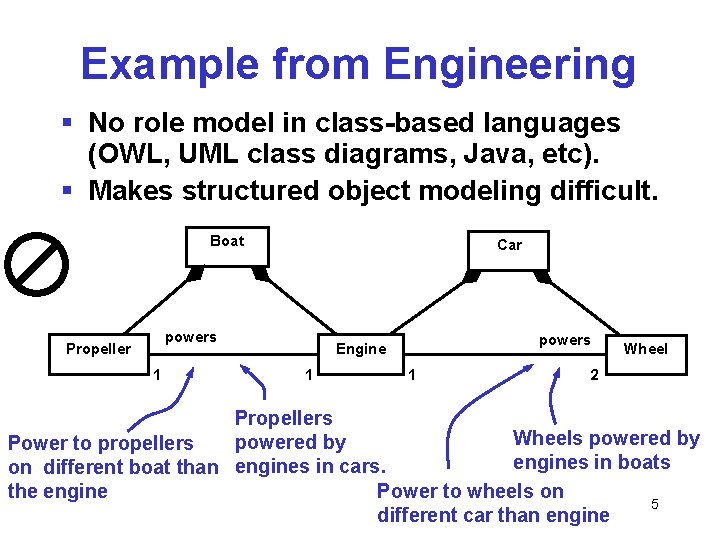
Example from Engineering § No role model in class-based languages (OWL, UML class diagrams, Java, etc). § Makes structured object modeling difficult. Boat Car powers Propeller 1 powers Engine 1 1 Wheel 2 Propellers Wheels powered by Power to propellers engines in boats on different boat than engines in cars. the engine Power to wheels on 5 different car than engine
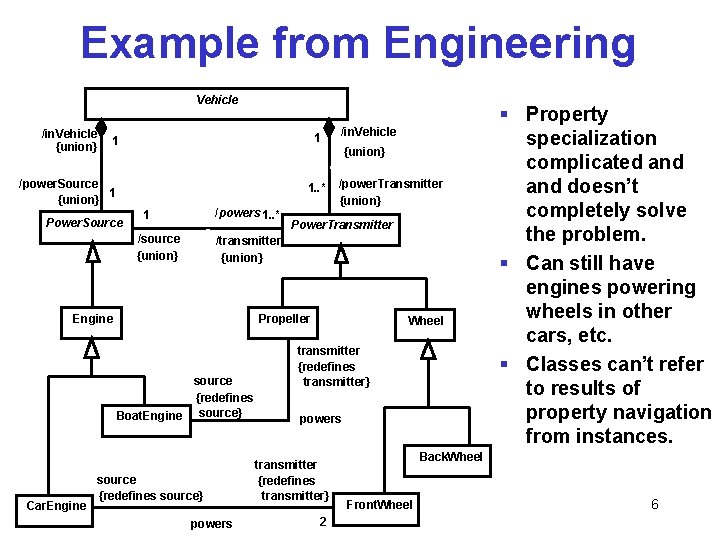
Example from Engineering Vehicle /in. Vehicle {union} 1 1 {union} /power. Source 1 {union} 1. . * Power. Source /powers 1. . * 1 /source {union} /power. Transmitter {union} Power. Transmitter /transmitter {union} Engine Propeller source {redefines Boat. Engine source} Car. Engine /in. Vehicle source {redefines source} powers Wheel transmitter {redefines transmitter} powers transmitter {redefines transmitter} 2 § Property specialization complicated and doesn’t completely solve the problem. § Can still have engines powering wheels in other cars, etc. § Classes can’t refer to results of property navigation from instances. Back. Wheel Front. Wheel 6
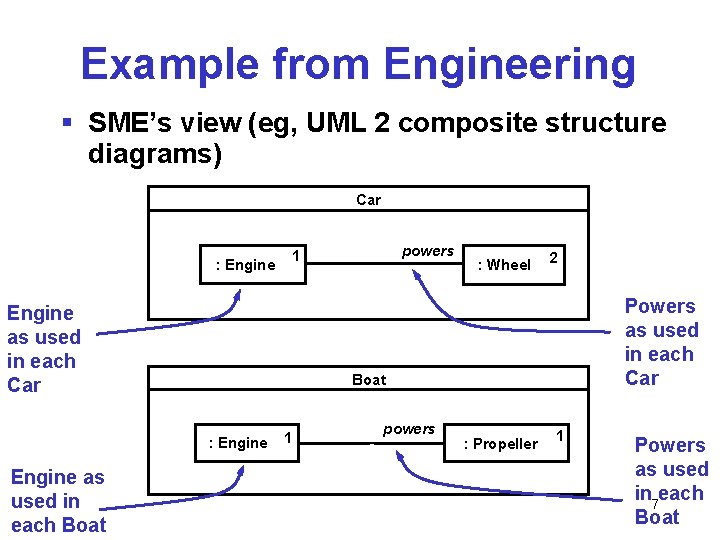
Example from Engineering § SME’s view (eg, UML 2 composite structure diagrams) Car : Engine as used in each Car : Wheel 2 Powers as used in each Car Boat : Engine as used in each Boat powers 1 1 powers : Propeller 1 Powers as used in 7 each Boat
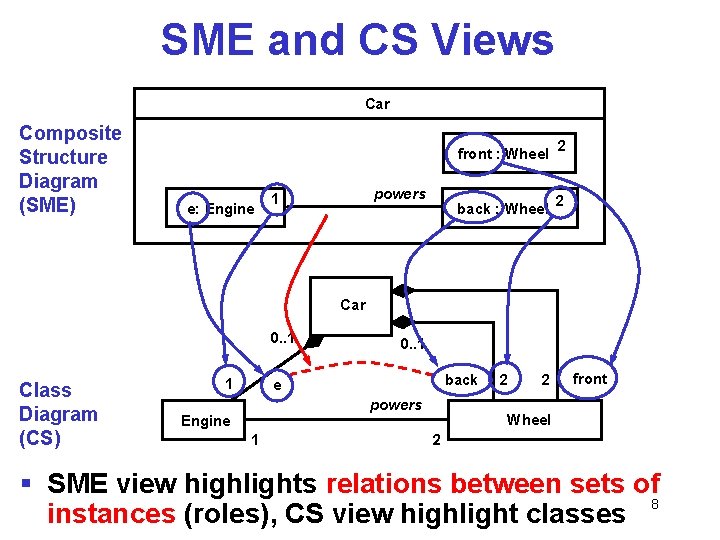
SME and CS Views Car Composite Structure Diagram (SME) front : Wheel 2 e: Engine powers 1 back : Wheel 2 Car 0. . 1 Class Diagram (CS) 1 0. . 1 back e powers Engine 1 2 2 front Wheel 2 § SME view highlights relations between sets of 8 instances (roles), CS view highlight classes
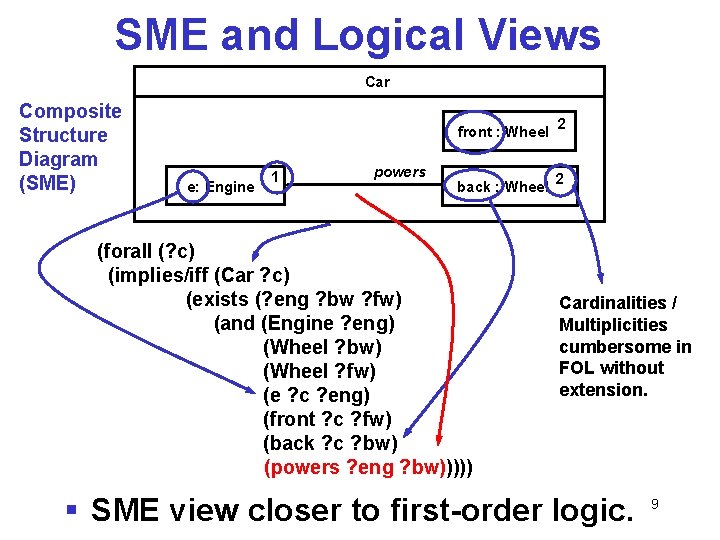
SME and Logical Views Car Composite Structure Diagram (SME) front : Wheel 2 e: Engine 1 powers back : Wheel (forall (? c) (implies/iff (Car ? c) (exists (? eng ? bw ? fw) (and (Engine ? eng) (Wheel ? bw) (Wheel ? fw) (e ? c ? eng) (front ? c ? fw) (back ? c ? bw) (powers ? eng ? bw))))) 2 Cardinalities / Multiplicities cumbersome in FOL without extension. § SME view closer to first-order logic. 9
Rules § Attempt to simplify procedural control structures. § Not present in conventional logic (implication includes contrapositive) § Not present in isolation in native SME discussion (SME rules specified in the context of procedures). § Suggest looking at languages where rules and processes are comparable (eg, Planner-like languages that allow queries and assertions in any order, or process 10 constraint languages).
Prognosis § Will grass roots movement around OWL overcome the obstacles? § Will ontologies go the way of expert systems? § Reduce risk by extending ontology and rule languages from SME viewpoint. § Address SME need for contextualized modeling techniques. 11
Some References § Bock, “UML 2 Composition Model, ” Journal of Object Technology, 3: 10, 47 -73, November. December, 2004. § Bock, “Goal-driven Modeling, ” Journal Of Object. Oriented Programming, 13: 5, 25 -28, September 2000. § Krogh, et. al. , “Strictly Class-based Modeling Can Be Harmful, ” HICSS 29, 1996. § Weber and Shanks ACM papers on conceptual modeling. 12
- Slides: 12