
Ontology and Databases 1 Well go around with
Ontology and Databases 1. We'll go around with a self-introduction of participants (10~15 minutes) - we'll skip this if we have more than 20 participants. 2. Introduction of Panelists (Moderator) 3. Opening by the Moderator (5 min. ) 4. 15~20 -minute brief by each panelist on their perspective 5. open general discussion by all participants (30~45 minutes) 6. Summary / Conclusion / Follow-up (Moderator) http: //ontolog. cim 3. net/cgi-bin/wiki. pl? Database. And. Ontology
Introduction of Panalists • Leo Orbst – Principal artificial intelligence scientist at MITRE’s (www. mitre. org) Center for Innovative Computing and Informatics, where he leads the Information Semantics group (semantics, ontological engineering, knowledge representation and management), and has been involved in projects on Semantic Web rule/ontology interaction, context-based semantic interoperability, ontology-based knowledge management, conceptual information retrieval, metadata and thesaurus construction for community knowledge sharing • Tatiana Malyuta – Associate Professor of Computer Systems Technology Department of the New York City College of Technology (City University of New York) where she is coordinating and teaching database courses. She wrote a textbook “Physical Design and implementation of Relational Databases. ” • Matthew West – Reference Data Architecture and Standards Manager for Shell’s Downstream (refinery to petrol pump) business, where he is currently developing Shell’s Global Downstream Data Model. He is a key technical contributor to ISO 15926 – "Lifecycle integration of process plant data including oil and gas production facilities". Matthew is the Shell Visiting Professor in the Keyworth Institute at the University of Leeds.
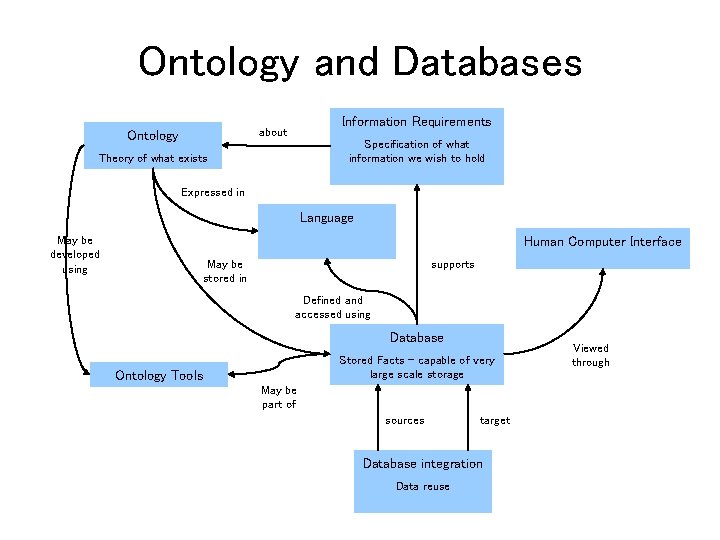
Ontology and Databases Information Requirements about Ontology Specification of what information we wish to hold Theory of what exists Expressed in Language May be developed using Human Computer Interface May be stored in supports Defined and accessed using Database Stored Facts – capable of very large scale storage Ontology Tools May be part of sources target Database integration Data reuse Viewed through
Issues to Explore 1. 2. 3. 4. 5. 6. 7. 8. How does ontology improve database design? What is there beyond ontology in database design? How do you design a database to manage an ontology? What are the limitations of databases in supporting ontologies? How do you discover the ontology implicit in a database? How do you map between ontologies? How does ontology help with the design and implementation of human computer interfaces? What are the key challenges in developing human computer interfaces using ontologies?
- Slides: 4