
Ontologies and RDF Schema COMP 6215 Semantic Web

Ontologies and RDF Schema COMP 6215 Semantic Web Technologies Dr Nicholas Gibbins – nmg@ecs. soton. ac. uk 2019 -2020
Knowledge Representation Knowledge representation is central to the Semantic Web • Data published on the Semantic Web must be structured and organised Long-standing concern in Artificial Intelligence • A good knowledge representation ‘naturally’ represents a given problem domain • A poor knowledge representation is unintelligible 3
Knowledge Representation Common KR approaches: • • Logic Production rules Semantic Networks Frames The Semantic Web combines aspects of all of these schemes 4
Knowledge Representation Most AI systems (and therefore SW systems) consist of: • A knowledge base (KB) • Forms the system's intelligence source • Structured according to the knowledge representation approach taken • An inference mechanism • Set of procedures that are used to examine the knowledge base to answer questions, solve problems or make decisions within the domain 5

Ontologies
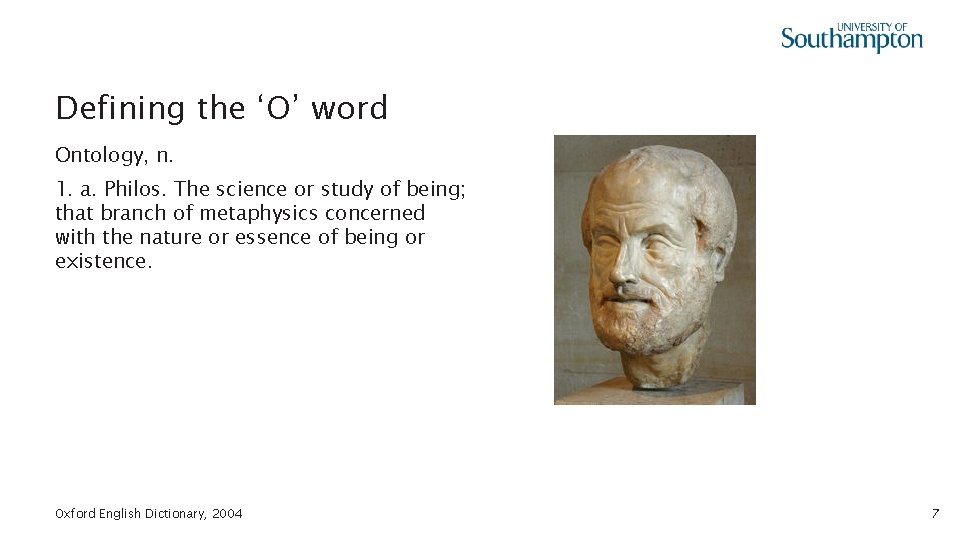
Defining the ‘O’ word Ontology, n. 1. a. Philos. The science or study of being; that branch of metaphysics concerned with the nature or essence of being or existence. Oxford English Dictionary, 2004 7
Defining the ‘O’ word An ontology is a specification of a conceptualisation • Specification: A formal description • Conceptualisation: The objects, concepts, and other entities that are assumed to always exist in some area of interest and the relationships that hold among them Referred to in the philosophical literature as Formal Ontology T. R. Gruber. A translation approach to portable ontologies. Knowledge Acquisition, 5(2): 199 -220, 1993 N. Guarino, D. Oberle, S. Staab. What is an ontology? In: S. Staab & R. Studer (eds. ). Handbook on Ontologies. 2 nd revised edition. Springer, 2009. 8
Ontology in Computer Science Ontologies as engineered artifacts: • constituted by a specific vocabulary used to describe a certain reality, plus • a set of explicit assumptions regarding the intended meaning of the vocabulary Benefits: • • • Shared understanding Facilitate communication Establish a joint terminology for a community of interest Normative models Inter-operability: sharing and reuse 9
Ontology Structure Ontologies typically have two distinct components: • Names for important concepts in the domain • Elephant, Adult_Elephant, African_Elephant, Herbivore, etc • Background knowledge/constraints on the domain • • • Elephants are a kind of animal Adult_Elephants are Elephants whose age is greater than 20 years Adult_Elephants weigh at least 2, 000 kg All Elephants are either African_Elephants or Indian_Elephants Herbivore are exactly those animals who eat only plants or parts of plants No individual can be both a Herbivore and a Carnivore 10
Informal Usage Informally, ‘ontology’ may also be used to describe a number of other types of conceptual specification: • Controlled vocabulary • Taxonomy • Thesaurus Study of ontology is not limited to computer scientists and philosophers • Rich tradition of knowledge representation and ontology in library and information science… • …but they talk about classification and metadata instead of ontologies 11
Controlled Vocabularies An explicitly enumerated list of terms, each with an unambiguous, non-redundant definition • No structure exists between terms • A controlled vocabulary is a flat list Examples: • Library of Congress Subject Headings (LCSH) • Medical Subject Headings (Me. SH) 12
Taxonomies A collection of controlled vocabulary terms organised into a hierarchical structure • Each term is in one or more parent-child relationships • May be several different types of parent-child relationship: • Type-instance • Genus-species • Part-whole (referred to as meronymy) 13
Taxonomy Examples Library classification schemes • Library of Congress • Dewey Decimal • UDC Linnean Classification • Kingdom, Phylum, Class, Order, Family, Genus, Species, Subspecies Me. SH Tree Structures 14
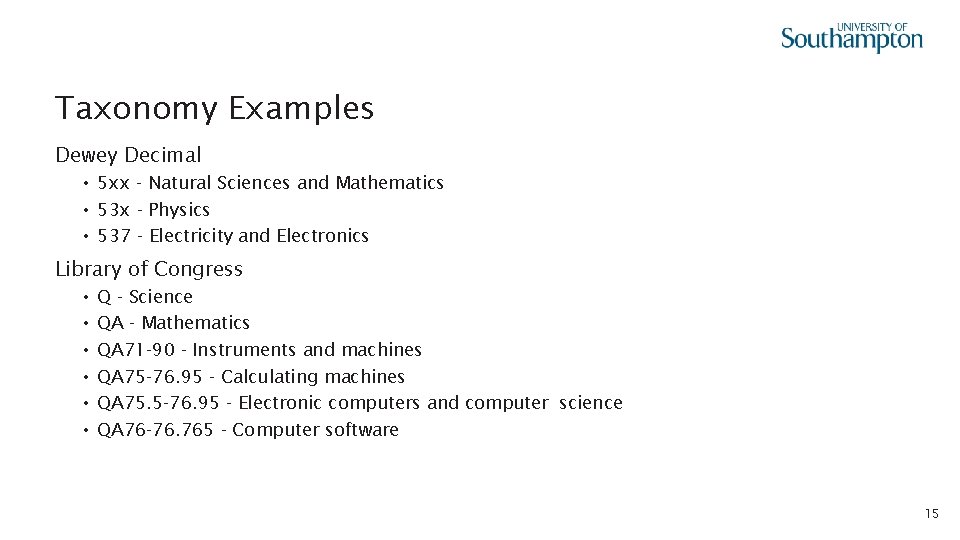
Taxonomy Examples Dewey Decimal • 5 xx - Natural Sciences and Mathematics • 53 x - Physics • 537 - Electricity and Electronics Library of Congress • • • Q - Science QA - Mathematics QA 71 -90 - Instruments and machines QA 75 -76. 95 - Calculating machines QA 75. 5 -76. 95 - Electronic computers and computer science QA 76 -76. 765 - Computer software 15
Thesauri A thesaurus is a taxonomy with additional relations showing lateral connections • Related Term (RT) • See Also Parent-child relation usually described in terms of Broader Terms (BT) and Narrower Terms (NT) Thesauri also typically contain scope notes which define the meaning of a term 16
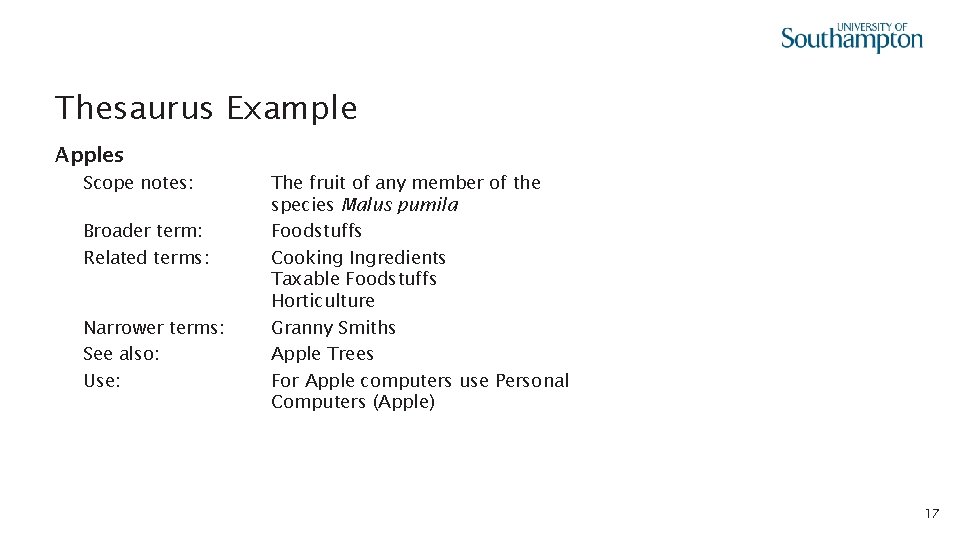
Thesaurus Example Apples Scope notes: Broader term: Related terms: Narrower terms: See also: Use: The fruit of any member of the species Malus pumila Foodstuffs Cooking Ingredients Taxable Foodstuffs Horticulture Granny Smiths Apple Trees For Apple computers use Personal Computers (Apple) 17
Ontology An ontology further specialises types of relationships (particularly related term) A ontology typically includes: • Class definitions and hierarchy • Relation definitions and hierarchy An ontology may also include the following: • Constraints • Axioms • Rule-based knowledge 18
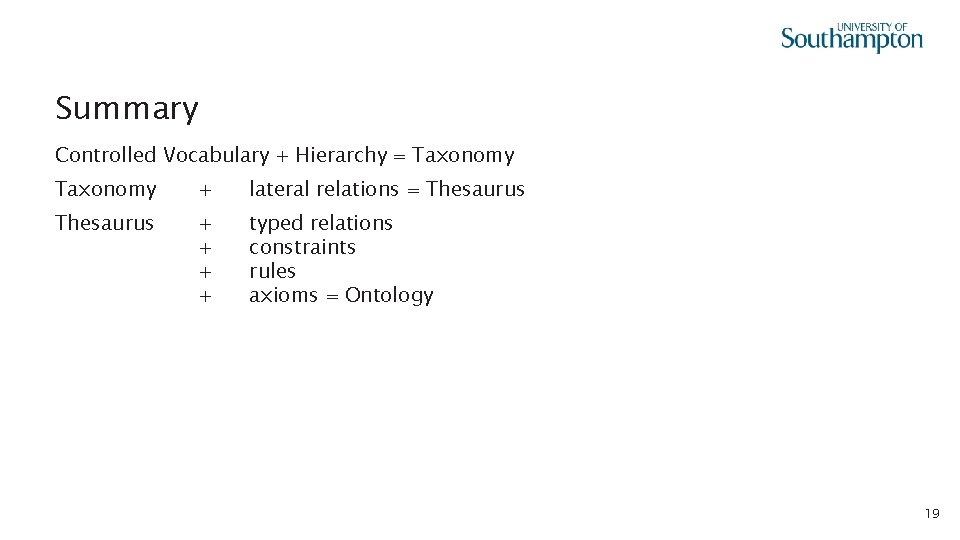
Summary Controlled Vocabulary + Hierarchy = Taxonomy + lateral relations = Thesaurus + + typed relations constraints rules axioms = Ontology 19
Further Reading N. Guarino, D. Oberle, S. Staab. What is an ontology? In: S. Staab & R. Studer. Handbook on Ontologies. 2 nd revised edition. Springer, 2009. https: //link. springer. com/chapter/10. 1007%2 F 978 -3 -540 -92673 -3_0 https: //userpages. uni-koblenz. de/~staab/Research/Publications/2009/handbook. Edition 2/what-isan-ontology. pdf 20

RDF Schema
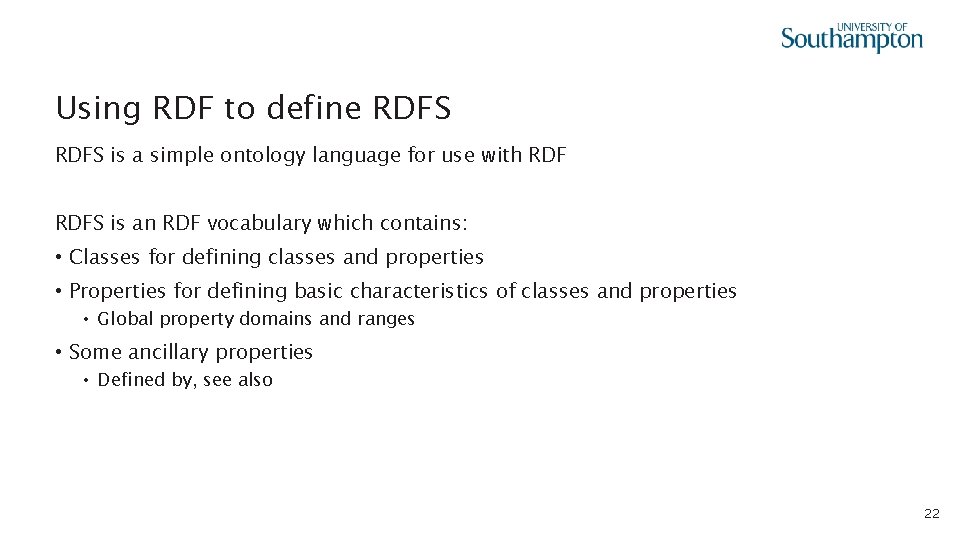
Using RDF to define RDFS is a simple ontology language for use with RDFS is an RDF vocabulary which contains: • Classes for defining classes and properties • Properties for defining basic characteristics of classes and properties • Global property domains and ranges • Some ancillary properties • Defined by, see also 22
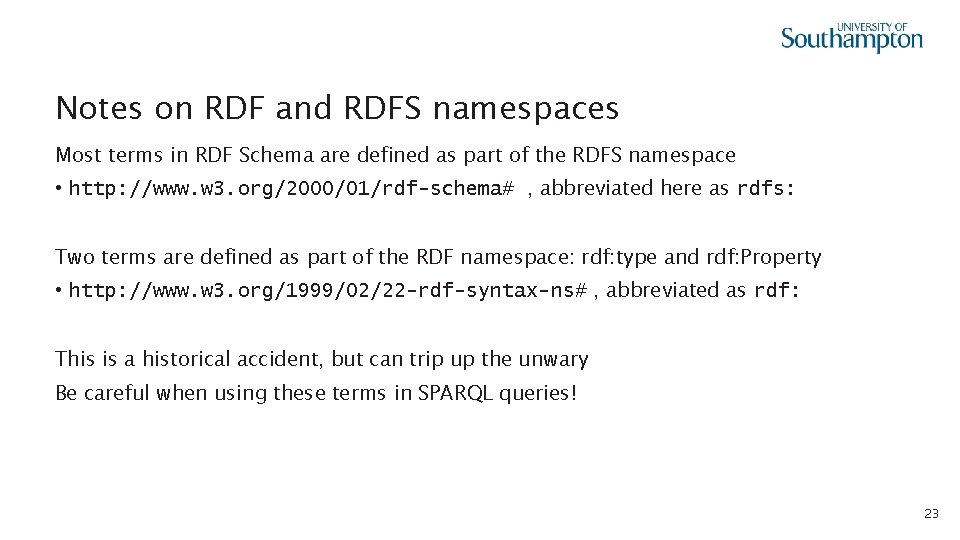
Notes on RDF and RDFS namespaces Most terms in RDF Schema are defined as part of the RDFS namespace • http: //www. w 3. org/2000/01/rdf-schema# , abbreviated here as rdfs: Two terms are defined as part of the RDF namespace: rdf: type and rdf: Property • http: //www. w 3. org/1999/02/22 -rdf-syntax-ns# , abbreviated as rdf: This is a historical accident, but can trip up the unwary Be careful when using these terms in SPARQL queries! 23
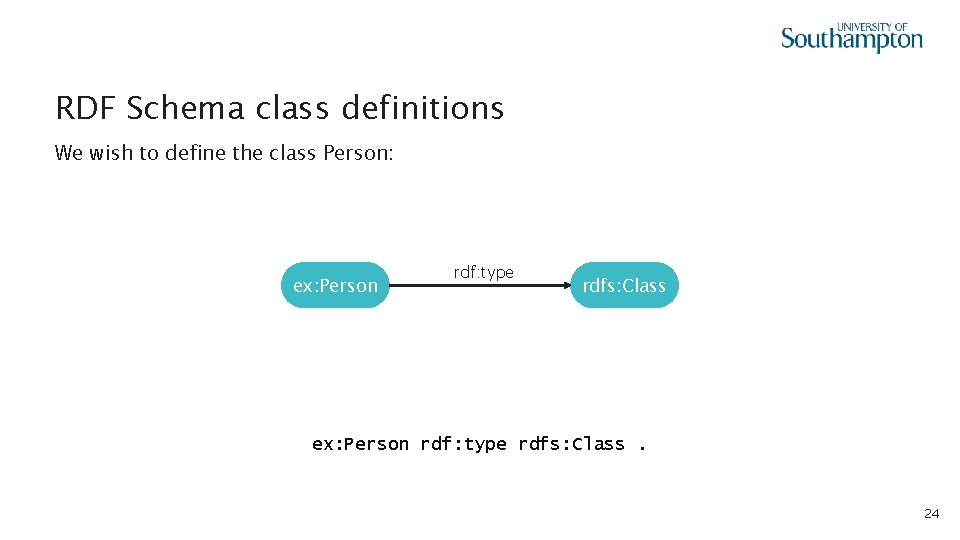
RDF Schema class definitions We wish to define the class Person: ex: Person rdf: type rdfs: Class. 24
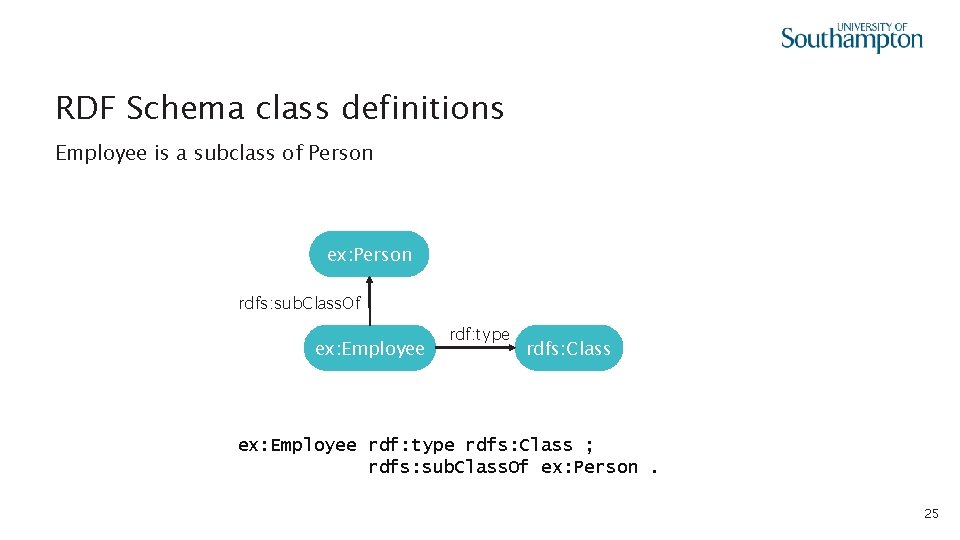
RDF Schema class definitions Employee is a subclass of Person ex: Person rdfs: sub. Class. Of ex: Employee rdf: type rdfs: Class ; rdfs: sub. Class. Of ex: Person. 25
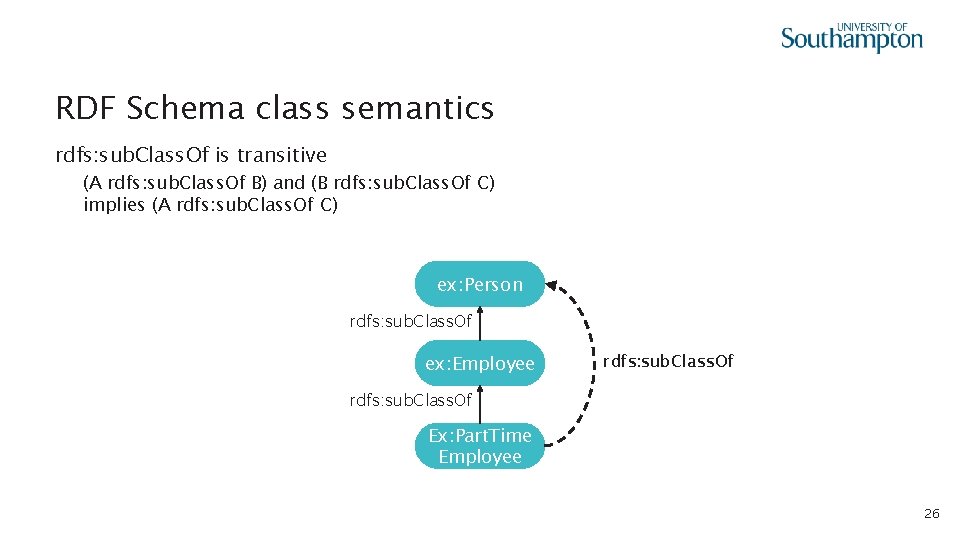
RDF Schema class semantics rdfs: sub. Class. Of is transitive (A rdfs: sub. Class. Of B) and (B rdfs: sub. Class. Of C) implies (A rdfs: sub. Class. Of C) ex: Person rdfs: sub. Class. Of ex: Employee rdfs: sub. Class. Of Ex: Part. Time Employee 26
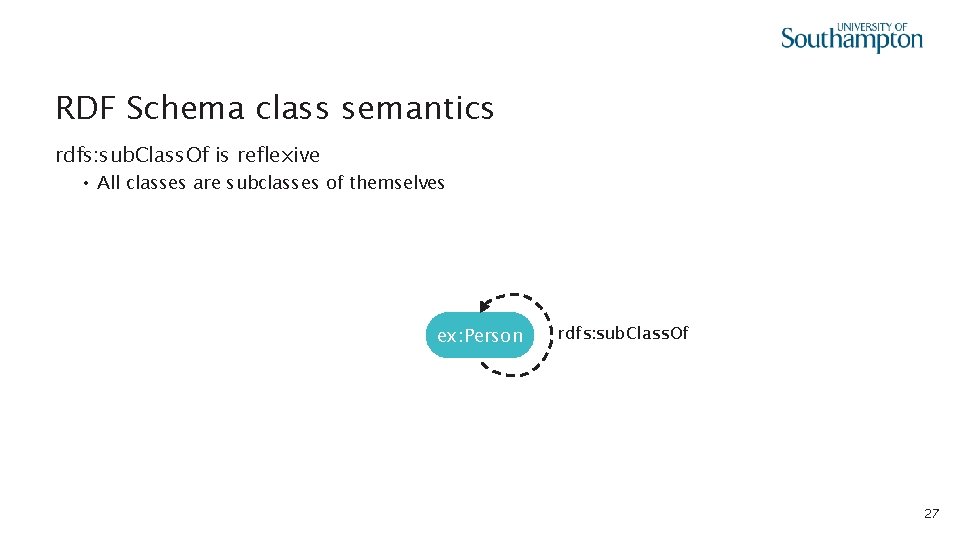
RDF Schema class semantics rdfs: sub. Class. Of is reflexive • All classes are subclasses of themselves ex: Person rdfs: sub. Class. Of 27
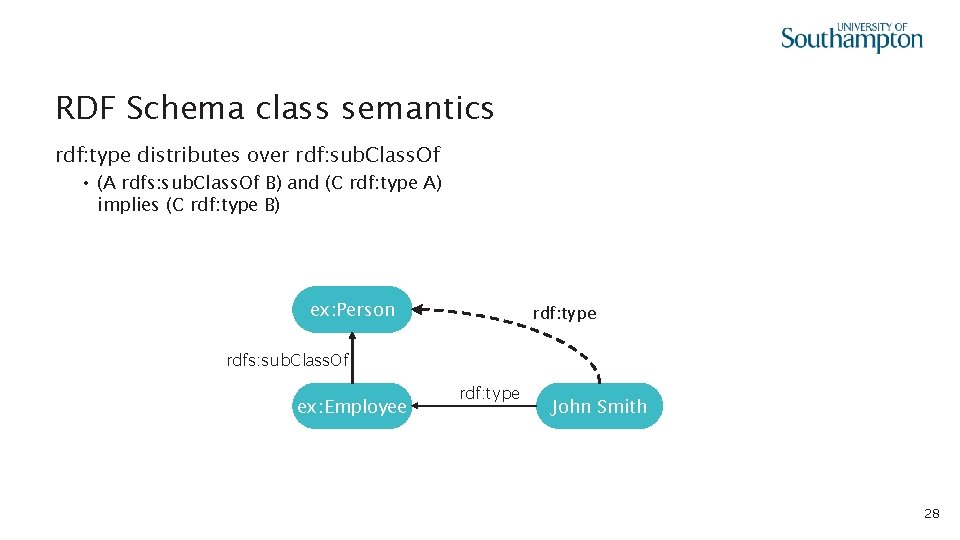
RDF Schema class semantics rdf: type distributes over rdf: sub. Class. Of • (A rdfs: sub. Class. Of B) and (C rdf: type A) implies (C rdf: type B) ex: Person rdf: type rdfs: sub. Class. Of ex: Employee rdf: type John Smith 28
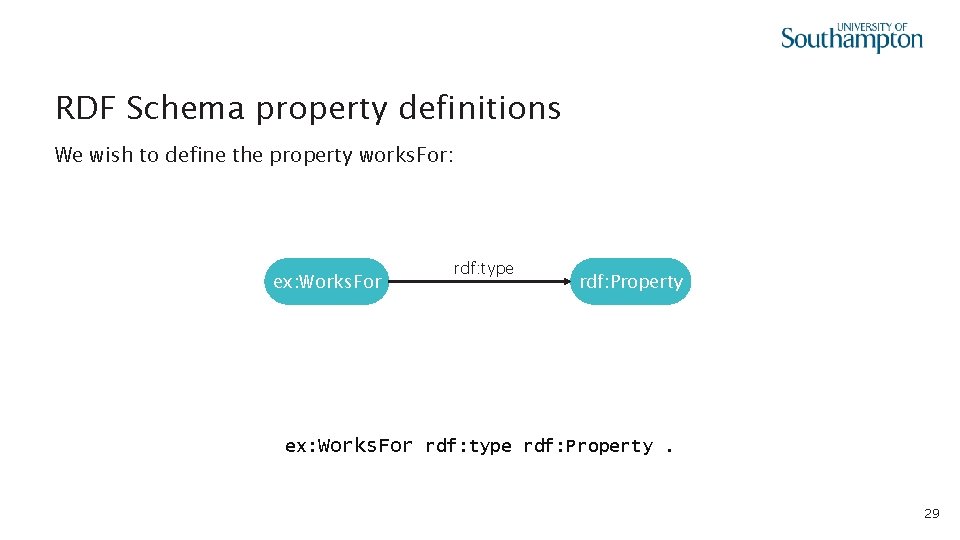
RDF Schema property definitions We wish to define the property works. For: ex: Works. For rdf: type rdf: Property. 29
RDF Schema property definitions Important difference between RDF and object-oriented programming languages • OO languages define classes in terms of the properties they have • RDF defines properties in terms of the classes whose instances they relate to each other The domain of a property is the class that the property runs from The range of a property is the class that a property runs to 30
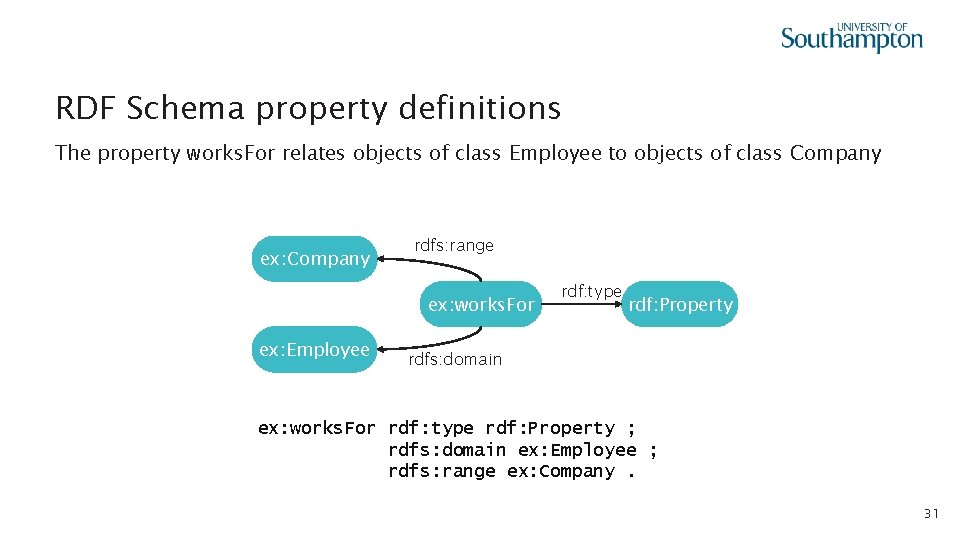
RDF Schema property definitions The property works. For relates objects of class Employee to objects of class Company ex: Company rdfs: range ex: works. For ex: Employee rdf: type rdf: Property rdfs: domain ex: works. For rdf: type rdf: Property ; rdfs: domain ex: Employee ; rdfs: range ex: Company. 31
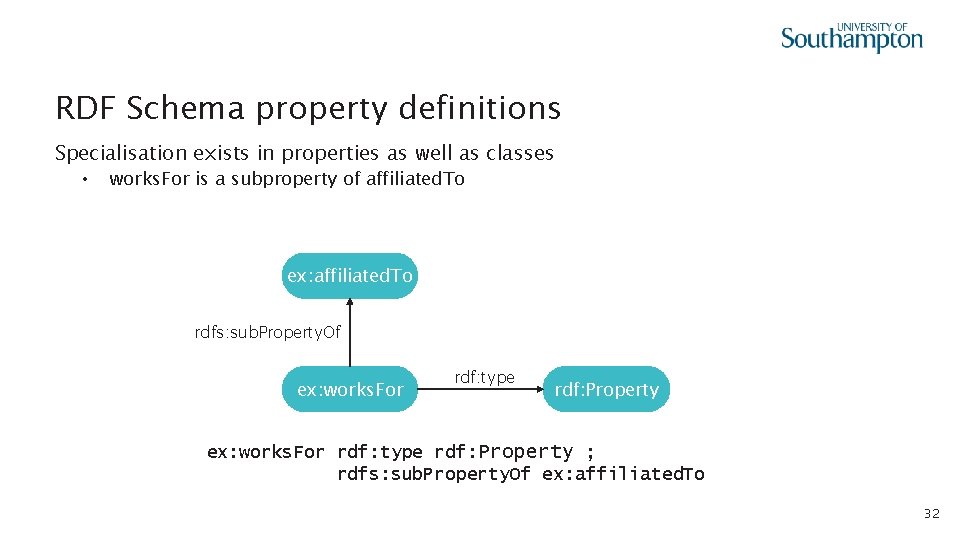
RDF Schema property definitions Specialisation exists in properties as well as classes • works. For is a subproperty of affiliated. To ex: affiliated. To rdfs: sub. Property. Of ex: works. For rdf: type rdf: Property ; rdfs: sub. Property. Of ex: affiliated. To 32
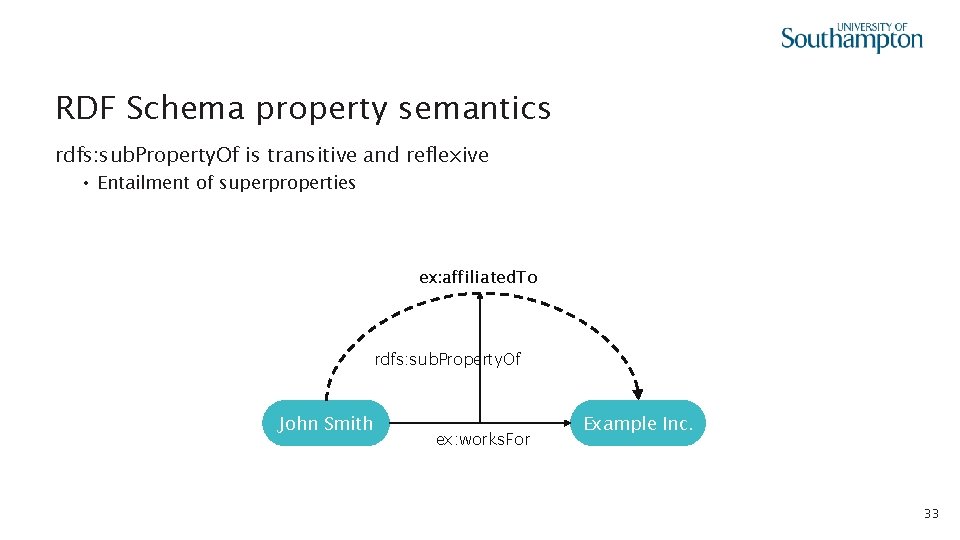
RDF Schema property semantics rdfs: sub. Property. Of is transitive and reflexive • Entailment of superproperties ex: affiliated. To rdfs: sub. Property. Of John Smith ex: works. For Example Inc. 33
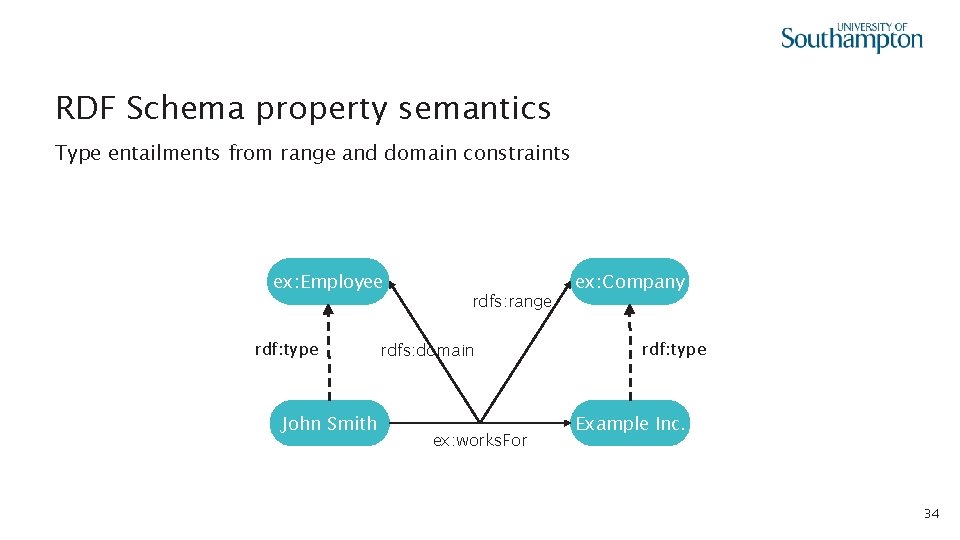
RDF Schema property semantics Type entailments from range and domain constraints ex: Employee ex: Company rdfs: range rdf: type John Smith rdfs: domain ex: works. For rdf: type Example Inc. 34
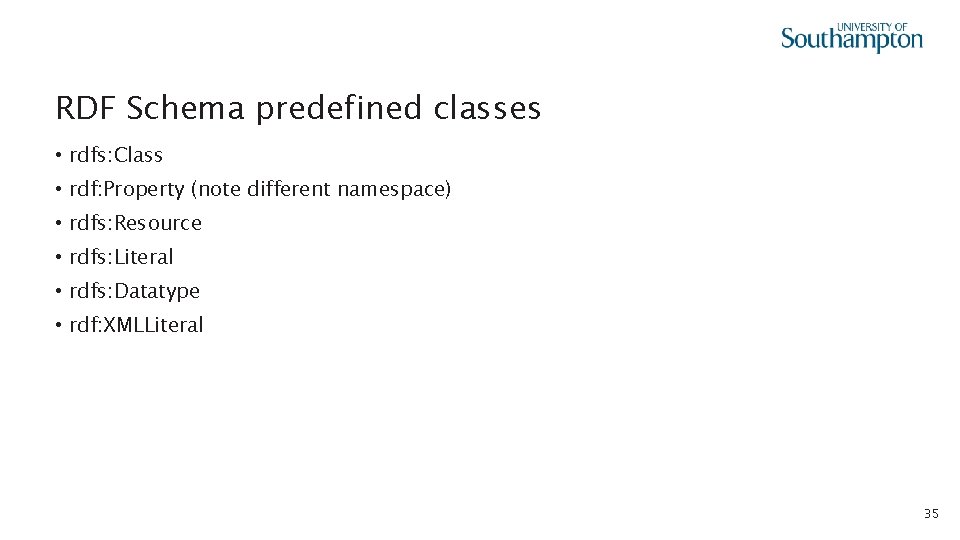
RDF Schema predefined classes • rdfs: Class • rdf: Property (note different namespace) • rdfs: Resource • rdfs: Literal • rdfs: Datatype • rdf: XMLLiteral 35
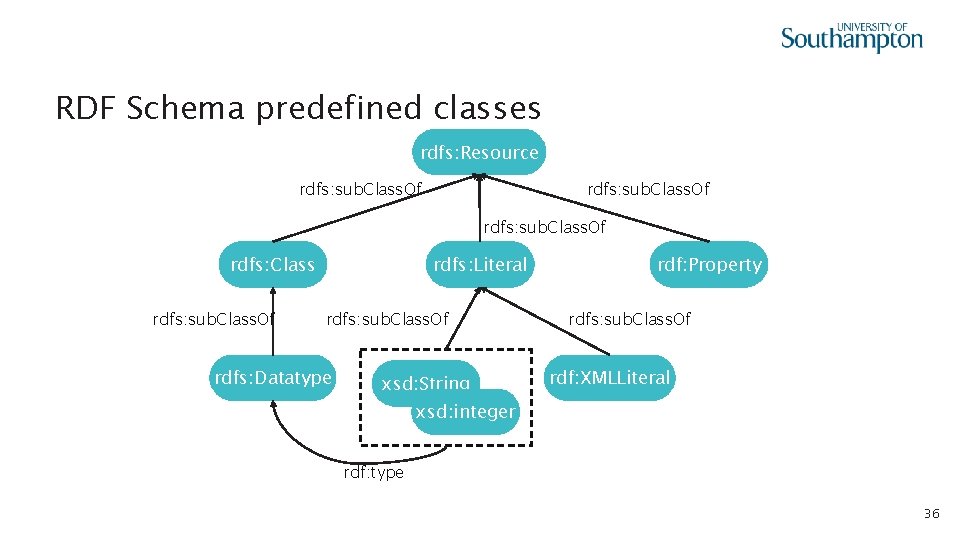
RDF Schema predefined classes rdfs: Resource rdfs: sub. Class. Of rdfs: Class rdfs: sub. Class. Of rdfs: Literal rdfs: sub. Class. Of rdfs: Datatype xsd: String rdf: Property rdfs: sub. Class. Of rdf: XMLLiteral xsd: integer rdf: type 36
RDF Schema ancillary features rdfs: label is used to give a human-readable name for a resource <#person-01269> rdfs: label “John Smith”. rdfs: comment is used to give a human-readable description for a resource <#Employee> rdfs: comment “A person who works. ”. 37
RDF Schema ancillary features rdfs: see. Also is used to indicate a resource which can be retrieved to give more information about something rdfs: is. Defined. By indicates a resource which is responsible for the definition of something • A subproperty of rdfs: see. Also 38
RDF Schema Status • Original version contemporary with RDF (but never became a W 3 C Recommendation) • Revised version published in 2004 • Second revision published in 2014 39
Next Lecture: Description Logics
- Slides: 40