
Ontarios Massive Hemorrhage Protocol MHP Presentation by Jeannie
Ontario’s Massive Hemorrhage Protocol (MHP) Presentation by: Jeannie Callum, BA, MD, FRCPC Kimmo Murto, MD, FRCPC Katerina Pavenski, BSc, MD, FRCPC *On behalf of the Provincial MHP Steering Committee

Learning objectives • Provide definition of massive hemorrhage • Define massive transfusion protocol and its benefits • Describe the elements of Ontario MHP and how it can be adapted for your hospital
What is a massive hemorrhage? • No widely accepted universal definition: – 10 units in 24 hrs, 6 RBC in 4 hours, etc. – Amount and rate of bleeding as well as likelihood of being able to rapidly achieve hemostasis • Rare, complex and high stress medical scenario • Associated with a high mortality rate
Who is at risk? • Massive hemorrhage may occur in the context of: – Trauma – Post-partum – Cardiovascular event (ex. ruptured abdominal aortic aneurysm, iatrogenic vessel injury) – Acute upper GI bleeding
What is a massive hemorrhage protocol? Protocol, systematic clinical workflow, algorithm, integrated care pathway – Aim (7 R’s): • Right health care workers, doing the right things, for the right patients, in the right order, at the right time, in the right place, with the right outcome – Outcomes: • Leads to improved outcomes Gawande 2009; Haynes et al NEJM 2009 ; Allen et al JBI Libr Syst Rev 2009

Are there proven benefits of MHP? • MHP implementation is associated with – Reduction in mortality, organ failure, postinjury complications • independent of what exactly is in the protocol – Faster delivery of blood components to patient – Not associated with increase in blood component wastage – Less blood component utilization (and less cost) – Decreased length of hospital stay Dente et al J Trauma 2009; Cotton et al J Trauma 2009; Riskin et al J Am Coll Surg 2009; Reed et al Injury 2017; Cotton et al J Trauma 2008; O’Keeffe et al Arch Surg 2008; Khan et al Injury 2013; Mitra B et al. ANZ J Surg. 2013
Key elements of MHP: T 7 1. Trigger and Treat bleeding (apply damage control resuscitation principles) 2. Team (including communication) and Training 3. Tranexamic acid (including blood components) 4. Temperature 5. Testing 6. Transfusion 7. Termination and Tracking performance
Ontario MHP Toolkit Outline • • • Patient Transport / pre-hospital services Principals of damage control resuscitation MHP / Code Transfusion Team Communication/Switchboard Laboratory Testing Temperature Blood Components and Products (TXA) Education (Implementation & Training) Pediatrics Patient and Family Support Quality Research
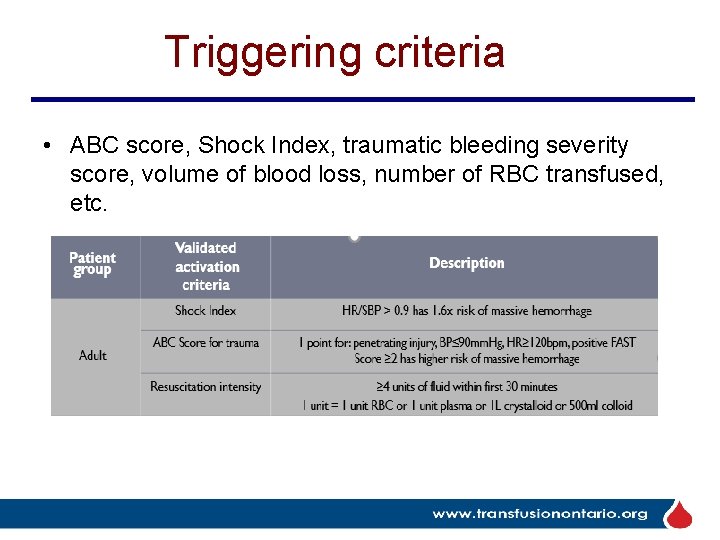
Triggering criteria • ABC score, Shock Index, traumatic bleeding severity score, volume of blood loss, number of RBC transfused, etc.

Triggering process • The protocol shall be called the Massive Hemorrhage Protocol (MHP) • Announced overhead as CODE TRANSFUSION – Announcing overhead instantaneously alerts all of the relevant parties and make bring additional resources • Single call to Locating/Switchboard with dissemination to all team members
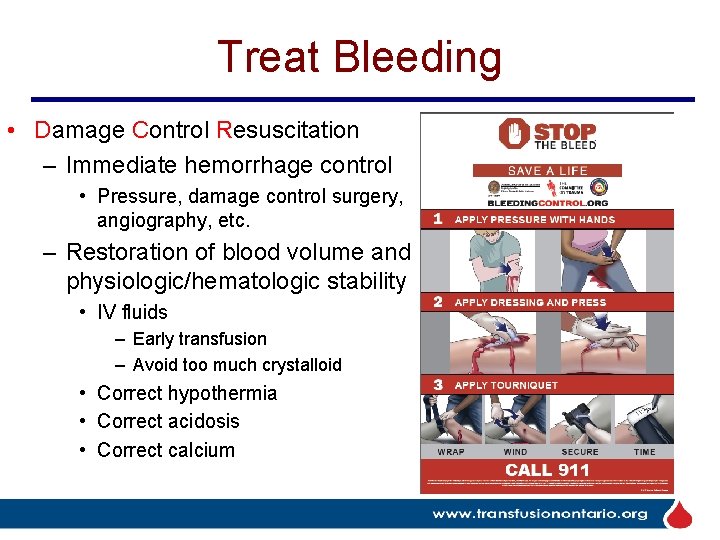
Treat Bleeding • Damage Control Resuscitation – Immediate hemorrhage control • Pressure, damage control surgery, angiography, etc. – Restoration of blood volume and physiologic/hematologic stability • IV fluids – Early transfusion – Avoid too much crystalloid • Correct hypothermia • Correct acidosis • Correct calcium
Expert Support for MHP • Any patient on whom MHP was activated and who cannot receive definitive management locally, must be considered for transfer ASAP • Criti. Call 1 800 668 4357
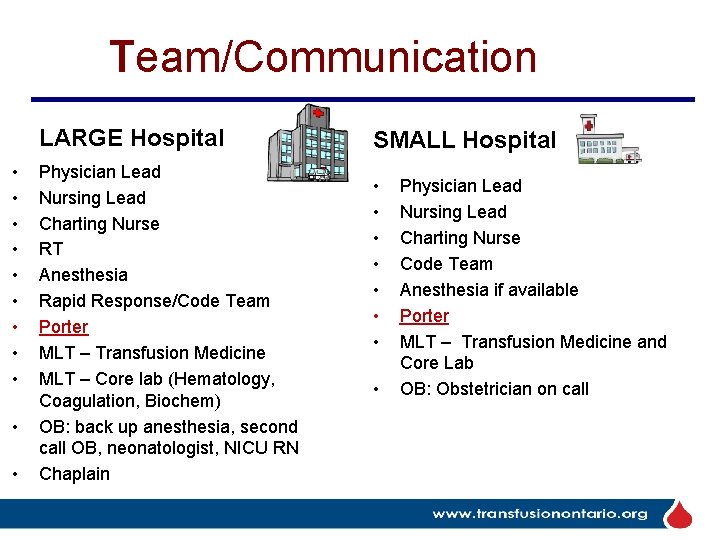
Team/Communication LARGE Hospital • • • Physician Lead Nursing Lead Charting Nurse RT Anesthesia Rapid Response/Code Team Porter MLT – Transfusion Medicine MLT – Core lab (Hematology, Coagulation, Biochem) OB: back up anesthesia, second call OB, neonatologist, NICU RN Chaplain SMALL Hospital • • Physician Lead Nursing Lead Charting Nurse Code Team Anesthesia if available Porter MLT – Transfusion Medicine and Core Lab OB: Obstetrician on call
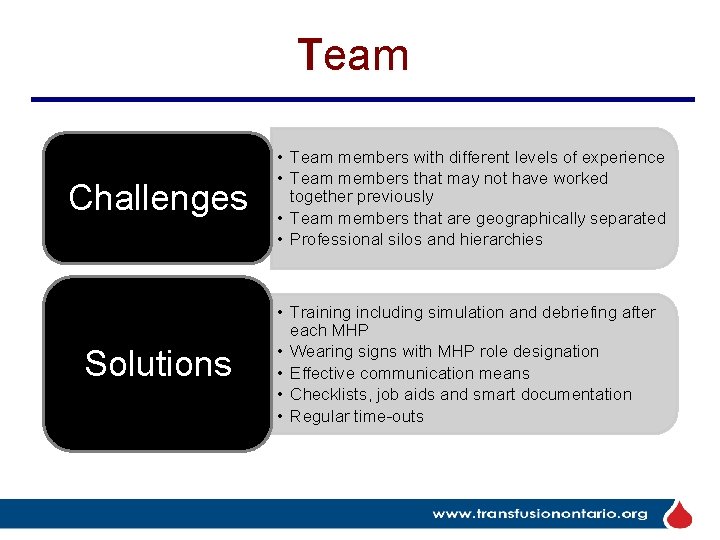
Team Challenges • Team members with different levels of experience • Team members that may not have worked together previously • Team members that are geographically separated • Professional silos and hierarchies Solutions • Training including simulation and debriefing after each MHP • Wearing signs with MHP role designation • Effective communication means • Checklists, job aids and smart documentation • Regular time-outs
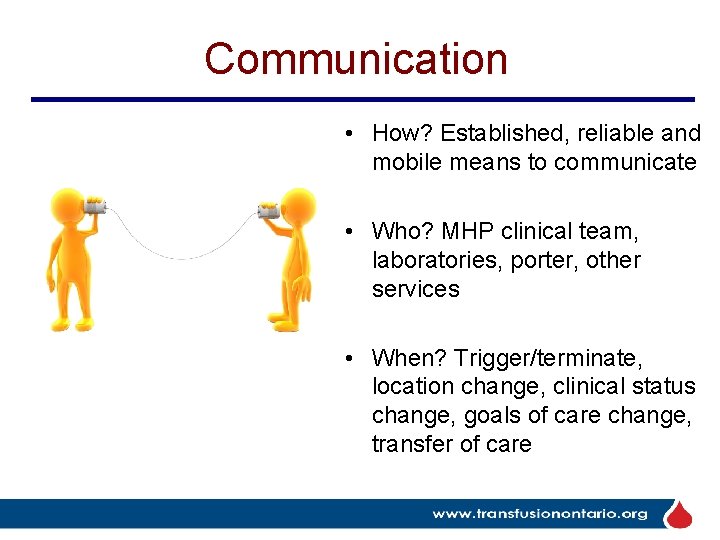
Communication • How? Established, reliable and mobile means to communicate • Who? MHP clinical team, laboratories, porter, other services • When? Trigger/terminate, location change, clinical status change, goals of care change, transfer of care
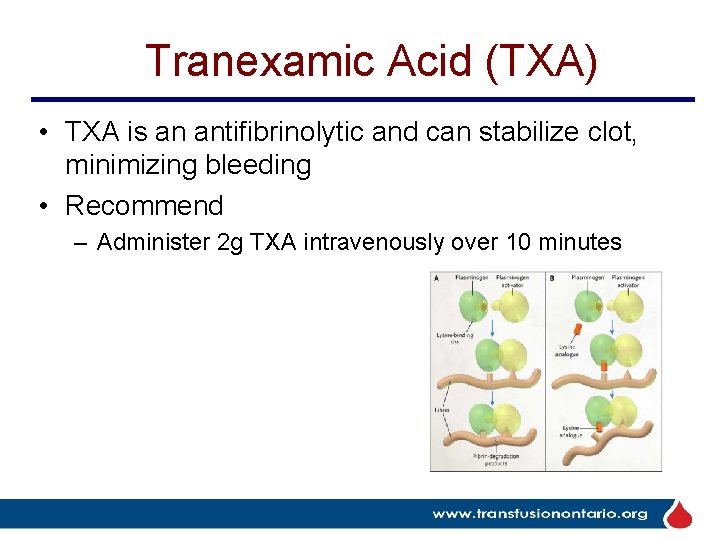
Tranexamic Acid (TXA) • TXA is an antifibrinolytic and can stabilize clot, minimizing bleeding • Recommend – Administer 2 g TXA intravenously over 10 minutes
TXA: CRASH-2 trial • N=20, 211 patients randomized to placebo vs. 1+1 gram of tranexamic acid • s. BP<90, HR>110, at risk for significant hemorrhage • Tranexamic acid reduces death rate overall (OR 0. 91) and death from bleeding (OR 0. 85) • Most effective in reducing risk of death from bleeding if given within the first hour from injury (OR 0. 68) • NNT to save 1 life = 1 in 67 (US $500) • No increase in arterial or venous thromboembolic complications Shakur H, et al. Lancet. 2010; 376: 23 -32
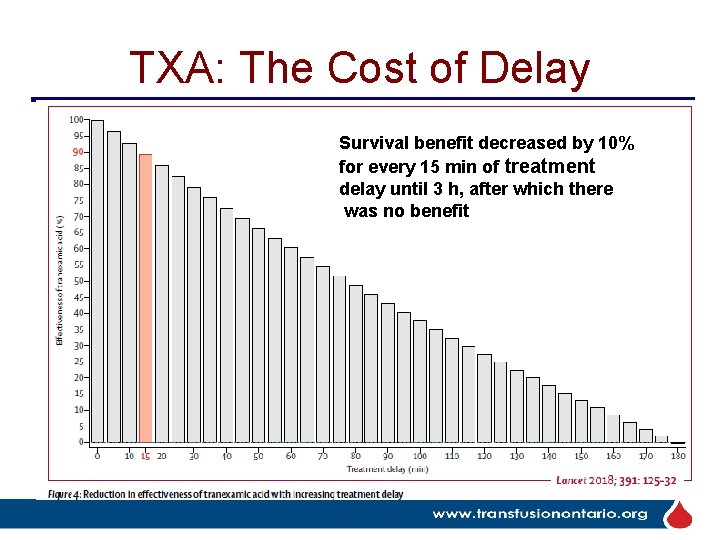
TXA: The Cost of Delay Survival benefit decreased by 10% for every 15 min of treatment delay until 3 h, after which there was no benefit
Temperature Management • Studies show that temperature is poorly monitored during pre-hospital and pre-OR phase of MHP • Temp <34°C is associated with an increase in mortality • Each 1°C drop will increase blood loss by 16% and risk of transfusion by 22% • In the pre-hospital phase, trauma patients with minor injury have a fall in temperature with passive warming (blankets) vs. a rise in temperature with resistive warming blankets Reynolds BR, et al. J Trauma Acute Care Surg. 2012; 73(2): 486 -91. Dirkmann D, et al. Anesth Analg. 2008; 106(6): 1627 -32. Kober A, et al. Mayo Clin Proc. 2001; 76(4): 369 -75. Walpoth BH, et al. N Engl J Med. 1997; 337(21): 1500 -5. Lundgren P, et al. Scand J Trauma Resusc Emerg Med. 2011; 19: 59.
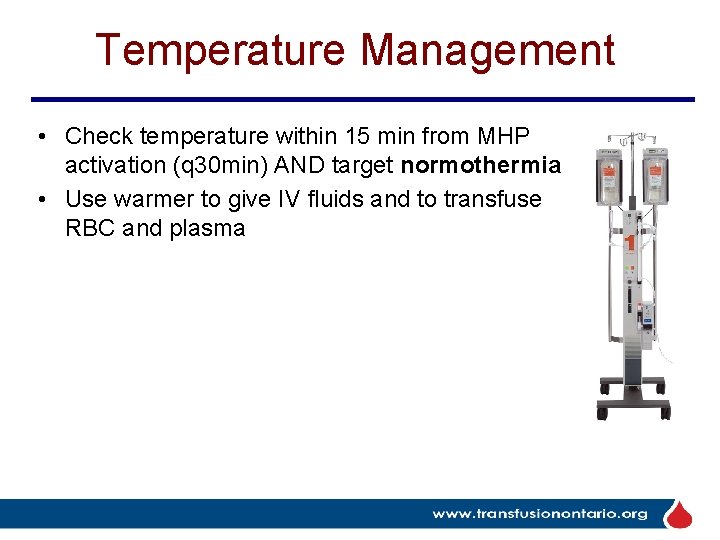
Temperature Management • Check temperature within 15 min from MHP activation (q 30 min) AND target normothermia • Use warmer to give IV fluids and to transfuse RBC and plasma
Testing • Tests to assess organ damage, adequacy of resuscitation or complications – Blood gases, lactate, troponin, electrolytes and creatinine, calcium • Tests to assess Hgb and hemostatic function – – CBC Standard: INR, a. PTT, fibrinogen Specialized: ROTEM/TEG (thromboelastometry) Consider that abnormal test results might be from anticoagulants in older patients • a. PTT up = dabigatran • INR up = warfarin, apixaban, rivaroxaban, edoxaban
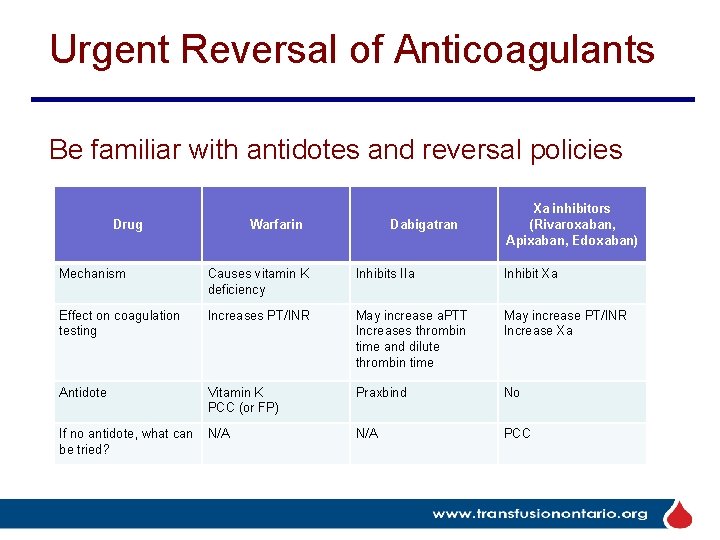
Urgent Reversal of Anticoagulants Be familiar with antidotes and reversal policies Drug Warfarin Dabigatran Xa inhibitors (Rivaroxaban, Apixaban, Edoxaban) Mechanism Causes vitamin K deficiency Inhibits IIa Inhibit Xa Effect on coagulation testing Increases PT/INR May increase a. PTT Increases thrombin time and dilute thrombin time May increase PT/INR Increase Xa Antidote Vitamin K PCC (or FP) Praxbind No If no antidote, what can be tried? N/A PCC
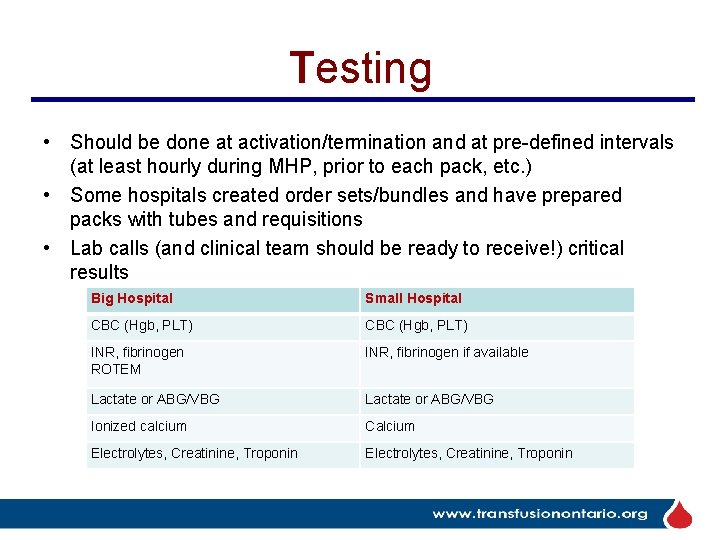
Testing • Should be done at activation/termination and at pre-defined intervals (at least hourly during MHP, prior to each pack, etc. ) • Some hospitals created order sets/bundles and have prepared packs with tubes and requisitions • Lab calls (and clinical team should be ready to receive!) critical results Big Hospital Small Hospital CBC (Hgb, PLT) INR, fibrinogen ROTEM INR, fibrinogen if available Lactate or ABG/VBG Ionized calcium Calcium Electrolytes, Creatinine, Troponin
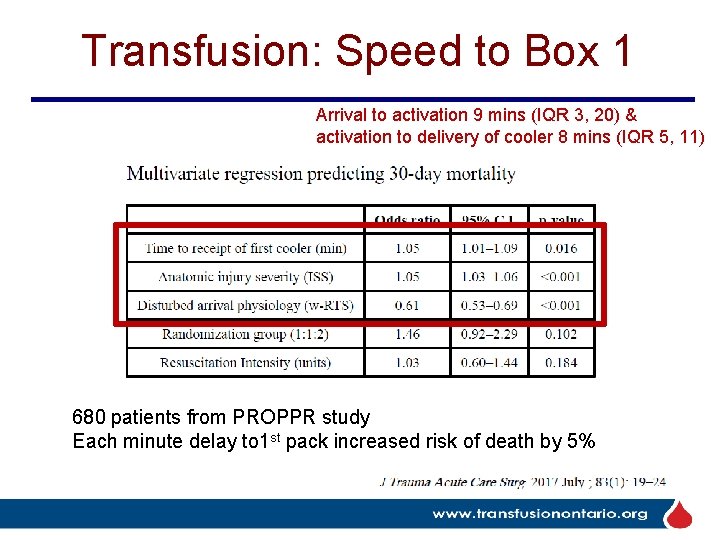
Transfusion: Speed to Box 1 Arrival to activation 9 mins (IQR 3, 20) & activation to delivery of cooler 8 mins (IQR 5, 11) 680 patients from PROPPR study Each minute delay to 1 st pack increased risk of death by 5%
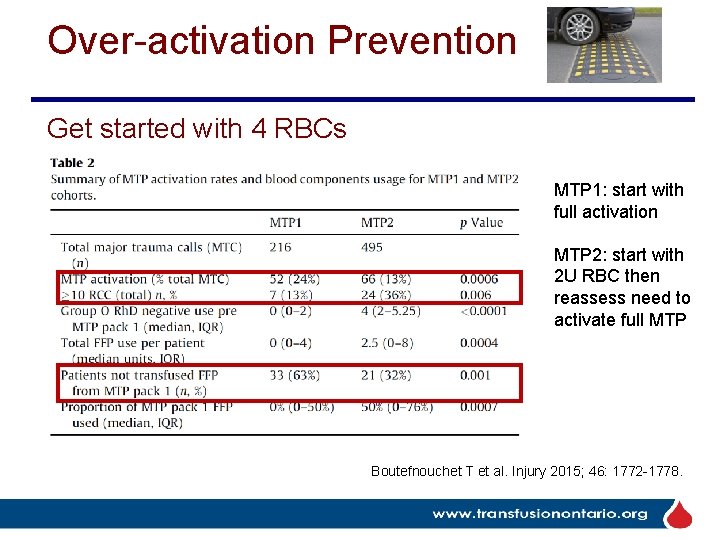
Over-activation Prevention Get started with 4 RBCs MTP 1: start with full activation MTP 2: start with 2 U RBC then reassess need to activate full MTP Boutefnouchet T et al. Injury 2015; 46: 1772 -1778.
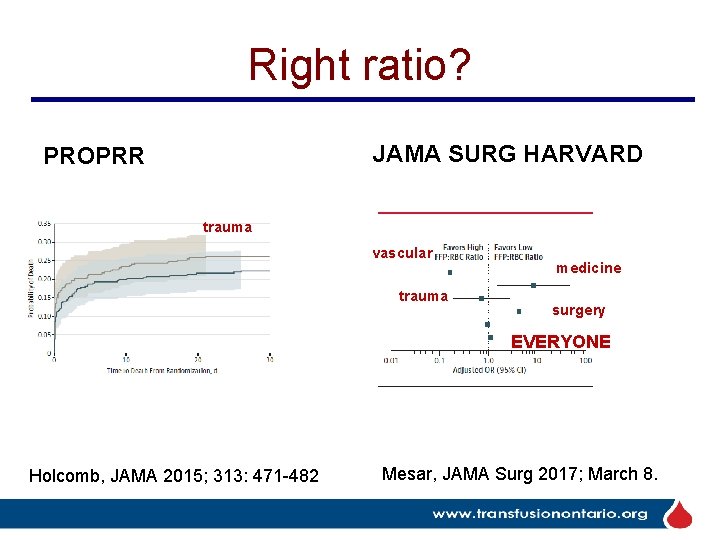
Right ratio? JAMA SURG HARVARD PROPRR trauma vascular trauma medicine surgery EVERYONE Holcomb, JAMA 2015; 313: 471 -482 Mesar, JAMA Surg 2017; March 8.
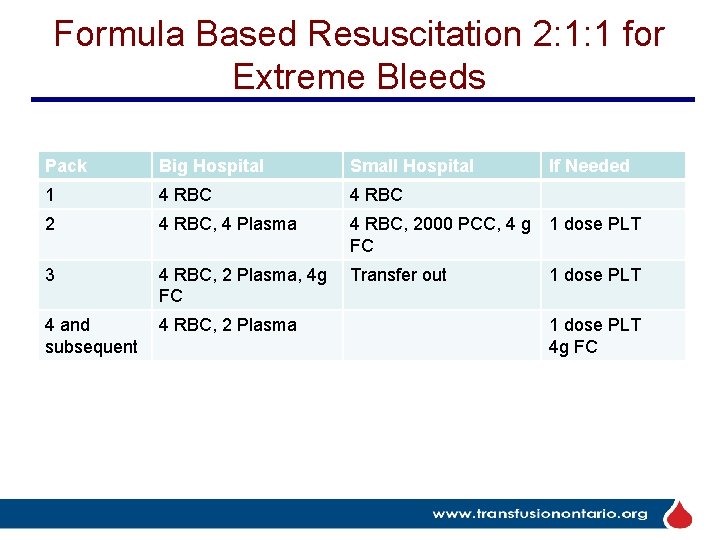
Formula Based Resuscitation 2: 1: 1 for Extreme Bleeds Pack Big Hospital Small Hospital If Needed 1 4 RBC 2 4 RBC, 4 Plasma 4 RBC, 2000 PCC, 4 g 1 dose PLT FC 3 4 RBC, 2 Plasma, 4 g FC Transfer out 4 and subsequent 4 RBC, 2 Plasma 1 dose PLT 4 g FC
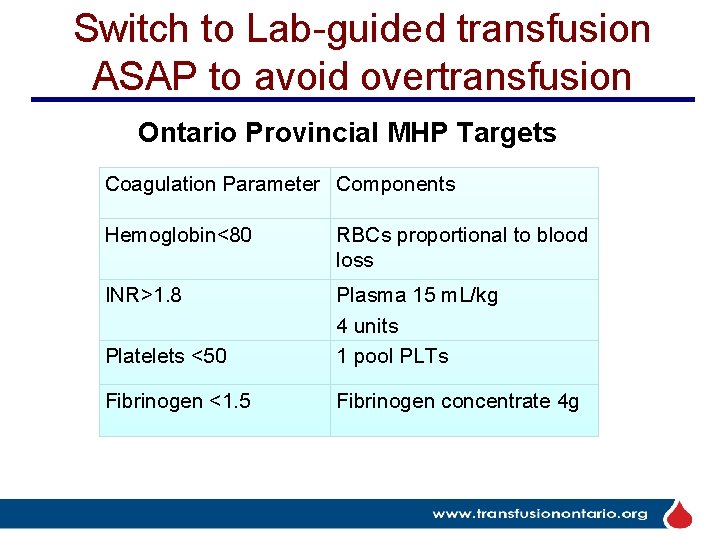
Switch to Lab-guided transfusion ASAP to avoid overtransfusion Ontario Provincial MHP Targets Coagulation Parameter Components Hemoglobin<80 RBCs proportional to blood loss INR>1. 8 Platelets <50 Plasma 15 m. L/kg 4 units 1 pool PLTs Fibrinogen <1. 5 Fibrinogen concentrate 4 g
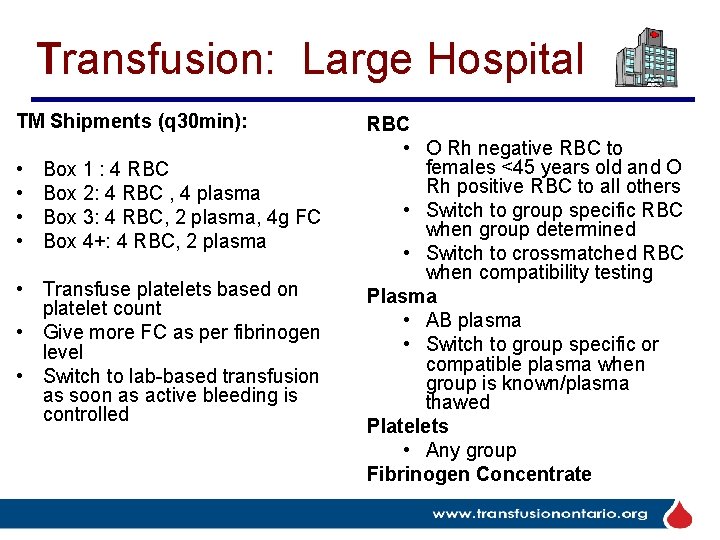
Transfusion: Large Hospital TM Shipments (q 30 min): • • Box 1 : 4 RBC Box 2: 4 RBC , 4 plasma Box 3: 4 RBC, 2 plasma, 4 g FC Box 4+: 4 RBC, 2 plasma • Transfuse platelets based on platelet count • Give more FC as per fibrinogen level • Switch to lab-based transfusion as soon as active bleeding is controlled RBC • O Rh negative RBC to females <45 years old and O Rh positive RBC to all others • Switch to group specific RBC when group determined • Switch to crossmatched RBC when compatibility testing Plasma • AB plasma • Switch to group specific or compatible plasma when group is known/plasma thawed Platelets • Any group Fibrinogen Concentrate
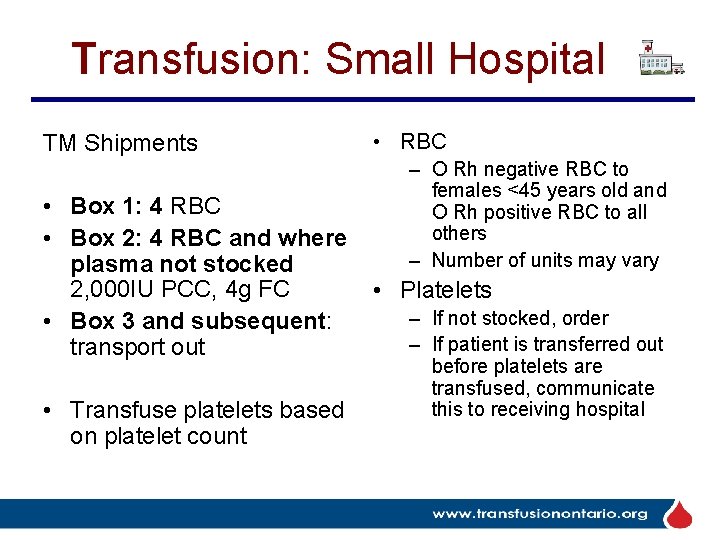
Transfusion: Small Hospital TM Shipments • Box 1: 4 RBC • Box 2: 4 RBC and where plasma not stocked 2, 000 IU PCC, 4 g FC • Box 3 and subsequent: transport out • Transfuse platelets based on platelet count • RBC – O Rh negative RBC to females <45 years old and O Rh positive RBC to all others – Number of units may vary • Platelets – If not stocked, order – If patient is transferred out before platelets are transfused, communicate this to receiving hospital
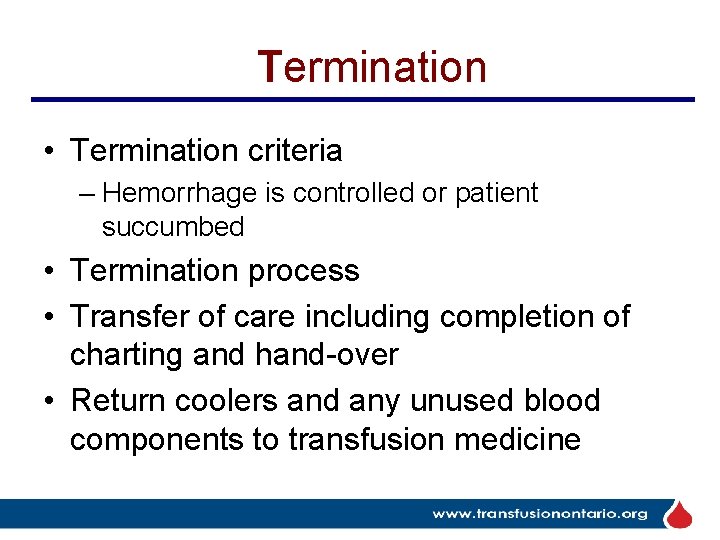
Termination • Termination criteria – Hemorrhage is controlled or patient succumbed • Termination process • Transfer of care including completion of charting and hand-over • Return coolers and any unused blood components to transfusion medicine
Termination • Inform patient and/or their substitute decision maker about MHP • Discuss risks of massive transfusion – Acute • Common: febrile, allergic, TACO, hyperkalemia • Uncommon: TRALI – Delayed • RBC alloimmunization: Women of child-bearing potential should undergo red cell antibody screening at 6 weeks and/or 6 months after transfusion
Training • Training and competency maintenance or assessment – Didactic, case-based, simulation – Mock codes/drills • In situ mock codes significantly improve response times, increase staff confidence levels and are correlated with improved patient survival Herbers & Heaser Am J Crti Care 2016; Andreatta et al Pediatr Crit Care Med 2011; Oldroyd et al BMC Res Notes 2016
Tracking Performance • Tracking of performance – Audits, mortality and morbidity rounds – Utilization review at a multidisciplinary committee – Debriefing, huddle • Debriefing improves psychological well-being and communication after trauma resuscitation • Structured audiovisual interdisciplinary debriefing improves patient survival • Benchmarking – Ontario Trauma Registry, Ontario MHP quality indicators Garden et al Anaesth Intensive Care 2015; Berg et al J Trauma Nurs 2014; Wolfe et al Crit Care Med 2014
Why Tracking Performance is Important? • Unfortunately, compliance with MHPs is not optimal – Canadian study: • Bawazeer et al: 1. 4 -94. 5% for various interventions – American studies • Cotton et al: 27% overall protocol compliance • Plackett et al: 27 -97% for various interventions – Significant variability between surgeons • Full compliance is an independent predictor of survival • We must strive to do better Bawazeer et al Injury 2015; Cotton et al J Trauma 2009; Plackett et al J Trauma Acute Care Surg 2017
Questions? For more information on the Provincial MHP or companion toolkit to aid hospitals in implementation of the MHP please visit: www. transfusionontario. org or contact Stephanie. cope@sunnybrook. ca
- Slides: 36