
Ontario Regions Integrated Service Delivery Network Leading People

- Slides: 31
Ontario Region’s Integrated Service Delivery Network Leading People for Results. Study Tour University of Ottawa May 9, 2018
SERVICE CANADA ONTARIO REGION 2
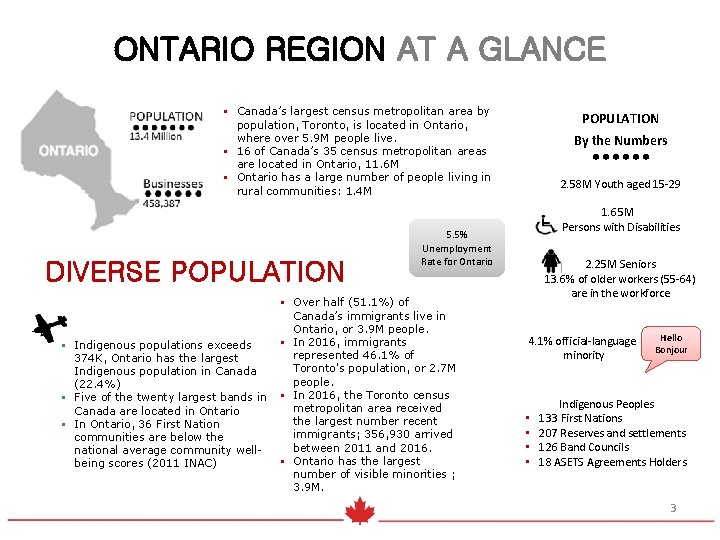
ONTARIO REGION AT A GLANCE § Canada’s largest census metropolitan area by population, Toronto, is located in Ontario, where over 5. 9 M people live. § 16 of Canada’s 35 census metropolitan areas are located in Ontario, 11. 6 M § Ontario has a large number of people living in rural communities: 1. 4 M DIVERSE POPULATION § Indigenous populations exceeds 374 K, Ontario has the largest Indigenous population in Canada (22. 4%) § Five of the twenty largest bands in Canada are located in Ontario § In Ontario, 36 First Nation communities are below the national average community wellbeing scores (2011 INAC) POPULATION By the Numbers • • • 2. 58 M Youth aged 15 -29 1. 65 M Persons with Disabilities 5. 5% Unemployment Rate for Ontario § Over half (51. 1%) of Canada’s immigrants live in Ontario, or 3. 9 M people. § In 2016, immigrants represented 46. 1% of Toronto's population, or 2. 7 M people. § In 2016, the Toronto census metropolitan area received the largest number recent immigrants; 356, 930 arrived between 2011 and 2016. § Ontario has the largest number of visible minorities ; 3. 9 M. 2. 25 M Seniors 13. 6% of older workers (55 -64) are in the workforce 4. 1% official-language minority • • Hello Bonjour Indigenous Peoples 133 First Nations 207 Reserves and settlements 126 Band Councils 18 ASETS Agreements Holders 3
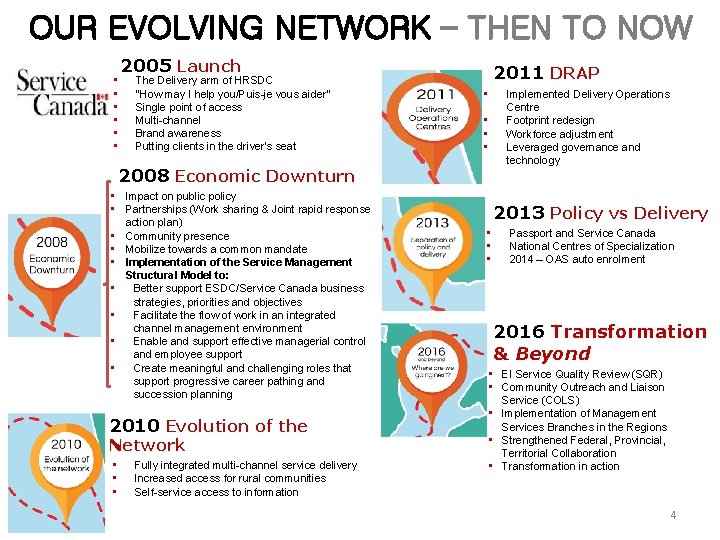
OUR EVOLVING NETWORK – THEN TO NOW • • • 2005 Launch The Delivery arm of HRSDC “How may I help you/Puis-je vous aider’’ Single point of access Multi-channel Brand awareness Putting clients in the driver’s seat 2011 DRAP • Implemented Delivery Operations Centre Footprint redesign Workforce adjustment Leveraged governance and technology • • • 2008 Economic Downturn • Impact on public policy • Partnerships (Work sharing & Joint rapid response action plan) • Community presence • Mobilize towards a common mandate • Implementation of the Service Management Structural Model to: • Better support ESDC/Service Canada business strategies, priorities and objectives • Facilitate the flow of work in an integrated channel management environment • Enable and support effective managerial control and employee support • Create meaningful and challenging roles that support progressive career pathing and succession planning 2010 Evolution of the Network • • • Fully integrated multi-channel service delivery Increased access for rural communities Self-service access to information 2013 Policy vs Delivery • • • Passport and Service Canada National Centres of Specialization 2014 – OAS auto enrolment 2016 Transformation & Beyond • EI Service Quality Review (SQR) • Community Outreach and Liaison Service (COLS) • Implementation of Management Services Branches in the Regions • Strengthened Federal, Provincial, Territorial Collaboration • Transformation in action 4
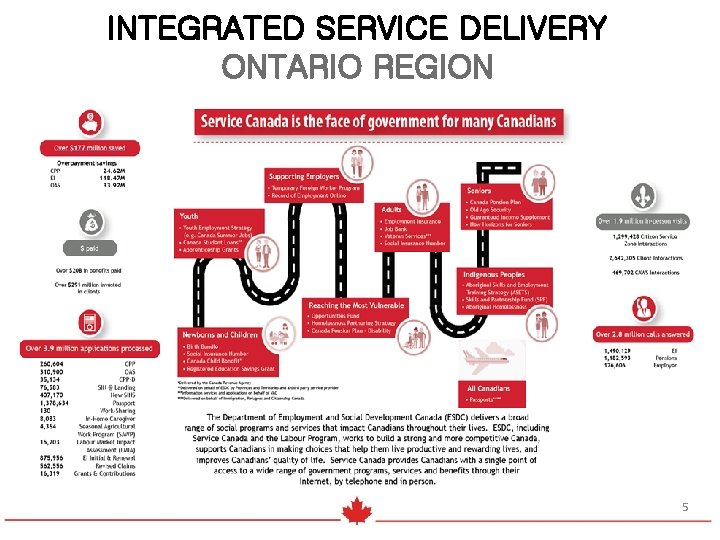
INTEGRATED SERVICE DELIVERY ONTARIO REGION 5 5
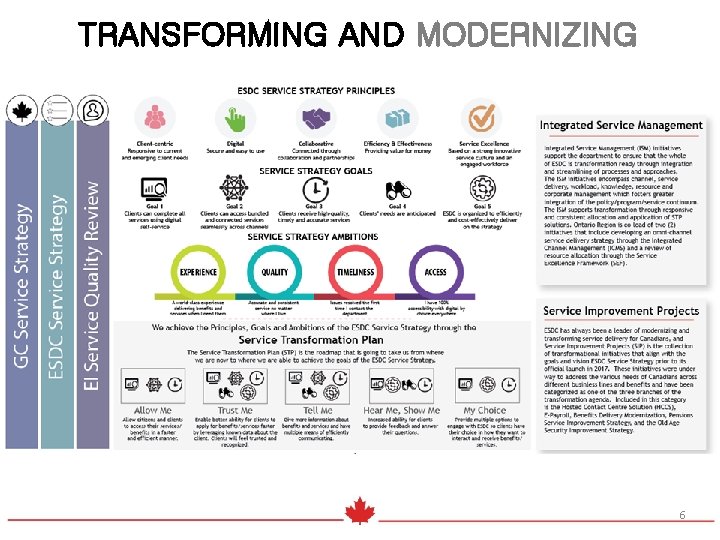
TRANSFORMING AND MODERNIZING 6
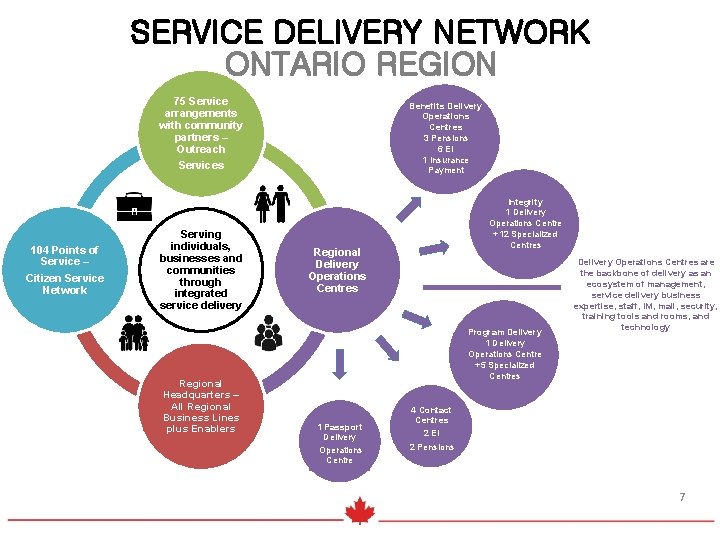
SERVICE DELIVERY NETWORK ONTARIO REGION 75 Service arrangements with community partners – Outreach Services 104 Points of Service – Citizen Service Network Serving individuals, businesses and communities through integrated service delivery Regional Headquarters – All Regional Business Lines plus Enablers Benefits Delivery Operations Centres 3 Pensions 6 EI 1 Insurance Payment Integrity 1 Delivery Operations Centre +12 Specialized Centres Regional Delivery Operations Centres Program Delivery 1 Delivery Operations Centre +5 Specialized Centres 1 Passport Delivery Operations Centres are the backbone of delivery as an ecosystem of management, service delivery business expertise, staff, IM, mail, security, training tools and rooms, and technology 4 Contact Centres 2 EI 2 Pensions 7
SERVICE CANADA ONTARIO REGION PEOPLE SERVING PEOPLE 8
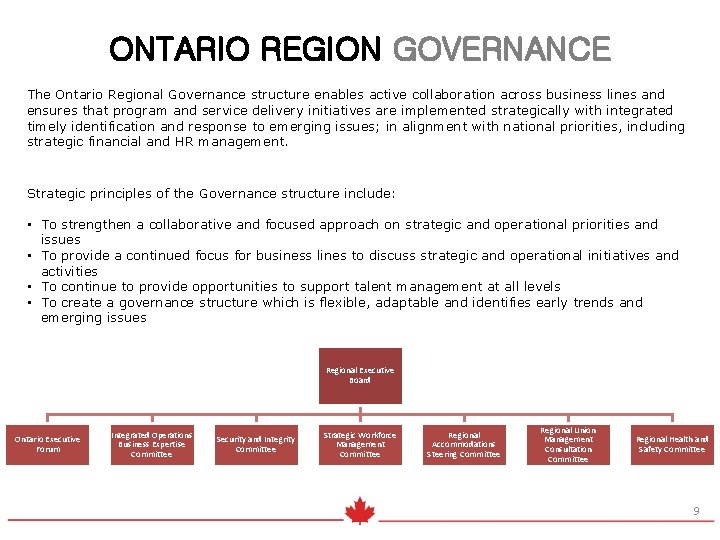
ONTARIO REGION GOVERNANCE The Ontario Regional Governance structure enables active collaboration across business lines and ensures that program and service delivery initiatives are implemented strategically with integrated timely identification and response to emerging issues; in alignment with national priorities, including strategic financial and HR management. Strategic principles of the Governance structure include: • To strengthen a collaborative and focused approach on strategic and operational priorities and issues • To provide a continued focus for business lines to discuss strategic and operational initiatives and activities • To continue to provide opportunities to support talent management at all levels Regional Executive • To create a governance structure which is flexible, adaptable and identifies early trends and Board emerging issues Regional Executive Board Ontario Executive Forum Integrated Operations Business Expertise Committee Security and Integrity Committee Strategic Workforce Management Committee Regional Accommodations Steering Committee Regional Union Management Consultation Committee Regional Health and Safety Committee 9
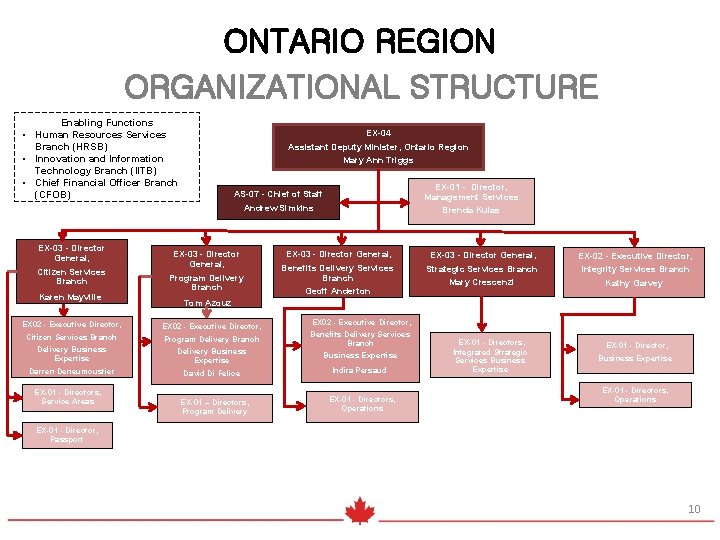
ONTARIO REGION ORGANIZATIONAL STRUCTURE Enabling Functions • Human Resources Services Branch (HRSB) • Innovation and Information Technology Branch (IITB) • Chief Financial Officer Branch (CFOB) EX-03 - Director General, Citizen Services Branch Karen Mayville EX 02 - Executive Director, EX-04 Assistant Deputy Minister, Ontario Region Mary Ann Triggs AS-07 - Chief of Staff EX-01 - Director, Management Services Andrew Simkins Brenda Kulas EX-03 - Director General, Program Delivery Branch EX-03 - Director General, EX-02 - Executive Director, Strategic Services Branch Integrity Services Branch Mary Crescenzi Kathy Garvey Geoff Anderton Tom Azouz EX 02 - Executive Director, Citizen Services Branch Program Delivery Branch Delivery Business Expertise Darren Deneumoustier David Di Felice EX-01 - Directors, Service Areas EX-03 - Director General, Benefits Delivery Services Branch EX-01 – Directors, Program Delivery EX 02 - Executive Director, Benefits Delivery Services Branch Business Expertise Indira Persaud EX-01 - Directors, Operations EX-01 - Directors, Integrated Strategic Services Business Expertise EX-01 - Director, Business Expertise EX-01 - Directors, Operations EX-01 - Director, Passport 10
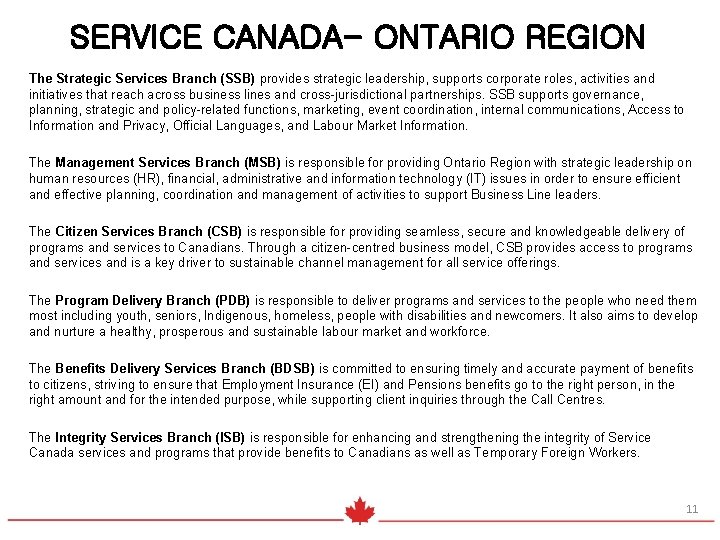
SERVICE CANADA- ONTARIO REGION The Strategic Services Branch (SSB) provides strategic leadership, supports corporate roles, activities and initiatives that reach across business lines and cross-jurisdictional partnerships. SSB supports governance, planning, strategic and policy-related functions, marketing, event coordination, internal communications, Access to Information and Privacy, Official Languages, and Labour Market Information. The Management Services Branch (MSB) is responsible for providing Ontario Region with strategic leadership on human resources (HR), financial, administrative and information technology (IT) issues in order to ensure efficient and effective planning, coordination and management of activities to support Business Line leaders. The Citizen Services Branch (CSB) is responsible for providing seamless, secure and knowledgeable delivery of programs and services to Canadians. Through a citizen-centred business model, CSB provides access to programs and services and is a key driver to sustainable channel management for all service offerings. The Program Delivery Branch (PDB) is responsible to deliver programs and services to the people who need them most including youth, seniors, Indigenous, homeless, people with disabilities and newcomers. It also aims to develop and nurture a healthy, prosperous and sustainable labour market and workforce. The Benefits Delivery Services Branch (BDSB) is committed to ensuring timely and accurate payment of benefits to citizens, striving to ensure that Employment Insurance (EI) and Pensions benefits go to the right person, in the right amount and for the intended purpose, while supporting client inquiries through the Call Centres. The Integrity Services Branch (ISB) is responsible for enhancing and strengthening the integrity of Service Canada services and programs that provide benefits to Canadians as well as Temporary Foreign Workers. 11
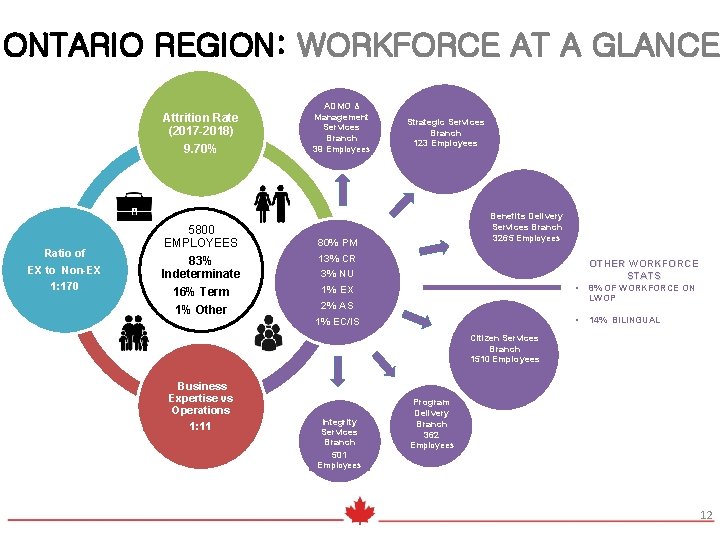
ONTARIO REGION: WORKFORCE AT A GLANCE Attrition Rate (2017 -2018) 9. 70% Ratio of EX to Non-EX 1: 170 5800 EMPLOYEES 83% Indeterminate 16% Term 1% Other ADMO & Management Services Branch 39 Employees Strategic Services Branch 123 Employees Benefits Delivery Services Branch 3265 Employees 80% PM 13% CR 3% NU 1% EX 2% AS 1% EC/IS OTHER WORKFORCE STATS • 8% OF WORKFORCE ON LWOP • 14% BILINGUAL Citizen Services Branch 1510 Employees Business Expertise vs Operations 1: 11 Integrity Services Branch 501 Employees Program Delivery Branch 362 Employees 12
LABOUR RELATIONS @ A GLANCE • Challenges of the world of work • Union-management relationships • Canada Employment and Immigration Union (CEIU) • Union of National Employees (UNE) • Professional Institute of the Public Service of Canada (PIPSC) • Canadian Association of Professional Employees (CAPE) 13
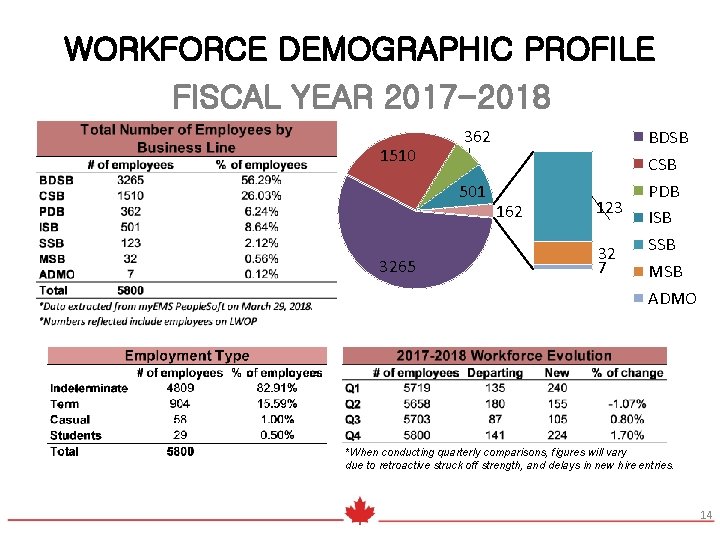
WORKFORCE DEMOGRAPHIC PROFILE FISCAL YEAR 2017 -2018 1510 362 501 3265 162 123 32 7 BDSB CSB PDB ISB SSB MSB ADMO *When conducting quarterly comparisons, figures will vary due to retroactive struck off strength, and delays in new hire entries. 14
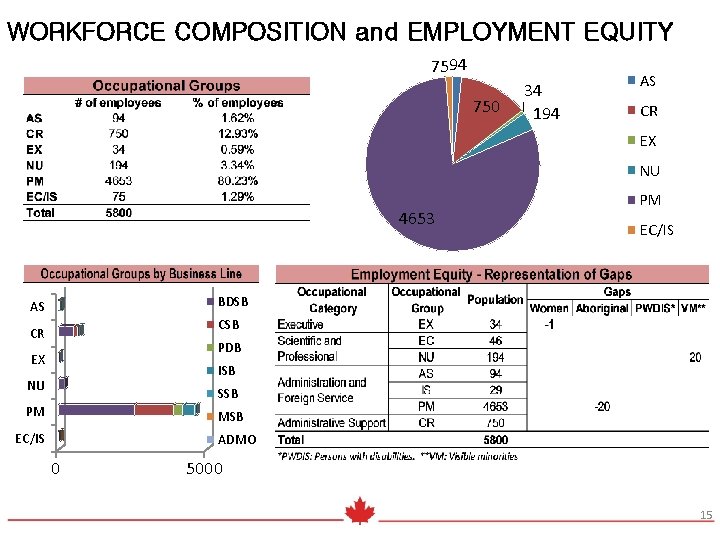
WORKFORCE COMPOSITION and EMPLOYMENT EQUITY 7594 750 34 194 AS CR EX NU 4653 PM EC/IS BDSB AS CSB CR PDB EX ISB NU SSB PM MSB EC/IS ADMO 0 5000 15
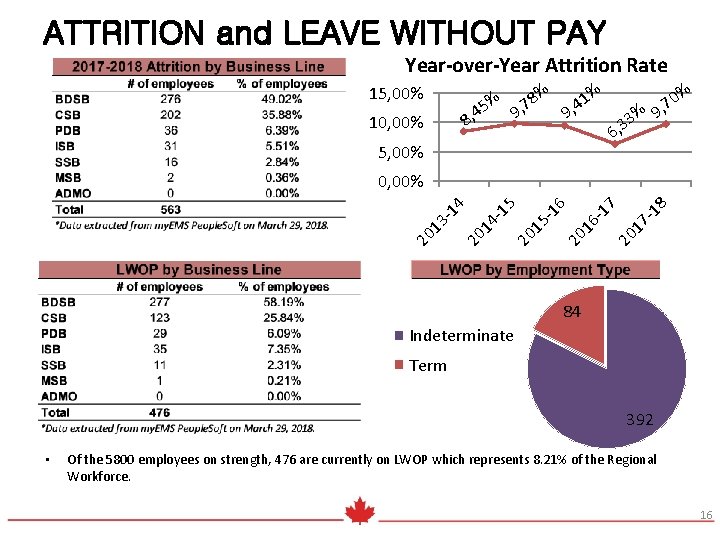
ATTRITION and LEAVE WITHOUT PAY Year-over-Year Attrition Rate % % % 0 8 1 % 7 7 4 5 9, 9, % 9, 3 8, 4 6, 3 15, 00% 10, 00% 5, 00% -1 8 20 17 -1 7 20 16 -1 6 20 15 5 -1 14 20 20 13 -1 4 0, 00% 84 Indeterminate Term 392 • Of the 5800 employees on strength, 476 are currently on LWOP which represents 8. 21% of the Regional Workforce. 16
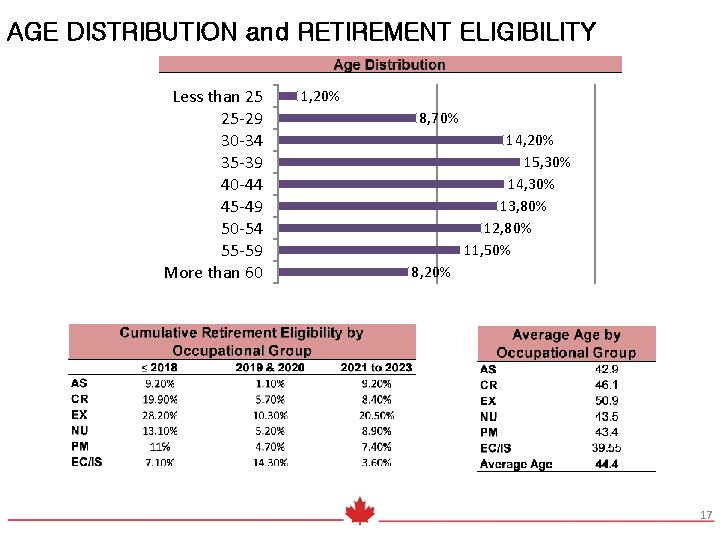
AGE DISTRIBUTION and RETIREMENT ELIGIBILITY Less than 25 25 -29 30 -34 35 -39 40 -44 45 -49 50 -54 55 -59 More than 60 1, 20% 8, 70% 14, 20% 15, 30% 14, 30% 13, 80% 12, 80% 11, 50% 8, 20% 17
SERVICE CANADA ONTARIO REGION STRATEGIC & INTEGRATED WORKFORCE MANAGEMENT 18
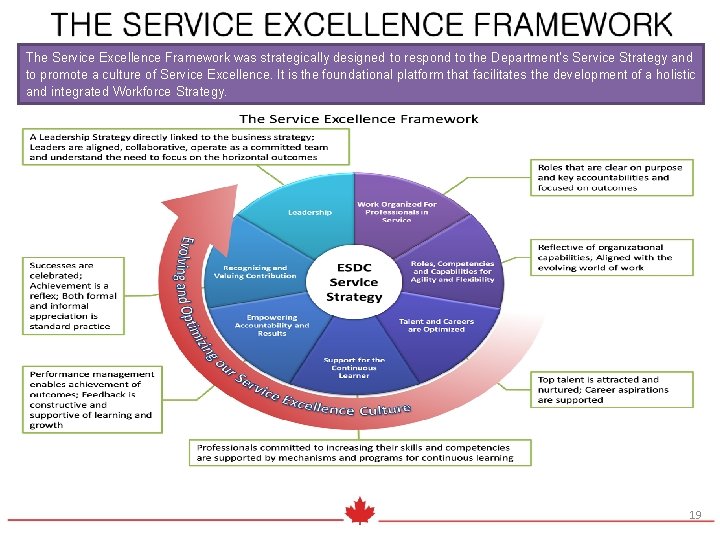
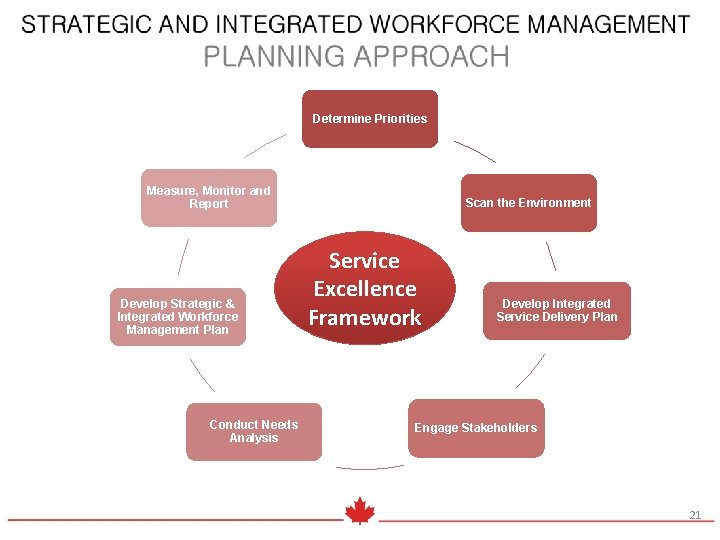
The Service Excellence Framework was strategically designed to respond to the Department’s Service Strategy and to promote a culture of Service Excellence. It is the foundational platform that facilitates the development of a holistic and integrated Workforce Strategy. 19
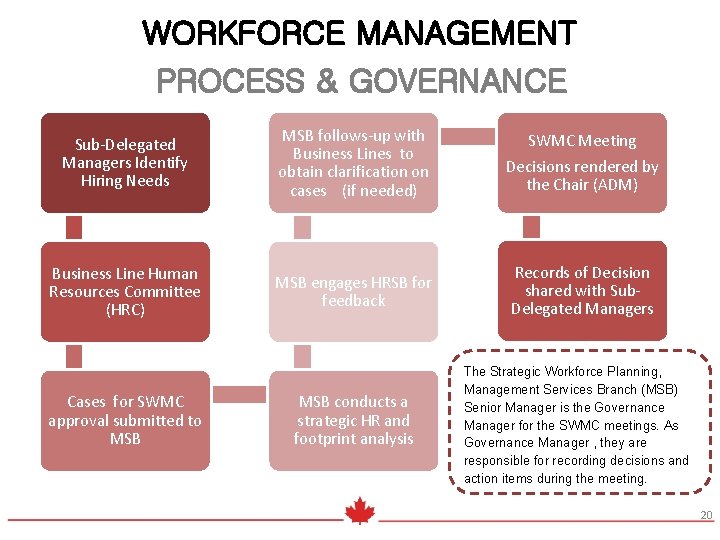
WORKFORCE MANAGEMENT PROCESS & GOVERNANCE Sub-Delegated Managers Identify Hiring Needs MSB follows-up with Business Lines to obtain clarification on cases (if needed) SWMC Meeting Decisions rendered by the Chair (ADM) Business Line Human Resources Committee (HRC) MSB engages HRSB for feedback Records of Decision shared with Sub. Delegated Managers Cases for SWMC approval submitted to MSB conducts a strategic HR and footprint analysis The Strategic Workforce Planning, Management Services Branch (MSB) Senior Manager is the Governance Manager for the SWMC meetings. As Governance Manager , they are responsible for recording decisions and action items during the meeting. 20
Determine Priorities Measure, Monitor and Report Develop Strategic & Integrated Workforce Management Plan Conduct Needs Analysis Scan the Environment Service Excellence Framework Develop Integrated Service Delivery Plan Engage Stakeholders 21
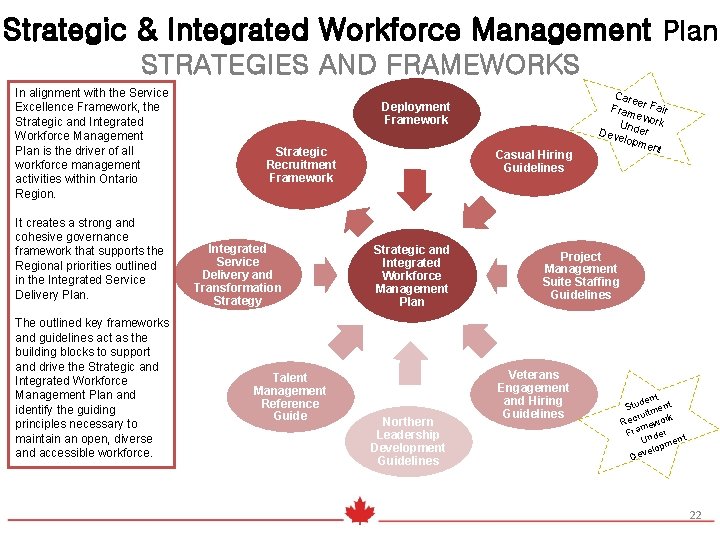
Strategic & Integrated Workforce Management Plan STRATEGIES AND FRAMEWORKS In alignment with the Service Excellence Framework, the Strategic and Integrated Workforce Management Plan is the driver of all workforce management activities within Ontario Region. It creates a strong and cohesive governance framework that supports the Regional priorities outlined in the Integrated Service Delivery Plan. The outlined key frameworks and guidelines act as the building blocks to support and drive the Strategic and Integrated Workforce Management Plan and identify the guiding principles necessary to maintain an open, diverse and accessible workforce. Deployment Framework Strategic Recruitment Framework Integrated Service Delivery and Transformation Strategy Talent Management Reference Guide Casual Hiring Guidelines Strategic and Integrated Workforce Management Plan Northern Leadership Development Guidelines Care e Fram r Fair ewo rk Un Deve der lopm ent Project Management Suite Staffing Guidelines Veterans Engagement and Hiring Guidelines t den Stu tment rui Rec ework m Fra nder nt U pme o l e Dev 22
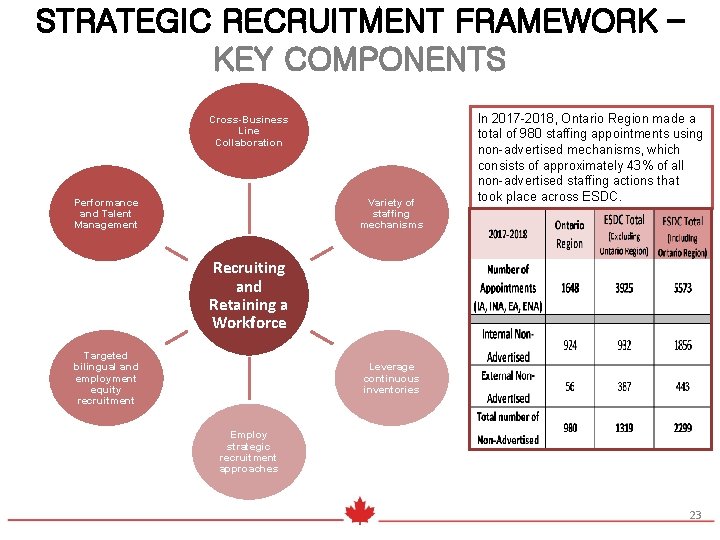
STRATEGIC RECRUITMENT FRAMEWORK – KEY COMPONENTS Cross-Business Line Collaboration Performance and Talent Management Variety of staffing mechanisms In 2017 -2018, Ontario Region made a total of 980 staffing appointments using non-advertised mechanisms, which consists of approximately 43% of all non-advertised staffing actions that took place across ESDC. Recruiting and Retaining a Workforce Targeted bilingual and employment equity recruitment Leverage continuous inventories Employ strategic recruitment approaches 23
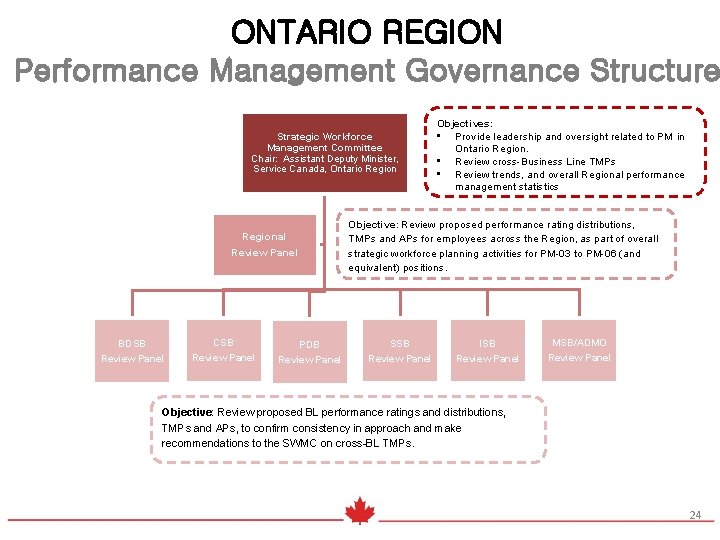
ONTARIO REGION Performance Management Governance Structure Strategic Workforce Management Committee Chair: Assistant Deputy Minister, Service Canada, Ontario Regional Review Panel BDSB Review Panel CSB Review Panel PDB Review Panel Objectives: • Provide leadership and oversight related to PM in Ontario Region. • Review cross-Business Line TMPs • Review trends, and overall Regional performance management statistics Objective: Review proposed performance rating distributions, TMPs and APs for employees across the Region, as part of overall strategic workforce planning activities for PM-03 to PM-06 (and equivalent) positions. SSB Review Panel ISB Review Panel MSB/ADMO Review Panel Objective: Review proposed BL performance ratings and distributions, TMPs and APs, to confirm consistency in approach and make recommendations to the SWMC on cross-BL TMPs. 24
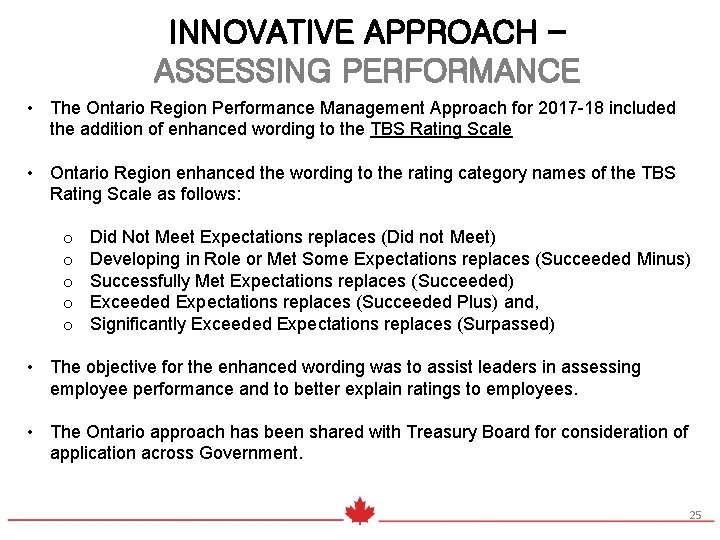
INNOVATIVE APPROACH – ASSESSING PERFORMANCE • The Ontario Region Performance Management Approach for 2017 -18 included the addition of enhanced wording to the TBS Rating Scale • Ontario Region enhanced the wording to the rating category names of the TBS Rating Scale as follows: o o o Did Not Meet Expectations replaces (Did not Meet) Developing in Role or Met Some Expectations replaces (Succeeded Minus) Successfully Met Expectations replaces (Succeeded) Exceeded Expectations replaces (Succeeded Plus) and, Significantly Exceeded Expectations replaces (Surpassed) • The objective for the enhanced wording was to assist leaders in assessing employee performance and to better explain ratings to employees. • The Ontario approach has been shared with Treasury Board for consideration of application across Government. 25
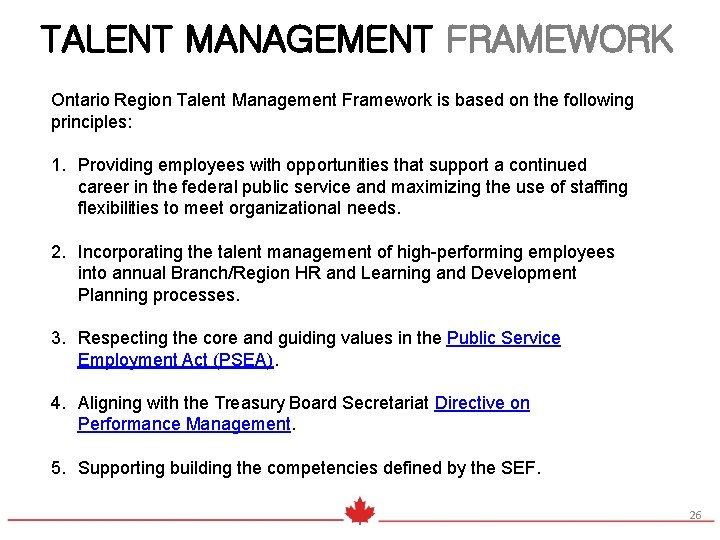
TALENT MANAGEMENT FRAMEWORK Ontario Region Talent Management Framework is based on the following principles: 1. Providing employees with opportunities that support a continued career in the federal public service and maximizing the use of staffing flexibilities to meet organizational needs. 2. Incorporating the talent management of high-performing employees into annual Branch/Region HR and Learning and Development Planning processes. 3. Respecting the core and guiding values in the Public Service Employment Act (PSEA). 4. Aligning with the Treasury Board Secretariat Directive on Performance Management. 5. Supporting building the competencies defined by the SEF. 26
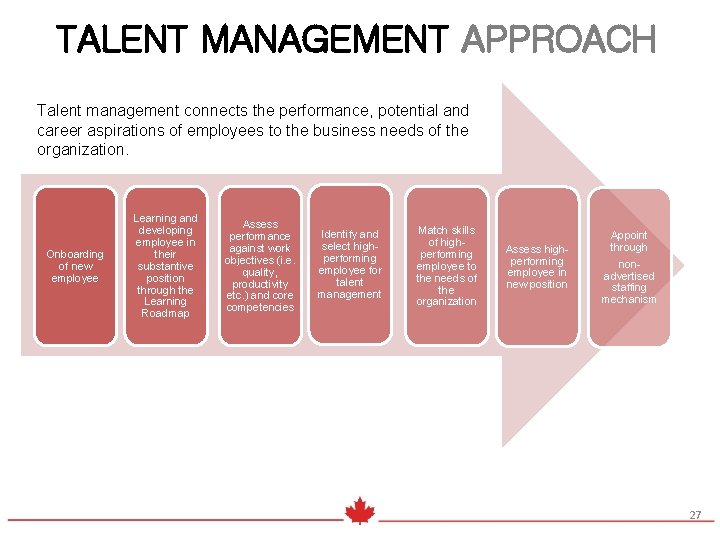
TALENT MANAGEMENT APPROACH Talent management connects the performance, potential and career aspirations of employees to the business needs of the organization. Onboarding of new employee Learning and developing employee in their substantive position through the Learning Roadmap Assess performance against work objectives (i. e. quality, productivity etc. ) and core competencies Identify and select highperforming employee for talent management Match skills of highperforming employee to the needs of the organization Assess highperforming employee in new position Appoint through nonadvertised staffing mechanism 27
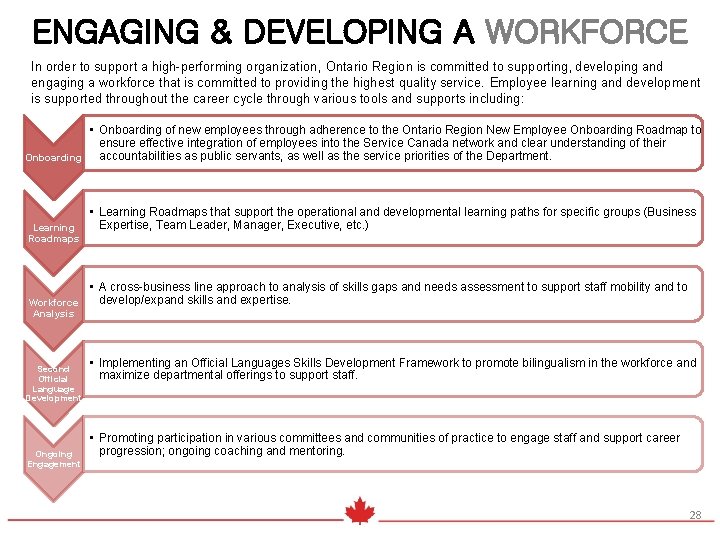
ENGAGING & DEVELOPING A WORKFORCE In order to support a high-performing organization, Ontario Region is committed to supporting, developing and engaging a workforce that is committed to providing the highest quality service. Employee learning and development is supported throughout the career cycle through various tools and supports including: Onboarding Learning Roadmaps Workforce Analysis Second Official Language Development Ongoing Engagement • Onboarding of new employees through adherence to the Ontario Region New Employee Onboarding Roadmap to ensure effective integration of employees into the Service Canada network and clear understanding of their accountabilities as public servants, as well as the service priorities of the Department. • Learning Roadmaps that support the operational and developmental learning paths for specific groups (Business Expertise, Team Leader, Manager, Executive, etc. ) • A cross-business line approach to analysis of skills gaps and needs assessment to support staff mobility and to develop/expand skills and expertise. • Implementing an Official Languages Skills Development Framework to promote bilingualism in the workforce and maximize departmental offerings to support staff. • Promoting participation in various committees and communities of practice to engage staff and support career progression; ongoing coaching and mentoring. 28
REAL LIFE EVENTS THAT SHAPED OUR WORLD DISCUSSION SCENARIOS DEFICIT REDUCTION ACTION PLAN GTA STRATEGY – HARMONIZATION OF SITES 29
CHALLENGES OF THE FUTURE • Demographic composition of the workforce • Evolving nature of work • Competencies required vs knowledge workers • Transformation in action • Continue day to day as we are building the future 30
THANK YOU 31