
Onsite Reviewer Training 2016 Standards Elements CAPTE Objectives
On-site Reviewer Training 2016 Standards & Elements CAPTE
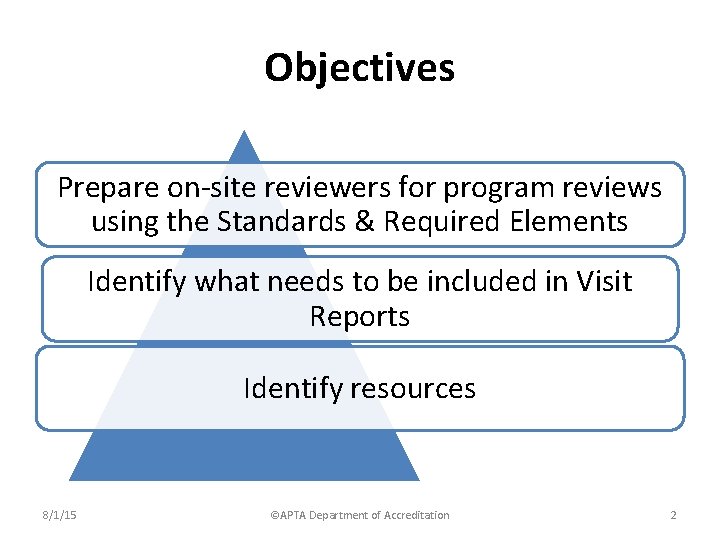
Objectives Prepare on-site reviewers for program reviews using the Standards & Required Elements Identify what needs to be included in Visit Reports Identify resources 8/1/15 ©APTA Department of Accreditation 2
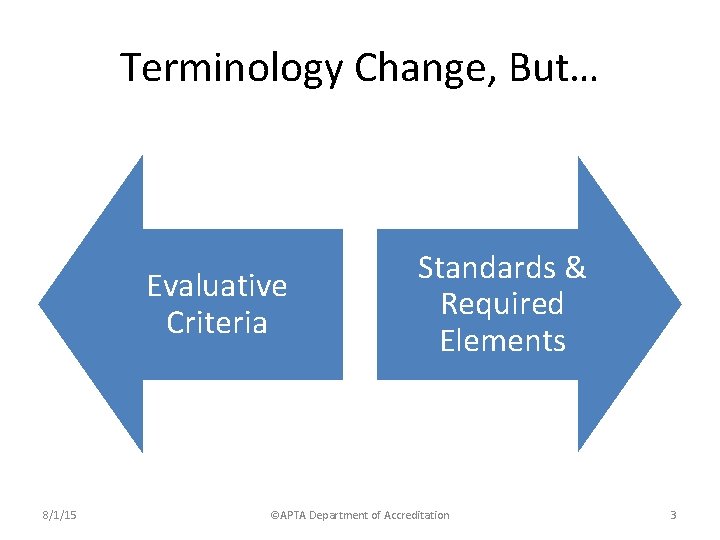
Terminology Change, But… Evaluative Criteria 8/1/15 Standards & Required Elements ©APTA Department of Accreditation 3
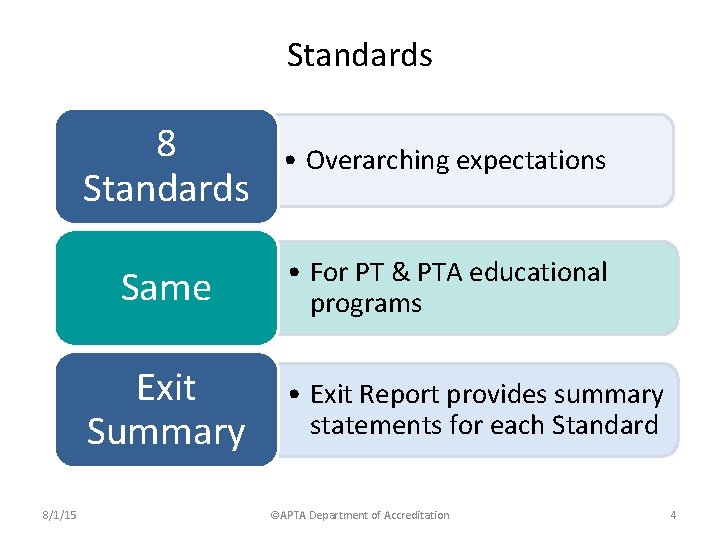
Standards 8 Standards • Overarching expectations Same • For PT & PTA educational programs Exit Summary 8/1/15 • Exit Report provides summary statements for each Standard ©APTA Department of Accreditation 4

Required Elements Equivalent PTA/PT Evidence Lists 8/1/15 • To current criteria • Many are now the same • Different where applicable • Requested information ©APTA Department of Accreditation 5
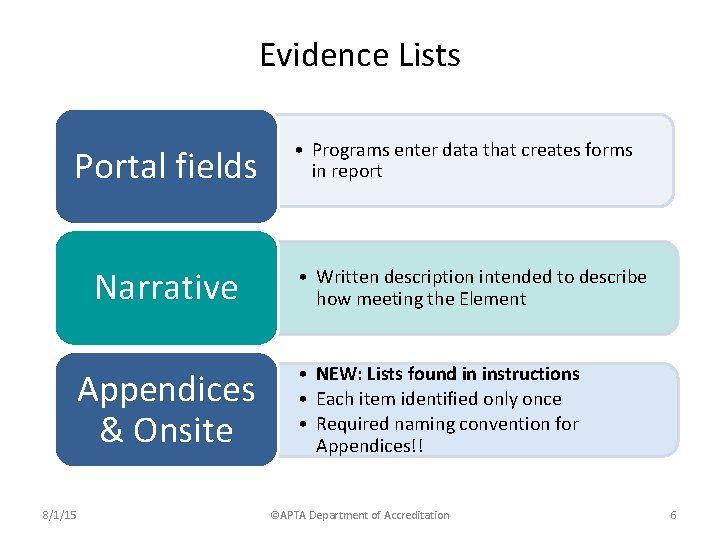
Evidence Lists Portal fields Narrative Appendices & Onsite 8/1/15 • Programs enter data that creates forms in report • Written description intended to describe how meeting the Element • NEW: Lists found in instructions • Each item identified only once • Required naming convention for Appendices!! ©APTA Department of Accreditation 6
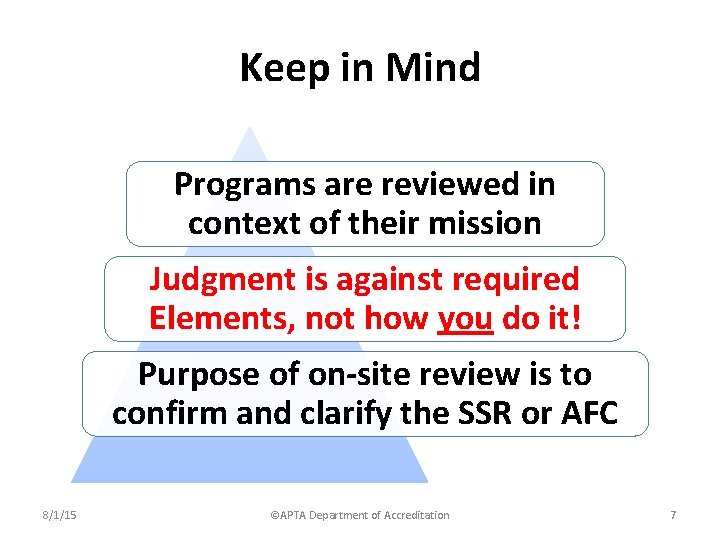
Keep in Mind Programs are reviewed in context of their mission Judgment is against required Elements, not how you do it! Purpose of on-site review is to confirm and clarify the SSR or AFC 8/1/15 ©APTA Department of Accreditation 7
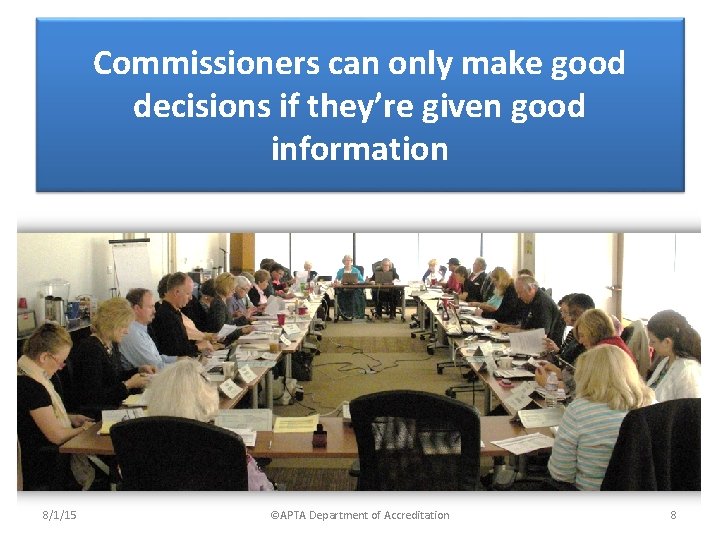
Commissioners can only make good decisions if they’re given good information 8/1/15 ©APTA Department of Accreditation 8
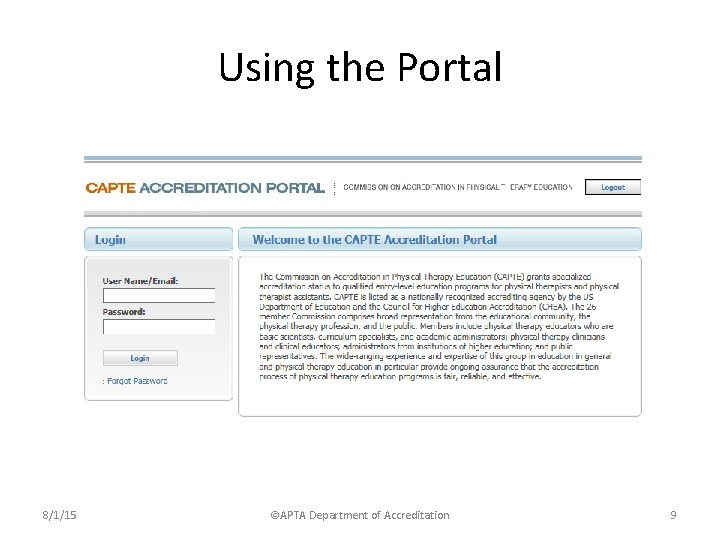
Using the Portal 8/1/15 ©APTA Department of Accreditation 9
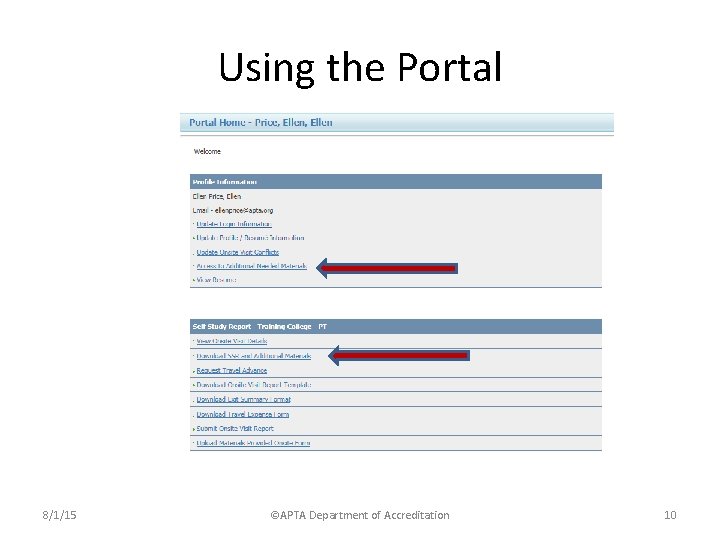
Using the Portal 8/1/15 ©APTA Department of Accreditation 10
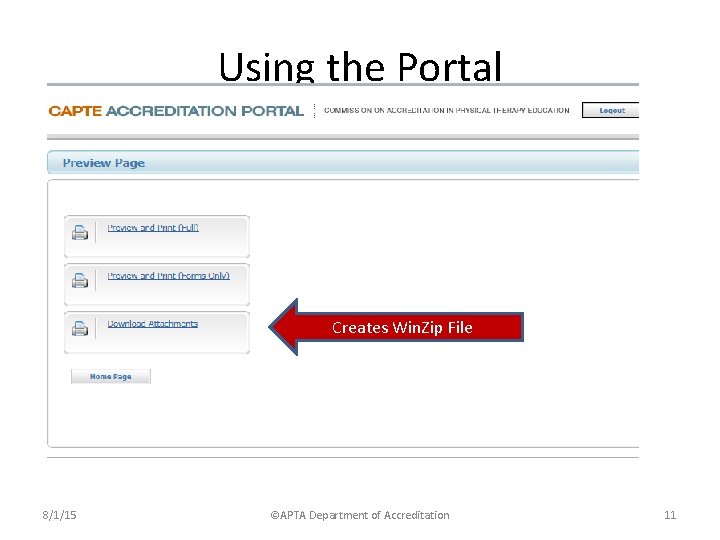
Using the Portal • Add picture of preview / print page Creates Win. Zip File 8/1/15 ©APTA Department of Accreditation 11
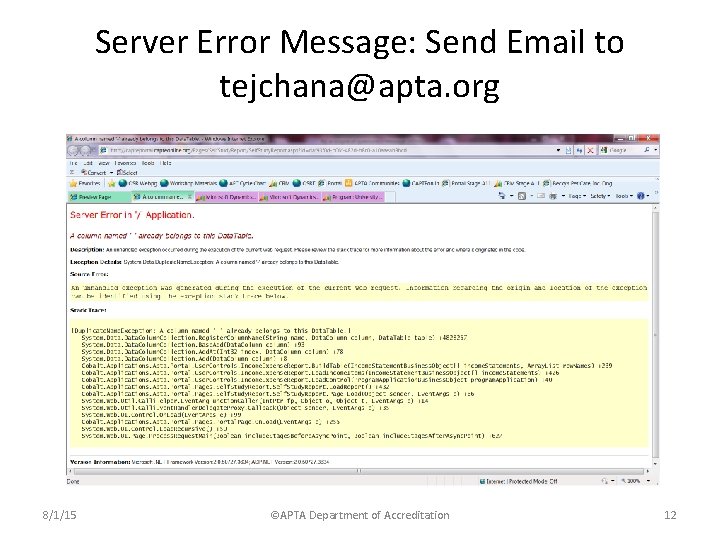
Server Error Message: Send Email to tejchana@apta. org 8/1/15 ©APTA Department of Accreditation 12
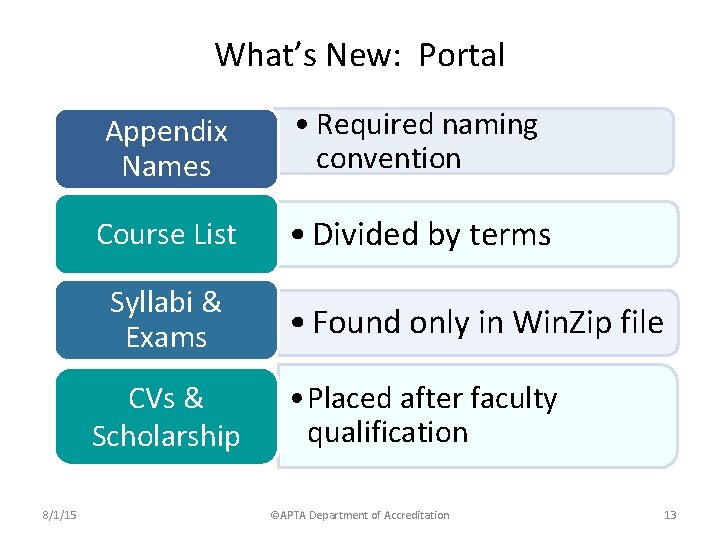
What’s New: Portal Appendix Names • Required naming convention Course List • Divided by terms Syllabi & Exams CVs & Scholarship 8/1/15 • Found only in Win. Zip file • Placed after faculty qualification ©APTA Department of Accreditation 13
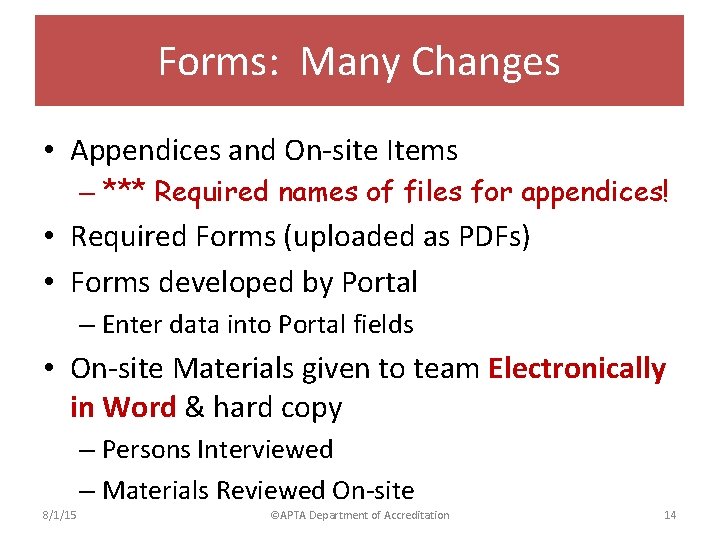
Forms: Many Changes • Appendices and On-site Items – *** Required names of files for appendices! • Required Forms (uploaded as PDFs) • Forms developed by Portal – Enter data into Portal fields • On-site Materials given to team Electronically in Word & hard copy – Persons Interviewed – Materials Reviewed On-site 8/1/15 ©APTA Department of Accreditation 14
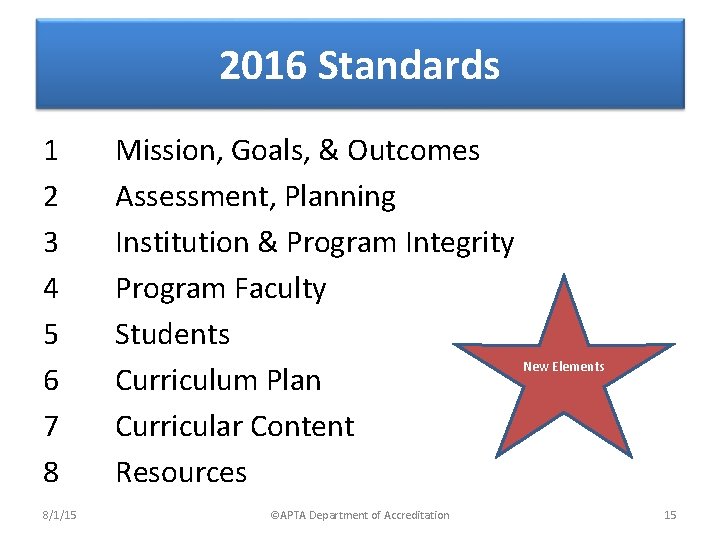
2016 Standards 1 2 3 4 5 6 7 8 8/1/15 Mission, Goals, & Outcomes Assessment, Planning Institution & Program Integrity Program Faculty Students New Elements Curriculum Plan Curricular Content Resources ©APTA Department of Accreditation 15
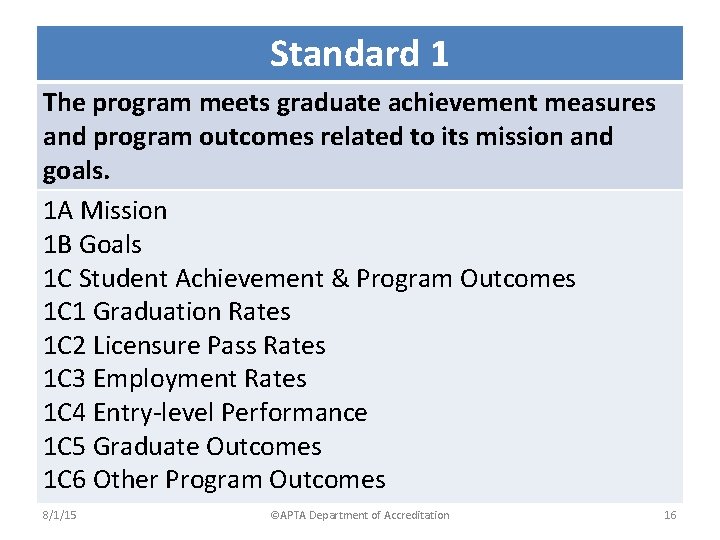
Standard 1 The program meets graduate achievement measures and program outcomes related to its mission and goals. 1 A Mission 1 B Goals 1 C Student Achievement & Program Outcomes 1 C 1 Graduation Rates 1 C 2 Licensure Pass Rates 1 C 3 Employment Rates 1 C 4 Entry-level Performance 1 C 5 Graduate Outcomes 1 C 6 Other Program Outcomes 8/1/15 ©APTA Department of Accreditation 16
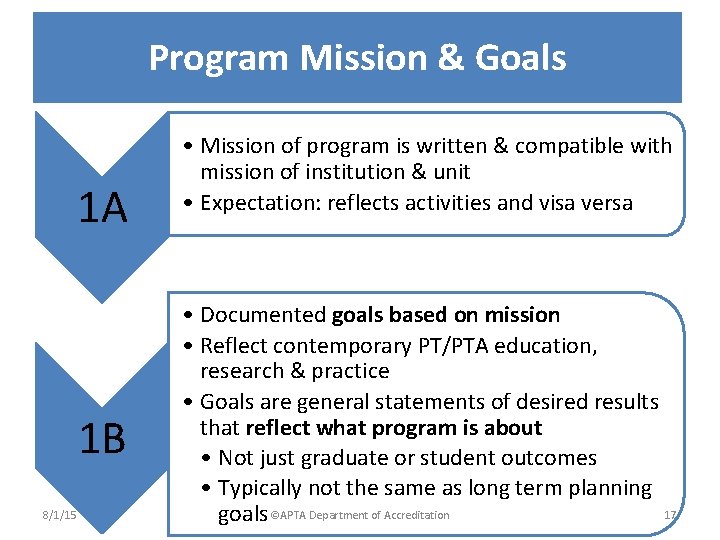
Program Mission & Goals 1 A 1 B 8/1/15 • Mission of program is written & compatible with mission of institution & unit • Expectation: reflects activities and visa versa • Documented goals based on mission • Reflect contemporary PT/PTA education, research & practice • Goals are general statements of desired results that reflect what program is about • Not just graduate or student outcomes • Typically not the same as long term planning 17 goals ©APTA Department of Accreditation
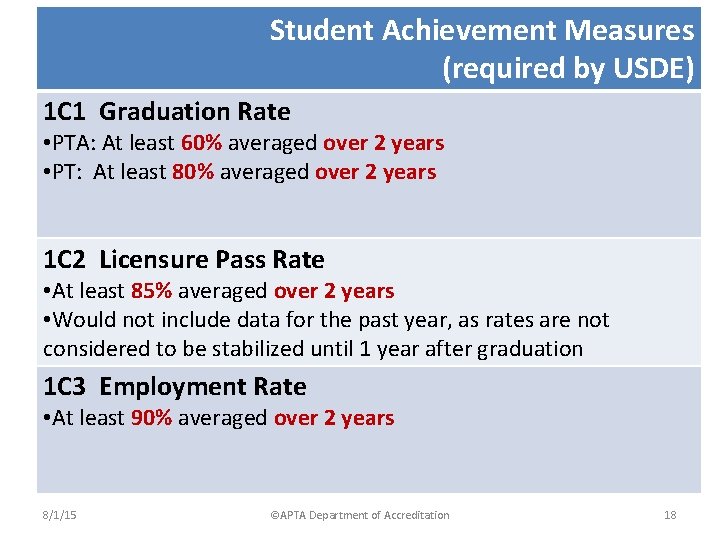
Student Achievement Measures (required by USDE) 1 C 1 Graduation Rate • PTA: At least 60% averaged over 2 years • PT: At least 80% averaged over 2 years 1 C 2 Licensure Pass Rate • At least 85% averaged over 2 years • Would not include data for the past year, as rates are not considered to be stabilized until 1 year after graduation 1 C 3 Employment Rate • At least 90% averaged over 2 years 8/1/15 ©APTA Department of Accreditation 18
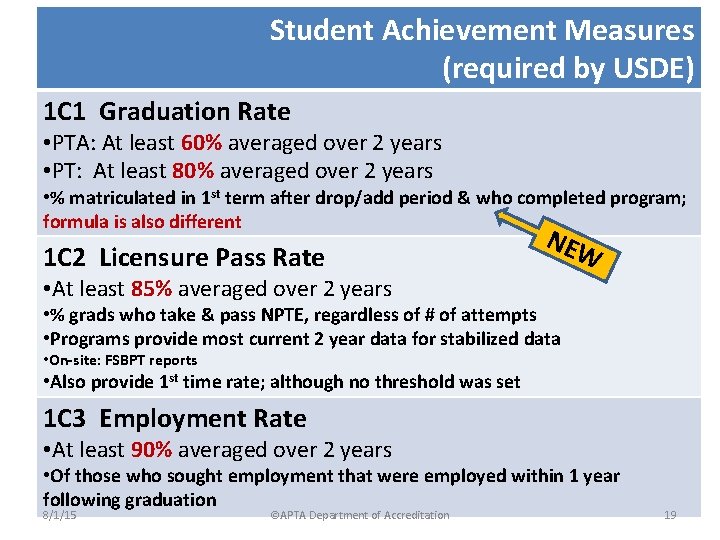
Student Achievement Measures (required by USDE) 1 C 1 Graduation Rate • PTA: At least 60% averaged over 2 years • PT: At least 80% averaged over 2 years • % matriculated in 1 st term after drop/add period & who completed program; formula is also different 1 C 2 Licensure Pass Rate NEW • At least 85% averaged over 2 years • % grads who take & pass NPTE, regardless of # of attempts • Programs provide most current 2 year data for stabilized data • On-site: FSBPT reports • Also provide 1 st time rate; although no threshold was set 1 C 3 Employment Rate • At least 90% averaged over 2 years • Of those who sought employment that were employed within 1 year following graduation 8/1/15 ©APTA Department of Accreditation 19
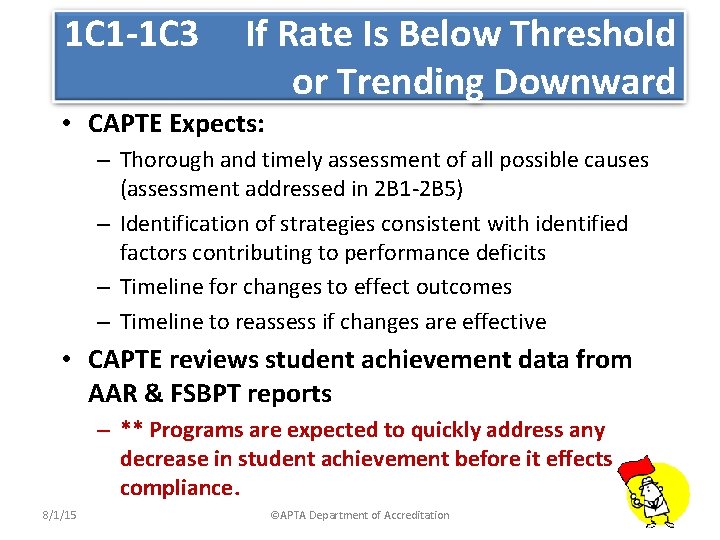
1 C 1 -1 C 3 If Rate Is Below Threshold or Trending Downward • CAPTE Expects: – Thorough and timely assessment of all possible causes (assessment addressed in 2 B 1 -2 B 5) – Identification of strategies consistent with identified factors contributing to performance deficits – Timeline for changes to effect outcomes – Timeline to reassess if changes are effective • CAPTE reviews student achievement data from AAR & FSBPT reports – ** Programs are expected to quickly address any decrease in student achievement before it effects compliance. 8/1/15 ©APTA Department of Accreditation 20
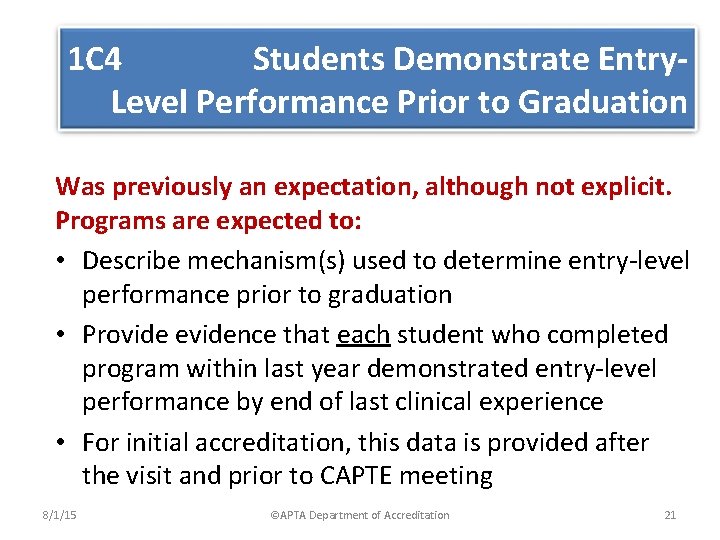
1 C 4 Students Demonstrate Entry. Level Performance Prior to Graduation Was previously an expectation, although not explicit. Programs are expected to: • Describe mechanism(s) used to determine entry-level performance prior to graduation • Provide evidence that each student who completed program within last year demonstrated entry-level performance by end of last clinical experience • For initial accreditation, this data is provided after the visit and prior to CAPTE meeting 8/1/15 ©APTA Department of Accreditation 21
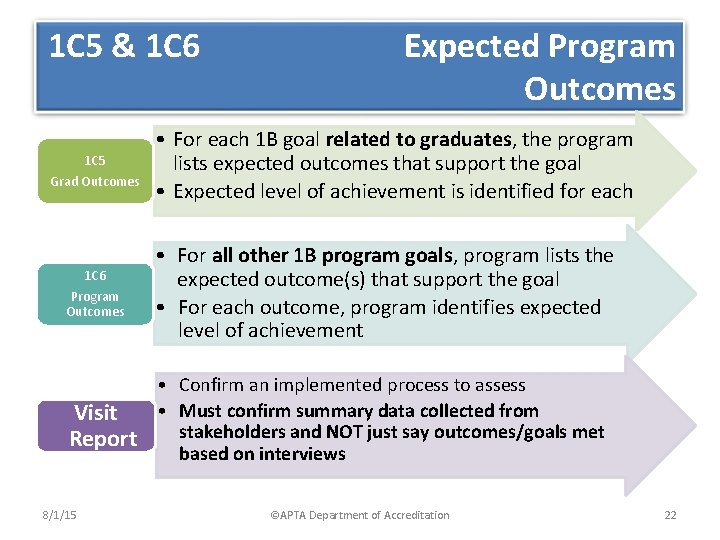
1 C 5 & 1 C 6 Expected Program Outcomes 1 C 5 Grad Outcomes 1 C 6 Program Outcomes • For each 1 B goal related to graduates, the program lists expected outcomes that support the goal • Expected level of achievement is identified for each • For all other 1 B program goals, program lists the expected outcome(s) that support the goal • For each outcome, program identifies expected level of achievement • Confirm an implemented process to assess Visit • Must confirm summary data collected from stakeholders and NOT just say outcomes/goals met Report based on interviews 8/1/15 ©APTA Department of Accreditation 22
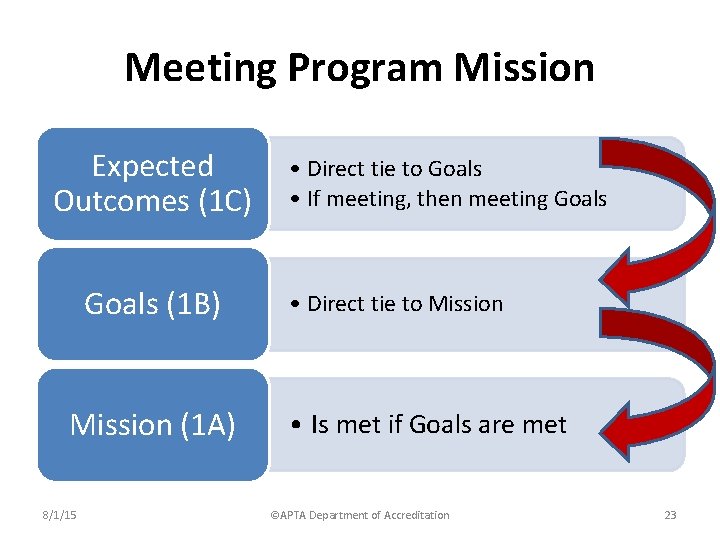
Meeting Program Mission Expected Outcomes (1 C) Goals (1 B) Mission (1 A) 8/1/15 • Direct tie to Goals • If meeting, then meeting Goals • Direct tie to Mission • Is met if Goals are met ©APTA Department of Accreditation 23
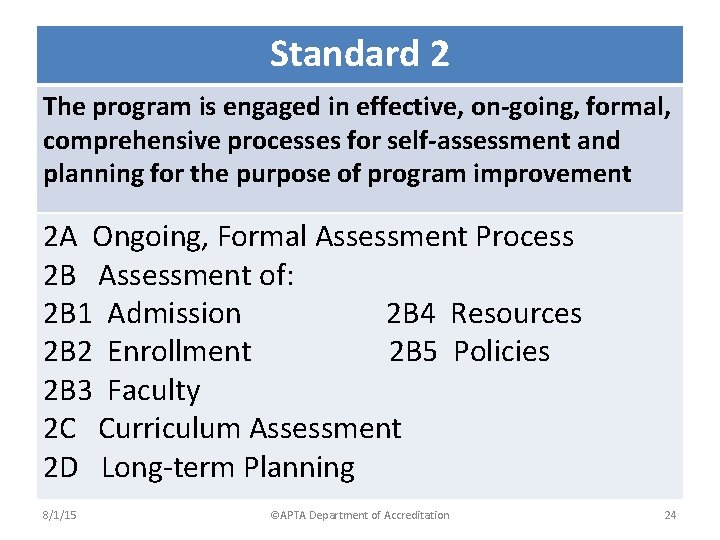
Standard 2 The program is engaged in effective, on-going, formal, comprehensive processes for self-assessment and planning for the purpose of program improvement 2 A Ongoing, Formal Assessment Process 2 B Assessment of: 2 B 1 Admission 2 B 4 Resources 2 B 2 Enrollment 2 B 5 Policies 2 B 3 Faculty 2 C Curriculum Assessment 2 D Long-term Planning 8/1/15 ©APTA Department of Accreditation 24
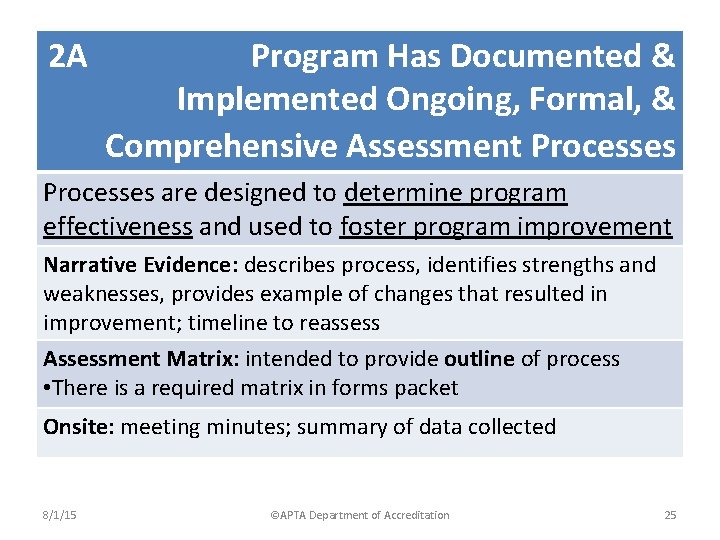
2 A Program Has Documented & ss Implemented Ongoing, Formal, & Comprehensive Assessment Processes are designed to determine program effectiveness and used to foster program improvement Narrative Evidence: describes process, identifies strengths and weaknesses, provides example of changes that resulted in improvement; timeline to reassess Assessment Matrix: intended to provide outline of process • There is a required matrix in forms packet Onsite: meeting minutes; summary of data collected 8/1/15 ©APTA Department of Accreditation 25
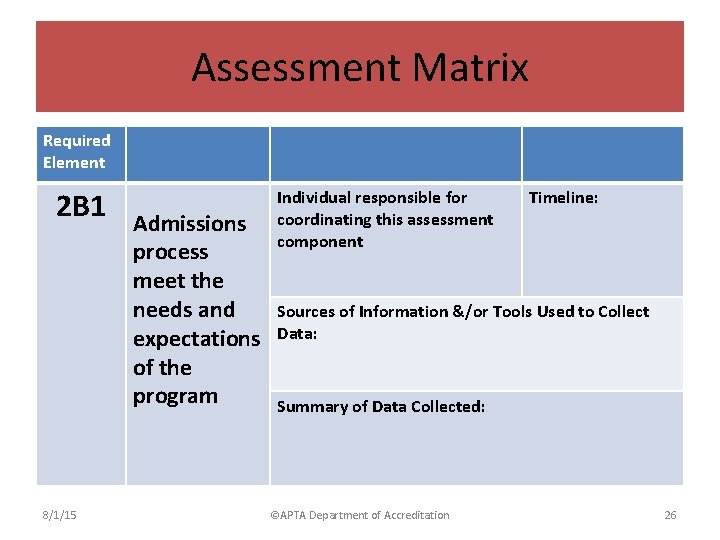
Assessment Matrix Required Element 2 B 1 8/1/15 Admissions process meet the needs and expectations of the program Individual responsible for coordinating this assessment component Timeline: Sources of Information &/or Tools Used to Collect Data: Summary of Data Collected: ©APTA Department of Accreditation 26
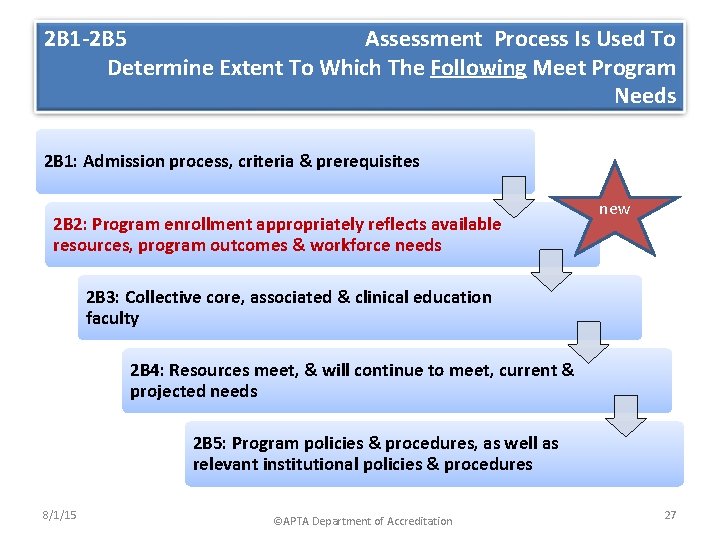
2 B 1 -2 B 5 Assessment Process Is Used To Determine Extent To Which The Following Meet Program Needs 2 B 1: Admission process, criteria & prerequisites 2 B 2: Program enrollment appropriately reflects available resources, program outcomes & workforce needs new 2 B 3: Collective core, associated & clinical education faculty 2 B 4: Resources meet, & will continue to meet, current & projected needs 2 B 5: Program policies & procedures, as well as relevant institutional policies & procedures 8/1/15 ©APTA Department of Accreditation 27
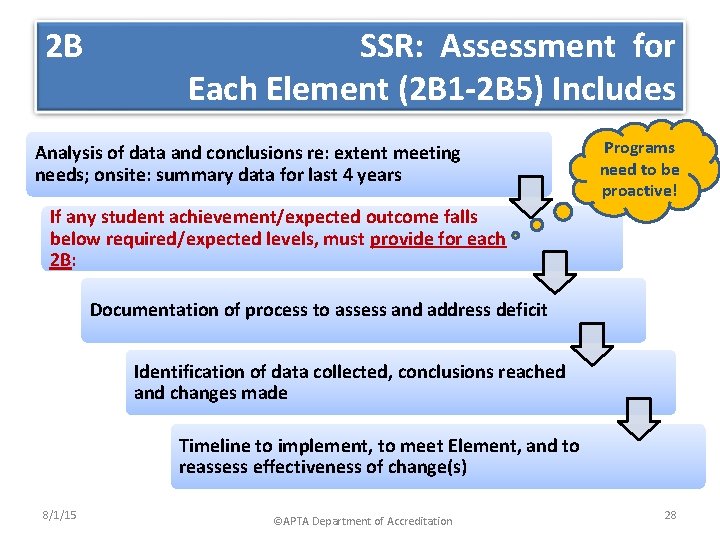
2 B SSR: Assessment for Each Element (2 B 1 -2 B 5) Includes Analysis of data and conclusions re: extent meeting needs; onsite: summary data for last 4 years Programs need to be proactive! If any student achievement/expected outcome falls below required/expected levels, must provide for each 2 B: Documentation of process to assess and address deficit Identification of data collected, conclusions reached and changes made Timeline to implement, to meet Element, and to reassess effectiveness of change(s) 8/1/15 ©APTA Department of Accreditation 28
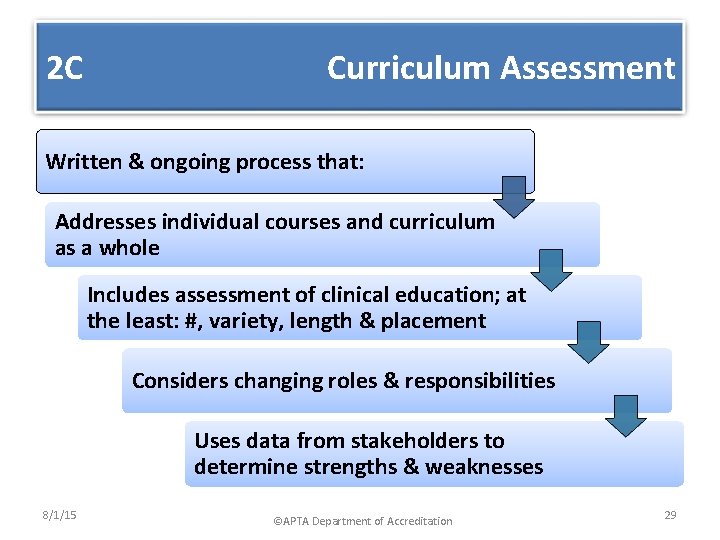
2 C Curriculum Assessment Written & ongoing process that: Addresses individual courses and curriculum as a whole Includes assessment of clinical education; at the least: #, variety, length & placement Considers changing roles & responsibilities Uses data from stakeholders to determine strengths & weaknesses 8/1/15 ©APTA Department of Accreditation 29
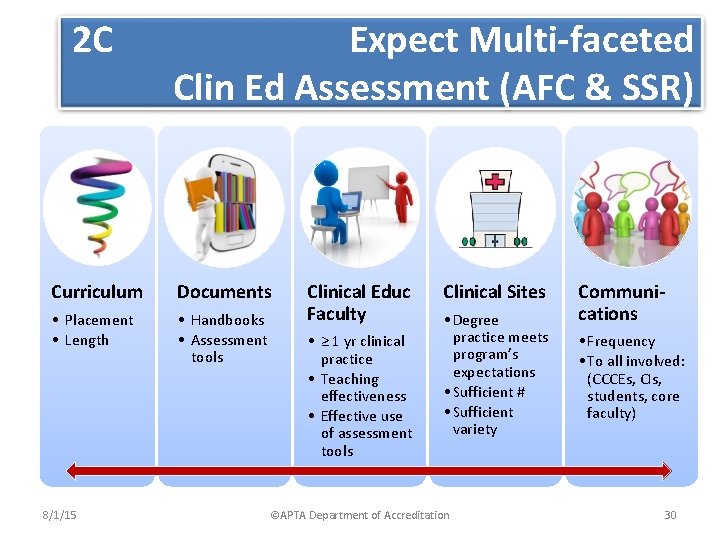
2 C Expect Multi-faceted Clin Ed Assessment (AFC & SSR) Curriculum Documents • Placement • Length • Handbooks • Assessment • ≥ 1 yr clinical tools practice • Teaching effectiveness • Effective use of assessment tools 8/1/15 Clinical Educ Faculty Clinical Sites • Degree practice meets program’s expectations • Sufficient # • Sufficient variety ©APTA Department of Accreditation Communications • Frequency • To all involved: (CCCEs, CIs, students, core faculty) 30
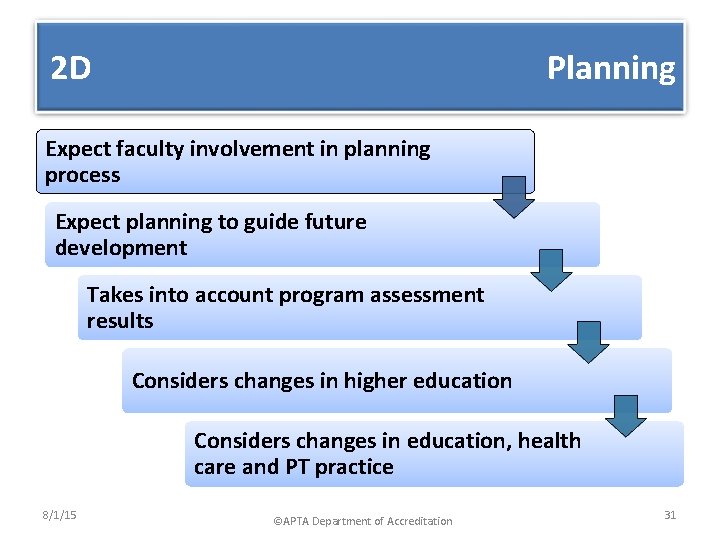
2 D Planning Expect faculty involvement in planning process Expect planning to guide future development Takes into account program assessment results Considers changes in higher education Considers changes in education, health care and PT practice 8/1/15 ©APTA Department of Accreditation 31
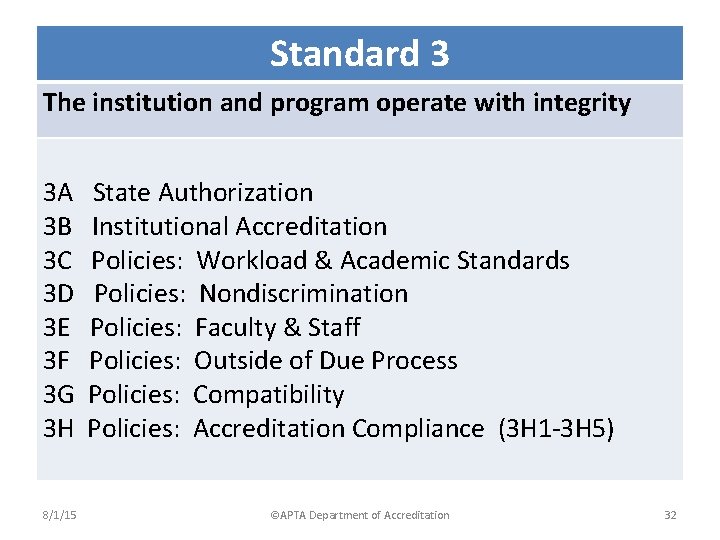
Standard 3 The institution and program operate with integrity 3 A State Authorization 3 B Institutional Accreditation 3 C Policies: Workload & Academic Standards 3 D Policies: Nondiscrimination 3 E Policies: Faculty & Staff 3 F Policies: Outside of Due Process 3 G Policies: Compatibility 3 H Policies: Accreditation Compliance (3 H 1 -3 H 5) 8/1/15 ©APTA Department of Accreditation 32
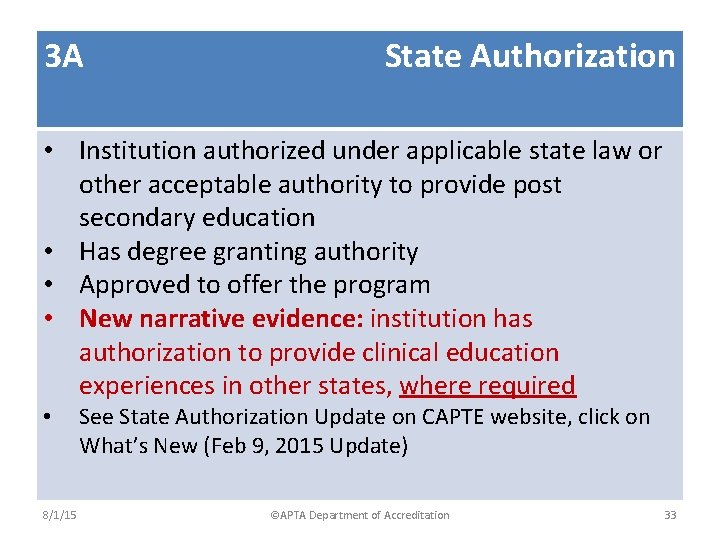
3 A State Authorization 3 B • Institution authorized under applicable state law or other acceptable authority to provide post secondary education • Has degree granting authority • Approved to offer the program • New narrative evidence: institution has authorization to provide clinical education experiences in other states, where required • 8/1/15 See State Authorization Update on CAPTE website, click on What’s New (Feb 9, 2015 Update) ©APTA Department of Accreditation 33
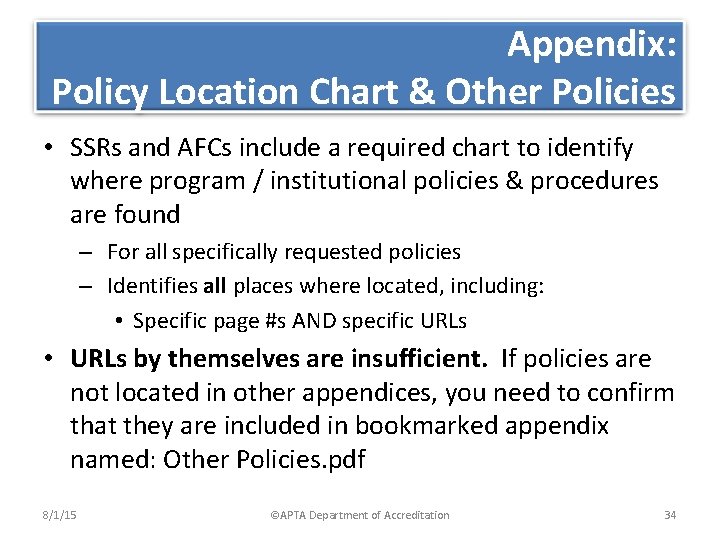
Appendix: Policy Location Chart & Other Policies • SSRs and AFCs include a required chart to identify where program / institutional policies & procedures are found – For all specifically requested policies – Identifies all places where located, including: • Specific page #s AND specific URLs • URLs by themselves are insufficient. If policies are not located in other appendices, you need to confirm that they are included in bookmarked appendix named: Other Policies. pdf 8/1/15 ©APTA Department of Accreditation 34
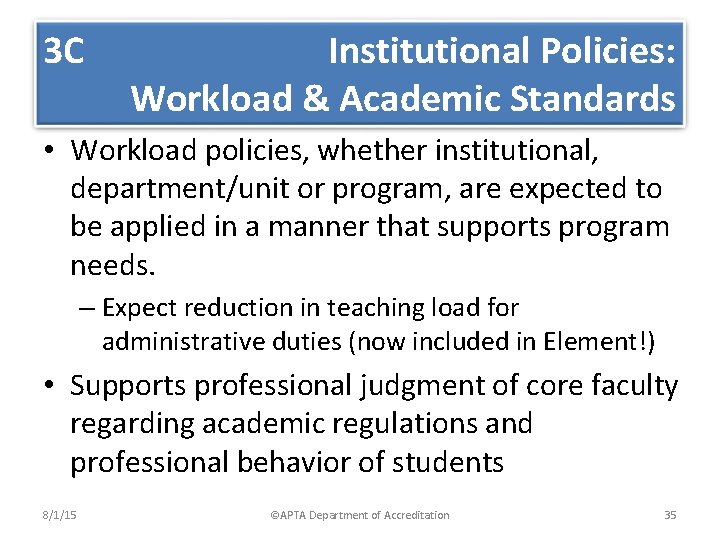
3 C Institutional Policies: Workload & Academic Standards • Workload policies, whether institutional, department/unit or program, are expected to be applied in a manner that supports program needs. – Expect reduction in teaching load for administrative duties (now included in Element!) • Supports professional judgment of core faculty regarding academic regulations and professional behavior of students 8/1/15 ©APTA Department of Accreditation 35
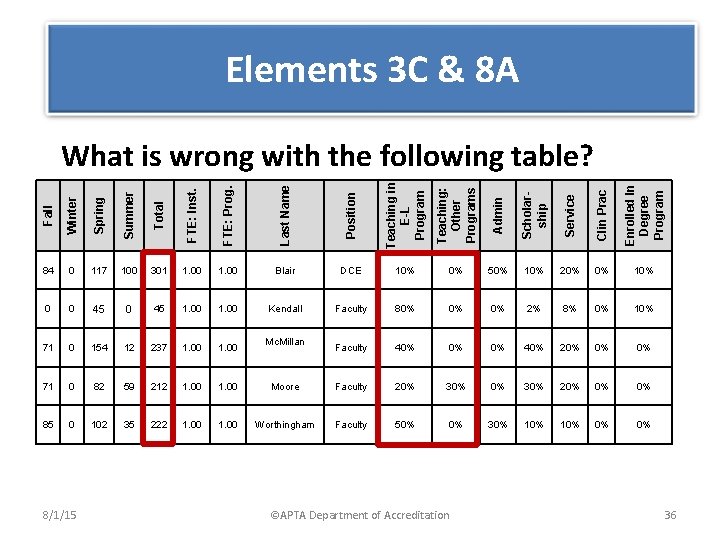
Elements 3 C & 8 A Fall Winter Spring Summer Total FTE: Inst. FTE: Prog. Last Name Position Teaching in E-L Program Teaching: Other Programs Admin Scholarship Service Clin Prac Enrolled In Degree Program What is wrong with the following table? 84 0 117 100 301 1. 00 Blair DCE 10% 0% 50% 10% 20% 0% 10% 0 0 45 1. 00 Kendall Faculty 80% 0% 0% 2% 8% 0% 10% 71 0 154 12 237 1. 00 Faculty 40% 0% 0% 40% 20% 0% 0% 71 0 82 59 212 1. 00 Moore Faculty 20% 30% 20% 0% 0% 85 0 102 35 222 1. 00 Worthingham Faculty 50% 0% 30% 10% 0% 0% 8/1/15 Mc. Millan ©APTA Department of Accreditation 36
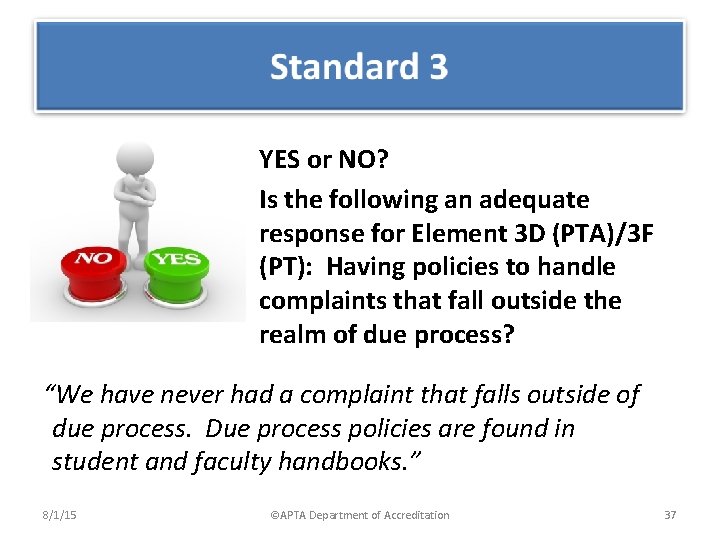
YES or NO? Is the following an adequate response for Element 3 D (PTA)/3 F (PT): Having policies to handle complaints that fall outside the realm of due process? “We have never had a complaint that falls outside of due process. Due process policies are found in student and faculty handbooks. ” 8/1/15 ©APTA Department of Accreditation 37
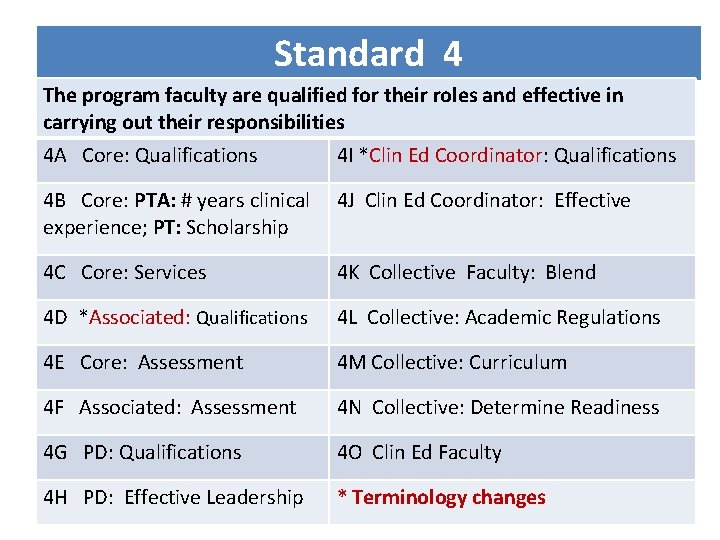
Standard 4 The program faculty are qualified for their roles and effective in carrying out their responsibilities 4 A Core: Qualifications 4 I *Clin Ed Coordinator: Qualifications 4 B Core: PTA: # years clinical 4 J Clin Ed Coordinator: Effective experience; PT: Scholarship 4 C Core: Services 4 K Collective Faculty: Blend 4 D *Associated: Qualifications 4 L Collective: Academic Regulations 4 E Core: Assessment 4 M Collective: Curriculum 4 F Associated: Assessment 4 N Collective: Determine Readiness 4 G PD: Qualifications 4 O Clin Ed Faculty 4 H PD: Effective Leadership 8/1/15 * Terminology changes ©APTA Department of Accreditation 38
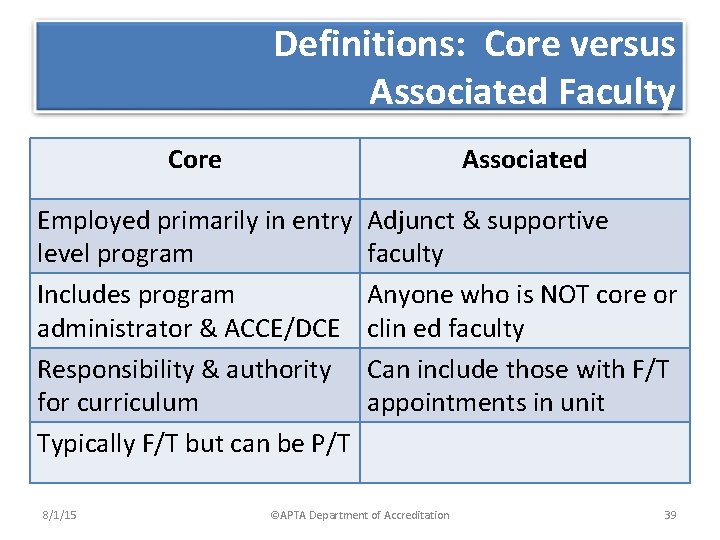
Definitions: Core versus Associated Faculty Core Associated Employed primarily in entry Adjunct & supportive level program faculty Includes program Anyone who is NOT core or administrator & ACCE/DCE clin ed faculty Responsibility & authority Can include those with F/T for curriculum appointments in unit Typically F/T but can be P/T 8/1/15 ©APTA Department of Accreditation 39
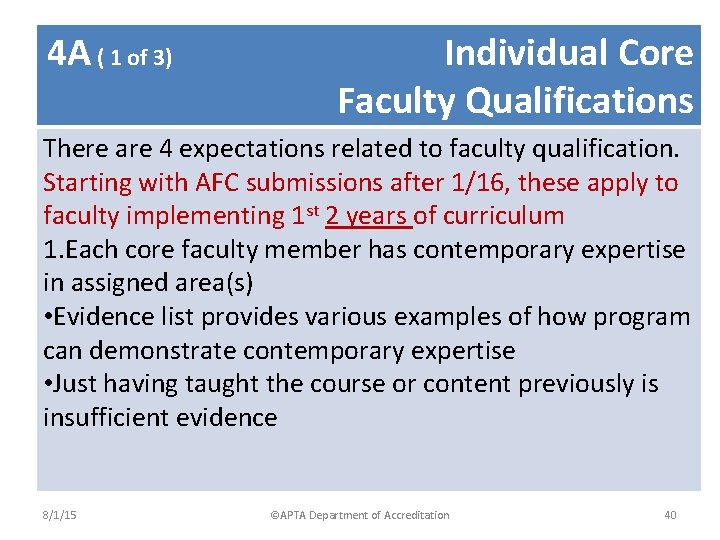
4 A ( 1 of 3) Individual Core Faculty Qualifications There are 4 expectations related to faculty qualification. Starting with AFC submissions after 1/16, these apply to faculty implementing 1 st 2 years of curriculum 1. Each core faculty member has contemporary expertise in assigned area(s) • Evidence list provides various examples of how program can demonstrate contemporary expertise • Just having taught the course or content previously is insufficient evidence 8/1/15 ©APTA Department of Accreditation 40
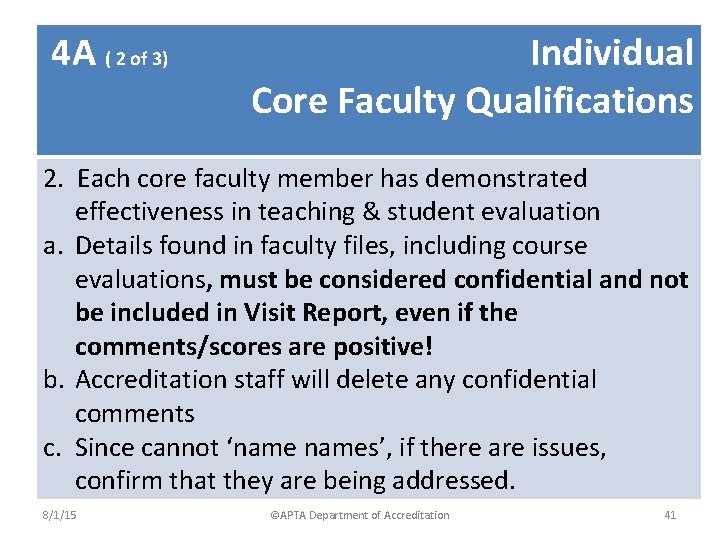
4 A ( 2 of 3) Individual Core Faculty Qualifications 2. Each core faculty member has demonstrated effectiveness in teaching & student evaluation a. Details found in faculty files, including course evaluations, must be considered confidential and not be included in Visit Report, even if the comments/scores are positive! b. Accreditation staff will delete any confidential comments c. Since cannot ‘names’, if there are issues, confirm that they are being addressed. 8/1/15 ©APTA Department of Accreditation 41
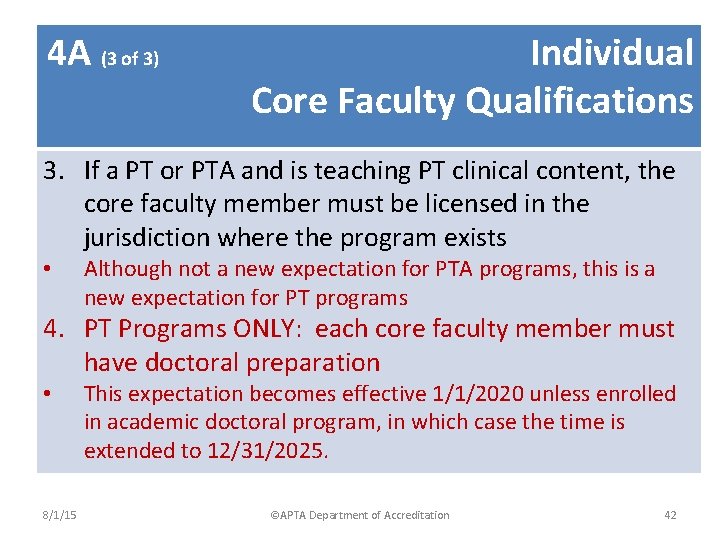
4 A (3 of 3) Individual Core Faculty Qualifications 3. If a PT or PTA and is teaching PT clinical content, the core faculty member must be licensed in the jurisdiction where the program exists • Although not a new expectation for PTA programs, this is a new expectation for PT programs 4. PT Programs ONLY: each core faculty member must have doctoral preparation • 8/1/15 This expectation becomes effective 1/1/2020 unless enrolled in academic doctoral program, in which case the time is extended to 12/31/2025. ©APTA Department of Accreditation 42
4 C Core Faculty: Service Each core faculty member has a record of institutional or professional service • New for PTA programs • Service includes professional activities as well as institutional and program governance 8/1/15 ©APTA Department of Accreditation 43
4 D Associated Faculty If used, CAPTE is looking for: • Information on all individuals involved in a course – Regardless of terminology used: guest lecturers, adjuncts, support • Contemporary expertise related to teaching responsibilities • Teaching effectiveness • If in 50% or > of course contact hours, there will be a Faculty Detail Page that includes narrative description of expertise related to assigned content and a CV. • If in <50% of course content hrs, then narrative includes: – Name, credentials, applicable course #/name; total contact hours; content taught, contemporary expertise in content taught 8/1/15 ©APTA Department of Accreditation 44
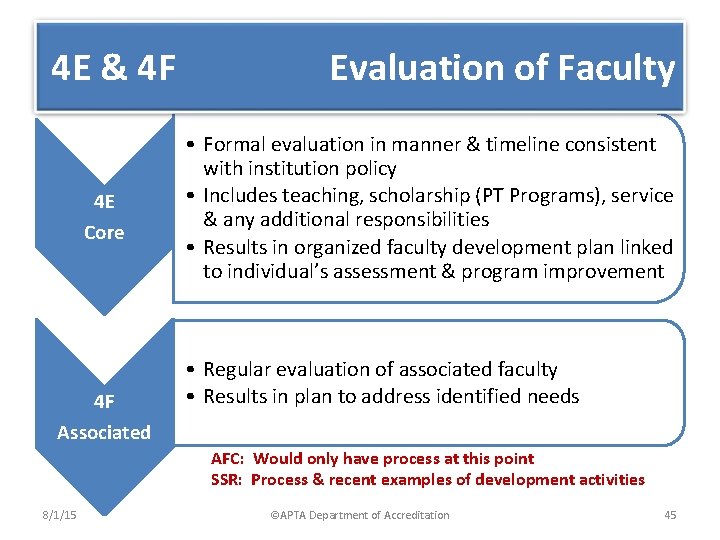
4 E & 4 F Evaluation of Faculty 4 E Core 4 F Associated • Formal evaluation in manner & timeline consistent with institution policy • Includes teaching, scholarship (PT Programs), service & any additional responsibilities • Results in organized faculty development plan linked to individual’s assessment & program improvement • Regular evaluation of associated faculty • Results in plan to address identified needs AFC: Would only have process at this point SSR: Process & recent examples of development activities 8/1/15 ©APTA Department of Accreditation 45
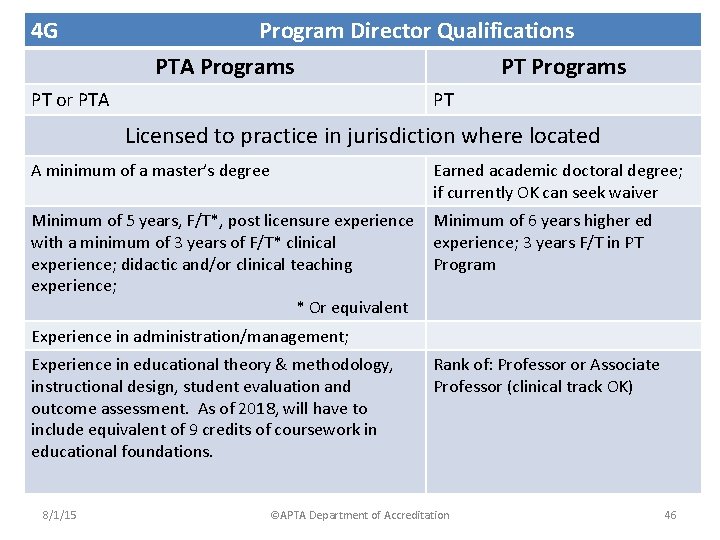
4 G Program Director Qualifications PTA Programs PT or PTA PT Programs PT Licensed to practice in jurisdiction where located A minimum of a master’s degree Earned academic doctoral degree; if currently OK can seek waiver Minimum of 5 years, F/T*, post licensure experience Minimum of 6 years higher ed with a minimum of 3 years of F/T* clinical experience; 3 years F/T in PT experience; didactic and/or clinical teaching Program experience; * Or equivalent Experience in administration/management; Experience in educational theory & methodology, instructional design, student evaluation and outcome assessment. As of 2018, will have to include equivalent of 9 credits of coursework in educational foundations. 8/1/15 Rank of: Professor or Associate Professor (clinical track OK) ©APTA Department of Accreditation 46
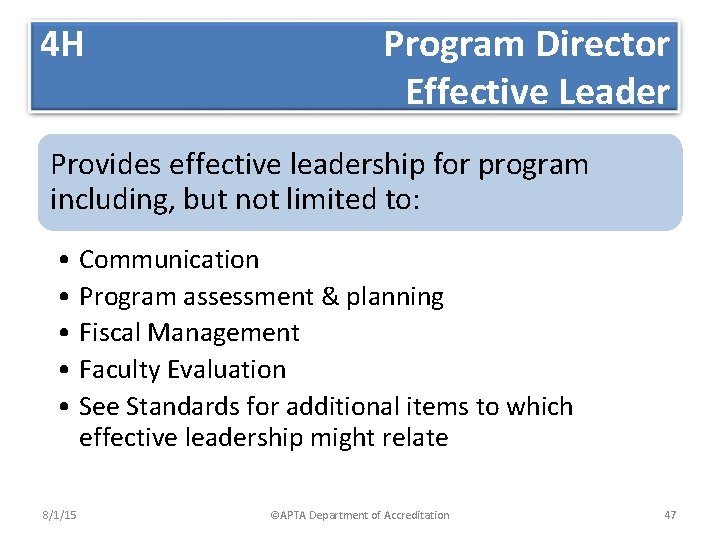
4 H Program Director Effective Leader Provides effective leadership for program including, but not limited to: • • • 8/1/15 Communication Program assessment & planning Fiscal Management Faculty Evaluation See Standards for additional items to which effective leadership might relate ©APTA Department of Accreditation 47
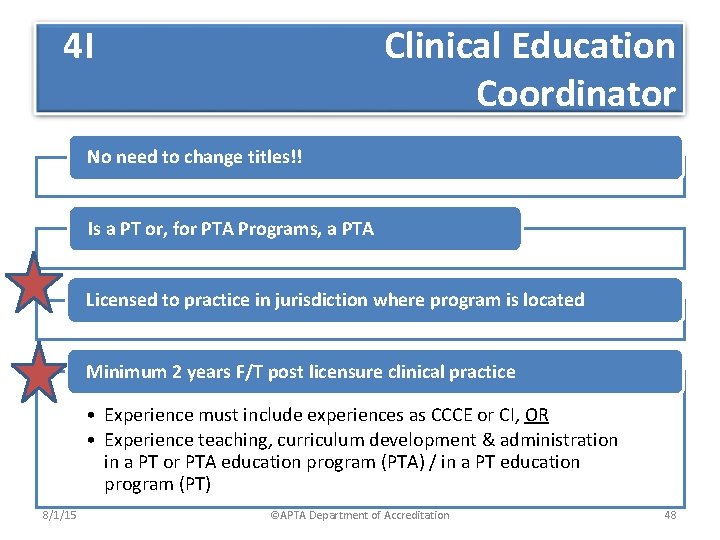
4 I Clinical Education Coordinator No need to change titles!! Is a PT or, for PTA Programs, a PTA Licensed to practice in jurisdiction where program is located Minimum 2 years F/T post licensure clinical practice • Experience must include experiences as CCCE or CI, OR • Experience teaching, curriculum development & administration in a PT or PTA education program (PTA) / in a PT education program (PT) 8/1/15 ©APTA Department of Accreditation 48
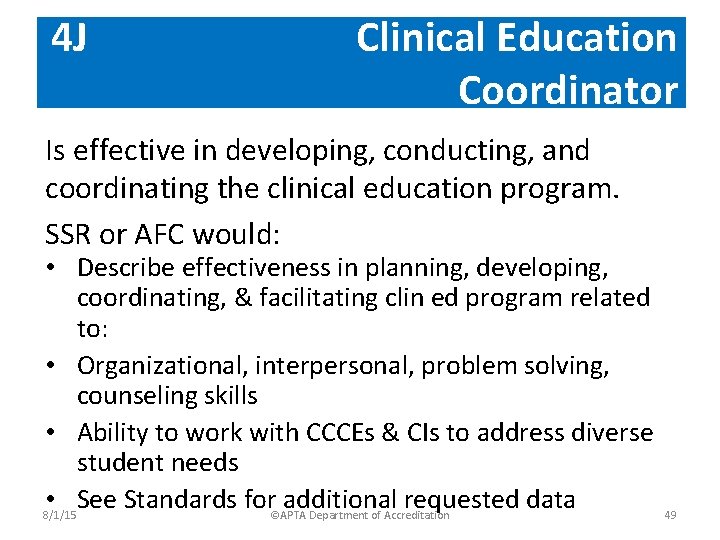
4 J Clinical Education Coordinator Is effective in developing, conducting, and coordinating the clinical education program. SSR or AFC would: • Describe effectiveness in planning, developing, coordinating, & facilitating clin ed program related to: • Organizational, interpersonal, problem solving, counseling skills • Ability to work with CCCEs & CIs to address diverse student needs • See Standards for additional requested data 8/1/15 ©APTA Department of Accreditation 49
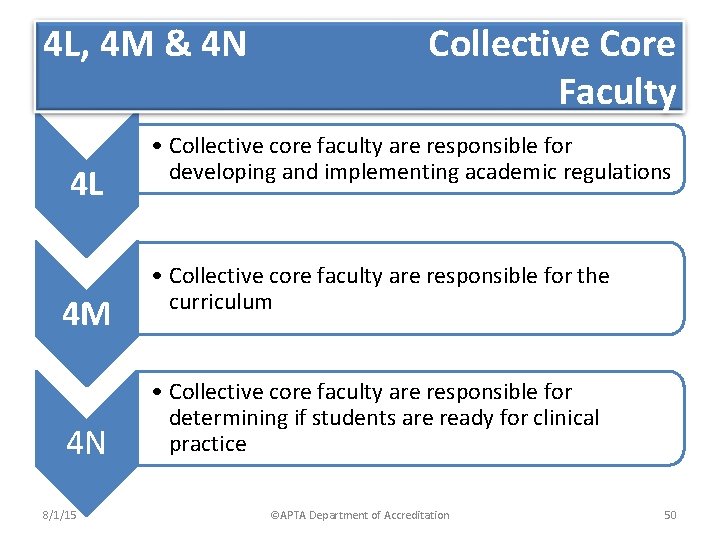
4 L, 4 M & 4 N Collective Core Faculty 4 L 4 M 4 N 8/1/15 • Collective core faculty are responsible for developing and implementing academic regulations • Collective core faculty are responsible for the curriculum • Collective core faculty are responsible for determining if students are ready for clinical practice ©APTA Department of Accreditation 50
4 O Clin Ed Faculty Are licensed with a minimum of 1 year F/T, postlicensure clinical experience and are effective role models and clinical teachers. • Program’s expectations for clinical competence and clinical teaching effectiveness of CIs • How sites are informed of these expectations • How expectations are (or will be, for an AFC) monitored • How CIs are (or will be, for an AFC) trained in use of tool to assess students • SSR: Qualifications & teaching effectiveness of those who provided instruction for minimum 160 hrs/same student in the last academic year 8/1/15 ©APTA Department of Accreditation 51
Standard 5 The program recruits, admits & graduates students consistent with the missions and goals of the institution & program and consistent with societal needs for physical therapy services for a diverse population 5 A Policies: Recruitment & Admission 5 B Provided Relevant Info 5 C Enrollment Agreements 5 D Policies: Students 5 E Policies: Retention & Progression 8/1/15 ©APTA Department of Accreditation 52
Standard 5: Student Policies Must include in Policy Location Chart and must provide a copy in the appendix named ‘Other Policies. pdf’ if not found in documents provided 8/1/15 ©APTA Department of Accreditation 53
Curriculum 8/1/15 6 • Curriculum Plan 7 • Curricular Content ©APTA Department of Accreditation 54
6 E (PTA) & 6 G (PT) Course Syllabi • New in terms of separate element but expectation is not new • Only response needed is to refer reader to syllabi • Program attaches syllabi on course detail page • Reviewers can ONLY access syllabi in Win. Zip file • Expect comprehensive syllabi, inclusive of all items listed in Evidence List (Appendices) – If institution requires different format, program can provide an addendum with the additional items 8/1/15 ©APTA Department of Accreditation 55
6 I (PTA) & 6 K (PT) Distance Education, If Used 1: Faculty teaching by distance are effective 2: Rigor of DE courses is equivalent to that of site-based courses 3: Student performance meets expectations described in course syllabi & demonstrated in student assessment 4: There is a mechanism for determining student identity during course activities and when testing is at a distance 5: There is a mechanism for maintaining test security & integrity when testing is at a distance 6: There is a mechanism for maintaining student privacy 7: Students have been informed of any additional fees 8: DE students have access to academic, health, counseling, disability & financial aid services commensurate with services students receive on campus 8/1/15 ©APTA Department of Accreditation 56
6 J (PTA) & 6 L (PT) Clinical Education Experiences (1 of 2) The curriculum plan includes clinical education experiences for each student that encompass, but are not limited to: 1: Management of patients with diseases and conditions representative of those commonly seen in practice across lifespan and continuum of care; 2: Practice settings representative of those in which physical therapy is commonly practiced. 8/1/15 ©APTA Department of Accreditation 57
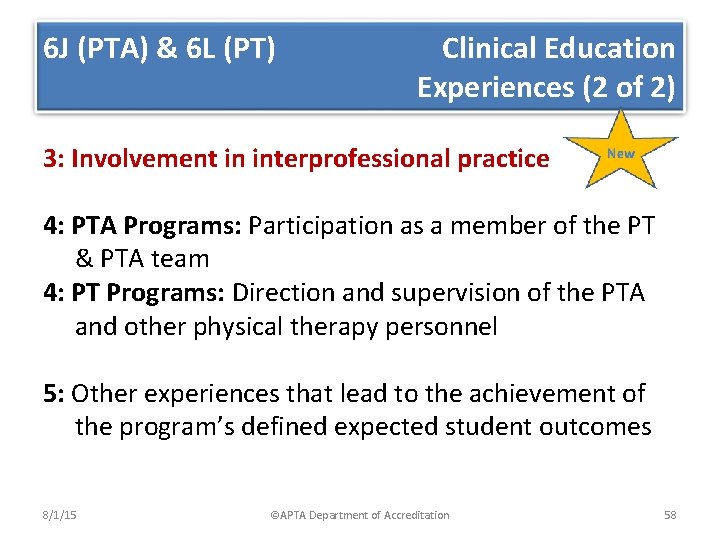
6 J (PTA) & 6 L (PT) Clinical Education Experiences (2 of 2) 3: Involvement in interprofessional practice 4: PTA Programs: Participation as a member of the PT & PTA team 4: PT Programs: Direction and supervision of the PTA and other physical therapy personnel 5: Other experiences that lead to the achievement of the program’s defined expected student outcomes 8/1/15 ©APTA Department of Accreditation 58
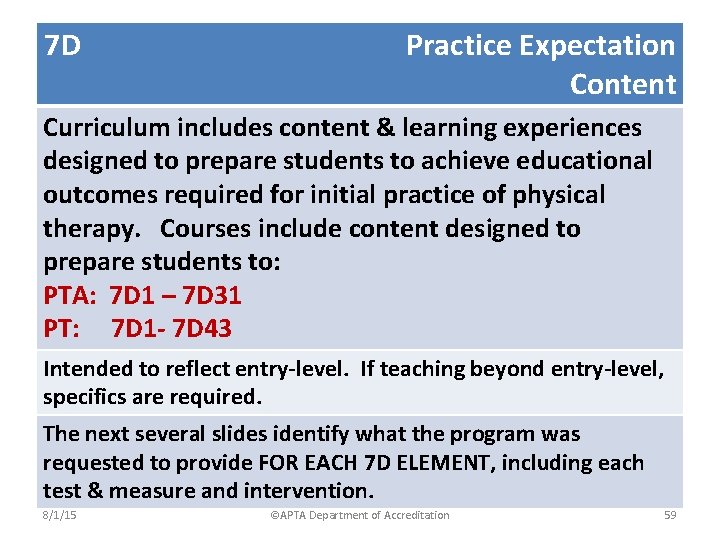
7 D Practice Expectation Content Curriculum includes content & learning experiences designed to prepare students to achieve educational outcomes required for initial practice of physical therapy. Courses include content designed to prepare students to: PTA: 7 D 1 – 7 D 31 PT: 7 D 1 - 7 D 43 Intended to reflect entry-level. If teaching beyond entry-level, specifics are required. The next several slides identify what the program was requested to provide FOR EACH 7 D ELEMENT, including each test & measure and intervention. 8/1/15 ©APTA Department of Accreditation 59
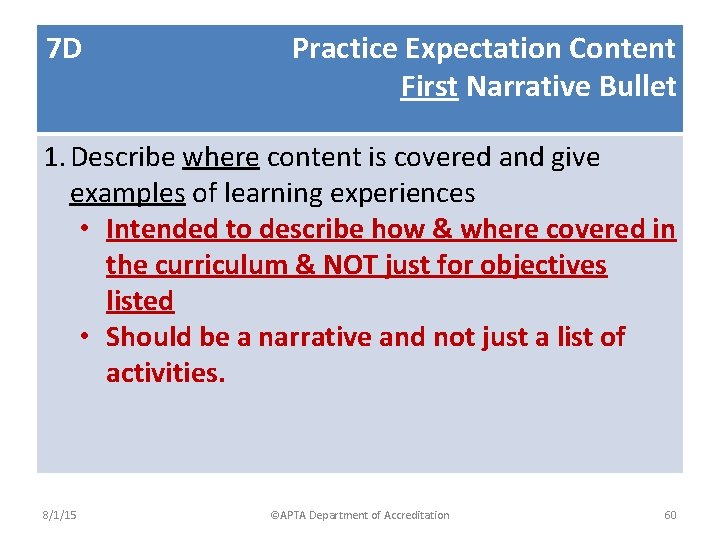
7 D Practice Expectation Content First Narrative Bullet 1. Describe where content is covered and give examples of learning experiences • Intended to describe how & where covered in the curriculum & NOT just for objectives listed • Should be a narrative and not just a list of activities. 8/1/15 ©APTA Department of Accreditation 60
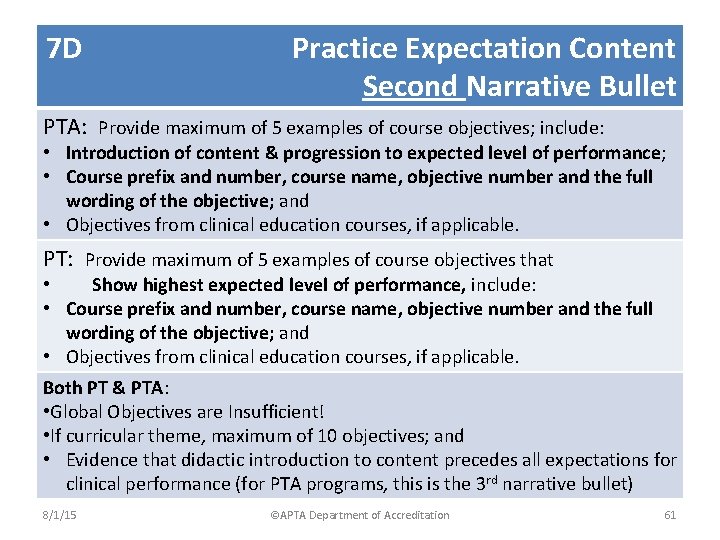
7 D Practice Expectation Content Second Narrative Bullet PTA: Provide maximum of 5 examples of course objectives; include: • Introduction of content & progression to expected level of performance; • Course prefix and number, course name, objective number and the full wording of the objective; and • Objectives from clinical education courses, if applicable. PT: Provide maximum of 5 examples of course objectives that • Show highest expected level of performance, include: • Course prefix and number, course name, objective number and the full wording of the objective; and • Objectives from clinical education courses, if applicable. Both PT & PTA: • Global Objectives are Insufficient! • If curricular theme, maximum of 10 objectives; and • Evidence that didactic introduction to content precedes all expectations for clinical performance (for PTA programs, this is the 3 rd narrative bullet) 8/1/15 ©APTA Department of Accreditation 61
7 D Practice Expectation Content Third/Fourth Narrative Bullet 3. Describe outcome data, where available, that demonstrates actual level of achievement • Place generalized comments (e. g. , pass exams, pass course, maintain GPA) under 7 D • This is so the program does not repeat the same thing 31+/43+ times!! • Exam questions are NOT requested • Looking only for data specific to each 7 D • Types of relevant outcome data: • CPI (appendix will be revised to match to the 7 Ds) • Graduate and employer surveys 8/1/15 ©APTA Department of Accreditation 62
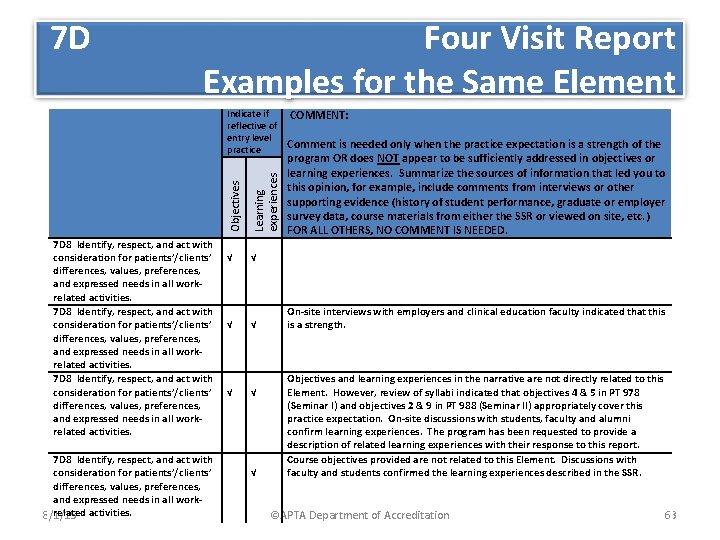
7 D Four Visit Report Examples for the Same Element COMMENT: Comment is needed only when the practice expectation is a strength of the program OR does NOT appear to be sufficiently addressed in objectives or learning experiences. Summarize the sources of information that led you to this opinion, for example, include comments from interviews or other supporting evidence (history of student performance, graduate or employer survey data, course materials from either the SSR or viewed on site, etc. ) FOR ALL OTHERS, NO COMMENT IS NEEDED. Learning experiences Indicate if reflective of entry level practice Objectives 7 D 8 Identify, respect, and act with consideration for patients’/clients’ differences, values, preferences, and expressed needs in all workrelated activities. √ √ On-site interviews with employers and clinical education faculty indicated that this is a strength. √ √ 7 D 8 Identify, respect, and act with consideration for patients’/clients’ differences, values, preferences, and expressed needs in all workrelated activities. 8/1/15 √ Objectives and learning experiences in the narrative are not directly related to this Element. However, review of syllabi indicated that objectives 4 & 5 in PT 978 (Seminar I) and objectives 2 & 9 in PT 988 (Seminar II) appropriately cover this practice expectation. On-site discussions with students, faculty and alumni confirm learning experiences. The program has been requested to provide a description of related learning experiences with their response to this report. Course objectives provided are not related to this Element. Discussions with faculty and students confirmed the learning experiences described in the SSR. ©APTA Department of Accreditation 63
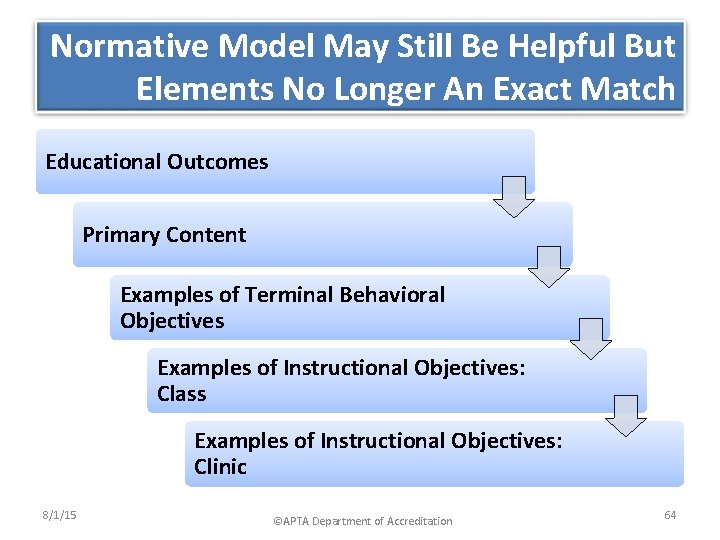
Normative Model May Still Be Helpful But Elements No Longer An Exact Match Educational Outcomes Primary Content Examples of Terminal Behavioral Objectives Examples of Instructional Objectives: Class Examples of Instructional Objectives: Clinic 8/1/15 ©APTA Department of Accreditation 64
Standard 8 The program resources are sufficient to meet the current and projected needs of the program 8 A Core faculty (see PTA or PT module) 8 B Administrative/Secretarial & Technical Support 8 C Financial Resources 8 D Space, Equipment, Technology, & Materials 8 E Library &Learning Resource Centers 8 F Clinical Education Sites 8 G Written Clinical Education Agreements 8 H Student Services 8/1/15 ©APTA Department of Accreditation 65
8 B Secretarial & Technical Support The program has, or has ensured access to, adequate secretarial/administrative and technical support services to meet expected program outcomes. • Describe secretarial, administrative, and/or technical support available to program, including support for clinical education program. 8/1/15 ©APTA Department of Accreditation 66
8 C Financial Resources • AFCs provide budget info for: • Academic year of the visit, AND • Each academic year through full implementation of the program – Should see budget to appropriately reflect increasing demands as program is implemented • Self-study Reports provide budget info for: • Academic year of the visit • Previous academic year • Projected next academic year 8/1/15 ©APTA Department of Accreditation 67
8 C Financial Resources • Income = Allocations to Program • Should never indicate no income! • Should not indicate total tuition dollars to the institution unless program receives all tuition dollars • Clarify in the Visit Report, if needed: – Revenue sources & how each is used, if applicable – Adequacy of budget to meet program needs – Process to determine short & long term budget needs that are tied to strategic planning – If monies come from a budget other than the program’s, identify • On-site: actual program budget documents 8/1/15 ©APTA Department of Accreditation 68
8 D Space, Equipment, Technology & Materials The program has, or has ensured access to, space, equipment, technology, & materials of sufficient quality & quantity to meet program goals related to teaching, scholarship & services 8 D 1 Classroom and laboratory environments 8 D 2 Office space 8 D 3 Lab space available outside of scheduled class time 8 D 4 Equipment & materials 8 D 5 Technology resources 8 D 6 Space & equipment for faculty scholarship (PT ONLY) 8/1/15 ©APTA Department of Accreditation 69
8 D 1, 8 D 2, 8 D 3 Classroom/Lab Space & Office Space must be suitable for all activities. • Classroom and laboratory space is: – supportive of effective teaching and learning – has access to current technology and safety features (e. g. , internet access, fire extinguishers) – clean, in good repair, temperature controlled, etc. – accessible to students outside scheduled class time • Office space for faculty and staff: – allows for private conversations/confidential meetings – has secure storage for office equipment, student files, and other confidential materials 8/1/15 ©APTA Department of Accreditation 70
8 D 4 & 8 D 5 Equipment & Technology • Equipment and materials are: – Typical of those used in contemporary PT practice – In good working condition (indicate maintenance agreements and inspection frequency) – Of sufficient number/availability – (Program does not have to own all equipment) • AFC: own or have ordered what needed for first year • Technology resources: – Meet the instructional needs of the program 8/1/15 ©APTA Department of Accreditation 71
8 F Clinical Sites new Clinical sites available to program are sufficient to provide the quality, quantity and variety of expected experiences to prepare students for their roles & responsibilities as PTs/PTAs In addition to sufficient sites, CAPTE is looking for: • Process to determine that clin ed sites offer experiences consistent with goals of clin ed portion of curriculum & with objectives of individual clin ed courses • How does the program monitor and ensure a sufficient # & variety of clin ed sites to support clin ed goals & to meet objectives of individual clin ed courses 8/1/15 ©APTA Department of Accreditation 72
8 F Clinical Sites Appendices: • For most recent graduating class, table demonstrating each student had experiences required by the program & in related Element (PTA: 6 J 1 -6 J 5; PT: 6 L 1 -5) • Clinical Education Placements Available Form (forms packet) On-site Materials • List clinical education sites that have accepted at least 1 student annually in the last 2 years • Compiled data of available sites for current AY • Evidence of current written clinical education agreements for all active sites • Clinical education files 8/1/15 ©APTA Department of Accreditation 73
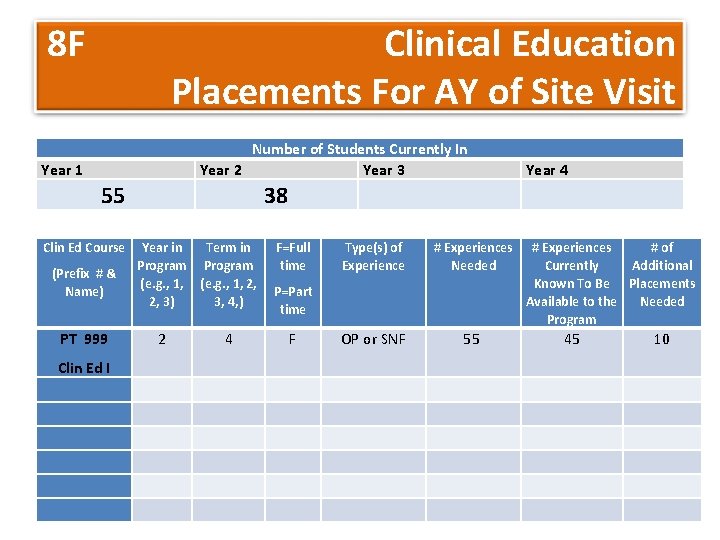
8 F Clinical Education Placements For AY of Site Visit Year 1 55 Clin Ed Course (Prefix # & Name) Year 1 Number of Students Currently In Year 2 Year 3 Year 4 38 Year in Term in F=Full Type(s) of # Experiences # of Program time Experience Needed Currently Additional (e. g. , 1, 2, Number of Students Currently In Known To Be Placements P=Part Year 2 Year 3 Year 4 2, 3) 3, 4, ) Available to the Needed time Program PT 999 2 4 F OP or SNF 55 45 10 Clin Ed I 74 8/1/15 ©APTA Department of Accreditation
Questions? Sandra Wise Sr Director of Accreditation sandrawise@apta. org Candy Bahner Lead PT Programs Specialist candybahner@apta. org For Portal Questions: Tej Chana Database Specialist tejchana@apta. org 8/1/15 ©APTA Department of Accreditation 75
- Slides: 75