
Onsite availability of guidelines and standard operating procedures
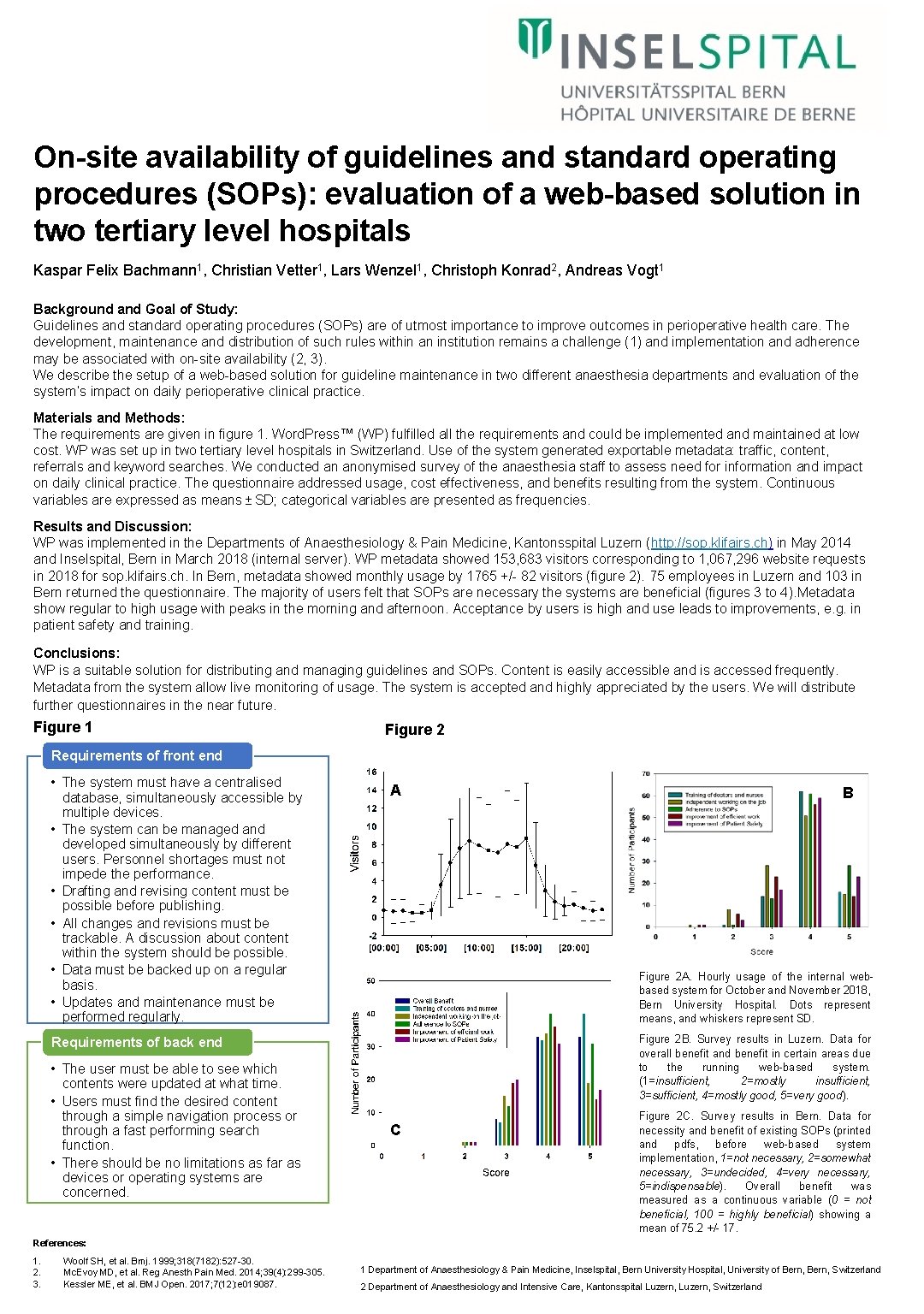
On-site availability of guidelines and standard operating procedures (SOPs): evaluation of a web-based solution in two tertiary level hospitals Kaspar Felix Bachmann 1, Christian Vetter 1, Lars Wenzel 1, Christoph Konrad 2, Andreas Vogt 1 Background and Goal of Study: Guidelines and standard operating procedures (SOPs) are of utmost importance to improve outcomes in perioperative health care. The development, maintenance and distribution of such rules within an institution remains a challenge (1) and implementation and adherence may be associated with on-site availability (2, 3). We describe the setup of a web-based solution for guideline maintenance in two different anaesthesia departments and evaluation of the system’s impact on daily perioperative clinical practice. Materials and Methods: The requirements are given in figure 1. Word. Press™ (WP) fulfilled all the requirements and could be implemented and maintained at low cost. WP was set up in two tertiary level hospitals in Switzerland. Use of the system generated exportable metadata: traffic, content, referrals and keyword searches. We conducted an anonymised survey of the anaesthesia staff to assess need for information and impact on daily clinical practice. The questionnaire addressed usage, cost effectiveness, and benefits resulting from the system. Continuous variables are expressed as means ± SD; categorical variables are presented as frequencies. Results and Discussion: WP was implemented in the Departments of Anaesthesiology & Pain Medicine, Kantonsspital Luzern (http: //sop. klifairs. ch) in May 2014 and Inselspital, Bern in March 2018 (internal server). WP metadata showed 153, 683 visitors corresponding to 1, 067, 296 website requests in 2018 for sop. klifairs. ch. In Bern, metadata showed monthly usage by 1765 +/- 82 visitors (figure 2). 75 employees in Luzern and 103 in Bern returned the questionnaire. The majority of users felt that SOPs are necessary the systems are beneficial (figures 3 to 4). Metadata show regular to high usage with peaks in the morning and afternoon. Acceptance by users is high and use leads to improvements, e. g. in patient safety and training. Conclusions: WP is a suitable solution for distributing and managing guidelines and SOPs. Content is easily accessible and is accessed frequently. Metadata from the system allow live monitoring of usage. The system is accepted and highly appreciated by the users. We will distribute further questionnaires in the near future. Figure 1 Figure 2 Requirements of front end • The system must have a centralised database, simultaneously accessible by multiple devices. • The system can be managed and developed simultaneously by different users. Personnel shortages must not impede the performance. • Drafting and revising content must be possible before publishing. • All changes and revisions must be trackable. A discussion about content within the system should be possible. • Data must be backed up on a regular basis. • Updates and maintenance must be performed regularly. A Figure 2 A. Hourly usage of the internal webbased system for October and November 2018, Bern University Hospital. Dots represent means, and whiskers represent SD. Figure 2 B. Survey results in Luzern. Data for overall benefit and benefit in certain areas due to the running web-based system. (1=insufficient, 2=mostly insufficient, 3=sufficient, 4=mostly good, 5=very good). Requirements of back end • The user must be able to see which contents were updated at what time. • Users must find the desired content through a simple navigation process or through a fast performing search function. • There should be no limitations as far as devices or operating systems are concerned. B C Figure 2 C. Survey results in Bern. Data for necessity and benefit of existing SOPs (printed and pdfs, before web-based system implementation, 1=not necessary, 2=somewhat necessary, 3=undecided, 4=very necessary, 5=indispensable). Overall benefit was measured as a continuous variable (0 = not beneficial, 100 = highly beneficial) showing a mean of 75. 2 +/- 17. References: 1. 2. 3. Woolf SH, et al. Bmj. 1999; 318(7182): 527 -30. Mc. Evoy MD, et al. Reg Anesth Pain Med. 2014; 39(4): 299 -305. Kessler ME, et al. BMJ Open. 2017; 7(12): e 019087. 1 Department of Anaesthesiology & Pain Medicine, Inselspital, Bern University Hospital, University of Bern, Switzerland 2 Department of Anaesthesiology and Intensive Care, Kantonsspital Luzern, Switzerland
- Slides: 1