
ONNX at One Flow Jianhao Zhang One Flow
- Slides: 13
ONNX at One. Flow Jianhao Zhang One. Flow Inc.
About me ● ● Git. Hub: daquexian A developer at One. Flow Inc. An active contributor from ONNX community, a member of operator SIG ONNX-related work: ○ ○ ● ONNX <-> One. Flow conversion (today’s presentation) onnx-simplifier onnx/optimizer resize and softmax op spec Also a presenter at the ONNX workshop in Shanghai last year (about one of my previous work, integration of Android NNAPI and ONNX Runtime)
What is One. Flow Oneflow is a brand-new open-source training framework which is focused on distributed training. It makes distributed training on multi-machines and multi-devices as easy as it is on a single device. ● ● ● Perfectly support container platforms(k 8 s & docker) Handle large models easily Almost zero runtime overhead & linear speedup Support multiple deep learning compilers (XLA, Tensor. RT etc) Support automatic mixed precision
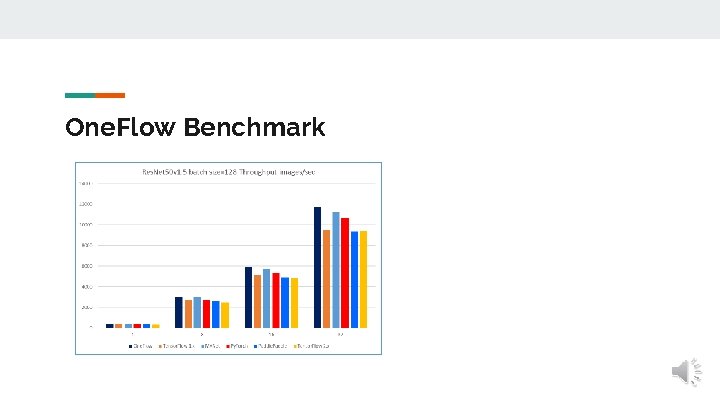
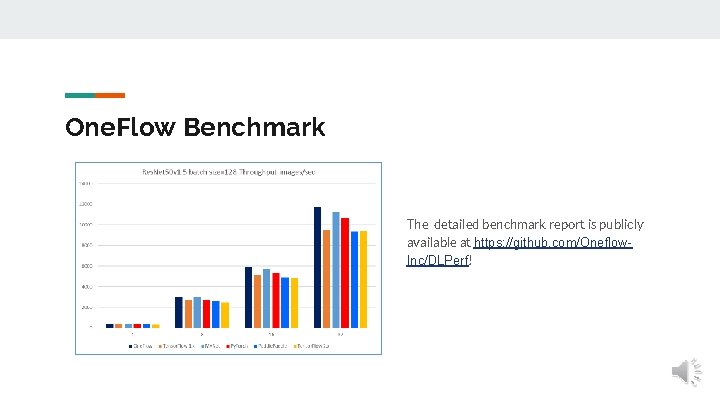
One. Flow Benchmark
One. Flow Benchmark The detailed benchmark report is publicly available at https: //github. com/Oneflow. Inc/DLPerf!
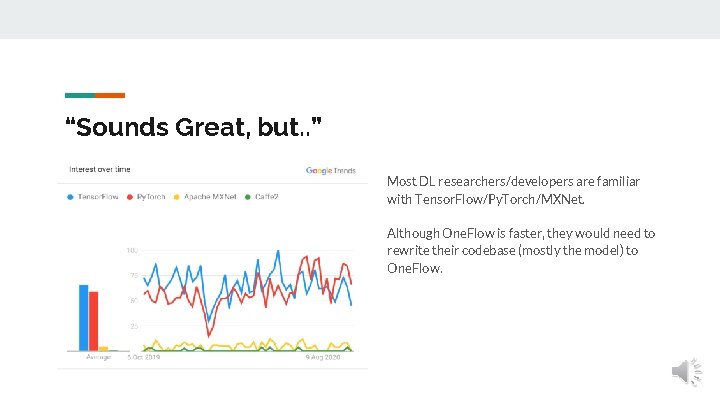
“Sounds Great, but. . ” Most DL researchers/developers are familiar with Tensor. Flow/Py. Torch/MXNet. Although One. Flow is faster, they would need to rewrite their codebase (mostly the model) to One. Flow.
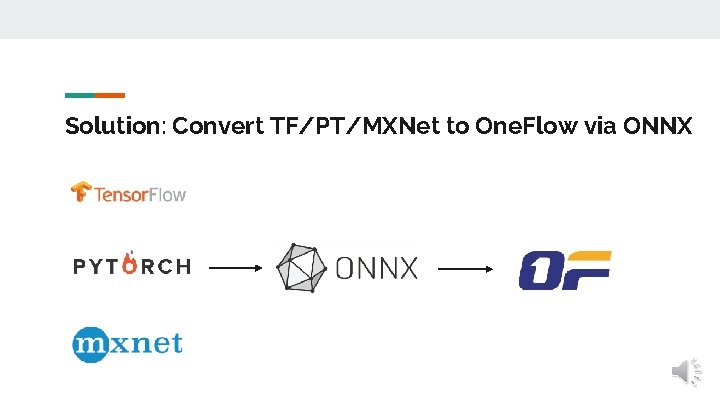
Solution: Convert TF/PT/MXNet to One. Flow via ONNX
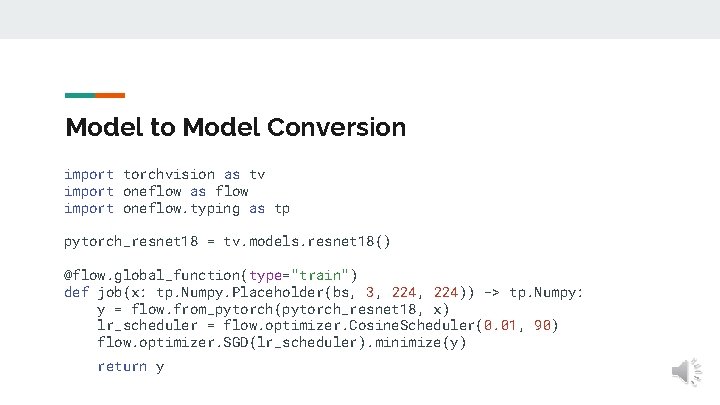
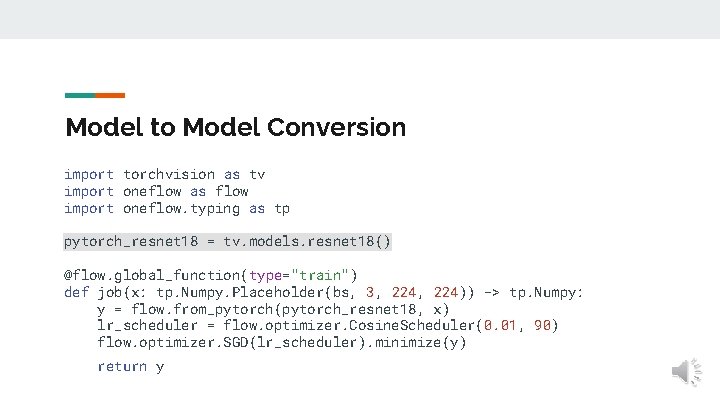
Model to Model Conversion import torchvision as tv import oneflow as flow import oneflow. typing as tp pytorch_resnet 18 = tv. models. resnet 18() @flow. global_function(type="train") def job(x: tp. Numpy. Placeholder(bs, 3, 224)) -> tp. Numpy: y = flow. from_pytorch(pytorch_resnet 18, x) lr_scheduler = flow. optimizer. Cosine. Scheduler(0. 01, 90) flow. optimizer. SGD(lr_scheduler). minimize(y) return y
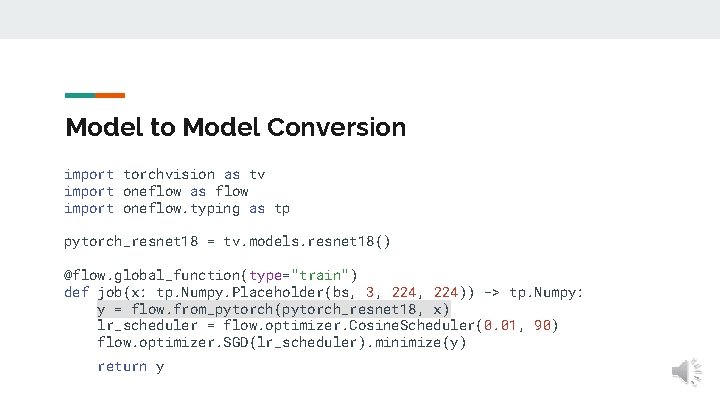
Model to Model Conversion import torchvision as tv import oneflow as flow import oneflow. typing as tp pytorch_resnet 18 = tv. models. resnet 18() @flow. global_function(type="train") def job(x: tp. Numpy. Placeholder(bs, 3, 224)) -> tp. Numpy: y = flow. from_pytorch(pytorch_resnet 18, x) lr_scheduler = flow. optimizer. Cosine. Scheduler(0. 01, 90) flow. optimizer. SGD(lr_scheduler). minimize(y) return y
Model to Model Conversion import torchvision as tv import oneflow as flow import oneflow. typing as tp pytorch_resnet 18 = tv. models. resnet 18() @flow. global_function(type="train") def job(x: tp. Numpy. Placeholder(bs, 3, 224)) -> tp. Numpy: y = flow. from_pytorch(pytorch_resnet 18, x) lr_scheduler = flow. optimizer. Cosine. Scheduler(0. 01, 90) flow. optimizer. SGD(lr_scheduler). minimize(y) return y
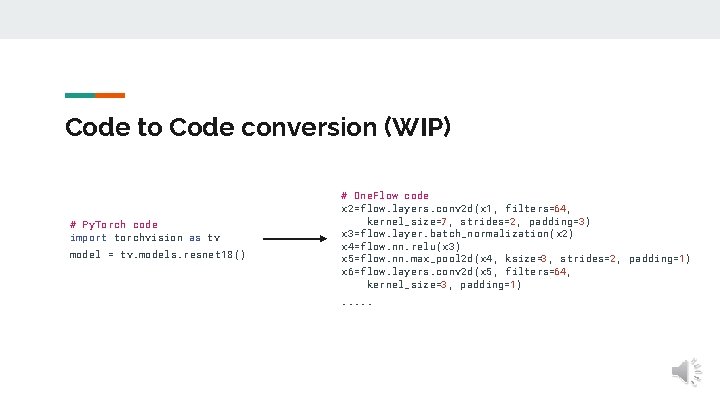
Code to Code conversion (WIP) # Py. Torch code import torchvision as tv model = tv. models. resnet 18() # One. Flow code x 2=flow. layers. conv 2 d(x 1, filters=64, kernel_size=7, strides=2, padding=3) x 3=flow. layer. batch_normalization(x 2) x 4=flow. nn. relu(x 3) x 5=flow. nn. max_pool 2 d(x 4, ksize=3, strides=2, padding=1) x 6=flow. layers. conv 2 d(x 5, filters=64, kernel_size=3, padding=1). . .
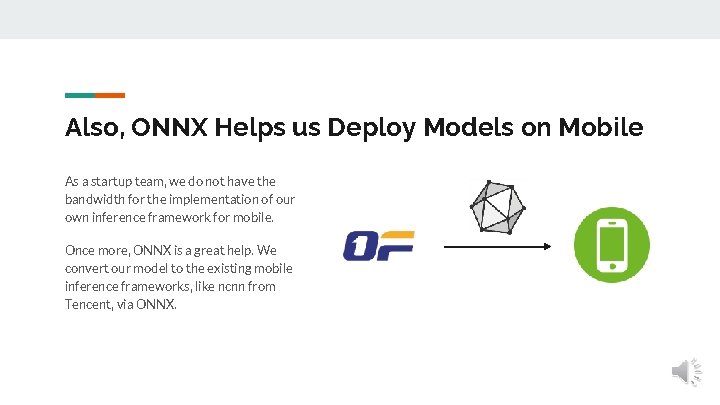
Also, ONNX Helps us Deploy Models on Mobile As a startup team, we do not have the bandwidth for the implementation of our own inference framework for mobile. Once more, ONNX is a great help. We convert our model to the existing mobile inference frameworks, like ncnn from Tencent, via ONNX.
Thanks! Our Git. Hub: https: //github. com/Oneflow-Inc