
Online water quality monitoring as a tool for
- Slides: 17
Online water quality monitoring as a tool for achieving SDG # 6. 3 Arab Water Week 2019 / Tharwh Qutaish
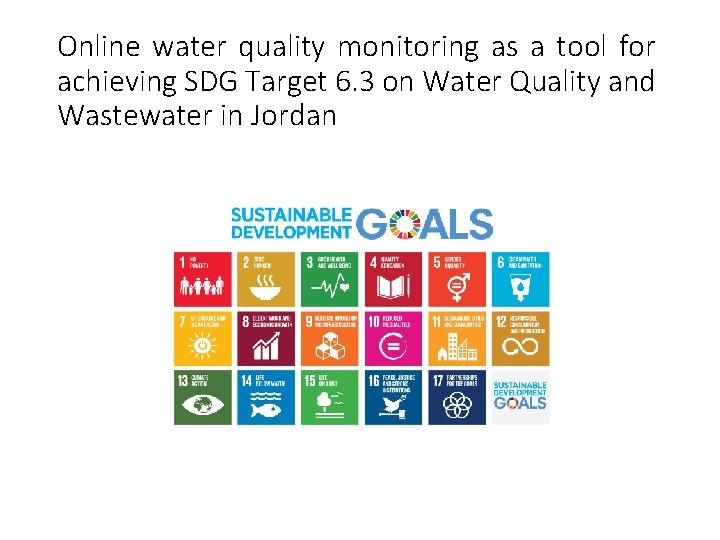
Online water quality monitoring as a tool for achieving SDG Target 6. 3 on Water Quality and Wastewater in Jordan
Target 6. 3 sets out to improve ambient water quality, which is essential to protecting both ecosystem health and human health, by eliminating, minimizing and significantly reducing different streams of pollution into water bodies. The main sources of pollution include wastewater from households, commercial establishments and industries (point sources), as well as run-off from urban and agricultural land (non-point sources).
Target 6. 3 has the aim to improve water quality by reducing pollution, eliminating dumping and minimizing release of hazardous chemicals and materials, halving the proportion of untreated wastewater and increasing recycling and safe reuse globally by 2030. Progress toward this target will be assessed on the basis of two indicators: 6. 3. 1, the proportion of wastewater safely treated, and 6. 3. 2, the proportion of water bodies with good water quality
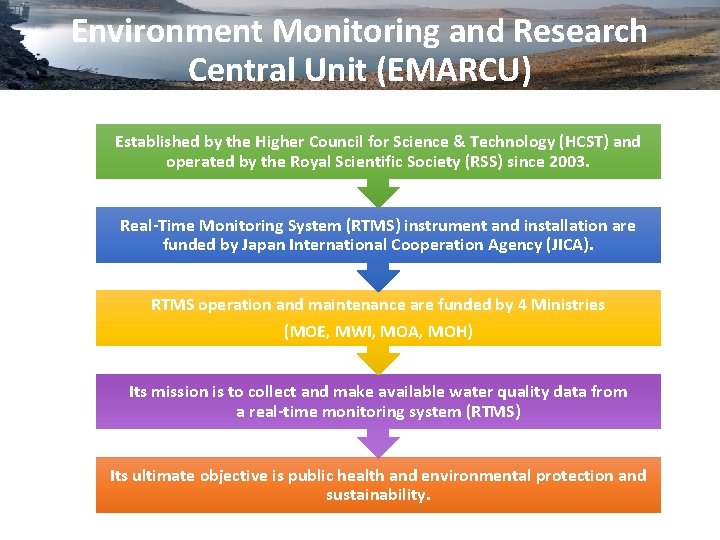
Environment Monitoring and Research Central Unit (EMARCU) Established by the Higher Council for Science & Technology (HCST) and operated by the Royal Scientific Society (RSS) since 2003. Real-Time Monitoring System (RTMS) instrument and installation are funded by Japan International Cooperation Agency (JICA). RTMS operation and maintenance are funded by 4 Ministries (MOE, MWI, MOA, MOH) Its mission is to collect and make available water quality data from a real-time monitoring system (RTMS) Its ultimate objective is public health and environmental protection and sustainability.
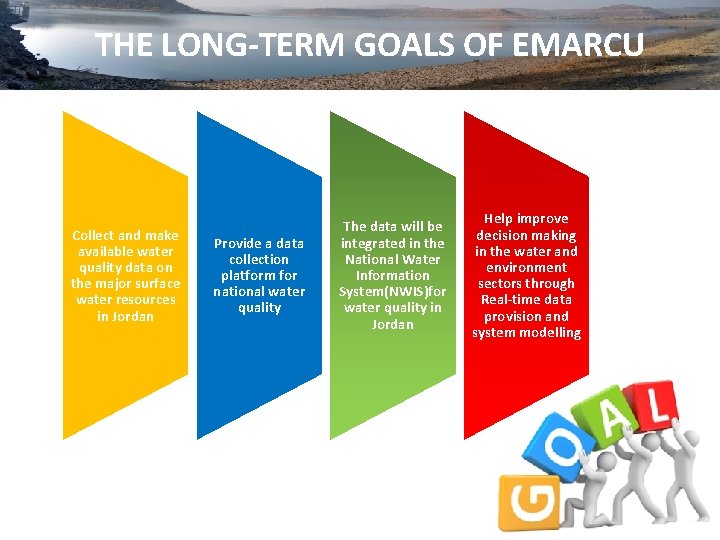
THE LONG-TERM GOALS OF EMARCU Collect and make available water quality data on the major surface water resources in Jordan Provide a data collection platform for national water quality The data will be integrated in the National Water Information System(NWIS)for water quality in Jordan Help improve decision making in the water and environment sectors through Real-time data provision and system modelling
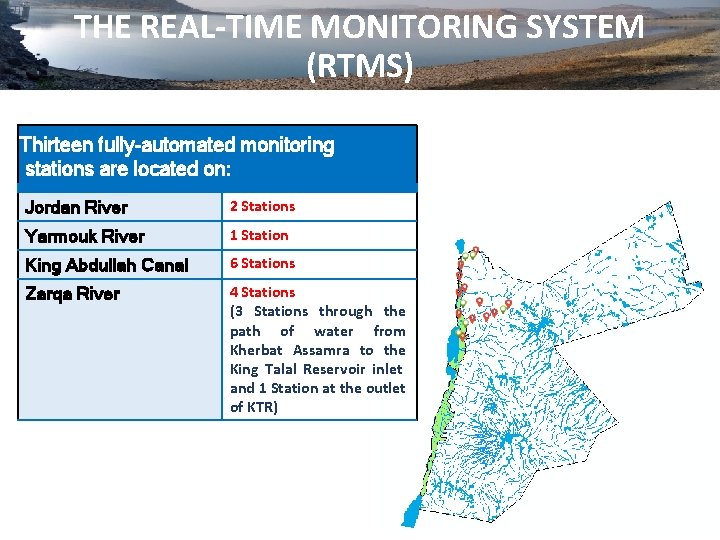
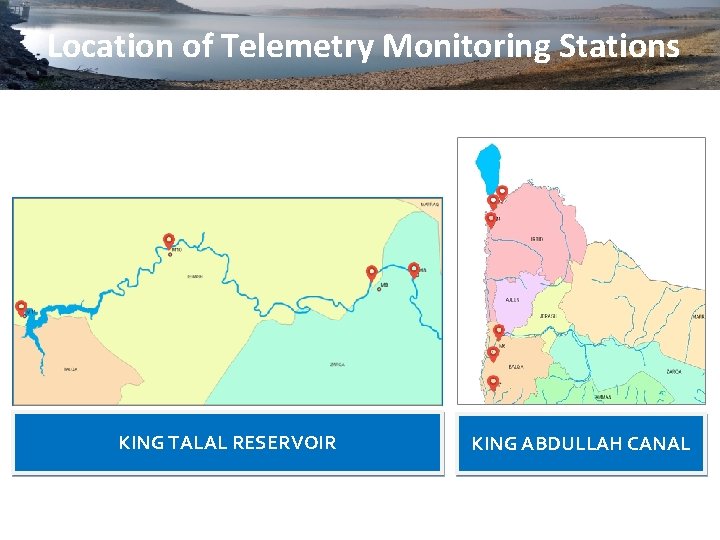
THE REAL-TIME MONITORING SYSTEM (RTMS) Thirteen fully-automated monitoring stations are located on: Jordan River 2 Stations Yarmouk River 1 Station King Abdullah Canal 6 Stations Zarqa River 4 Stations (3 Stations through the path of water from Kherbat Assamra to the King Talal Reservoir inlet and 1 Station at the outlet of KTR)
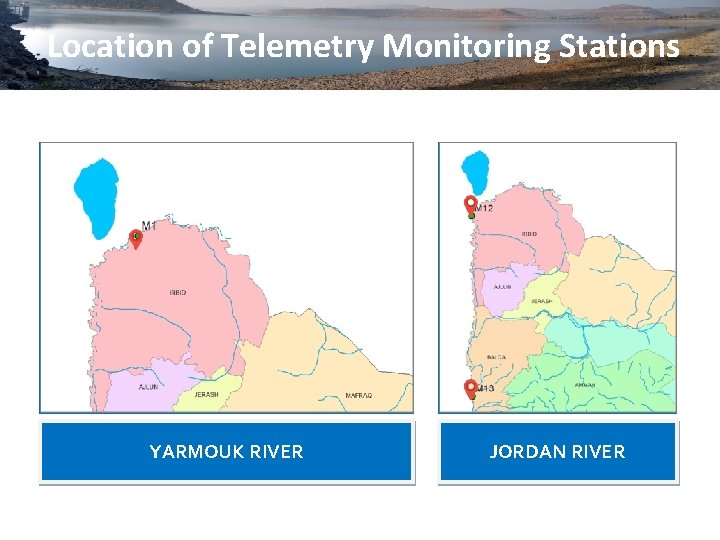
Location of Telemetry Monitoring Stations YARMOUK RIVER JORDAN RIVER
Location of Telemetry Monitoring Stations KING TALAL RESERVOIR KING ABDULLAH CANAL
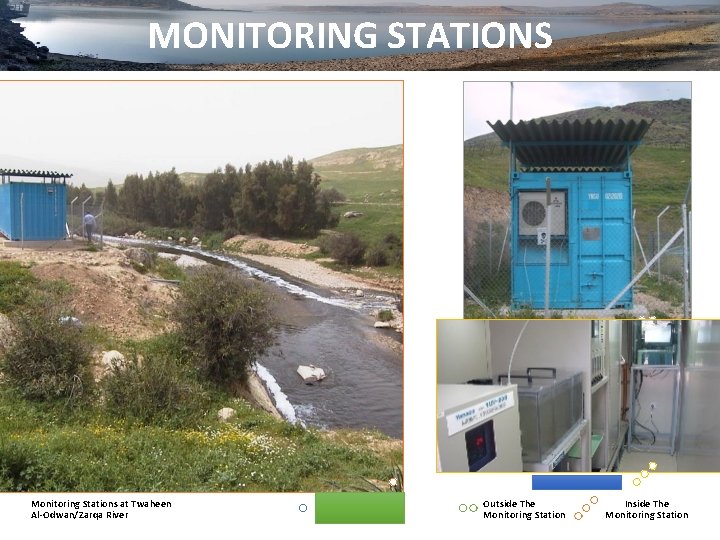
MONITORING STATIONS Monitoring Stations at Twaheen Al-Odwan/Zarqa River Outside The Monitoring Station Inside The Monitoring Station
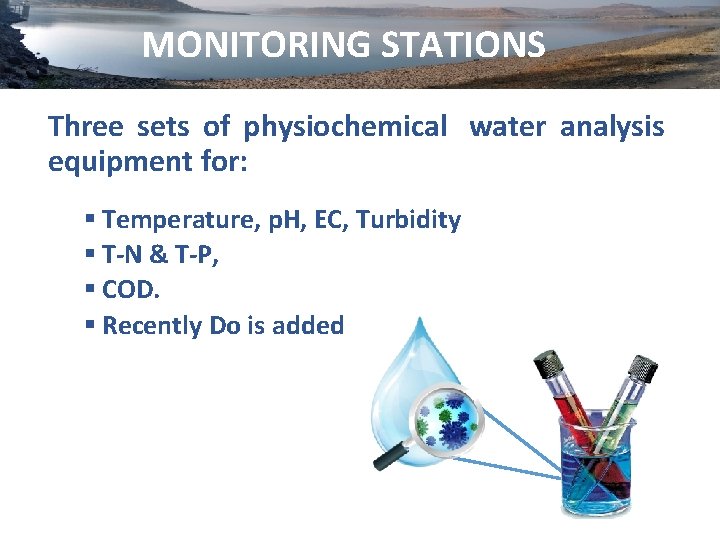
MONITORING STATIONS Three sets of physiochemical water analysis equipment for: § Temperature, p. H, EC, Turbidity § T-N & T-P, § COD. § Recently Do is added
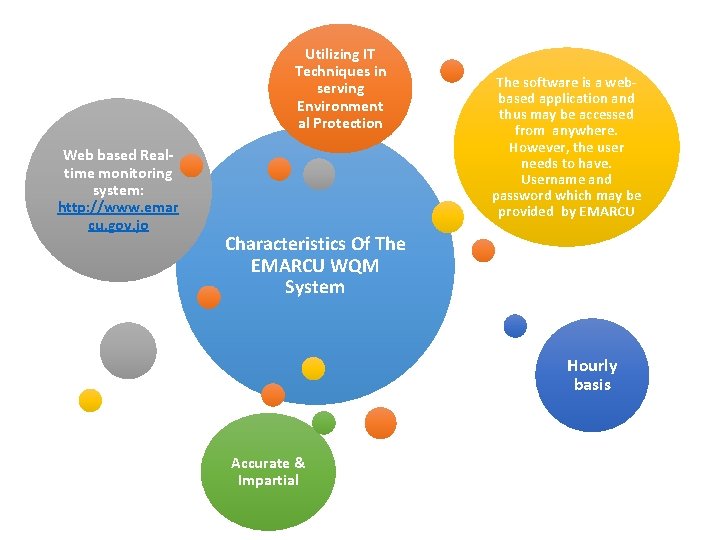
Utilizing IT Techniques in serving Environment al Protection Web based Realtime monitoring system: http: //www. emar cu. gov. jo The software is a webbased application and thus may be accessed from anywhere. However, the user needs to have. Username and password which may be provided by EMARCU Characteristics Of The EMARCU WQM System Hourly basis Accurate & Impartial
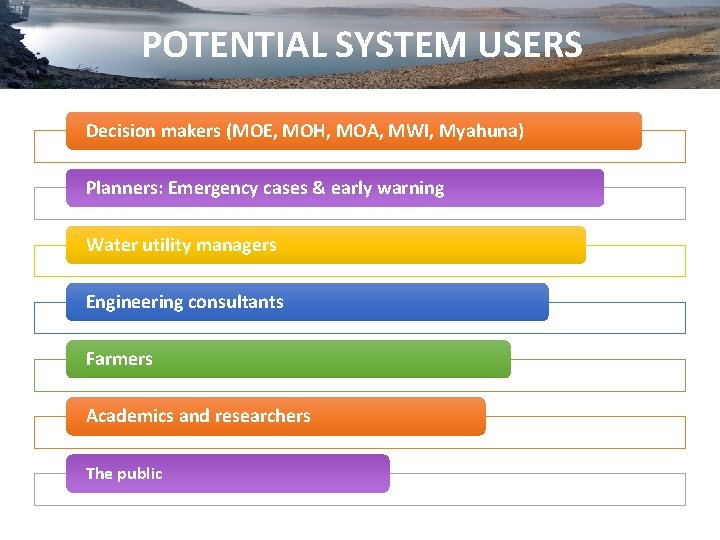
POTENTIAL SYSTEM USERS Decision makers (MOE, MOH, MOA, MWI, Myahuna) Planners: Emergency cases & early warning Water utility managers Engineering consultants Farmers Academics and researchers The public
EMARCU ACCREDITATION Accreditation EMARCU has been Accredited by UKAS, we are the first online system to be accredited in the Middle East.
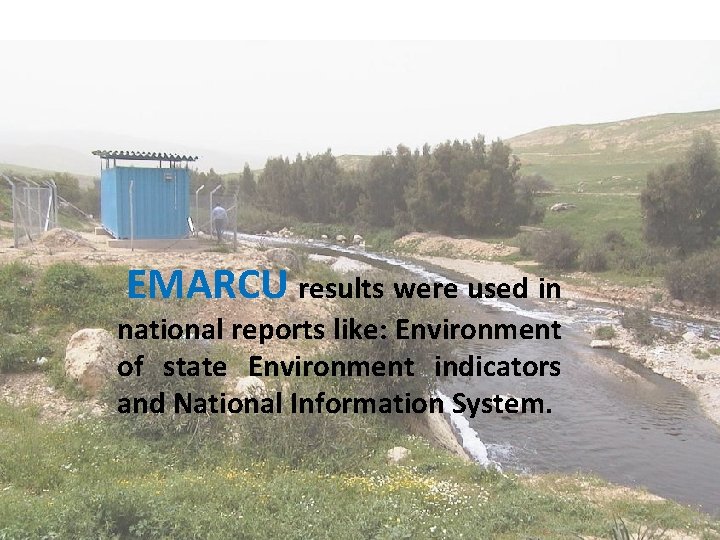
EMARCU results were used in national reports like: Environment of state Environment indicators and National Information System.
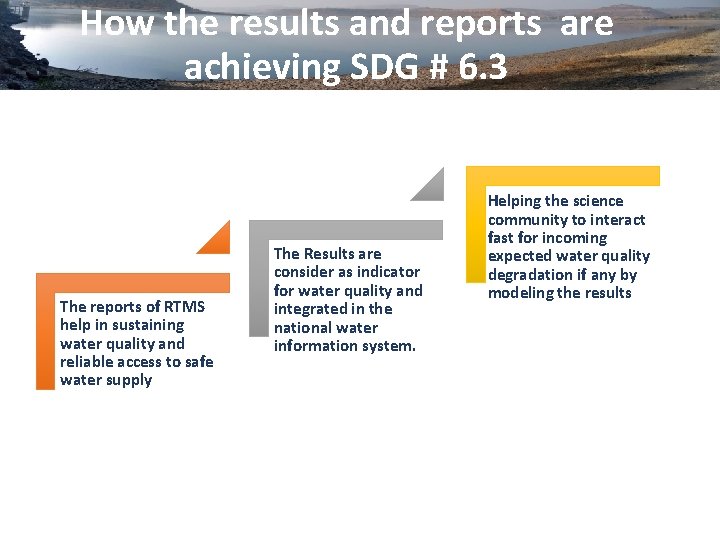
How the results and reports are achieving SDG # 6. 3 The reports of RTMS help in sustaining water quality and reliable access to safe water supply The Results are consider as indicator for water quality and integrated in the national water information system. Helping the science community to interact fast for incoming expected water quality degradation if any by modeling the results
THANK YOU