
Online Positioning User Service OPUS Part 2 NGS
- Slides: 44
Online Positioning User Service (OPUS) Part 2 NGS Geospatial Summit May 5, 2021 Phillip Mc. Farland Dru Smith Dan Gillins Spatial Reference Systems phillip. mcfarland@noaa. gov Modernization Manager dru. smith@noaa. gov Observation and Analysis daniel. gillins@noaa. gov 1
Poll Question For those familiar with OPUS, how useful would you find a tool that auto selects the best CORSs to use as geodetic control? A. Extremely useful B. Probably useful C. Neutral D. Probably not useful E. Definitely not useful 2
Motivation Use OPUS to process data the way you want “We will build significant flexibility into OPUS for you to process your data your way. ” -NGS Blueprint for 2022 Part 3 p. 63 3
Motivation Use OPUS to process data the way you want “We will build significant flexibility into OPUS for you to process your data your way. ” -NGS Blueprint for 2022 Part 3 p. 63 …but if you want your solution “tied to the NSRS” you must follow OPUS Recommendations. 4
Motivation Use OPUS to process data the way you want “We will build significant flexibility into OPUS for you to process your data your way. ” -NGS Blueprint for 2022 Part 3 p. 63 …but if you want your solution “tied to the NSRS” you must follow OPUS Recommendations. 5
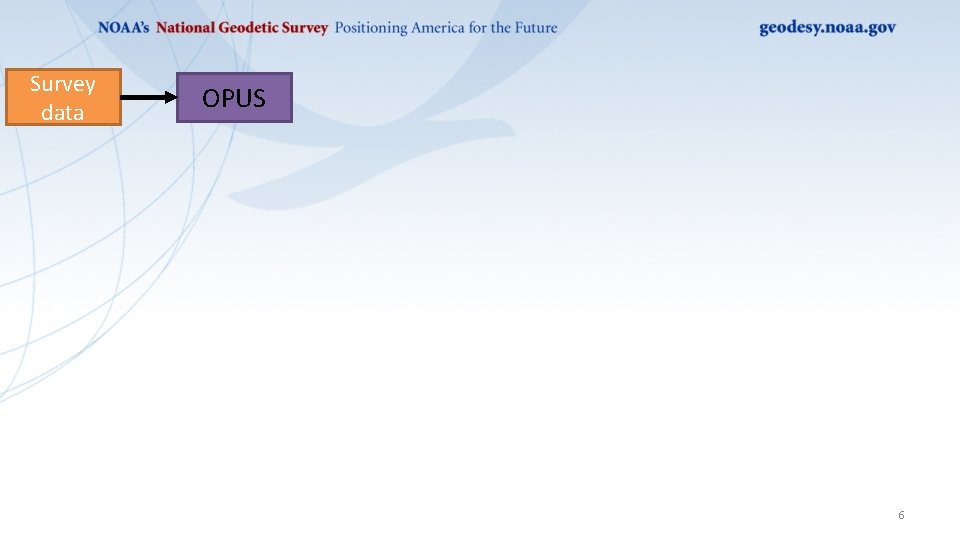
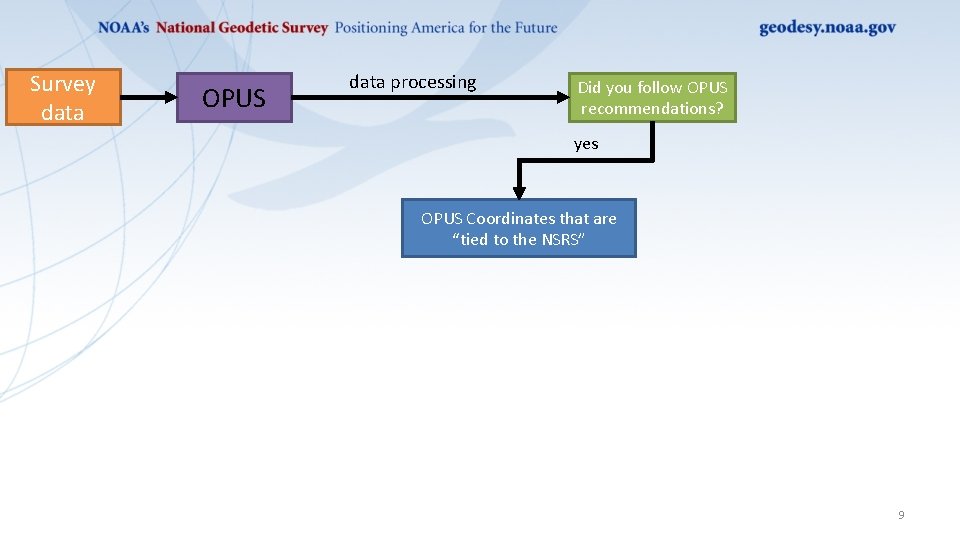
Survey data OPUS 6
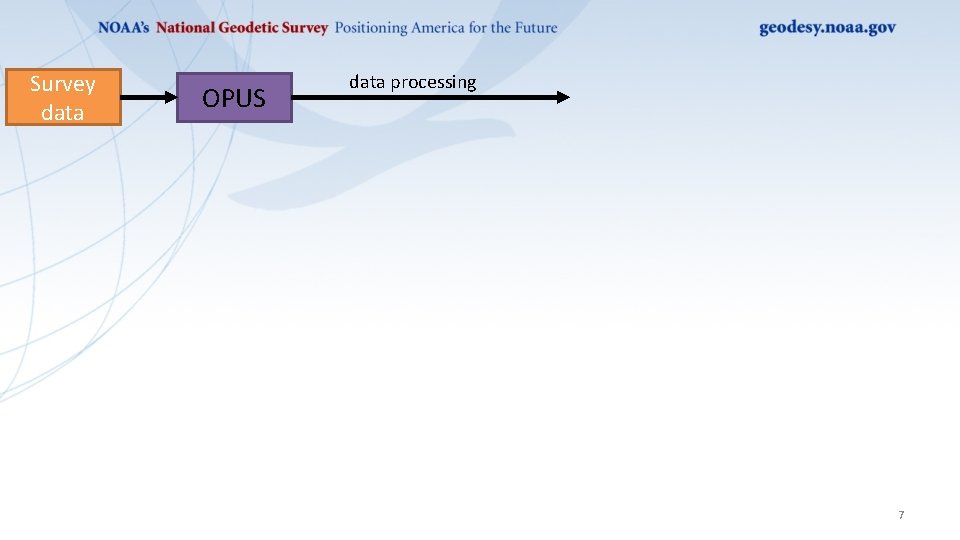
Survey data OPUS data processing 7
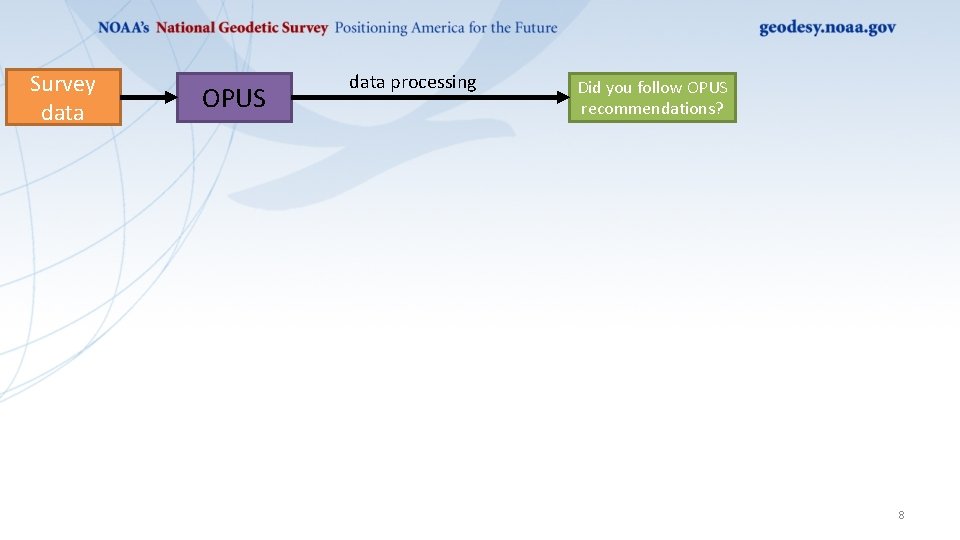
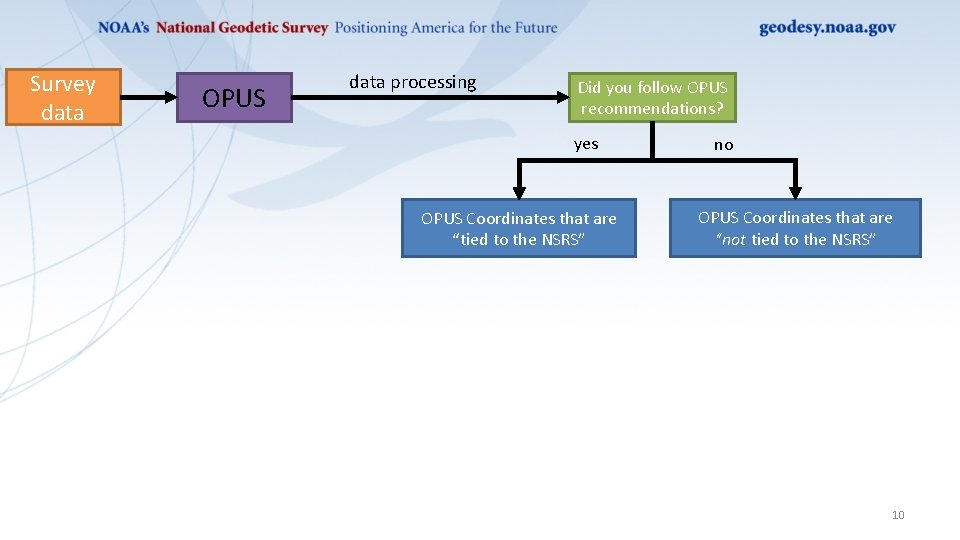
Survey data OPUS data processing Did you follow OPUS recommendations? 8
Survey data OPUS data processing Did you follow OPUS recommendations? yes OPUS Coordinates that are “tied to the NSRS” 9
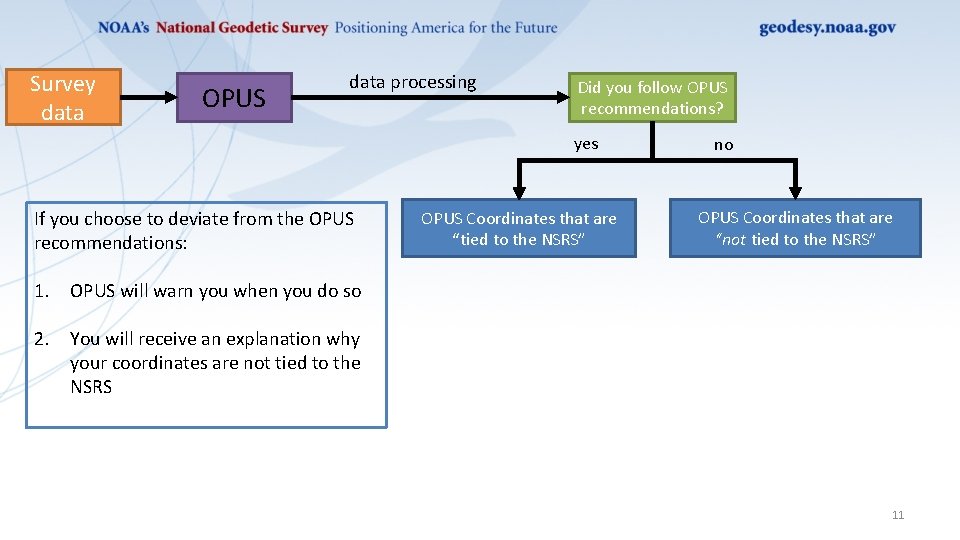
Survey data OPUS data processing Did you follow OPUS recommendations? yes OPUS Coordinates that are “tied to the NSRS” no OPUS Coordinates that are “not tied to the NSRS” 10
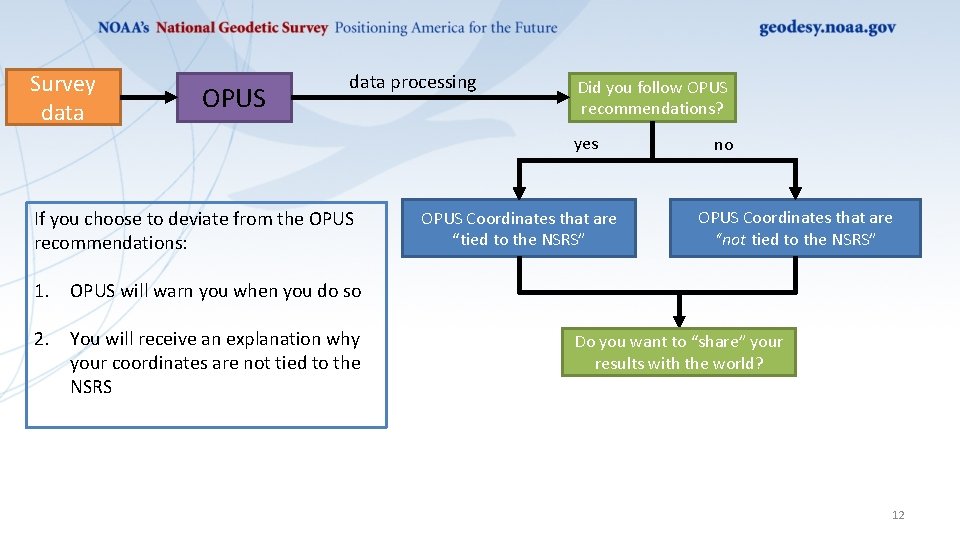
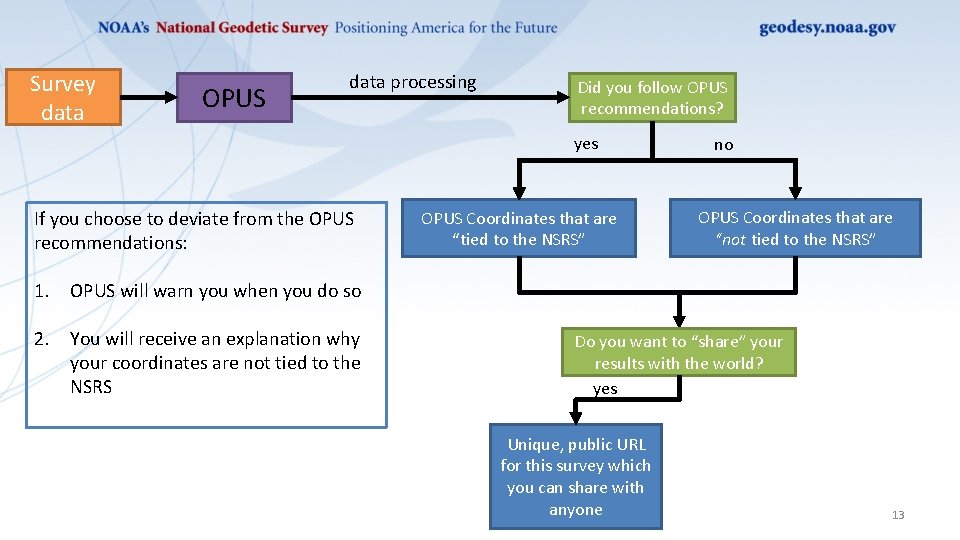
Survey data OPUS data processing Did you follow OPUS recommendations? yes If you choose to deviate from the OPUS recommendations: OPUS Coordinates that are “tied to the NSRS” no OPUS Coordinates that are “not tied to the NSRS” 1. OPUS will warn you when you do so 2. You will receive an explanation why your coordinates are not tied to the NSRS 11
Survey data OPUS data processing Did you follow OPUS recommendations? yes If you choose to deviate from the OPUS recommendations: OPUS Coordinates that are “tied to the NSRS” no OPUS Coordinates that are “not tied to the NSRS” 1. OPUS will warn you when you do so 2. You will receive an explanation why your coordinates are not tied to the NSRS Do you want to “share” your results with the world? 12
Survey data OPUS data processing Did you follow OPUS recommendations? yes If you choose to deviate from the OPUS recommendations: OPUS Coordinates that are “tied to the NSRS” no OPUS Coordinates that are “not tied to the NSRS” 1. OPUS will warn you when you do so 2. You will receive an explanation why your coordinates are not tied to the NSRS Do you want to “share” your results with the world? yes Unique, public URL for this survey which you can share with anyone 13
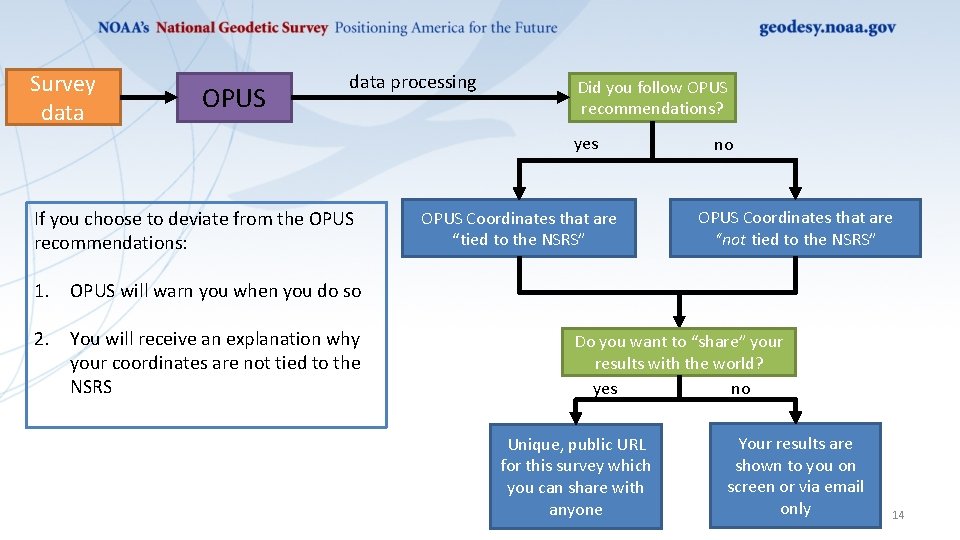
Survey data OPUS data processing Did you follow OPUS recommendations? yes If you choose to deviate from the OPUS recommendations: OPUS Coordinates that are “tied to the NSRS” no OPUS Coordinates that are “not tied to the NSRS” 1. OPUS will warn you when you do so 2. You will receive an explanation why your coordinates are not tied to the NSRS Do you want to “share” your results with the world? yes no Unique, public URL for this survey which you can share with anyone Your results are shown to you on screen or via email only 14
So what are the OPUS Recommendations going to be? 15
So what are the OPUS Recommendations going to be? DISCLAIMER – many OPUS Recommendations are still TBD 16
So what are the OPUS Recommendations going to be? DISCLAIMER – many OPUS Recommendations are still TBD General Classical surveying techniques Leveling GNSS 17
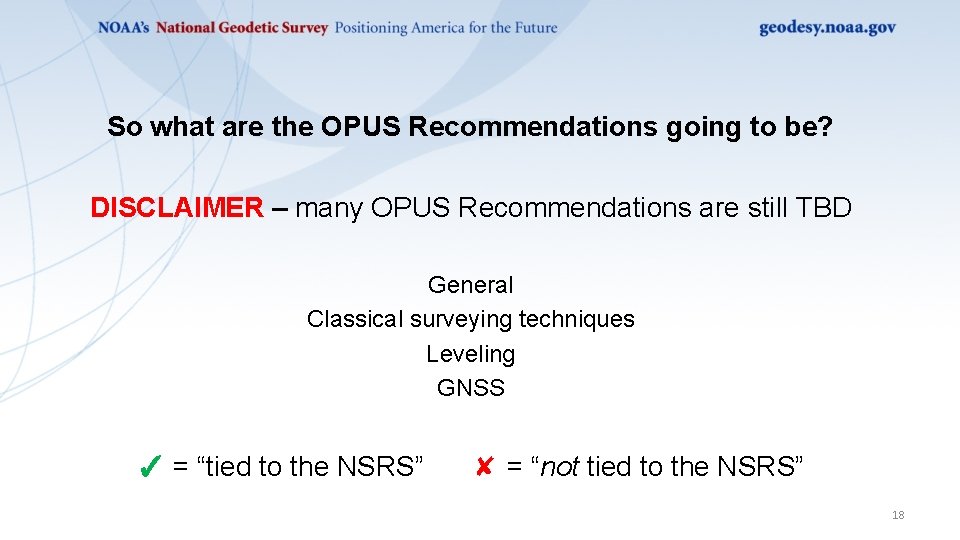
So what are the OPUS Recommendations going to be? DISCLAIMER – many OPUS Recommendations are still TBD General Classical surveying techniques Leveling GNSS ✓ = “tied to the NSRS” ✘ = “not tied to the NSRS” 18
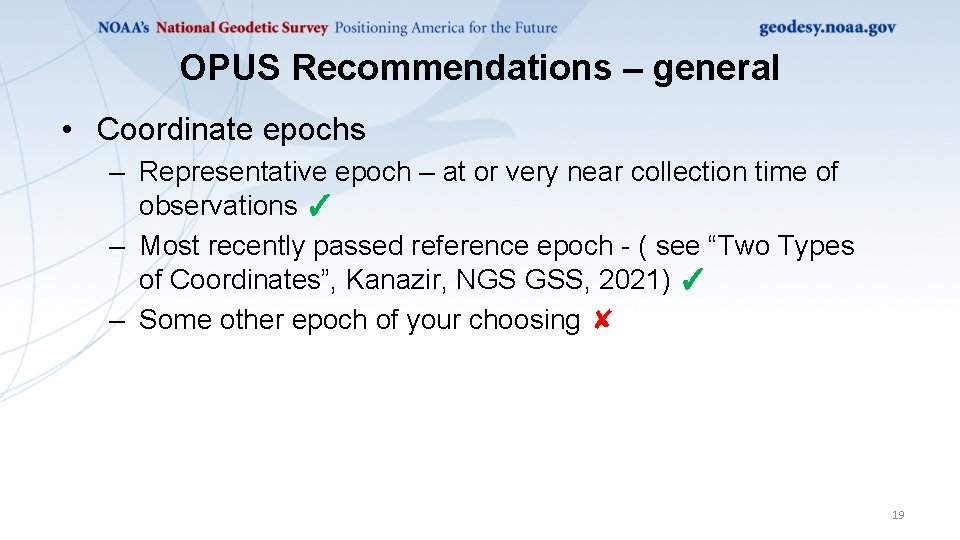
OPUS Recommendations – general • Coordinate epochs – Representative epoch – at or very near collection time of observations ✓ – Most recently passed reference epoch - ( see “Two Types of Coordinates”, Kanazir, NGS GSS, 2021) ✓ – Some other epoch of your choosing ✘ 19
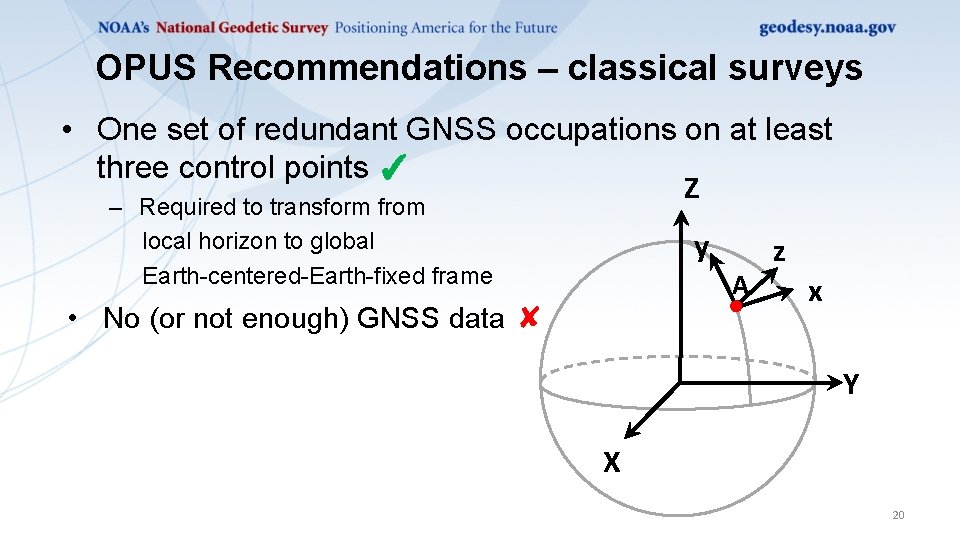
OPUS Recommendations – classical surveys • One set of redundant GNSS occupations on at least three control points ✓ Z – Required to transform from local horizon to global Earth-centered-Earth-fixed frame y A • No (or not enough) GNSS data ✘ z x Y X 20
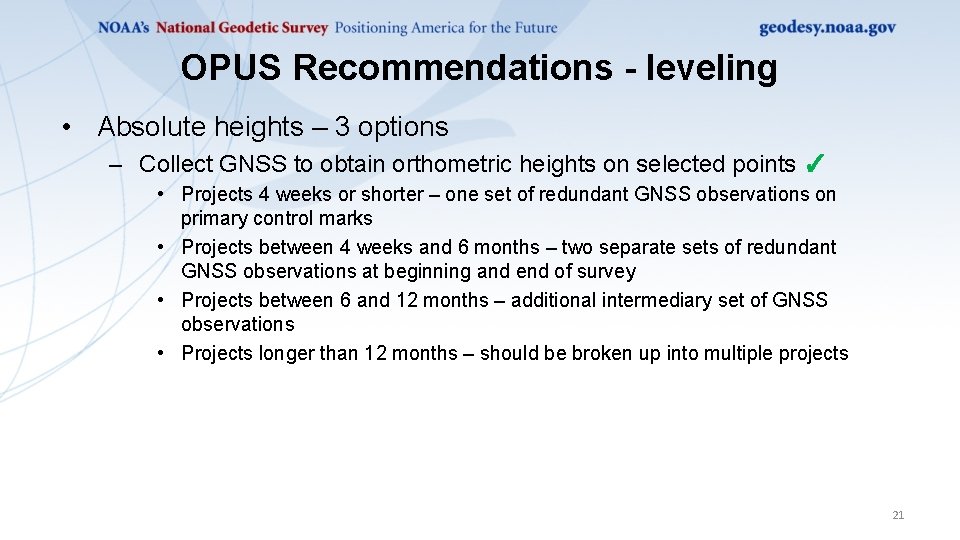
OPUS Recommendations - leveling • Absolute heights – 3 options – Collect GNSS to obtain orthometric heights on selected points ✓ • Projects 4 weeks or shorter – one set of redundant GNSS observations on primary control marks • Projects between 4 weeks and 6 months – two separate sets of redundant GNSS observations at beginning and end of survey • Projects between 6 and 12 months – additional intermediary set of GNSS observations • Projects longer than 12 months – should be broken up into multiple projects 21
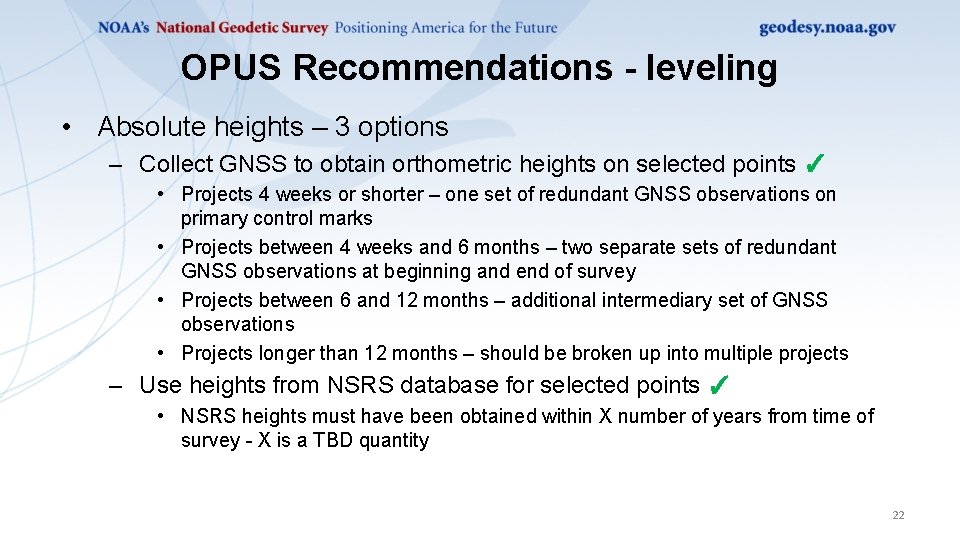
OPUS Recommendations - leveling • Absolute heights – 3 options – Collect GNSS to obtain orthometric heights on selected points ✓ • Projects 4 weeks or shorter – one set of redundant GNSS observations on primary control marks • Projects between 4 weeks and 6 months – two separate sets of redundant GNSS observations at beginning and end of survey • Projects between 6 and 12 months – additional intermediary set of GNSS observations • Projects longer than 12 months – should be broken up into multiple projects – Use heights from NSRS database for selected points ✓ • NSRS heights must have been obtained within X number of years from time of survey - X is a TBD quantity 22
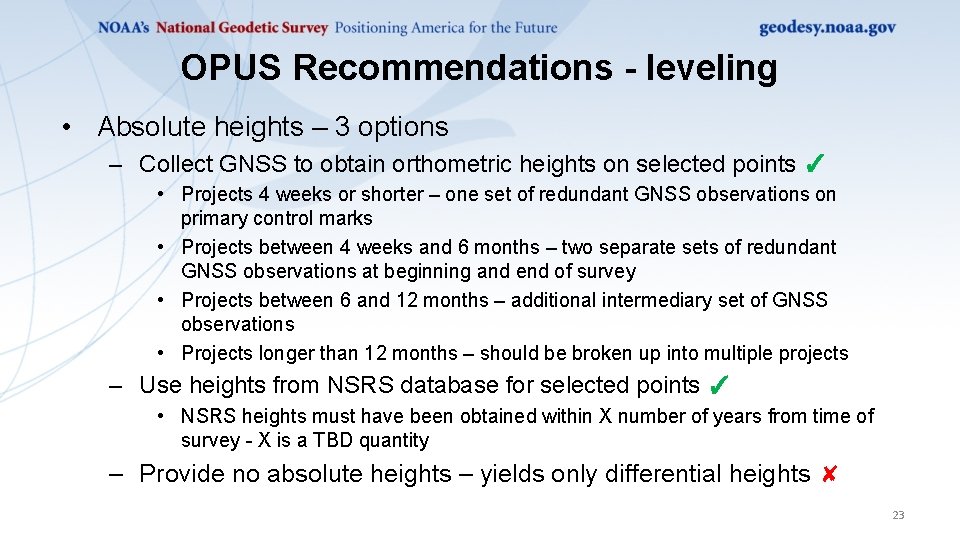
OPUS Recommendations - leveling • Absolute heights – 3 options – Collect GNSS to obtain orthometric heights on selected points ✓ • Projects 4 weeks or shorter – one set of redundant GNSS observations on primary control marks • Projects between 4 weeks and 6 months – two separate sets of redundant GNSS observations at beginning and end of survey • Projects between 6 and 12 months – additional intermediary set of GNSS observations • Projects longer than 12 months – should be broken up into multiple projects – Use heights from NSRS database for selected points ✓ • NSRS heights must have been obtained within X number of years from time of survey - X is a TBD quantity – Provide no absolute heights – yields only differential heights ✘ 23
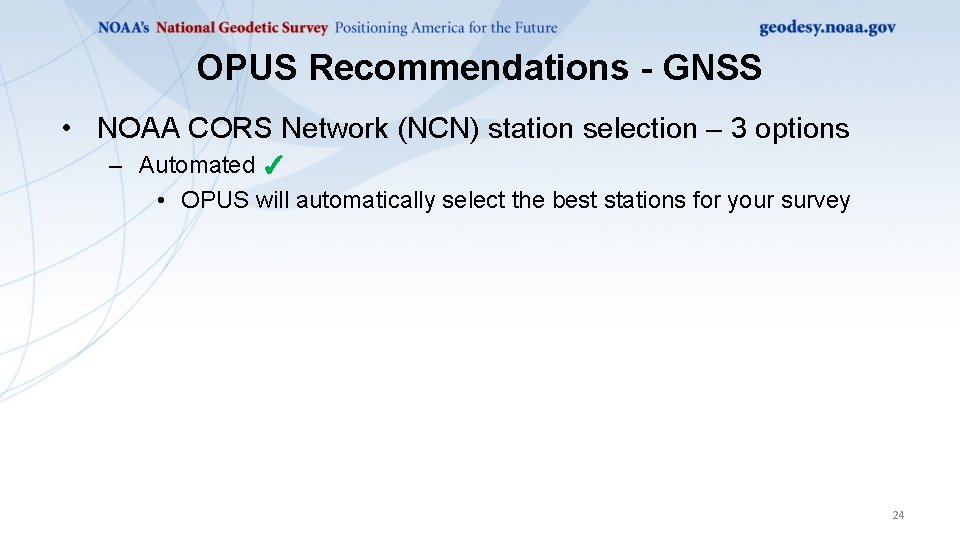
OPUS Recommendations - GNSS • NOAA CORS Network (NCN) station selection – 3 options – Automated ✓ • OPUS will automatically select the best stations for your survey 24
OPUS Recommendations - GNSS • NOAA CORS Network (NCN) station selection – 3 options – Automated ✓ • OPUS will automatically select the best stations for your survey – Manual selection from OPUS recommendations ✓ • The user will be able to select stations from a list of OPUS recommended stations that fall above a TBD quality threshold 25
OPUS Recommendations - GNSS • NOAA CORS Network (NCN) station selection – 3 options – Automated ✓ • OPUS will automatically select the best stations for your survey – Manual selection from OPUS recommendations ✓ • The user will be able to select stations from a list of OPUS recommended stations that fall above a TBD quality threshold – Manual selection ignoring OPUS recommendations • The station can be used – but not as control – and coordinates may still be labelled “tied to the NSRS” ✓ • If the station is used as control – the resulting coordinates will not be tied to the NSRS ✘ 26
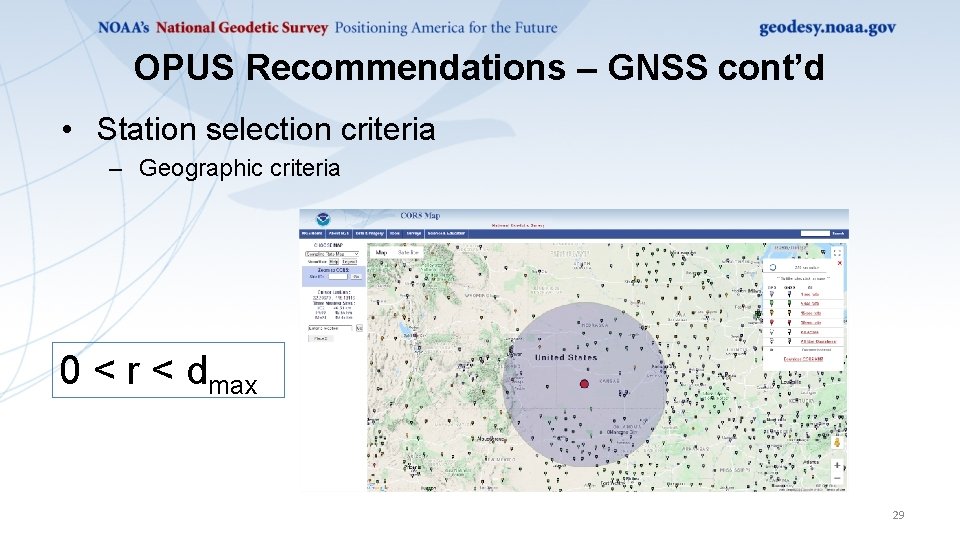
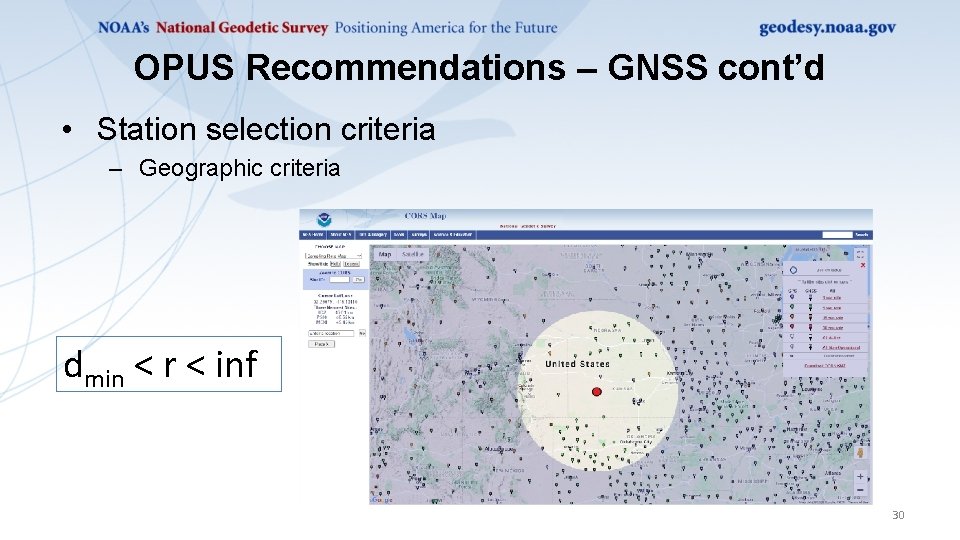
OPUS Recommendations – GNSS cont’d • Station selection criteria – Geographic criteria – Quantitative criteria – Qualitative criteria 27
OPUS Recommendations – GNSS cont’d • Station selection criteria – Geographic criteria – Quantitative criteria – Qualitative criteria 28
OPUS Recommendations – GNSS cont’d • Station selection criteria – Geographic criteria 0 < r < dmax 29
OPUS Recommendations – GNSS cont’d • Station selection criteria – Geographic criteria dmin < r < inf 30
OPUS Recommendations – GNSS cont’d • Station selection criteria – Geographic criteria – Quantitative criteria – Qualitative criteria 31
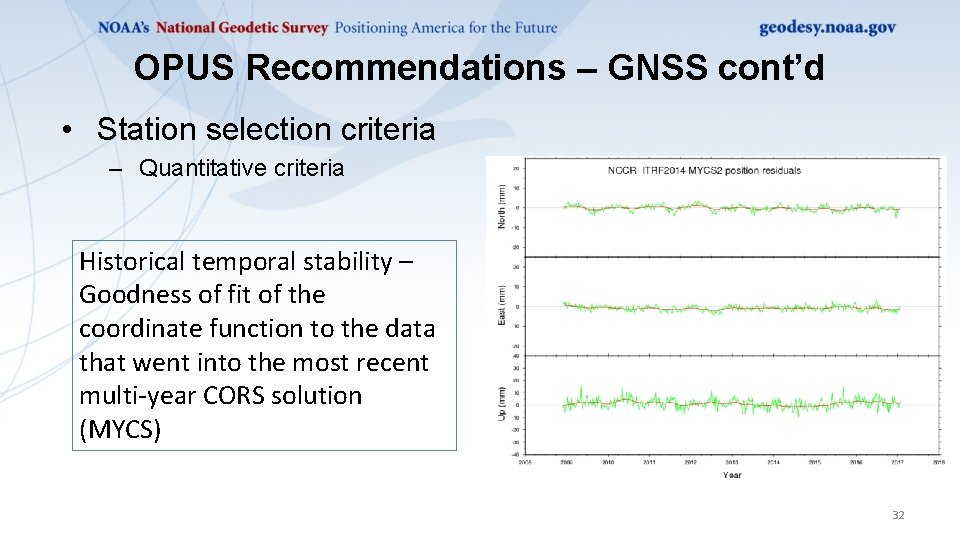
OPUS Recommendations – GNSS cont’d • Station selection criteria – Quantitative criteria Historical temporal stability – Goodness of fit of the coordinate function to the data that went into the most recent multi-year CORS solution (MYCS) 32
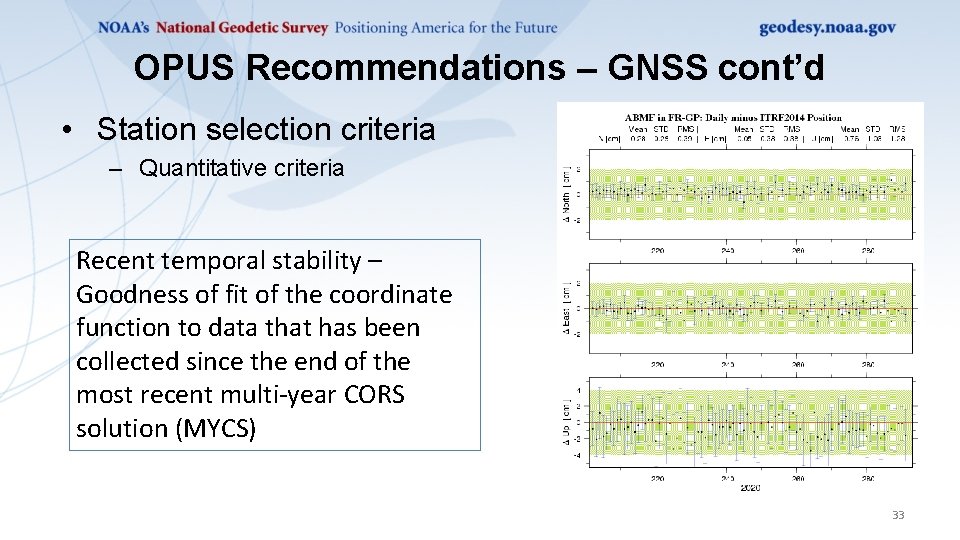
OPUS Recommendations – GNSS cont’d • Station selection criteria – Quantitative criteria Recent temporal stability – Goodness of fit of the coordinate function to data that has been collected since the end of the most recent multi-year CORS solution (MYCS) 33
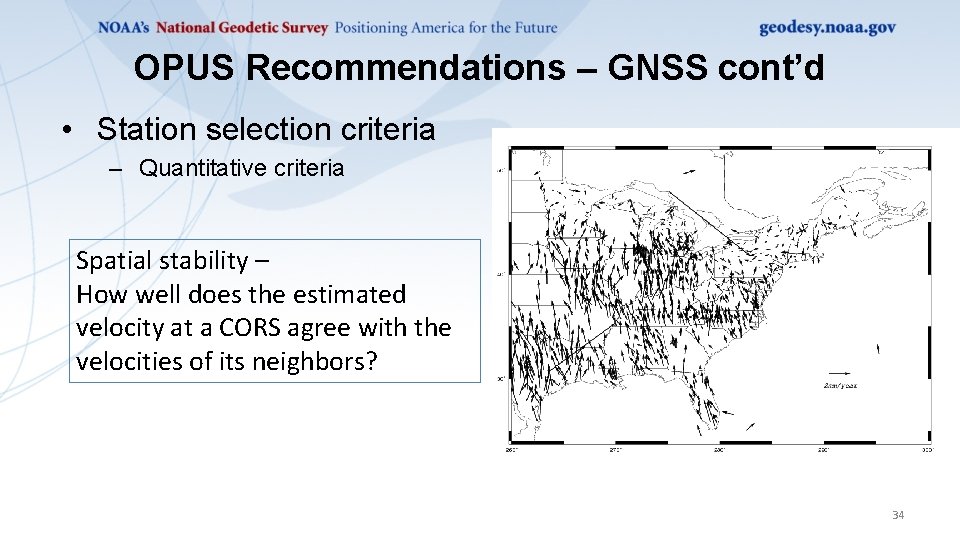
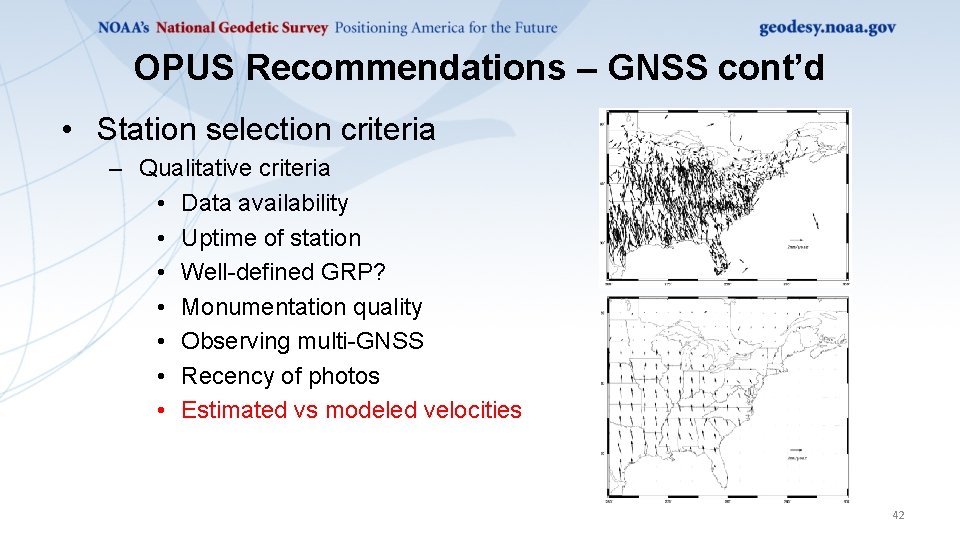
OPUS Recommendations – GNSS cont’d • Station selection criteria – Quantitative criteria Spatial stability – How well does the estimated velocity at a CORS agree with the velocities of its neighbors? 34
OPUS Recommendations – GNSS cont’d • Station selection criteria – Geographic criteria – Quantitative criteria – Qualitative criteria 35
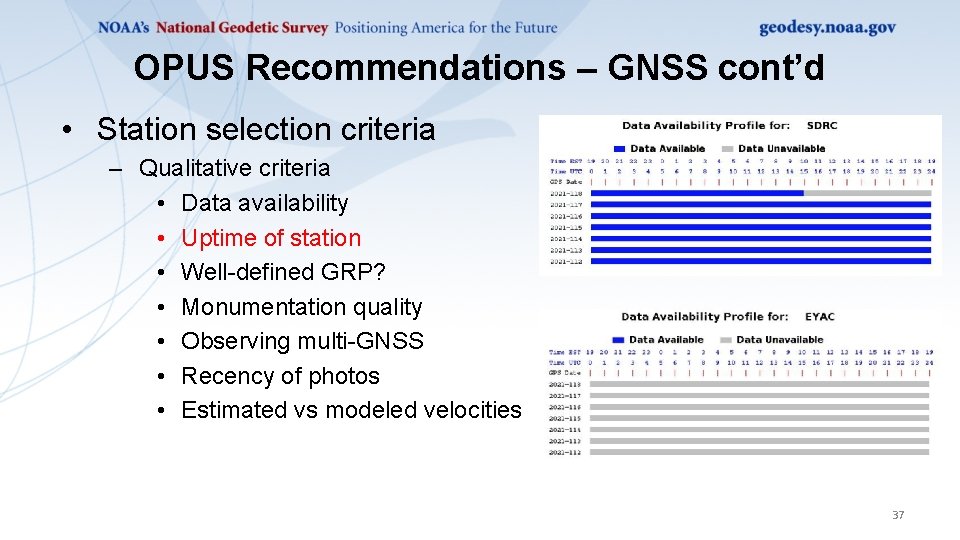
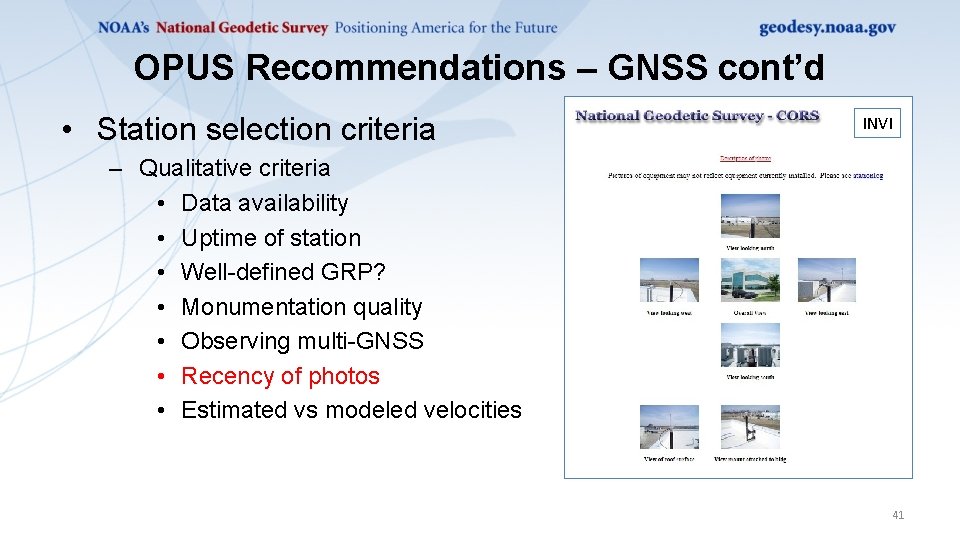
OPUS Recommendations – GNSS cont’d • Station selection criteria – Qualitative criteria • Data availability • Uptime of station • Well-defined GRP? • Monumentation quality • Observing multi-GNSS • Recency of photos • Estimated vs modeled velocities 36
OPUS Recommendations – GNSS cont’d • Station selection criteria – Qualitative criteria • Data availability • Uptime of station • Well-defined GRP? • Monumentation quality • Observing multi-GNSS • Recency of photos • Estimated vs modeled velocities 37
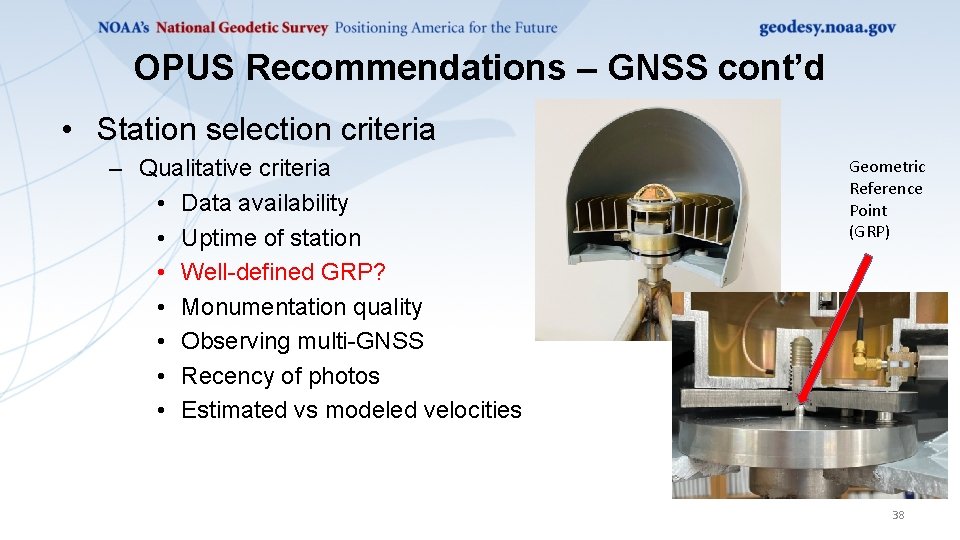
OPUS Recommendations – GNSS cont’d • Station selection criteria – Qualitative criteria • Data availability • Uptime of station • Well-defined GRP? • Monumentation quality • Observing multi-GNSS • Recency of photos • Estimated vs modeled velocities Geometric Reference Point (GRP) 38
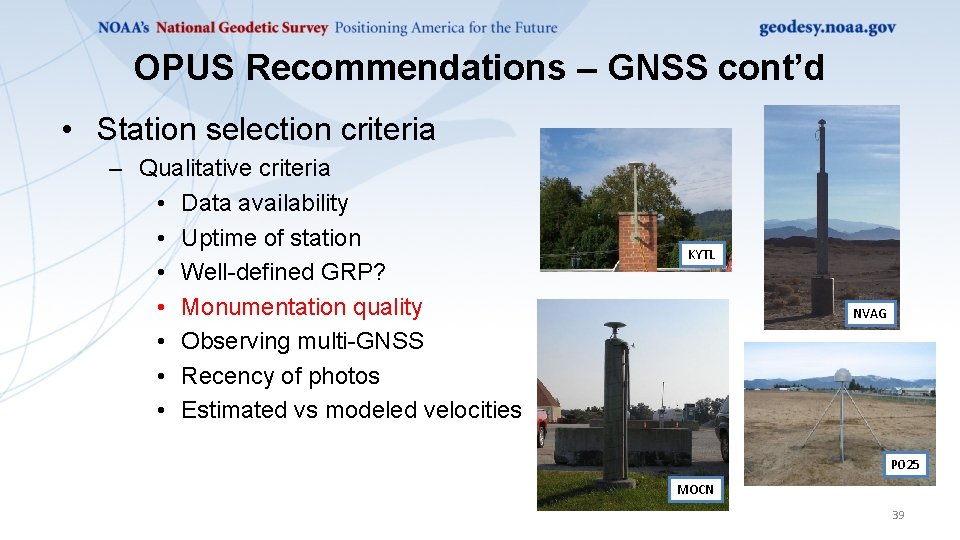
OPUS Recommendations – GNSS cont’d • Station selection criteria – Qualitative criteria • Data availability • Uptime of station • Well-defined GRP? • Monumentation quality • Observing multi-GNSS • Recency of photos • Estimated vs modeled velocities KYTL NVAG P 025 MOCN 39
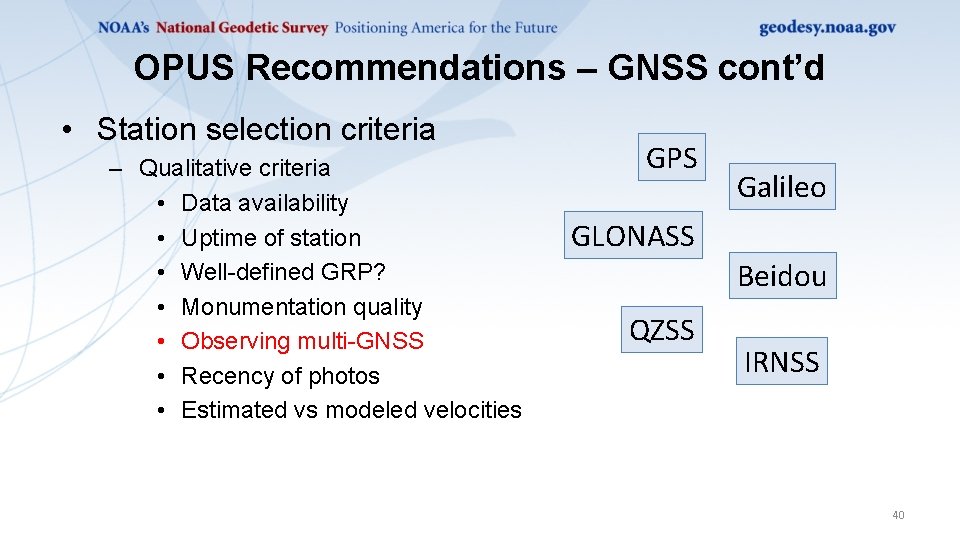
OPUS Recommendations – GNSS cont’d • Station selection criteria – Qualitative criteria • Data availability • Uptime of station • Well-defined GRP? • Monumentation quality • Observing multi-GNSS • Recency of photos • Estimated vs modeled velocities GPS Galileo GLONASS Beidou QZSS IRNSS 40
OPUS Recommendations – GNSS cont’d • Station selection criteria INVI – Qualitative criteria • Data availability • Uptime of station • Well-defined GRP? • Monumentation quality • Observing multi-GNSS • Recency of photos • Estimated vs modeled velocities 41
OPUS Recommendations – GNSS cont’d • Station selection criteria – Qualitative criteria • Data availability • Uptime of station • Well-defined GRP? • Monumentation quality • Observing multi-GNSS • Recency of photos • Estimated vs modeled velocities 42
The Big Takeaway OPUS 6. 0 will be built so that you can process your data the way you want… …but if you want your coordinates to be “tied to the NSRS” you will need to follow NGS-prescribed best practice – i. e. OPUS Recommendations. 43
Thank You! 44