
Online Knowledge Surveys as a Means of Library

Online Knowledge Surveys as a Means of Library Instruction Assessment Steven Baumgart, Memorial Library Elizabeth Hassemer, Steenbock Memorial Library
Objectives • Ease of web survey software • Example uses of web survey software in library instruction sessions • Knowledge surveys – What is a knowledge survey? – Advantages to knowledge surveys – How to create a knowledge survey 2
Online Survey Software • • Web. Survey (UW Do. IT) Survey. Monkey Zoomerang Survey Solutions Express 3
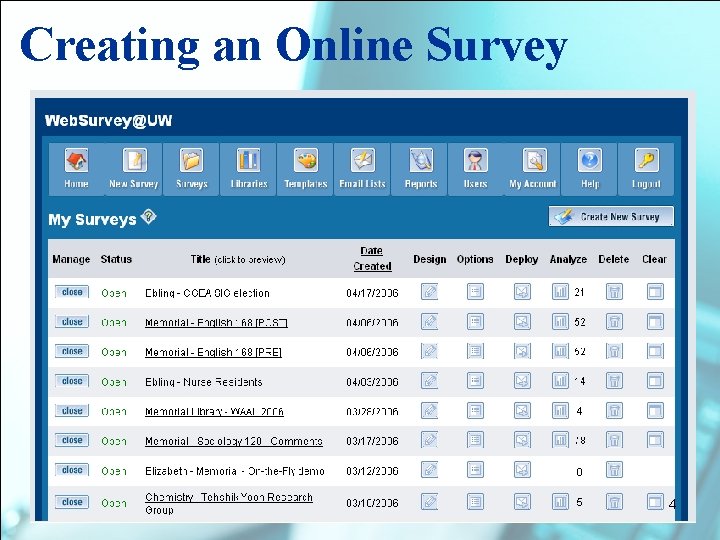
Creating an Online Survey 4
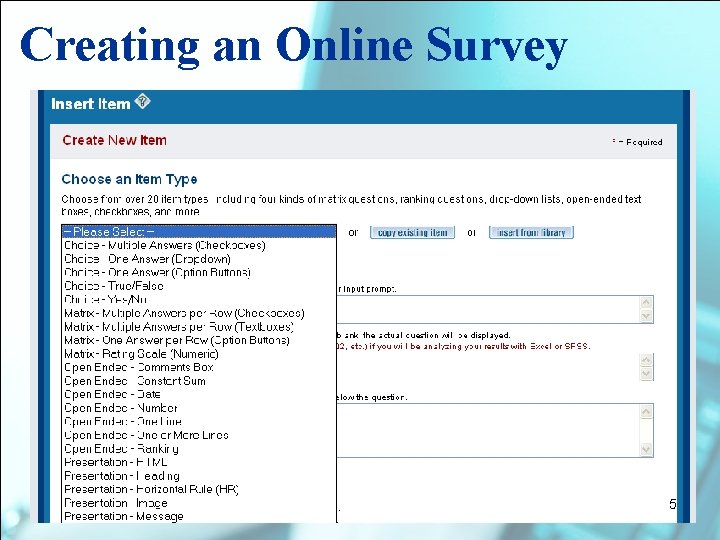
Creating an Online Survey 5

Creating an Online Survey 6
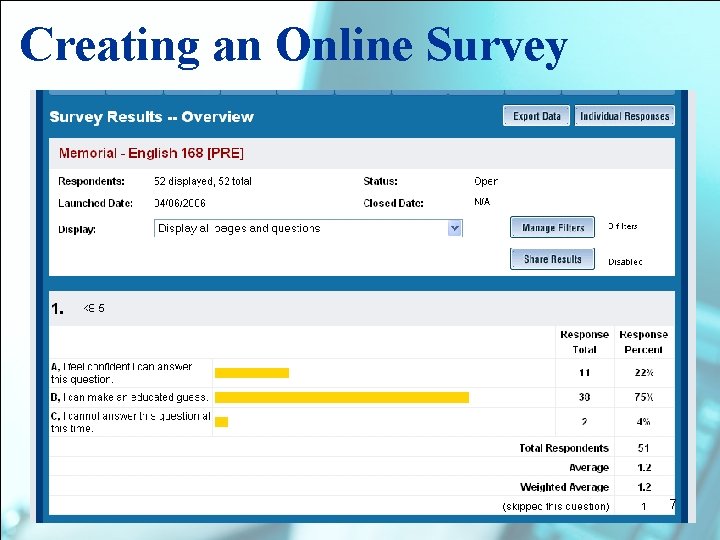
Creating an Online Survey 7
Pedagogy: Theory • Engages students • Encourages full participation • Gives students space to process 8
Pedagogy: Advantages • • Easy collection and tabulation of data Full-disclosure Tailor classes on-the-fly to meet student needs Connects with students by using their technology 9
Pedagogy: Practice • • • Comment cards Web. Survey Post-session instructor evaluations In-class exercises Web. Survey On-the-fly tailoring of classes Pre- and post-testing – Knowledge survey 10
Knowledge Survey • • Measures confidence in subject material Comprehensive, allowing granularity Based on learning outcomes Linked to Bloom’s Taxonomy Web. Survey 11
Knowledge Survey Activity Formulate questions for your learning outcomes that you could ask students at the end of a library instruction class to test them on what they've learned. 12
Knowledge Survey: Advantages • • Planning tool for instructors Quick and easy to create Indicator of students’ strengths and weaknesses Allows instructor to ask questions too difficult to score • Allows instructor to score results quickly • Objective assessment measure 13
Knowledge Survey: Preliminary Results • Before library session, confidence is closer to performance • After library session, confidence is overreported • Students with previous library instruction perform better • Students who know their topics perform the same as students who do not have topics 14
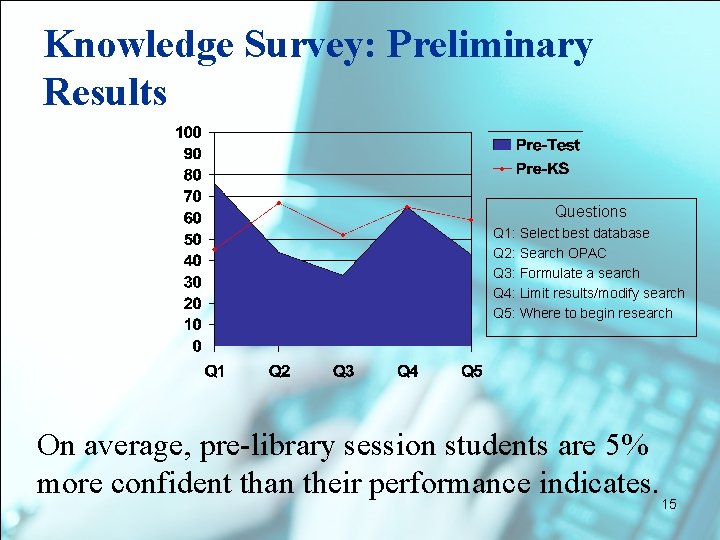
Knowledge Survey: Preliminary Results Questions Q 1: Select best database Q 2: Search OPAC Q 3: Formulate a search Q 4: Limit results/modify search Q 5: Where to begin research On average, pre-library session students are 5% more confident than their performance indicates. 15
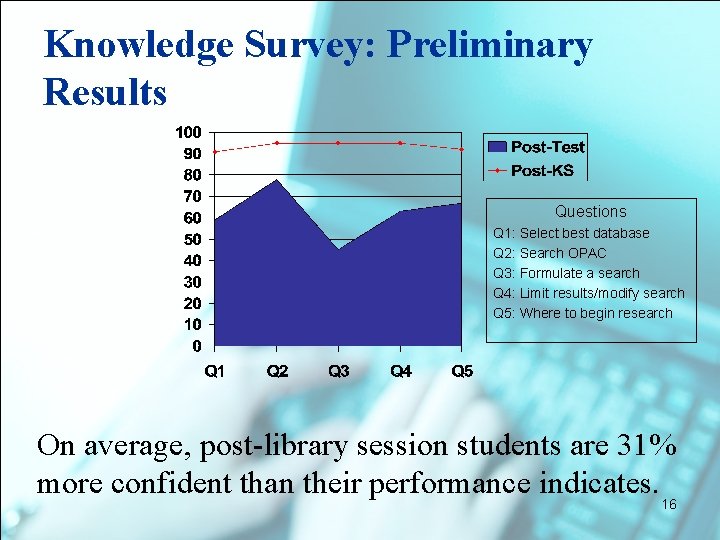
Knowledge Survey: Preliminary Results Questions Q 1: Select best database Q 2: Search OPAC Q 3: Formulate a search Q 4: Limit results/modify search Q 5: Where to begin research On average, post-library session students are 31% more confident than their performance indicates. 16
Thank You! Steven Baumgart Memorial Library, UW-Madison sbaumgart@library. wisc. edu Elizabeth Hassemer Steenbock Memorial Library, UW-Madison ehassemer@library. wisc. edu 17
- Slides: 17