
Online Cryptography Course Dan Boneh Public Key Encryption
Online Cryptography Course Dan Boneh Public Key Encryption from trapdoor permutations Public key encryption: definitions and security Dan Boneh
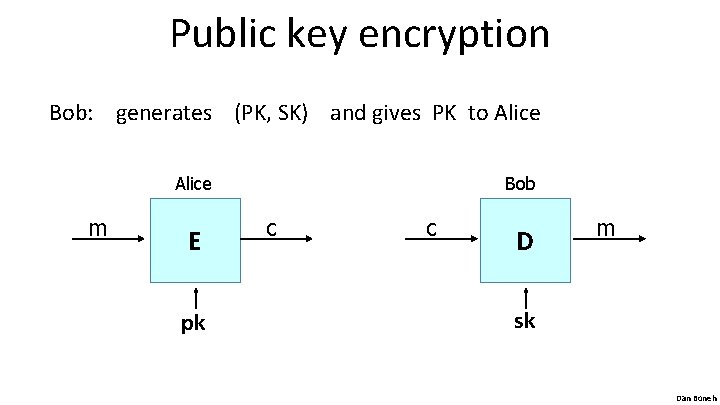
Public key encryption Bob: generates (PK, SK) and gives PK to Alice m E pk Bob c c D m sk Dan Boneh
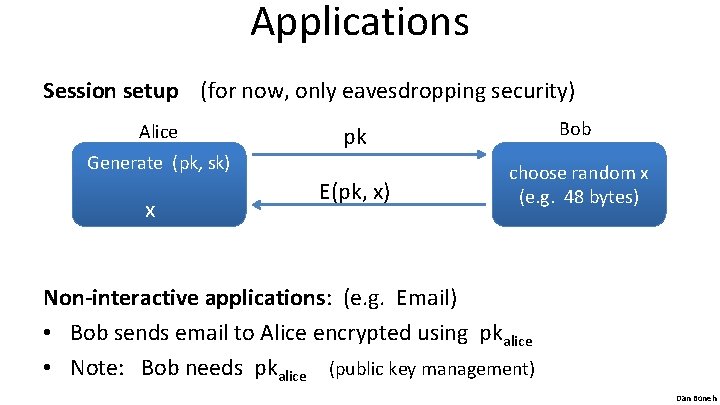
Applications Session setup (for now, only eavesdropping security) Alice Generate (pk, sk) x pk Bob E(pk, x) choose random x (e. g. 48 bytes) Non-interactive applications: (e. g. Email) • Bob sends email to Alice encrypted using pkalice • Note: Bob needs pkalice (public key management) Dan Boneh
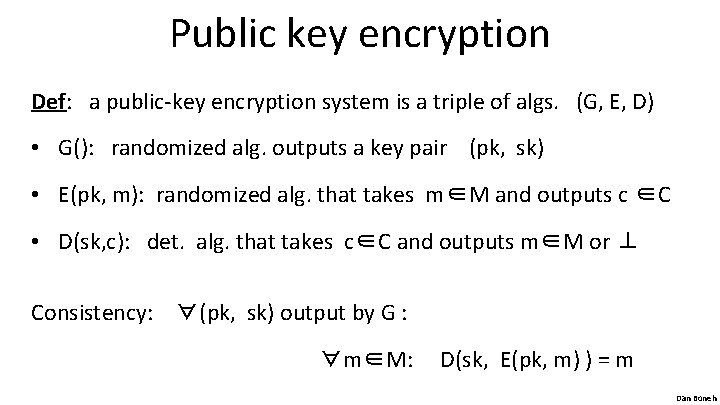
Public key encryption Def: a public-key encryption system is a triple of algs. (G, E, D) • G(): randomized alg. outputs a key pair (pk, sk) • E(pk, m): randomized alg. that takes m∈M and outputs c ∈C • D(sk, c): det. alg. that takes c∈C and outputs m∈M or ⊥ Consistency: ∀(pk, sk) output by G : ∀m∈M: D(sk, E(pk, m) ) = m Dan Boneh

Security: eavesdropping For b=0, 1 define experiments EXP(0) and EXP(1) as: b Chal. (pk, sk) G() pk m 0 , m 1 M : |m 0| = |m 1| Adv. A c E(pk, mb) b’ {0, 1} EXP(b) Def: E =(G, E, D) is sem. secure (a. k. a IND-CPA) if for all efficient A: Adv. SS [A, E] = |Pr[EXP(0)=1] – Pr[EXP(1)=1] | < negligible Dan Boneh
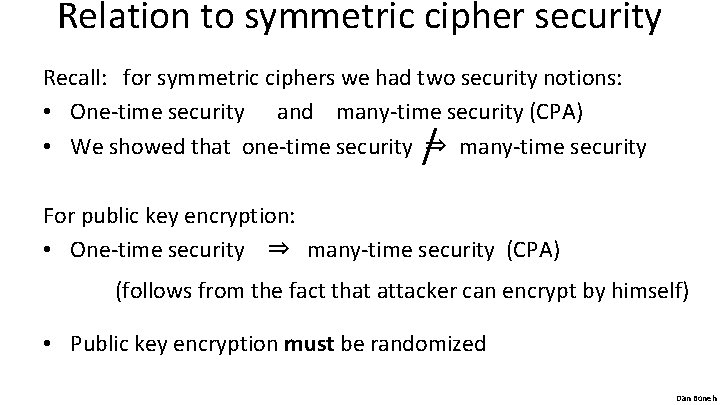
Relation to symmetric cipher security Recall: for symmetric ciphers we had two security notions: • One-time security and many-time security (CPA) • We showed that one-time security ⇒ many-time security For public key encryption: • One-time security ⇒ many-time security (CPA) (follows from the fact that attacker can encrypt by himself) • Public key encryption must be randomized Dan Boneh
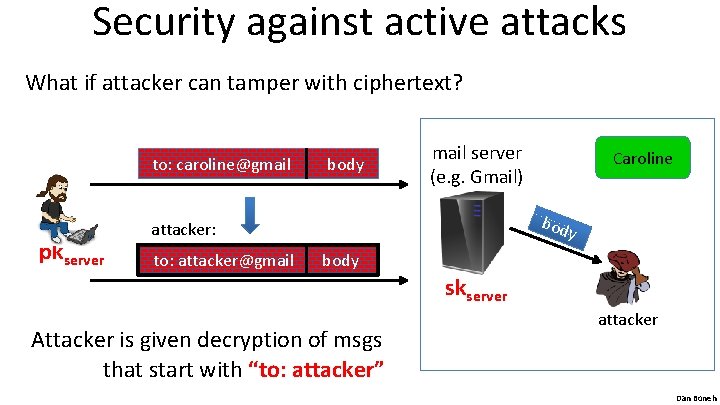
Security against active attacks What if attacker can tamper with ciphertext? to: caroline@gmail pkserver body mail server (e. g. Gmail) bod attacker: to: attacker@gmail Caroline y body skserver Attacker is given decryption of msgs that start with “to: attacker” attacker Dan Boneh
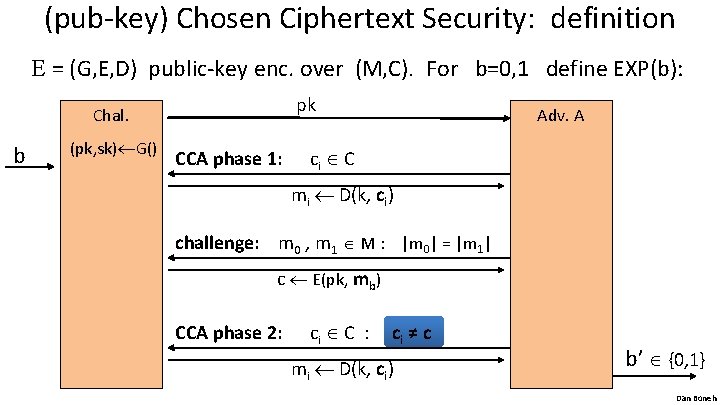
(pub-key) Chosen Ciphertext Security: definition E = (G, E, D) public-key enc. over (M, C). For b=0, 1 define EXP(b): pk Chal. b (pk, sk) G() CCA phase 1: Adv. A ci C mi D(k, ci) challenge: m 0 , m 1 M : |m 0| = |m 1| c E(pk, mb) CCA phase 2: ci C : ci ≠ c mi D(k, ci) b’ {0, 1} Dan Boneh
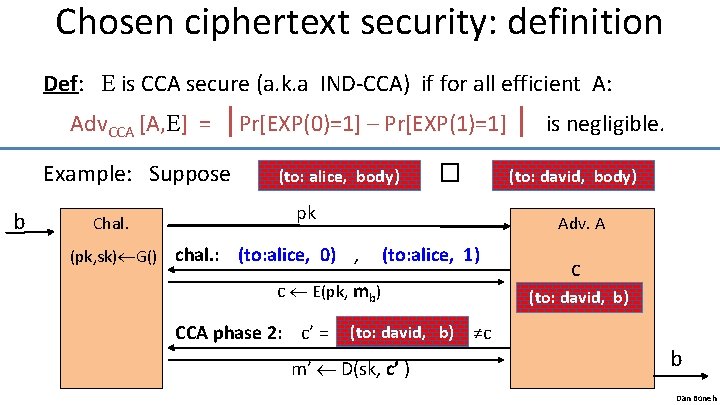
Chosen ciphertext security: definition Def: E is CCA secure (a. k. a IND-CCA) if for all efficient A: Adv. CCA [A, E] = |Pr[EXP(0)=1] – Pr[EXP(1)=1] | Example: Suppose b (to: alice, body) � (to: david, body) pk Chal. (pk, sk) G() chal. : Adv. A (to: alice, 0) , (to: alice, 1) c E(pk, mb) CCA phase 2: c’ = is negligible. (to: david, b) m’ D(sk, c’ ) c (to: david, b) ≠c b Dan Boneh
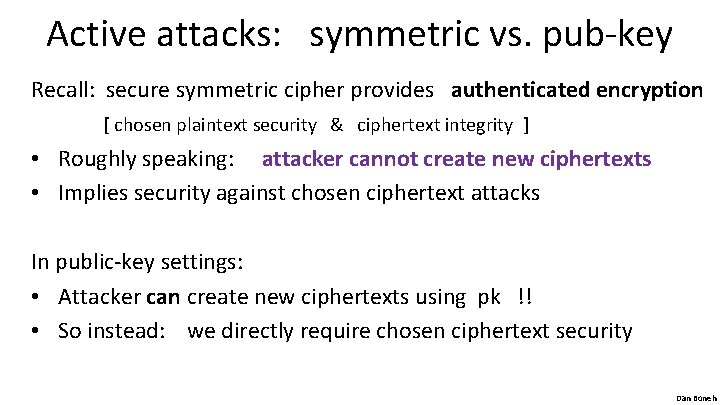
Active attacks: symmetric vs. pub-key Recall: secure symmetric cipher provides authenticated encryption [ chosen plaintext security & ciphertext integrity ] • Roughly speaking: attacker cannot create new ciphertexts • Implies security against chosen ciphertext attacks In public-key settings: • Attacker can create new ciphertexts using pk !! • So instead: we directly require chosen ciphertext security Dan Boneh
This and next module: constructing CCA secure pub-key systems End of Segment Dan Boneh
Online Cryptography Course Dan Boneh Public Key Encryption from trapdoor permutations Constructions Goal: construct chosen-ciphertext secure public-key encryption Dan Boneh
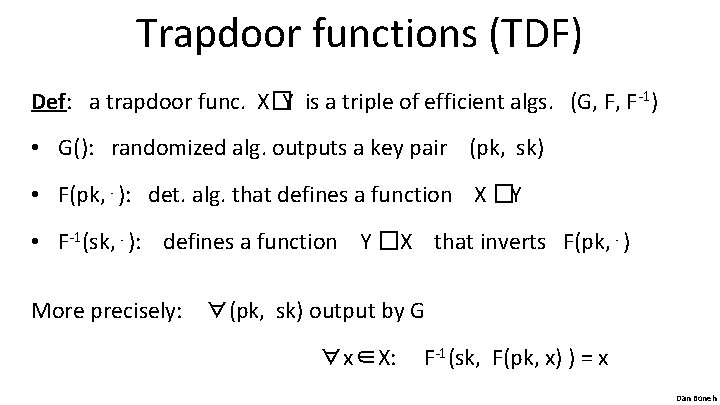
Trapdoor functions (TDF) Def: a trapdoor func. X�Y is a triple of efficient algs. (G, F, F-1) • G(): randomized alg. outputs a key pair (pk, sk) • F(pk, ⋅): det. alg. that defines a function X �Y • F-1(sk, ⋅): defines a function Y �X that inverts F(pk, ⋅) More precisely: ∀(pk, sk) output by G ∀x∈X: F-1(sk, F(pk, x) ) = x Dan Boneh
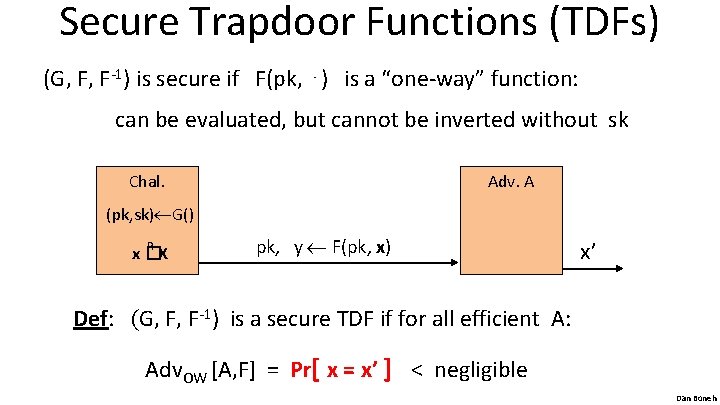
Secure Trapdoor Functions (TDFs) (G, F, F-1) is secure if F(pk, ⋅) is a “one-way” function: can be evaluated, but cannot be inverted without sk Chal. Adv. A (pk, sk) G() R x� X pk, y F(pk, x) x’ Def: (G, F, F-1) is a secure TDF if for all efficient A: Adv. OW [A, F] = Pr[ x = x’ ] < negligible Dan Boneh
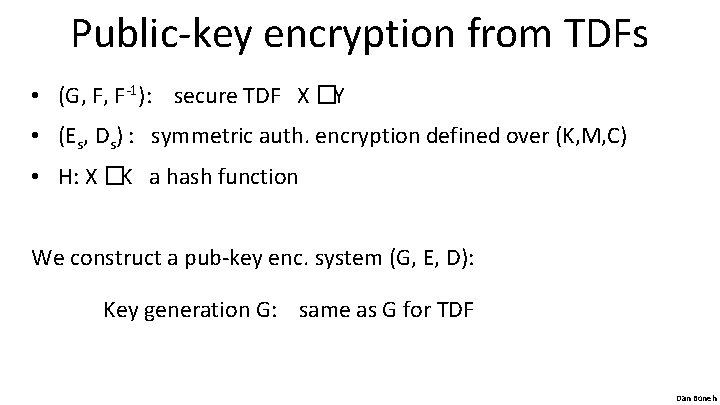
Public-key encryption from TDFs • (G, F, F-1): secure TDF X �Y • (Es, Ds) : symmetric auth. encryption defined over (K, M, C) • H: X �K a hash function We construct a pub-key enc. system (G, E, D): Key generation G: same as G for TDF Dan Boneh

Public-key encryption from TDFs • (G, F, F-1): secure TDF X �Y • (Es, Ds) : symmetric auth. encryption defined over (K, M, C) • H: X �K a hash function E( pk, m) : R x� X, y �F(pk, x) k �H(x), c �Es(k, m) output (y, c) D( sk, (y, c) ) : x �F-1(sk, y), k �H(x), m �Ds(k, c) output m Dan Boneh

In pictures: F(pk, x) Es( H(x), m ) header body Security Theorem: If (G, F, F-1) is a secure TDF, (Es, Ds) provides auth. enc. and H: X �K is a “random oracle” then (G, E, D) is CCAro secure. Dan Boneh
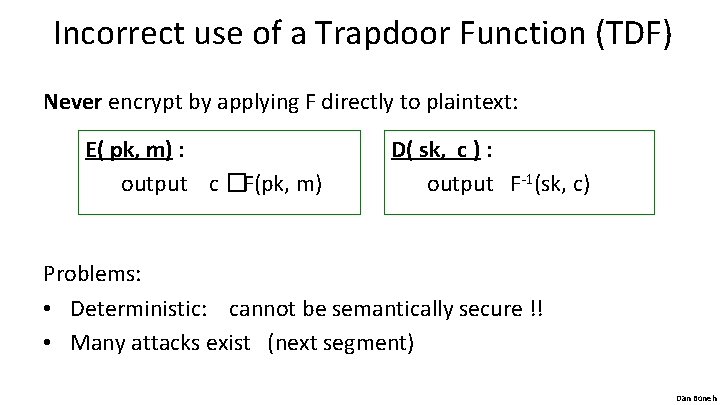
Incorrect use of a Trapdoor Function (TDF) Never encrypt by applying F directly to plaintext: E( pk, m) : output c �F(pk, m) D( sk, c ) : output F-1(sk, c) Problems: • Deterministic: cannot be semantically secure !! • Many attacks exist (next segment) Dan Boneh
Next step: construct a TDF End of Segment Dan Boneh
Online Cryptography Course Dan Boneh Public Key Encryption from trapdoor permutations The RSA trapdoor permutation Dan Boneh
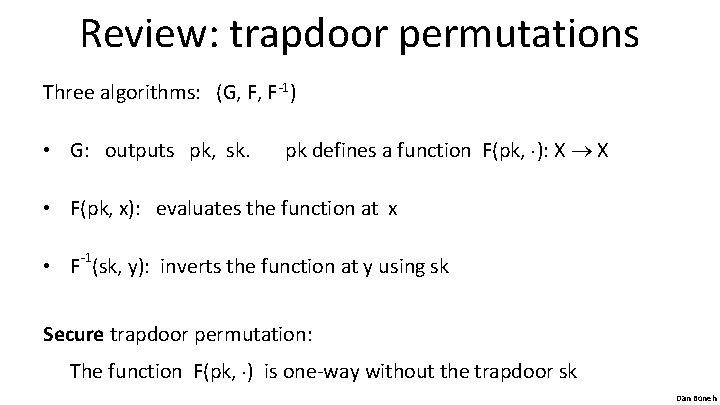
Review: trapdoor permutations Three algorithms: (G, F, F-1) • G: outputs pk, sk. pk defines a function F(pk, ): X X • F(pk, x): evaluates the function at x • F-1(sk, y): inverts the function at y using sk Secure trapdoor permutation: The function F(pk, ) is one-way without the trapdoor sk Dan Boneh
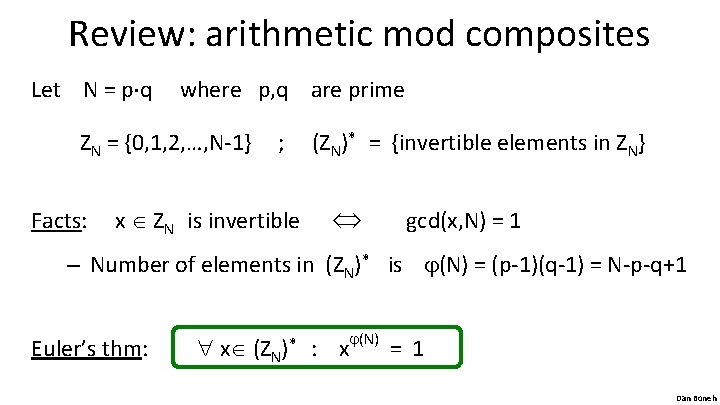
Review: arithmetic mod composites Let N = p q where p, q are prime ZN = {0, 1, 2, …, N-1} Facts: ; x ZN is invertible (ZN)* = {invertible elements in ZN} gcd(x, N) = 1 – Number of elements in (ZN)* is (N) = (p-1)(q-1) = N-p-q+1 Euler’s thm: x (ZN)* : x (N) = 1 Dan Boneh
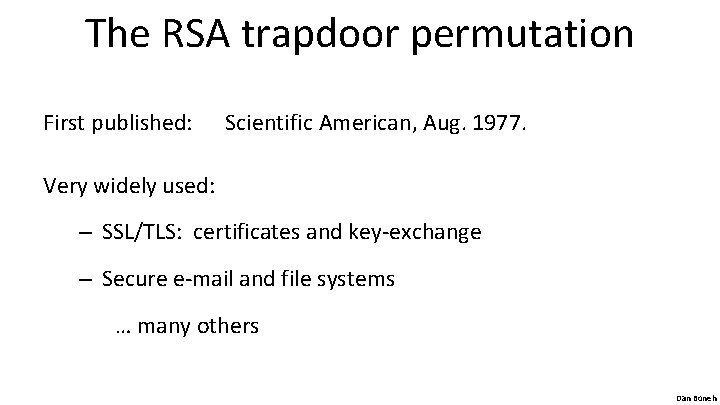
The RSA trapdoor permutation First published: Scientific American, Aug. 1977. Very widely used: – SSL/TLS: certificates and key-exchange – Secure e-mail and file systems … many others Dan Boneh
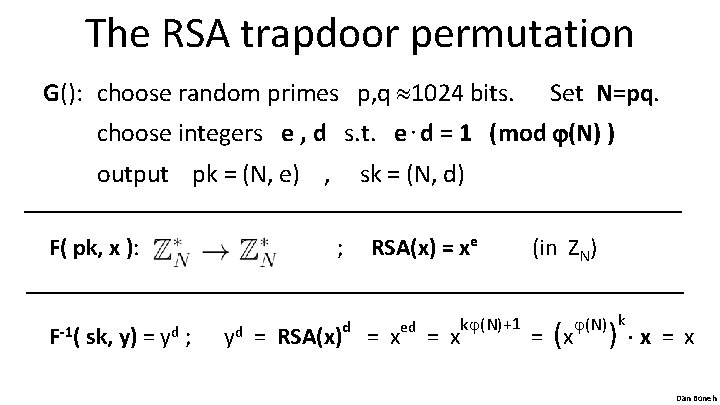
The RSA trapdoor permutation G(): choose random primes p, q 1024 bits. Set N=pq. choose integers e , d s. t. e⋅d = 1 (mod (N) ) output pk = (N, e) , F( pk, x ): F-1( sk, y) = sk = (N, d) ; yd = RSA(x) d RSA(x) = xe = x ed = x k (N)+1 (in ZN) = (x (N) k ) x = x Dan Boneh
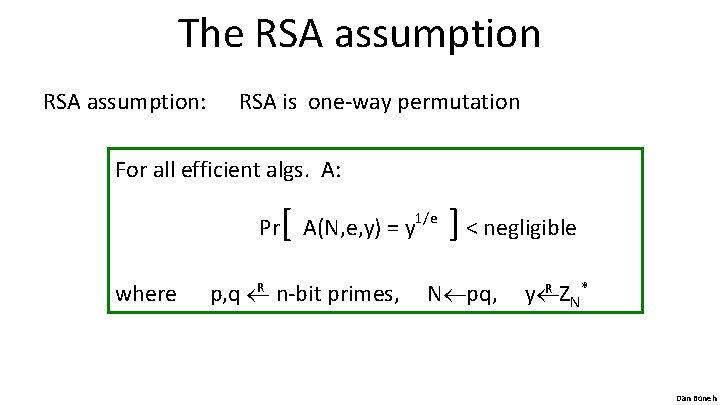
The RSA assumption: RSA is one-way permutation For all efficient algs. A: [ Pr A(N, e, y) = y 1/e where R p, q n-bit primes, ] < negligible N pq, R * y Z N Dan Boneh

Review: RSA pub-key encryption (ISO std) (Es, Ds): symmetric enc. scheme providing auth. encryption. H: ZN K where K is key space of (Es, Ds) • G(): generate RSA params: • E(pk, m): pk = (N, e), sk = (N, d) (1) choose random x in ZN (2) y RSA(x) = xe , k H(x) (3) output (y , Es(k, m) ) • D(sk, (y, c) ): output Ds( H(RSA-1 (y)) , c) Dan Boneh
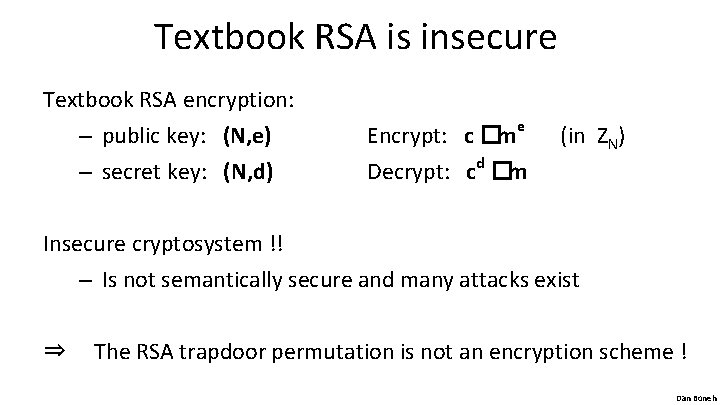
Textbook RSA is insecure Textbook RSA encryption: – public key: (N, e) – secret key: (N, d) Encrypt: c �me Decrypt: cd �m (in ZN) Insecure cryptosystem !! – Is not semantically secure and many attacks exist ⇒ The RSA trapdoor permutation is not an encryption scheme ! Dan Boneh

A simple attack on textbook RSA random session-key k CLIENT HELLO Web Browser SERVER HELLO (e, N) c=RSA(k) Suppose k is 64 bits: k {0, …, 264}. If k = k 1 k 2 where k 1, k 2 < 234 Web Server d Eve sees: c= ke in ZN (prob. 20%) then c/k 1 e = k 2 e in ZN Step 1: build table: c/1 e, c/2 e, c/3 e, …, c/234 e. time: 234 Step 2: for k 2 = 0, …, 234 test if k 2 e is in table. time: 234 Output matching (k 1, k 2). Total attack time: 240 << 264 Dan Boneh
End of Segment Dan Boneh
Online Cryptography Course Dan Boneh Public Key Encryption from trapdoor permutations PKCS 1 Dan Boneh
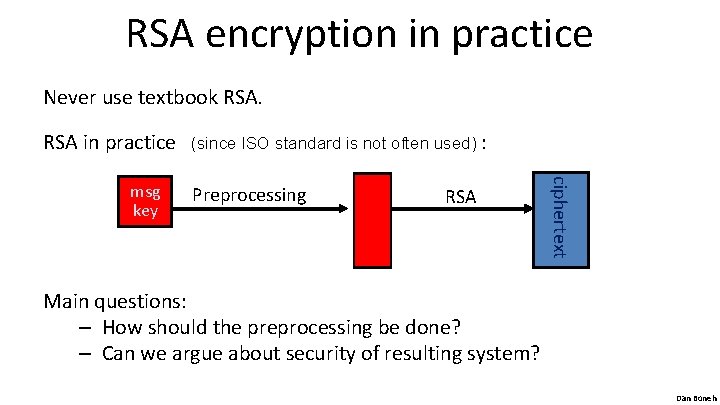
RSA encryption in practice Never use textbook RSA in practice Preprocessing RSA ciphertext msg key (since ISO standard is not often used) : Main questions: – How should the preprocessing be done? – Can we argue about security of resulting system? Dan Boneh
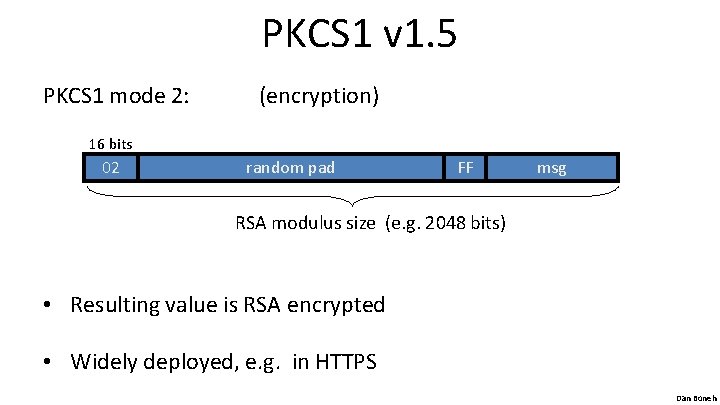
PKCS 1 v 1. 5 PKCS 1 mode 2: (encryption) 16 bits 02 random pad FF msg RSA modulus size (e. g. 2048 bits) • Resulting value is RSA encrypted • Widely deployed, e. g. in HTTPS Dan Boneh
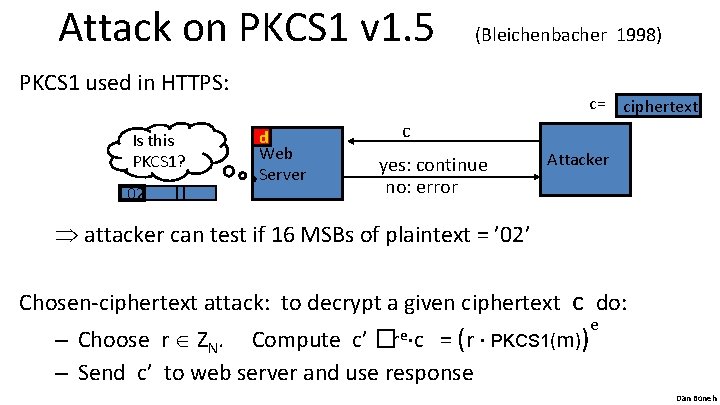
Attack on PKCS 1 v 1. 5 (Bleichenbacher 1998) PKCS 1 used in HTTPS: Is this PKCS 1? 02 c= ciphertext d Web Server c yes: continue no: error Attacker attacker can test if 16 MSBs of plaintext = ’ 02’ Chosen-ciphertext attack: to decrypt a given ciphertext c do: – Choose r ZN. Compute c’ = (r PKCS 1(m)) – Send c’ to web server and use response �re c e Dan Boneh
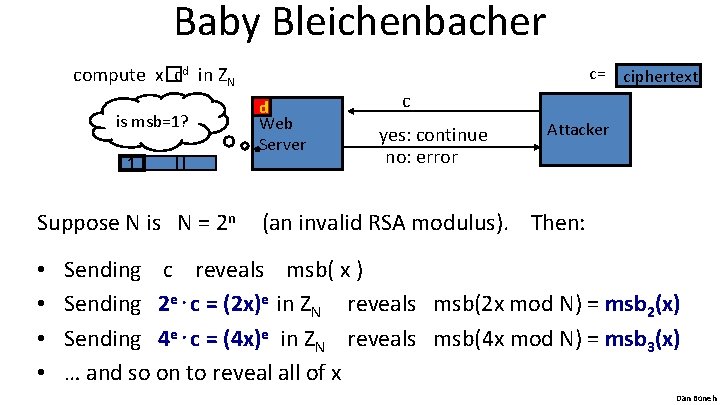
Baby Bleichenbacher compute x�cd in ZN is msb=1? 1 Suppose N is N = 2 n • • c= ciphertext d Web Server c yes: continue no: error Attacker (an invalid RSA modulus). Then: Sending c reveals msb( x ) Sending 2 e⋅c = (2 x)e in ZN reveals msb(2 x mod N) = msb 2(x) Sending 4 e⋅c = (4 x)e in ZN reveals msb(4 x mod N) = msb 3(x) … and so on to reveal all of x Dan Boneh
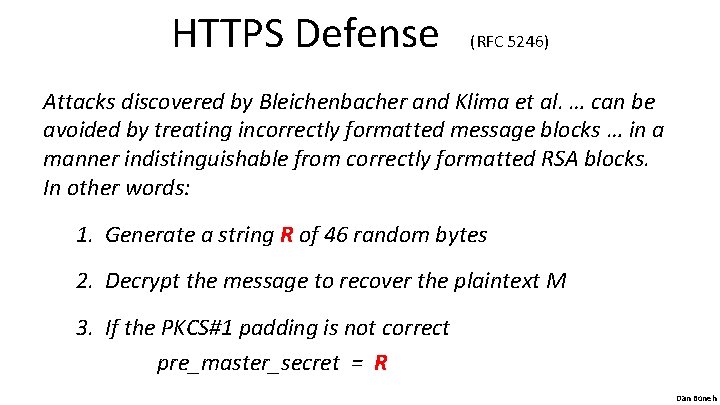
HTTPS Defense (RFC 5246) Attacks discovered by Bleichenbacher and Klima et al. … can be avoided by treating incorrectly formatted message blocks … in a manner indistinguishable from correctly formatted RSA blocks. In other words: 1. Generate a string R of 46 random bytes 2. Decrypt the message to recover the plaintext M 3. If the PKCS#1 padding is not correct pre_master_secret = R Dan Boneh
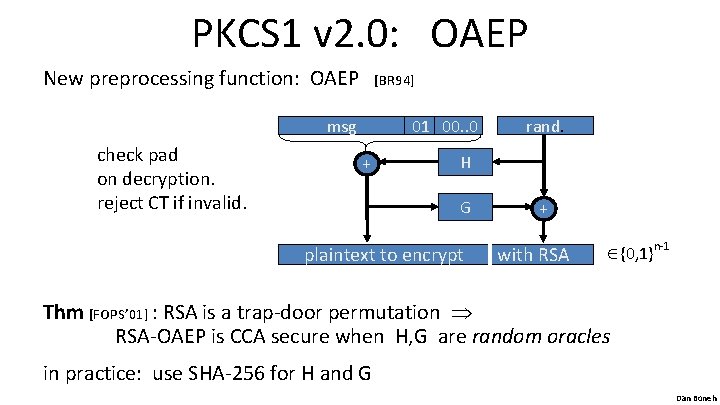
PKCS 1 v 2. 0: OAEP New preprocessing function: OAEP [BR 94] msg check pad on decryption. reject CT if invalid. 01 00. . 0 + rand. H G plaintext to encrypt + with RSA {0, 1}n-1 Thm [FOPS’ 01] : RSA is a trap-door permutation RSA-OAEP is CCA secure when H, G are random oracles in practice: use SHA-256 for H and G Dan Boneh
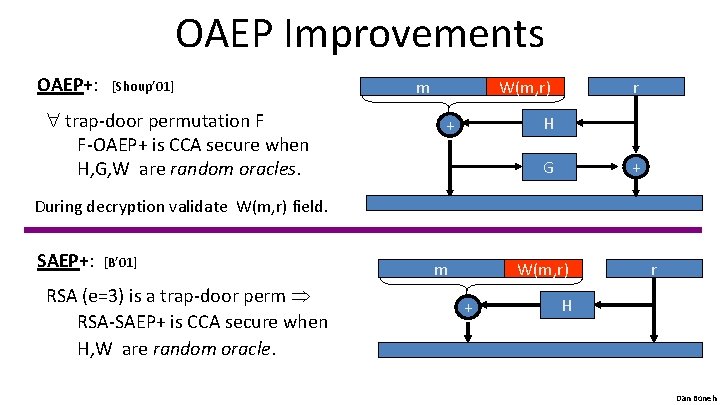
OAEP Improvements OAEP+: [Shoup’ 01] trap-door permutation F F-OAEP+ is CCA secure when H, G, W are random oracles. m W(m, r) r H + G + During decryption validate W(m, r) field. SAEP+: [B’ 01] RSA (e=3) is a trap-door perm RSA-SAEP+ is CCA secure when H, W are random oracle. m W(m, r) + r H Dan Boneh
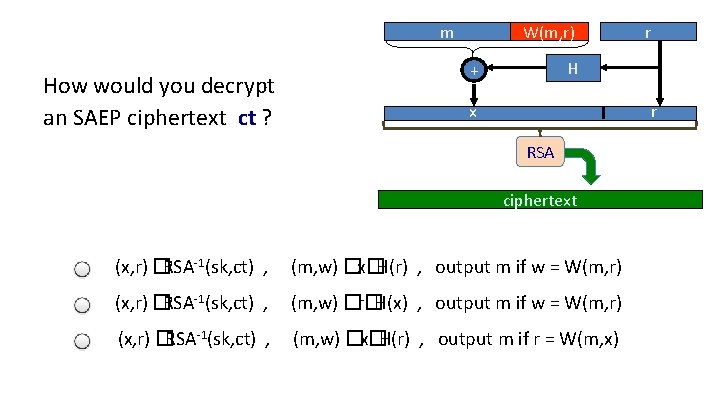
m How would you decrypt an SAEP ciphertext ct ? W(m, r) r H + x r RSA ciphertext (x, r) �RSA-1(sk, ct) , (m, w) �x�H(r) , output m if w = W(m, r) (x, r) �RSA-1(sk, ct) , (m, w) �r�H(x) , output m if w = W(m, r) (x, r) �RSA-1(sk, ct) , (m, w) �x�H(r) , output m if r = W(m, x)
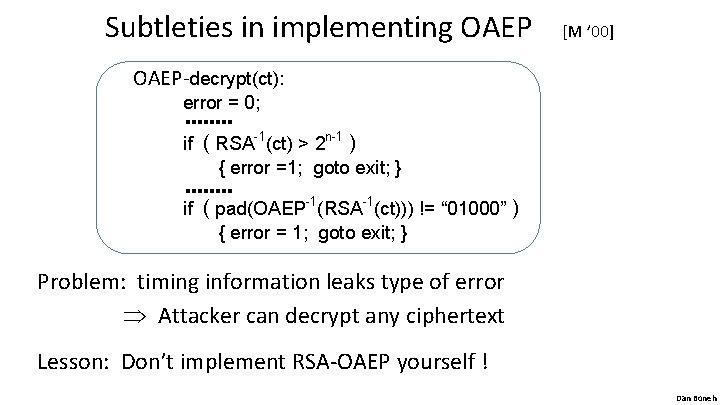
Subtleties in implementing OAEP [M ’ 00] OAEP-decrypt(ct): error = 0; if ( RSA-1(ct) > 2 n-1 ) { error =1; goto exit; } if ( pad(OAEP-1(RSA-1(ct))) != “ 01000” ) { error = 1; goto exit; } Problem: timing information leaks type of error Attacker can decrypt any ciphertext Lesson: Don’t implement RSA-OAEP yourself ! Dan Boneh
End of Segment Dan Boneh
Online Cryptography Course Dan Boneh Public Key Encryption from trapdoor permutations Is RSA a one-way function? Dan Boneh
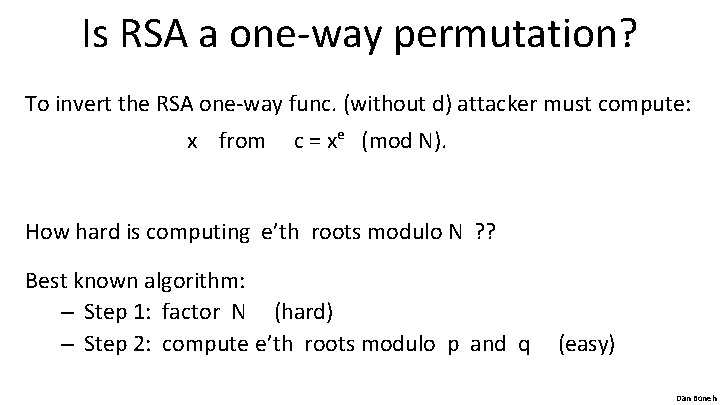
Is RSA a one-way permutation? To invert the RSA one-way func. (without d) attacker must compute: x from c = xe (mod N). How hard is computing e’th roots modulo N ? ? Best known algorithm: – Step 1: factor N (hard) – Step 2: compute e’th roots modulo p and q (easy) Dan Boneh
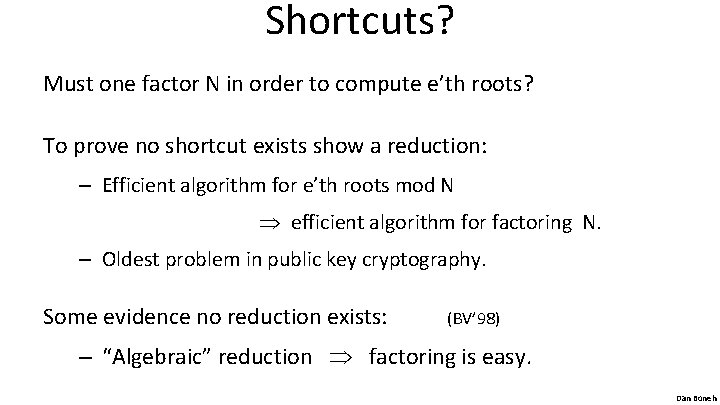
Shortcuts? Must one factor N in order to compute e’th roots? To prove no shortcut exists show a reduction: – Efficient algorithm for e’th roots mod N efficient algorithm for factoring N. – Oldest problem in public key cryptography. Some evidence no reduction exists: (BV’ 98) – “Algebraic” reduction factoring is easy. Dan Boneh
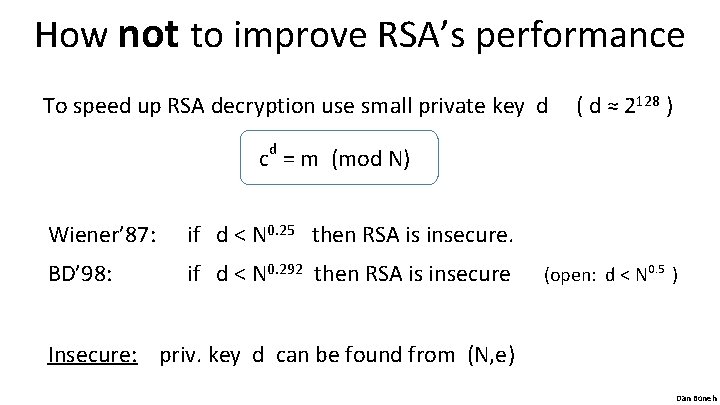
How not to improve RSA’s performance To speed up RSA decryption use small private key d ( d ≈ 2128 ) cd = m (mod N) Wiener’ 87: if d < N 0. 25 then RSA is insecure. BD’ 98: if d < N 0. 292 then RSA is insecure (open: d < N 0. 5 ) Insecure: priv. key d can be found from (N, e) Dan Boneh
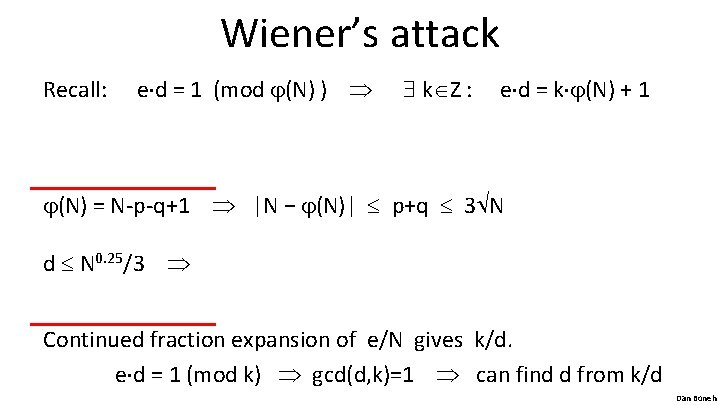
Wiener’s attack Recall: e d = 1 (mod (N) ) k Z : e d = k (N) + 1 (N) = N-p-q+1 |N − (N)| p+q 3 N d N 0. 25/3 Continued fraction expansion of e/N gives k/d. e d = 1 (mod k) gcd(d, k)=1 can find d from k/d Dan Boneh
End of Segment Dan Boneh
Online Cryptography Course Dan Boneh Public Key Encryption from trapdoor permutations RSA in practice Dan Boneh
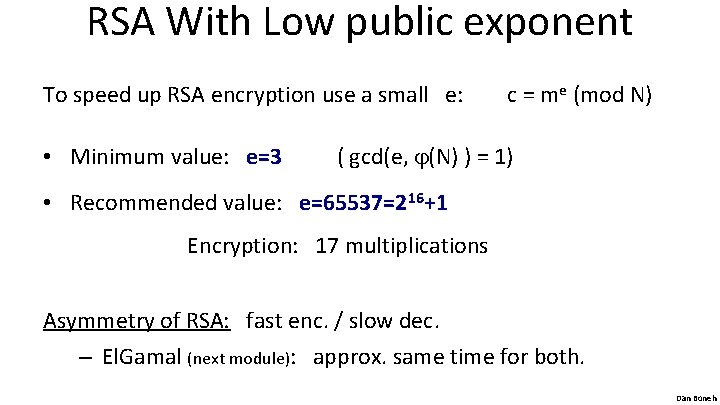
RSA With Low public exponent To speed up RSA encryption use a small e: • Minimum value: e=3 c = me (mod N) ( gcd(e, (N) ) = 1) • Recommended value: e=65537=216+1 Encryption: 17 multiplications Asymmetry of RSA: fast enc. / slow dec. – El. Gamal (next module): approx. same time for both. Dan Boneh
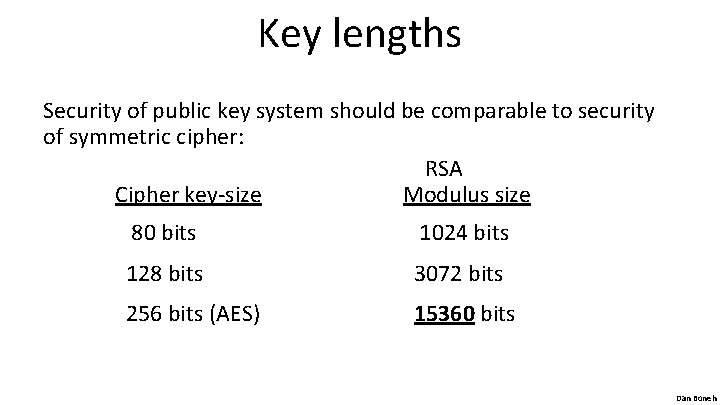
Key lengths Security of public key system should be comparable to security of symmetric cipher: RSA Cipher key-size Modulus size 80 bits 1024 bits 128 bits 3072 bits 256 bits (AES) 15360 bits Dan Boneh
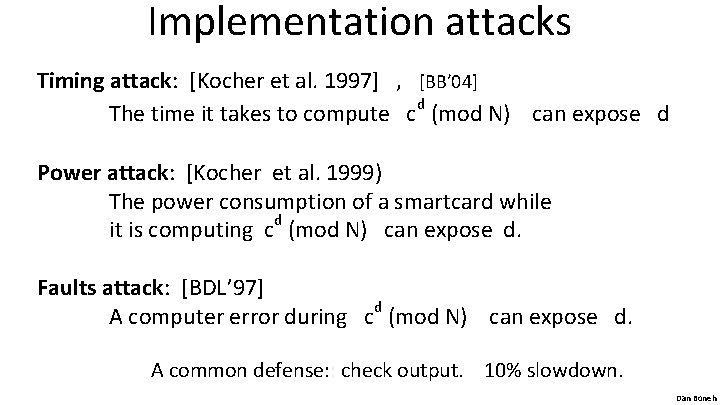
Implementation attacks Timing attack: [Kocher et al. 1997] , [BB’ 04] The time it takes to compute cd (mod N) can expose d Power attack: [Kocher et al. 1999) The power consumption of a smartcard while it is computing cd (mod N) can expose d. Faults attack: [BDL’ 97] A computer error during cd (mod N) can expose d. A common defense: : check output. 10% slowdown. Dan Boneh
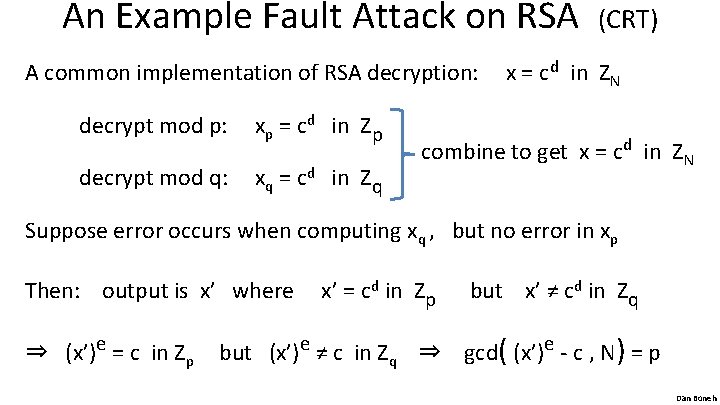
An Example Fault Attack on RSA A common implementation of RSA decryption: decrypt mod p: xp = cd in Zp decrypt mod q: xq = cd in Zq (CRT) x = cd in ZN combine to get x = cd in ZN Suppose error occurs when computing xq , but no error in xp Then: output is x’ where ⇒ (x’)e = c in Zp x’ = cd in Zp but x’ ≠ cd in Zq but (x’)e ≠ c in Zq ⇒ gcd( (x’)e - c , N) = p Dan Boneh
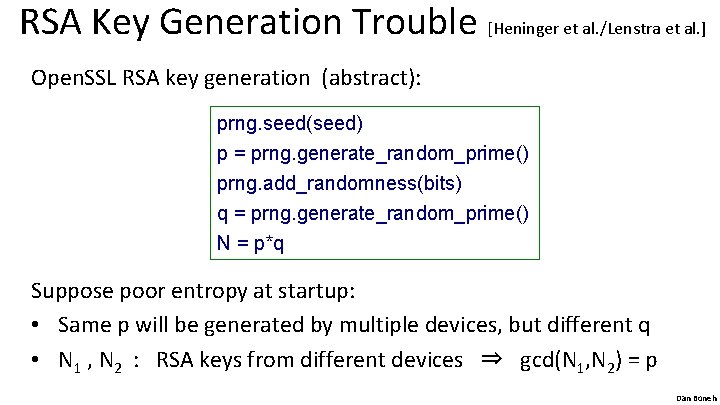
RSA Key Generation Trouble [Heninger et al. /Lenstra et al. ] Open. SSL RSA key generation (abstract): prng. seed(seed) p = prng. generate_random_prime() prng. add_randomness(bits) q = prng. generate_random_prime() N = p*q Suppose poor entropy at startup: • Same p will be generated by multiple devices, but different q • N 1 , N 2 : RSA keys from different devices ⇒ gcd(N 1, N 2) = p Dan Boneh
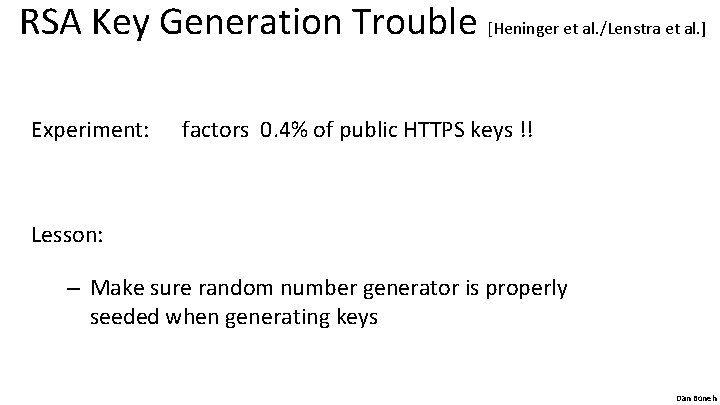
RSA Key Generation Trouble [Heninger et al. /Lenstra et al. ] Experiment: factors 0. 4% of public HTTPS keys !! Lesson: – Make sure random number generator is properly seeded when generating keys Dan Boneh
Further reading • Why chosen ciphertext security matters, V. Shoup, 1998 • Twenty years of attacks on the RSA cryptosystem, D. Boneh, Notices of the AMS, 1999 • OAEP reconsidered, V. Shoup, Crypto 2001 • Key lengths, A. Lenstra, 2004 Dan Boneh
End of Segment Dan Boneh
- Slides: 55