
Online Cryptography Course Dan Boneh Message Integrity A
Online Cryptography Course Dan Boneh Message Integrity A Parallel MAC Dan Boneh
• ECBC and NMAC are sequential. • Can we build a parallel MAC from a small PRF ? ? Dan Boneh

Construction 3: PMAC – parallel MAC P(k, i): an easy to compute function key = (k, k 1) Padding similar to CMAC m[0] P(k, 0) m[1] P(k, 1) F(k 1, ) Let F: K × X �X be a PRF Define new PRF FPMAC : K 2 × X≤L �X m[2] P(k, 2) F(k 1, ) m[3] P(k, 3) F(k 1, ) tag Dan Boneh
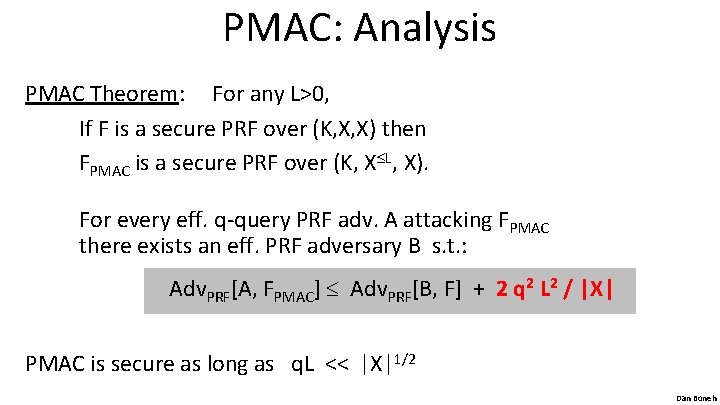
PMAC: Analysis PMAC Theorem: For any L>0, If F is a secure PRF over (K, X, X) then FPMAC is a secure PRF over (K, X L, X). For every eff. q-query PRF adv. A attacking FPMAC there exists an eff. PRF adversary B s. t. : Adv. PRF[A, FPMAC] Adv. PRF[B, F] + 2 q 2 L 2 / |X| PMAC is secure as long as q. L << |X|1/2 Dan Boneh
![PMAC is incremental Suppose F is a PRP. m[0] P(k, 0) When m[1] �m’[1]](http://slidetodoc.com/presentation_image_h/bb8c2481dc5bf0e50dd252e00608866f/image-5.jpg "PMAC is incremental Suppose F is a PRP. m[0] P(k, 0) When m[1] �m’[1]")
PMAC is incremental Suppose F is a PRP. m[0] P(k, 0) When m[1] �m’[1] can we quickly update tag? F(k 1, ) m[1] P(k, 1) m[3] P(k, 2) F(k 1, ) m[4] P(k, 3) F(k 1, ) tag no, it can’t be done do F-1(k 1, tag) �F(k 1, m’[1] �P(k, 1)) do F-1(k 1, tag) �F(k 1, m[1] �P(k, 1)) �F(k 1, m’[1] �P(k, 1)) do tag �F(k 1, m[1] �P(k, 1)) �F(k 1, m’[1] �P(k, 1)) Then apply F(k 1, ⋅)
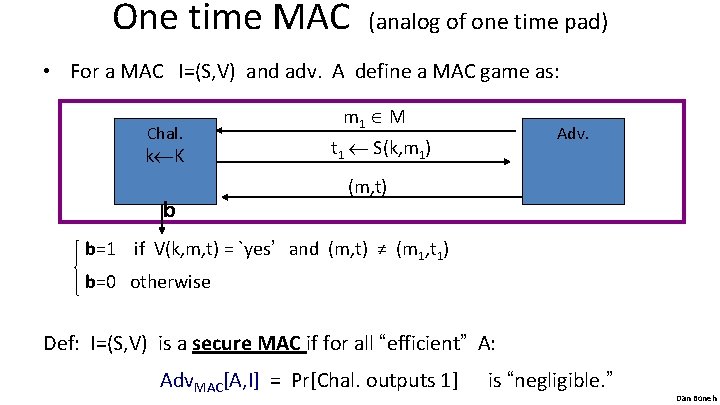
One time MAC (analog of one time pad) • For a MAC I=(S, V) and adv. A define a MAC game as: Chal. k K b m 1 M Adv. t 1 S(k, m 1) (m, t) b=1 if V(k, m, t) = `yes’ and (m, t) ≠ (m 1, t 1) b=0 otherwise Def: I=(S, V) is a secure MAC if for all “efficient” A: Adv. MAC[A, I] = Pr[Chal. outputs 1] is “negligible. ” Dan Boneh
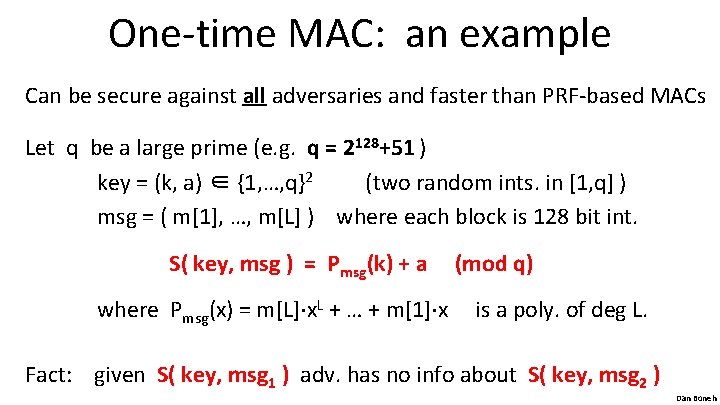
One-time MAC: an example Can be secure against all adversaries and faster than PRF-based MACs Let q be a large prime (e. g. q = 2128+51 ) key = (k, a) ∈ {1, …, q}2 (two random ints. in [1, q] ) msg = ( m[1], …, m[L] ) where each block is 128 bit int. S( key, msg ) = Pmsg(k) + a where Pmsg(x) = m[L] x. L + … + m[1] x (mod q) is a poly. of deg L. Fact: given S( key, msg 1 ) adv. has no info about S( key, msg 2 ) Dan Boneh
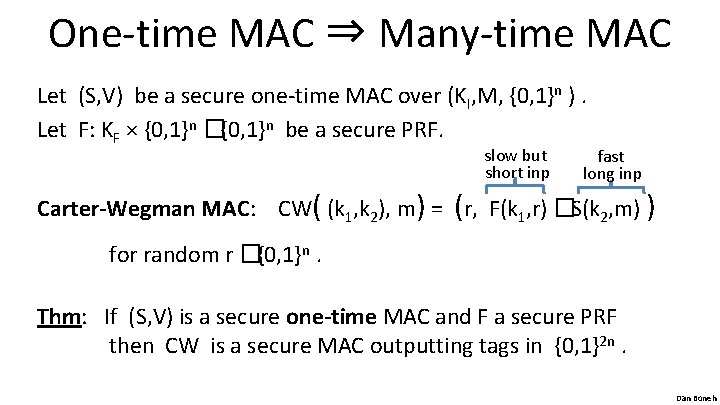
One-time MAC ⇒ Many-time MAC Let (S, V) be a secure one-time MAC over (KI, M, {0, 1}n ). Let F: KF × {0, 1}n �{0, 1}n be a secure PRF. slow but short inp fast long inp Carter-Wegman MAC: CW( (k 1, k 2), m) = (r, F(k 1, r) �S(k 2, m) ) for random r �{0, 1}n. Thm: If (S, V) is a secure one-time MAC and F a secure PRF then CW is a secure MAC outputting tags in {0, 1}2 n. Dan Boneh
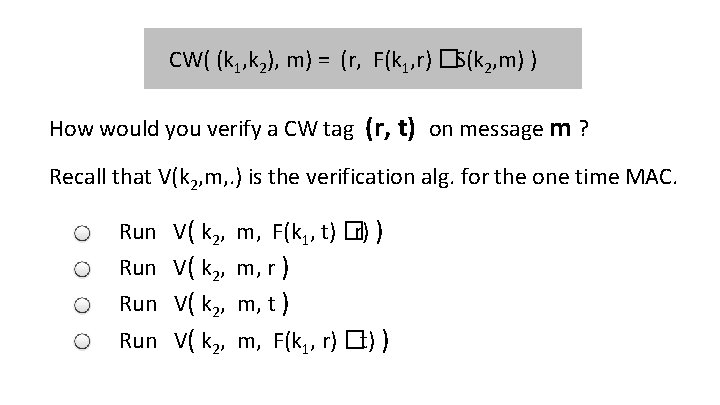
CW( (k 1, k 2), m) = (r, F(k 1, r) �S(k 2, m) ) How would you verify a CW tag (r, t) on message m ? Recall that V(k 2, m, . ) is the verification alg. for the one time MAC. Run V( k 2, m, F(k 1, t) �r) ) Run V( k 2, m, r ) Run V( k 2, m, t ) Run V( k 2, m, F(k 1, r) �t) )
Construction 4: HMAC (Hash-MAC) Most widely used MAC on the Internet. … but, we first we need to discuss hash function. Dan Boneh
Further reading • J. Black, P. Rogaway: CBC MACs for Arbitrary-Length Messages: The Three. Key Constructions. J. Cryptology 18(2): 111 -131 (2005) • K. Pietrzak: A Tight Bound for EMAC. ICALP (2) 2006: 168 -179 • J. Black, P. Rogaway: A Block-Cipher Mode of Operation for Parallelizable Message Authentication. EUROCRYPT 2002: 384 -397 • M. Bellare: New Proofs for NMAC and HMAC: Security Without Collision. Resistance. CRYPTO 2006: 602 -619 • Y. Dodis, K. Pietrzak, P. Puniya: A New Mode of Operation for Block Ciphers and Length-Preserving MACs. EUROCRYPT 2008: 198 -219 Dan Boneh
End of Segment Dan Boneh
- Slides: 12