
Online Cryptography Course Dan Boneh Collision resistance Introduction
Online Cryptography Course Dan Boneh Collision resistance Introduction Dan Boneh
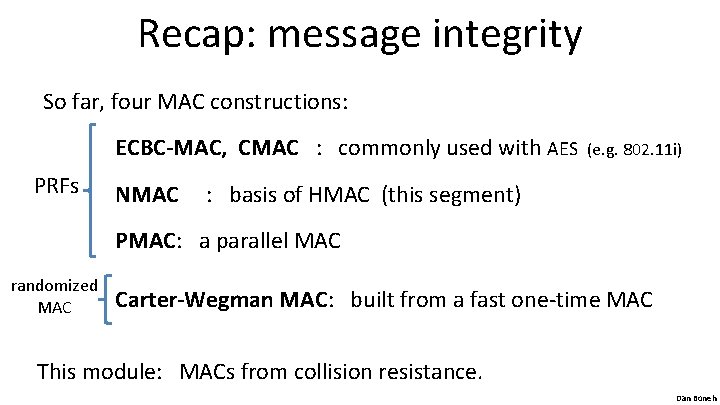
Recap: message integrity So far, four MAC constructions: ECBC-MAC, CMAC : commonly used with AES PRFs NMAC (e. g. 802. 11 i) : basis of HMAC (this segment) PMAC: a parallel MAC randomized MAC Carter-Wegman MAC: built from a fast one-time MAC This module: MACs from collision resistance. Dan Boneh
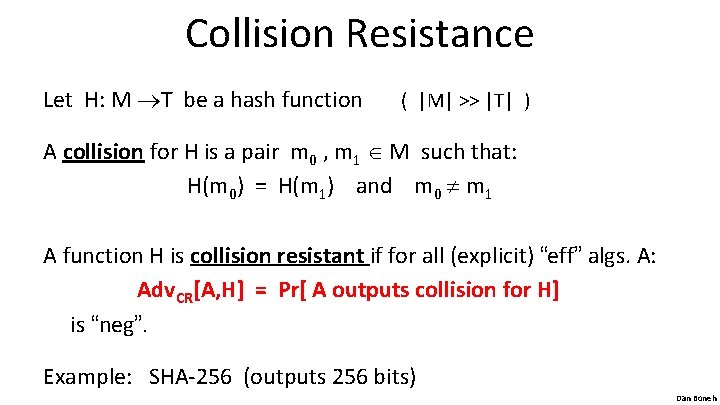
Collision Resistance Let H: M T be a hash function ( |M| >> |T| ) A collision for H is a pair m 0 , m 1 M such that: H(m 0) = H(m 1) and m 0 m 1 A function H is collision resistant if for all (explicit) “eff” algs. A: Adv. CR[A, H] = Pr[ A outputs collision for H] is “neg”. Example: SHA-256 (outputs 256 bits) Dan Boneh
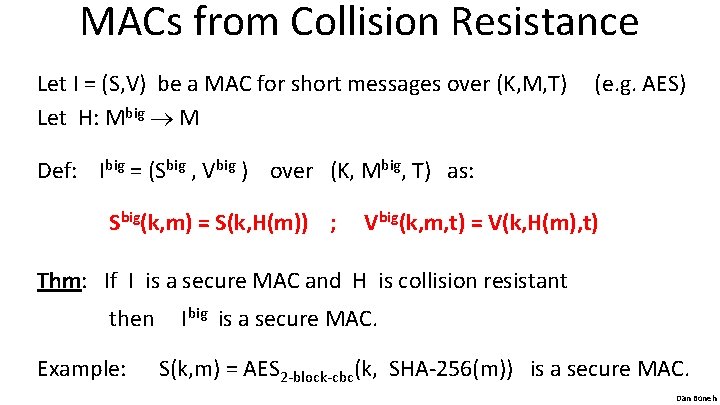
MACs from Collision Resistance Let I = (S, V) be a MAC for short messages over (K, M, T) Let H: Mbig M (e. g. AES) Def: Ibig = (Sbig , Vbig ) over (K, Mbig, T) as: Sbig(k, m) = S(k, H(m)) ; Vbig(k, m, t) = V(k, H(m), t) Thm: If I is a secure MAC and H is collision resistant then Example: Ibig is a secure MAC. S(k, m) = AES 2 -block-cbc(k, SHA-256(m)) is a secure MAC. Dan Boneh
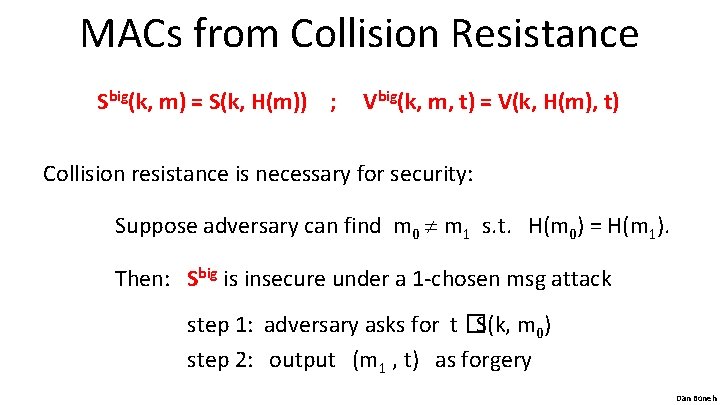
MACs from Collision Resistance Sbig(k, m) = S(k, H(m)) ; Vbig(k, m, t) = V(k, H(m), t) Collision resistance is necessary for security: Suppose adversary can find m 0 m 1 s. t. H(m 0) = H(m 1). Then: Sbig is insecure under a 1 -chosen msg attack step 1: adversary asks for t �S(k, m 0) step 2: output (m 1 , t) as forgery Dan Boneh
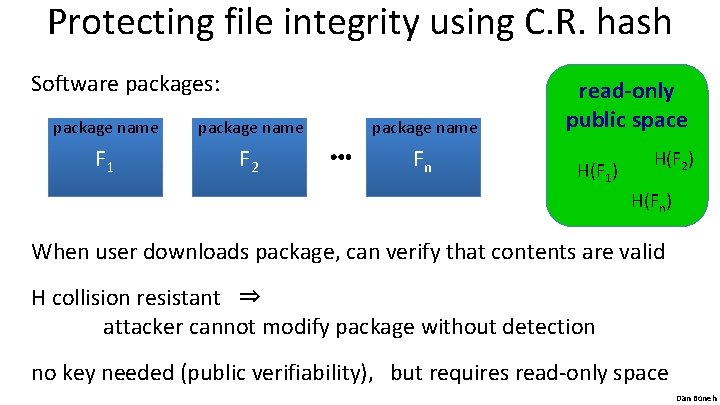
Protecting file integrity using C. R. hash Software packages: package name F 1 F 2 ⋯ package name Fn read-only public space H(F 1) H(F 2) H(Fn) When user downloads package, can verify that contents are valid H collision resistant ⇒ attacker cannot modify package without detection no key needed (public verifiability), but requires read-only space Dan Boneh
End of Segment Dan Boneh
Online Cryptography Course Dan Boneh Collision resistance Generic birthday attack Dan Boneh
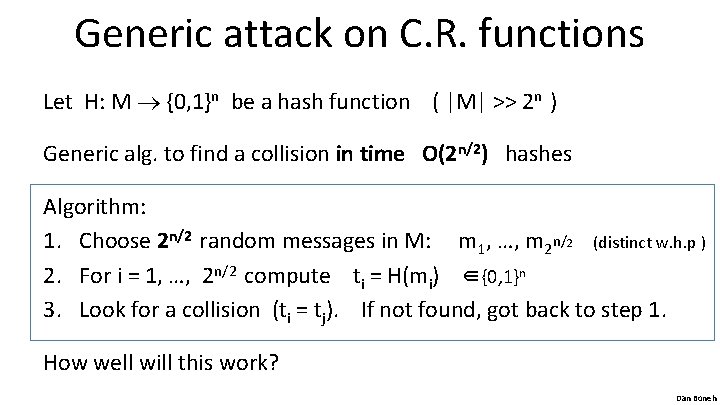
Generic attack on C. R. functions Let H: M {0, 1}n be a hash function ( |M| >> 2 n ) Generic alg. to find a collision in time O(2 n/2) hashes Algorithm: 1. Choose 2 n/2 random messages in M: m 1, …, m 2 n/2 (distinct w. h. p ) 2. For i = 1, …, 2 n/2 compute ti = H(mi) ∈{0, 1}n 3. Look for a collision (ti = tj). If not found, got back to step 1. How well will this work? Dan Boneh
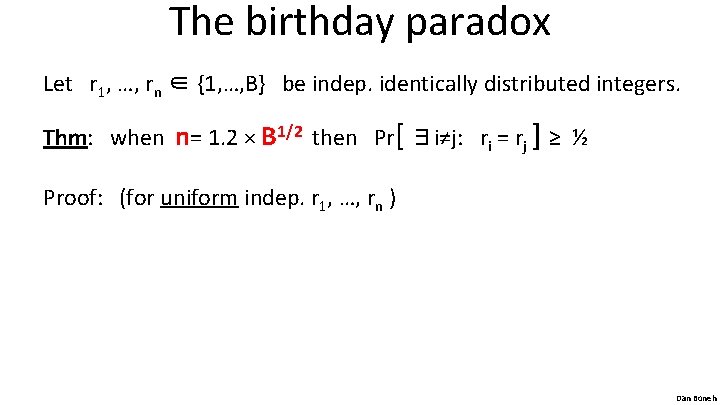
The birthday paradox Let r 1, …, rn ∈ {1, …, B} be indep. identically distributed integers. Thm: when n= 1. 2 × B 1/2 then Pr[ ∃i≠j: ri = rj ] ≥ ½ Proof: (for uniform indep. r 1, …, rn ) Dan Boneh
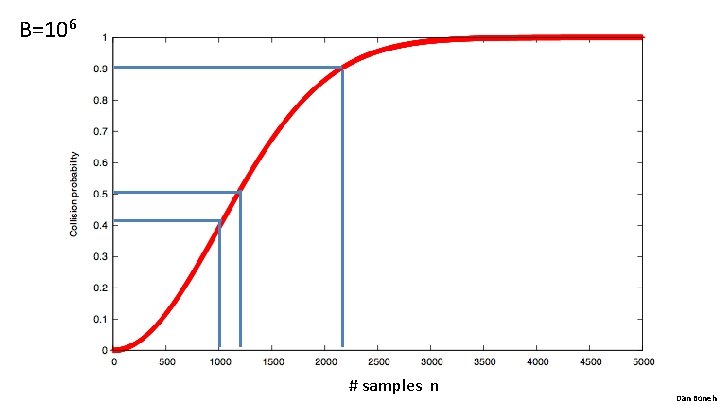
B=106 # samples n Dan Boneh
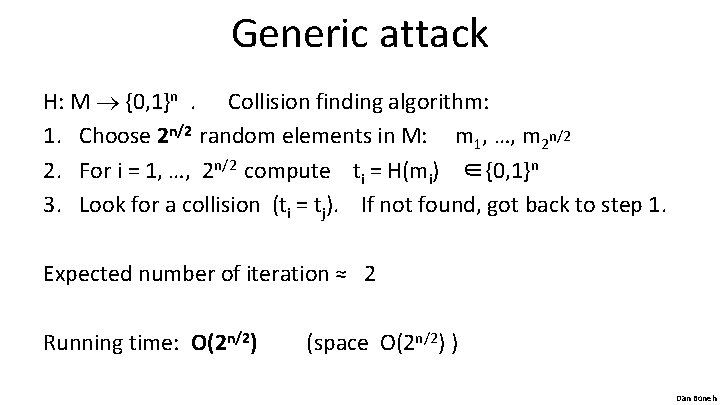
Generic attack H: M {0, 1}n. Collision finding algorithm: 1. Choose 2 n/2 random elements in M: m 1, …, m 2 n/2 2. For i = 1, …, 2 n/2 compute ti = H(mi) ∈{0, 1}n 3. Look for a collision (ti = tj). If not found, got back to step 1. Expected number of iteration ≈ 2 Running time: O(2 n/2) (space O(2 n/2) ) Dan Boneh
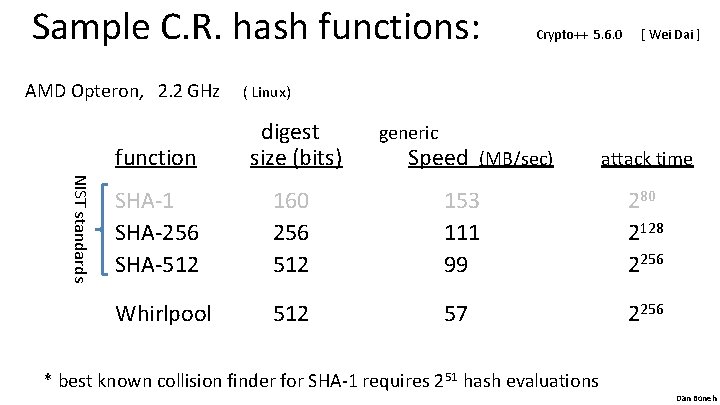
Sample C. R. hash functions: AMD Opteron, 2. 2 GHz Crypto++ 5. 6. 0 [ Wei Dai ] ( Linux) NIST standards function digest size (bits) SHA-1 SHA-256 SHA-512 160 256 512 153 111 99 280 2128 2256 Whirlpool 512 57 2256 generic Speed (MB/sec) attack time * best known collision finder for SHA-1 requires 251 hash evaluations Dan Boneh

Quantum Collision Finder Block cipher E: K × X �X exhaustive search Hash function H: M �T collision finder Classical algorithms Quantum algorithms O( |K| ) O( |K|1/2 ) O( |T|1/3 ) Dan Boneh
End of Segment Dan Boneh
Online Cryptography Course Dan Boneh Collision resistance The Merkle-Damgard Paradigm Dan Boneh

Collision resistance: review Let H: M T be a hash function ( |M| >> |T| ) A collision for H is a pair m 0 , m 1 M such that: H(m 0) = H(m 1) and m 0 m 1 Goal: collision resistant (C. R. ) hash functions Step 1: given C. R. function for short messages, construct C. R. function for long messages Dan Boneh
![The Merkle-Damgard iterated construction m[0] IV (fixed) H 0 h m[1] H 1 Given](http://slidetodoc.com/presentation_image/1fbea7bdc789e48368ff98039a436e6d/image-18.jpg "The Merkle-Damgard iterated construction m[0] IV (fixed) H 0 h m[1] H 1 Given")
The Merkle-Damgard iterated construction m[0] IV (fixed) H 0 h m[1] H 1 Given h: T × X �T we obtain H: X≤L �T. PB: padding block m[2] h H 2 m[3] ll PB h H 3 h H 4 H(m) (compression function) Hi - chaining variables 1000… 0 ll msg len 64 bits If no space for PB add another block Dan Boneh
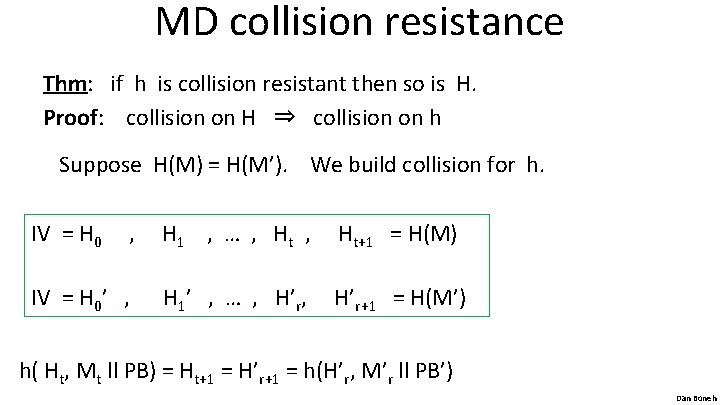
MD collision resistance Thm: if h is collision resistant then so is H. Proof: collision on H ⇒ collision on h Suppose H(M) = H(M’). We build collision for h. IV = H 0 , H 1 , … , H t , Ht+1 = H(M) IV = H 0’ , H 1’ , … , H’r, H’r+1 = H(M’) h( Ht, Mt ll PB) = Ht+1 = H’r+1 = h(H’r, M’r ll PB’) Dan Boneh
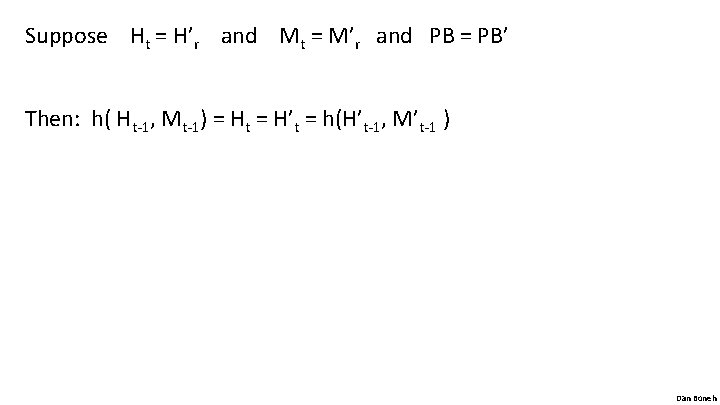
Suppose Ht = H’r and Mt = M’r and PB = PB’ Then: h( Ht-1, Mt-1) = Ht = H’t = h(H’t-1, M’t-1 ) Dan Boneh
⇒ To construct C. R. function, suffices to construct compression function End of Segment Dan Boneh

Online Cryptography Course Dan Boneh Collision resistance Constructing Compression Functions Dan Boneh
![The Merkle-Damgard iterated construction m[0] IV (fixed) h m[1] m[2] h m[3] ll PB](http://slidetodoc.com/presentation_image/1fbea7bdc789e48368ff98039a436e6d/image-23.jpg "The Merkle-Damgard iterated construction m[0] IV (fixed) h m[1] m[2] h m[3] ll PB")
The Merkle-Damgard iterated construction m[0] IV (fixed) h m[1] m[2] h m[3] ll PB h h H(m) Thm: h collision resistant ⇒ H collision resistant Goal: construct compression function h: T × X �T Dan Boneh
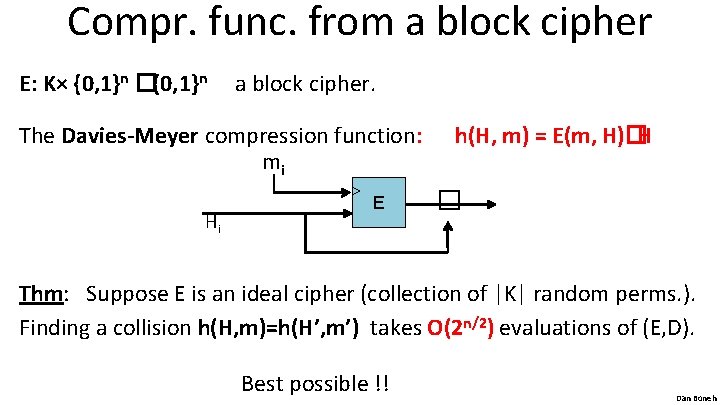
Compr. func. from a block cipher E: K× {0, 1}n �{0, 1}n a block cipher. The Davies-Meyer compression function: mi > Hi E h(H, m) = E(m, H)�H � Thm: Suppose E is an ideal cipher (collection of |K| random perms. ). Finding a collision h(H, m)=h(H’, m’) takes O(2 n/2) evaluations of (E, D). Best possible !! Dan Boneh

Suppose we define h(H, m) = E(m, H) Then the resulting h(. , . ) is not collision resistant: to build a collision (H, m) and (H’, m’) choose random (H, m, m’) and construct H’ as follows: H’=D(m’, E(m, H)) H’=E(m’, D(m, H)) H’=E(m’, E(m, H)) H’=D(m’, D(m, H))
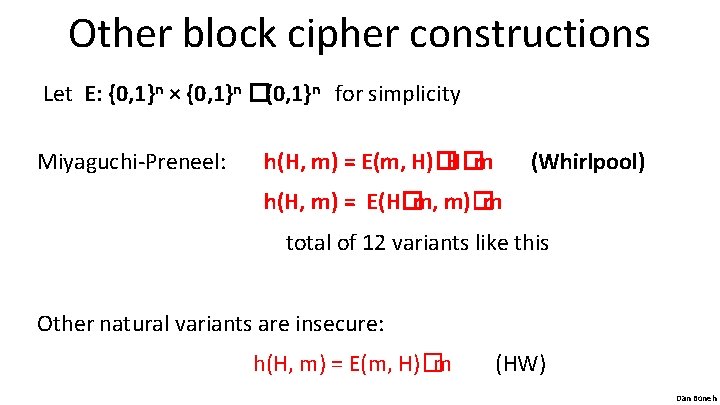
Other block cipher constructions Let E: {0, 1}n × {0, 1}n �{0, 1}n for simplicity Miyaguchi-Preneel: h(H, m) = E(m, H)�H�m (Whirlpool) h(H, m) = E(H�m, m)�m total of 12 variants like this Other natural variants are insecure: h(H, m) = E(m, H)�m (HW) Dan Boneh
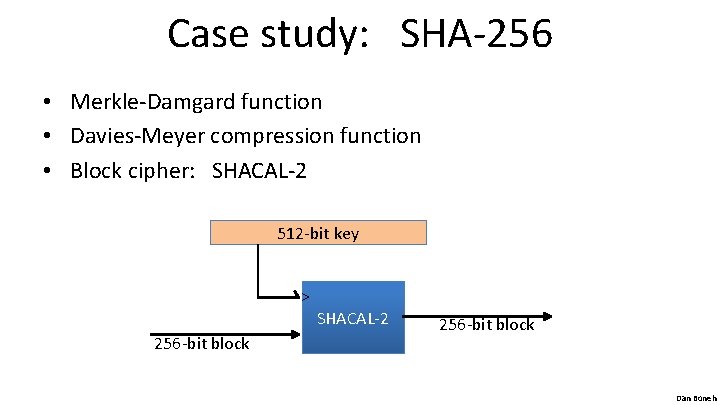
Case study: SHA-256 • Merkle-Damgard function • Davies-Meyer compression function • Block cipher: SHACAL-2 512 -bit key > 256 -bit block SHACAL-2 256 -bit block Dan Boneh
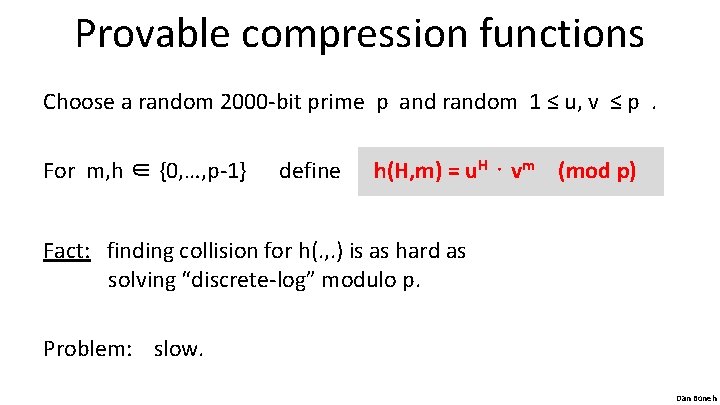
Provable compression functions Choose a random 2000 -bit prime p and random 1 ≤ u, v ≤ p. For m, h ∈ {0, …, p-1} define h(H, m) = u. H ⋅ vm (mod p) Fact: finding collision for h(. , . ) is as hard as solving “discrete-log” modulo p. Problem: slow. Dan Boneh
End of Segment Dan Boneh
Online Cryptography Course Dan Boneh Collision resistance HMAC: a MAC from SHA-256 Dan Boneh
![The Merkle-Damgard iterated construction m[0] IV (fixed) h m[1] m[2] h m[3] ll PB](http://slidetodoc.com/presentation_image/1fbea7bdc789e48368ff98039a436e6d/image-31.jpg "The Merkle-Damgard iterated construction m[0] IV (fixed) h m[1] m[2] h m[3] ll PB")
The Merkle-Damgard iterated construction m[0] IV (fixed) h m[1] m[2] h m[3] ll PB h h H(m) Thm: h collision resistant ⇒ H collision resistant Can we use H(. ) to directly build a MAC? Dan Boneh
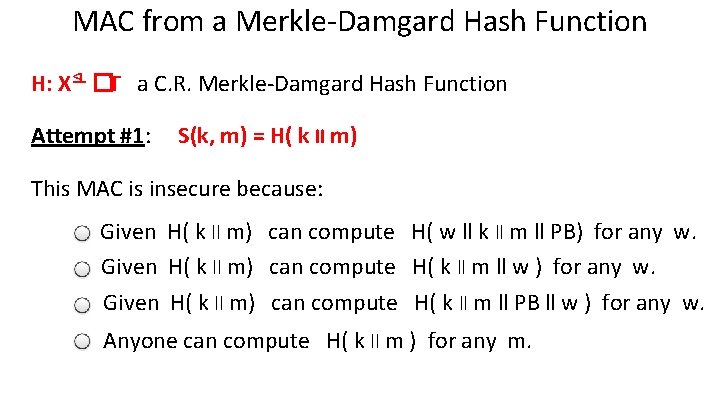
MAC from a Merkle-Damgard Hash Function H: X≤L �T a C. R. Merkle-Damgard Hash Function Attempt #1: S(k, m) = H( k ll m) This MAC is insecure because: Given H( k ll m) can compute H( w ll k ll m ll PB) for any w. Given H( k ll m) can compute H( k ll m ll w ) for any w. Given H( k ll m) can compute H( k ll m ll PB ll w ) for any w. Anyone can compute H( k ll m ) for any m.
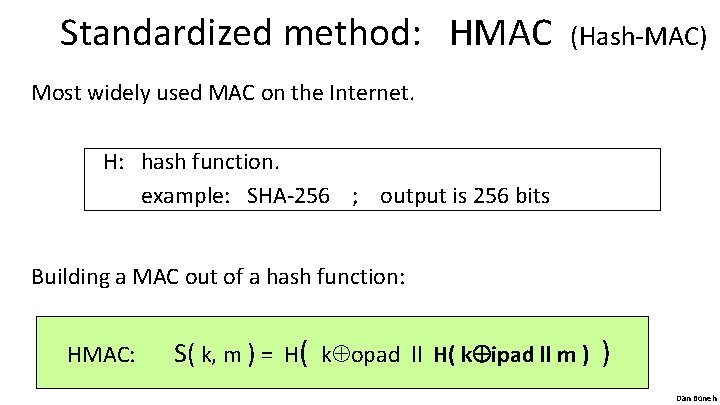
Standardized method: HMAC (Hash-MAC) Most widely used MAC on the Internet. H: hash function. example: SHA-256 ; output is 256 bits Building a MAC out of a hash function: HMAC: S( k, m ) = H( k opad ll H( k ipad ll m ) ) Dan Boneh
![HMAC in pictures k�ipad IV (fixed) > h m[0] > m[1] h > m[2]](http://slidetodoc.com/presentation_image/1fbea7bdc789e48368ff98039a436e6d/image-34.jpg "HMAC in pictures k�ipad IV (fixed) > h m[0] > m[1] h > m[2]")
HMAC in pictures k�ipad IV (fixed) > h m[0] > m[1] h > m[2] ll PB h > h k�opad > IV (fixed) h > h tag Similar to the NMAC PRF. main difference: the two keys k 1, k 2 are dependent Dan Boneh
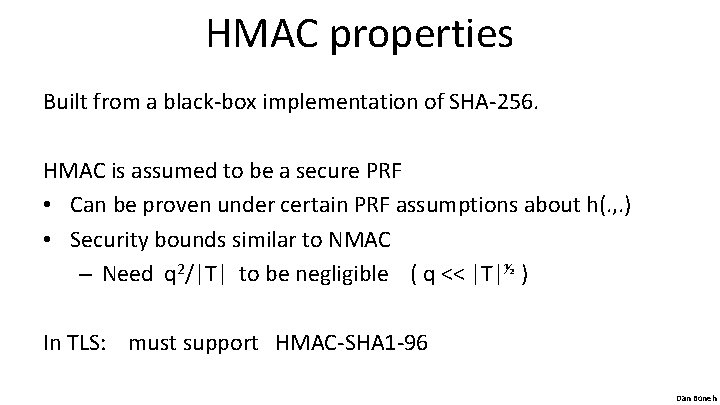
HMAC properties Built from a black-box implementation of SHA-256. HMAC is assumed to be a secure PRF • Can be proven under certain PRF assumptions about h(. , . ) • Security bounds similar to NMAC – Need q 2/|T| to be negligible ( q << |T|½ ) In TLS: must support HMAC-SHA 1 -96 Dan Boneh
End of Segment Dan Boneh
Online Cryptography Course Dan Boneh Collision resistance Timing attacks on MAC verification Dan Boneh
![Warning: verification timing attacks Example: Keyczar crypto library (Python) [L’ 09] [simplified] def Verify(key,](http://slidetodoc.com/presentation_image/1fbea7bdc789e48368ff98039a436e6d/image-38.jpg "Warning: verification timing attacks Example: Keyczar crypto library (Python) [L’ 09] [simplified] def Verify(key,")
Warning: verification timing attacks Example: Keyczar crypto library (Python) [L’ 09] [simplified] def Verify(key, msg, sig_bytes): return HMAC(key, msg) == sig_bytes The problem: ‘==‘ implemented as a byte-by-byte comparison • Comparator returns false when first inequality found Dan Boneh
![Warning: verification timing attacks target msg m m , tag [L’ 09] k accept](http://slidetodoc.com/presentation_image/1fbea7bdc789e48368ff98039a436e6d/image-39.jpg "Warning: verification timing attacks target msg m m , tag [L’ 09] k accept")
Warning: verification timing attacks target msg m m , tag [L’ 09] k accept or reject Timing attack: to compute tag for target message m do: Step 1: Query server with random tag Step 2: Loop over all possible first bytes and query server. stop when verification takes a little longer than in step 1 Step 3: repeat for all tag bytes until valid tag found Dan Boneh
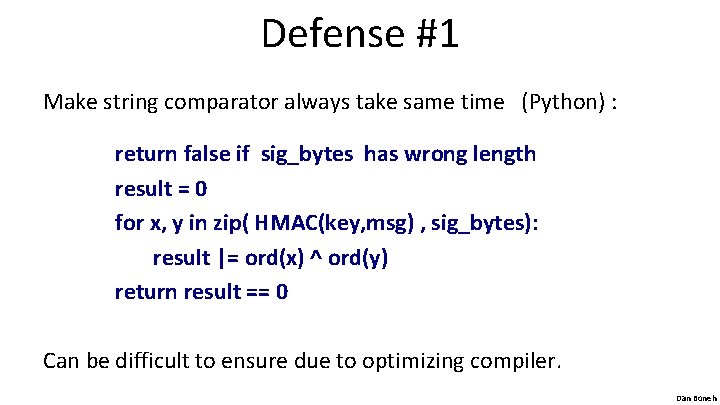
Defense #1 Make string comparator always take same time (Python) : return false if sig_bytes has wrong length result = 0 for x, y in zip( HMAC(key, msg) , sig_bytes): result |= ord(x) ^ ord(y) return result == 0 Can be difficult to ensure due to optimizing compiler. Dan Boneh
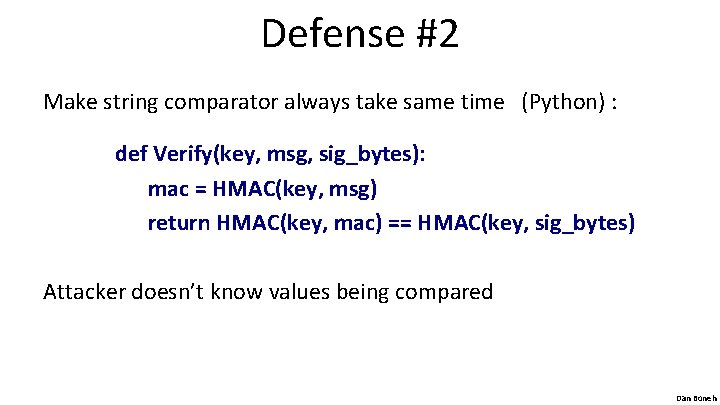
Defense #2 Make string comparator always take same time (Python) : def Verify(key, msg, sig_bytes): mac = HMAC(key, msg) return HMAC(key, mac) == HMAC(key, sig_bytes) Attacker doesn’t know values being compared Dan Boneh
Lesson Don’t implement crypto yourself ! Dan Boneh
End of Segment Dan Boneh
- Slides: 43