
Online Cryptography Course Dan Boneh Block ciphers What
Online Cryptography Course Dan Boneh Block ciphers What is a block cipher? Dan Boneh
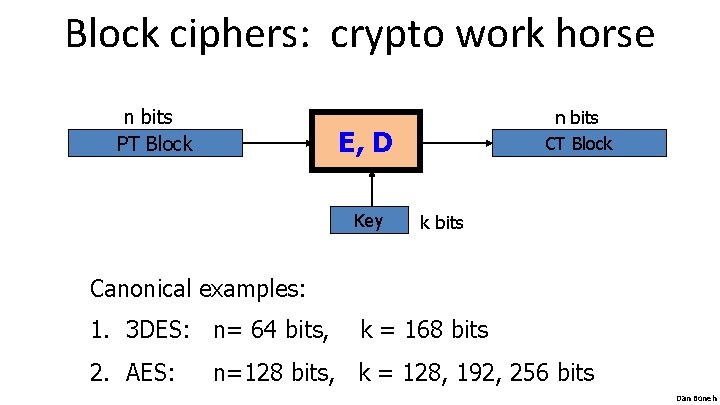
Block ciphers: crypto work horse n bits PT Block n bits CT Block E, D Key k bits Canonical examples: 1. 3 DES: n= 64 bits, 2. AES: k = 168 bits n=128 bits, k = 128, 192, 256 bits Dan Boneh
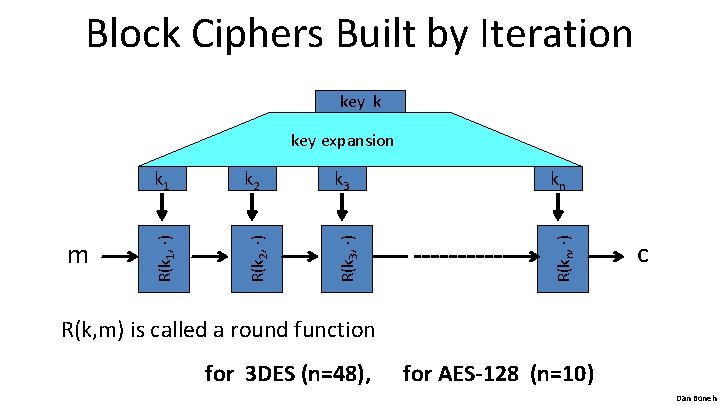
Block Ciphers Built by Iteration key k k 2 k 3 kn R(k 2, ) R(k 3, ) R(kn, ) m k 1 R(k 1, ) key expansion c R(k, m) is called a round function for 3 DES (n=48), for AES-128 (n=10) Dan Boneh
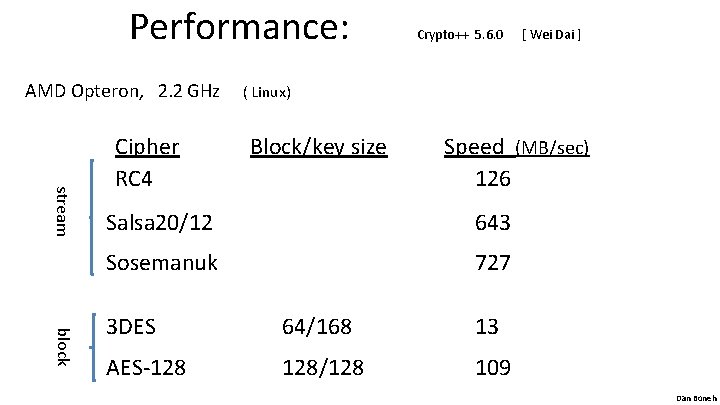
Performance: AMD Opteron, 2. 2 GHz stream Cipher RC 4 Crypto++ 5. 6. 0 [ Wei Dai ] ( Linux) Block/key size Speed (MB/sec) 126 Salsa 20/12 643 Sosemanuk 727 block 3 DES 64/168 13 AES-128 128/128 109 Dan Boneh
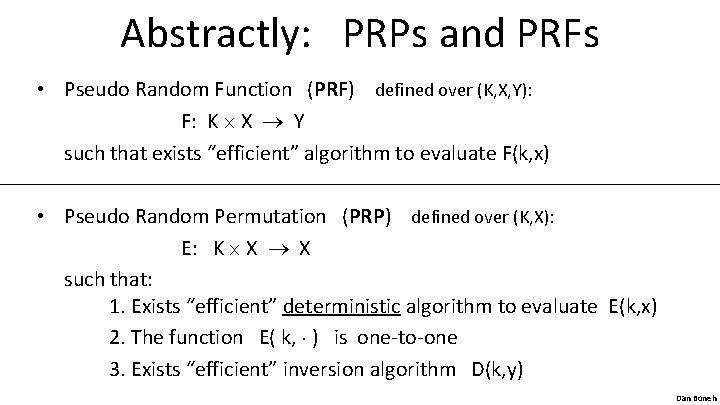
Abstractly: PRPs and PRFs • Pseudo Random Function (PRF) defined over (K, X, Y): F: K X Y such that exists “efficient” algorithm to evaluate F(k, x) • Pseudo Random Permutation (PRP) defined over (K, X): E: K X X such that: 1. Exists “efficient” deterministic algorithm to evaluate E(k, x) 2. The function E( k, ) is one-to-one 3. Exists “efficient” inversion algorithm D(k, y) Dan Boneh
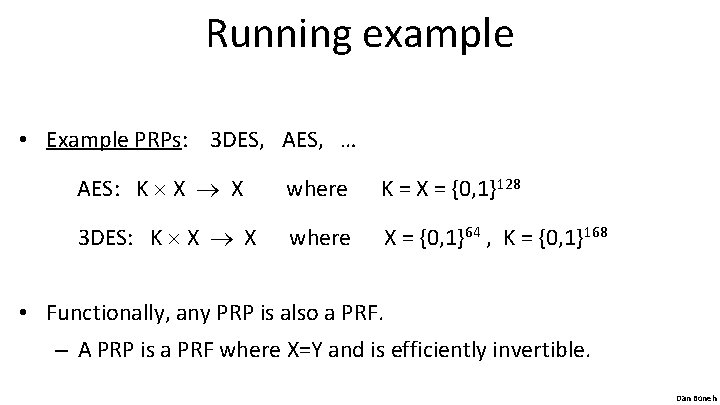
Running example • Example PRPs: 3 DES, AES, … AES: K X X where K = X = {0, 1}128 3 DES: K X X where X = {0, 1}64 , K = {0, 1}168 • Functionally, any PRP is also a PRF. – A PRP is a PRF where X=Y and is efficiently invertible. Dan Boneh
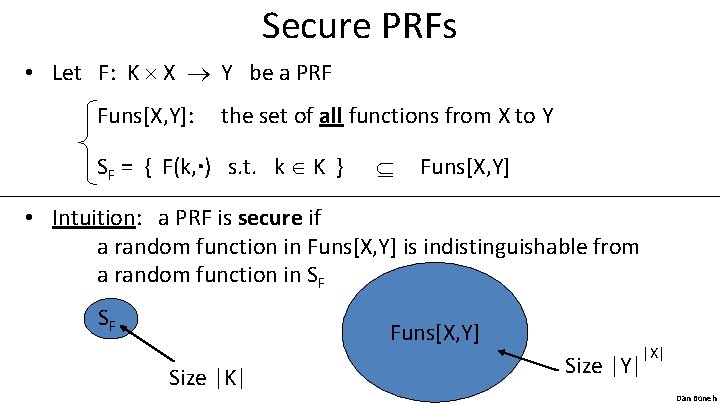
Secure PRFs • Let F: K X Y be a PRF Funs[X, Y]: the set of all functions from X to Y SF = { F(k, ) s. t. k K } Funs[X, Y] • Intuition: a PRF is secure if a random function in Funs[X, Y] is indistinguishable from a random function in SF SF Funs[X, Y] Size |K| Size |Y| |X| Dan Boneh
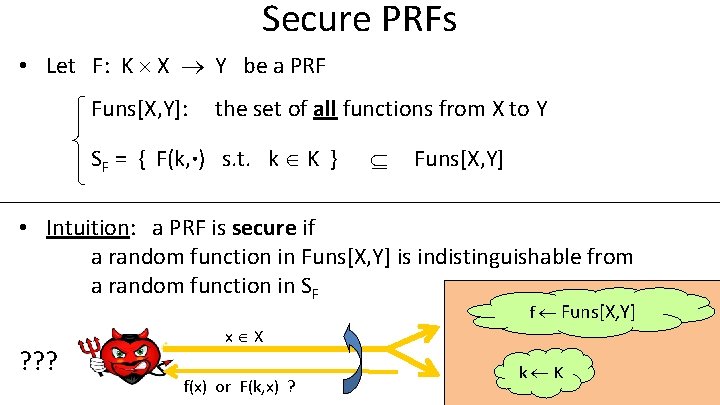
Secure PRFs • Let F: K X Y be a PRF Funs[X, Y]: the set of all functions from X to Y SF = { F(k, ) s. t. k K } Funs[X, Y] • Intuition: a PRF is secure if a random function in Funs[X, Y] is indistinguishable from a random function in SF f Funs[X, Y] ? ? ? x X f(x) or F(k, x) ? k K Dan Boneh
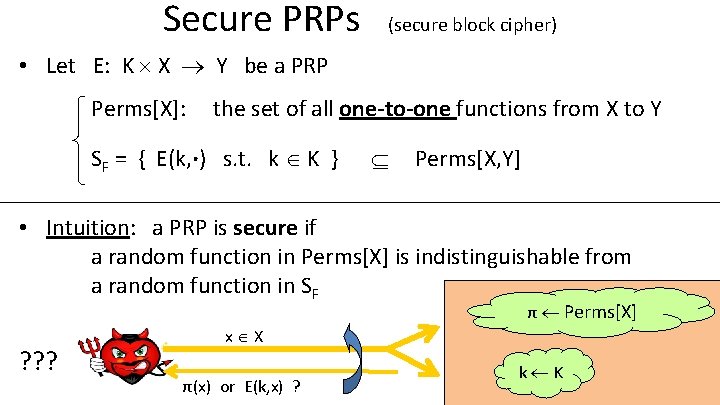
Secure PRPs (secure block cipher) • Let E: K X Y be a PRP Perms[X]: the set of all one-to-one functions from X to Y SF = { E(k, ) s. t. k K } Perms[X, Y] • Intuition: a PRP is secure if a random function in Perms[X] is indistinguishable from a random function in SF π Perms[X] ? ? ? x X π(x) or E(k, x) ? k K Dan Boneh

Let F: K X {0, 1}128 be a secure PRF. Is the following G a secure PRF? G(k, x) = 0 128 if x=0 F(k, x) otherwise No, it is easy to distinguish G from a random function Yes, an attack on G would also break F It depends on F
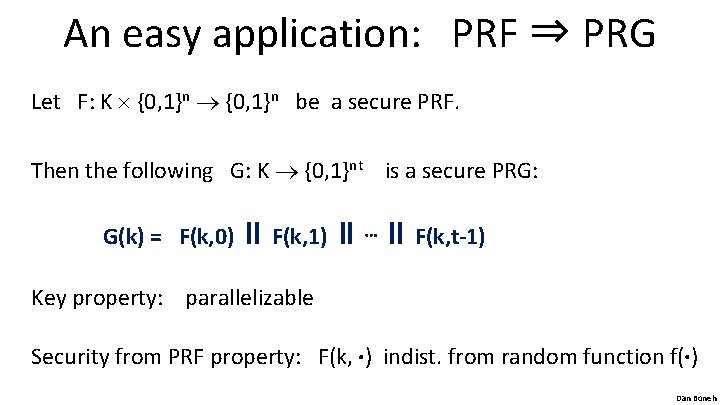
An easy application: PRF ⇒ PRG Let F: K {0, 1}n be a secure PRF. Then the following G: K {0, 1}nt is a secure PRG: G(k) = F(k, 0) ll F(k, 1) ll ⋯ ll F(k, t-1) Key property: parallelizable Security from PRF property: F(k, ) indist. from random function f( ) Dan Boneh
End of Segment Dan Boneh
Online Cryptography Course Dan Boneh Block ciphers The data encryption standard (DES) Dan Boneh
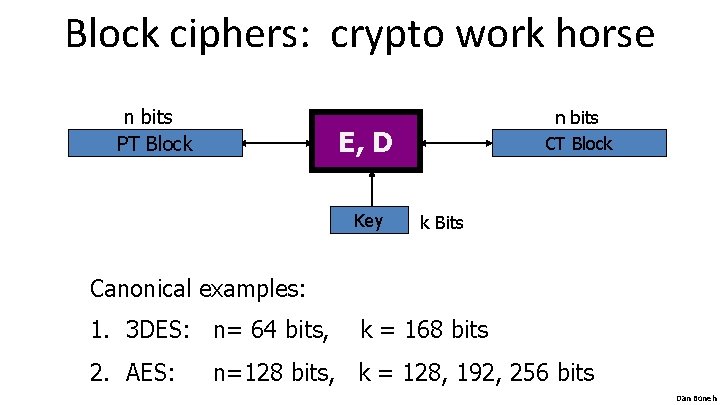
Block ciphers: crypto work horse n bits PT Block n bits CT Block E, D Key k Bits Canonical examples: 1. 3 DES: n= 64 bits, 2. AES: k = 168 bits n=128 bits, k = 128, 192, 256 bits Dan Boneh
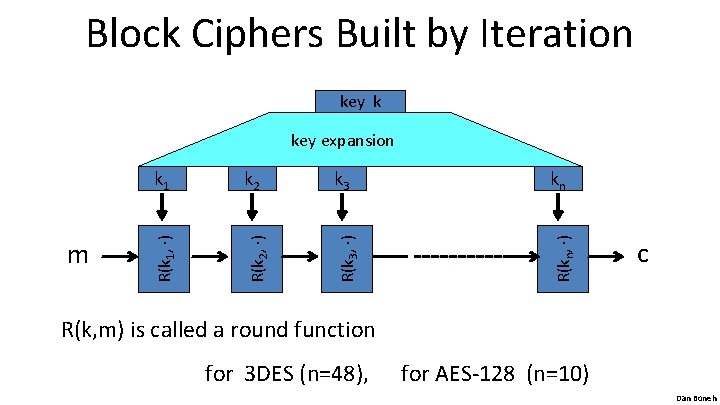
Block Ciphers Built by Iteration key k k 2 k 3 kn R(k 2, ) R(k 3, ) R(kn, ) m k 1 R(k 1, ) key expansion c R(k, m) is called a round function for 3 DES (n=48), for AES-128 (n=10) Dan Boneh
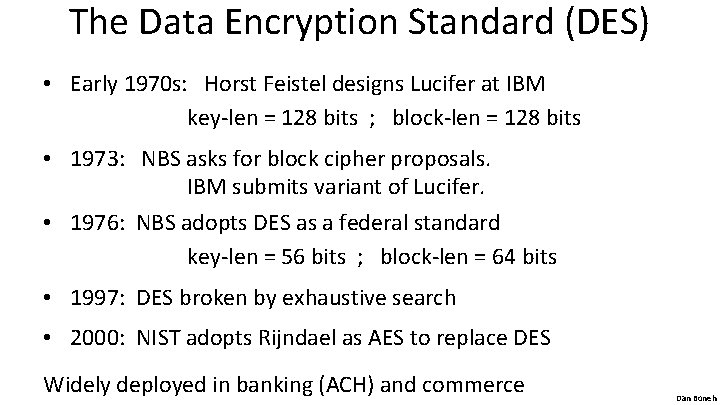
The Data Encryption Standard (DES) • Early 1970 s: Horst Feistel designs Lucifer at IBM key-len = 128 bits ; block-len = 128 bits • 1973: NBS asks for block cipher proposals. IBM submits variant of Lucifer. • 1976: NBS adopts DES as a federal standard key-len = 56 bits ; block-len = 64 bits • 1997: DES broken by exhaustive search • 2000: NIST adopts Rijndael as AES to replace DES Widely deployed in banking (ACH) and commerce Dan Boneh
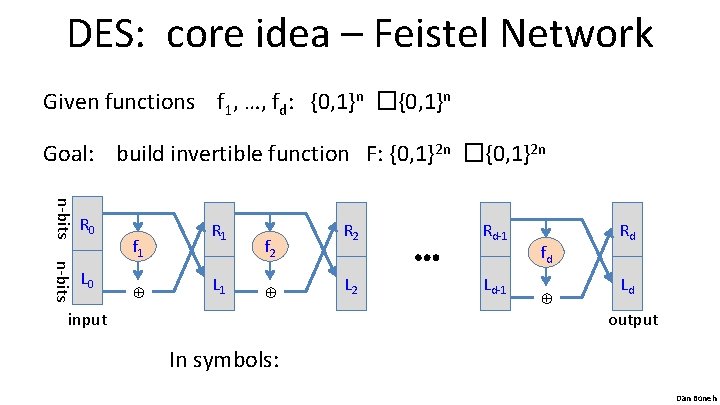
DES: core idea – Feistel Network Given functions f 1, …, fd: {0, 1}n �{0, 1}n Goal: build invertible function F: {0, 1}2 n �{0, 1}2 n L 1 f 2 ⊕ ⊕ n-bits L 0 f 1 R 1 input R 2 L 2 ⋯ Rd-1 Ld-1 fd ⊕ n-bits R 0 Rd Ld output In symbols: Dan Boneh
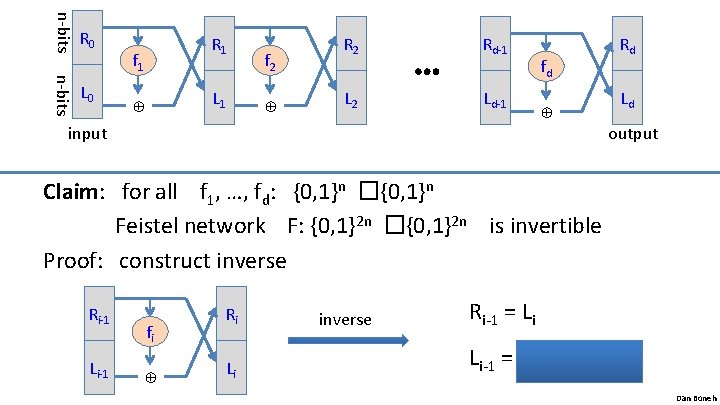
f 1 L 1 f 2 ⊕ ⊕ n-bits L 0 R 1 R 2 L 2 ⋯ Rd-1 Ld-1 input fd ⊕ n-bits R 0 Rd Ld output Claim: for all f 1, …, fd: {0, 1}n �{0, 1}n Feistel network F: {0, 1}2 n �{0, 1}2 n is invertible Proof: construct inverse Li-1 fi ⊕ Ri-1 Ri Li inverse Ri-1 = Li Li-1 = fi(Li) �Ri Dan Boneh
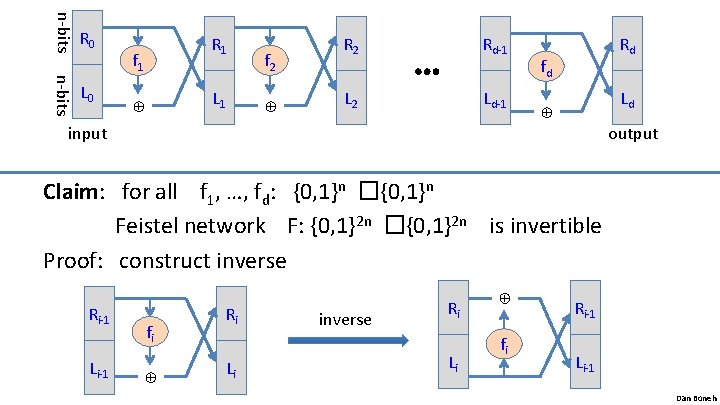
f 1 L 1 f 2 ⊕ ⊕ n-bits L 0 R 1 R 2 L 2 Rd-1 ⋯ Ld-1 input Rd fd Ld ⊕ n-bits R 0 output Claim: for all f 1, …, fd: {0, 1}n �{0, 1}n Feistel network F: {0, 1}2 n �{0, 1}2 n is invertible Proof: construct inverse Li-1 fi ⊕ Ri-1 Ri Li inverse Ri Li ⊕ fi Ri-1 Li-1 Dan Boneh
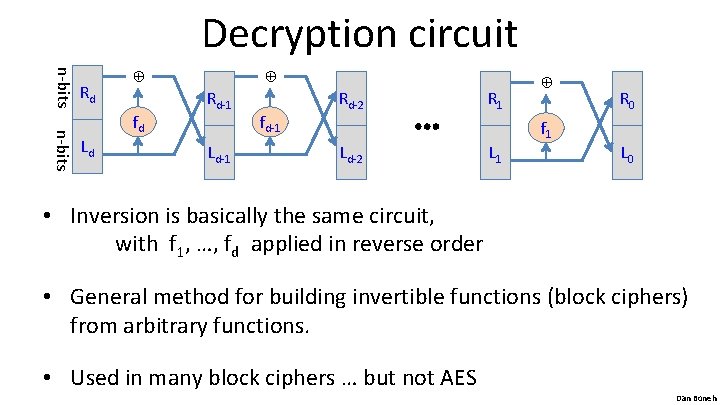
Decryption circuit n-bits Rd n-bits Ld ⊕ fd Rd-1 Ld-1 ⊕ fd-1 Rd-2 Ld-2 ⋯ R 1 L 1 ⊕ f 1 R 0 L 0 • Inversion is basically the same circuit, with f 1, …, fd applied in reverse order • General method for building invertible functions (block ciphers) from arbitrary functions. • Used in many block ciphers … but not AES Dan Boneh
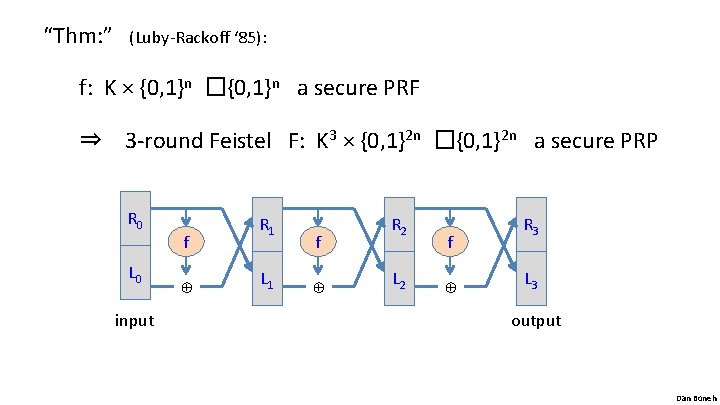
“Thm: ” (Luby-Rackoff ‘ 85): f: K × {0, 1}n �{0, 1}n a secure PRF ⇒ 3 -round Feistel F: K 3 × {0, 1}2 n �{0, 1}2 n a secure PRP ⊕ input L 1 f ⊕ L 0 f R 1 R 2 L 2 f ⊕ R 0 R 3 L 3 output Dan Boneh
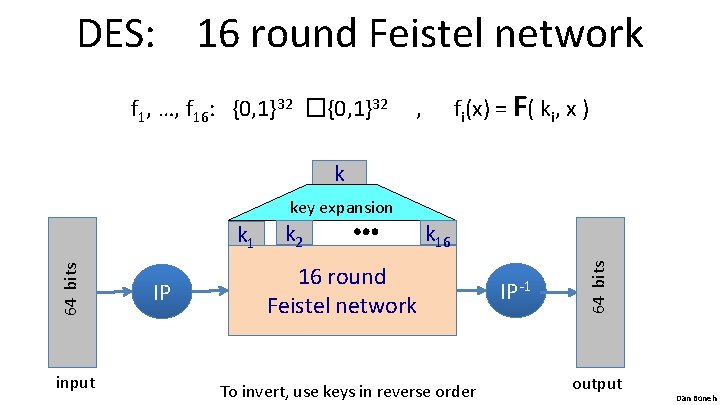
DES: 16 round Feistel network f 1, …, f 16: {0, 1}32 �{0, 1}32 fi(x) = F( ki, x ) , k key expansion input IP k 2 ⋯ k 16 16 round Feistel network To invert, use keys in reverse order IP-1 64 bits k 1 output Dan Boneh
The function F(ki, x) S-box: function {0, 1}6 �{0, 1}4 , implemented as look-up table. Dan Boneh
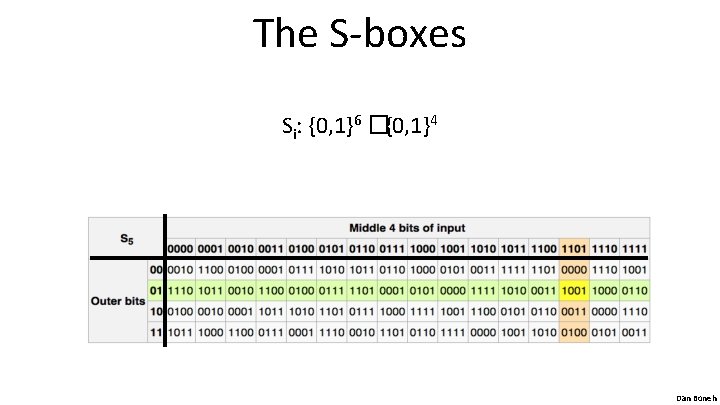
The S-boxes Si: {0, 1}6 �{0, 1}4 Dan Boneh
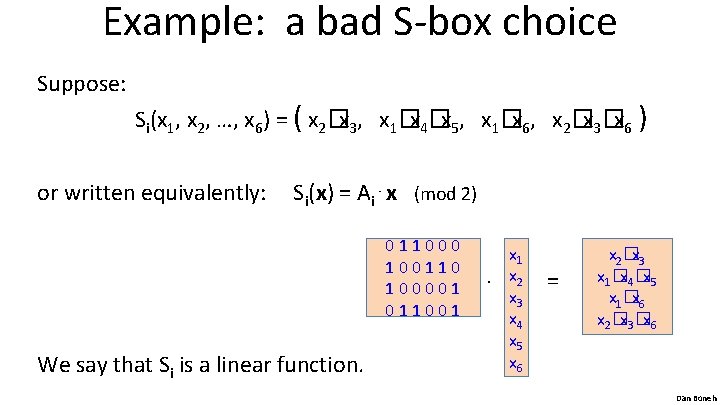
Example: a bad S-box choice Suppose: Si(x 1, x 2, …, x 6) = ( x 2�x 3, x 1�x 4�x 5, x 1�x 6, x 2�x 3�x 6 ) or written equivalently: Si(x) = Ai⋅x (mod 2) 011000 100110 100001 011001 We say that Si is a linear function. x 1. x 2 x 3 x 4 x 5 x 6 = x 2�x 3 x 1�x 4�x 5 x 1�x 6 x 2�x 3�x 6 Dan Boneh
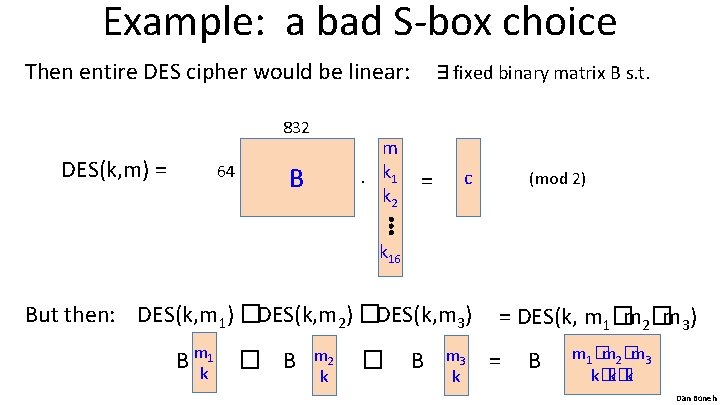
Example: a bad S-box choice Then entire DES cipher would be linear: ∃fixed binary matrix B s. t. 832 DES(k, m) = 64 m. k 1 k 2 B = c (mod 2) ⋮ k 16 But then: DES(k, m 1) �DES(k, m 2) �DES(k, m 3) B mk 1 � B m 2 k � B m 3 k = DES(k, m 1�m 2�m 3) = B m 1�m 2�m 3 k�k�k Dan Boneh
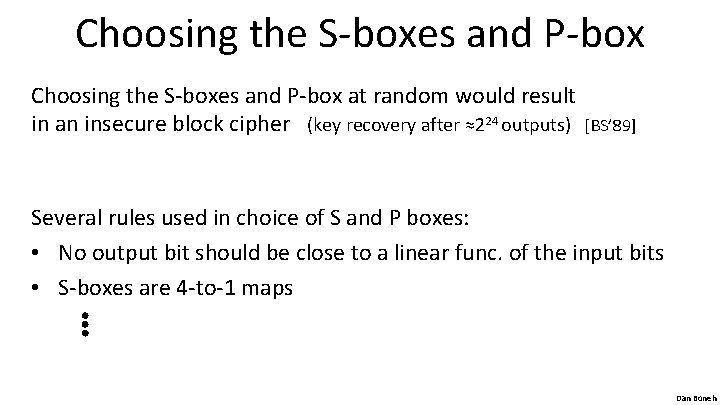
Choosing the S-boxes and P-box at random would result in an insecure block cipher (key recovery after ≈224 outputs) [BS’ 89] Several rules used in choice of S and P boxes: • No output bit should be close to a linear func. of the input bits • S-boxes are 4 -to-1 maps ⋮ Dan Boneh
End of Segment Dan Boneh
Online Cryptography Course Dan Boneh Block ciphers Exhaustive Search Attacks Dan Boneh
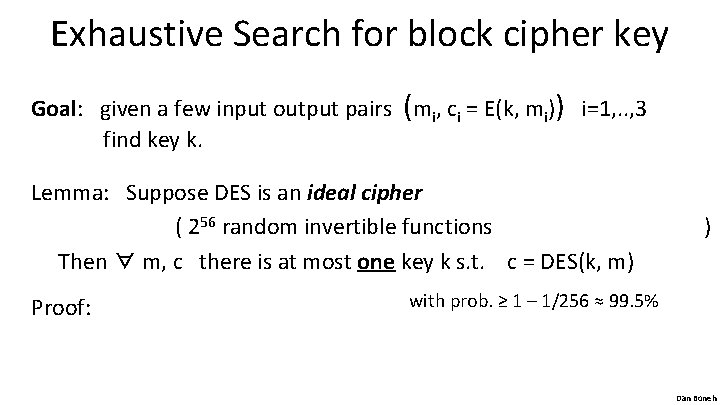
Exhaustive Search for block cipher key Goal: given a few input output pairs (mi, ci = E(k, mi)) i=1, . . , 3 find key k. Lemma: Suppose DES is an ideal cipher ( 256 random invertible functions Then ∀ m, c there is at most one key k s. t. c = DES(k, m) Proof: ) with prob. ≥ 1 – 1/256 ≈ 99. 5% Dan Boneh
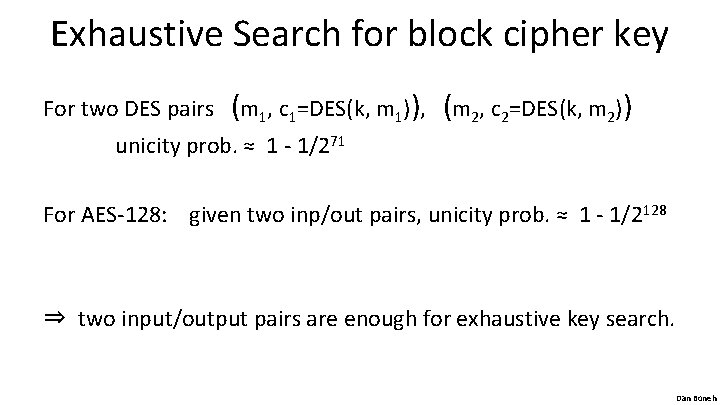
Exhaustive Search for block cipher key For two DES pairs (m 1, c 1=DES(k, m 1)), (m 2, c 2=DES(k, m 2)) unicity prob. ≈ 1 - 1/271 For AES-128: given two inp/out pairs, unicity prob. ≈ 1 - 1/2128 ⇒ two input/output pairs are enough for exhaustive key search. Dan Boneh
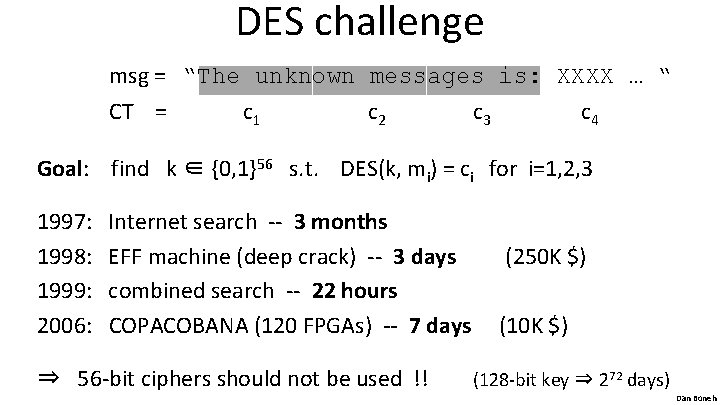
DES challenge msg = “The unknown messages is: XXXX … “ CT = c 1 c 2 c 3 c 4 Goal: find k ∈ {0, 1}56 s. t. DES(k, mi) = ci for i=1, 2, 3 1997: 1998: 1999: 2006: Internet search -- 3 months EFF machine (deep crack) -- 3 days combined search -- 22 hours COPACOBANA (120 FPGAs) -- 7 days ⇒ 56 -bit ciphers should not be used !! (250 K $) (128 -bit key ⇒ 272 days) Dan Boneh
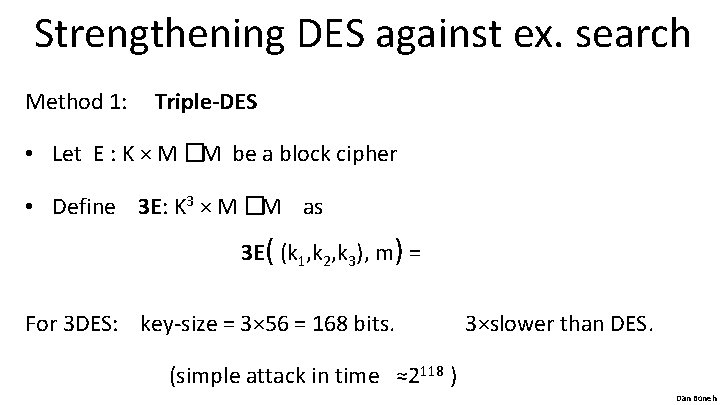
Strengthening DES against ex. search Method 1: Triple-DES • Let E : K × M �M be a block cipher • Define 3 E: K 3 × M �M as 3 E( (k 1, k 2, k 3), m) = For 3 DES: key-size = 3× 56 = 168 bits. 3×slower than DES. (simple attack in time ≈2118 ) Dan Boneh
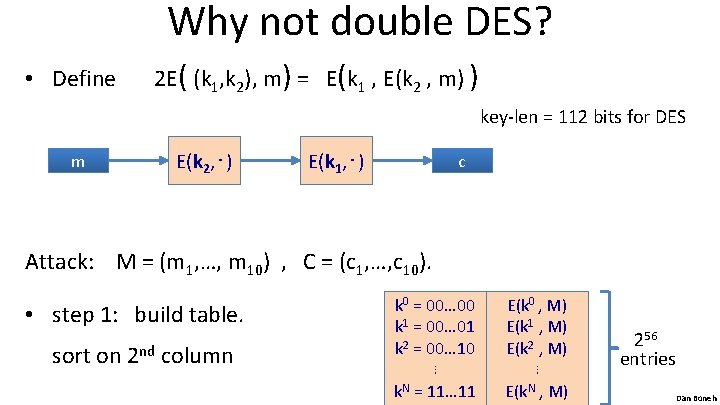
Why not double DES? • Define 2 E( (k 1, k 2), m) = E(k 1 , E(k 2 , m) ) key-len = 112 bits for DES m E(k 2, ⋅) E(k 1, ⋅) c Attack: M = (m 1, …, m 10) , C = (c 1, …, c 10). • step 1: build table. sort on 2 nd column k 0 = 00… 00 k 1 = 00… 01 k 2 = 00… 10 ⋮ k. N = 11… 11 E(k 0 , M) E(k 1 , M) E(k 2 , M) ⋮ E(k. N , M) 256 entries Dan Boneh
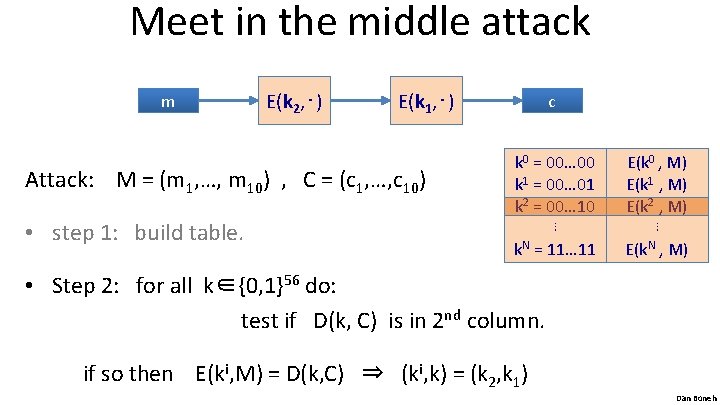
Meet in the middle attack m E(k 2, ⋅) E(k 1, ⋅) Attack: M = (m 1, …, m 10) , C = (c 1, …, c 10) • step 1: build table. c k 0 = 00… 00 k 1 = 00… 01 k 2 = 00… 10 ⋮ k. N = 11… 11 E(k 0 , M) E(k 1 , M) E(k 2 , M) ⋮ E(k. N , M) • Step 2: for all k∈{0, 1}56 do: test if D(k, C) is in 2 nd column. if so then E(ki, M) = D(k, C) ⇒ (ki, k) = (k 2, k 1) Dan Boneh
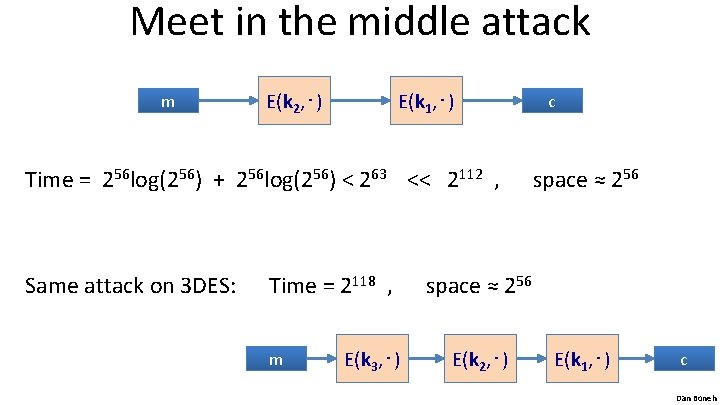
Meet in the middle attack m E(k 2, ⋅) E(k 1, ⋅) Time = 256 log(256) + 256 log(256) < 263 << 2112 , Same attack on 3 DES: Time = 2118 , m E(k 3, ⋅) c space ≈ 256 E(k 2, ⋅) E(k 1, ⋅) c Dan Boneh
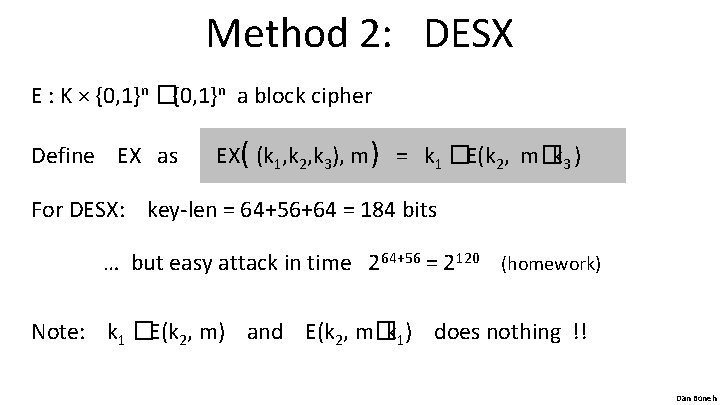
Method 2: DESX E : K × {0, 1}n �{0, 1}n a block cipher Define EX as EX( (k 1, k 2, k 3), m) = k 1 �E(k 2, m�k 3 ) For DESX: key-len = 64+56+64 = 184 bits … but easy attack in time 264+56 = 2120 (homework) Note: k 1 �E(k 2, m) and E(k 2, m�k 1) does nothing !! Dan Boneh
End of Segment Dan Boneh
Online Cryptography Course Dan Boneh Block ciphers More attacks on block ciphers Dan Boneh
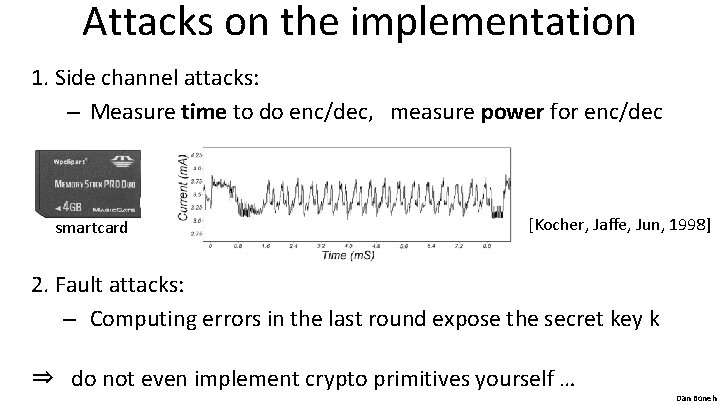
Attacks on the implementation 1. Side channel attacks: – Measure time to do enc/dec, measure power for enc/dec smartcard [Kocher, Jaffe, Jun, 1998] 2. Fault attacks: – Computing errors in the last round expose the secret key k ⇒ do not even implement crypto primitives yourself … Dan Boneh
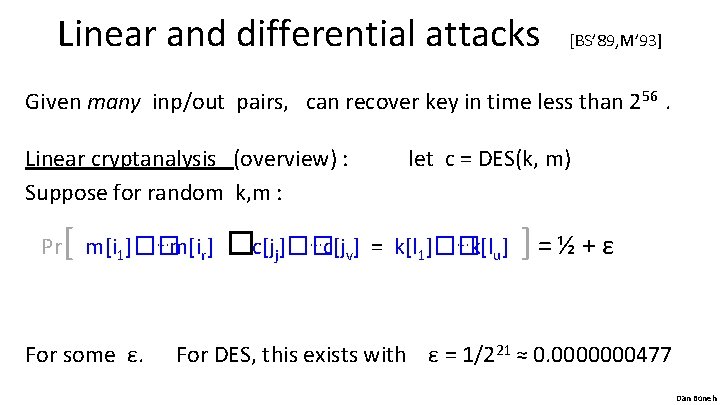
Linear and differential attacks [BS’ 89, M’ 93] Given many inp/out pairs, can recover key in time less than 256. Linear cryptanalysis (overview) : Suppose for random k, m : [ Pr m[i 1]�⋯�m[ir] For some ε. �c[jj]�⋯�c[jv] let c = DES(k, m) = k[l 1]�⋯�k[lu] ]=½+ε For DES, this exists with ε = 1/221 ≈ 0. 0000000477 Dan Boneh
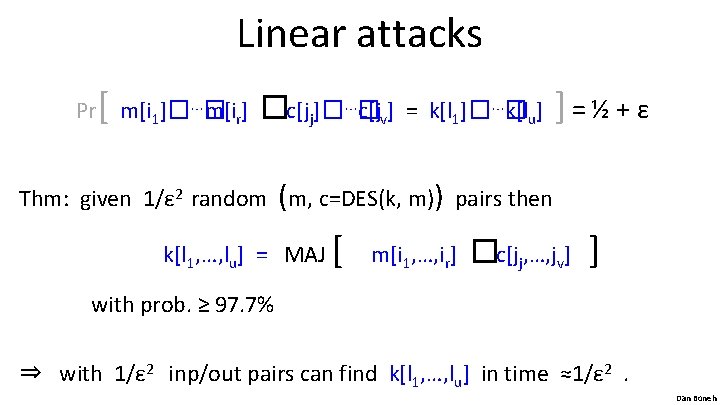
Linear attacks [ Pr m[i 1]�⋯� m[ir] �c[jj]�⋯� c[jv] = k[l 1]�⋯� k[lu] ]=½+ε Thm: given 1/ε 2 random (m, c=DES(k, m)) pairs then k[l 1, …, lu] = MAJ [ m[i 1, …, ir] �c[jj, …, jv] ] with prob. ≥ 97. 7% ⇒ with 1/ε 2 inp/out pairs can find k[l 1, …, lu] in time ≈1/ε 2. Dan Boneh
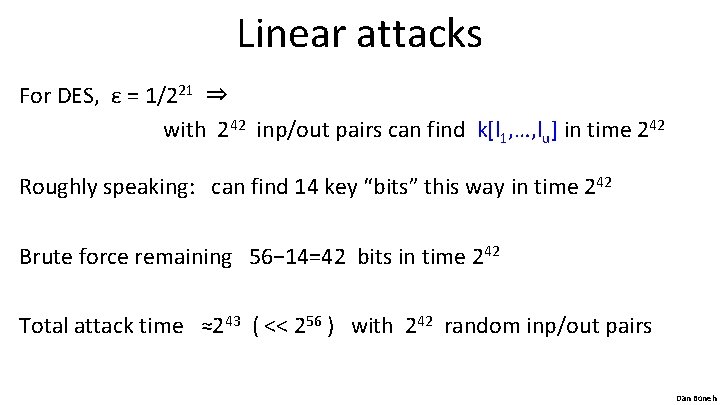
Linear attacks For DES, ε = 1/221 ⇒ with 242 inp/out pairs can find k[l 1, …, lu] in time 242 Roughly speaking: can find 14 key “bits” this way in time 242 Brute force remaining 56− 14=42 bits in time 242 Total attack time ≈243 ( << 256 ) with 242 random inp/out pairs Dan Boneh
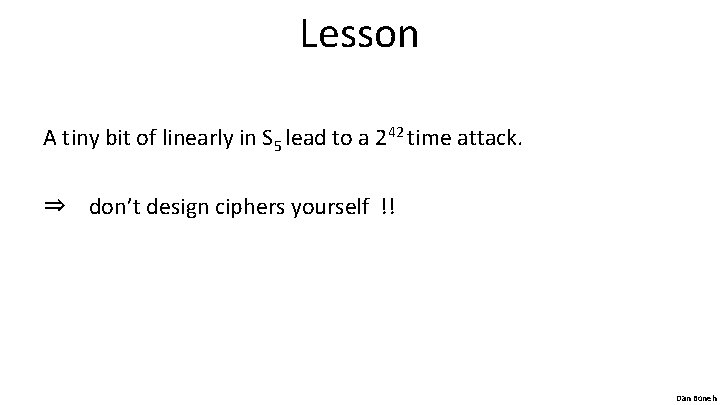
Lesson A tiny bit of linearly in S 5 lead to a 242 time attack. ⇒ don’t design ciphers yourself !! Dan Boneh
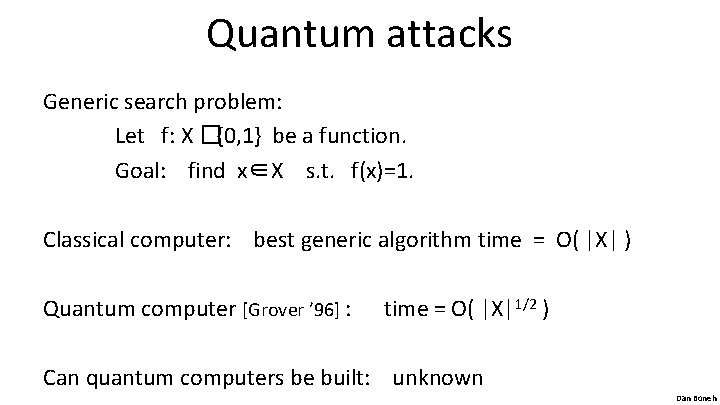
Quantum attacks Generic search problem: Let f: X �{0, 1} be a function. Goal: find x∈X s. t. f(x)=1. Classical computer: best generic algorithm time = O( |X| ) Quantum computer [Grover ’ 96] : time = O( |X|1/2 ) Can quantum computers be built: unknown Dan Boneh
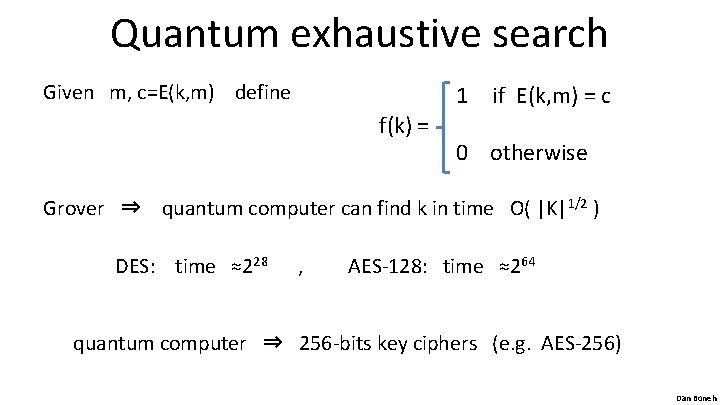
Quantum exhaustive search Given m, c=E(k, m) define 1 if E(k, m) = c f(k) = 0 otherwise Grover ⇒ quantum computer can find k in time O( |K|1/2 ) DES: time ≈228 , AES-128: time ≈264 quantum computer ⇒ 256 -bits key ciphers (e. g. AES-256) Dan Boneh
End of Segment Dan Boneh
Online Cryptography Course Dan Boneh Block ciphers The AES block cipher Dan Boneh
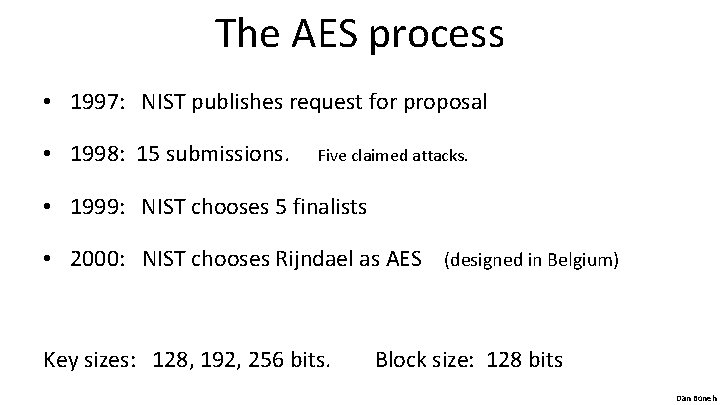
The AES process • 1997: NIST publishes request for proposal • 1998: 15 submissions. Five claimed attacks. • 1999: NIST chooses 5 finalists • 2000: NIST chooses Rijndael as AES (designed in Belgium) Key sizes: 128, 192, 256 bits. Block size: 128 bits Dan Boneh
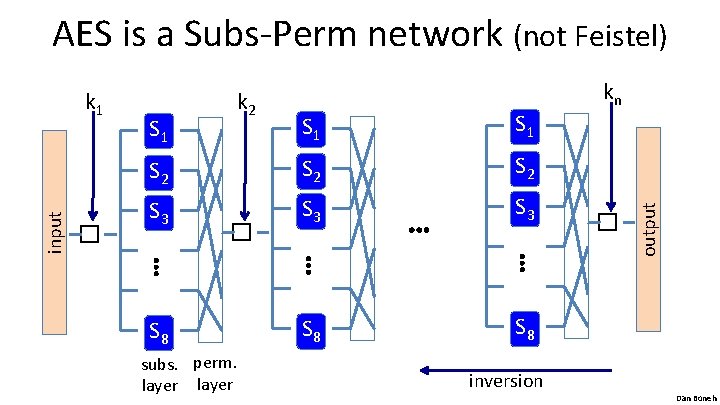
AES is a Subs-Perm network (not Feistel) S 1 S 2 S 2 S 3 S 3 ⋯ ⋯ � ⋯ S 8 S 8 subs. perm. layer output S 1 kn � k 2 ⋯ � input k 1 inversion Dan Boneh
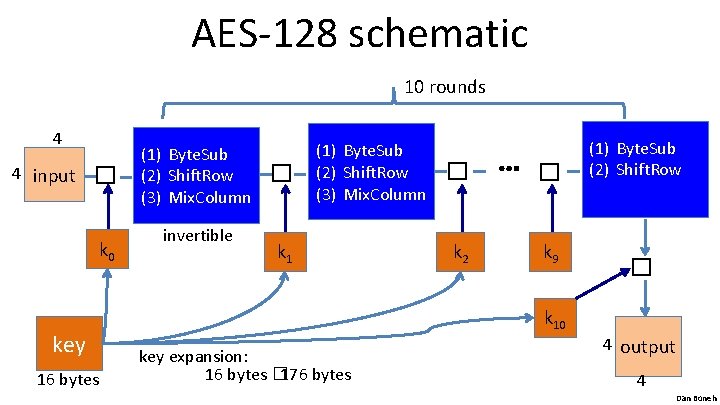
AES-128 schematic key 16 bytes invertible k 1 k 2 ⋯ � (1) Byte. Sub (2) Shift. Row (3) Mix. Column k 9 k 10 key expansion: 16 bytes � 176 bytes (1) Byte. Sub (2) Shift. Row � k 0 (1) Byte. Sub (2) Shift. Row (3) Mix. Column � 4 input � 4 � 10 rounds 4 output 4 Dan Boneh
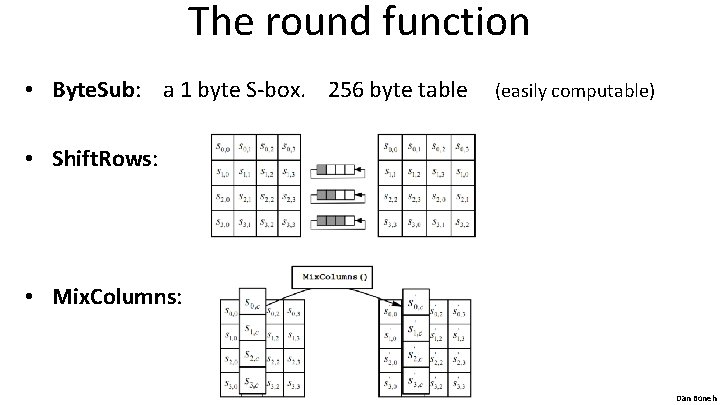
The round function • Byte. Sub: a 1 byte S-box. 256 byte table (easily computable) • Shift. Rows: • Mix. Columns: Dan Boneh
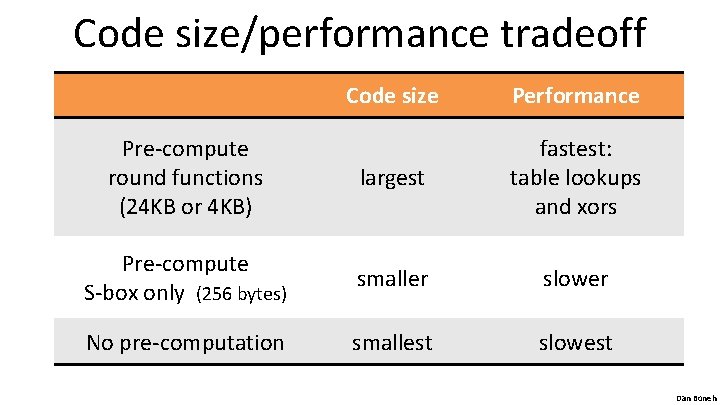
Code size/performance tradeoff Code size Performance Pre-compute round functions (24 KB or 4 KB) largest fastest: table lookups and xors Pre-compute S-box only (256 bytes) smaller slower No pre-computation smallest slowest Dan Boneh
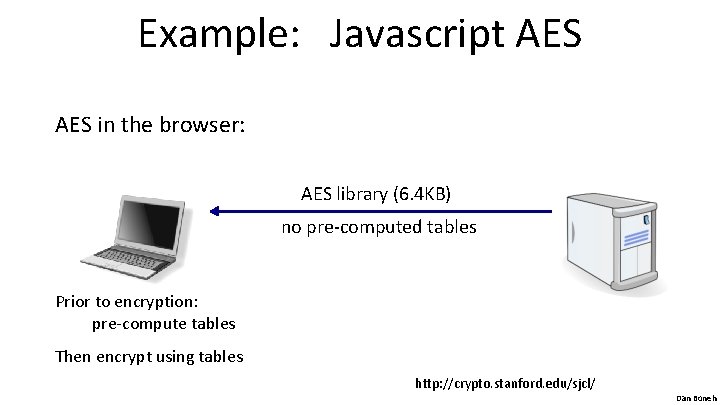
Example: Javascript AES in the browser: AES library (6. 4 KB) no pre-computed tables Prior to encryption: pre-compute tables Then encrypt using tables http: //crypto. stanford. edu/sjcl/ Dan Boneh
AES in hardware AES instructions in Intel Westmere: • aesenc, aesenclast: do one round of AES 128 -bit registers: xmm 1=state, xmm 2=round key aesenc xmm 1, xmm 2 ; puts result in xmm 1 • aeskeygenassist: performs AES key expansion • Claim 14 x speed-up over Open. SSL on same hardware Similar instructions on AMD Bulldozer Dan Boneh
Attacks Best key recovery attack: four times better than ex. search [BKR’ 11] Related key attack on AES-256: [BK’ 09] Given 299 inp/out pairs from four related keys in AES-256 can recover keys in time ≈299 Dan Boneh
End of Segment Dan Boneh
Online Cryptography Course Dan Boneh Block ciphers from PRGs Dan Boneh
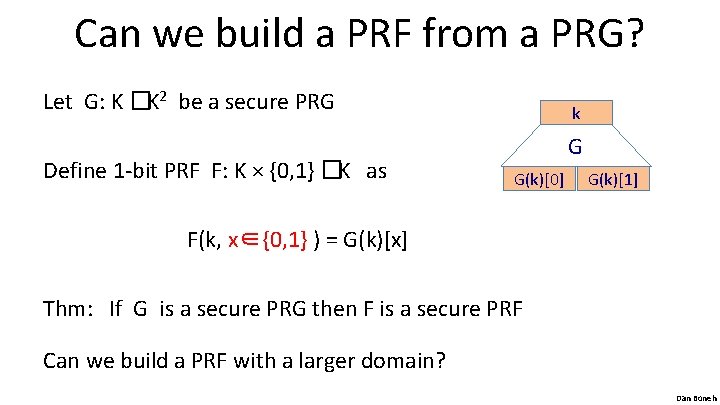
Can we build a PRF from a PRG? Let G: K �K 2 be a secure PRG Define 1 -bit PRF F: K × {0, 1} �K as k G G(k)[0] G(k)[1] F(k, x∈{0, 1} ) = G(k)[x] Thm: If G is a secure PRG then F is a secure PRF Can we build a PRF with a larger domain? Dan Boneh
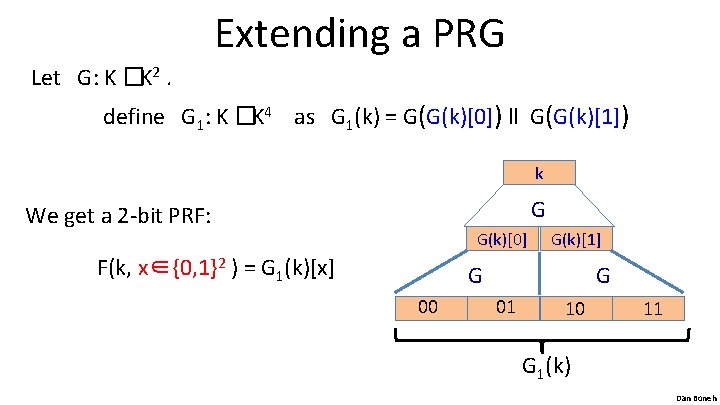
Extending a PRG Let G: K �K 2. define G 1: K �K 4 as G 1(k) = G(G(k)[0]) ll G(G(k)[1]) k G We get a 2 -bit PRF: G(k)[0] F(k, x∈{0, 1}2 ) = G 1(k)[x] G(k)[1] G 00 G 01 10 11 G 1(k) Dan Boneh
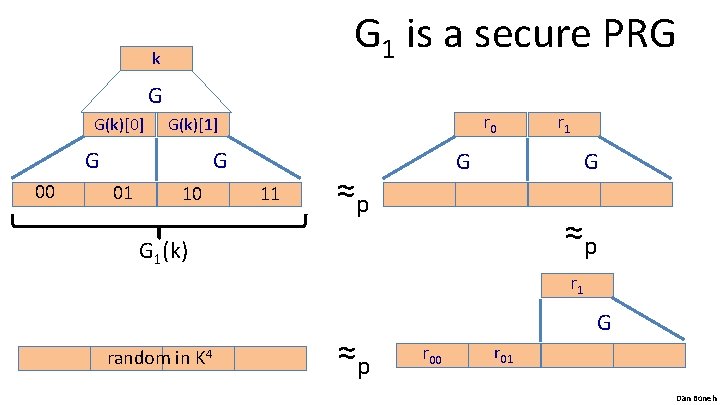
G 1 is a secure PRG k G G(k)[0] G 00 r 0 G(k)[1] G 01 10 11 G ≈p r 1 G ≈p G 1(k) r 1 random in K 4 ≈p G r 00 r 01 Dan Boneh
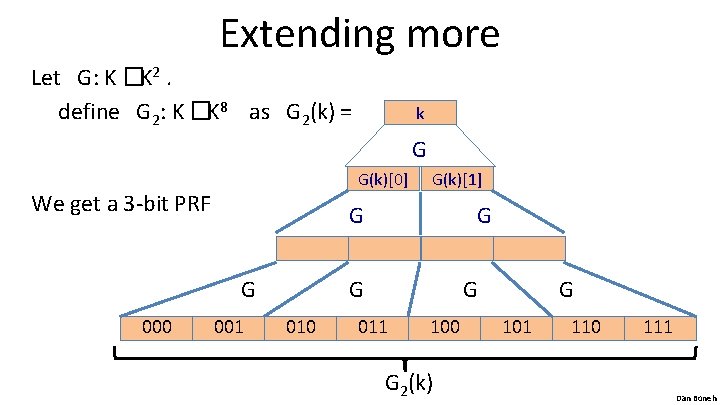
Extending more Let G: K �K 2. define G 2: K �K 8 as G 2(k) = k G G(k)[0] We get a 3 -bit PRF G G 000 G(k)[1] 001 G G 010 G 011 100 G 2(k) G 101 110 111 Dan Boneh
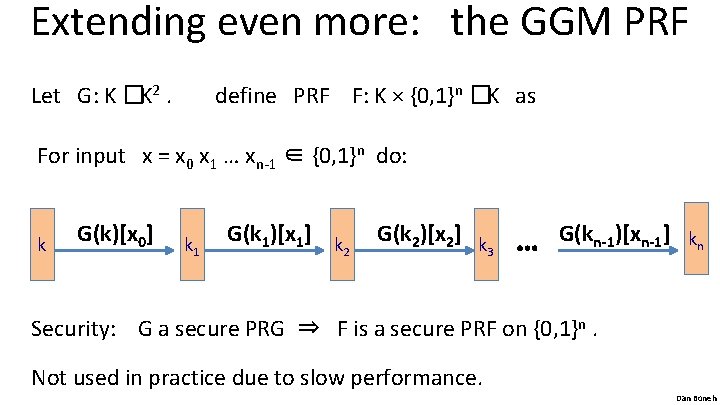
Extending even more: the GGM PRF Let G: K �K 2. define PRF F: K × {0, 1}n �K as For input x = x 0 x 1 … xn-1 ∈ {0, 1}n do: k G(k)[x 0] k 1 G(k 1)[x 1] k 2 G(k 2)[x 2] k 3 ⋯ G(kn-1)[xn-1] kn Security: G a secure PRG ⇒ F is a secure PRF on {0, 1}n. Not used in practice due to slow performance. Dan Boneh
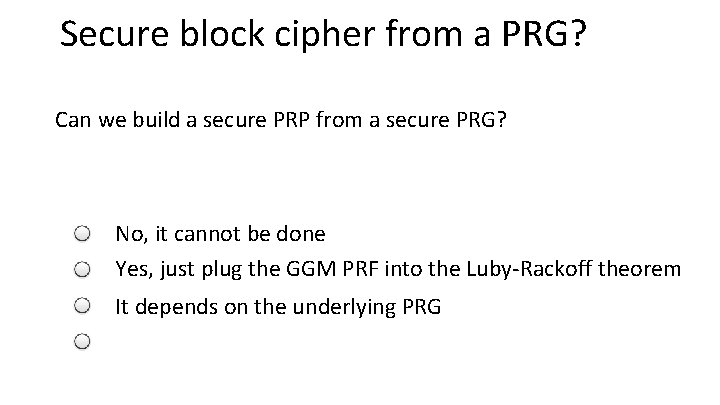
Secure block cipher from a PRG? Can we build a secure PRP from a secure PRG? No, it cannot be done Yes, just plug the GGM PRF into the Luby-Rackoff theorem It depends on the underlying PRG
End of Segment Dan Boneh
- Slides: 65