
ONLINE COURSE PART I AN INTRODUCTION TO RADIATION











- Slides: 68
ONLINE COURSE, PART I : AN INTRODUCTION TO RADIATION
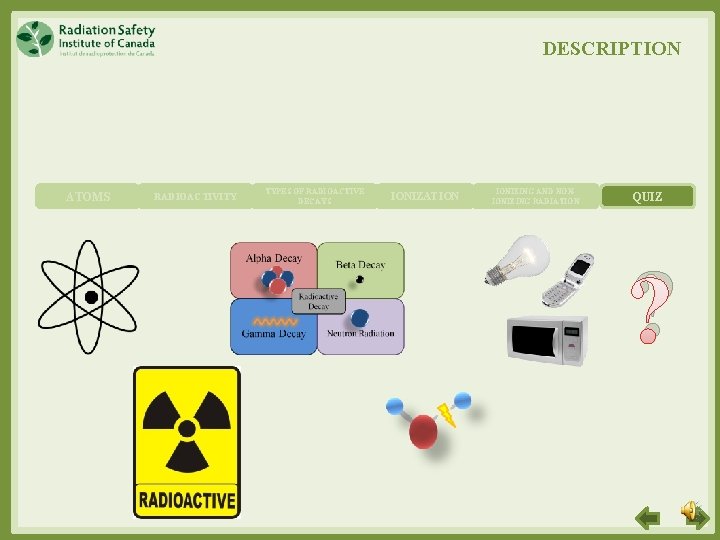
DESCRIPTION ATOMS RADIOACTIVITY TYPES OF RADIOACTIVE DECAYS IONIZATION IONIZING AND NONIONIZING RADIATION QUIZ ?
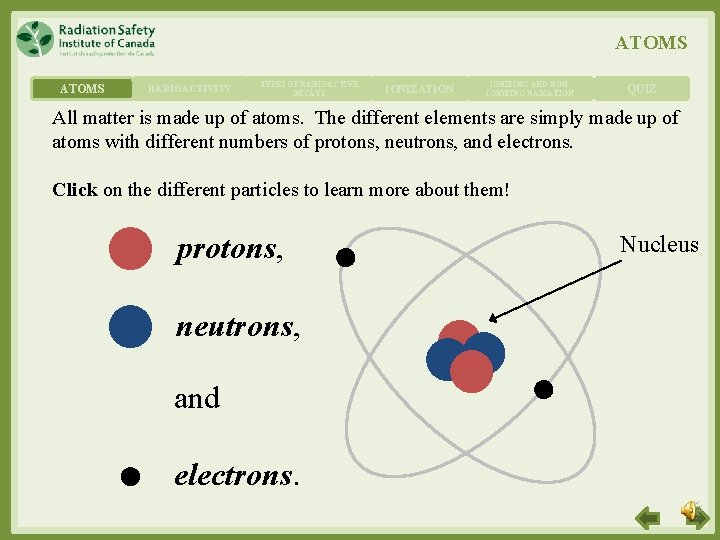
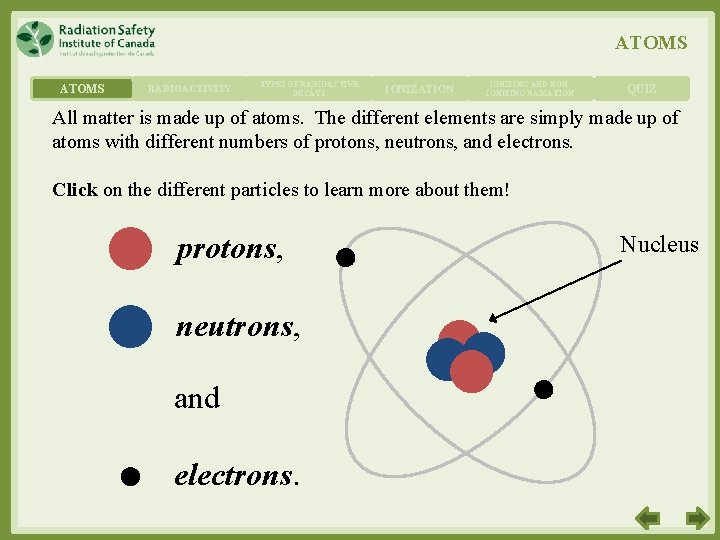
ATOMS RADIOACTIVITY TYPES OF RADIOACTIVE DECAYS IONIZATION IONIZING AND NONIONIZING RADIATION QUIZ All matter is made up of atoms. The different elements are simply made up of atoms with different numbers of protons, neutrons, and electrons. Click on the different particles to learn more about them! protons, neutrons, and electrons. Nucleus
ATOMS RADIOACTIVITY TYPES OF RADIOACTIVE DECAYS IONIZATION IONIZING AND NONIONIZING RADIATION QUIZ All matter is made up of atoms. The different elements are simply made up of atoms with different numbers of protons, neutrons, and electrons. Click on the different particles to learn more about them! protons, neutrons, and electrons. Nucleus
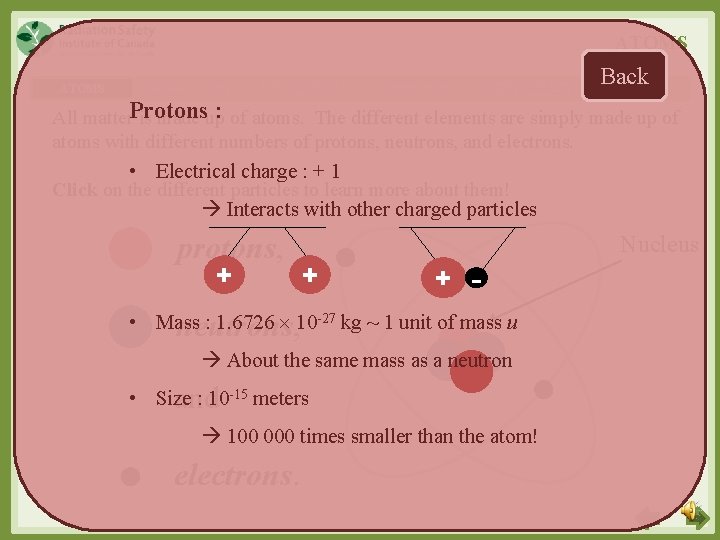
ATOMS RADIOACTIVITY TYPES OF RADIOACTIVE DECAYS IONIZATION IONIZING AND NONIONIZING RADIATION Back QUIZ : of atoms. The different elements are simply made up of All matter. Protons is made up atoms with different numbers of protons, neutrons, and electrons. • Electrical charge : + 1 Click on the different particles to learn more about them! Interacts with other charged particles protons, + Nucleus + + - • Mass : 1. 6726 10 -27 kg ~ 1 unit of mass u neutrons, About the same mass as a neutron • Size : 10 -15 meters and 100 000 times smaller than the atom! electrons.
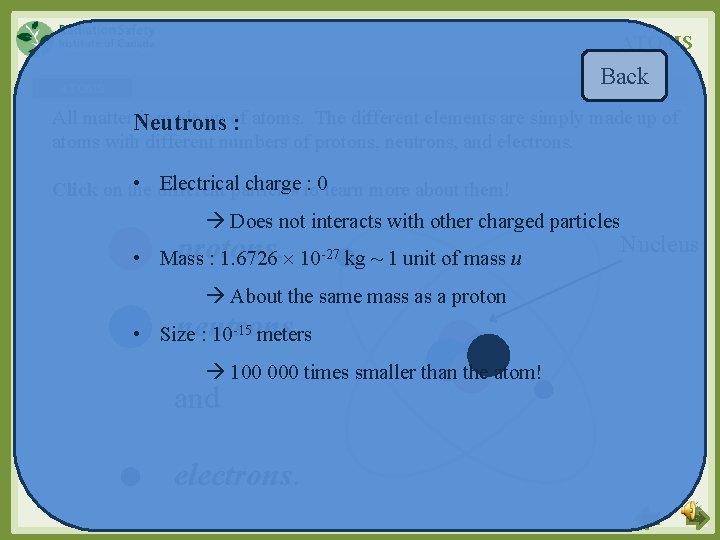
ATOMS RADIOACTIVITY TYPES OF RADIOACTIVE DECAYS IONIZATION IONIZING AND NONIONIZING RADIATION Back QUIZ All matter. Neutrons is made up of : atoms. The different elements are simply made up of atoms with different numbers of protons, neutrons, and electrons. • different Electricalparticles charge to : 0 learn more about them! Click on the Does not interacts with other charged particles • protons, Mass : 1. 6726 10 -27 kg ~ 1 unit of mass u About the same mass as a proton neutrons, • Size : 10 -15 meters 100 000 times smaller than the atom! and electrons. Nucleus
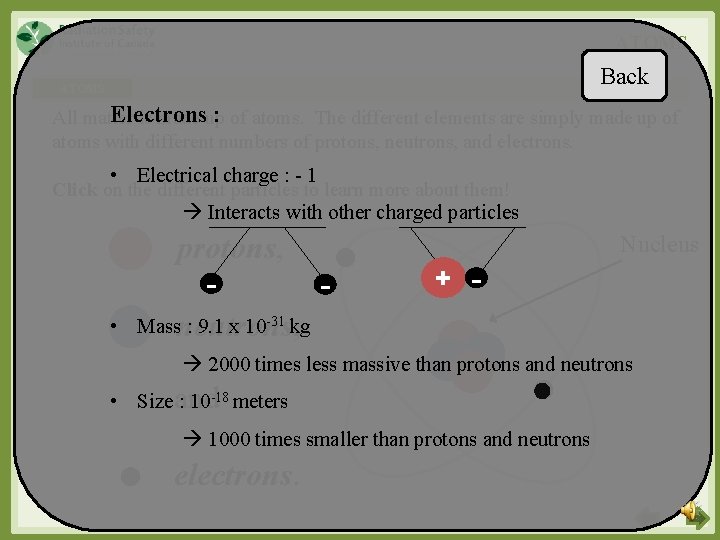
ATOMS RADIOACTIVITY TYPES OF RADIOACTIVE DECAYS IONIZATION IONIZING AND NONIONIZING RADIATION Back QUIZ Electrons : of atoms. The different elements are simply made up of All matter is made up atoms with different numbers of protons, neutrons, and electrons. • Electrical charge : - 1 Click on the different particles to learn more about them! Interacts with other charged particles • protons, Massneutrons, : 9. 1 x 10 -31 kg Nucleus + - 2000 times less massive than protons and neutrons • Sizeand : 10 -18 meters 1000 times smaller than protons and neutrons electrons.
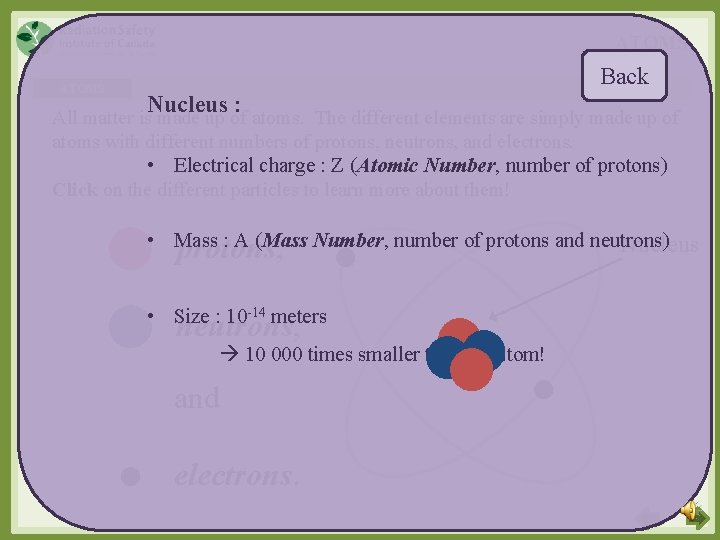
ATOMS RADIOACTIVITY Nucleus : TYPES OF RADIOACTIVE DECAYS IONIZATION IONIZING AND NONIONIZING RADIATION Back QUIZ All matter is made up of atoms. The different elements are simply made up of atoms with different numbers of protons, neutrons, and electrons. • Electrical charge : Z (Atomic Number, number of protons) Click on the different particles to learn more about them! • Mass : A (Mass Number, number of protons and neutrons) Nucleus protons, • Size : 10 -14 meters neutrons, 10 000 times smaller than the atom! and electrons.
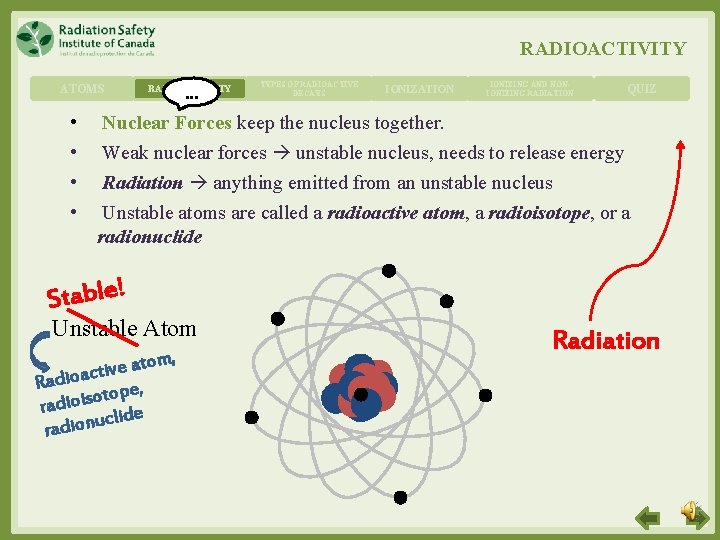
RADIOACTIVITY ATOMS • • . . . RADIOACTIVITY TYPES OF RADIOACTIVE DECAYS IONIZATION IONIZING AND NONIONIZING RADIATION QUIZ Nuclear Forces keep the nucleus together. Weak nuclear forces unstable nucleus, needs to release energy Radiation anything emitted from an unstable nucleus Unstable atoms are called a radioactive atom, a radioisotope, or a radionuclide ! e l b a t S Unstable Atom atom, ctive a o i d a R ope, t o s i o i rad lide c u n o i rad Radiation
RADIOACTIVITY ATOMS • • . . . RADIOACTIVITY TYPES OF RADIOACTIVE DECAYS IONIZATION IONIZING AND NONIONIZING RADIATION QUIZ Nuclear Forces keep the nucleus together. Weak nuclear forces unstable nucleus, needs to release energy Radiation anything emitted from an unstable nucleus Unstable atoms are called a radioactive atom, a radioisotope, or a radionuclide ! e l b a t S Unstable Atom atom, ctive a o i d a R ope, t o s i o i rad lide c u n o i rad Radiation
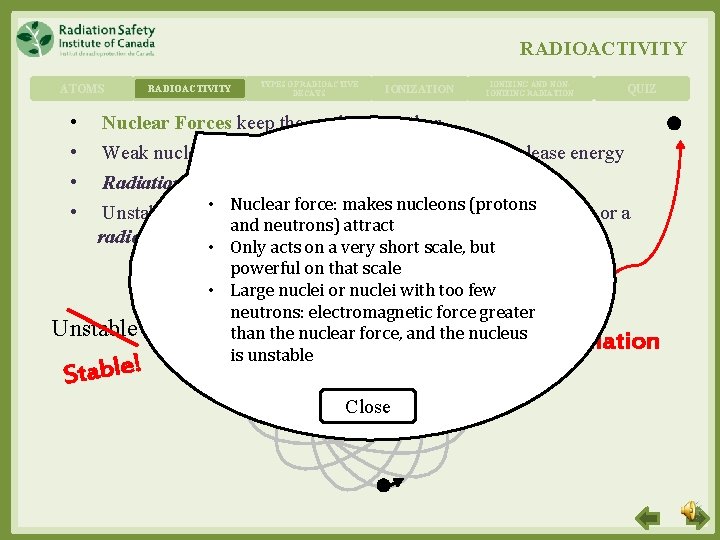
RADIOACTIVITY ATOMS • • RADIOACTIVITY TYPES OF RADIOACTIVE DECAYS IONIZATION IONIZING AND NONIONIZING RADIATION QUIZ Nuclear Forces keep the nucleus together. Weak nuclear forces unstable nucleus, needs to release energy Radiation anything emitted from an unstable nucleus • Nuclear force: makes nucleons (protons Unstable atoms are called a radioactive atom, a radioisotope, or a and neutrons) attract radionuclide • Only acts on a very short scale, but Unstable Atom ! e l b a t S powerful on that scale • Large nuclei or nuclei with too few neutrons: electromagnetic force greater than the nuclear force, and the nucleus is unstable Close Radiation
TYPES OF RADIOACTIVE DECAY ATOMS RADIOACTIVITY TYPES OF RADIOACTIVE DECAYS IONIZATION IONIZING AND NONIONIZING RADIATION QUIZ A radioactive decay is a process in which the unstable nucleus releases energy. There are several types of radioactive decays. Click on each to lean more about them! Alpha Decay Beta Decay Radioactive Decay Gamma Decay Neutron Radiation
TYPES OF RADIOACTIVE DECAY ATOMS RADIOACTIVITY TYPES OF RADIOACTIVE DECAYS IONIZATION IONIZING AND NONIONIZING RADIATION QUIZ A radioactive decay is a process in which the unstable nucleus releases energy. There are several types of radioactive decays. Click on each to lean more about them! Alpha Decay Beta Decay Radioactive Decay Gamma Decay Neutron Radiation
TYPES OF RADIOACTIVE DECAY ATOMS TYPES OF RADIOACTIVE DECAYS Alpha Decays : RADIOACTIVITY IONIZATION IONIZING AND NONIONIZING RADIATION Back. QUIZ A radioactive decay is a process in which the unstable nucleus releases • 2 protons and 2 neutrons energy. There are several types of radioactive decays. Click on each to • They lean more about them! are heavy and doubly charged • They interact strongly with other charged particles Alpha • A sheet of. Decay paper can stop. Beta them Decay • If they are ingested, inhaled or absorbed by the skin, Radioactive they can be very damaging Decay • Alpha decays only occur in elements heavier than lead Neutron Radiation Gamma Decay (Z > 82) Examples of alpha decays
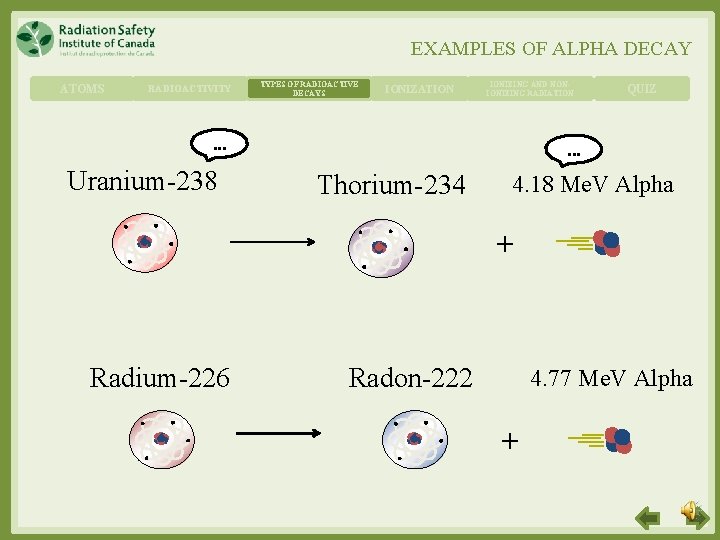
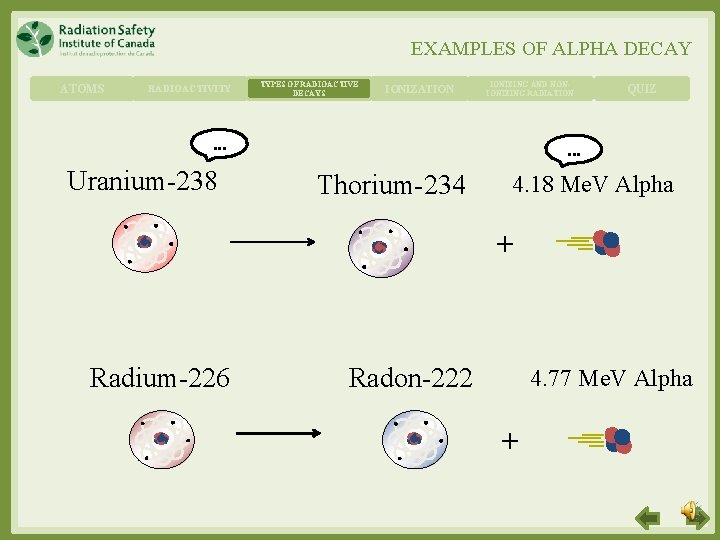
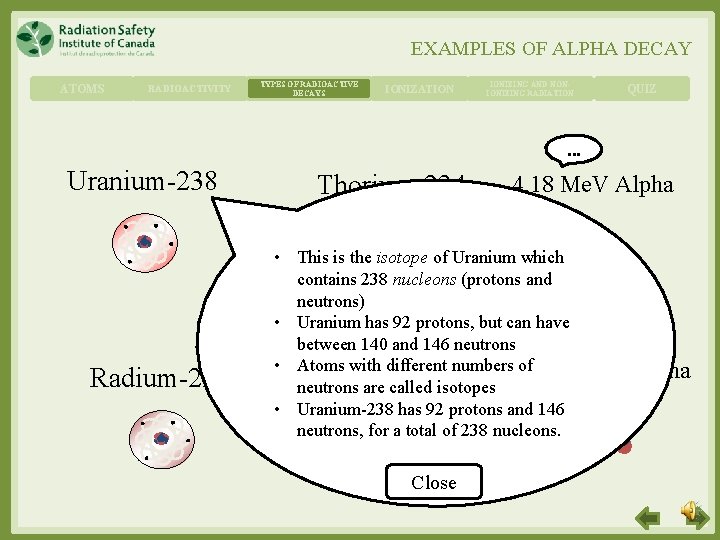
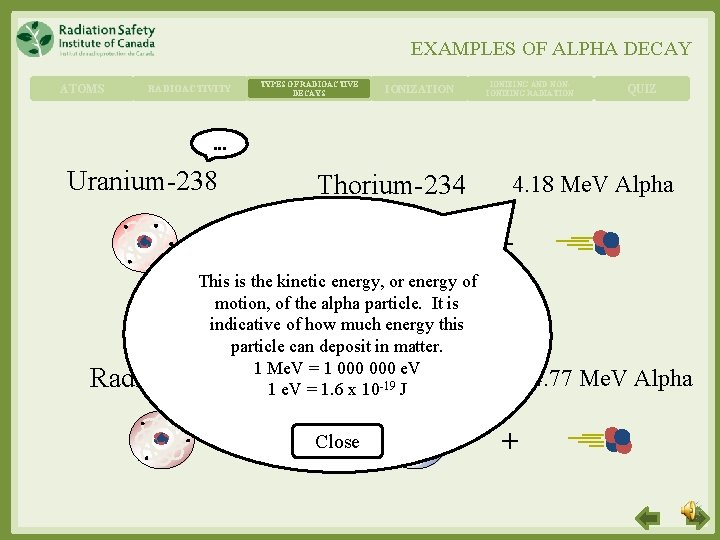
EXAMPLES OF ALPHA DECAY ATOMS RADIOACTIVITY TYPES OF RADIOACTIVE DECAYS IONIZATION IONIZING AND NONIONIZING RADIATION . . . Uranium-238 QUIZ . . . Thorium-234 4. 18 Me. V Alpha + Radium-226 Radon-222 4. 77 Me. V Alpha +
EXAMPLES OF ALPHA DECAY ATOMS RADIOACTIVITY TYPES OF RADIOACTIVE DECAYS IONIZATION IONIZING AND NONIONIZING RADIATION . . . Uranium-238 QUIZ . . . Thorium-234 4. 18 Me. V Alpha + Radium-226 Radon-222 4. 77 Me. V Alpha +
EXAMPLES OF ALPHA DECAY ATOMS RADIOACTIVITY TYPES OF RADIOACTIVE DECAYS IONIZATION IONIZING AND NONIONIZING RADIATION QUIZ . . . Uranium-238 Thorium-234 4. 18 Me. V Alpha + Radium-226 • This is the isotope of Uranium which contains 238 nucleons (protons and neutrons) • Uranium has 92 protons, but can have between 140 and 146 neutrons • Atoms with different numbers of 4. 77 Radon-222 neutrons are called isotopes • Uranium-238 has 92 protons and 146 neutrons, for a total of 238 nucleons. + Close Me. V Alpha
EXAMPLES OF ALPHA DECAY ATOMS RADIOACTIVITY TYPES OF RADIOACTIVE DECAYS IONIZATION IONIZING AND NONIONIZING RADIATION QUIZ . . . Uranium-238 Thorium-234 4. 18 Me. V Alpha + This is the kinetic energy, or energy of motion, of the alpha particle. It is indicative of how much energy this particle can deposit in matter. = 1 000 e. V Radium-226 1 Me. V 1 e. V = 1. 6 x. Radon-222 10 -19 J Close 4. 77 Me. V Alpha +
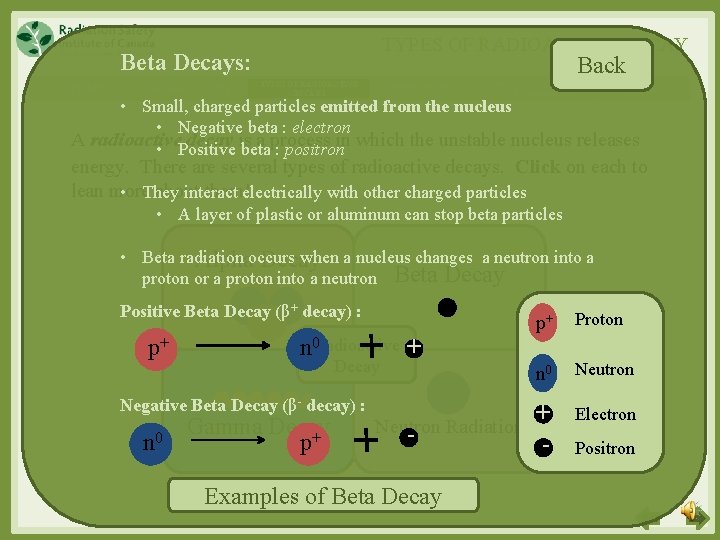
TYPES OF RADIOACTIVE DECAY Beta Decays: ATOMS RADIOACTIVITY Back TYPES OF RADIOACTIVE DECAYS IONIZATION IONIZING AND NONIONIZING RADIATION QUIZ • Small, charged particles emitted from the nucleus • Negative beta : electron A radioactive decay is a process in which the unstable nucleus releases • Positive beta : positron energy. There are several types of radioactive decays. Click on each to lean more about them!electrically with other charged particles • They interact • A layer of plastic or aluminum can stop beta particles • Beta radiation when a nucleus changes a neutron into a Alphaoccurs Decay proton or a proton into a neutron Beta Decay Positive Beta Decay (β+ decay) : p+ Proton n 0 Neutron + - Electron n 0 Radioactive + Decay Negative Beta Decay (β- decay) : n 0 p+ Gamma Decay p+ Neutron - Radiation Examples of Beta Decay Positron
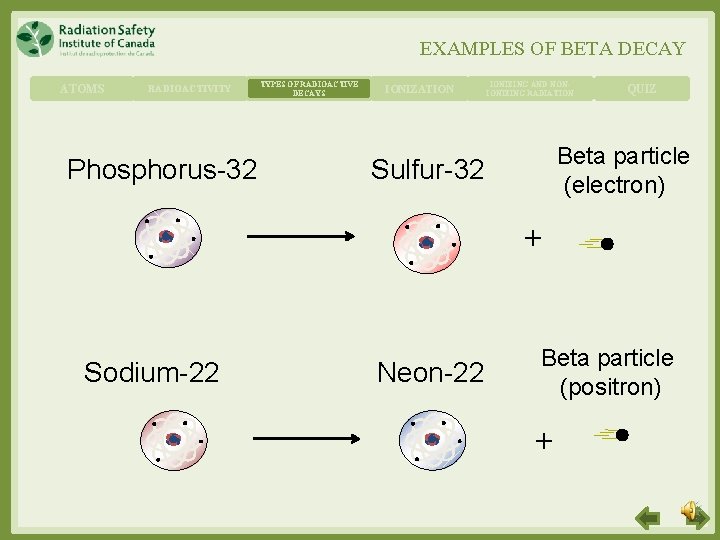
EXAMPLES OF BETA DECAY ATOMS RADIOACTIVITY Phosphorus-32 TYPES OF RADIOACTIVE DECAYS IONIZATION IONIZING AND NONIONIZING RADIATION QUIZ Beta particle (electron) Sulfur-32 + Sodium-22 Neon-22 Beta particle (positron) +
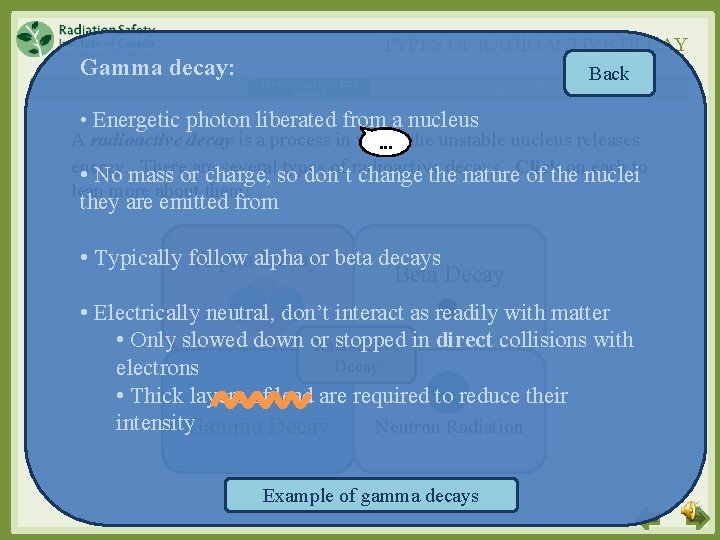
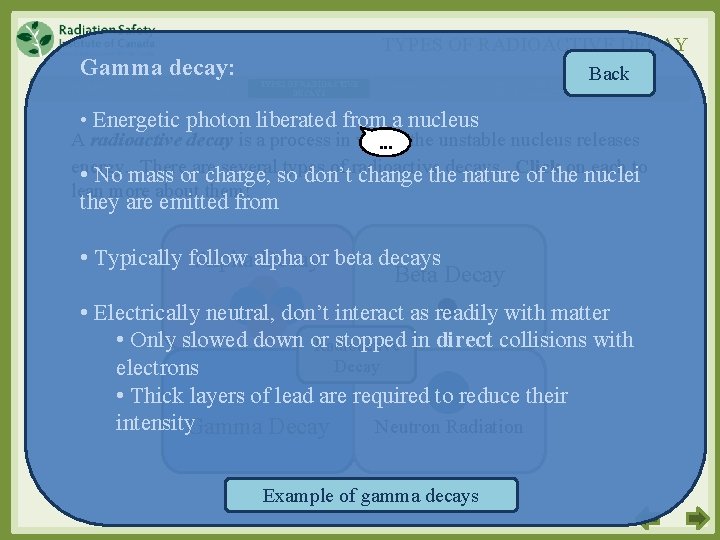
Gamma decay: ATOMS RADIOACTIVITY TYPES OF RADIOACTIVE DECAYS TYPES OF RADIOACTIVE DECAY Back IONIZATION IONIZING AND NONIONIZING RADIATION QUIZ • Energetic photon liberated from a nucleus A radioactive decay is a process in which. . . the unstable nucleus releases energy. Thereorare severalso types of radioactive onnuclei each to • No mass charge, don’t change thedecays. nature. Click of the lean more about them! they are emitted from • Typically follow Alphaalpha Decayor beta decays Beta Decay • Electrically neutral, don’t interact as readily with matter • Only slowed down or stopped in direct collisions with Radioactive Decay electrons • Thick layers of lead are required to reduce their intensity. Gamma Decay Neutron Radiation Example of gamma decays
Gamma decay: ATOMS RADIOACTIVITY TYPES OF RADIOACTIVE DECAYS TYPES OF RADIOACTIVE DECAY Back IONIZATION IONIZING AND NONIONIZING RADIATION QUIZ • Energetic photon liberated from a nucleus A radioactive decay is a process in which. . . the unstable nucleus releases energy. Thereorare severalso types of radioactive onnuclei each to • No mass charge, don’t change thedecays. nature. Click of the lean more about them! they are emitted from • Typically follow Alphaalpha Decayor beta decays Beta Decay • Electrically neutral, don’t interact as readily with matter • Only slowed down or stopped in direct collisions with Radioactive Decay electrons • Thick layers of lead are required to reduce their intensity. Gamma Decay Neutron Radiation Example of gamma decays
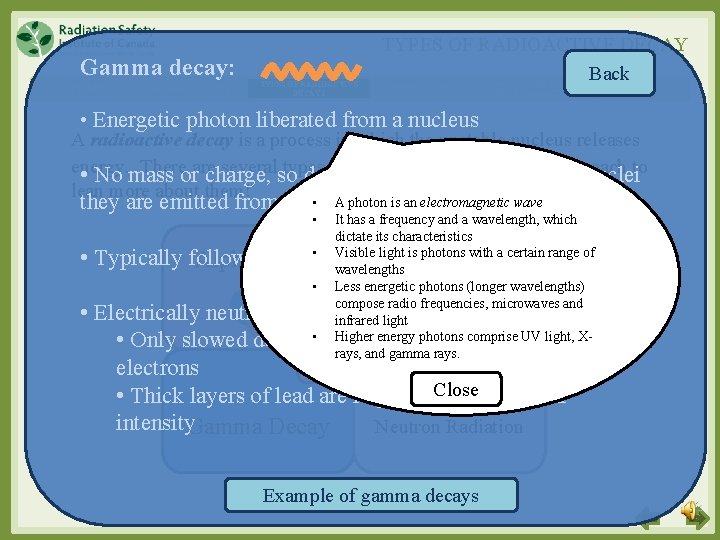
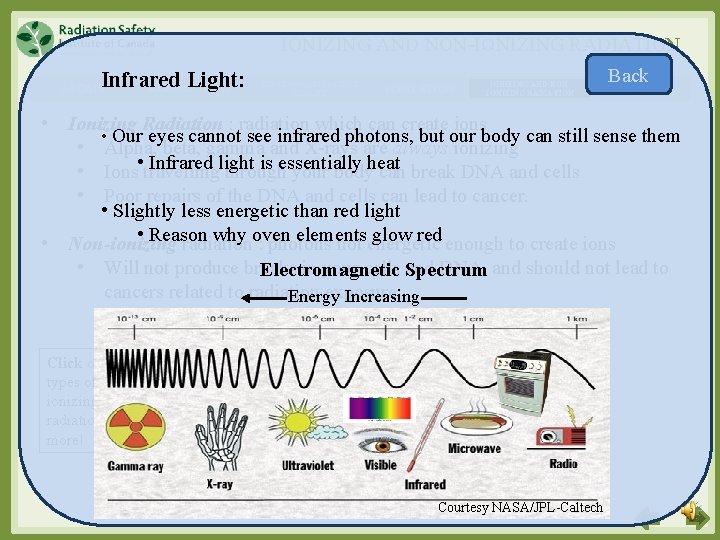
Gamma decay: ATOMS RADIOACTIVITY TYPES OF RADIOACTIVE DECAYS TYPES OF RADIOACTIVE DECAY Back IONIZATION IONIZING AND NONIONIZING RADIATION QUIZ • Energetic photon liberated from a nucleus A radioactive decay is a process in which the unstable nucleus releases energy. Thereorare severalso types of radioactive onnuclei each to • No mass charge, don’t change thedecays. nature. Click of the lean more about them! they are emitted from • • A photon is an electromagnetic wave It has a frequency and a wavelength, which dictate its characteristics • Visible light is photons with a certain range of wavelengths • Less energetic photons (longer wavelengths) compose radio frequencies, microwaves and infrared light • Higher energy photons comprise UV light, XRadioactive rays, and gamma rays. • Typically follow Alphaalpha Decayor beta decays Beta Decay • Electrically neutral, don’t interact as readily with matter • Only slowed down or stopped in direct collisions with Decay electrons • Thick layers of lead are required Close to reduce their intensity. Gamma Decay Neutron Radiation Example of gamma decays
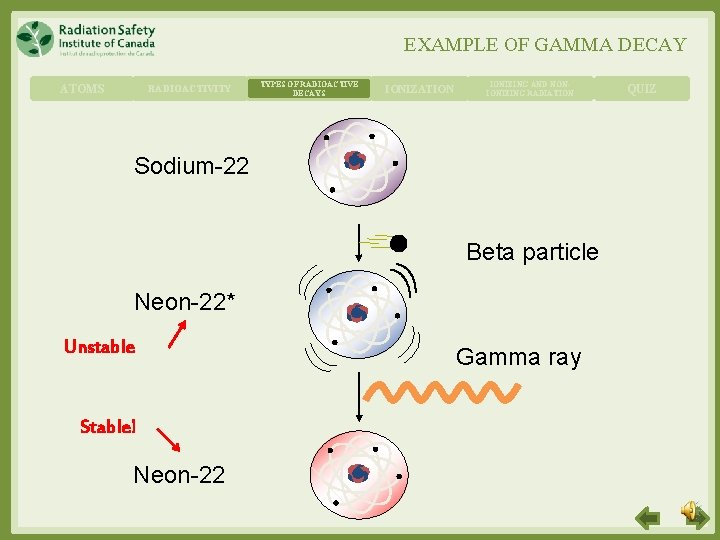
EXAMPLE OF GAMMA DECAY ATOMS RADIOACTIVITY TYPES OF RADIOACTIVE DECAYS IONIZATION IONIZING AND NONIONIZING RADIATION Sodium-22 Beta particle Neon-22* Unstable Stable! Neon-22 Gamma ray QUIZ
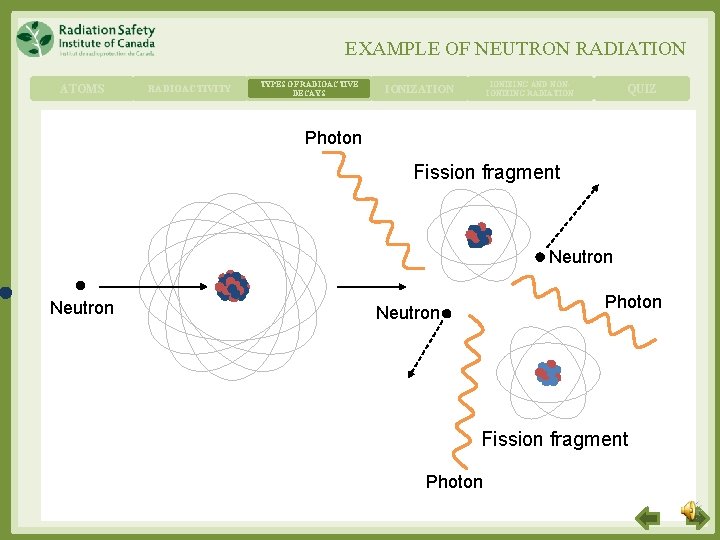
TYPES OF RADIOACTIVE DECAY ATOMS TYPES OF RADIOACTIVE DECAYS Neutron radiation : RADIOACTIVITY IONIZATION IONIZING AND NONIONIZING RADIATION Back. QUIZ A radioactive decay a process the unstable nucleus releases • Neutrons are is not emitted in onwhich their own from an unstable nucleus energy. There are several types of radioactive decays. Click on each to • During nuclear fission, several neutrons can be ejected lean more about them! • They only interact with particles through direct collisions • They deposit a lot of energy in collisions with single protons Alpha Decay • There are many single protons in water (hydrogen) Beta Decay • The tissue in our body is made of 60% water • Neutrons therefore deposit a lot of energy in our body Radioactive • Good shields : . . . Decay • Thick layers of water, preferably heavy water • Other materials heavy in hydrogen (e. g. concrete, paraffin) Neutron Radiation Gamma Decay Example of neutron radiation
TYPES OF RADIOACTIVE DECAY ATOMS TYPES OF RADIOACTIVE DECAYS Neutron radiation : RADIOACTIVITY IONIZATION IONIZING AND NONIONIZING RADIATION Back. QUIZ A radioactive decay a process the unstable nucleus releases • Neutrons are is not emitted in onwhich their own from an unstable nucleus energy. There are several types of radioactive decays. Click on each to • During nuclear fission, several neutrons can be ejected lean more about them! • They only interact with particles through direct collisions • They deposit a lot of energy in collisions with single protons Alpha Decay • There are many single protons in water (hydrogen) Beta Decay • The tissue in our body is made of 60% water • Neutrons therefore deposit a lot of energy in our body Radioactive • Good shields : . . . Decay • Thick layers of water, preferably heavy water • Other materials heavy in hydrogen (e. g. concrete, paraffin) Neutron Radiation Gamma Decay Example of neutron radiation
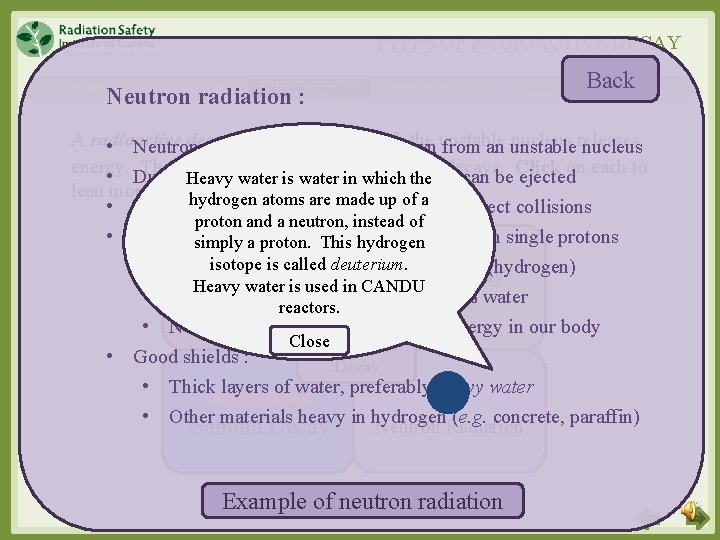
TYPES OF RADIOACTIVE DECAY ATOMS TYPES OF RADIOACTIVE DECAYS Neutron radiation : RADIOACTIVITY IONIZATION IONIZING AND NONIONIZING RADIATION Back. QUIZ A radioactive decay a process the unstable nucleus releases • Neutrons are is not emitted in onwhich their own from an unstable nucleus energy. There are several types of radioactive decays. Click on each to • During. Heavy nuclear fission, several neutrons can be ejected water is water in which the lean more about them! atoms are made up of a hydrogen • They only interact with particles through direct collisions proton and a neutron, instead of • They deposit of energy in collisions with single protons simplyaa lot proton. This hydrogen Alpha Decay isotope is called deuterium. • There are many single protons in water (hydrogen) Beta Decay Heavy water is used in CANDU • The tissue in our body is made of 60% water reactors. • Neutrons therefore deposit a lot of energy in our body Close Radioactive • Good shields : Decay • Thick layers of water, preferably heavy water • Other materials heavy in hydrogen (e. g. concrete, paraffin) Neutron Radiation Gamma Decay Example of neutron radiation
EXAMPLE OF NEUTRON RADIATION ATOMS RADIOACTIVITY TYPES OF RADIOACTIVE DECAYS IONIZING AND NONIONIZING RADIATION IONIZATION QUIZ Photon Fission fragment Neutron Photon Neutron Fission fragment Photon
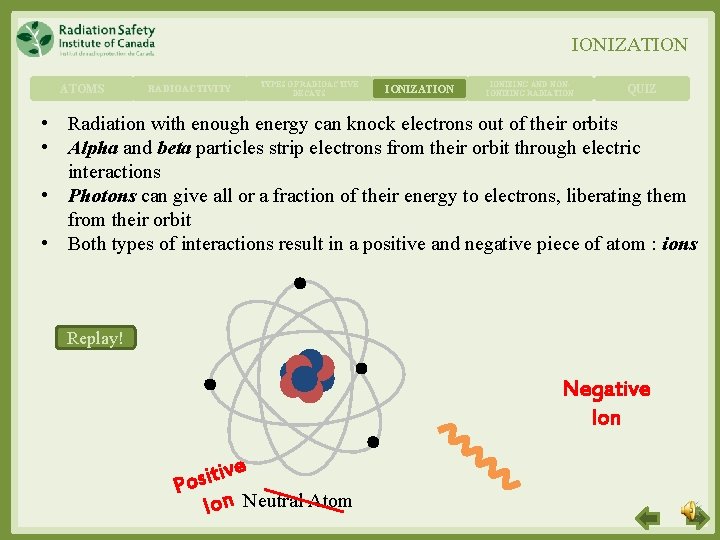
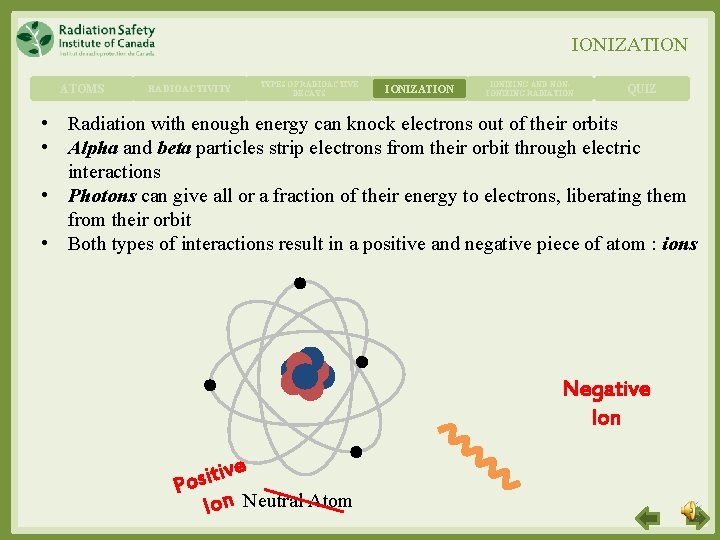
IONIZATION ATOMS RADIOACTIVITY TYPES OF RADIOACTIVE DECAYS IONIZATION IONIZING AND NONIONIZING RADIATION QUIZ • Radiation with enough energy can knock electrons out of their orbits • Alpha and beta particles strip electrons from their orbit through electric interactions • Photons can give all or a fraction of their energy to electrons, liberating them from their orbit • Both types of interactions result in a positive and negative piece of atom : ions Replay! Negative Ion ve i t i s Po Ion Neutral Atom
IONIZATION ATOMS RADIOACTIVITY TYPES OF RADIOACTIVE DECAYS IONIZATION IONIZING AND NONIONIZING RADIATION QUIZ • Radiation with enough energy can knock electrons out of their orbits • Alpha and beta particles strip electrons from their orbit through electric interactions • Photons can give all or a fraction of their energy to electrons, liberating them from their orbit • Both types of interactions result in a positive and negative piece of atom : ions Negative Ion ve i t i s Po Ion Neutral Atom
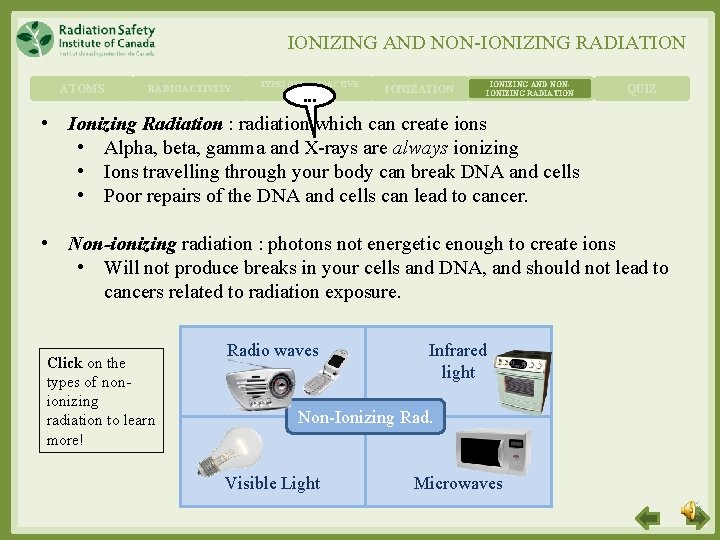
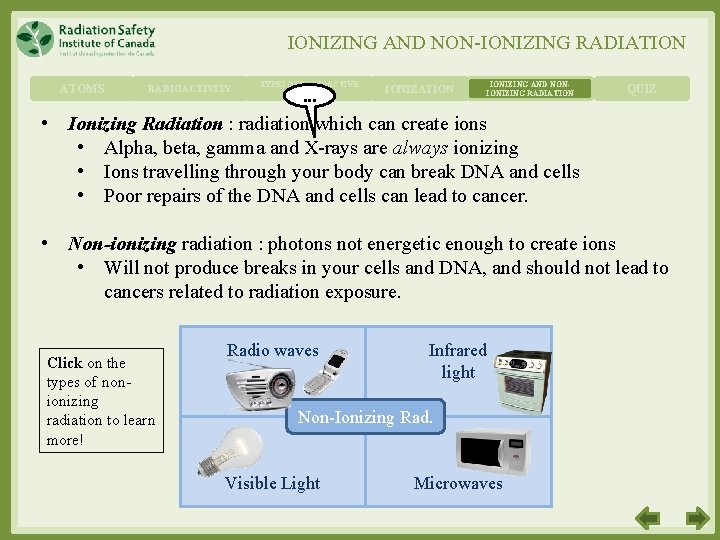
IONIZING AND NON-IONIZING RADIATION ATOMS RADIOACTIVITY TYPES OF RADIOACTIVE DECAYS . . . IONIZATION IONIZING AND NONIONIZING RADIATION QUIZ • Ionizing Radiation : radiation which can create ions • Alpha, beta, gamma and X-rays are always ionizing • Ions travelling through your body can break DNA and cells • Poor repairs of the DNA and cells can lead to cancer. • Non-ionizing radiation : photons not energetic enough to create ions • Will not produce breaks in your cells and DNA, and should not lead to cancers related to radiation exposure. Click on the types of nonionizing radiation to learn more! Radio waves Infrared light Non-Ionizing Rad. Visible Light Microwaves
IONIZING AND NON-IONIZING RADIATION ATOMS RADIOACTIVITY TYPES OF RADIOACTIVE DECAYS . . . IONIZATION IONIZING AND NONIONIZING RADIATION QUIZ • Ionizing Radiation : radiation which can create ions • Alpha, beta, gamma and X-rays are always ionizing • Ions travelling through your body can break DNA and cells • Poor repairs of the DNA and cells can lead to cancer. • Non-ionizing radiation : photons not energetic enough to create ions • Will not produce breaks in your cells and DNA, and should not lead to cancers related to radiation exposure. Click on the types of nonionizing radiation to learn more! Radio waves Infrared light Non-Ionizing Rad. Visible Light Microwaves
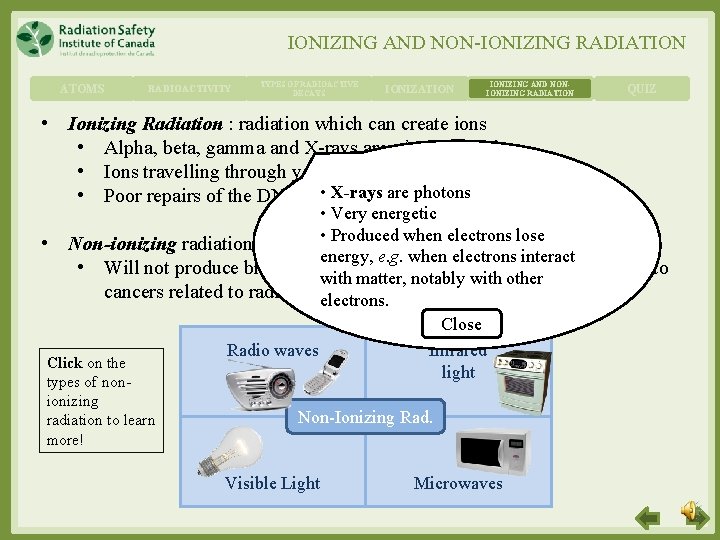
IONIZING AND NON-IONIZING RADIATION ATOMS RADIOACTIVITY TYPES OF RADIOACTIVE DECAYS IONIZATION IONIZING AND NONIONIZING RADIATION • Ionizing Radiation : radiation which can create ions • Alpha, beta, gamma and X-rays are always ionizing • Ions travelling through your body can break DNA and cells • X-rays are lead photons • Poor repairs of the DNA and cells can to cancer. QUIZ • Very energetic • Produced when electrons lose • Non-ionizing radiation : photons not energetic enough to create ions energy, e. g. when electrons interact • Will not produce breaks in with your cells and DNA, and should not lead to matter, notably with other cancers related to radiationelectrons. exposure. Close Radio waves Infrared Click on the light types of nonionizing radiation to learn more! Non-Ionizing Rad. Visible Light Microwaves
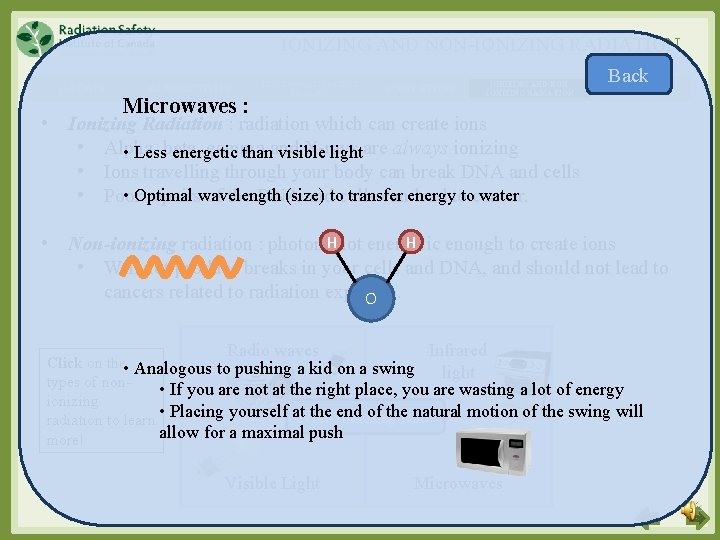
IONIZING AND NON-IONIZING RADIATION ATOMS RADIOACTIVITY Microwaves : TYPES OF RADIOACTIVE DECAYS IONIZATION IONIZING AND NONIONIZING RADIATION Back QUIZ • Ionizing Radiation : radiation which can create ions • Alpha, gamma X-rays • Lessbeta, energetic thanand visible lightare always ionizing • Ions travelling through your body can break DNA and cells • Optimal (size) transfer water • Poor repairswavelength of the DNA andtocells canenergy lead totocancer. H • Non-ionizing radiation : photons. Hnot energetic enough to create ions • Will not produce breaks in your cells and DNA, and should not lead to cancers related to radiation exposure. O Radio waves Infrared Visible Light Microwaves Click on the • Analogous to pushing a kid on a swing light types of non • If you are not at the right place, you are wasting a lot of energy ionizing • Placing yourself at. Non-Ionizing the end of the. Rad. natural motion of the swing will radiation to learn allow for a maximal push more!
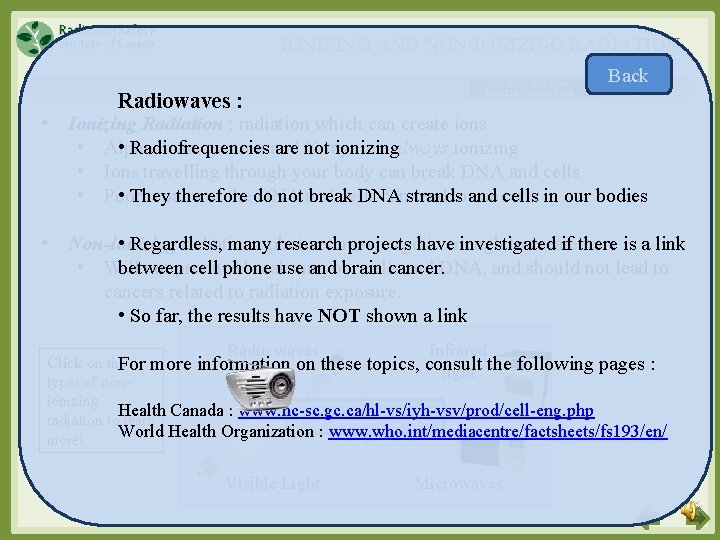
IONIZING AND NON-IONIZING RADIATION ATOMS RADIOACTIVITY Radiowaves : TYPES OF RADIOACTIVE DECAYS IONIZATION IONIZING AND NONIONIZING RADIATION Back QUIZ • Ionizing Radiation : radiation which can create ions • Alpha, beta, gamma and are always ionizing • Radiofrequencies are X-rays not ionizing • Ions travelling through your body can break DNA and cells • Poor repairs of the do DNA cells canstrands lead toand cancer. • They therefore not and break DNA cells in our bodies • Non-ionizing radiation : photons energetic to create ions is a link • Regardless, many researchnot projects haveenough investigated if there • Will not produce breaks your cells and DNA, and should not lead to between cell phone useinand brain cancers related to radiation exposure. • So far, the results have NOT shown a link Radio waves Infrared Visible Light Microwaves Click on the For more information on these topics, consult light the following pages : types of nonionizing Health Canada : www. hc-sc. gc. ca/hl-vs/iyh-vsv/prod/cell-eng. php Non-Ionizing Rad. radiation to learn World Health Organization : www. who. int/mediacentre/factsheets/fs 193/en/ more!
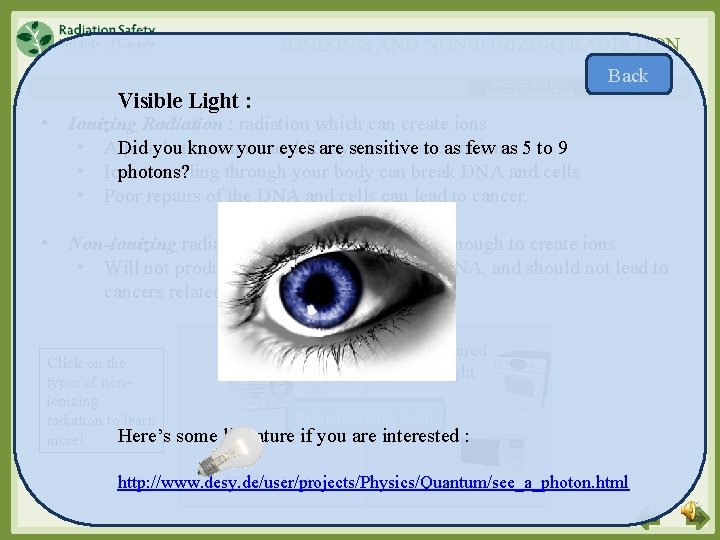
IONIZING AND NON-IONIZING RADIATION ATOMS RADIOACTIVITY Visible Light : TYPES OF RADIOACTIVE DECAYS IONIZATION IONIZING AND NONIONIZING RADIATION Back QUIZ • Ionizing Radiation : radiation which can create ions • Alpha, beta, gamma X-rays are always Did you know yourand eyes are sensitive to asionizing few as 5 to 9 • Ions travelling through your body can break DNA and cells photons? • Poor repairs of the DNA and cells can lead to cancer. • Non-ionizing radiation : photons not energetic enough to create ions • Will not produce breaks in your cells and DNA, and should not lead to cancers related to radiation exposure. Click on the types of nonionizing radiation to learn Here’s more! Radio waves Infrared light Non-Ionizing Rad. some literature if you are interested : http: //www. desy. de/user/projects/Physics/Quantum/see_a_photon. html Visible Light Microwaves
IONIZING AND NON-IONIZING RADIATION Infrared Light: RADIOACTIVITY ATOMS TYPES OF RADIOACTIVE DECAYS IONIZATION IONIZING AND NONIONIZING RADIATION Back QUIZ • Ionizing Radiation : radiation which can create ions • Our eyes cannot see infrared photons, but our body can still sense them • Alpha, beta, gamma and X-rays are always ionizing Infrared light is essentially • Ions • travelling through your bodyheat can break DNA and cells • Poor repairs of the DNA and cells can lead to cancer. • Slightly less energetic than red light • Reason why oven elements glow red enough to create ions • Non-ionizing radiation : photons not energetic • Will not produce breaks in your cells Spectrum and DNA, and should not lead to Electromagnetic cancers related to radiation exposure. Energy Increasing Click on the types of nonionizing radiation to learn more! Radio waves Infrared light Non-Ionizing Rad. Visible Light Microwaves Courtesy NASA/JPL-Caltech
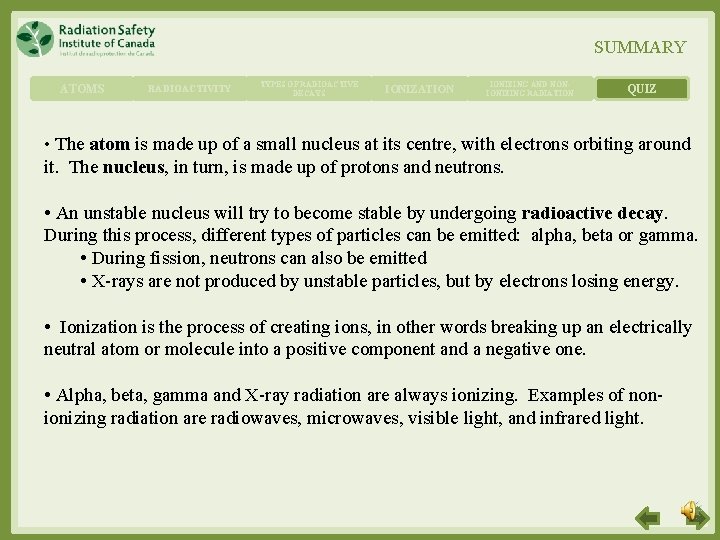
SUMMARY ATOMS RADIOACTIVITY TYPES OF RADIOACTIVE DECAYS IONIZATION IONIZING AND NONIONIZING RADIATION QUIZ • The atom is made up of a small nucleus at its centre, with electrons orbiting around it. The nucleus, in turn, is made up of protons and neutrons. • An unstable nucleus will try to become stable by undergoing radioactive decay. During this process, different types of particles can be emitted: alpha, beta or gamma. • During fission, neutrons can also be emitted • X-rays are not produced by unstable particles, but by electrons losing energy. • Ionization is the process of creating ions, in other words breaking up an electrically neutral atom or molecule into a positive component and a negative one. • Alpha, beta, gamma and X-ray radiation are always ionizing. Examples of nonionizing radiation are radiowaves, microwaves, visible light, and infrared light.
QUIZ ATOMS RADIOACTIVITY TYPES OF RADIOACTIVE DECAYS IONIZATION IONIZING AND NONIONIZING RADIATION QUIZ 1. All types of radiation are dangerous and exposure to them can lead to cancer. True False
QUIZ ATOMS RADIOACTIVITY TYPES OF RADIOACTIVE DECAYS IONIZATION IONIZING AND NONIONIZING RADIATION QUIZ 1. All types of radiation are dangerous and exposure to them can lead to cancer. True False
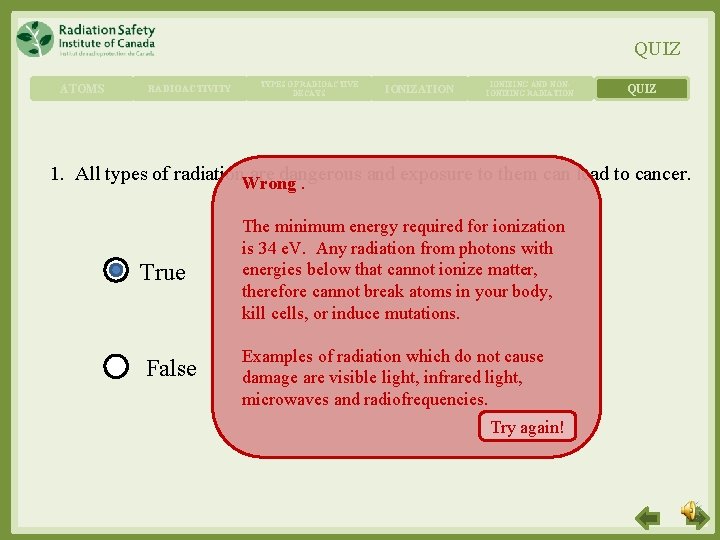
QUIZ ATOMS RADIOACTIVITY TYPES OF RADIOACTIVE DECAYS IONIZATION IONIZING AND NONIONIZING RADIATION QUIZ 1. All types of radiation. Wrong are dangerous and exposure to them can lead to cancer. . True False The minimum energy required for ionization is 34 e. V. Any radiation from photons with energies below that cannot ionize matter, therefore cannot break atoms in your body, kill cells, or induce mutations. Examples of radiation which do not cause damage are visible light, infrared light, microwaves and radiofrequencies. Try again!
QUIZ ATOMS RADIOACTIVITY TYPES OF RADIOACTIVE DECAYS IONIZATION IONIZING AND NONIONIZING RADIATION QUIZ 1. All types of radiation are dangerous and exposure to them can lead to cancer. Good ! True False The minimum energy required for ionization is 34 e. V. Any radiation from photons with energies below that cannot ionize matter, therefore cannot break atoms in your body, kill cells, or induce mutations. Examples of unharmful radiation are visible light, infrared light, microwaves and radiofrequencies. Continue
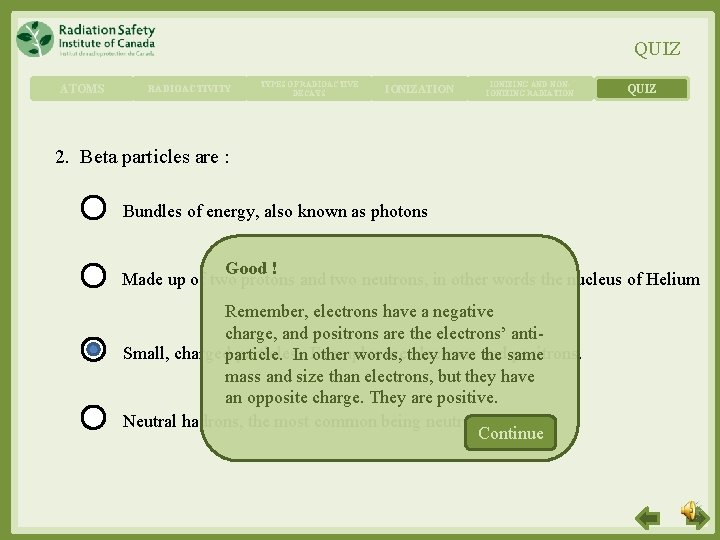
QUIZ ATOMS RADIOACTIVITY TYPES OF RADIOACTIVE DECAYS IONIZATION IONIZING AND NONIONIZING RADIATION QUIZ 2. Beta particles are : Bundles of energy, also known as photons Made up of two protons and two neutrons, in other words the nucleus of Helium Small, charged particles. Examples are electrons and positrons. Neutral hadrons, the most common being neutrons
QUIZ ATOMS RADIOACTIVITY TYPES OF RADIOACTIVE DECAYS IONIZATION IONIZING AND NONIONIZING RADIATION QUIZ 2. Beta particles are : Bundles of energy, also known as photons Made up of two protons and two neutrons, in other words the nucleus of Helium Small, charged particles. Examples are electrons and positrons. Neutral hadrons, the most common being neutrons
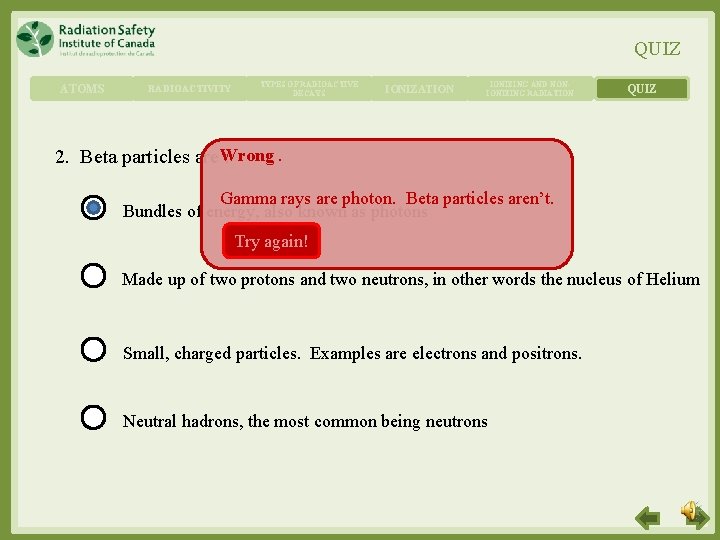
QUIZ ATOMS RADIOACTIVITY TYPES OF RADIOACTIVE DECAYS IONIZATION IONIZING AND NONIONIZING RADIATION QUIZ . 2. Beta particles are Wrong : Gamma rays are photon. Beta particles aren’t. Bundles of energy, also known as photons Try again! Made up of two protons and two neutrons, in other words the nucleus of Helium Small, charged particles. Examples are electrons and positrons. Neutral hadrons, the most common being neutrons
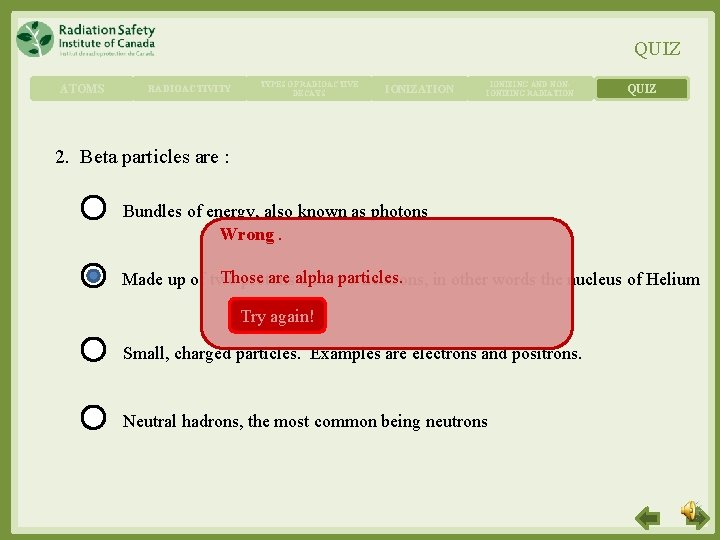
QUIZ ATOMS RADIOACTIVITY TYPES OF RADIOACTIVE DECAYS IONIZATION IONIZING AND NONIONIZING RADIATION QUIZ 2. Beta particles are : Bundles of energy, also known as photons Wrong. Those are alpha particles. Made up of two protons and two neutrons, in other words the nucleus of Helium Try again! Small, charged particles. Examples are electrons and positrons. Neutral hadrons, the most common being neutrons
QUIZ ATOMS RADIOACTIVITY TYPES OF RADIOACTIVE DECAYS IONIZATION IONIZING AND NONIONIZING RADIATION QUIZ 2. Beta particles are : Bundles of energy, also known as photons Good ! Made up of two protons and two neutrons, in other words the nucleus of Helium Remember, electrons have a negative charge, and positrons are the electrons’ anti. Small, chargedparticles. In Examples arethey electrons andsame positrons. other words, have the mass and size than electrons, but they have an opposite charge. They are positive. Neutral hadrons, the most common being neutrons Continue
QUIZ ATOMS RADIOACTIVITY TYPES OF RADIOACTIVE DECAYS IONIZATION IONIZING AND NONIONIZING RADIATION QUIZ 2. Beta particles are : Bundles of energy, also known as photons Made up of two protons and two neutrons, in other words the nucleus of Helium Small, charged particles. Examples are electrons and positrons. Wrong. Neutral hadrons, the most common being neutrons Try again!
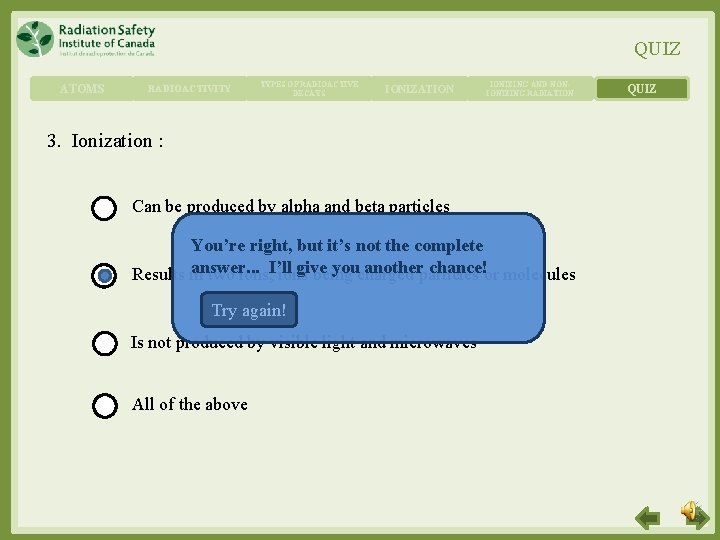
QUIZ ATOMS RADIOACTIVITY TYPES OF RADIOACTIVE DECAYS IONIZATION IONIZING AND NONIONIZING RADIATION 3. Ionization : Can be produced by alpha and beta particles Results in two ions, ions being charged particles or molecules Is not produced by visible light and microwaves All of the above QUIZ
QUIZ ATOMS RADIOACTIVITY TYPES OF RADIOACTIVE DECAYS IONIZATION IONIZING AND NONIONIZING RADIATION 3. Ionization : Can be produced by alpha and beta particles Results in two ions, ions being charged particles or molecules Is not produced by visible light and microwaves All of the above QUIZ
QUIZ ATOMS RADIOACTIVITY TYPES OF RADIOACTIVE DECAYS IONIZATION IONIZING AND NONIONIZING RADIATION 3. Ionization : You’re right, but it’s not the complete I’llalpha give and youbeta another chance! Can be answer. . . produced by particles Try again! Results in two ions, ions being charged particles or molecules Is not produced by visible light and microwaves All of the above QUIZ
QUIZ ATOMS RADIOACTIVITY TYPES OF RADIOACTIVE DECAYS IONIZATION IONIZING AND NONIONIZING RADIATION 3. Ionization : Can be produced by alpha and beta particles You’re right, but it’s not the complete answer. . . give youcharged anotherparticles chance!or molecules Results in two ions, I’ll ions being Try again! Is not produced by visible light and microwaves All of the above QUIZ
QUIZ ATOMS RADIOACTIVITY TYPES OF RADIOACTIVE DECAYS IONIZATION IONIZING AND NONIONIZING RADIATION 3. Ionization : Can be produced by alpha and beta particles Results in two ions, ions being charged particles or molecules You’re right, but it’s not the complete answer. . . I’ll give you another chance! Is not produced by visible light and microwaves Try again! All of the above QUIZ
QUIZ ATOMS RADIOACTIVITY TYPES OF RADIOACTIVE DECAYS IONIZATION IONIZING AND NONIONIZING RADIATION 3. Ionization : Can be produced by alpha and beta particles Good ! Results in two ions, isions being charged particles molecules Ionization the process of creating ions. or. Alpha and beta particles are always ionizing. Photons, on the other hand, have to be energetic enough Is not produced visible light and microwaves to knockbyelectrons out of orbit in order to be ionizing. Gamma Rays and X-Rays are ionizing, but visible light, microwaves, All of the above radiowaves and infrared light are examples of photons which aren’t energetic enough to ionize matter. Continue QUIZ
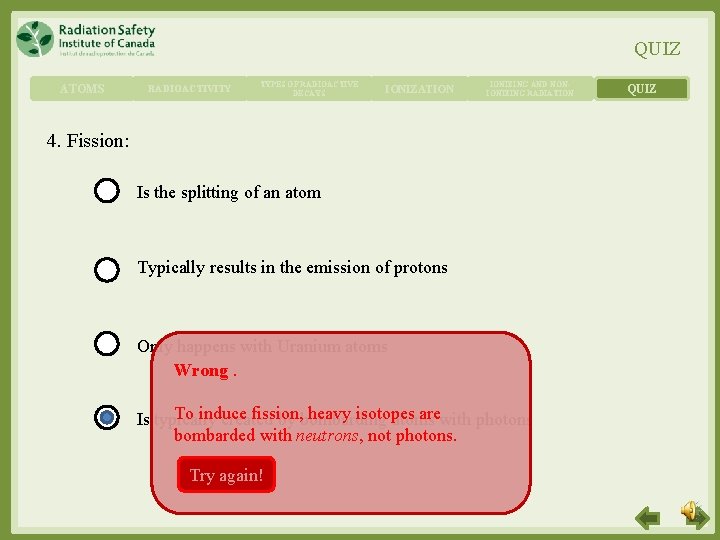
QUIZ ATOMS RADIOACTIVITY TYPES OF RADIOACTIVE DECAYS IONIZATION IONIZING AND NONIONIZING RADIATION 4. Fission: Is the splitting of an atom Typically results in the emission of protons Only happens with Uranium atoms Is typically created by bombarding atoms with photons QUIZ
QUIZ ATOMS RADIOACTIVITY TYPES OF RADIOACTIVE DECAYS IONIZATION IONIZING AND NONIONIZING RADIATION 4. Fission: Is the splitting of an atom Typically results in the emission of protons Only happens with Uranium atoms Is typically created by bombarding atoms with photons QUIZ
QUIZ ATOMS 4. Fission: RADIOACTIVITY TYPES OF RADIOACTIVE DECAYS IONIZATION IONIZING AND NONIONIZING RADIATION Good ! Is the splitting an atom Fission isofused in nuclear power plants to produce power. The fission is induced by the bombardment of Uranium, Plutonium or Thorium neutrons. When fission Typically resultsnuclei in theby emission of protons occurs, large amounts of energy are released. Continue Only happens with Uranium atoms Is typically created by bombarding atoms with photons QUIZ
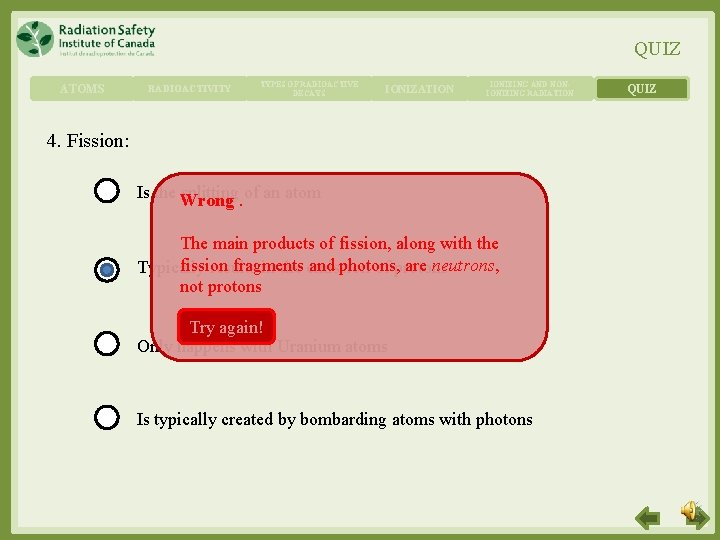
QUIZ ATOMS RADIOACTIVITY TYPES OF RADIOACTIVE DECAYS IONIZATION IONIZING AND NONIONIZING RADIATION 4. Fission: Is the Wrong splitting. of an atom The main products of fission, along with the fission fragments and photons, are neutrons, Typically results in the emission of protons not protons Try again! Only happens with Uranium atoms Is typically created by bombarding atoms with photons QUIZ
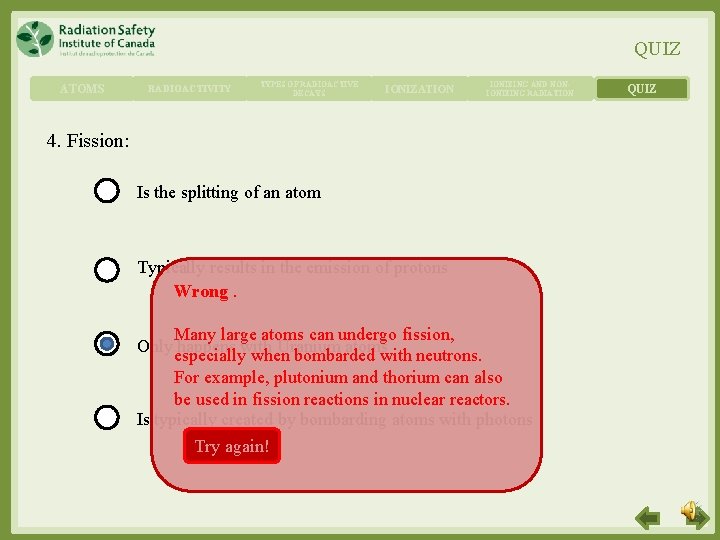
QUIZ ATOMS RADIOACTIVITY TYPES OF RADIOACTIVE DECAYS IONIZATION IONIZING AND NONIONIZING RADIATION 4. Fission: Is the splitting of an atom Typically results in the emission of protons Wrong. Many large atoms can undergo fission, Only happens with Uranium atoms especially when bombarded with neutrons. For example, plutonium and thorium can also be used in fission reactions in nuclear reactors. Is typically created by bombarding atoms with photons Try again! QUIZ
QUIZ ATOMS RADIOACTIVITY TYPES OF RADIOACTIVE DECAYS IONIZATION IONIZING AND NONIONIZING RADIATION 4. Fission: Is the splitting of an atom Typically results in the emission of protons Only happens with Uranium atoms Wrong. To induce fission, heavy isotopes arewith photons Is typically created by bombarding atoms bombarded with neutrons, not photons. Try again! QUIZ
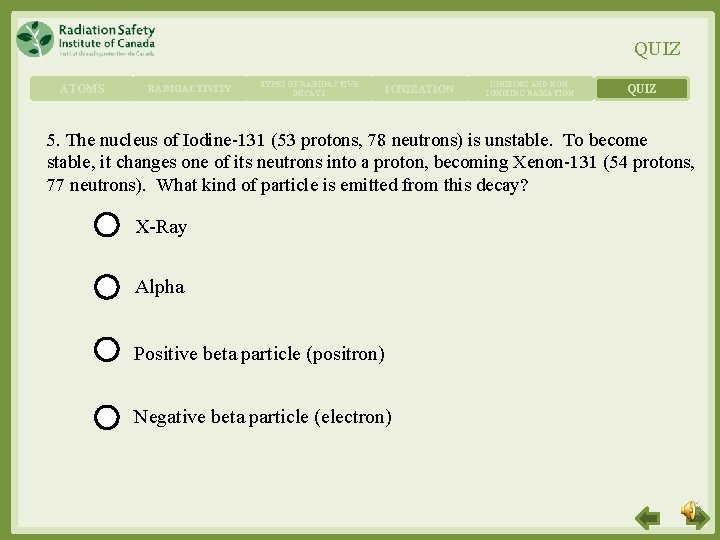
QUIZ ATOMS RADIOACTIVITY TYPES OF RADIOACTIVE DECAYS IONIZATION IONIZING AND NONIONIZING RADIATION QUIZ 5. The nucleus of Iodine-131 (53 protons, 78 neutrons) is unstable. To become stable, it changes one of its neutrons into a proton, becoming Xenon-131 (54 protons, 77 neutrons). What kind of particle is emitted from this decay? X-Ray Alpha Positive beta particle (positron) Negative beta particle (electron)
QUIZ ATOMS RADIOACTIVITY TYPES OF RADIOACTIVE DECAYS IONIZATION IONIZING AND NONIONIZING RADIATION QUIZ 5. The nucleus of Iodine-131 (53 protons, 78 neutrons) is unstable. To become stable, it changes one of its neutrons into a proton, becoming Xenon-131 (54 protons, 77 neutrons). What kind of particle is emitted from this decay? X-Ray Alpha Positive beta particle (positron) Negative beta particle (electron)
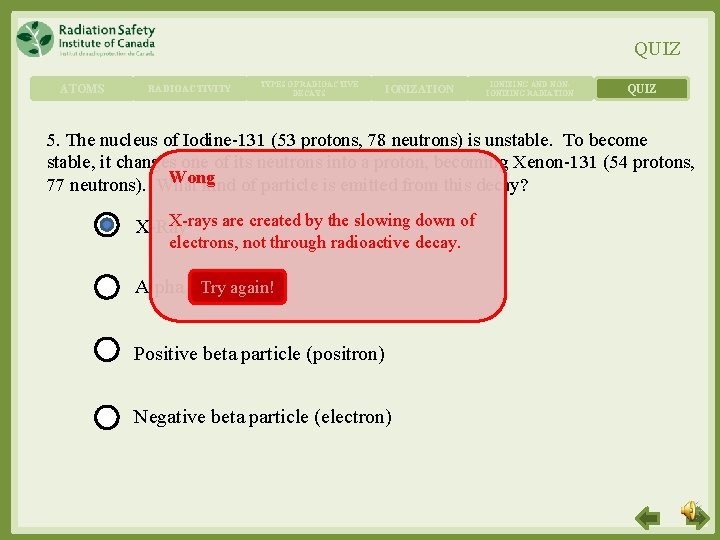
QUIZ ATOMS RADIOACTIVITY TYPES OF RADIOACTIVE DECAYS IONIZATION IONIZING AND NONIONIZING RADIATION QUIZ 5. The nucleus of Iodine-131 (53 protons, 78 neutrons) is unstable. To become stable, it changes one of its neutrons into a proton, becoming Xenon-131 (54 protons, Wong 77 neutrons). What kind of particle is emitted from this decay? X-rays are created by the slowing down of X-Ray electrons, not through radioactive decay. Alpha Try again! Positive beta particle (positron) Negative beta particle (electron)
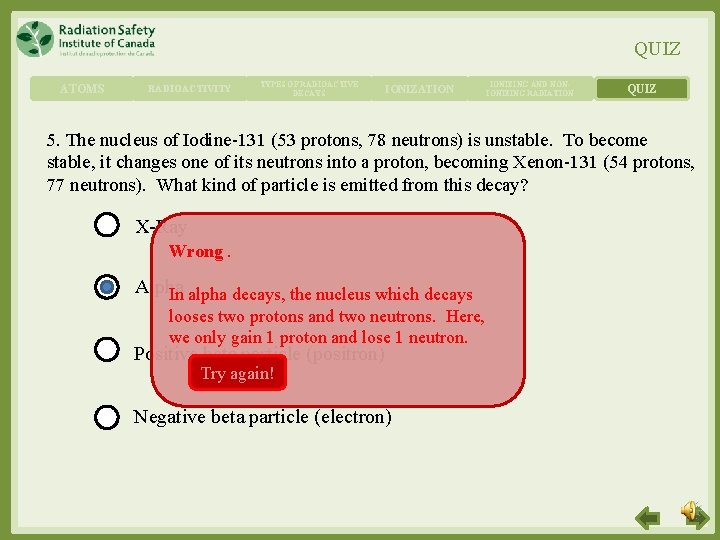
QUIZ ATOMS RADIOACTIVITY TYPES OF RADIOACTIVE DECAYS IONIZATION IONIZING AND NONIONIZING RADIATION QUIZ 5. The nucleus of Iodine-131 (53 protons, 78 neutrons) is unstable. To become stable, it changes one of its neutrons into a proton, becoming Xenon-131 (54 protons, 77 neutrons). What kind of particle is emitted from this decay? X-Ray Wrong. Alpha In alpha decays, the nucleus which decays looses two protons and two neutrons. Here, we only gain 1 proton and lose 1 neutron. Positive beta particle (positron) Try again! Negative beta particle (electron)
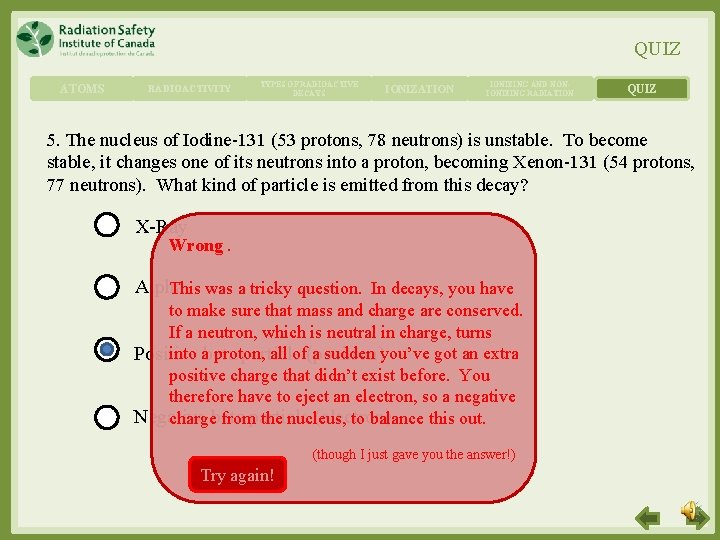
QUIZ ATOMS RADIOACTIVITY TYPES OF RADIOACTIVE DECAYS IONIZATION IONIZING AND NONIONIZING RADIATION QUIZ 5. The nucleus of Iodine-131 (53 protons, 78 neutrons) is unstable. To become stable, it changes one of its neutrons into a proton, becoming Xenon-131 (54 protons, 77 neutrons). What kind of particle is emitted from this decay? X-Ray Wrong. Alpha This was a tricky question. In decays, you have to make sure that mass and charge are conserved. If a neutron, which is neutral in charge, turns into abeta proton, all of(positron) a sudden you’ve got an extra Positive particle positive charge that didn’t exist before. You therefore have to eject an electron, so a negative Negative (electron) chargebeta fromparticle the nucleus, to balance this out. (though I just gave you the answer!) Try again!
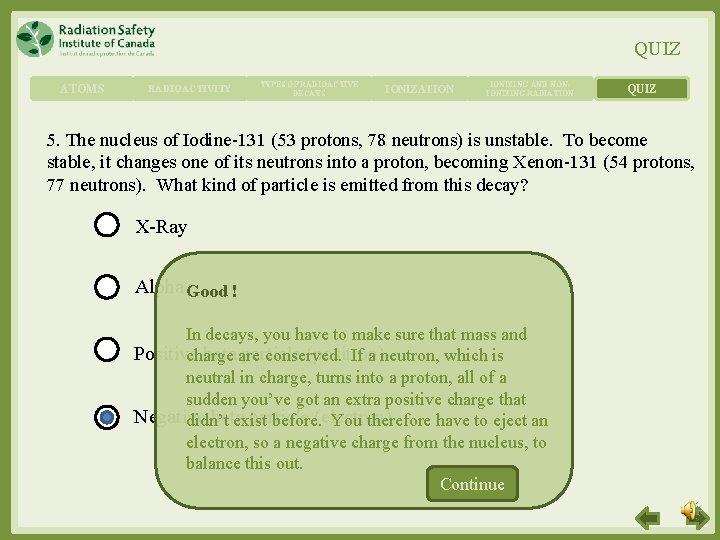
QUIZ ATOMS RADIOACTIVITY TYPES OF RADIOACTIVE DECAYS IONIZATION IONIZING AND NONIONIZING RADIATION QUIZ 5. The nucleus of Iodine-131 (53 protons, 78 neutrons) is unstable. To become stable, it changes one of its neutrons into a proton, becoming Xenon-131 (54 protons, 77 neutrons). What kind of particle is emitted from this decay? X-Ray Alpha Good ! In decays, you have to make sure that mass and Positive beta are particle (positron) charge conserved. If a neutron, which is neutral in charge, turns into a proton, all of a sudden you’ve got an extra positive charge that Negative beta particle didn’t exist before. (electron) You therefore have to eject an electron, so a negative charge from the nucleus, to balance this out. Continue
THE END ATOMS RADIOACTIVITY TYPES OF RADIOACTIVE DECAYS IONIZATION IONIZING AND NONIONIZING RADIATION QUIZ Learn more : • Take the second part of this online course, Radiation and Our Surroundings, which you can also find at radiationsafety. ca/online-courses. • Visit our website to view our list of Professional Certificate Courses, Radiation Safety Awareness Courses, and Employee Radiation Safety Training Courses : radiationsafety. ca/workplace/education-and-trainingservices • Contact our Training Coordinator, Tara Hargreaves, at th<AT>radiationsafety<DOT>ca. If you have comments or questions regarding this course, please send them to me, Claire, at ccohalan <AT> radiationsafety <DOT> ca. Acknowledgements
ACKNOWLEDGMENTS ATOMS RADIOACTIVITY TYPES OF RADIOACTIVE DECAYS IONIZATION IONIZING AND NONIONIZING RADIATION QUIZ The Radiation Safety Institute of Canada wishes to express its appreciation to the following contributors of this online course : • • Claire Cohalan Tara Hargreaves Justin Mc. Kinnon Don Bell Reza Moridi Brian Bjorndal Ian Watson