
Online Budgeted Social Choice Joel Oren University of

Online (Budgeted) Social Choice Joel Oren, University of Toronto Joint work with Brendan Lucier, Microsoft Research.
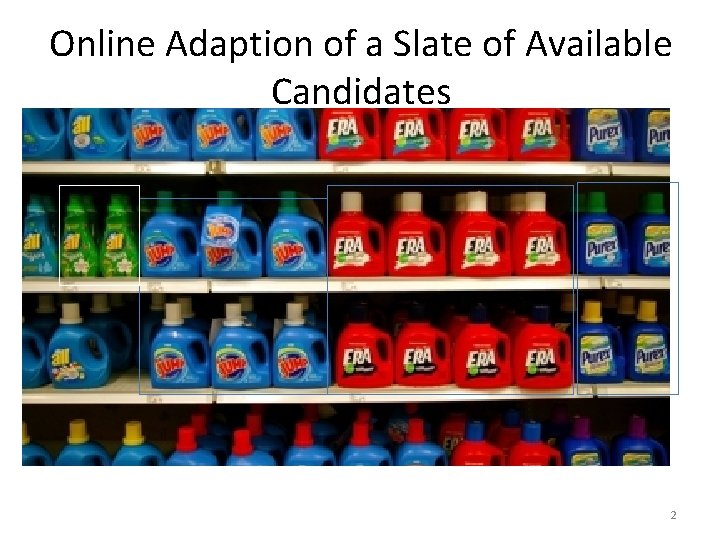
Online Adaption of a Slate of Available Candidates 2
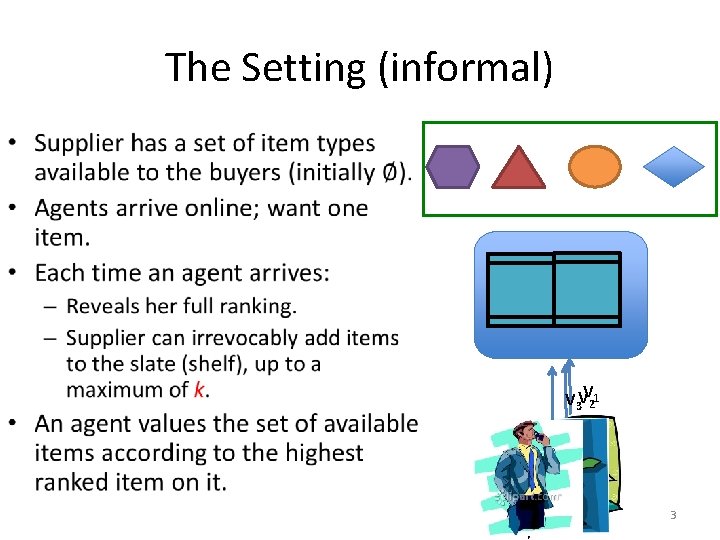
The Setting (informal) • V 3 VV 21 3
The Setting (informal) • Goal: select a k-set of items, so that agents tend to get preferred items. • Use scoring rules to measure to quantify performance. • Assumption 1: each agent reveals her full preference. • Assumption 2: the addition of items to the slate is irrevocable. – Motivation: adding an item is a costly operation. – We will relax this assumption towards the end. 4
Last Ingredient: Three Models of Input • We consider three models of input: 1. Adversarial: an adversarial sets the sequence of preferences (adaptive/non-adaptive). 2. Random order model: an adversary determines the preferences, but the order of their arrival is uniformly random. 3. Distributional: there’s an underlying distribution over the possible preferences. 5
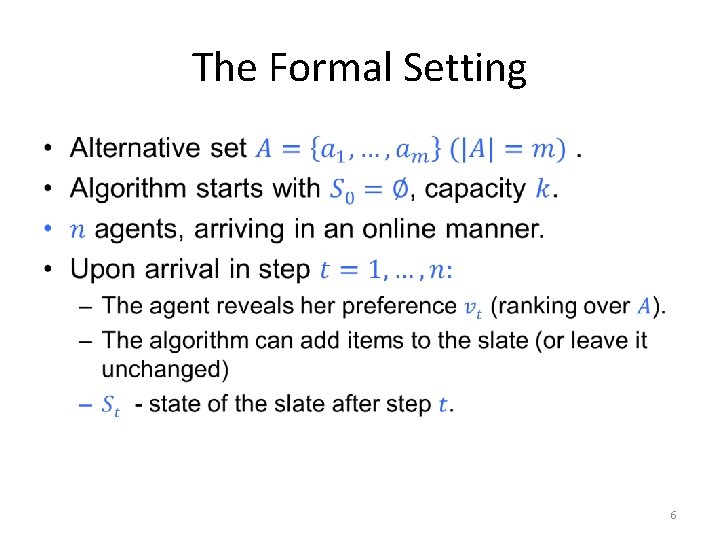
The Formal Setting • 6
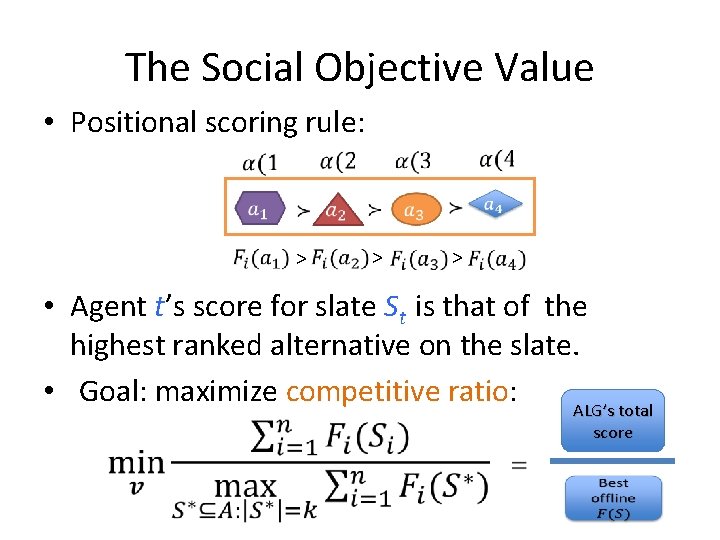
The Social Objective Value • Positional scoring rule: > > • Agent t’s score for slate St is that of the highest ranked alternative on the slate. • Goal: maximize competitive ratio: ALG’s total score 7
Related Work • Traditional social choice: The offline version (fully known preferences), k=1. • Courant & Chamberlin [83] - A framework for agent valuations in a multi-winner social choice setting. • Boutilier & Lu [11] – (offline) Budgeted social choice. Give a constant approximation to the offline version of the problem. • Skowron et al. [13] – consider extensions of (offline) budgeted social choice in the Chamberlin & Courant/Monroe frameworks, increasing/decreasing PSF, social welfare/Maximin objective functions. 8
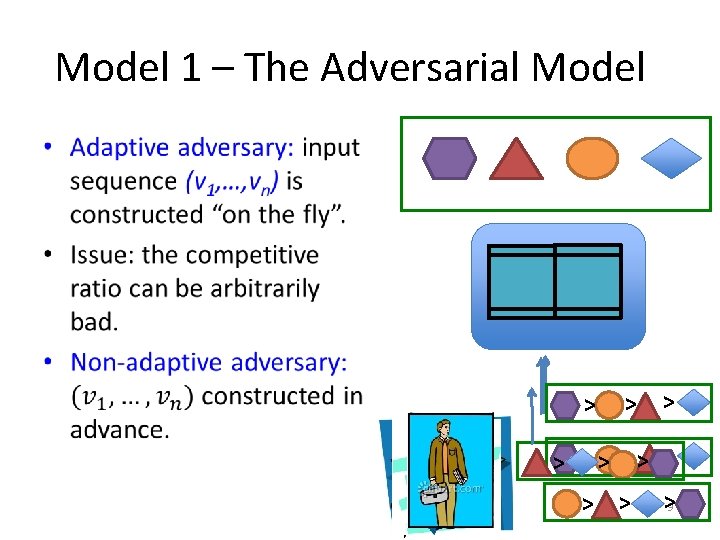
Model 1 – The Adversarial Model • > > >> > > >9
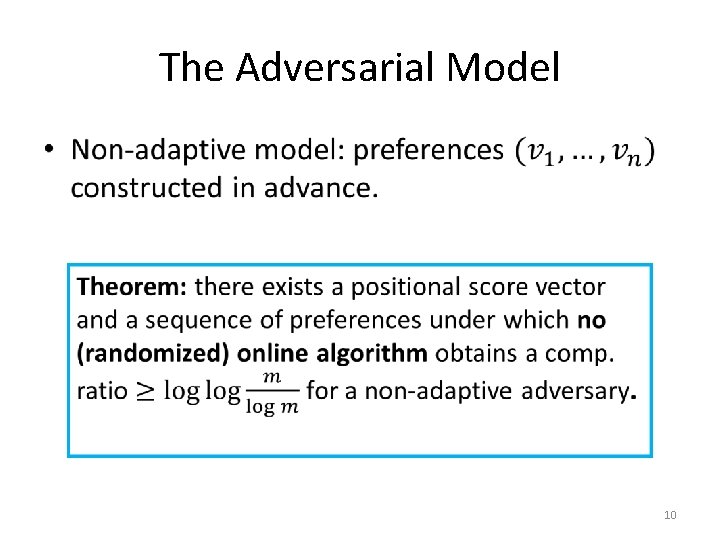
The Adversarial Model • 10
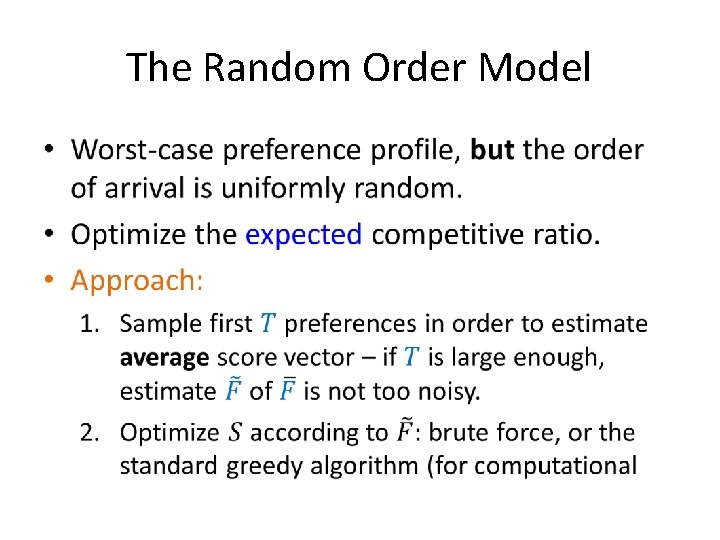
The Random Order Model •
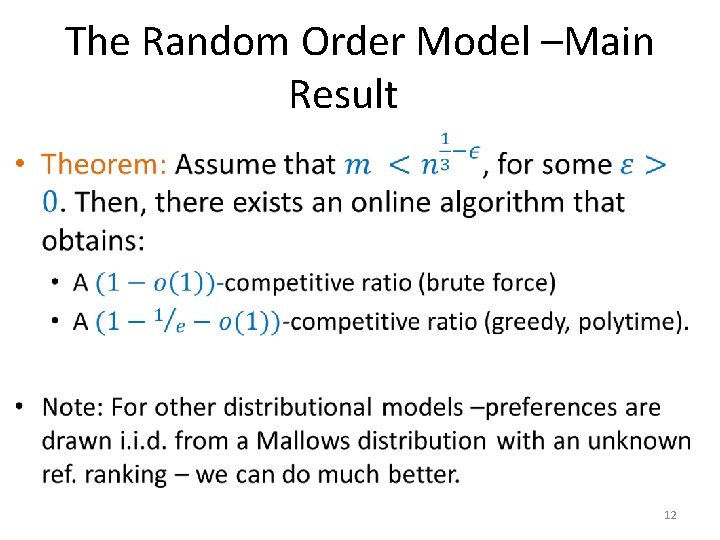
The Random Order Model –Main Result • 12
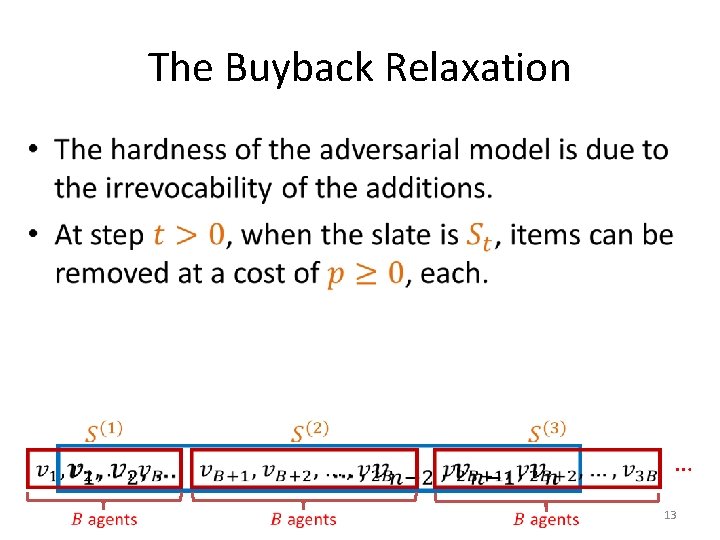
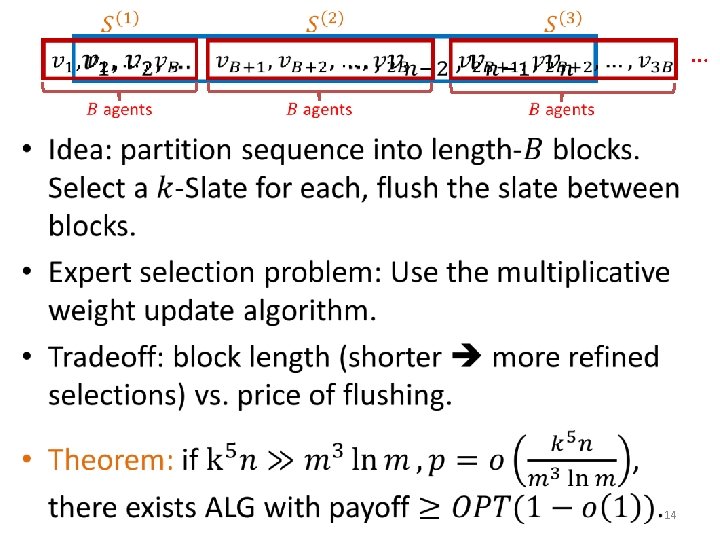
The Buyback Relaxation • … 13
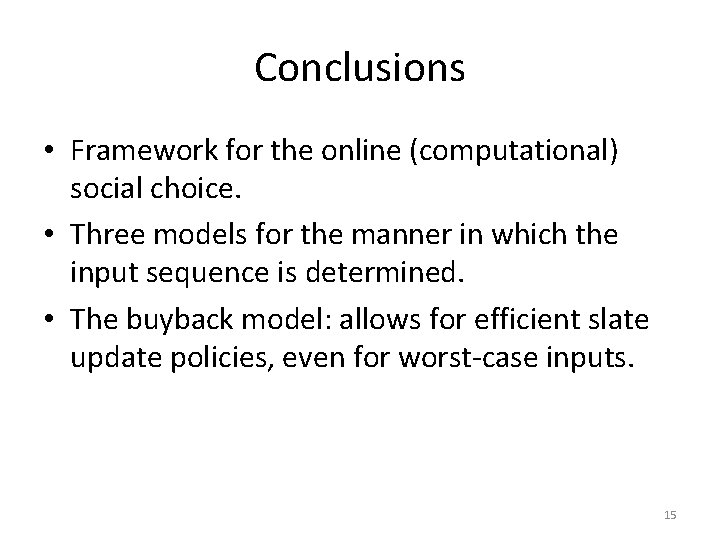
Conclusions • Framework for the online (computational) social choice. • Three models for the manner in which the input sequence is determined. • The buyback model: allows for efficient slate update policies, even for worst-case inputs. 15
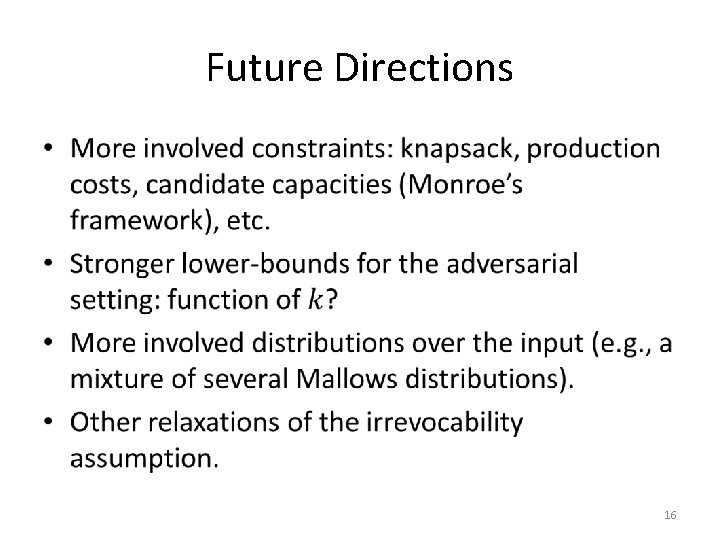
Future Directions • 16

Thank you!
- Slides: 17