
ONLINE ANALYTICAL PROCESSING OLAP OVERVIE W INTRODUCTION HISTORY



- Slides: 27
ONLINE ANALYTICAL PROCESSING (OLAP)
OVERVIE W • • • INTRODUCTION HISTORY OF OLAP TYPES OLAP CUBE DIFFERENCE BETWEEN OLAP & OLTP • OLAP OPERATIONS • ADVANTAGES & DISADVANTAGES
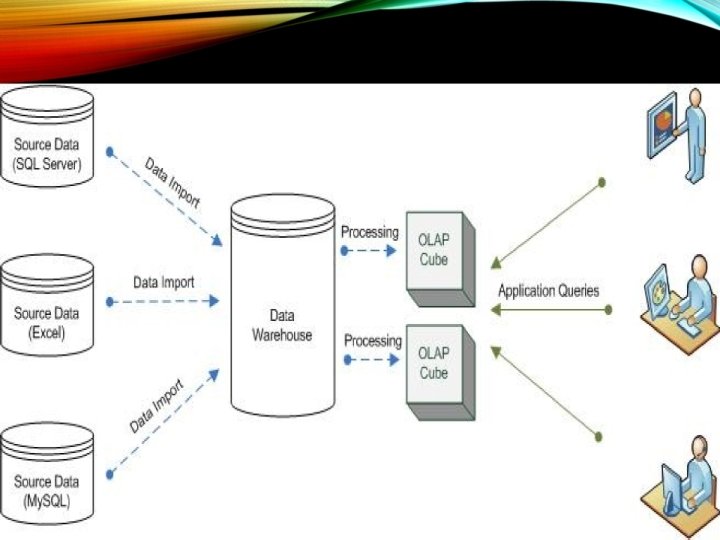
INTRODUCTION TO OLAP • OLAP (online analytical processing) is computer processing that enables a user to easily and selectively extract and view data from different points of view. • OLAP allows users to analyze database information from multiple database systems at one time.
HISTOR Y • In 1993, E. F. Codd came up with the term online analytical processing (OLAP) and proposed 12 criteria to define an OLAP database • The term OLAP seems perfect to describe databases designed to facilitate decision making (analysis) in an organization • The first product that performed OLAP queries was Express, which was released in 1970 (and acquired by Oracle in 1995 from Information Resources).
Some popular OLAP server software programs include: Oracle Express Server Hyperion Solutions Essbase OLAP processing is often used for data mining. OLAP products are typically designed for multipleuser environments, with the cost of the software based on the number of users.
OLAP TYPES We have four types of OLAP servers − - Relational OLAP (ROLAP) - Multidimensional OLAP (MOLAP) - Hybrid OLAP (HOLAP) - Specialized SQL Servers
ROLAP – Relational OLAP ROLAP servers are placed between relational back-end server and client front-end tools. To store and manage warehouse data, ROLAP uses relational or extended-relational DBMS. ROLAP includes the following − - Implementation of aggregation navigation logic. - Optimization for each DBMS back end. - Additional tools and services.
MOLAP – Multidimensional OLAP MOLAP uses array-based multidimensional storage engines for multidimensional views of data. With multidimensional data stores, the storage utilization may be low if the data set is sparse. Therefore, many MOLAP server use two levels of data storage representation to handle dense and sparse data sets.
HOLAP – Hybrid OLAP is a combination of both ROLAP and MOLAP. It offers higher scalability of ROLAP and faster computation of MOLAP. HOLAP servers allows to store the large data volumes of detailed information. The aggregations are stored separately in MOLAP store.
Specialized SQL Servers Specialized SQL servers provide advanced query language and query processing support for SQL queries over star and snowflake schemas in a read-only environment.
OLAP CUBE • An OLAP Cube is a data structure that allows fast analysis of data. • The arrangement of data into cubes overcomes a limitation of relational databases. • The OLAP cube consists of numeric facts called measures which are categorized by dimensions.
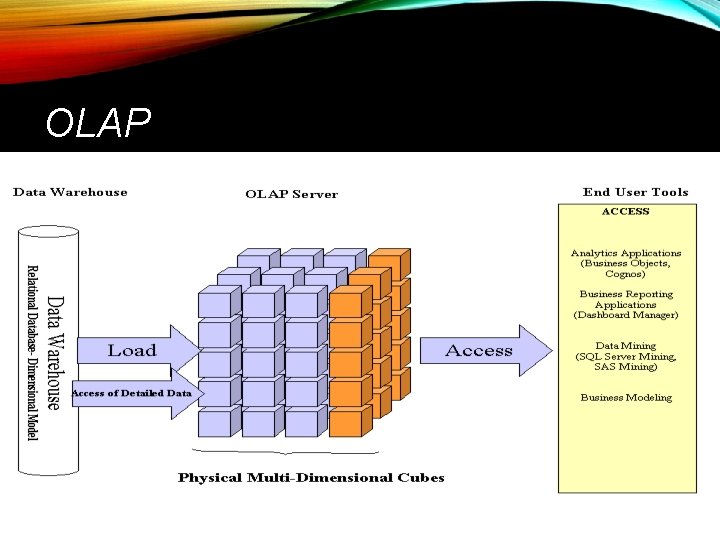
OLAP CUBE
OLTP VS OLAP • Source of data • • • Purpose of data Queries Processing speed Space Requirement Database Design Backup and Recovery
OPERATIONS OF OLAP • There are different kind of operations which we • • can perform in OLAP Roll up Drill Down Slice Dice Pivot Drill-across Drill-through
ROLL • UP Takes the current aggregation level of fact values does a further aggregation on one or more of the dimensions. and • Equivalent to doing GROUP BY to this dimension by using attribute hierarchy. SELECT [attribute list], SUM [attribute names] FROM [table list] WHERE [condition list] GROUP BY [grouping list];
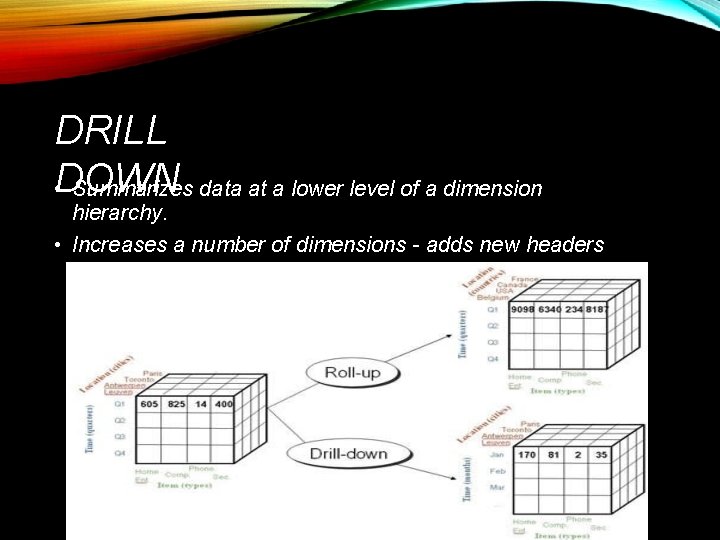
DRILL • DOWN Summarizes data at a lower level of a dimension hierarchy. • Increases a number of dimensions - adds new headers
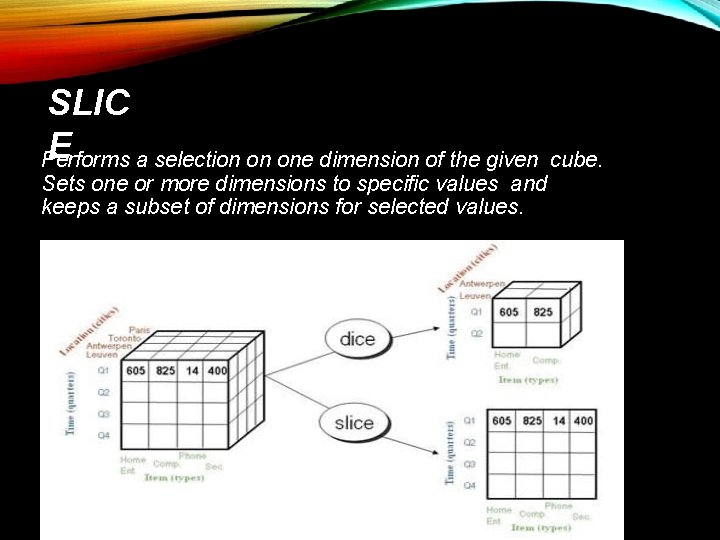
SLIC E Performs a selection on one dimension of the given Sets one or more dimensions to specific values and keeps a subset of dimensions for selected values. cube.
DIC E Define a sub-cube by performing a selection of one or more dimensions. Refers to range select condition on one dimension, or to select condition on more than one dimension. Reduces the number of member values of one or more dimensions.
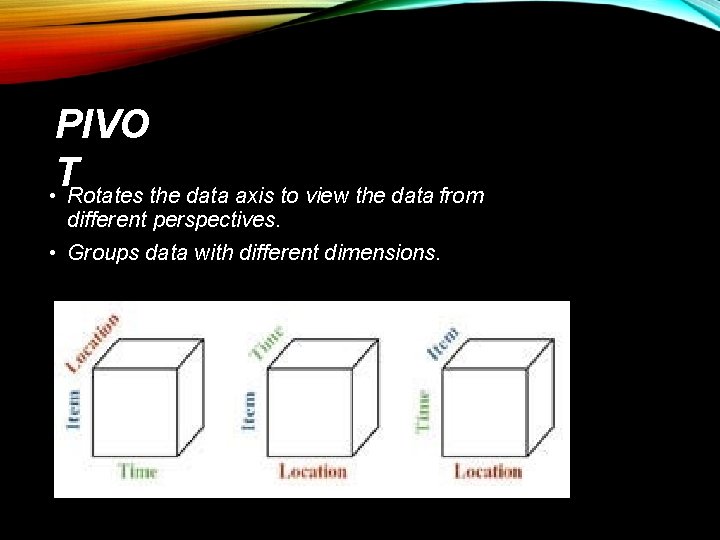
PIVO T • Rotates the data axis to view the data from different perspectives. • Groups data with different dimensions.
DRILL-ACROSS AND DRILLTHROUGH Drill-across : Accesses more than one fact table that is linked by common dimensions. Combines cubes that share one or more dimensions. • Drill-through: Drill down to the bottom level of a data cube down to its back-end relational tables.
APPLICATION S • Financial Applications Marketing/Sales Applications Business modeling
ADVANTAGE S • Consistency of Information and calculations • What if" scenarios • It allows a manager to pull down data from an OLAP database in broad or specific terms. • OLAP creates a single platform for all the information and business needs, planning, budgeting, forecasting, reporting and analysis
DISADVANTAGE S • Pre-Modeling • Great Dependence on IT • Slow In Reacting
PURPOSE OF OLAP • To derive summarized information from large volume database • To generate automated reports for human view
CONCLUSION • OLAP is a significant improvement over query systems • OLAP is an interactive system to show different summaries of multidimensional data by interactively selecting the attributes in a multidimensional data cube
REFERENC • ES http: //www. skybuffer. com/blog/1/ • https: // en. wikipedia. org/wiki/Online_analytical_processing • http: // searchdatamanagement. techtarget. com/definition/O LAP • http: //olap. com/olap-definition/ • https: //support. office. com/en-my/article/Overview-of. Online-Analytical-Processing-OLAP-15 d 2 cdde-f 70 b- 4277 b 009 -ed 732 b 75 fdd 6