
ONF Core Model Profile Template model by Nigel
ONF Core. Model Profile & Template model by Nigel Davis, Thorsten Heinze and Martin Skorupski

Problem Description • Often a device functionality and behavior can be modified by selecting a single Profile instance. • In some cases the existents of a specific hardware selected a Profile (e. g. plugging an SFP), in other cases a user selects “his” Profile (e. g. operator dependent default values, user profiles) • Usually there is a list of Profiles as a set of concrete values. Once a profile is selected, software uses those values in its business logic. • In some cases Profile Object Instances are called “Template”. ØHow can such construct be modeled in the Core. Model?
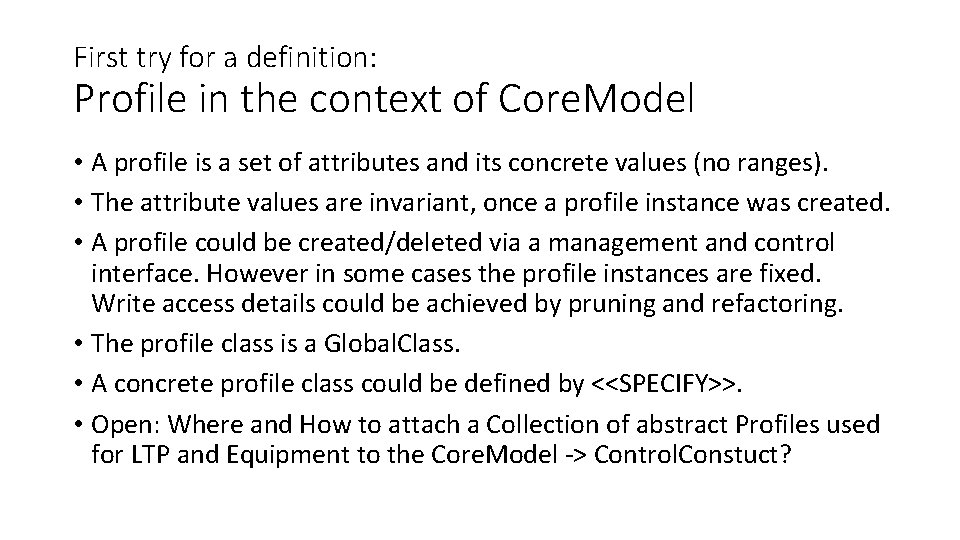
First try for a definition: Profile in the context of Core. Model • A profile is a set of attributes and its concrete values (no ranges). • The attribute values are invariant, once a profile instance was created. • A profile could be created/deleted via a management and control interface. However in some cases the profile instances are fixed. Write access details could be achieved by pruning and refactoring. • The profile class is a Global. Class. • A concrete profile class could be defined by <<SPECIFY>>. • Open: Where and How to attach a Collection of abstract Profiles used for LTP and Equipment to the Core. Model -> Control. Constuct?
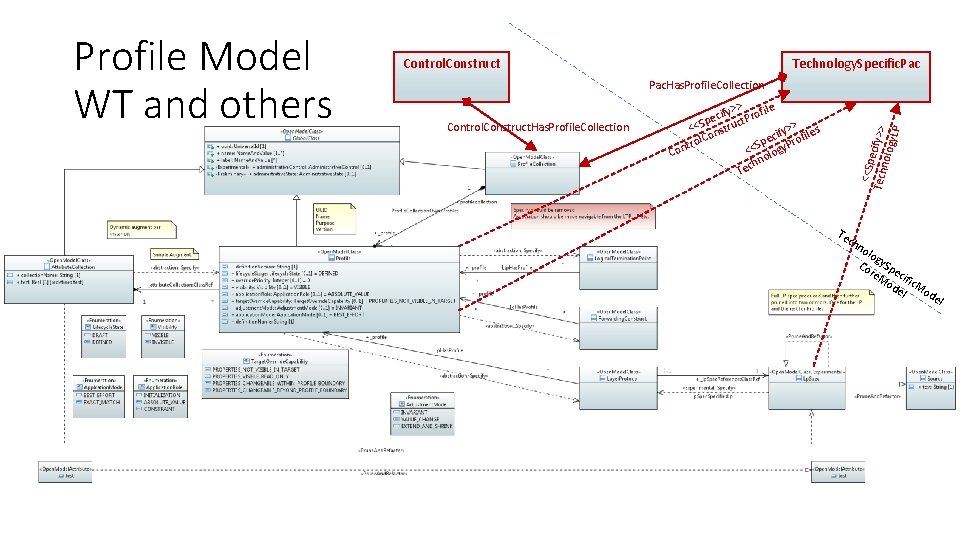
Control. Construct Technology. Specific. Pac. Has. Profile. Collection Control. Construct. Has. Profile. Collection > ify> Profile c e t p > <<S nstruc ify> ofiles o c C l e r p tro <<S logy. P Con hno Tec <<Sp Tech ecify>> nolo gy. LP Profile Model WT and others Te ch no log Co y. Sp re. M eci od fic. M el od e l

Fragment of model

Backup

Property Value Profiles Nigel Davis 20190317
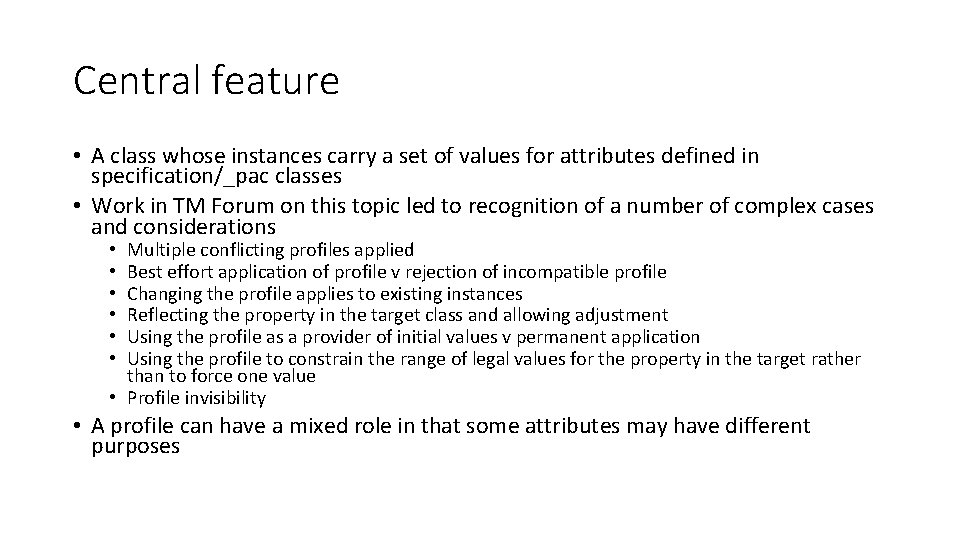
Central feature • A class whose instances carry a set of values for attributes defined in specification/_pac classes • Work in TM Forum on this topic led to recognition of a number of complex cases and considerations Multiple conflicting profiles applied Best effort application of profile v rejection of incompatible profile Changing the profile applies to existing instances Reflecting the property in the target class and allowing adjustment Using the profile as a provider of initial values v permanent application Using the profile to constrain the range of legal values for the property in the target rather than to force one value • Profile invisibility • • A profile can have a mixed role in that some attributes may have different purposes
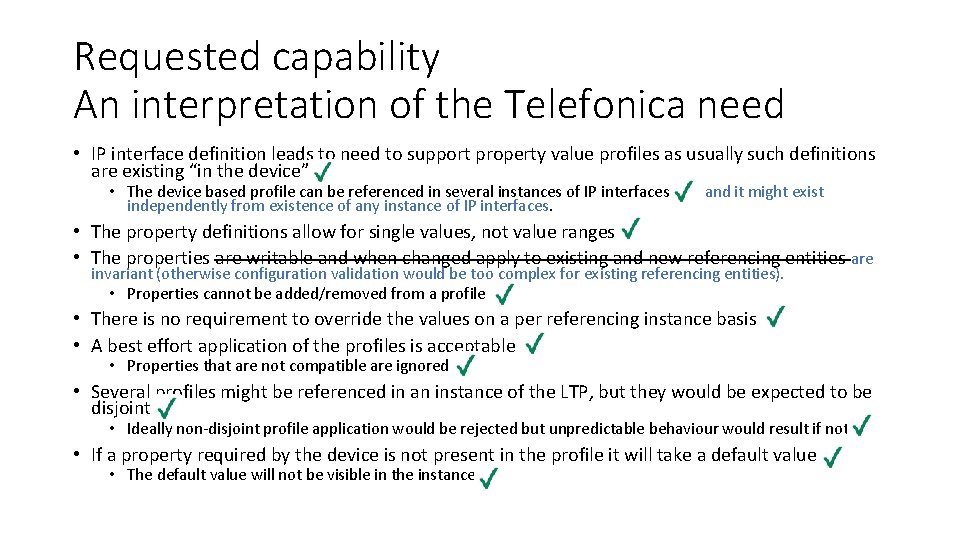
Requested capability An interpretation of the Telefonica need • IP interface definition leads to need to support property value profiles as usually such definitions are existing “in the device” • The device based profile can be referenced in several instances of IP interfaces independently from existence of any instance of IP interfaces. and it might exist • The property definitions allow for single values, not value ranges. • The properties are writable and when changed apply to existing and new referencing entities are invariant (otherwise configuration validation would be too complex for existing referencing entities). • Properties cannot be added/removed from a profile • There is no requirement to override the values on a per referencing instance basis • A best effort application of the profiles is acceptable • Properties that are not compatible are ignored • Several profiles might be referenced in an instance of the LTP, but they would be expected to be disjoint • Ideally non-disjoint profile application would be rejected but unpredictable behaviour would result if not • If a property required by the device is not present in the profile it will take a default value • The default value will not be visible in the instance
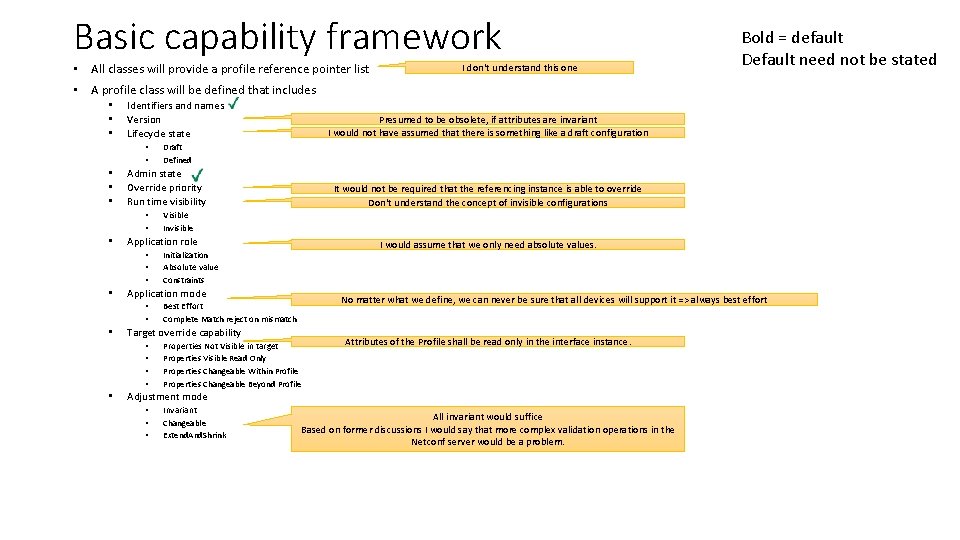
Basic capability framework • All classes will provide a profile reference pointer list I don‘t understand this one Bold = default Default need not be stated • A profile class will be defined that includes • • • Identifiers and names Version Lifecycle state • • • I would assume that we only need absolute values. Initialization Absolute value Constraints No matter what we define, we can never be sure that all devices will support it => always best effort Best Effort Complete Match reject on mismatch Target override capability • • • Visible Invisible Application mode • • • It would not be required that the referencing instance is able to override Don‘t understand the concept of invisible configurations Application role • • Draft Defined Admin state Override priority Run time visibility • • • Presumed to be obsolete, if attributes are invariant I would not have assumed that there is something like a draft configuration Properties Not Visible in target Properties Visible Read Only Properties Changeable Within Profile Properties Changeable Beyond Profile Attributes of the Profile shall be read only in the interface instance. Adjustment mode • • • Invariant Changeable Extend. And. Shrink All invariant would suffice Based on former discussions I would say that more complex validation operations in the Netconf server would be a problem.
Profiles and Templates Nigel Davis (building on work by Chris Hartley) 20190502 11
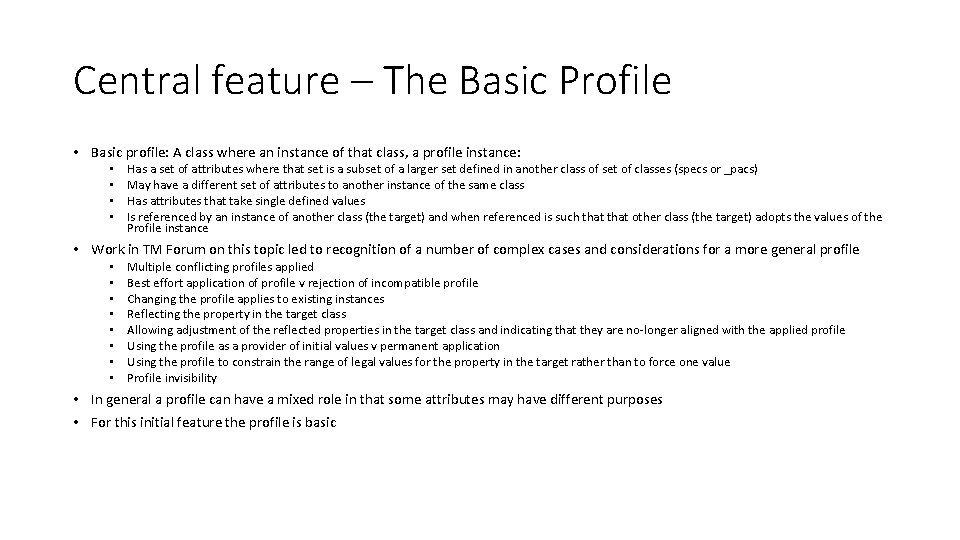
Central feature – The Basic Profile • Basic profile: A class where an instance of that class, a profile instance: • • Has a set of attributes where that set is a subset of a larger set defined in another class of set of classes (specs or _pacs) May have a different set of attributes to another instance of the same class Has attributes that take single defined values Is referenced by an instance of another class (the target) and when referenced is such that other class (the target) adopts the values of the Profile instance • Work in TM Forum on this topic led to recognition of a number of complex cases and considerations for a more general profile • • Multiple conflicting profiles applied Best effort application of profile v rejection of incompatible profile Changing the profile applies to existing instances Reflecting the property in the target class Allowing adjustment of the reflected properties in the target class and indicating that they are no-longer aligned with the applied profile Using the profile as a provider of initial values v permanent application Using the profile to constrain the range of legal values for the property in the target rather than to force one value Profile invisibility • In general a profile can have a mixed role in that some attributes may have different purposes • For this initial feature the profile is basic
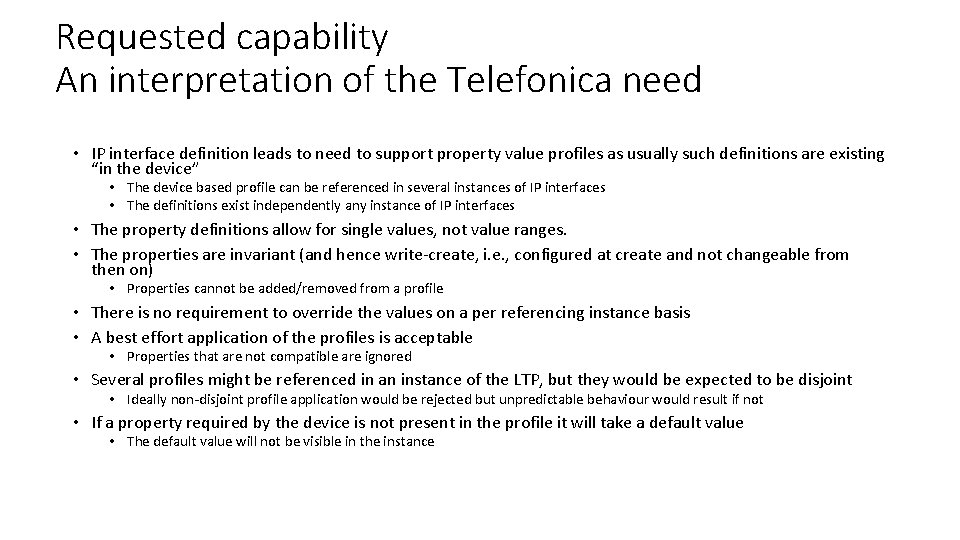
Requested capability An interpretation of the Telefonica need • IP interface definition leads to need to support property value profiles as usually such definitions are existing “in the device” • The device based profile can be referenced in several instances of IP interfaces • The definitions exist independently any instance of IP interfaces • The property definitions allow for single values, not value ranges. • The properties are invariant (and hence write-create, i. e. , configured at create and not changeable from then on) • Properties cannot be added/removed from a profile • There is no requirement to override the values on a per referencing instance basis • A best effort application of the profiles is acceptable • Properties that are not compatible are ignored • Several profiles might be referenced in an instance of the LTP, but they would be expected to be disjoint • Ideally non-disjoint profile application would be rejected but unpredictable behaviour would result if not • If a property required by the device is not present in the profile it will take a default value • The default value will not be visible in the instance
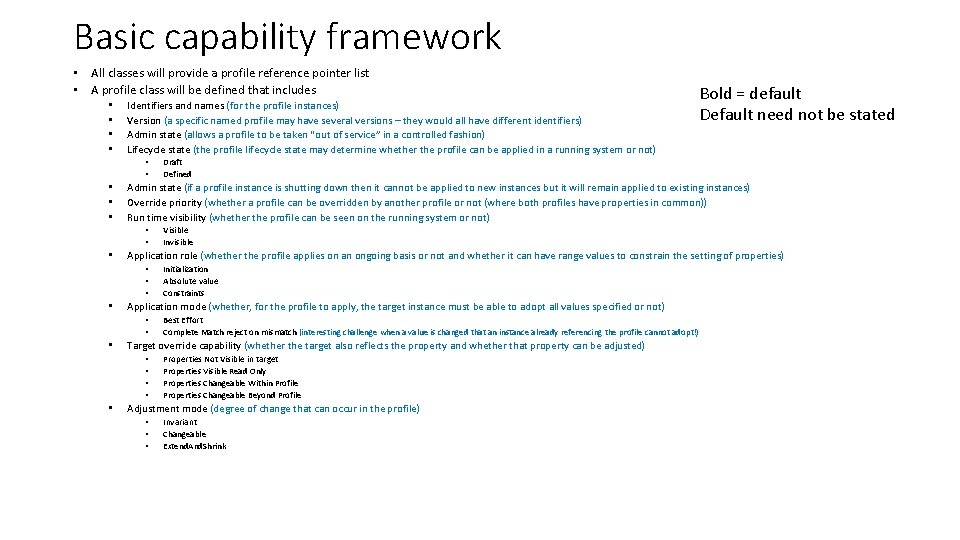
Basic capability framework • All classes will provide a profile reference pointer list • A profile class will be defined that includes • • Identifiers and names (for the profile instances) Version (a specific named profile may have several versions – they would all have different identifiers) Admin state (allows a profile to be taken “out of service” in a controlled fashion) Lifecycle state (the profile lifecycle state may determine whether the profile can be applied in a running system or not) • • • Best Effort Complete Match reject on mismatch (interesting challenge when a value is changed that an instance already referencing the profile cannot adopt!) Target override capability (whether the target also reflects the property and whether that property can be adjusted) • • • Initialization Absolute value Constraints Application mode (whether, for the profile to apply, the target instance must be able to adopt all values specified or not) • • • Visible Invisible Application role (whether the profile applies on an ongoing basis or not and whether it can have range values to constrain the setting of properties) • • Draft Defined Admin state (if a profile instance is shutting down then it cannot be applied to new instances but it will remain applied to existing instances) Override priority (whether a profile can be overridden by another profile or not (where both profiles have properties in common)) Run time visibility (whether the profile can be seen on the running system or not) • • • Bold = default Default need not be stated Properties Not Visible in target Properties Visible Read Only Properties Changeable Within Profile Properties Changeable Beyond Profile Adjustment mode (degree of change that can occur in the profile) • • • Invariant Changeable Extend. And. Shrink

Questions • Do we need ? • Profile Object instance (Template) version ? Propose no? A specific named instance of properties applied to an instance is equivalent to an FC with a composed part and we do not version an FC when we change a value in a composed part etc. It may however need an application maturity level (as the specific set of values may be experimental) and an application purpose name (i. e. , why this set of values is relevant). • Profile Class version ? Propose potentially yes, with the caveat that it is the set of attributes with their qualities that is being versioned (more of an occurrence) and not the overall profile mechanism. The profile class (occurrence) may have properties added or removed. This seems much more like changes to the class model. BUT we do not version our classes. So perhaps the profile class (occurrence) should simply change with no explicit versioning. • Do you want a class / attribute style structure or a (Yang like) tree style structure or just a bag of attributes (no structure) ? Propose that we have an opportunity for a structure not just a bag or tree. • Use of generics will simplify the result with type safety Basic Type Square Pattern • Also need to consider event / Kafka support ! • The profile instance should be reported as for any other instance.

There are 4 basic hard / soft representation Model Soft Hard • options Soft = Soft Properties, Hard = normal attribute Profile / Soft • For the hard – hard option Template Hard • Need the attributes in a ‘PAC’ • Then the profile is just an instance of the PAC • Do we need the profile to populate ALL values in the PAC ? Do we need all the attributes in the PAC to allow null ? Or extend the metamodel to allow for this ? ? (see later sketch) • Some attributes may not be profile settable and this can be represented too (2) Not sensible Aiming for hard-hard but with the necessary flexibility. (1) (2) Hard-hard pattern (3) Profile metadata attribs
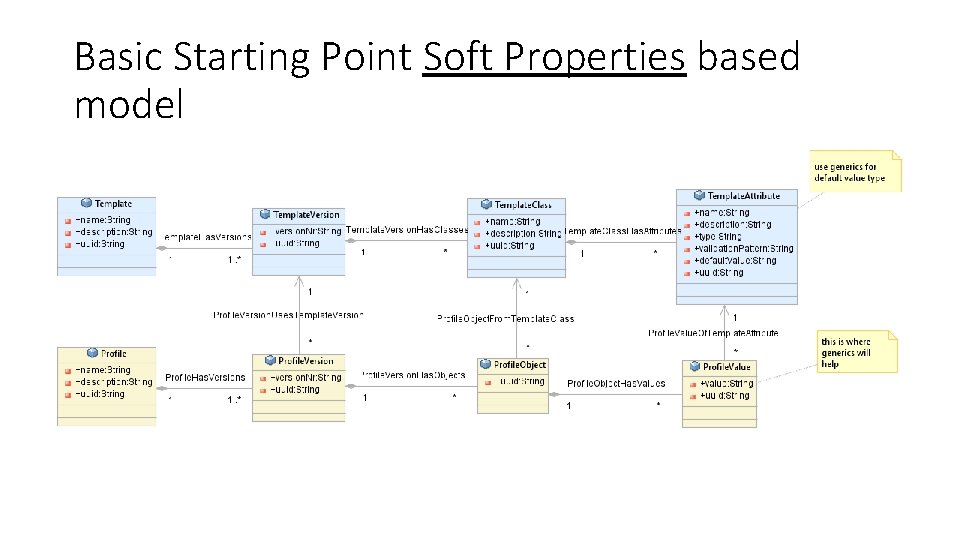
Basic Starting Point Soft Properties based model
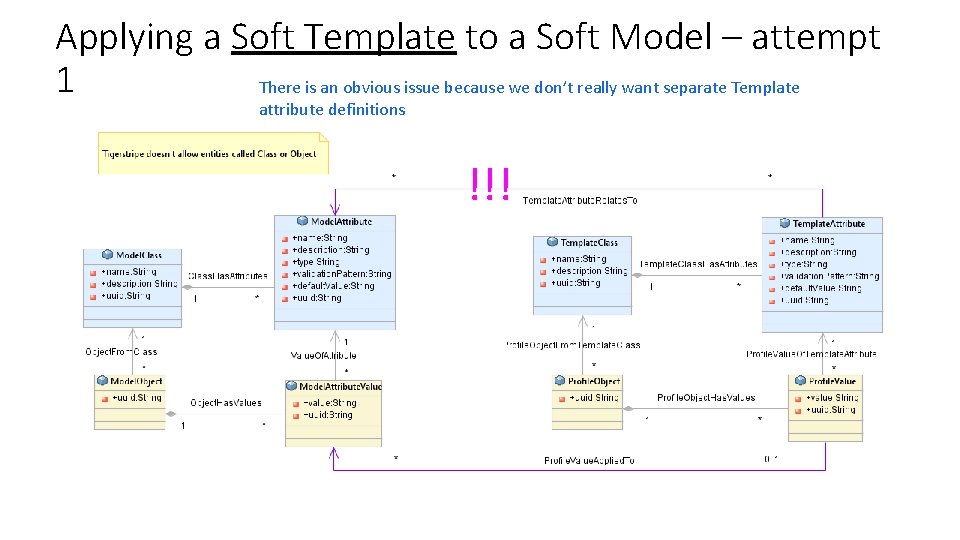
Applying a Soft Template to a Soft Model – attempt 1 There is an obvious issue because we don’t really want separate Template attribute definitions !!!
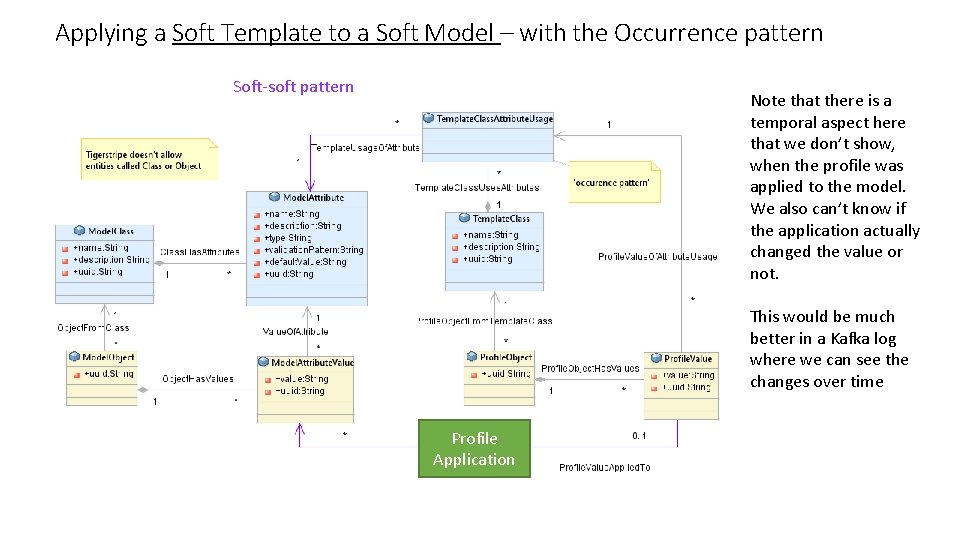
Applying a Soft Template to a Soft Model – with the Occurrence pattern Soft-soft pattern Note that there is a temporal aspect here that we don’t show, when the profile was applied to the model. We also can’t know if the application actually changed the value or not. This would be much better in a Kafka log where we can see the changes over time Profile Application
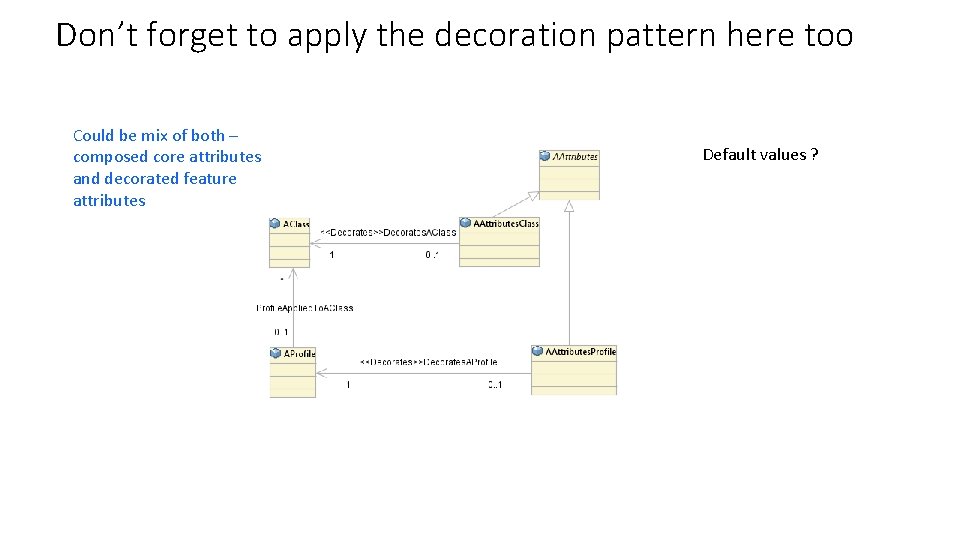
Don’t forget to apply the decoration pattern here too Could be mix of both – composed core attributes and decorated feature attributes Default values ?
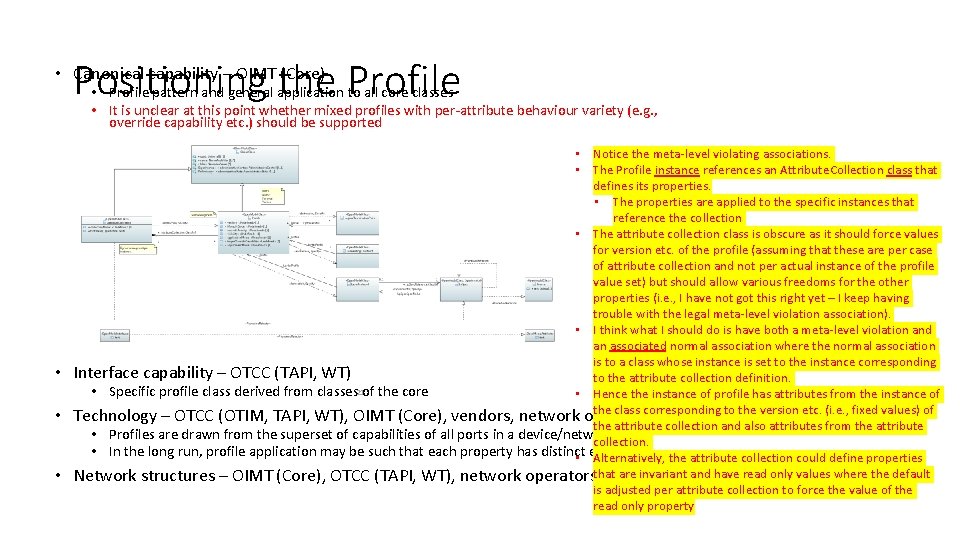
Positioning the Profile • Canonical capability – OIMT (Core) • Profile pattern and general application to all core classes • It is unclear at this point whether mixed profiles with per-attribute behaviour variety (e. g. , override capability etc. ) should be supported • • Notice the meta-level violating associations. • The Profile instance references an Attribute. Collection class that defines its properties. • The properties are applied to the specific instances that reference the collection • The attribute collection class is obscure as it should force values for version etc. of the profile (assuming that these are per case of attribute collection and not per actual instance of the profile value set) but should allow various freedoms for the other properties (i. e. , I have not got this right yet – I keep having trouble with the legal meta-level violation association). • I think what I should do is have both a meta-level violation and an associated normal association where the normal association is to a class whose instance is set to the instance corresponding Interface capability – OTCC (TAPI, WT) to the attribute collection definition. 21 • Specific profile class derived from classes of the core • Hence the instance of profile has attributes from the instance of the class corresponding to the version etc. (i. e. , fixed values) of Technology – OTCC (OTIM, TAPI, WT), OIMT (Core), vendors, network operators the attribute collection and also attributes from the attribute • Profiles are drawn from the superset of capabilities of all ports in a device/network collection. • In the long run, profile application may be such that each property has distinct effort etc. the attribute collection could define properties • Alternatively, are invariant and have read only values where the default Network structures – OIMT (Core), OTCC (TAPI, WT), network operatorsthat vendor is adjusted per attribute collection to force the value of the read only property
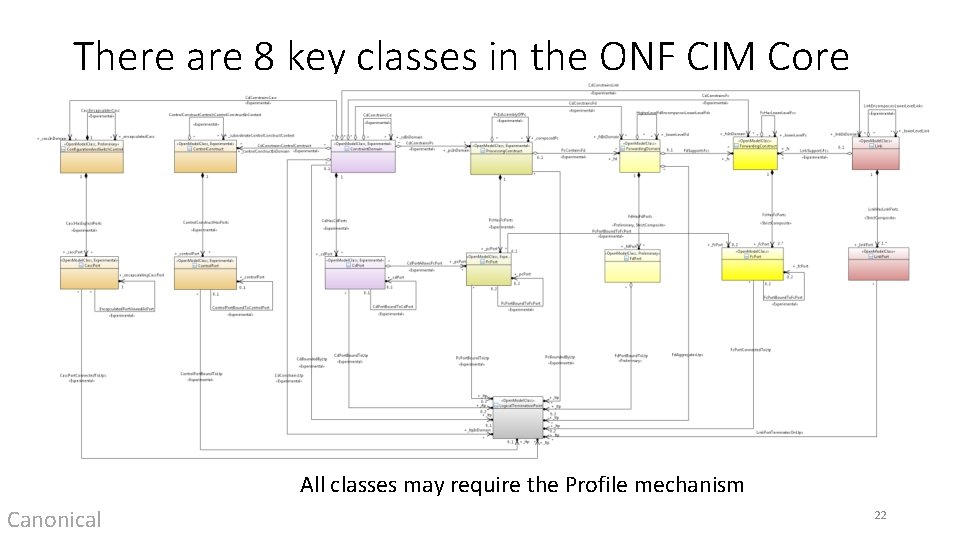
There are 8 key classes in the ONF CIM Core Model All classes may require the Profile mechanism Canonical 22
Technology extensions considering Profiles • Utilise Core model spec approach • This is available in TAPI and being adopted by WT • Take work from external body, rearrange into appropriate spec structures • Note that the core LTP spec is being enhanced to support more complex structure • Attach specs to appropriate model class (TAPI/WT) • Whilst these specs could be used as they are, the expectation is that vendors produce their own variants that provide a clear statement of per device combination capability 23 • Technology extensions should have a run-time dynamic application Technology
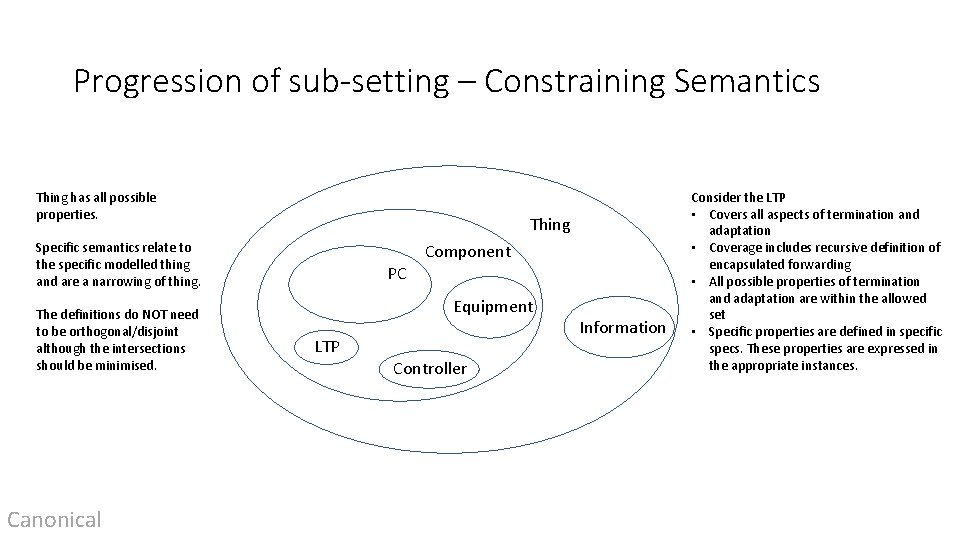
Progression of sub-setting – Constraining Semantics Thing has all possible properties. Thing Specific semantics relate to the specific modelled thing and are a narrowing of thing. The definitions do NOT need to be orthogonal/disjoint although the intersections should be minimised. Canonical PC Component Equipment LTP Controller Information Consider the LTP • Covers all aspects of termination and adaptation • Coverage includes recursive definition of encapsulated forwarding • All possible properties of termination and adaptation are within the allowed set • Specific properties are defined in specific specs. These properties are expressed in the appropriate instances.
Further thoughts • The detailed capability of a thing is expressed by decorating with parts that themselves have constrained semantics that fit within the definition of the thing • The capabilities may be expressed in terms of apparent subordinate parts where these parts can be positioned on the constrained semantic map • An LTP may have controllers within it but those controllers only emerges when the LTP is dismantled or its behaviour is expressed. Canonical
Observations • The method discussed so far applies a set of predefined properties for a specific technology to the CEP • The extension is provided as part of the TAPI standard • The spec simply causes an augment and hence the specify stereotype triggers the construction of Yang augment • There is a broader set of requirements for the Spec which will be discussed under the “Spec Rework” Topic 26

Rough sketch of Basic Profile (for further discussion) Specify opportunities for referencing instance include: • Augmentation (decorates… inserting attributes into class that drives the instance) P&R allows for: • Constrained redefine of attributes • Narrow range • Becomes read only • Removal of non-mandatory attributes • Constrained restructuring of the Technology Model • Addition of ONF specific properties and stereotypes Implied (Has. Spec) Specify Pattern Core Model Class P&R Specific class to class relationships P&R, Instantiate Refined Tech Spec Model Trace Back P&R, Occurrence Technology Model P&R, Occurrence Implied (Has. Spec (Class-instance)) Application Instance Run. Time 27 Augment Profile Instance Has. Profile (Class-Instance) Run. Time Refined Tech Spec Occurrence Disjoint OR Read. Only Refined Tech Spec Occurrence P&R Related Augment Tech Model Occurrence P&R

Several sub cases Attribute in profile are read/write and one of: 1. Attribute NOT in instance, instance takes default value for attribute if profile not applied 2. Attribute visible as read only in instance a) b) 3. Instance takes default value if profile not applied Attribute keeps last set value from profile when profile removed Attribute visible in instance a) b) Read only when profile is applied Read/write when profile not applied 28 i. Takes last set value from profile when profile removed (starting at a create value) ii. Takes default value if profile removed
Discussion 29
Backup 30

There is an issue with applying a soft profile to a hard class model • We don’t have an easy way of relating a soft property to a ‘hard’ attribute • The underlying problem is that the soft property model is representing the UML metamodel as a model so for hard-soft we are trying to associate across meta-layers ! • In fact it’s even worse than that, as the soft model could relate to any / every attribute / Entity in the ‘hard’ model – and we don’t want a Top class that it could relate to • Even ‘just’ trying to do it for LTP/port shows the sort of issues to be faced
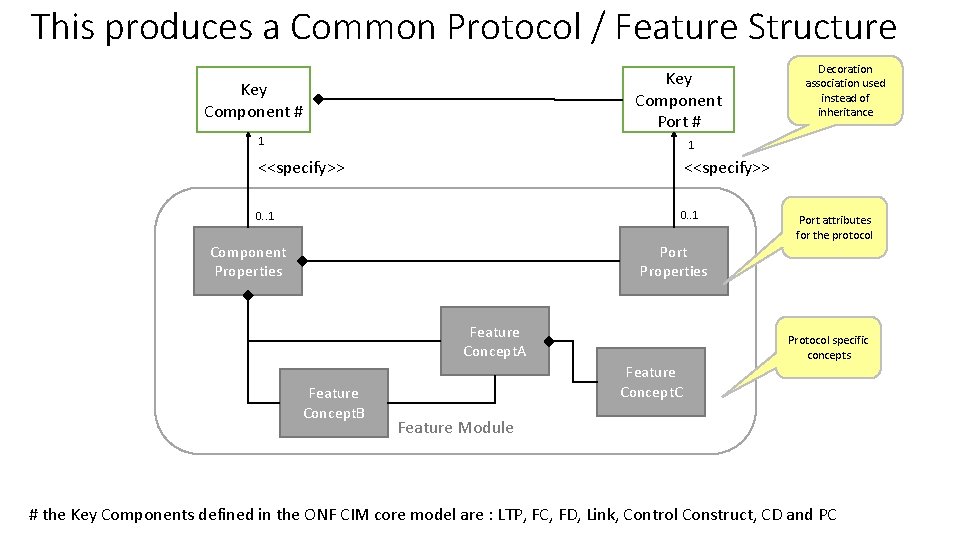
This produces a Common Protocol / Feature Structure Key Component Port # Key Component # 1 Decoration association used instead of inheritance 1 <<specify>> 0. . 1 Component Properties Port attributes for the protocol Port Properties Feature Concept. A Feature Concept. B Protocol specific concepts Feature Concept. C Feature Module # the Key Components defined in the ONF CIM core model are : LTP, FC, FD, Link, Control Construct, CD and PC

How the Protocols / Features add up <<specify>> ERPS Properties PTP Concept. B <<specify>> Key Component # PTP Properties ERPS Concept. A ERPS Concept. B <<specify>> ERPS Port Properties ERPS Module <<spcify>> Key Component Port # PTP Port Properties PTP Concept. A PTP Clock Module # the Key Components defined in the ONF CIM core model are : LTP, FC, FD, Link, Control Construct, CD and PC
- Slides: 33