
ONEBOX MODEL Chemical production Inflow Fin P X
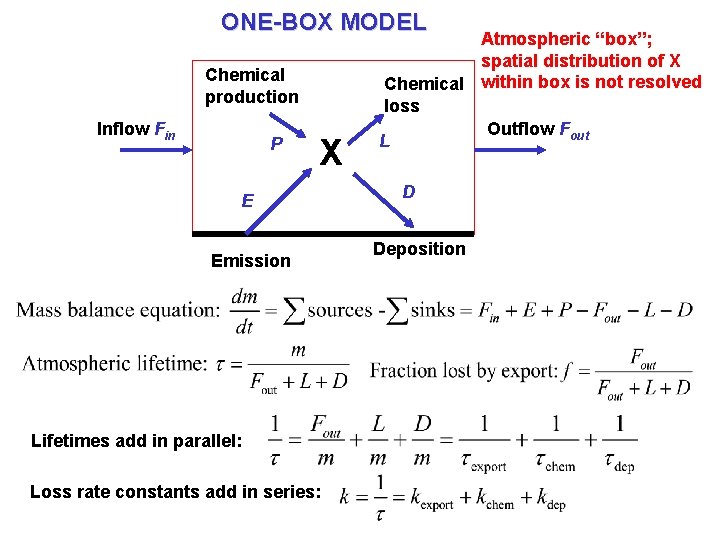
ONE-BOX MODEL Chemical production Inflow Fin P X E Emission Lifetimes add in parallel: Loss rate constants add in series: Atmospheric “box”; spatial distribution of X Chemical within box is not resolved loss Outflow Fout L D Deposition
![EXAMPLE: GLOBAL BOX MODEL FOR CO 2 (Pg C yr-1) IPCC [2001]](http://slidetodoc.com/presentation_image_h2/cd45f4ede6e46db482c1f56321de5bce/image-2.jpg "EXAMPLE: GLOBAL BOX MODEL FOR CO 2 (Pg C yr-1) IPCC [2001]")
EXAMPLE: GLOBAL BOX MODEL FOR CO 2 (Pg C yr-1) IPCC [2001]
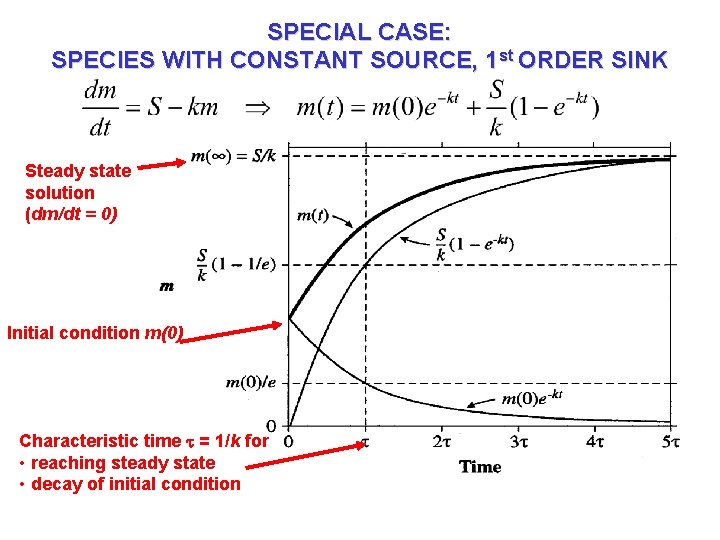
SPECIAL CASE: SPECIES WITH CONSTANT SOURCE, 1 st ORDER SINK Steady state solution (dm/dt = 0) Initial condition m(0) Characteristic time t = 1/k for • reaching steady state • decay of initial condition
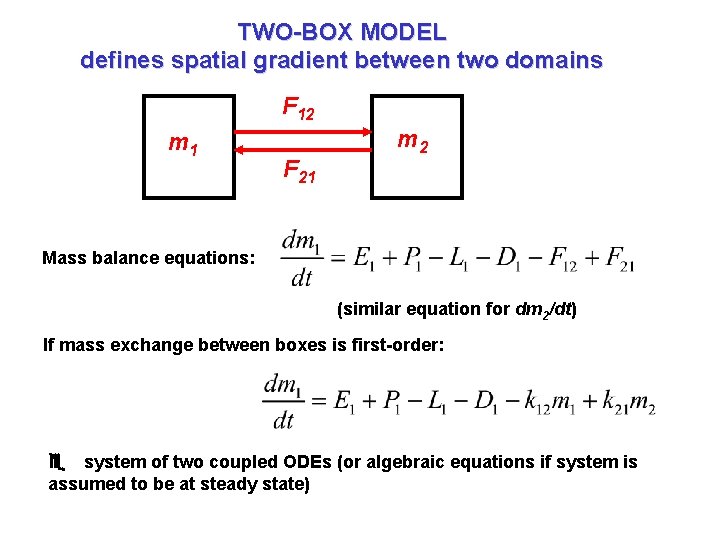
TWO-BOX MODEL defines spatial gradient between two domains F 12 m 1 F 21 m 2 Mass balance equations: (similar equation for dm 2/dt) If mass exchange between boxes is first-order: e system of two coupled ODEs (or algebraic equations if system is assumed to be at steady state)

Illustrates long time scale for interhemispheric exchange; can use 2 -box model to place constraints on sources/sinks in each hemisphere
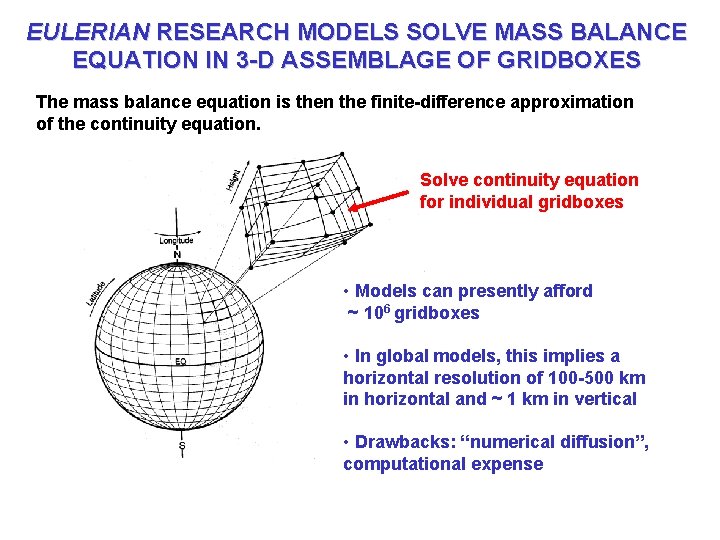
EULERIAN RESEARCH MODELS SOLVE MASS BALANCE EQUATION IN 3 -D ASSEMBLAGE OF GRIDBOXES The mass balance equation is then the finite-difference approximation of the continuity equation. Solve continuity equation for individual gridboxes • Models can presently afford ~ 106 gridboxes • In global models, this implies a horizontal resolution of 100 -500 km in horizontal and ~ 1 km in vertical • Drawbacks: “numerical diffusion”, computational expense
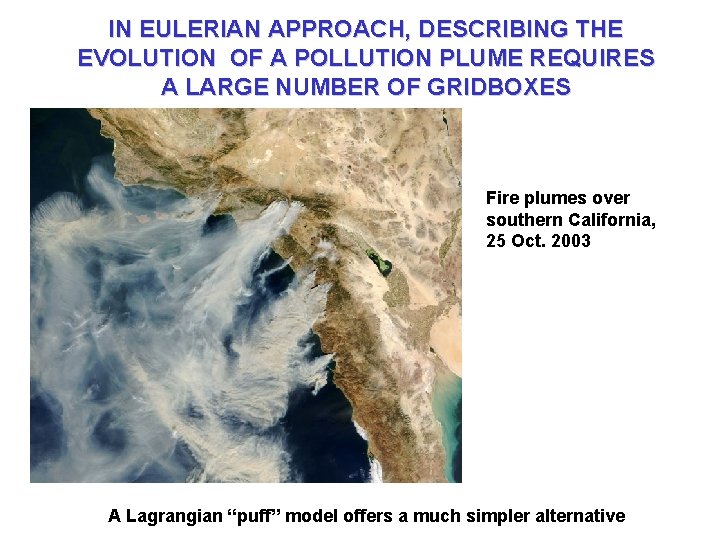
IN EULERIAN APPROACH, DESCRIBING THE EVOLUTION OF A POLLUTION PLUME REQUIRES A LARGE NUMBER OF GRIDBOXES Fire plumes over southern California, 25 Oct. 2003 A Lagrangian “puff” model offers a much simpler alternative
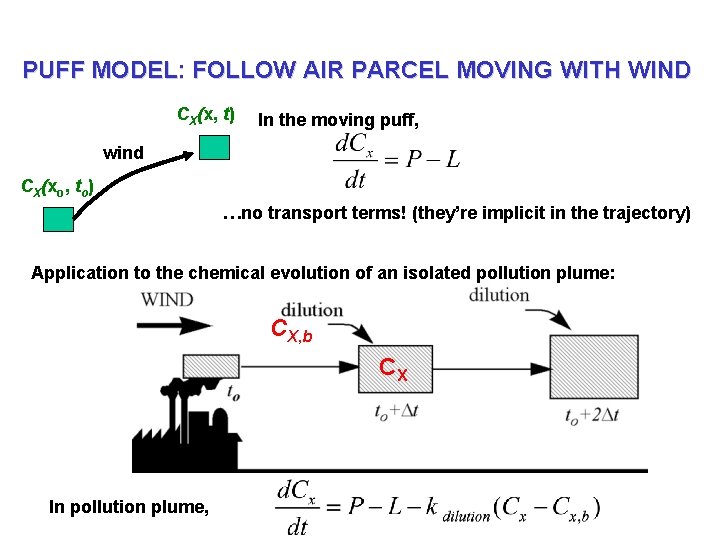
PUFF MODEL: FOLLOW AIR PARCEL MOVING WITH WIND CX(x, t) In the moving puff, wind CX(xo, to) …no transport terms! (they’re implicit in the trajectory) Application to the chemical evolution of an isolated pollution plume: CX, b CX In pollution plume,
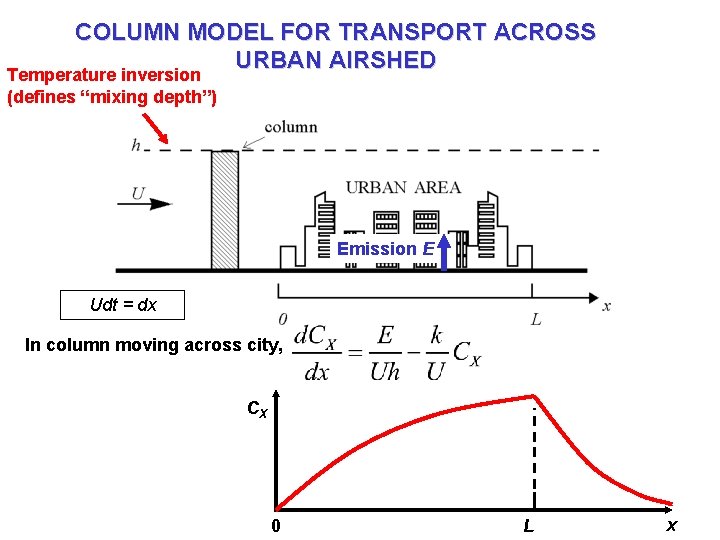
COLUMN MODEL FOR TRANSPORT ACROSS URBAN AIRSHED Temperature inversion (defines “mixing depth”) Emission E Udt = dx In column moving across city, CX 0 L x
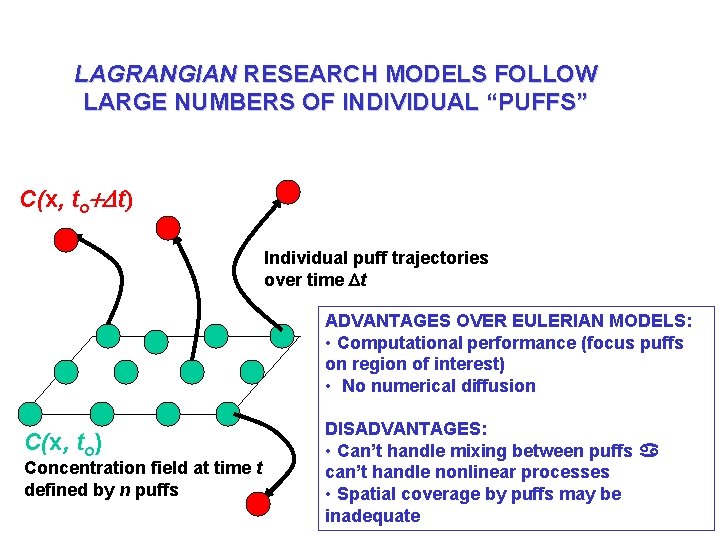
LAGRANGIAN RESEARCH MODELS FOLLOW LARGE NUMBERS OF INDIVIDUAL “PUFFS” C(x, to+Dt) Individual puff trajectories over time Dt ADVANTAGES OVER EULERIAN MODELS: • Computational performance (focus puffs on region of interest) • No numerical diffusion C(x, to) Concentration field at time t defined by n puffs DISADVANTAGES: • Can’t handle mixing between puffs a can’t handle nonlinear processes • Spatial coverage by puffs may be inadequate
SHORT QUESTIONS 1. 2. 3. • • • The Montreal Protocol has banned worldwide production of CFC-12 is removed from the atmosphere by photolysis with a lifetime of 100 years. Assuming compliance with the Protocol, and neglecting residual emissions from existing stocks, how long will it take for CFC-12 concentrations to drop to half of present-day values? Consider a 2 -box model for the atmosphere where one box is the troposphere (1000 -150 h. Pa) and the other is the stratosphere (150 -1 h. Pa). Assume a 2 -year residence time for air in the stratosphere. What is the corresponding residence time of air in the troposphere? Of the simple models presented in chapter 3, which one would be most appropriate for answering the following questions: Will atmospheric releases of a new industrial gas harm the stratospheric ozone layer? What areas will be affected by the radioactive plume from a nuclear accident? An air pollution monitoring site suddenly detects high concentrations of a toxic gas. Where is this gas coming from?
- Slides: 11