
One year on from Future in Mind Peter

- Slides: 33
One year on from Future in Mind Peter Fonagy, National Clinical Lead for CYP IAPT Kathryn Pugh, Children and Young People’s Programme Lead Anne O’Herlihy, Project Manager CYP IAPT and the Children and Young People’s Team, NHS England www. england. nhs. uk
My ‘take home’ message • A lot has happened, but there is still so much to do • We need to keep the focus now on implementation of Local Transformation Plans, including integrating them with whole system Sustainability and Transformation Plans • We need to maintain support to keep all partners engaged – children and young people, families, schools & colleges , health, local authorities, voluntary sector • More evidence based treatment pathways are coming • The work you are doing on data and outcomes is vital to the mainstreaming of CAMHS as core business www. england. nhs. uk
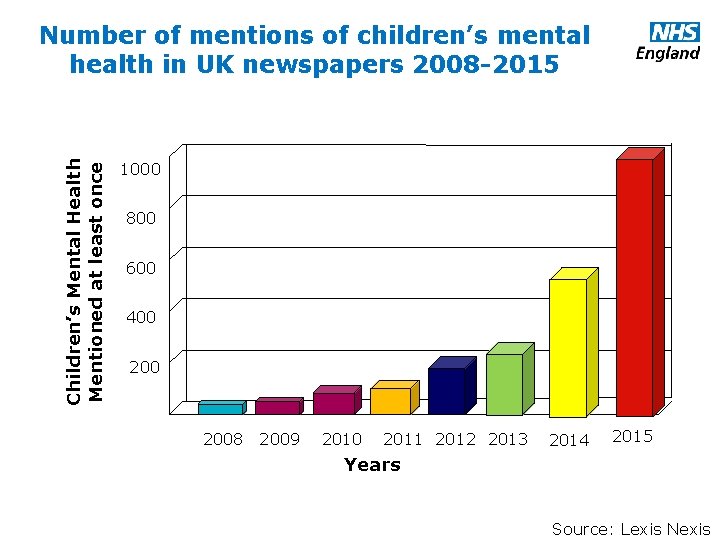
Children’s Mental Health Mentioned at least once Number of mentions of children’s mental health in UK newspapers 2008 -2015 1000 800 600 400 2008 2009 2010 2011 2012 2013 2014 2015 Years www. england. nhs. uk Source: Lexis Nexis
www. england. nhs. uk
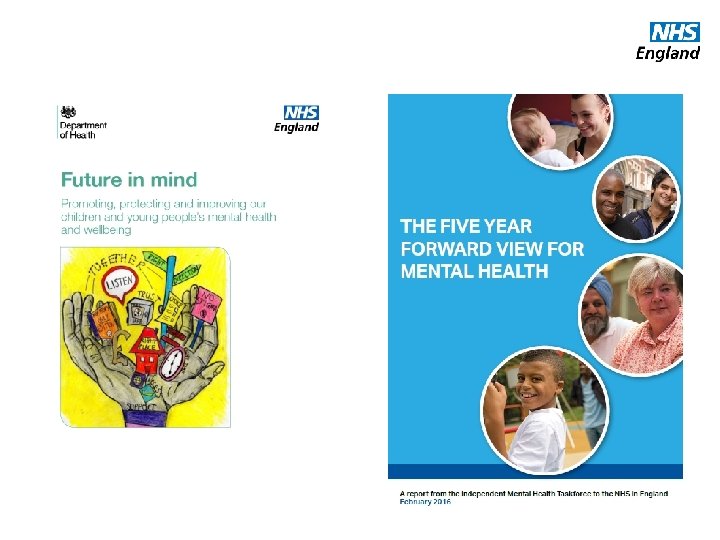
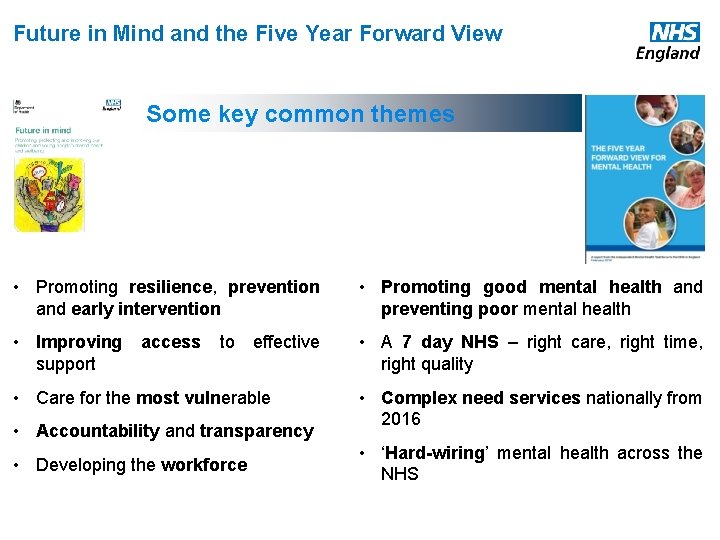
Future in Mind and the Five Year Forward View Some key common themes • Promoting resilience, prevention and early intervention • Promoting good mental health and preventing poor mental health • Improving support • A 7 day NHS – right care, right time, right quality access to effective • Care for the most vulnerable • Accountability and transparency • Developing the workforce www. england. nhs. uk • Complex need services nationally from 2016 • ‘Hard-wiring’ mental health across the NHS
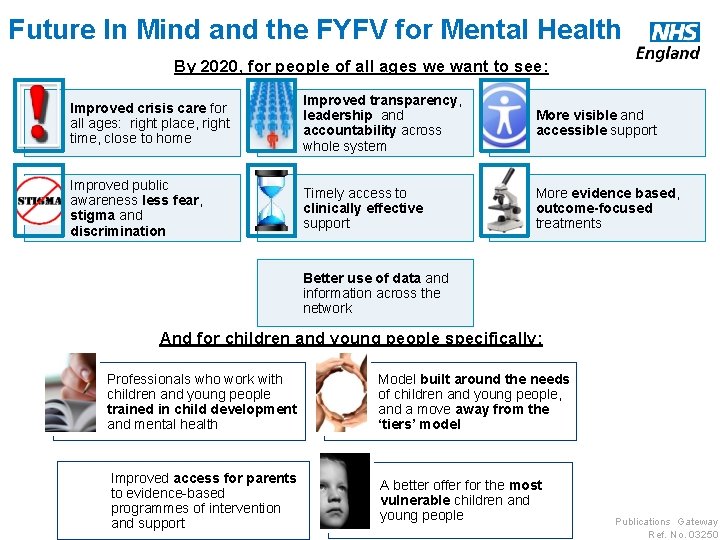
Future In Mind and the FYFV for Mental Health By 2020, for people of all ages we want to see: Improved crisis care for all ages: right place, right time, close to home Improved transparency, leadership and accountability across whole system More visible and accessible support Improved public awareness less fear, stigma and discrimination Timely access to clinically effective support More evidence based, outcome-focused treatments Better use of data and information across the network And for children and young people specifically: Professionals who work with children and young people trained in child development and mental health Improved access for parents to evidence-based programmes of intervention www. england. nhs. uk and support Model built around the needs of children and young people, and a move away from the ‘tiers’ model A better offer for the most vulnerable children and young people Publications Gateway Ref. No. 03250
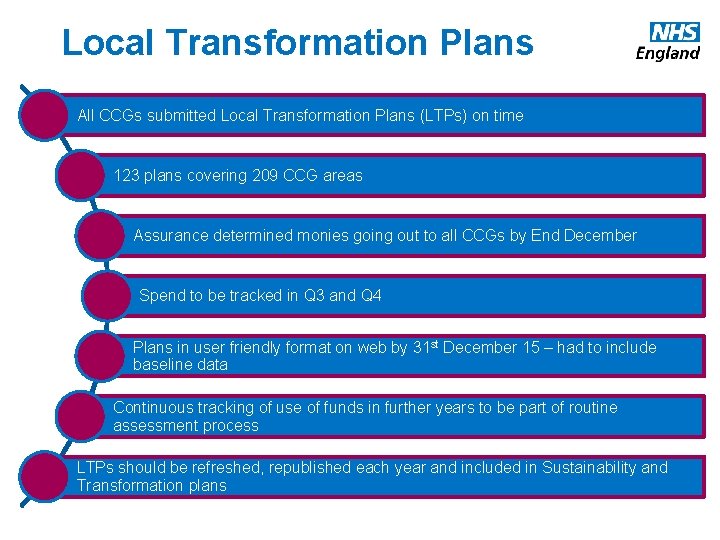
Local Transformation Plans All CCGs submitted Local Transformation Plans (LTPs) on time 123 plans covering 209 CCG areas Assurance determined monies going out to all CCGs by End December Spend to be tracked in Q 3 and Q 4 Plans in user friendly format on web by 31 st December 15 – had to include baseline data Continuous tracking of use of funds in further years to be part of routine assessment process LTPs should be refreshed, republished each year and included in Sustainability and Transformation plans www. england. nhs. uk
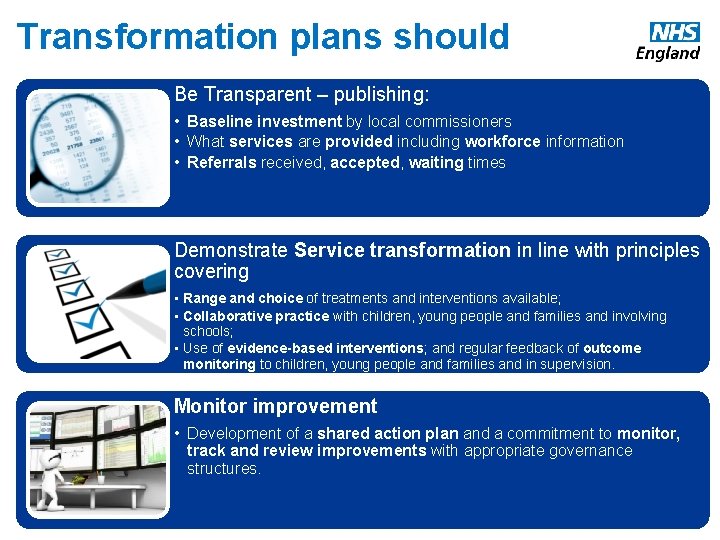
Transformation plans should Be Transparent – publishing: • Baseline investment by local commissioners • What services are provided including workforce information • Referrals received, accepted, waiting times Demonstrate Service transformation in line with principles covering • Range and choice of treatments and interventions available; • Collaborative practice with children, young people and families and involving schools; • Use of evidence-based interventions; and regular feedback of outcome monitoring to children, young people and families and in supervision. Monitor improvement • Development of a shared action plan and a commitment to monitor, track and review improvements with appropriate governance structures. www. england. nhs. uk
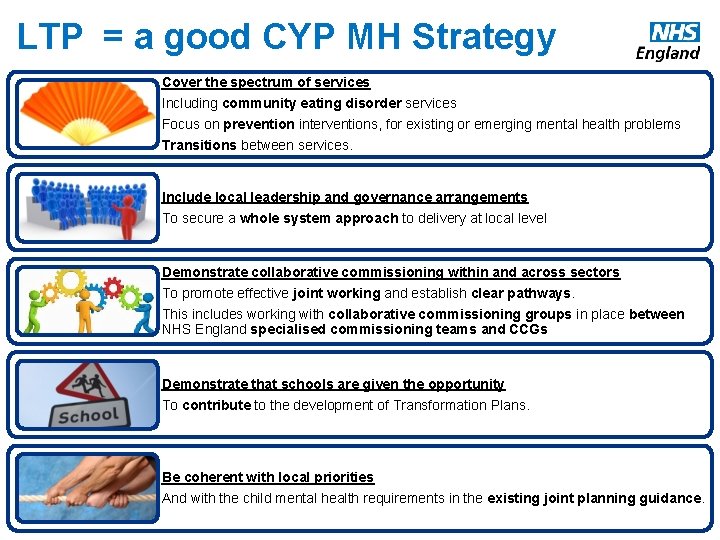
LTP = a good CYP MH Strategy Cover the spectrum of services Including community eating disorder services Focus on prevention interventions, for existing or emerging mental health problems Transitions between services. Include local leadership and governance arrangements To secure a whole system approach to delivery at local level Demonstrate collaborative commissioning within and across sectors To promote effective joint working and establish clear pathways. This includes working with collaborative commissioning groups in place between NHS England specialised commissioning teams and CCGs Demonstrate that schools are given the opportunity To contribute to the development of Transformation Plans. Be coherent with local priorities And with the child mental health requirements in the existing joint planning guidance. www. england. nhs. uk
Things to celebrate from the LTPs Complete focus from many local areas with clear leadership Joined up approach Understanding of importance of EBP and authentic participation Focus of strategic players supporting local areas Raised profile of CYP MH locally and nationally Creative ideas and energy www. england. nhs. uk
Key challenges for us all Workforce planning and capacity - across all sectors Variable leadership, commissioning and collaboration Joint commissioning – how rather than why IT planning - need to comply with requirements to be able to flow data and use outcomes in the room www. england. nhs. uk Anxiety about spending the money in the best possible way
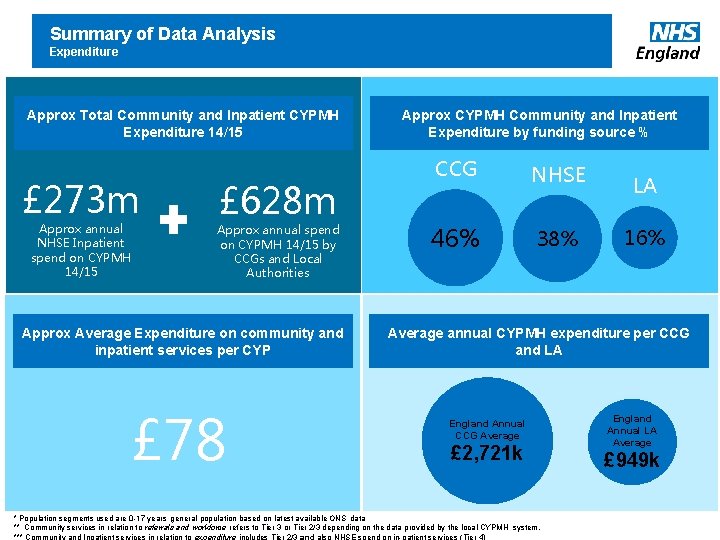
Summary of Data Analysis Expenditure Approx Total Community and Inpatient CYPMH Expenditure 14/15 £ 273 m Approx annual NHSE Inpatient spend on CYPMH 14/15 £ 628 m Approx annual spend on CYPMH 14/15 by CCGs and Local Authorities Approx Average Expenditure on community and inpatient services per CYP £ 78 Approx CYPMH Community and Inpatient Expenditure by funding source % CCG NHSE 46% 38% LA 16% Average annual CYPMH expenditure per CCG and LA England Annual CCG Average £ 2, 721 k www. england. nhs. uk * Population segments used are 0 -17 years general population based on latest available ONS data ** Community services in relation to referrals and workforce refers to Tier 3 or Tier 2/3 depending on the data provided by the local CYPMH system. England Annual LA Average £ 949 k
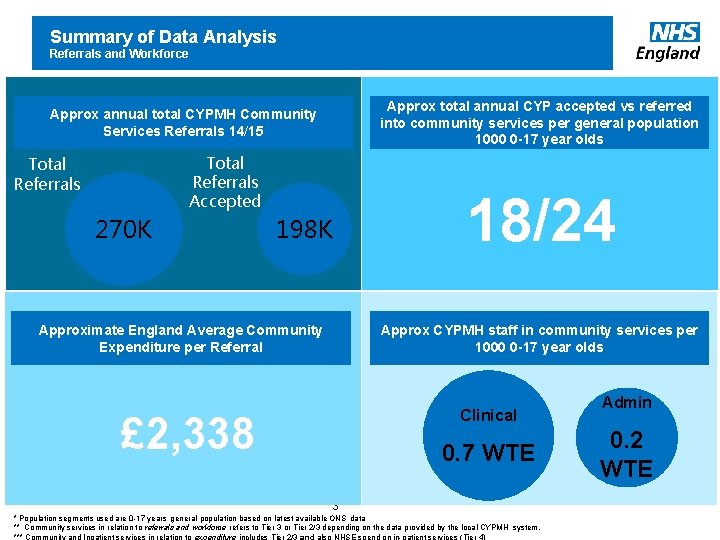
Summary of Data Analysis Referrals and Workforce Approx total annual CYP accepted vs referred into community services per general population 1000 0 -17 year olds Approx annual total CYPMH Community Services Referrals 14/15 Total Referrals Accepted Total Referrals 270 K 198 K Approximate England Average Community Expenditure per Referral 18/24 Approx CYPMH staff in community services per 1000 0 -17 year olds Clinical £ 2, 338 0. 7 WTE 1 3 www. england. nhs. uk * Population segments used are 0 -17 years general population based on latest available ONS data ** Community services in relation to referrals and workforce refers to Tier 3 or Tier 2/3 depending on the data provided by the local CYPMH system. Admin 0. 2 WTE
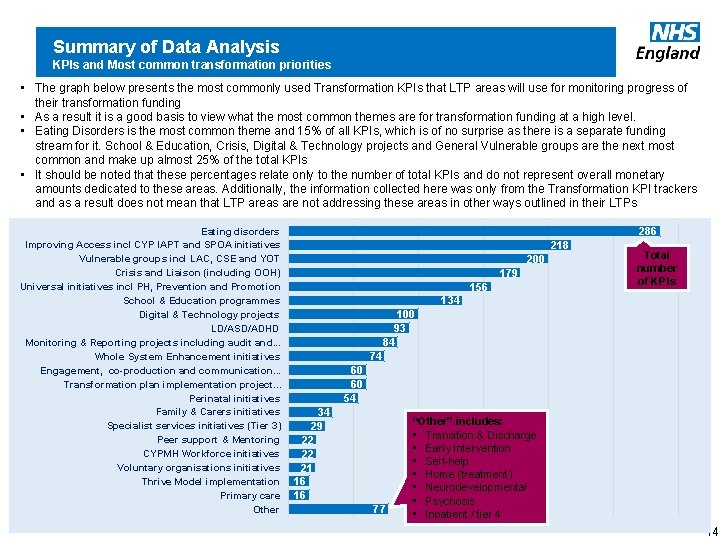
Summary of Data Analysis KPIs and Most common transformation priorities • The graph below presents the most commonly used Transformation KPIs that LTP areas will use for monitoring progress of their transformation funding • As a result it is a good basis to view what the most common themes are for transformation funding at a high level. • Eating Disorders is the most common theme and 15% of all KPIs, which is of no surprise as there is a separate funding stream for it. School & Education, Crisis, Digital & Technology projects and General Vulnerable groups are the next most common and make up almost 25% of the total KPIs • It should be noted that these percentages relate only to the number of total KPIs and do not represent overall monetary amounts dedicated to these areas. Additionally, the information collected here was only from the Transformation KPI trackers and as a result does not mean that LTP areas are not addressing these areas in other ways outlined in their LTPs Eating disorders Improving Access incl CYP IAPT and SPOA initiatives Vulnerable groups incl LAC, CSE and YOT Crisis and Liaison (including OOH) Universal initiatives incl PH, Prevention and Promotion School & Education programmes Digital & Technology projects LD/ASD/ADHD Monitoring & Reporting projects including audit and. . . Whole System Enhancement initiatives Engagement, co-production and communication. . . Transformation plan implementation project. . . Perinatal initiatives Family & Carers initiatives Specialist services initiatives (Tier 3) Peer support & Mentoring CYPMH Workforce initiatives Voluntary organisations initiatives Thrive Model implementation Primary care Other www. england. nhs. uk 286 218 200 179 156 Total number of KPIs 134 100 93 84 74 60 60 54 34 29 22 22 21 16 16 77 “Other” includes: • Transition & Discharge • Early Intervention • Self-help • Home (treatment) • Neurodevelopmental • Psychosis • Inpatient / tier 4 14
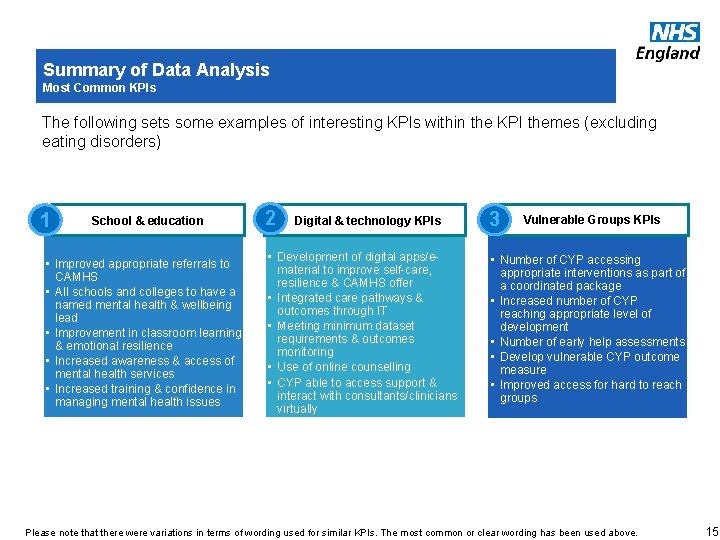
Summary of Data Analysis Most Common KPIs The following sets some examples of interesting KPIs within the KPI themes (excluding eating disorders) 1 School & education • Improved appropriate referrals to CAMHS • All schools and colleges to have a named mental health & wellbeing lead • Improvement in classroom learning & emotional resilience • Increased awareness & access of mental health services • Increased training & confidence in managing mental health issues 2 Digital & technology KPIs • Development of digital apps/ematerial to improve self-care, resilience & CAMHS offer • Integrated care pathways & outcomes through IT • Meeting minimum dataset requirements & outcomes monitoring • Use of online counselling • CYP able to access support & interact with consultants/clinicians virtually 3 Vulnerable Groups KPIs • Number of CYP accessing appropriate interventions as part of a coordinated package • Increased number of CYP reaching appropriate level of development • Number of early help assessments • Develop vulnerable CYP outcome measure • Improved access for hard to reach groups www. england. nhs. uk Please note that there were variations in terms of wording used for similar KPIs. The most common or clear wording has been used above. 15
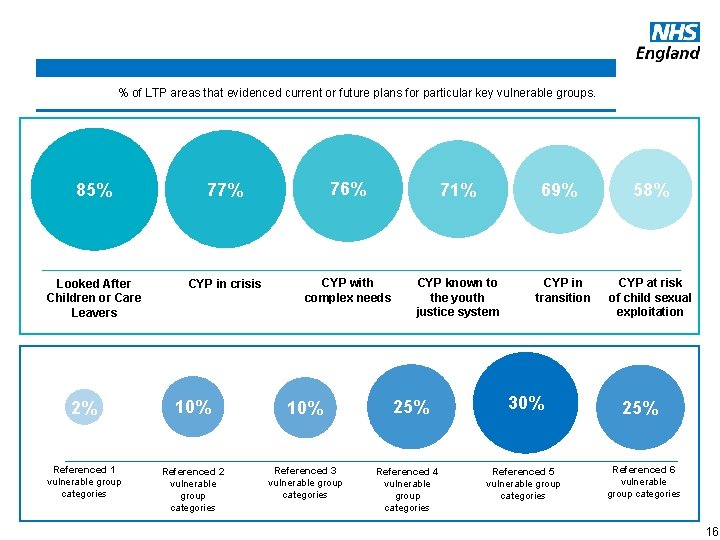
Vulnerable Summary Keyor. Facts % of. Groups LTP areas that evidenced current future plans for particular key vulnerable groups. 85% 77% 76% 71% Looked After Children or Care Leavers CYP in crisis CYP with complex needs CYP known to the youth justice system 2% 10% Referenced 1 vulnerable group categories Referenced 2 vulnerable group categories Referenced 3 vulnerable group categories www. england. nhs. uk 25% Referenced 4 vulnerable group categories 69% CYP in transition 30% Referenced 5 vulnerable group categories 58% CYP at risk of child sexual exploitation 25% Referenced 6 vulnerable group categories 16
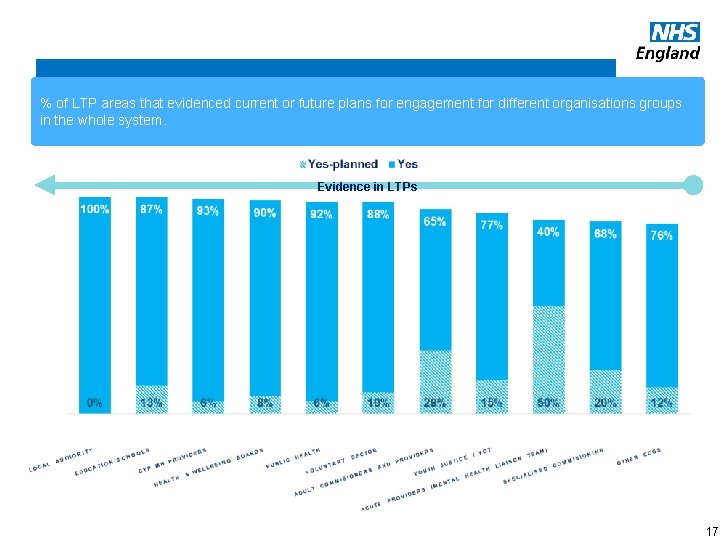
Whole Systems Summary Key Facts % of LTP areas that evidenced current or future plans for engagement for different organisations groups in the whole system. Evidence in LTPs www. england. nhs. uk 17
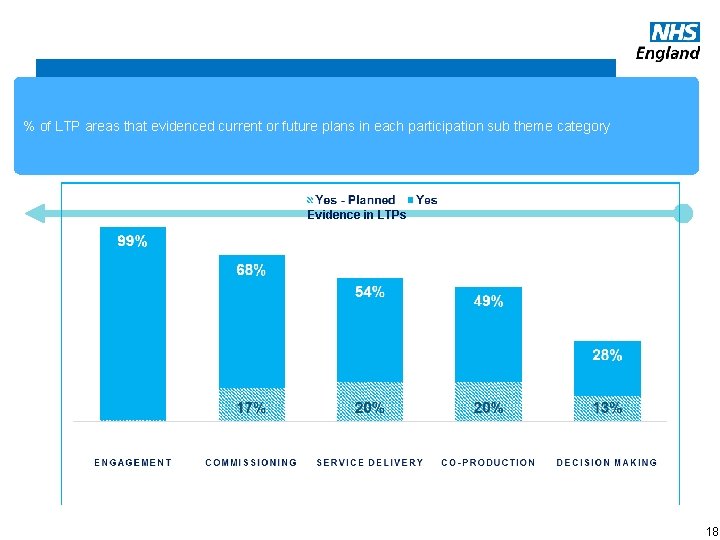
CYP Participation Summary Key Facts % of LTP areas that evidenced current or future plans in each participation sub theme category Evidence in LTPs www. england. nhs. uk 18
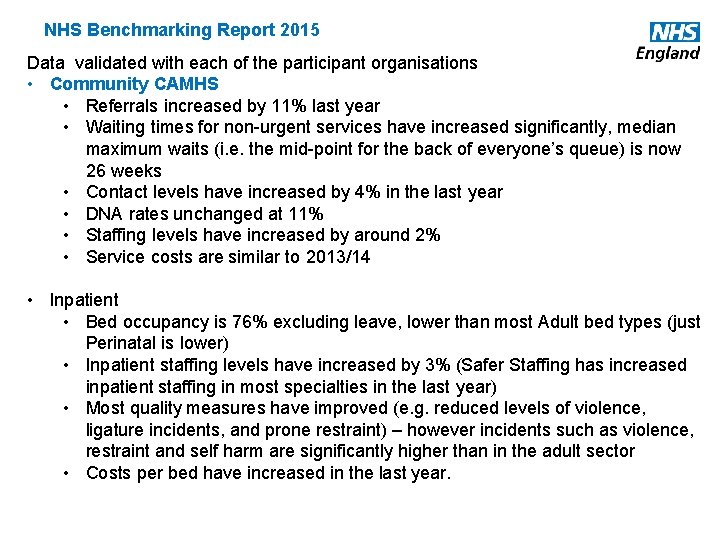
NHS Benchmarking Report 2015 Data validated with each of the participant organisations • Community CAMHS • Referrals increased by 11% last year • Waiting times for non-urgent services have increased significantly, median maximum waits (i. e. the mid-point for the back of everyone’s queue) is now 26 weeks • Contact levels have increased by 4% in the last year • DNA rates unchanged at 11% • Staffing levels have increased by around 2% • Service costs are similar to 2013/14 • Inpatient • Bed occupancy is 76% excluding leave, lower than most Adult bed types (just Perinatal is lower) • Inpatient staffing levels have increased by 3% (Safer Staffing has increased inpatient staffing in most specialties in the last year) • Most quality measures have improved (e. g. reduced levels of violence, ligature incidents, and prone restraint) – however incidents such as violence, restraint and self harm are significantly higher than in the adult sector • Costs per bed have increased in the last year. www. england. nhs. uk
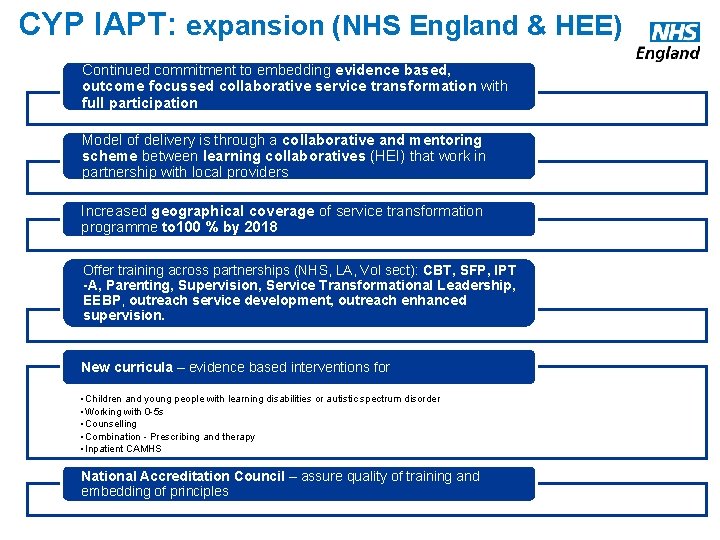
CYP IAPT: expansion (NHS England & HEE) Continued commitment to embedding evidence based, outcome focussed collaborative service transformation with full participation Model of delivery is through a collaborative and mentoring scheme between learning collaboratives (HEI) that work in partnership with local providers Increased geographical coverage of service transformation programme to 100 % by 2018 Offer training across partnerships (NHS, LA, Vol sect): CBT, SFP, IPT -A, Parenting, Supervision, Service Transformational Leadership, EEBP, outreach service development, outreach enhanced supervision. New curricula – evidence based interventions for • Children and young people with learning disabilities or autistic spectrum disorder • Working with 0 -5 s • Counselling • Combination - Prescribing and therapy • Inpatient CAMHS National Accreditation Council – assure quality of training and embedding of principles www. england. nhs. uk
CYP IAPT Partnerships Map Following recruitment of 6 th collaborative, programme on target to work with services covering 80% of 0 -19 population by March 2016. This goes up to 87% when including ‘light touch’ outreach and service leadership work to prepare partnerships for full modality training www. england. nhs. uk
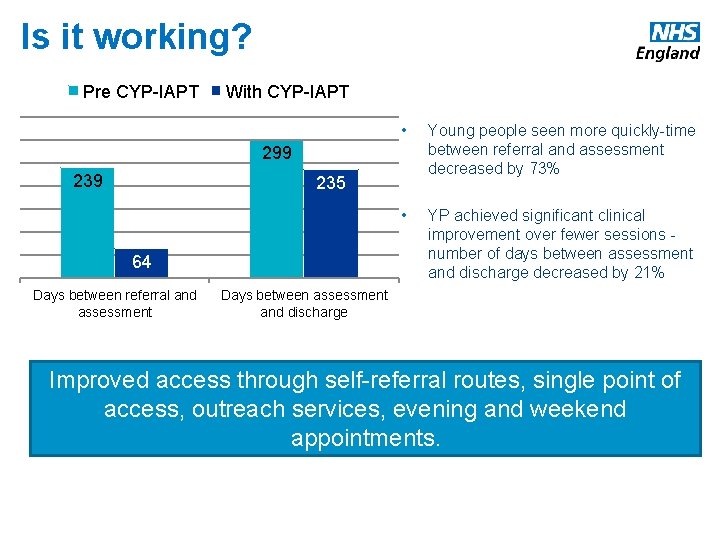
Is it working? Pre CYP-IAPT With CYP-IAPT • Young people seen more quickly-time between referral and assessment decreased by 73% • YP achieved significant clinical improvement over fewer sessions number of days between assessment and discharge decreased by 21% 299 235 64 Days between referral and assessment Days between assessment and discharge Improved access through self-referral routes, single point of access, outreach services, evening and weekend appointments. www. england. nhs. uk
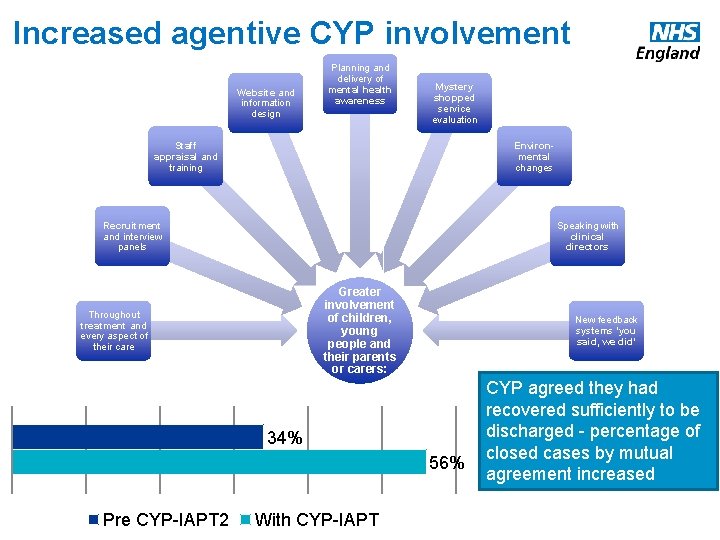
Increased agentive CYP involvement Website and information design Planning and delivery of mental health awareness Mystery shopped service evaluation Staff appraisal and training Environmental changes Recruitment and interview panels Speaking with clinical directors Greater involvement of children, young people and their parents or carers: Throughout treatment and every aspect of their care New feedback systems ‘you said, we did’ 34% 56% www. england. nhs. uk Pre CYP-IAPT 2 With CYP-IAPT CYP agreed they had recovered sufficiently to be discharged - percentage of closed cases by mutual agreement increased
CYP and parent/carer engagement • Young People’s Health Select Committee Report launched November http: //www. parliament. uk/business/news/2015/november/yout h-select-committee-report/ Proposals include - parity of funding, joined up system, statutory level of attainment for MH in schools, training for teachers and GPs as well as MH workforce focused work cyberbullying and exam stress • Time to Change anti stigma campaign www. time-to-change. org. uk www. england. nhs. uk
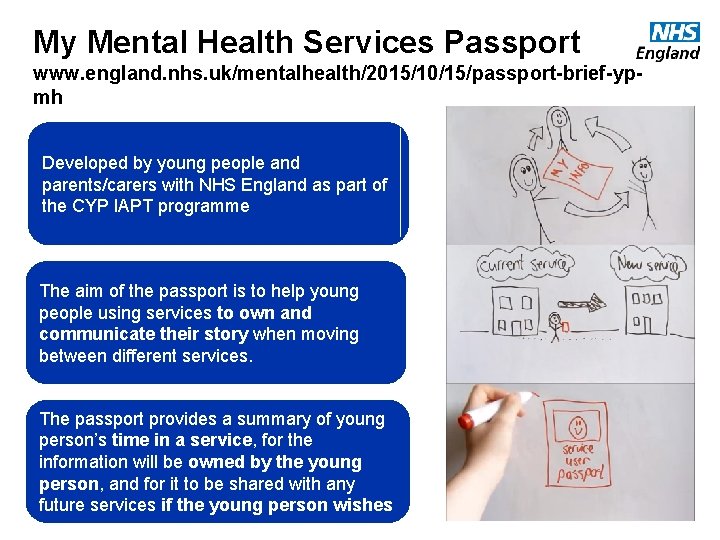
My Mental Health Services Passport www. england. nhs. uk/mentalhealth/2015/10/15/passport-brief-ypmh Developed by young people and parents/carers with NHS England as part of the CYP IAPT programme The aim of the passport is to help young people using services to own and communicate their story when moving between different services. The passport provides a summary of young person’s time in a service, for the information will be owned by the young person, and for it to be shared with any future services if the young person wishes www. england. nhs. uk
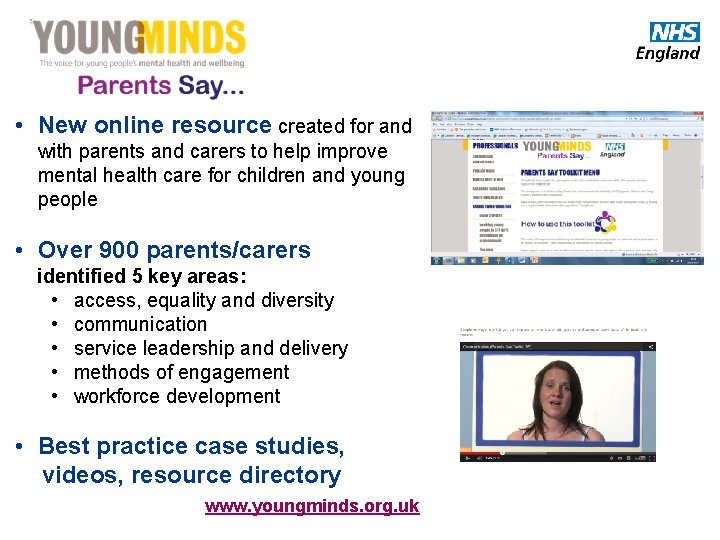
• New online resource created for and with parents and carers to help improve mental health care for children and young people • Over 900 parents/carers identified 5 key areas: • access, equality and diversity • communication • service leadership and delivery • methods of engagement • workforce development • Best practice case studies, videos, resource directory www. england. nhs. uk www. youngminds. org. uk
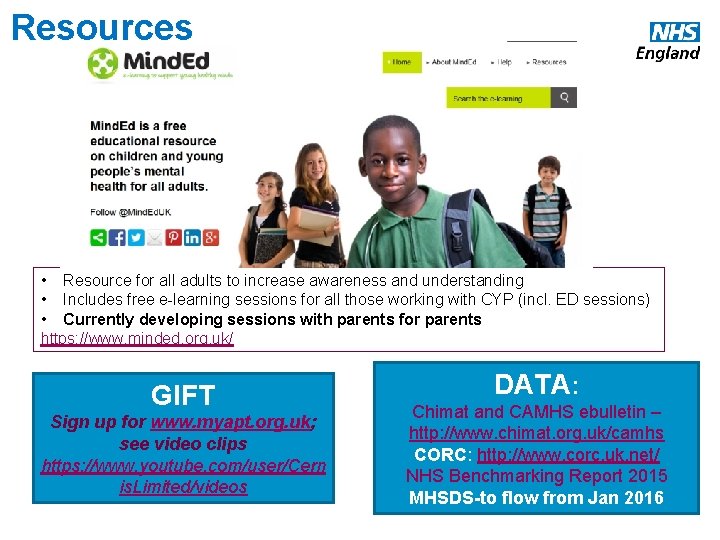
Resources • Resource for all adults to increase awareness and understanding • Includes free e-learning sessions for all those working with CYP (incl. ED sessions) • Currently developing sessions with parents for parents https: //www. minded. org. uk/ GIFT Sign up for www. myapt. org. uk; see video clips https: //www. youtube. com/user/Cern is. Limited/videos www. england. nhs. uk DATA: Chimat and CAMHS ebulletin – http: //www. chimat. org. uk/camhs CORC: http: //www. corc. uk. net/ NHS Benchmarking Report 2015 MHSDS-to flow from Jan 2016
At the National Level • DH chaired system oversight board – PHE, HEE, LGA, ADCS, Df. E, NHS E, CQC , ADPH • Cross cutting board aims to • develop effective system wide governance arrangements to support and sustain local transformation of mental health services for children and young people. • support work that either requires or receives significant benefit from joint approach • information sharing www. england. nhs. uk
System wide subgroups • Data and Outcomes • National metrics, MHMDS, data sharing • Joint work on vulnerable children • Operational group • Vulnerable children • Prevention and Early Intervention • Workforce www. england. nhs. uk
Data update • MHMDS first reports from CYP MH published • ALL MH services commissioned by NHS flow data – we need to assist 3 rd sector • Prevalence Survey commissioned to report by 2018 • Research by Df. E into MH spend in schools • Further work by NHSE on Programme Funds • Plan to test currencies next year www. england. nhs. uk
Other work streams in NHS England • Tier 4 procurement and further improvements to access beds in a timely fashion – new models of care • Transforming Care - Case managers to support CTRs and EHC plan • Df. E shared pilot schools link : 22 sites, 255 schools • Further support for Health and Justice commissioning and liaison and diversion • Eating Disorders - work on training specification for whole team training • Crisis and urgent care – joining whole life groups • Generic pathway standards www. england. nhs. uk
Direct support for commissioners • • System Dynamic model - final version Scope Commissioning support training Refresh specifications published last year Deliver new specification for Eating Disorders based on guidance • Each access and waiting time standard will include commissioner guidelines www. england. nhs. uk
www. england. nhs. uk