
One Winged Butterflies ModeSelection For Azimuthal Magnetorotational Instability
One Winged Butterflies: Mode-Selection For Azimuthal Magnetorotational Instability By Thermal Convection Ashish Mishra Co-authors: G. Mamatsashvili, M. Seilmayer, F. Stefani 16 th June 2020 Ashish Mishra I Institute of Fluid Dynamics I www. hzdr. de
Introduction Magnetorotational Instability (MRI) is one of the most efficient mechanism to transport angular momentum in differentially rotating flows, ranging from Taylor-Couette flow in lab to astrophysical accretion disks It was originally discovered by Velikhov (1959) and Chandrashekhar (1960) in the context of magnetized Taylor. Couette (TC) flow. Implications and significance of MRI to accretion disks was studied by Balbus & Hawley (1991). However, for high resistivity, or very small magnetic Prandtl numbers, which are found in disks and in the lab, standard (i. e. , with a pure vertical field) MRI does not survive ! Page 2 Member of the Helmholtz Association Ashish Mishra I Institute of Fluid Dynamics I www. hzdr. de
Variants of standard MRI at small Pm << 1 Hollerbach and Rudiger (2005) suggested to apply azimuthal magnetic field together with vertical magnetic field producing helical MRI (HMRI) HMRI was first detected in the PROMISE experiment (Stefani et. al. , 2006, 2009). Hollerbach, Teeluck and Rüdiger (2010) found yet another new version of MRI at small Pm<<1 for a purely azimuthal magnetic field labelled Azimuthal MRI (AMRI). The existence of AMRI was also first verified in the PROMISE facility (Seilmayer et. al. , 2014) Page 3 Member of the Helmholtz Association Ashish Mishra I Institute of Fluid Dynamics I www. hzdr. de
AMRI+Convection Recent PROMISE experiments (Seilmayer et al. 2020) demonstrated that different temperatures at the inner and outer cylinders can give rise to convective circulations in the device, which can significantly affect the properties of AMRI and its experimental manifestations Main Goals To understand characterize how AMRI is modified by radial temperature gradient, using the linear stability analysis of the TC flow with added convective vertical velocity. To compare the results of experiments in the improved PROMISE setup and theoretical results. Page 4 Member of the Helmholtz Association Ashish Mishra I Institute of Fluid Dynamics I www. hzdr. de
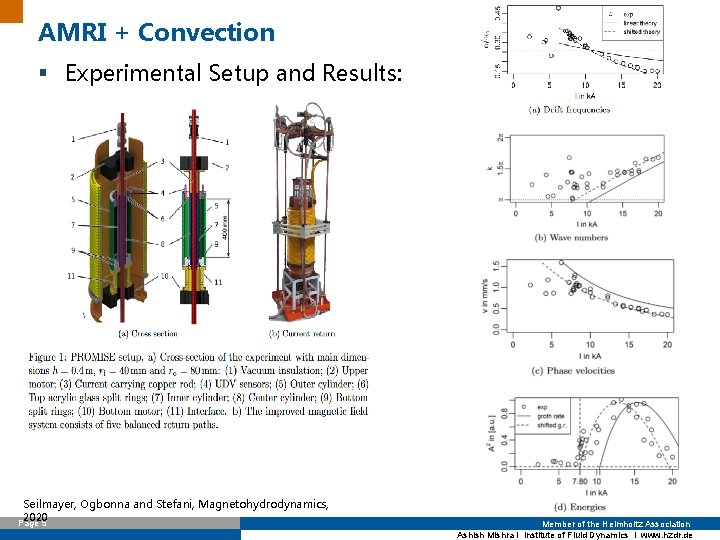
AMRI + Convection Experimental Setup and Results: Seilmayer, Ogbonna and Stefani, Magnetohydrodynamics, 2020 Page 5 Member of the Helmholtz Association Ashish Mishra I Institute of Fluid Dynamics I www. hzdr. de
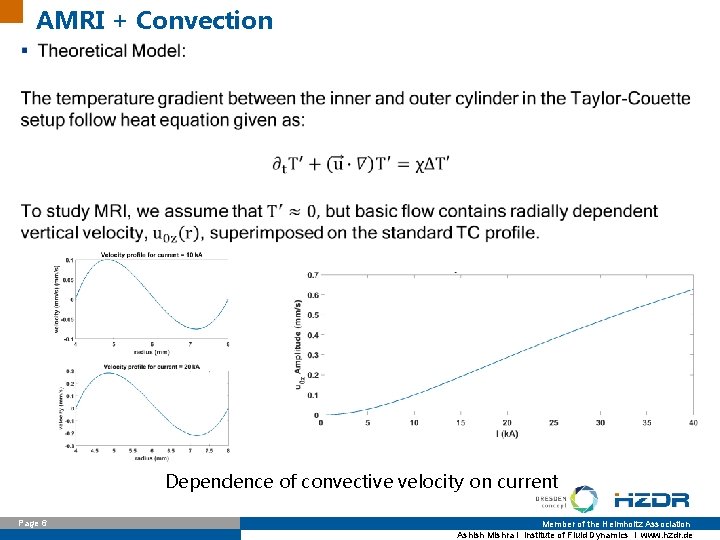
AMRI + Convection Dependence of convective velocity on current Page 6 Member of the Helmholtz Association Ashish Mishra I Institute of Fluid Dynamics I www. hzdr. de
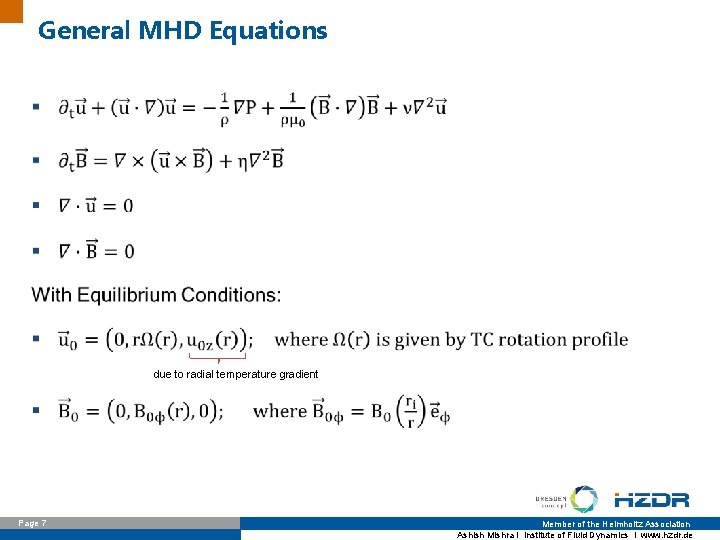
General MHD Equations due to radial temperature gradient Page 7 Member of the Helmholtz Association Ashish Mishra I Institute of Fluid Dynamics I www. hzdr. de
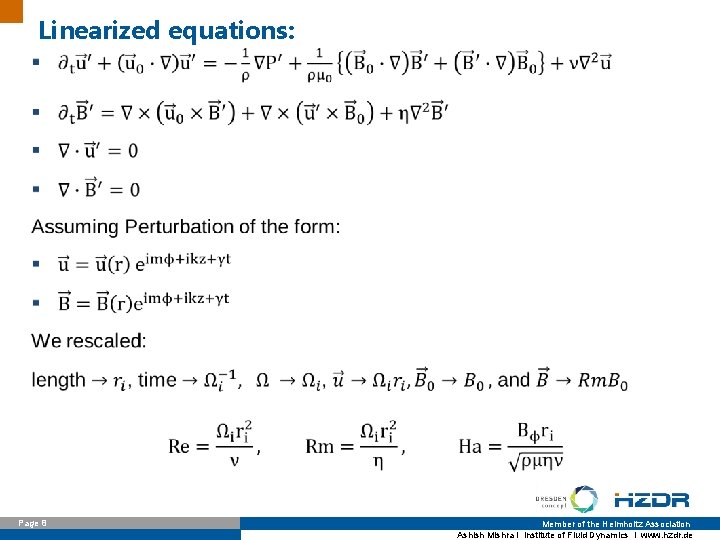
Linearized equations: Page 8 Member of the Helmholtz Association Ashish Mishra I Institute of Fluid Dynamics I www. hzdr. de
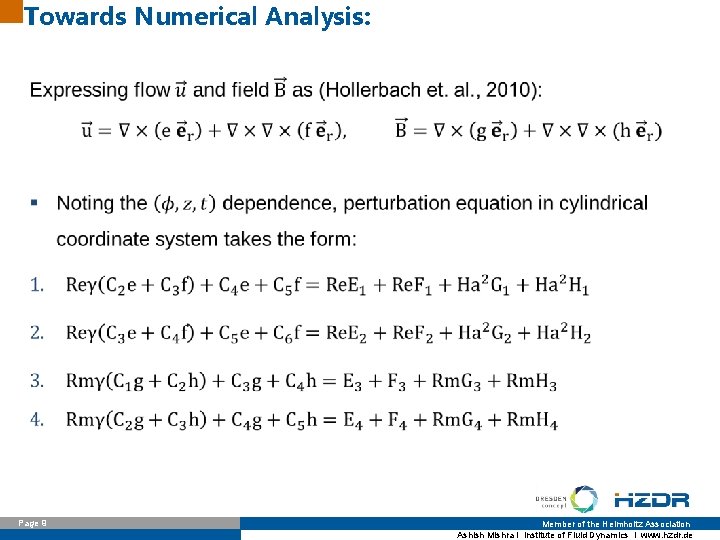
Towards Numerical Analysis: Page 9 Member of the Helmholtz Association Ashish Mishra I Institute of Fluid Dynamics I www. hzdr. de
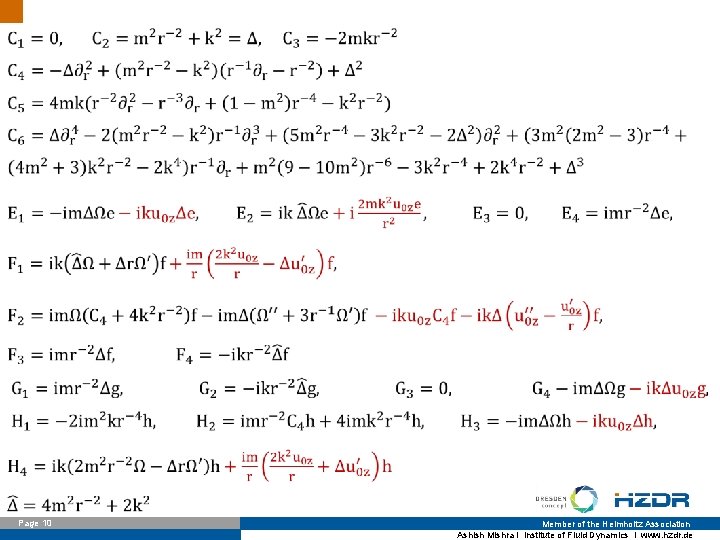
Page 10 Member of the Helmholtz Association Ashish Mishra I Institute of Fluid Dynamics I www. hzdr. de
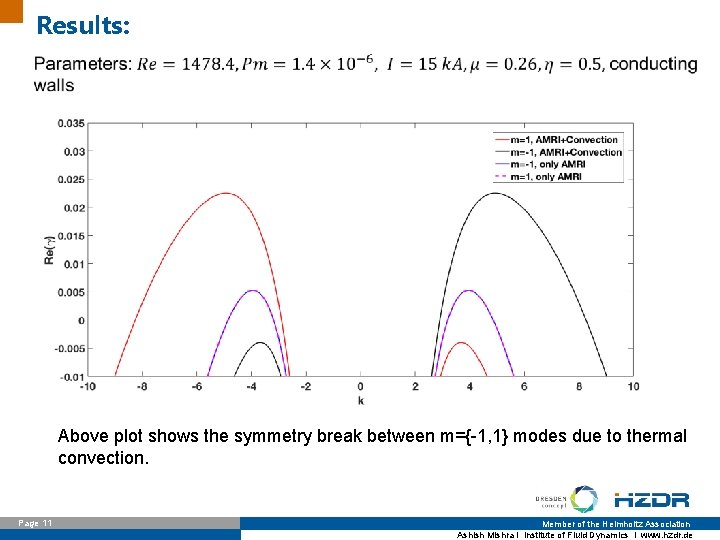
Results: Above plot shows the symmetry break between m={-1, 1} modes due to thermal convection. Page 11 Member of the Helmholtz Association Ashish Mishra I Institute of Fluid Dynamics I www. hzdr. de
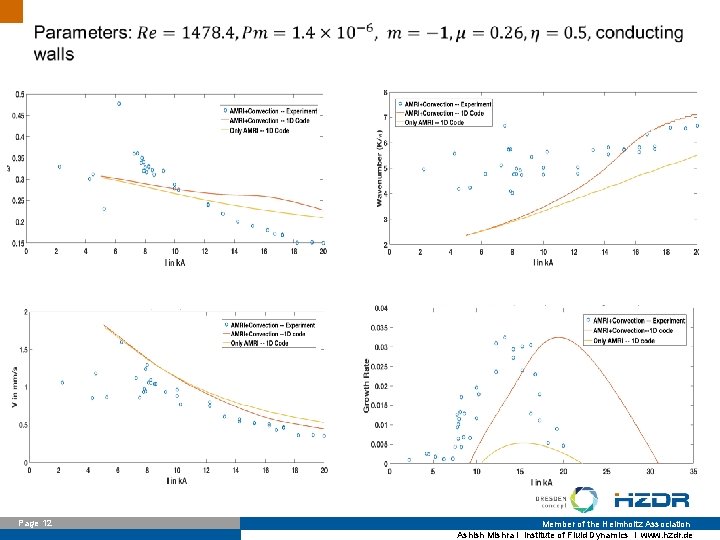
Page 12 Member of the Helmholtz Association Ashish Mishra I Institute of Fluid Dynamics I www. hzdr. de
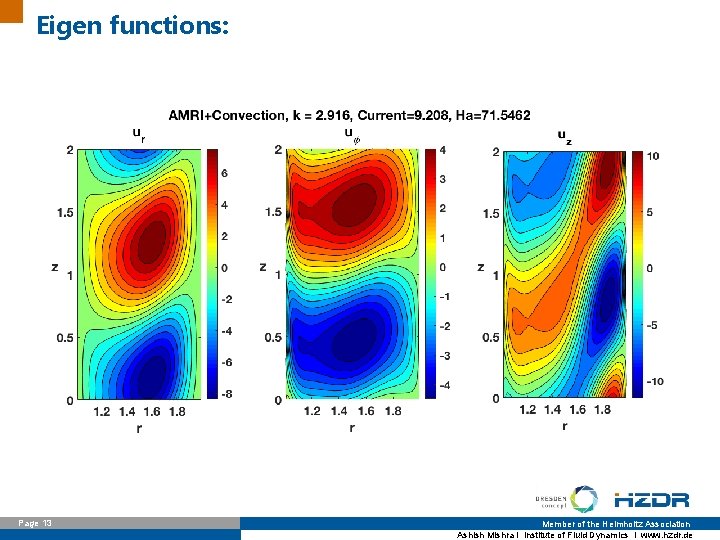
Eigen functions: Page 13 Member of the Helmholtz Association Ashish Mishra I Institute of Fluid Dynamics I www. hzdr. de
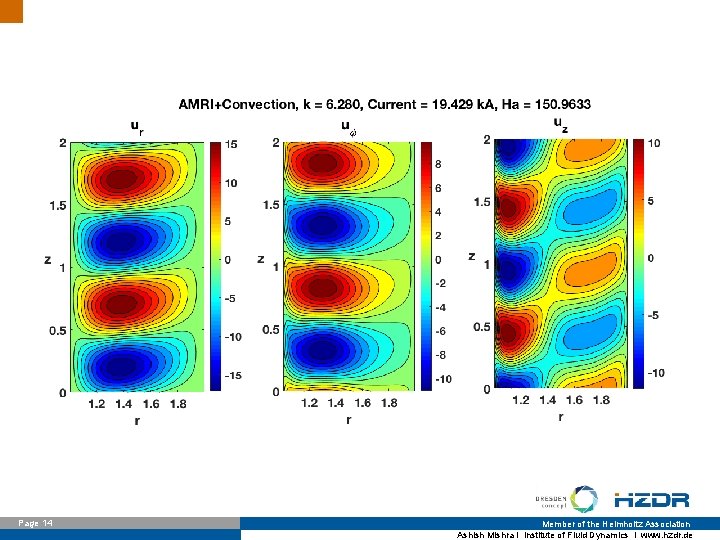
Page 14 Member of the Helmholtz Association Ashish Mishra I Institute of Fluid Dynamics I www. hzdr. de
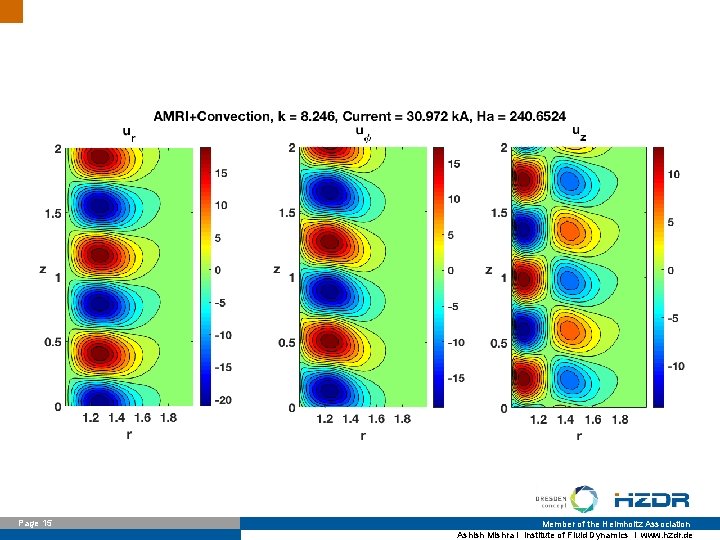
Page 15 Member of the Helmholtz Association Ashish Mishra I Institute of Fluid Dynamics I www. hzdr. de
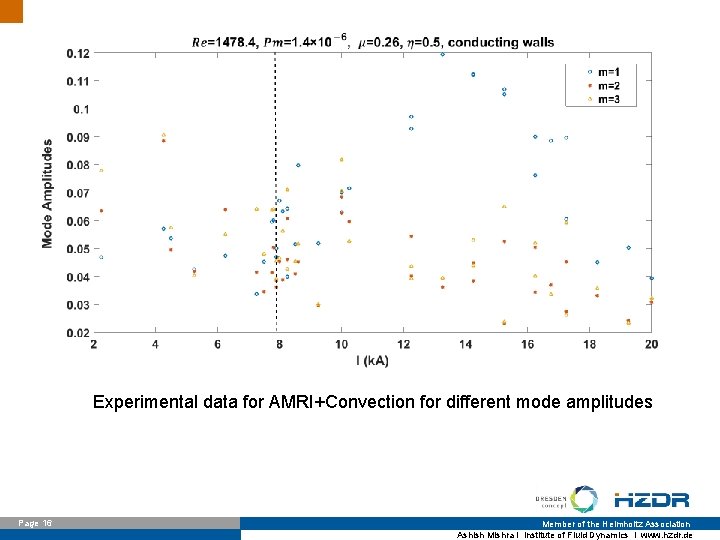
Experimental data for AMRI+Convection for different mode amplitudes Page 16 Member of the Helmholtz Association Ashish Mishra I Institute of Fluid Dynamics I www. hzdr. de
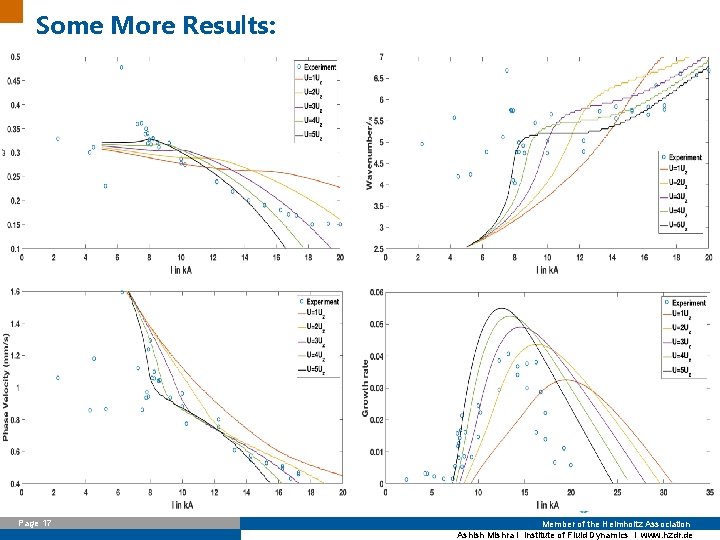
Some More Results: Page 17 Member of the Helmholtz Association Ashish Mishra I Institute of Fluid Dynamics I www. hzdr. de
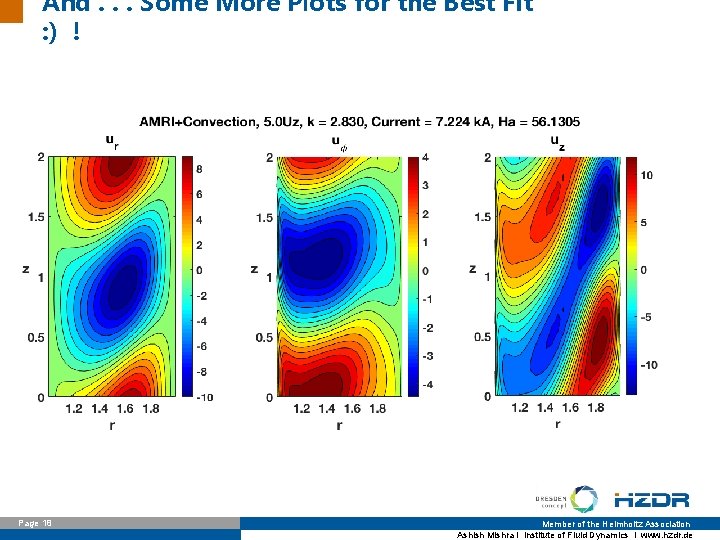
And. . . Some More Plots for the Best Fit : ) ! Page 18 Member of the Helmholtz Association Ashish Mishra I Institute of Fluid Dynamics I www. hzdr. de
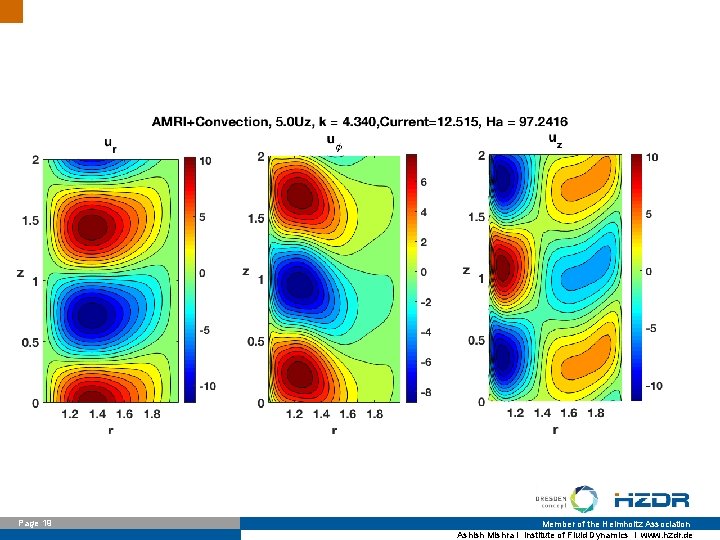
Page 19 Member of the Helmholtz Association Ashish Mishra I Institute of Fluid Dynamics I www. hzdr. de
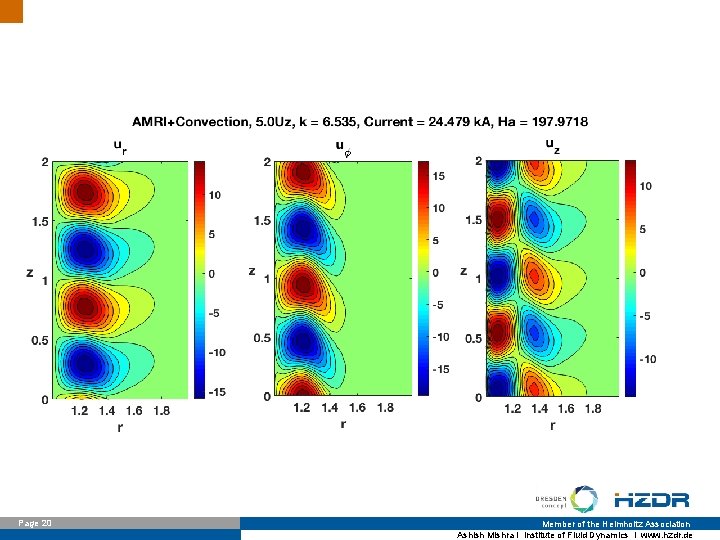
Page 20 Member of the Helmholtz Association Ashish Mishra I Institute of Fluid Dynamics I www. hzdr. de
Conclusion Results form Linear 1 D code are in good qualitative agreement with the experimental results from PROMISE experiment, especially for the phase velocity. More work is required to achieve a better agreement for the wavenumber and frequency. We observed that the vertical convection increases the instability in the system and breaks the symmetry of wave modes (m=-1, 1) along the vertical axis. Vertical velocity profile damps nears the outer radius, making it less sensitive to sensors on the outer cylinder of the PROMISE setup. Thank you for your attention. Page 21 Member of the Helmholtz Association Ashish Mishra I Institute of Fluid Dynamics I www. hzdr. de
- Slides: 21