
One Step Photoemission from Ag111 Siddharth Karkare What
- Slides: 12
One Step Photoemission from Ag(111) - Siddharth Karkare What role does band structure play in photoemission? Can we use conservation of transverse momentum for better emittance? Acknowledgements – Weishi Wan (LBNL) Jun Feng (LBNL) Howard Padmore (LBNL) T. -C. Chiang (UIUC) T. Miller (UIUC) 1 skarkare@lbl. gov
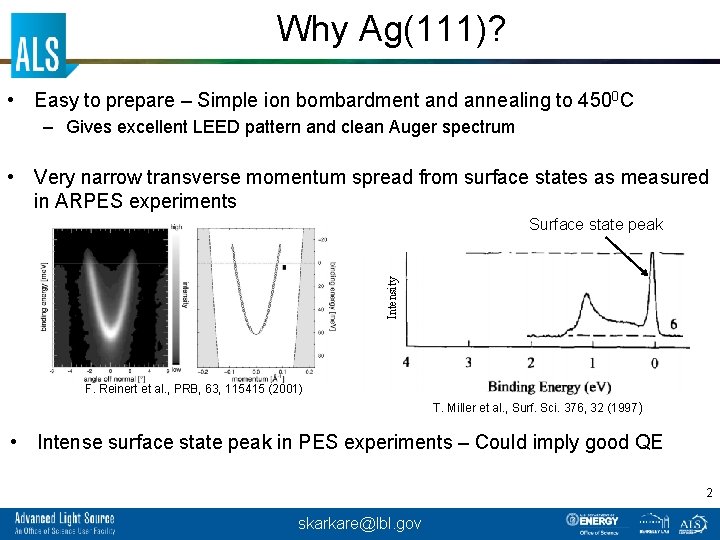
Why Ag(111)? • Easy to prepare – Simple ion bombardment and annealing to 4500 C – Gives excellent LEED pattern and clean Auger spectrum • Very narrow transverse momentum spread from surface states as measured in ARPES experiments Intensity Surface state peak F. Reinert et al. , PRB, 63, 115415 (2001) T. Miller et al. , Surf. Sci. 376, 32 (1997) • Intense surface state peak in PES experiments – Could imply good QE 2 skarkare@lbl. gov
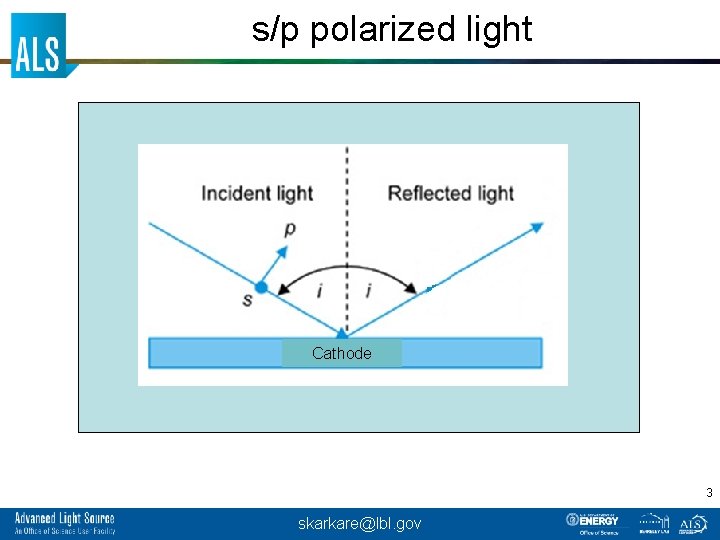
s/p polarized light Cathode 3 skarkare@lbl. gov
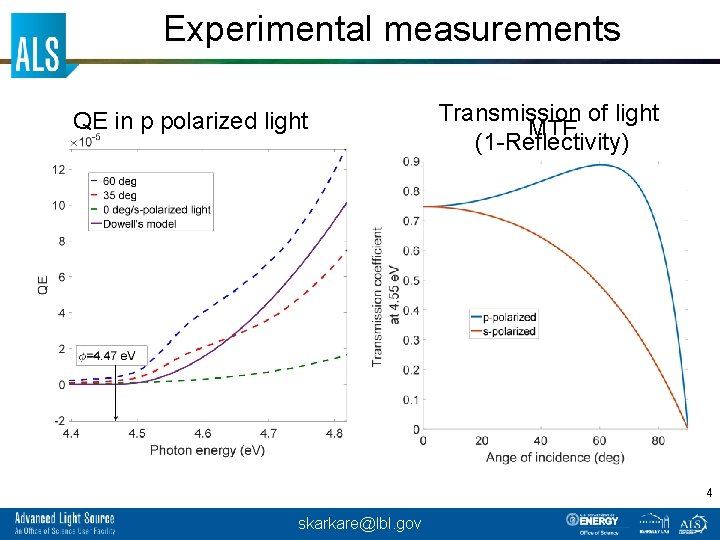
Experimental measurements QE in p polarized light Transmission of light MTE (1 -Reflectivity) 4 skarkare@lbl. gov
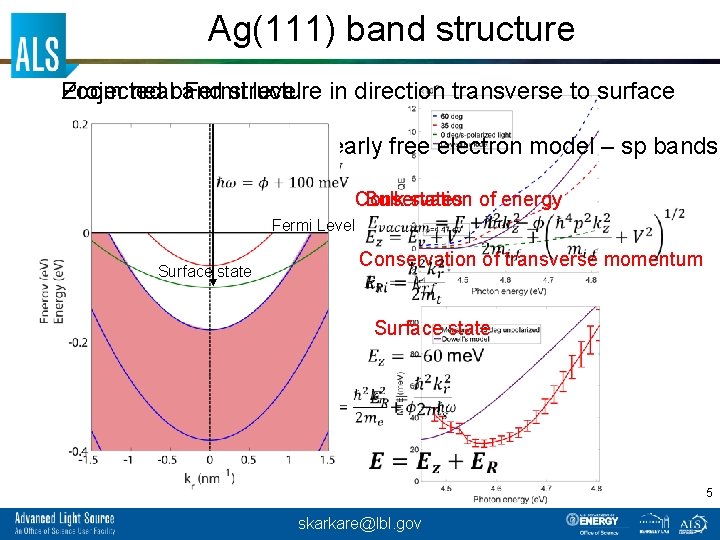
Ag(111) band structure Zoom near Fermi level Projected band structure in direction transverse to surface Nearly free electron model – sp bands Bulk states Vacuum Level Conservation of energy Fermi Level Conservation of transverse momentum Surface state Fermi Level 5 skarkare@lbl. gov
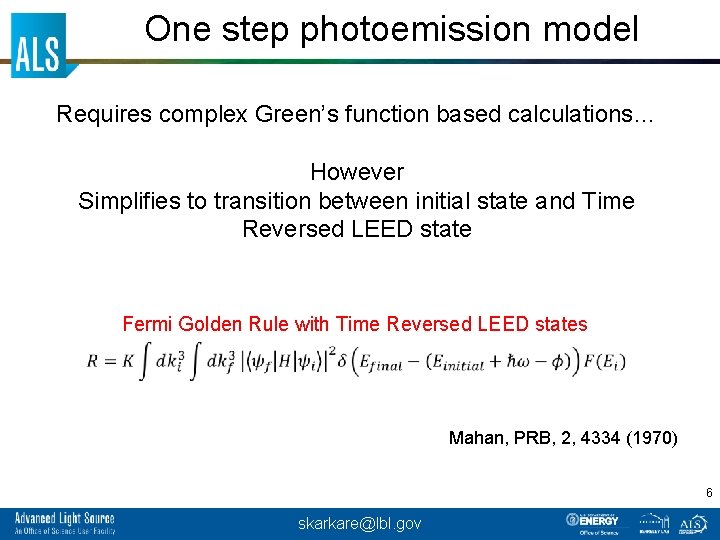
One step photoemission model Requires complex Green’s function based calculations… However Simplifies to transition between initial state and Time Reversed LEED state Fermi Golden Rule with Time Reversed LEED states Mahan, PRB, 2, 4334 (1970) 6 skarkare@lbl. gov
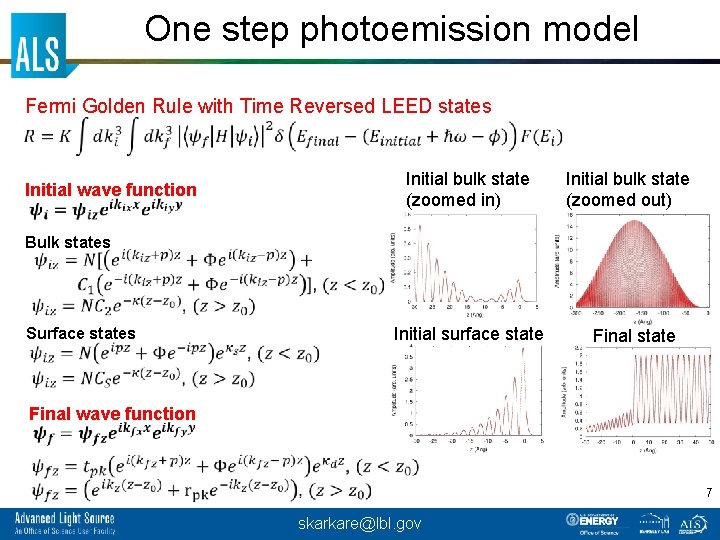
One step photoemission model Fermi Golden Rule with Time Reversed LEED states Initial wave function Initial bulk state (zoomed in) Initial bulk state (zoomed out) Initial surface state Final state Bulk states Surface states Final wave function 7 skarkare@lbl. gov
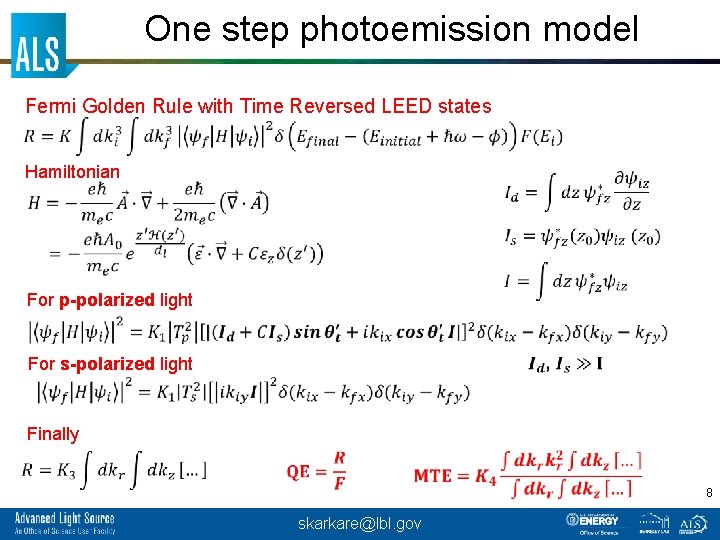
One step photoemission model Fermi Golden Rule with Time Reversed LEED states Hamiltonian For p-polarized light For s-polarized light Finally 8 skarkare@lbl. gov
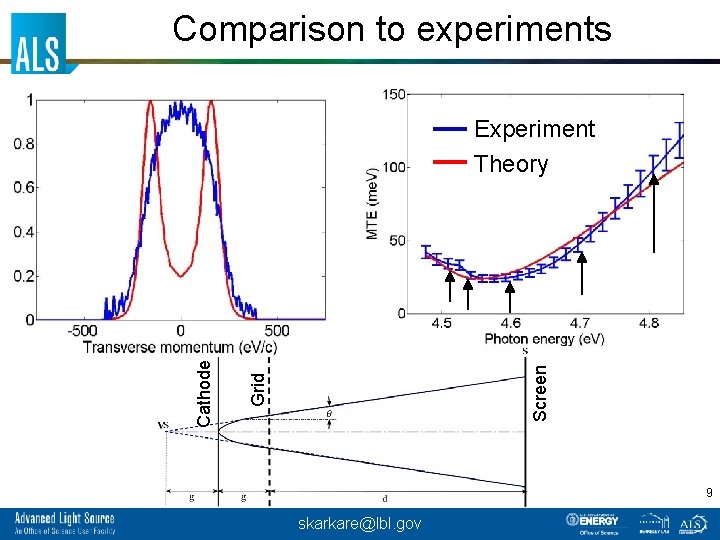
Comparison to experiments Experiment Theory g e d g 0 e 6 d 5 3 Experiment Theory Screen Grid Cathode 0 deg 9 skarkare@lbl. gov
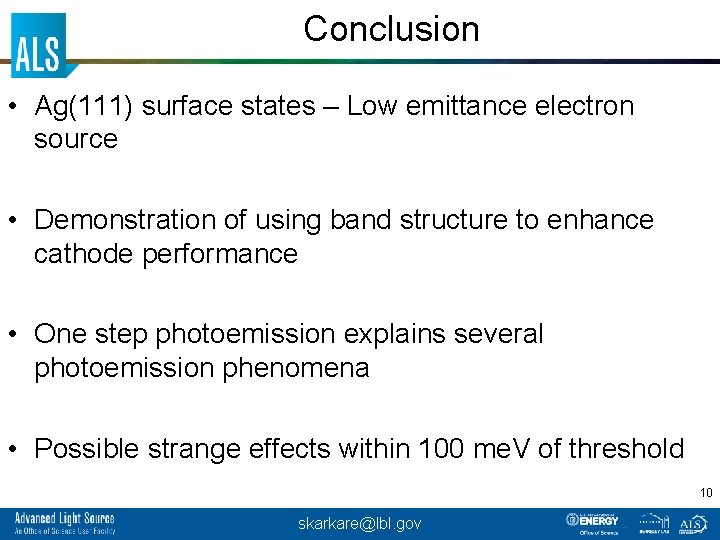
Conclusion • Ag(111) surface states – Low emittance electron source • Demonstration of using band structure to enhance cathode performance • One step photoemission explains several photoemission phenomena • Possible strange effects within 100 me. V of threshold 10 skarkare@lbl. gov
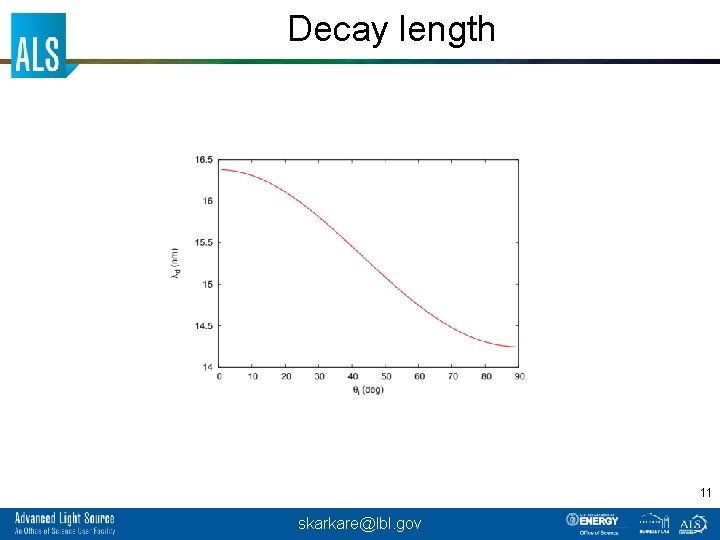
Decay length 11 skarkare@lbl. gov
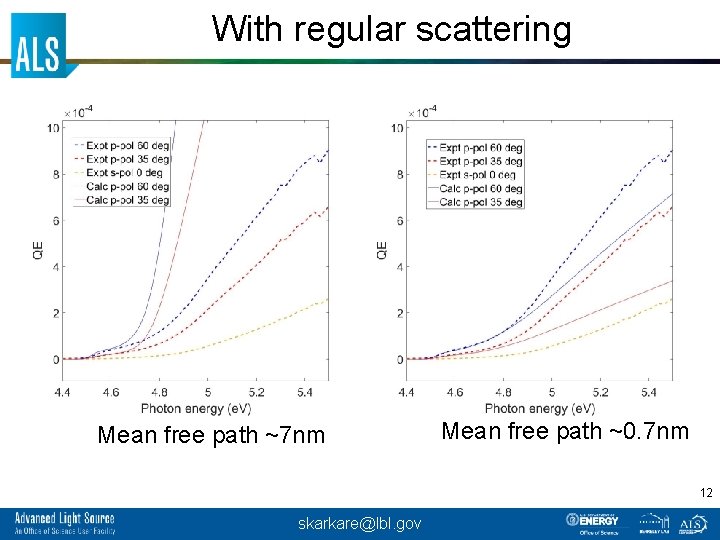
With regular scattering Mean free path ~7 nm Mean free path ~0. 7 nm 12 skarkare@lbl. gov