
ONE Spring HandsOn Institute Network Theory OSI and
- Slides: 43
@ONE Spring Hands-On Institute Network Theory – OSI and TCP/IP Models 1 -1
@ONE Spring Hands-On Institute Internetworking: An Overview 1 -2
@ONE Spring Hands-On Institute What is Networking? • Networking - the interconnection of workstations, peripherals, terminals and other devices* 1 -3
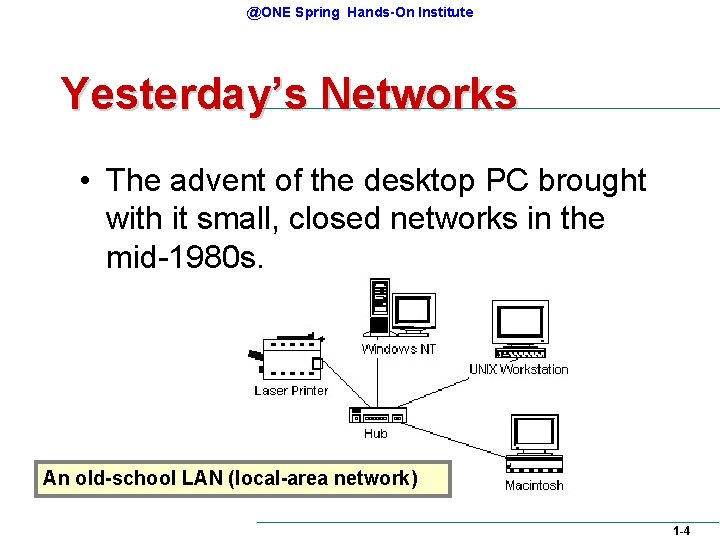
@ONE Spring Hands-On Institute Yesterday’s Networks • The advent of the desktop PC brought with it small, closed networks in the mid-1980 s. An old-school LAN (local-area network) 1 -4
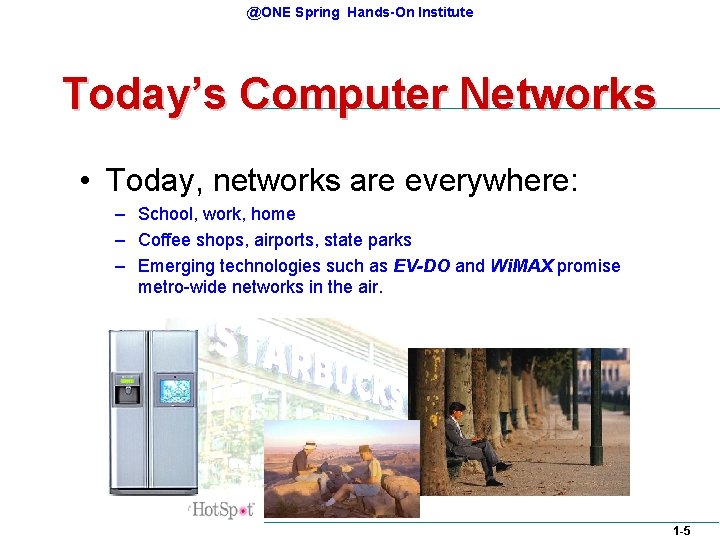
@ONE Spring Hands-On Institute Today’s Computer Networks • Today, networks are everywhere: – School, work, home – Coffee shops, airports, state parks – Emerging technologies such as EV-DO and Wi. MAX promise metro-wide networks in the air. 1 -5
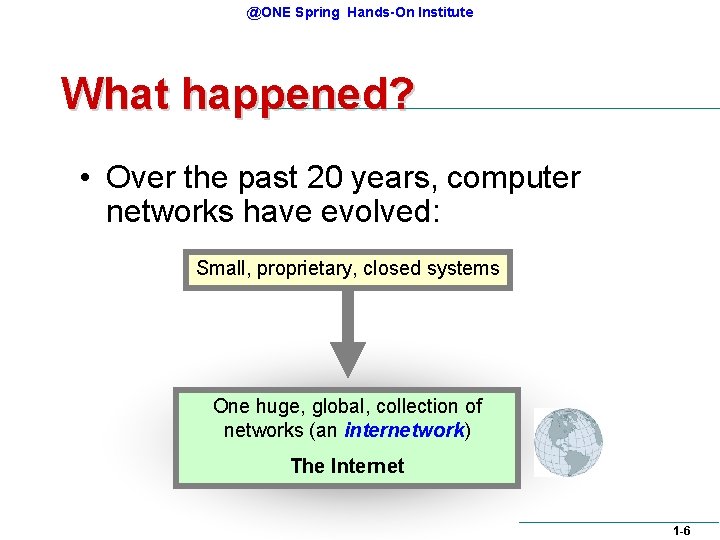
@ONE Spring Hands-On Institute What happened? • Over the past 20 years, computer networks have evolved: Small, proprietary, closed systems One huge, global, collection of networks (an internetwork) The Internet 1 -6
@ONE Spring Hands-On Institute What happened? • Vendors realized that standardizing their products would help them make money. • Various groups got together and proposed networking standards. • The Internet (b. 1969) offered an attractive de facto set of standards. 1 -7
@ONE Spring Hands-On Institute Network Protocols and Standardization 1 -8
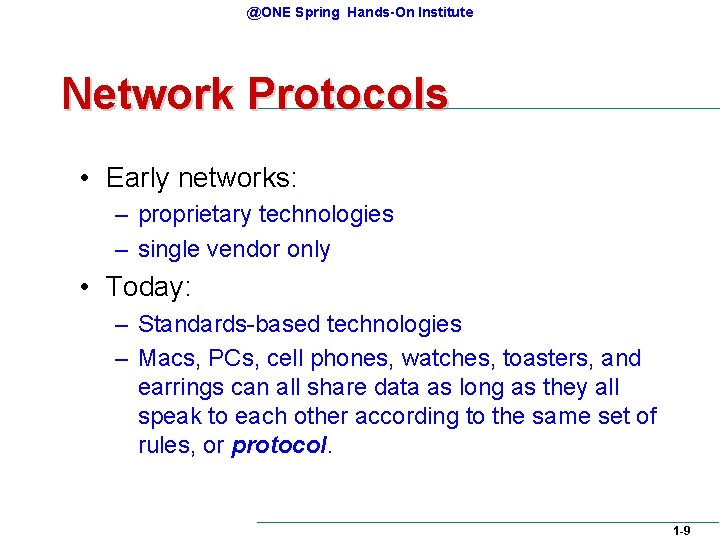
@ONE Spring Hands-On Institute Network Protocols • Early networks: – proprietary technologies – single vendor only • Today: – Standards-based technologies – Macs, PCs, cell phones, watches, toasters, and earrings can all share data as long as they all speak to each other according to the same set of rules, or protocol. 1 -9
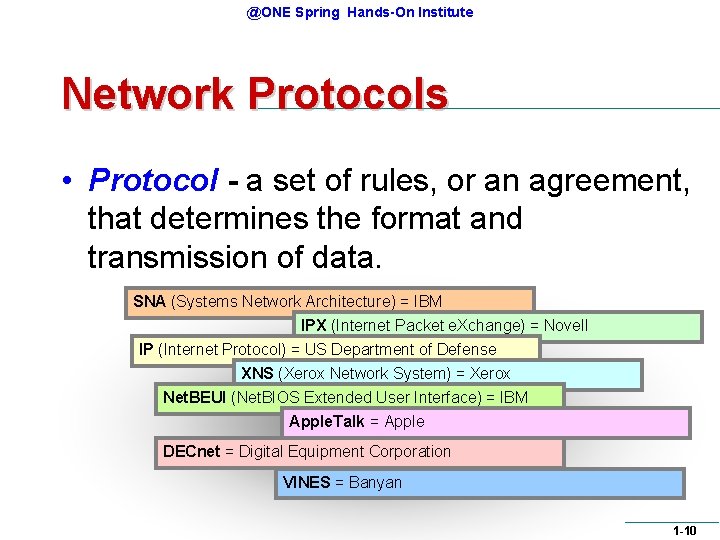
@ONE Spring Hands-On Institute Network Protocols • Protocol - a set of rules, or an agreement, that determines the format and transmission of data. SNA (Systems Network Architecture) = IBM IPX (Internet Packet e. Xchange) = Novell IP (Internet Protocol) = US Department of Defense XNS (Xerox Network System) = Xerox Net. BEUI (Net. BIOS Extended User Interface) = IBM Apple. Talk = Apple DECnet = Digital Equipment Corporation VINES = Banyan 1 -10
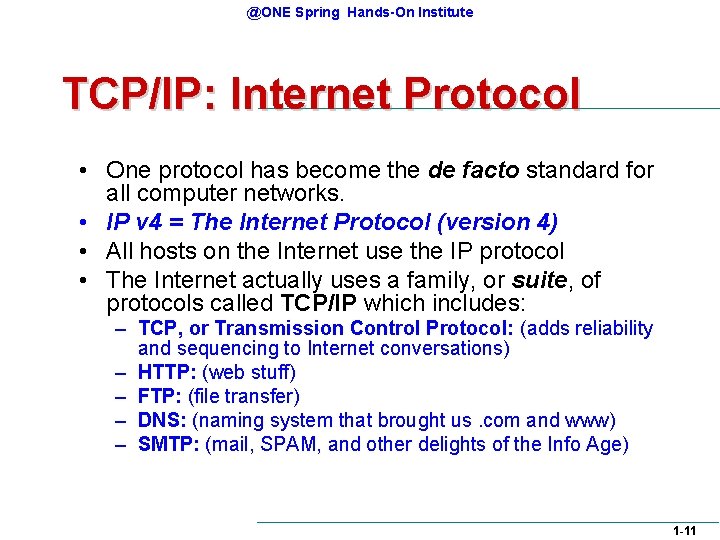
@ONE Spring Hands-On Institute TCP/IP: Internet Protocol • One protocol has become the de facto standard for all computer networks. • IP v 4 = The Internet Protocol (version 4) • All hosts on the Internet use the IP protocol • The Internet actually uses a family, or suite, of protocols called TCP/IP which includes: – TCP, or Transmission Control Protocol: (adds reliability and sequencing to Internet conversations) – HTTP: (web stuff) – FTP: (file transfer) – DNS: (naming system that brought us. com and www) – SMTP: (mail, SPAM, and other delights of the Info Age) 1 -11
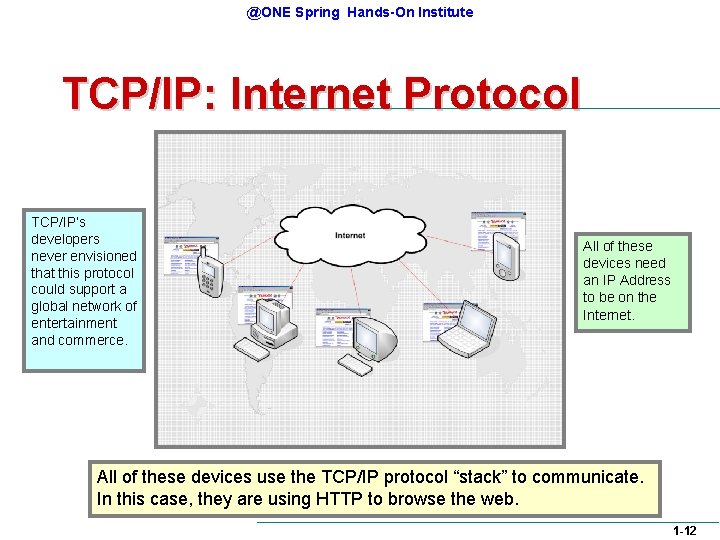
@ONE Spring Hands-On Institute TCP/IP: Internet Protocol TCP/IP’s developers never envisioned that this protocol could support a global network of entertainment and commerce. All of these devices need an IP Address to be on the Internet. All of these devices use the TCP/IP protocol “stack” to communicate. In this case, they are using HTTP to browse the web. 1 -12
@ONE Spring Hands-On Institute Reality Check • In the mid-1980 s, Cisco (like all other vendors) focused on “multi-protocol” platforms. • Because TCP/IP has emerged as the dominant protocol, our focus is entirely on IP networks. • So, this is an Introduction to Cisco IP Network Devices 1 -13
@ONE Spring Hands-On Institute Types of Networks 1 -14
@ONE Spring Hands-On Institute LANs • Local-Area Networks (LANs) emerged in the mid 1980 s • LANs – connects workstations, peripherals, and other devices in a single building – LANs made it possible to efficiently share such things as files and printers 1 -15
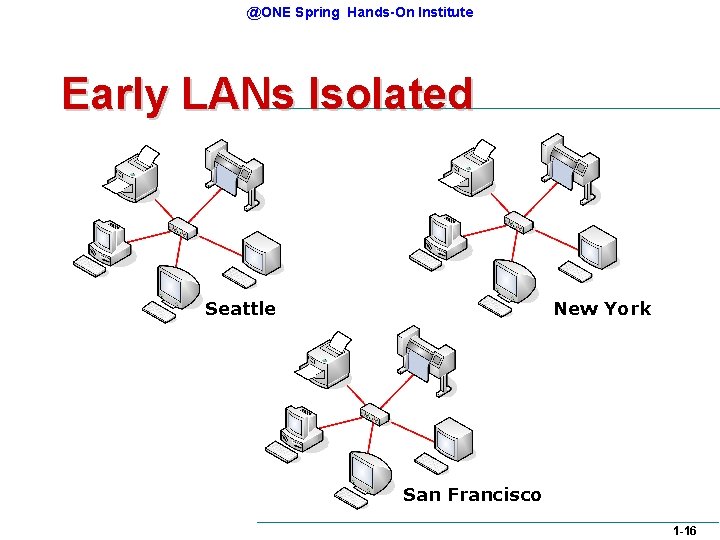
@ONE Spring Hands-On Institute Early LANs Isolated Seattle New York San Francisco 1 -16
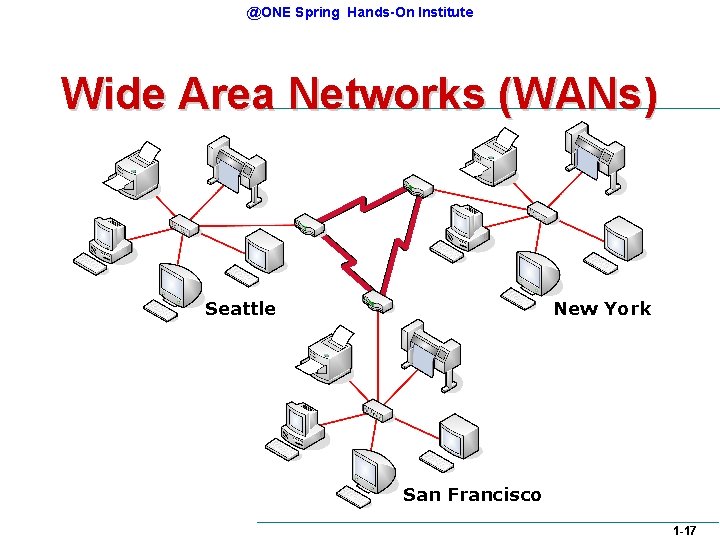
@ONE Spring Hands-On Institute Wide Area Networks (WANs) Seattle New York San Francisco 1 -17
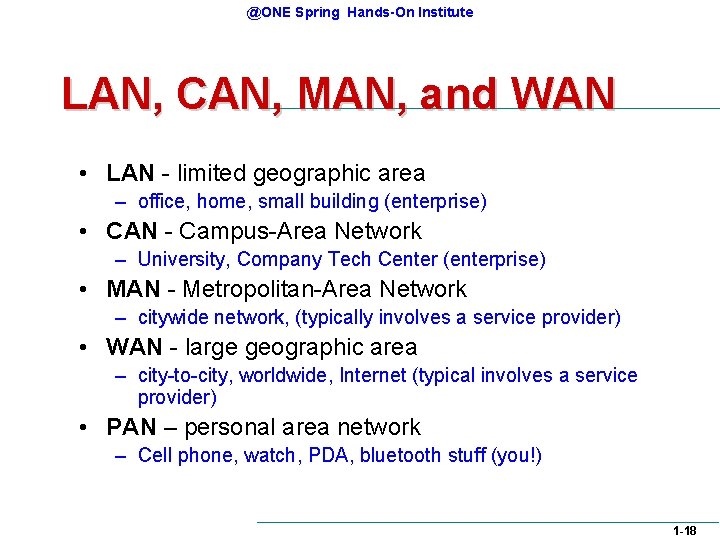
@ONE Spring Hands-On Institute LAN, CAN, MAN, and WAN • LAN - limited geographic area – office, home, small building (enterprise) • CAN - Campus-Area Network – University, Company Tech Center (enterprise) • MAN - Metropolitan-Area Network – citywide network, (typically involves a service provider) • WAN - large geographic area – city-to-city, worldwide, Internet (typical involves a service provider) • PAN – personal area network – Cell phone, watch, PDA, bluetooth stuff (you!) 1 -18
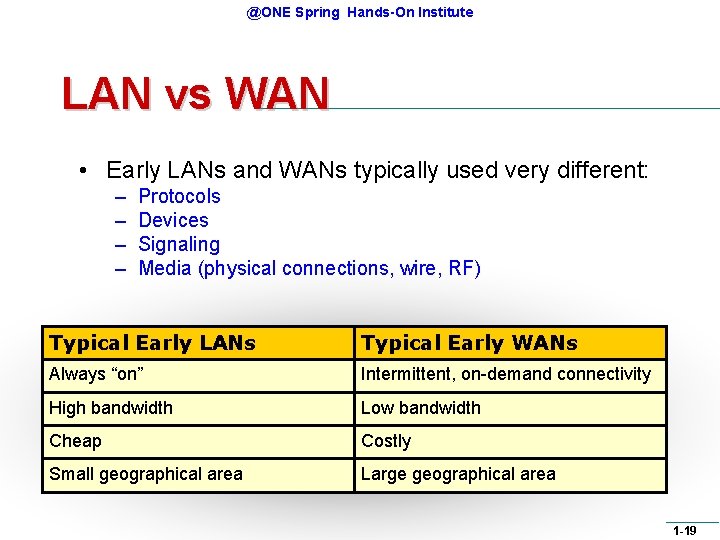
@ONE Spring Hands-On Institute LAN vs WAN • Early LANs and WANs typically used very different: – – Protocols Devices Signaling Media (physical connections, wire, RF) Typical Early LANs Typical Early WANs Always “on” Intermittent, on-demand connectivity High bandwidth Low bandwidth Cheap Costly Small geographical area Large geographical area 1 -19
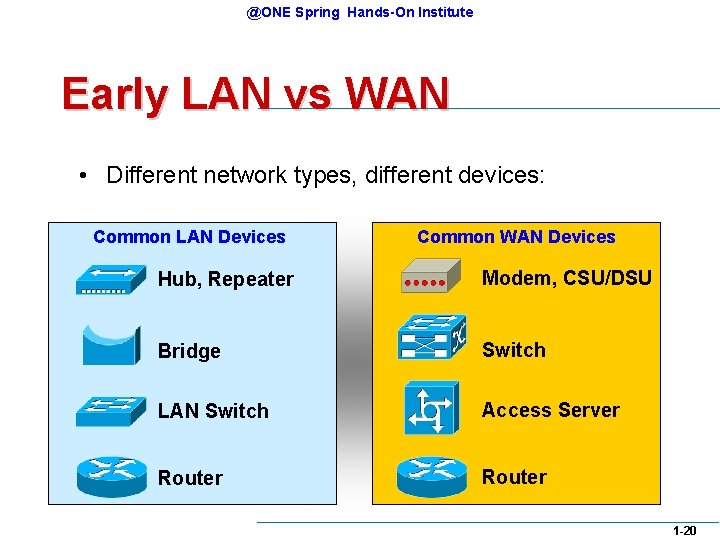
@ONE Spring Hands-On Institute Early LAN vs WAN • Different network types, different devices: Common LAN Devices Common WAN Devices Hub, Repeater Modem, CSU/DSU Bridge Switch LAN Switch Access Server Router 1 -20
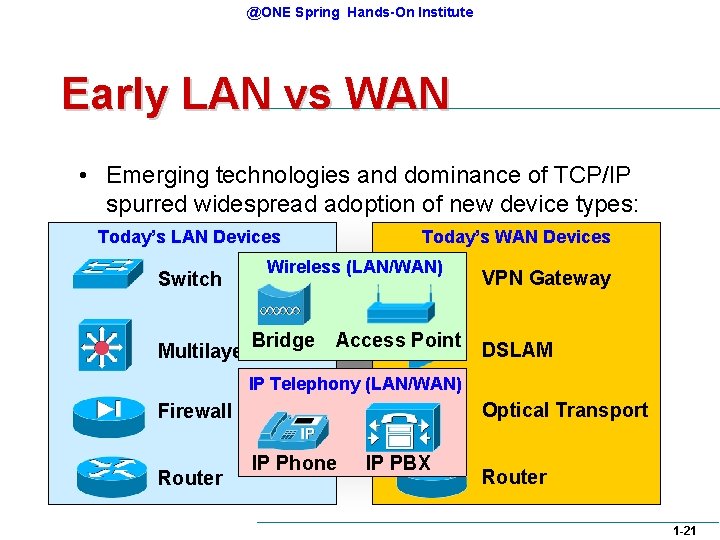
@ONE Spring Hands-On Institute Early LAN vs WAN • Emerging technologies and dominance of TCP/IP spurred widespread adoption of new device types: Today’s LAN Devices Switch Today’s WAN Devices Wireless (LAN/WAN) Bridge Access Point Multilayer Switch VPN Gateway DSLAM IP Telephony (LAN/WAN) Optical Transport Firewall Router IP Phone IP PBX Router 1 -21
@ONE Spring Hands-On Institute Today’s LAN/WAN • Several factors have blurred the distinctions between WANs and LANs and the devices that operate in each. • However, for the purposes of our discussions, we will talk about devices as either “LAN” or “WAN” 1 -22
@ONE Spring Hands-On Institute The OSI Reference Model 1 -23
@ONE Spring Hands-On Institute Enter ISO • ISO – International Organization for Standardization (Geneva) – Voluntary, non-treaty organization charted by the UN • From the earliest days of networking, it was clear to ISO that standards were needed. • Standardization aids: development, interoperability, education… 1 -24
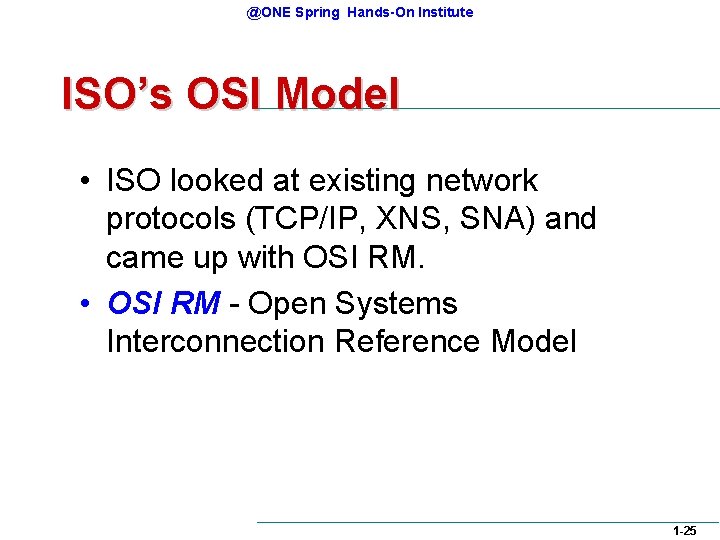
@ONE Spring Hands-On Institute ISO’s OSI Model • ISO looked at existing network protocols (TCP/IP, XNS, SNA) and came up with OSI RM. • OSI RM - Open Systems Interconnection Reference Model 1 -25
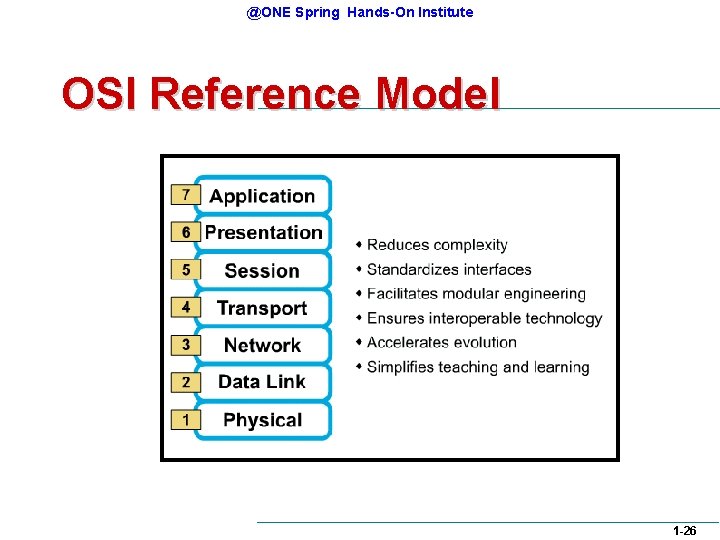
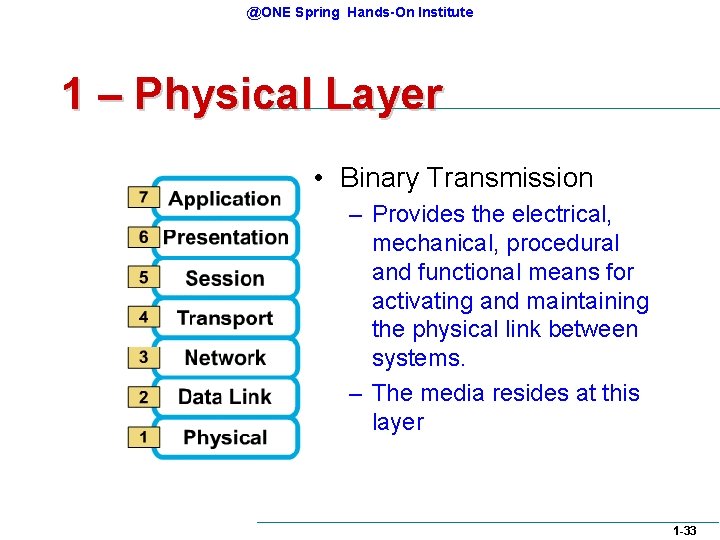
@ONE Spring Hands-On Institute OSI Reference Model 1 -26
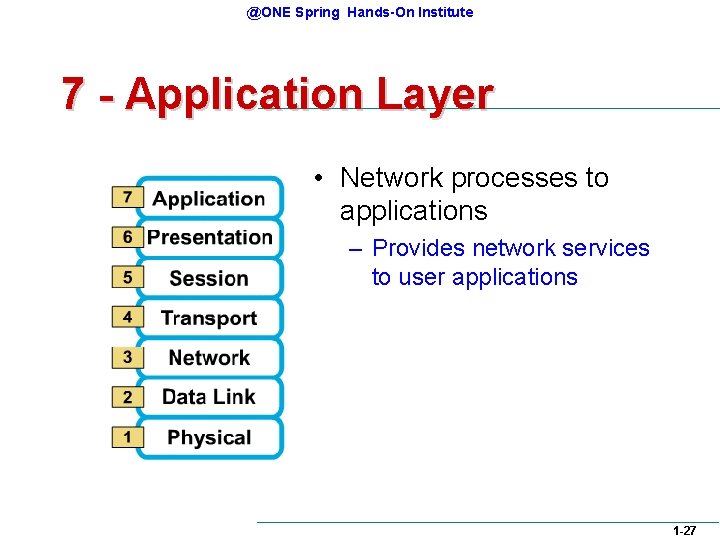
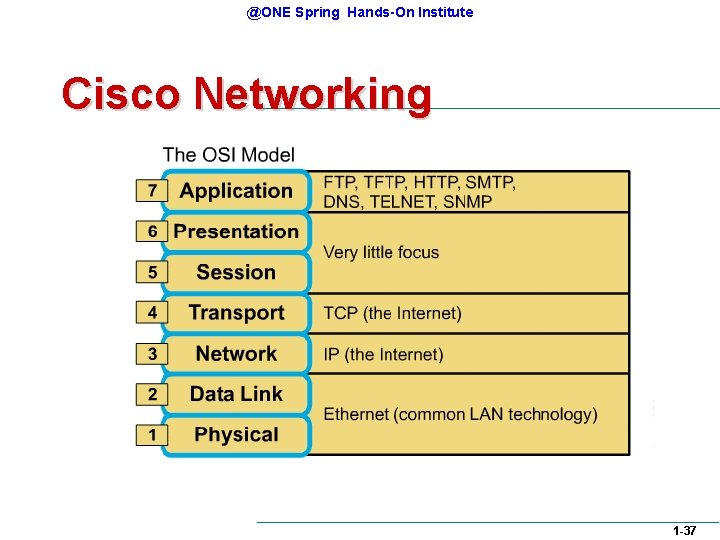
@ONE Spring Hands-On Institute 7 - Application Layer • Network processes to applications – Provides network services to user applications 1 -27
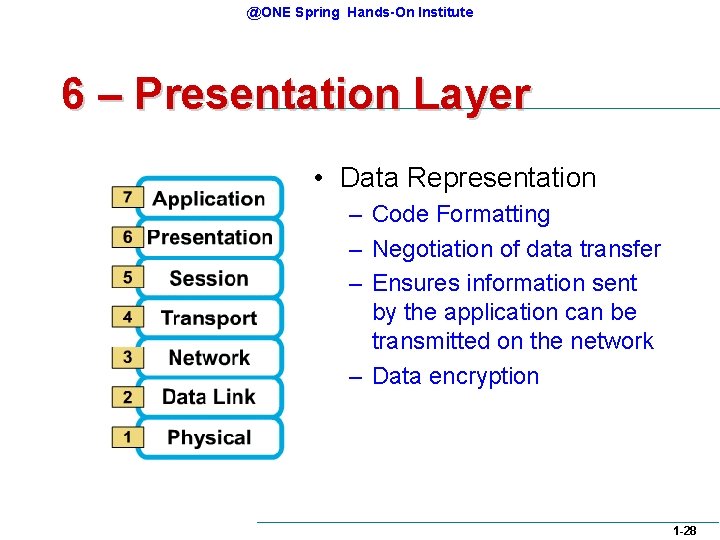
@ONE Spring Hands-On Institute 6 – Presentation Layer • Data Representation – Code Formatting – Negotiation of data transfer – Ensures information sent by the application can be transmitted on the network – Data encryption 1 -28
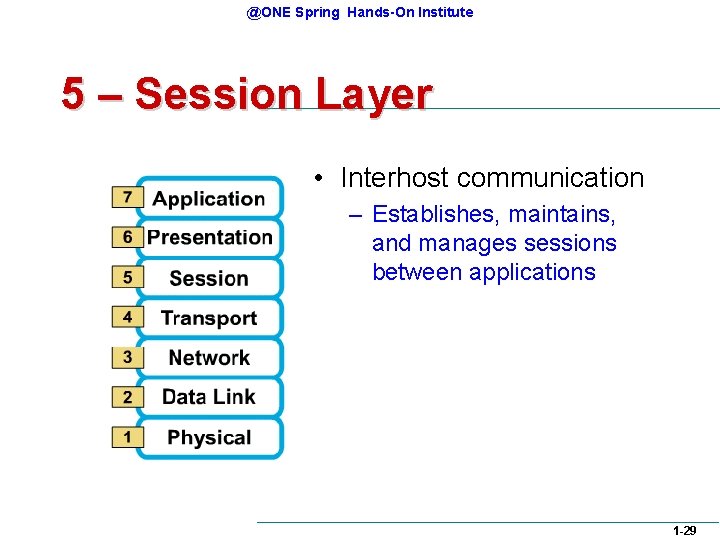
@ONE Spring Hands-On Institute 5 – Session Layer • Interhost communication – Establishes, maintains, and manages sessions between applications 1 -29
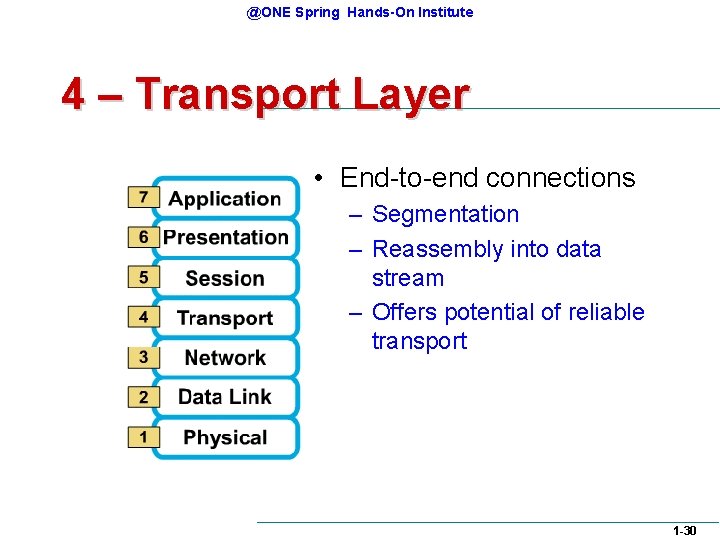
@ONE Spring Hands-On Institute 4 – Transport Layer • End-to-end connections – Segmentation – Reassembly into data stream – Offers potential of reliable transport 1 -30
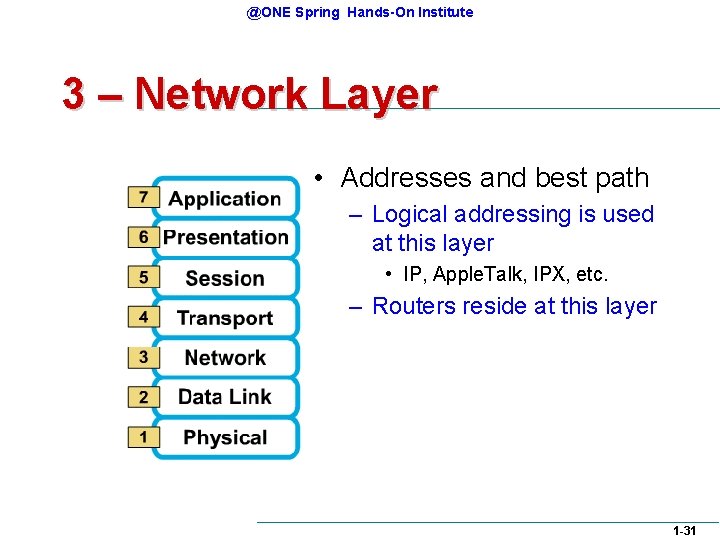
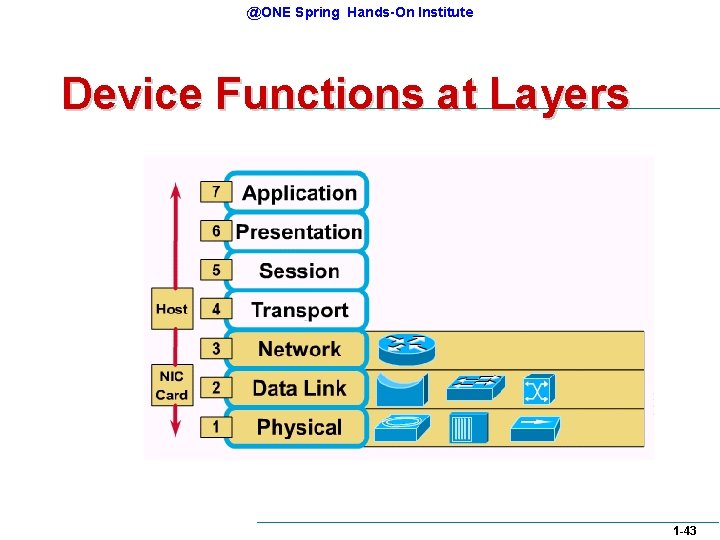
@ONE Spring Hands-On Institute 3 – Network Layer • Addresses and best path – Logical addressing is used at this layer • IP, Apple. Talk, IPX, etc. – Routers reside at this layer 1 -31
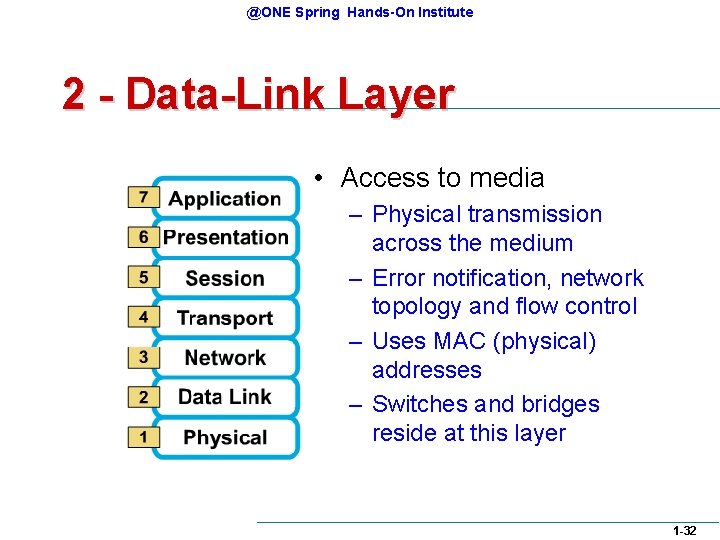
@ONE Spring Hands-On Institute 2 - Data-Link Layer • Access to media – Physical transmission across the medium – Error notification, network topology and flow control – Uses MAC (physical) addresses – Switches and bridges reside at this layer 1 -32
@ONE Spring Hands-On Institute 1 – Physical Layer • Binary Transmission – Provides the electrical, mechanical, procedural and functional means for activating and maintaining the physical link between systems. – The media resides at this layer 1 -33
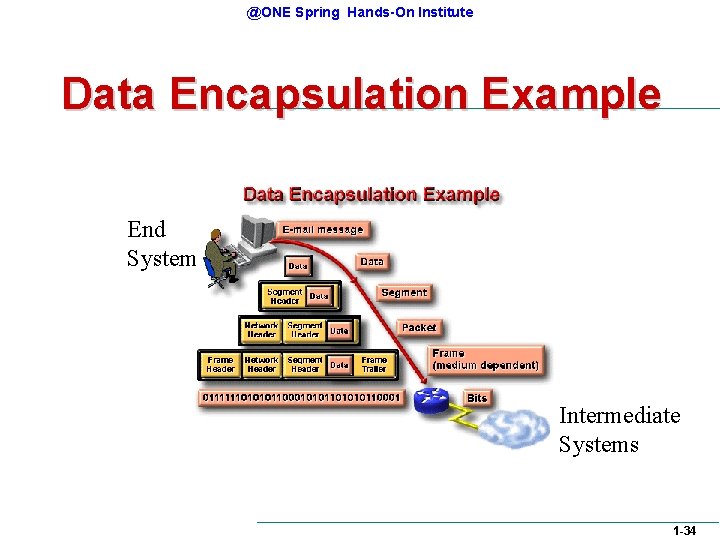
@ONE Spring Hands-On Institute Data Encapsulation Example End System Intermediate Systems 1 -34
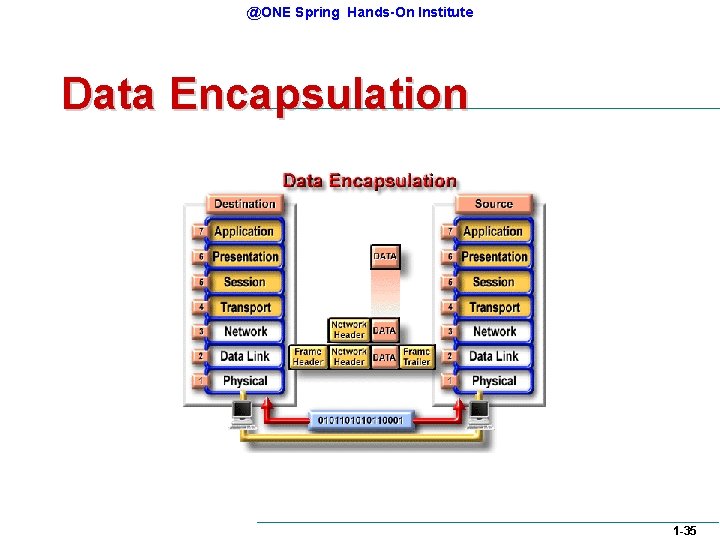
@ONE Spring Hands-On Institute Data Encapsulation 1 -35
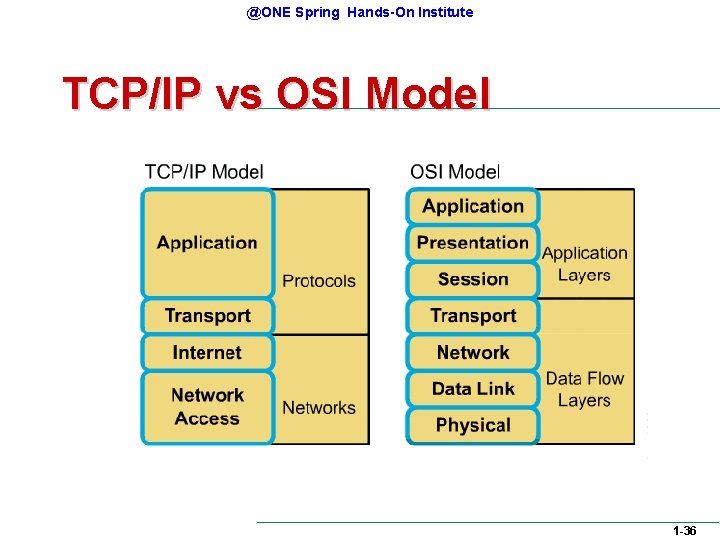
@ONE Spring Hands-On Institute TCP/IP vs OSI Model 1 -36
@ONE Spring Hands-On Institute Cisco Networking 1 -37
@ONE Spring Hands-On Institute Brief(est) History of LANs 1 -38
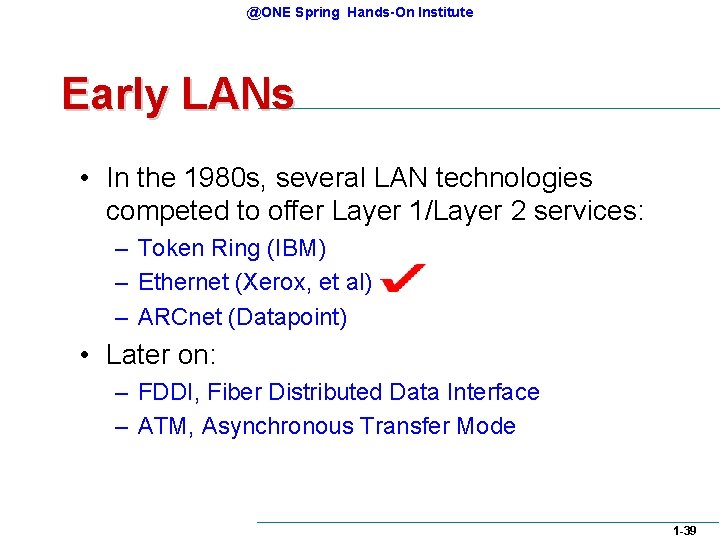
@ONE Spring Hands-On Institute Early LANs • In the 1980 s, several LAN technologies competed to offer Layer 1/Layer 2 services: – Token Ring (IBM) – Ethernet (Xerox, et al) – ARCnet (Datapoint) • Later on: – FDDI, Fiber Distributed Data Interface – ATM, Asynchronous Transfer Mode 1 -39
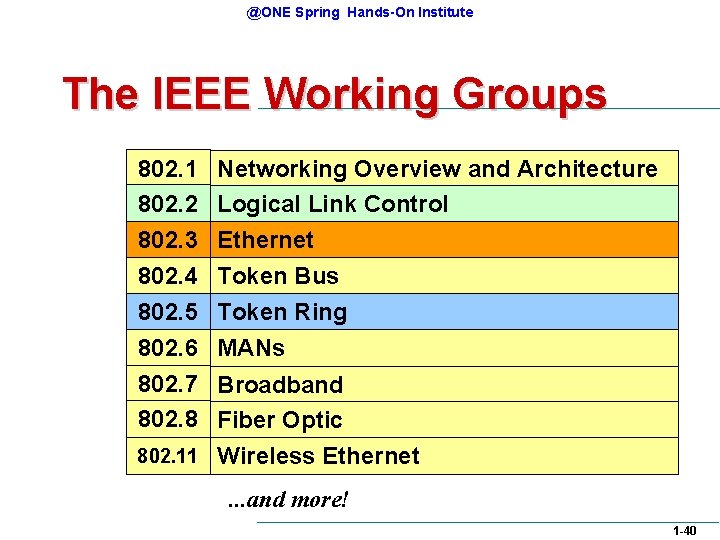
@ONE Spring Hands-On Institute The IEEE Working Groups 802. 1 Networking Overview and Architecture 802. 2 Logical Link Control 802. 3 Ethernet 802. 4 Token Bus 802. 5 Token Ring 802. 6 MANs 802. 7 Broadband 802. 8 Fiber Optic 802. 11 Wireless Ethernet. . . and more! 1 -40
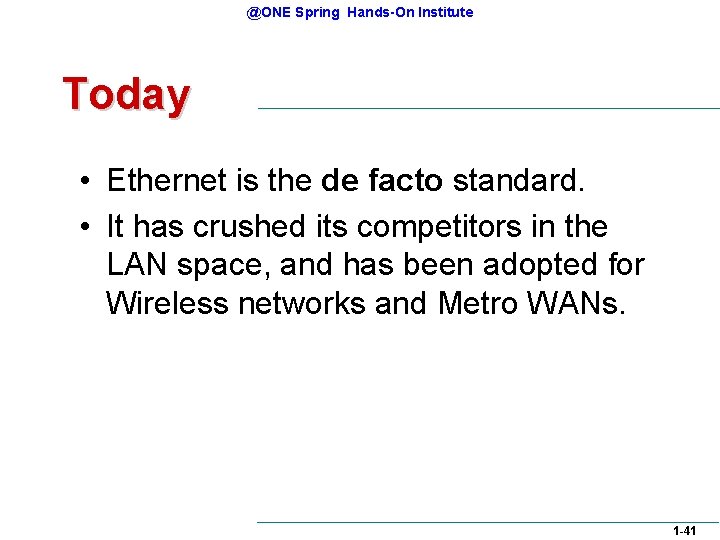
@ONE Spring Hands-On Institute Today • Ethernet is the de facto standard. • It has crushed its competitors in the LAN space, and has been adopted for Wireless networks and Metro WANs. 1 -41
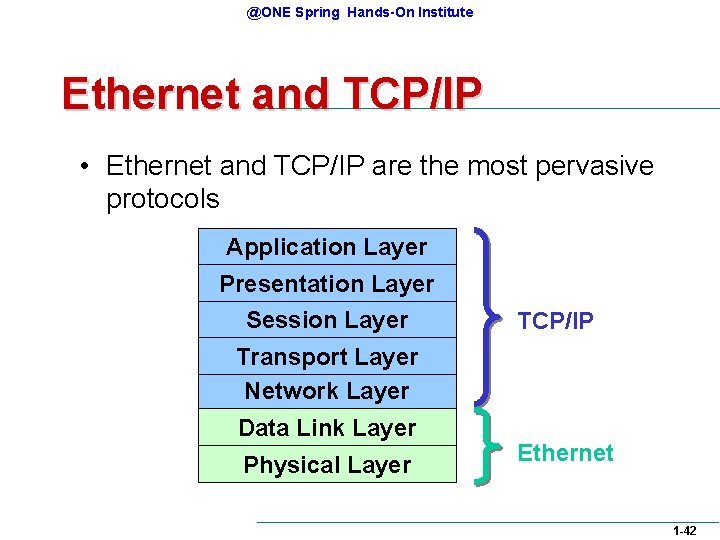
@ONE Spring Hands-On Institute Ethernet and TCP/IP • Ethernet and TCP/IP are the most pervasive protocols Application Layer Presentation Layer Session Layer TCP/IP Transport Layer Network Layer Data Link Layer Physical Layer Ethernet 1 -42
@ONE Spring Hands-On Institute Device Functions at Layers 1 -43