
One Nation Two Economies Two Societies Latin American
- Slides: 14
One Nation – Two Economies, Two Societies
Latin American Independence and the Role of the United States • 1810 -1823 – Independence movements achieve independence for the majority of Latin American countries • Creoles (Spaniards born in the Americas) – began the movements • Simón Bolivar – The Liberator • Each movement was inspired by the others • Florida – 1821 –Adams-Onis Treaty • Monroe Doctrine- 1823
The Midwestern & Northeastern Economy Midwest and Northeast: • More Enterprise (people starting new businesses) • More diverse economy (small farms & industry) • More specialization (each worker – defined tasks) • More factories • Larger Cities • More immigrants • More young women working outside home
The Southern Economy South: • Almost entirely farming • Cotton Belt – SC, GA, AL, MS, AR, LA, TX • Tobacco – VA, NC, KY; • Sugar – SC • Almost completely rural; smaller cities • Dependent on slavery • Small farms → big plantations
Midwest Industries/Crops Small farms: Corn, Wheat, Other Grains Raising pigs, cattle Beer and whiskey Service industry: Slaughterhouses, shipping companies, banks
Northeast Industries Industrialization (growth of factories, manufacturing companies) Textiles, leather Furniture, Carpet, Clocks, Glass, Tinware Coal, Iron Ships, Lumber Bricks, Building Materials
Slavery in the U. S. – early 1800 s Slavery dying in North - By 1804, all northern states passed laws to ban slavery (some gradually) Slave importation prohibited (1808) Slavery doubles due to: - Cotton gin, increased demand for slavery - Internal population growth (more babies) Prices for slaves triple Small farms → large plantations (worse for slaves)
Slave Revolts • Gabriel’s Conspiracy (1800): take over Richmond, VA • Denmark Vesey’s plan (1822): Seize Charlestown, SC • Nat Turner’s Rebellion (1831) – Southampton County, Virginia – Killed more than 57 white men – Resulted in violent backlash against African Americans • States pass Slave Codes, prohibiting slaves: – – – to read or write to meet (in groups of more than 3) to move freely bear arms testify in court, make contracts, make charges vs. owners
Other forms of slave resistance • Escape – Underground Railroad: network of people and hideouts used to help slaves escape to north • • • Refuse to work Violate slave codes Organize with other slaves Sabotage work on plantation David Walker’s appeal – Called on slaves to rebel – Attacked racist attitudes used to justify slavery
Age of Jackson • • • Andrew Jackson (1829 -1837), 7 th president States expand voting rights to all white males Jackson elected with great popular support First “Westerner” in White House Patronage/Spoils System – Put friends/supporters in government jobs • Limited federal government • Increased power of presidency – Vetoed more bills than any previous presidents
Tariff Crisis and States’ Rights • South Carolina nullifies Tariff of 1828, tries to prevent enforcement • State sovereignty: “States have rights to nullify federal laws, secede/leave nation” • Jackson threatens to send federal troops to SC, passes Force Bill • Compromise reached – tariff reduced
Indian Removal/Trail of Tears • “ 5 Civilized Tribes”: live in GA, FL, AL, MS, TN Cherokee, Creek, Choctaw, Chicasaw, Seminole • Indian Removal Act (1830) – Indians forced to leave cultivated land in east for wild land in west • 5 Civilized Tribes (100, 000) forcibly removed • Cherokees assimilated, still forced to move • Supreme Court says GA can’t move them, but GA does anyway, with support of Jackson • Trail of Tears, 4, 000 of 15, 000 die of cold/disease • Black Hawk War (IL), 2 nd Seminole War (FL)
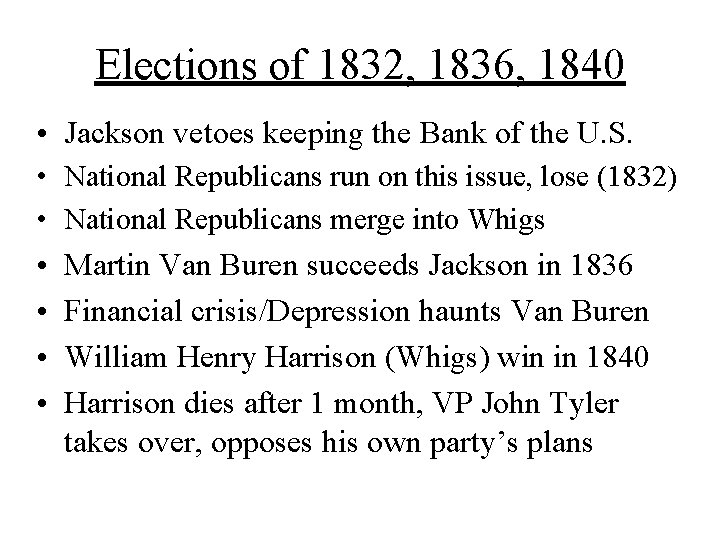
Elections of 1832, 1836, 1840 • Jackson vetoes keeping the Bank of the U. S. • National Republicans run on this issue, lose (1832) • National Republicans merge into Whigs • Martin Van Buren succeeds Jackson in 1836 • Financial crisis/Depression haunts Van Buren • William Henry Harrison (Whigs) win in 1840 • Harrison dies after 1 month, VP John Tyler takes over, opposes his own party’s plans
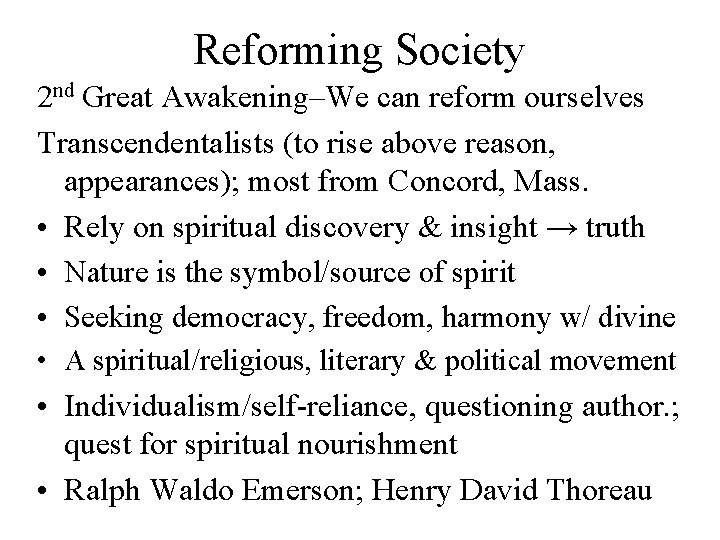
Reforming Society 2 nd Great Awakening–We can reform ourselves Transcendentalists (to rise above reason, appearances); most from Concord, Mass. • Rely on spiritual discovery & insight → truth • Nature is the symbol/source of spirit • Seeking democracy, freedom, harmony w/ divine • A spiritual/religious, literary & political movement • Individualism/self-reliance, questioning author. ; quest for spiritual nourishment • Ralph Waldo Emerson; Henry David Thoreau