
One Flew Over the Cuckoos Nest Style Source



- Slides: 11
One Flew Over the Cuckoo’s Nest Style Source: www. enotes. com
Style • Point of View • Setting • Characterization
Point of View • Kesey seems to follow a fairly straightforward course in unfolding the plot of One Flew Over the Cuckoo's Nest. • Except for a few flashbacks and digressions, the story is essentially told from beginning to end. • The first-person ("I") narrator Chief Bromden, however, is a schizophrenic—a person prone to hallucinations and delusions.
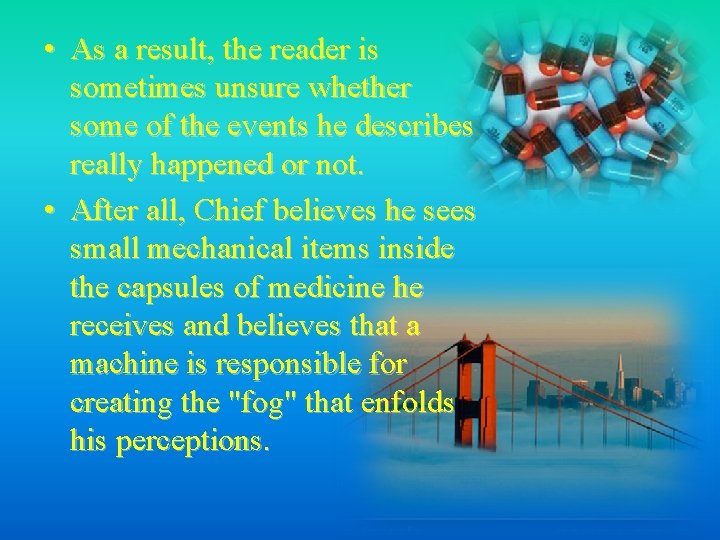
• As a result, the reader is sometimes unsure whether some of the events he describes really happened or not. • After all, Chief believes he sees small mechanical items inside the capsules of medicine he receives and believes that a machine is responsible for creating the "fog" that enfolds his perceptions.
• Having Chief as a narrator also adds to the development of the story, however, for told through his eyes, the story unfolds in part through Chief's changing emotional and intellectual state. • After Mc. Murphy leads the revolt over the World Series, for example, Chief notes that "there's no more fog any place, " implying that Mc. Murphy is actually helping to bring sanity to the ward.
Setting • The setting plays a pivotal role in the novel, especially because it rarely changes. • By keeping the action in one place—the Chronic/Acute Ward of a mental institution— Kesey is able to create a whole society in miniature. • As the novel opens, this society is an ordered holding pen for men who have various degrees of mental illness.
• When the outsider Mc. Murphy arrives, he brings the monotonous, repetitive qualities of this setting into focus. • Only on one occasion does the action take place outside of the hospital, when the men go on a trip. • With the vivid descriptions of this trip, the pace picks up as the men come alive. • This provides further contrast to life on the ward, which is increasingly seen as cruel and dehumanizing. • The author further enriches the setting with language that is strong, concrete, direct, and vivid. • It brings the reader right into the midst of the action.
Characterization • The portrayal of the inmates of the institution, for the most part, is real and believable. • Some are modeled on patients Kesey observed while doing night supervisory duty on a mental ward. • For instance, the behavior of George Sorenson, known as "Rub-a-Dub, " who is so concerned about cleanliness he won't touch anyone, is an example of obsessive-compulsive disorder.
• Especially moving is Chief's slow awakening to a validation of himself as a person, after experiencing years of racial slurs and physical degradation. • The novel's portrayal of female and African American characters, however, is more problematic. • Women are either control freaks who emasculate the men around them, such as Nurse Ratched, Vera Harding, and Billy Bibbit's mother, or objects for sexual gratification.
• The "black boys" Chief describes are alternately servile to their boss, Nurse Ratched, and cruel to the patients, showing no emotion but hatred. • While Mr. Turkle's character is more sympathetic, he too is portrayed as fearful of authority and responsibility. • While broad stereotypes such as these serve a purpose in creating a satire such as Cuckoo's Nest, they have still led to accusations of sexism and racism.
Style • Point of View • Setting • Characterization